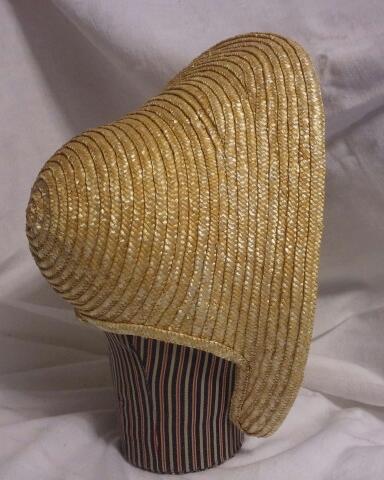
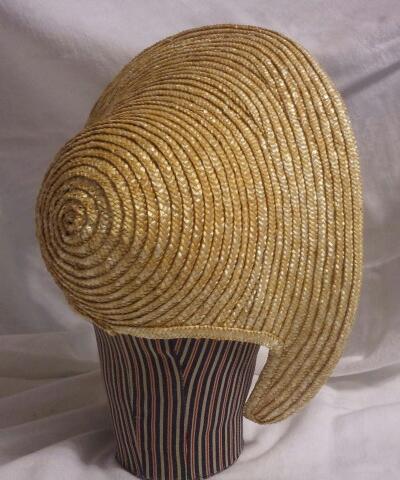
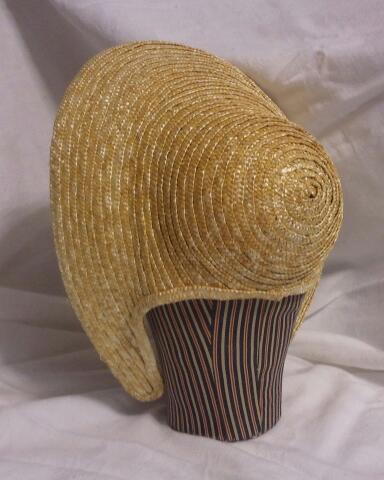
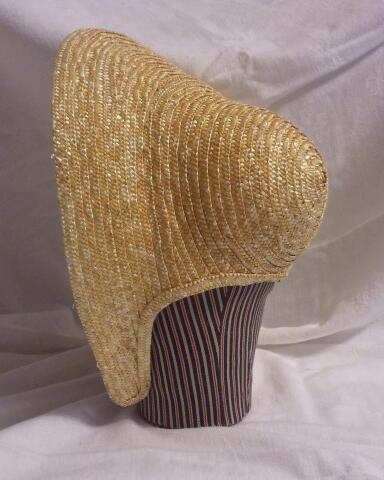
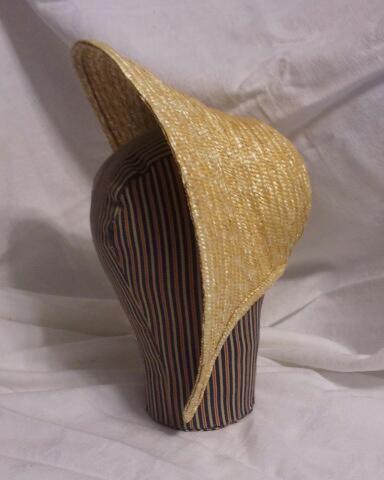
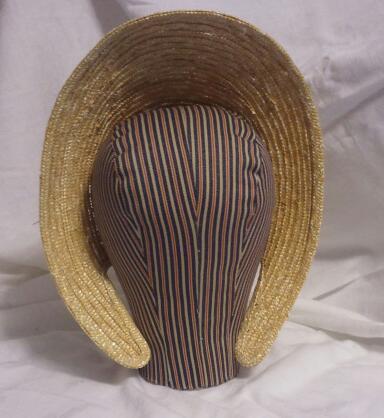
This is my first straw bonnet of the summer. Right now I’m with a fantastic narrow whole straw plait. I love the golden colors it has. I also love the sweet smell of the straw.
This bonnet has already found its new owner. It is an average size high brim spoon bonnet popular in the early 1860s. The rows of straw plait are hand sewn, with the brim and cheektabs wired.
Please visit my Etsy Store to see each of my bonnets as they become available.

First Bonnet of the Summer
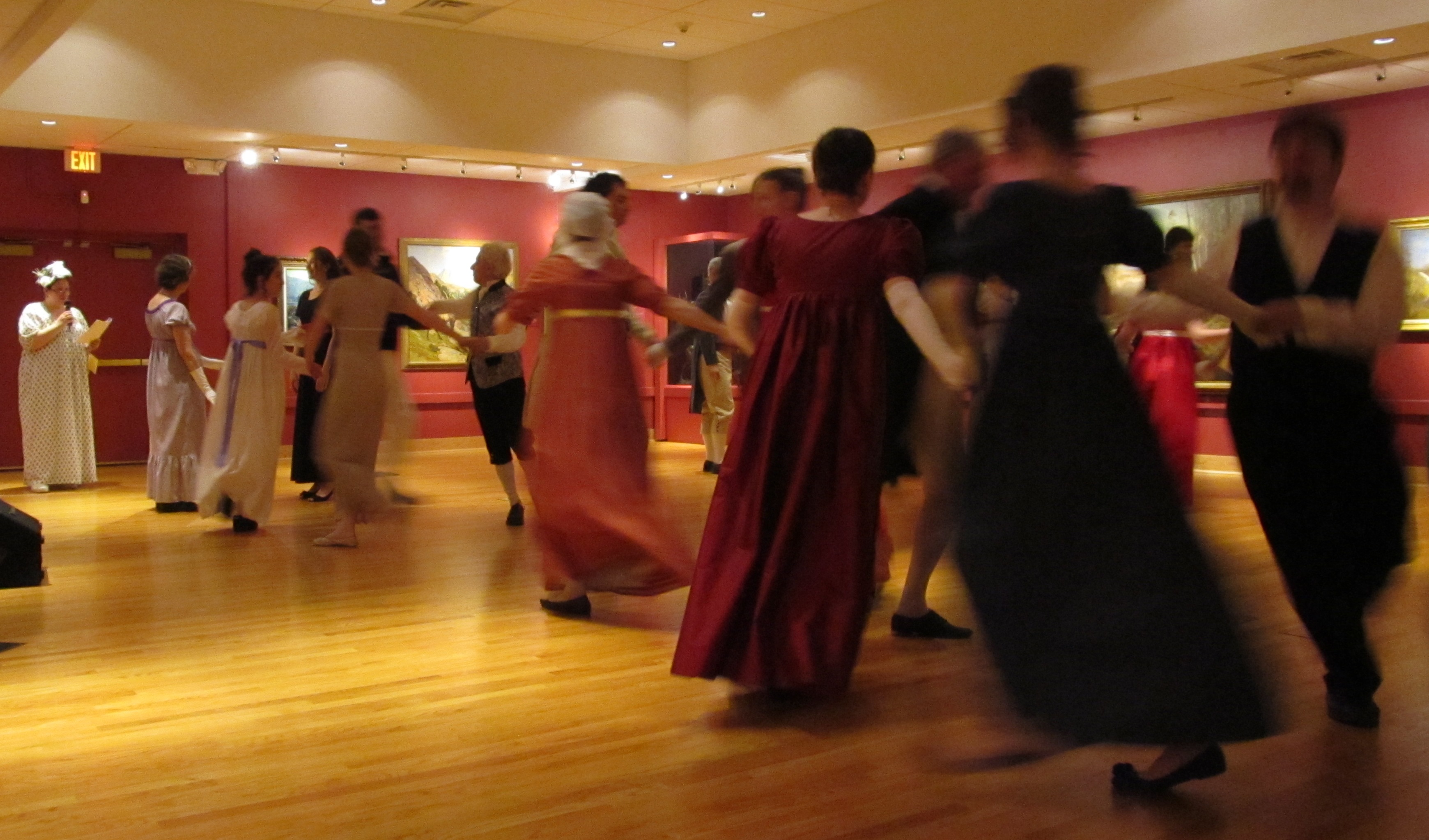
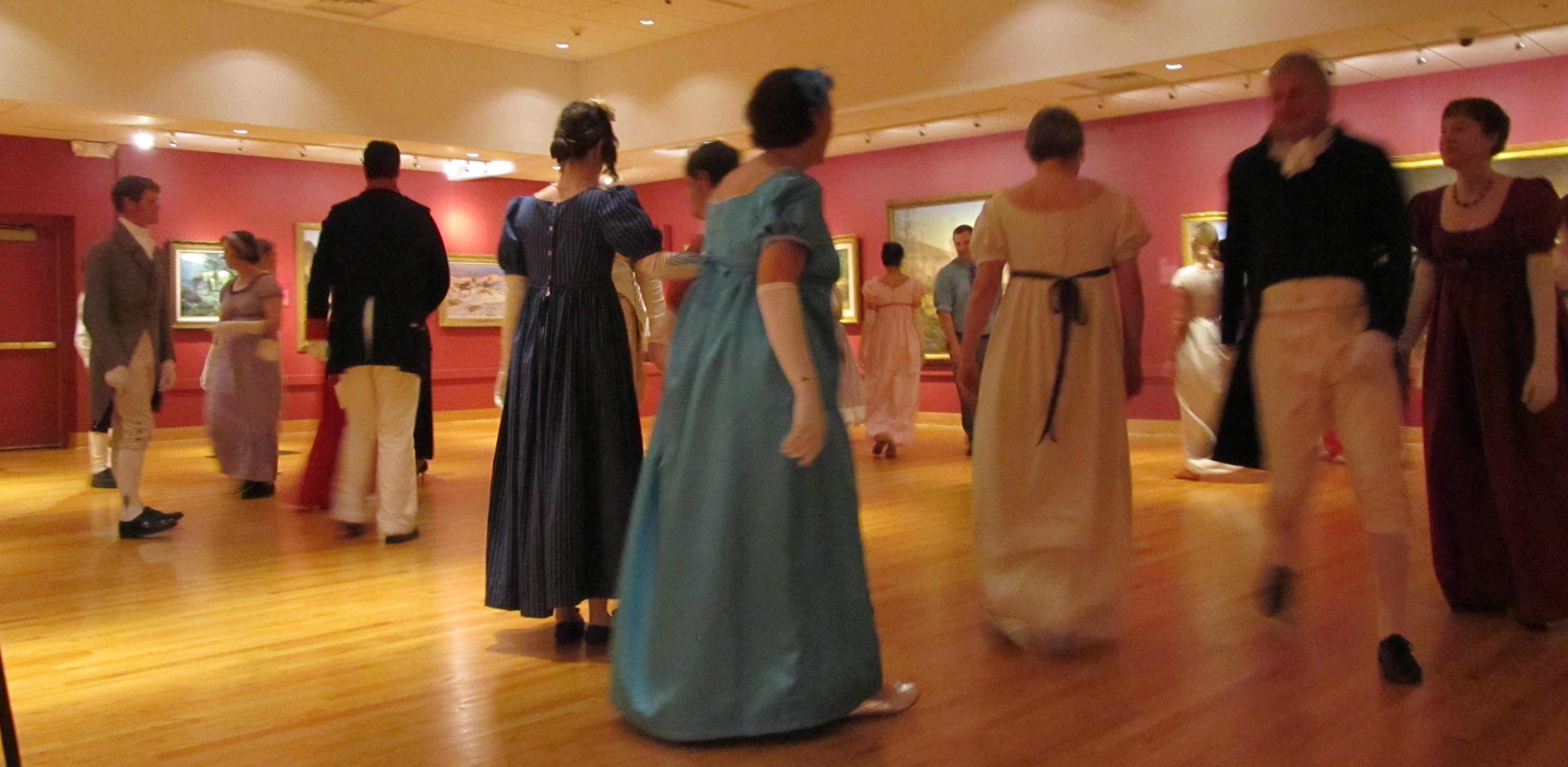
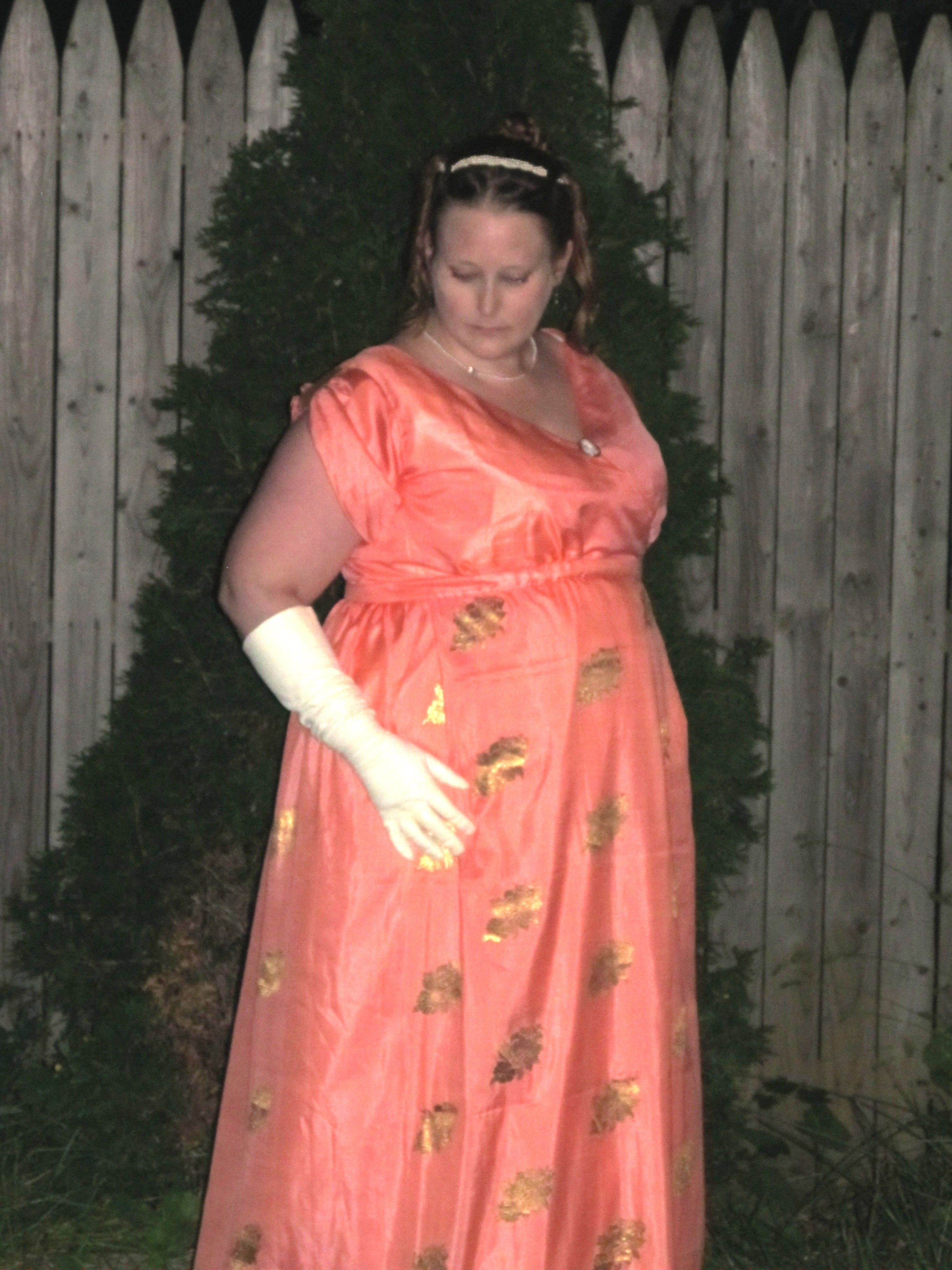
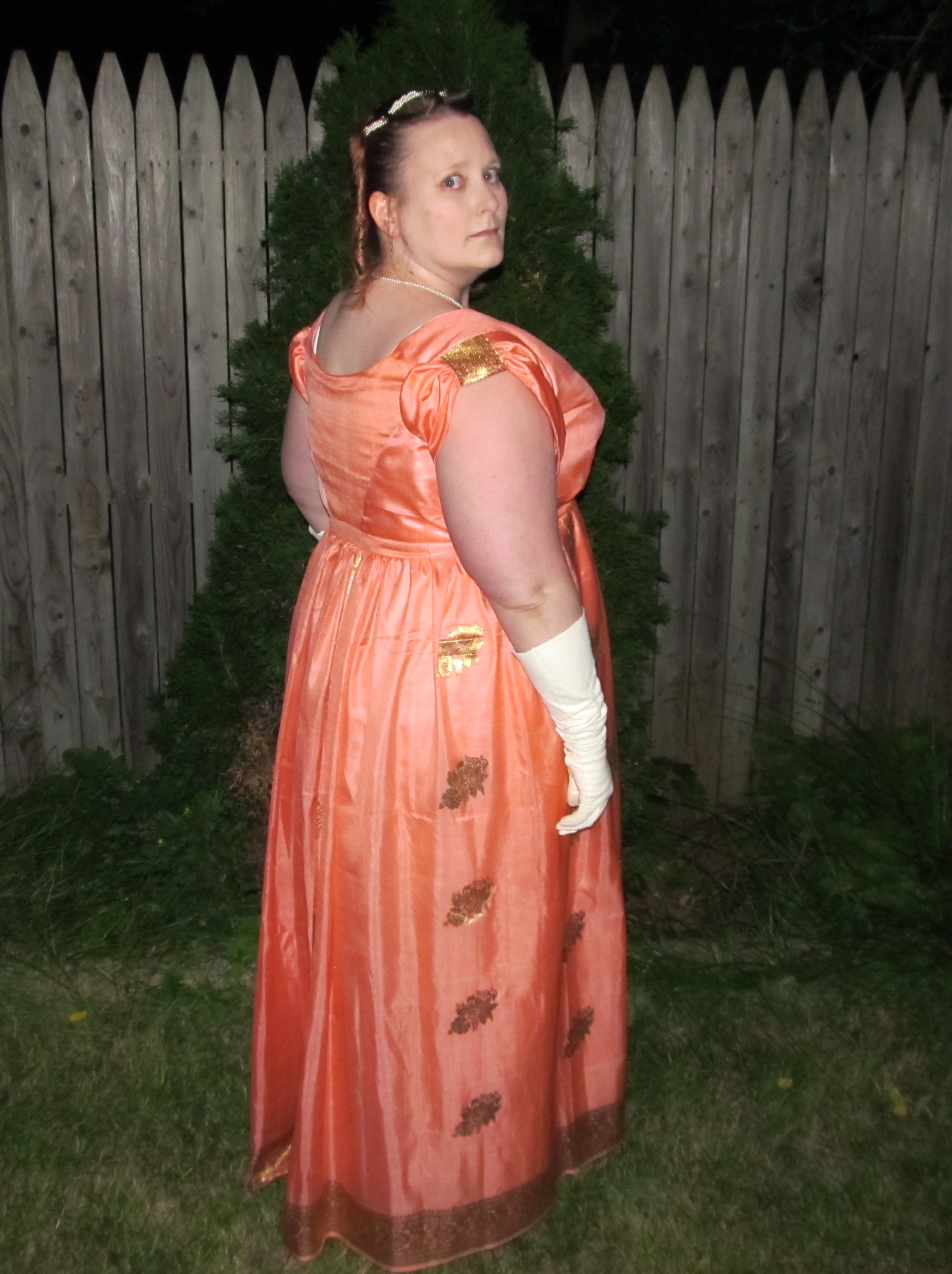
Netherfield Ball
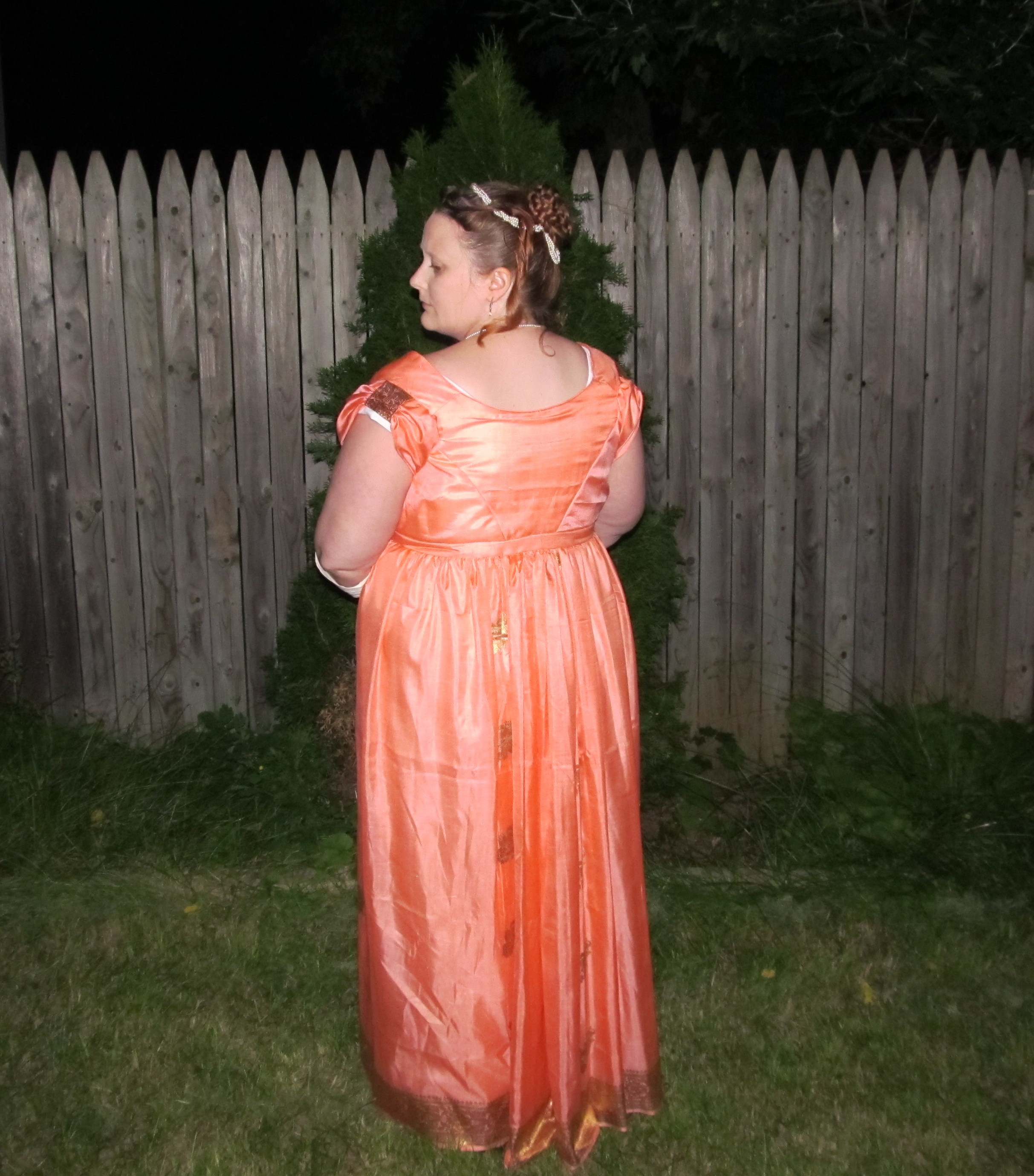
I’ve had a few people ask for photos. So, I want to get the few I have up asap. I’ll add some text later.
As a summary – Had a lovely time. I slid all over the place. Finally got to waltz with my husband for the first time since Fort Stanton. Barb’s shawl to the rescue.

Me
Around the House – Water-proof Cloth
I find these directions for water-proof cloth interesting, as well as their uses.
Transparent and Water-proof Cloth – To every quart of raw linseed oil, add half a pint of copal varnish and two ounces of sugar of lead. Mix well together and apply with a brush. This mixture applied to thin sheeting, answers a good purpose in place of glass, for hot-beds, letting in plenty of light, excluding cold and wet equally well, and protecting the young plants from the hot breath of the old shiner, which proves often time fatal to them. (The Genesee Farmer, April 1860)
To Make Cloth Waterproof – Take half on ounce of isinglass (Russian is best), put it into one pound of rain water, and boil until dissolved; take one ounce of alum, put it into two pounds of water, and boil till it is dissolved; take a quarter of an ounce of white soap, and one pound of rain water, and boil till it is dissolved. After each of these ingredients has been separately dissolved, strain them separately through a piece of linen; afterwards mix them well together in a pot, put it on the fire again till it simmers, then take it off, and while thus near boiling, dip a brush into it, and apply it to the wrong side of the cloth intended to be waterproof.
The cloth must be spread out on a table during the operation, and remain there until it is dry; after it is dry must be brushed on the wrong side against the grain; and then dipping the brush in clear water, pass it lightly over, and leave it again dry.
After that, the gloss caused by the application of the ingredients can be taken off.
Three days after the operation has been done, the cloth will be impervious to water but not air. (The Workwoman’s Guide)
You can also find an expanded description of water-proof cloth in Thomas Webster’s An Encyclopaedia of Domestic Economy.
Around the House – Purchasing Furniture
Advice for purchasing new furniture, from The Workwoman’s Guide:
A misfortune of not very rare occurrence, is the splitting of valuable tables that are veneered. We have known the infliction, and we guard others from a similar annoyance.
One of the causes may be traced to the cabinet makers; it is not unusual for them to make use of wood for the foundation, that has not been sufficiently seasoned, and is besides of an open porous texture, so different from the close hard grained wood, which is to form the veneer, that a very long time is requisite before they can manufacture their goods without risk of shrinking.
In order to ensure this certainty of seasoning, a larger stock of wood is required than is always convenient to be on hand by a cabinet maker, either from want of capital or accommodation; hence, the purchase of new furniture requires circumspection.
In this, as well as every other requisite, we would enforce the oft repeated advice, that a preference is always given to the trader of know probity.
Chance bargains, cheap to the eye, almost always become dear and unsatisfactory in the end.
Veneered furniture which is purchased from a damp warehouse, and brought suddenly into a well aired warm room will almost infallibly fly.
Chests of drawers, particularly if they be made of coarse Honduras mahogany, scarcely fail to crack, and throw up from their edges slips of veneer, which snap off, and are swept away, leaving unsightly white gaps; these have to be replaced, and look shabby and patched.
Spanish mahogany, though much more expensive in the first purchase, is far more certain, hard, rich-coloured, and durable.
It is essential that new furniture should be insured by degrees to change temperature, in order to prevent this hazardous warping, and unequal contracting of the wood. Tables in particular, if intended to occupy a station opposite a fire, should be kept with the grain of the wood laying longways; not the ends of the grain and the joint pointing into the fire; for want of this simple precaution, we have known a beautiful rosewood table entirely spoiled.
Spanish mahogany was the beautiful wood which was first known in England, and which was said to be of so hard and close grain as to turn the edges of our workmen’s tools’ but since our possessions and commerce have been extended to the North of America, we have been stocked with vast quantities of that open grained inferior kind, that is made into almost all our household goods, and which, from it facility of working, is so cheap, that purchasers are continually deceived by unprincipled tradesmen, by the substitution of on for the other.
No person can well be deceived, however, to whom the two sorts of wood have been explained; the one (Spanish) being rich coloured, of an even texture, like satin, when polished, with not grain visible; the other plate, rough, and uneven when highly polished, shewing the coarse grain like threads; the latter too is so soft, that it is dented with the slightest touch, a pencil-case falling upon it, six inches from its surface, will leave a dent that never can be removed, unless the whole is plained over.
Summer Time
As we roll into the last week of school exams, I am a bit drawn looking forward to summer. I am eagar to have sewing time, relaxing time and family time. On the flipside, I am more than a bit nervous about the teeny-tiny paychecks of summer. Money makes me crazy; not having enough for the basics makes me ill. In trying to stay optimitic and not freaked out, here is what I’m looking forward to…
– In this final week of school, I’ll finish our NB clothes & enjoy the ball.
– The following week, I’ll be fixing dear hubby’s cot, stool & chair as well as get together what he needs for his event.
– I’ll then dive into some much needed Etsy sewing. This includes a special request bonnet. (More below)
– Hopefully in early July, Derek, Heather & Bailey will visit.
– This summer has two weddings, family & friends.
– July will be the GCV event, while August will likely be a mini-even for Lily’s birthday.
– I have several projects to work on including some fair entries I have in mind.
For those who enjoy my Etsy store, I’m planning to get several goodies made & available soon. These will include:
– Straw bonnets for the 50s and 60s, plus some other eras. I have a well made straw plait that has been waiting for attention. I’m also trying to get my hands on some French plait.
– At least 2 uber-fancy sewing cases. I’ve been itching to do some fancy pieces.
– An assortment of destash once I have sewingroom cleaning time
– Some doll size millinery. (I’d love to know which sizes you would like to see.)
– I’ll start on some winter bonnets later in the summer. (I mentally drafted another in my mind today.)
What would you think about materials kits for Fanciful Utility? I made up several for the book signing that was detoured by construction. They are just sitting in a box waiting to become sewing cases. (I’m open to other Etsy ideas/requests)
I hope everyone has a pleasant start of summer.
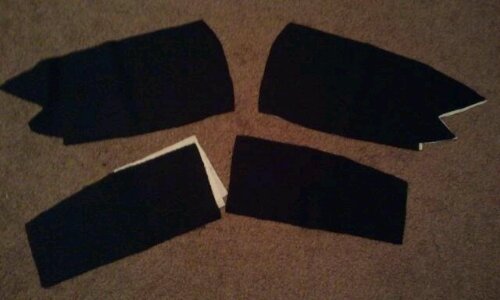
The Collar, aka “where I’m stuck”
Okay, folks…. help.
I understand the quilting the layers together part. What I don’t get is how these 4 pieces are sewn together. I figure the top two are sewn together and the bottom two are sewn together at the centers. After that, I’m just puzzled
If I had 4 of the top pieces, that would make more sense to me. But, the directions said to cut 2 and 2. (I should mention there are only little scraps left.)
Help?
Among the Milliners
This humorous article is far less about milliners or millinery than it is about the follies of the ‘reporter.’ It is such a level of ridiculousness, I do hope you enjoy it. (I also have other suspicions)
Among the Milliners.
Beau Hackett as a fashion reporter. I was fowling in the marches of Calumet when I received your note. I was preying remorselessly upon the feathered tribe generally, with a double-barreled shot gun. My ammunition was about exhausted. I had startled with a quarter bottle full of powder in my breast pocket, but tha tall was gone except a ‘snit.’ My shot pouch was almost empty, too, but I did not care for that. A man can hunt well enough without shot if only he has plenty of powder – the kind that flies to the head.
Your message arrived in good time to be heeded. I had just got a splendid duck – by falling off a log into a stream of muddy water. I felt so much elated by my success that I was ready to quit. Only a few hours previous to that I had slain a dozen of the plumpest ducks I ever saw. Before I had time to collect them together the owner appeared upon the field of carnage, and informed me that they were his ducks, and were not wild, and had never been. The owner’s name was Drake. – You can image how I felt when I learned that my ducks were all Drake’s. I gave them up, like a reasonable man, and charged him nothing for killing them. I can be generous whenever I want to.
After so many repeated successes it is not strange that I felt ready to leave the field. I read the cabalistic line of your message, ‘come up and do the openings.’ I wanted to come bad enough, but I had no idea what the missive meant. There were so many openings in the world, so many things that can be opened. There are letters, for instance; letter that belong to you and letters that don’t; and there is champagne that can be opened; and so can ink bottles, so can a bank, so can oysters (can oysters). When I arrived at oysters I stopped a while, and it occurred to me that I had caught your idea. Somebody was going to open a can of oysters (the first of the season, may be), and you wanted me to report the affair. Accordingly I came to the city in great haste, my speed being accelerated by knowledge of the fact that my powder was all gone, and there is no good powder outside of Chicago I was disappointed, not disagreeably, however, when I was informed that the grand season of opening millinery and straw goods had arrived, and that I was wanted to make a tour of Lake street and make an article on the fall fashions.
I felt complimented when I was told that I was the man for the position, because I had a more intimate acquaintance with milliners, and could get information from the fair sex better than anybody else. I am susceptible of flattery, a little, and I felt complimented, but I mistrusted my ability. I have not had much experience in reporting. I wrote local items for three days on a country newspaper six years ago, and some of them are going the rounds of the press yet. I ought to have had them copyrighted for they are never credited to me. I will give one of them – the first I ever wrote – and which is reproduced in the papers every month or two. It is pretty good, and will give you an inkling of my style:
“ACCIDENT – Yesterday a team attached to a wagon rushed madly down one of our principal streets a distance of a mile or two, and were only prevented from running away by gentleman who, at the hazard of his life, seized them by the reins and stopped them. We are fearfully and wonderfully made.”
If you hear of anybody that wants to engage a man to write that sort of items all the time, I wish you would let me know it.
I commenced at the foot of Lake street to do the fashions. I went through the great union depot from one end to the other, and up stairs and down, but I could find no millinery store there. I then struck out boldly up Lake street, and came to a large house nearly opposite a large house on the opposite side of the street. I am thus precise in giving localities that the public may know where the millinery store is to be found. A reliable gentleman, to whom truth is a greater stranger that fiction, told me that the second story of the large house on the opposite side of the street was a bonnet and straw goods establishment. That was the information I was looking for, and I bounded up stairs.
‘Like a wild gazelle,”
If I may be allowed to institute a comparison. At this time I was absorbed in deep meditation, thinking how I should begin my article, and whether I should puff anybody. I was abstracted, I think, and I sailed up the stairway with my body bent forward about nineteen degrees from the perpendicular, a pencil under my arm and a reporter’s book over my right ear. I reached the head of the stairs suddenly, inasmuch as I was going very rapidly, and as a consequence of my abstractedness, or something else, I drove my head plump into a bonnet that the proprietress was showing to a customer, and tried to stammer an apology, but it was a no go.
The proprietress looked reaping machines at me. I threw my pencil down and begged pardon for smoking in her presence, thinking it was a cigar. Told her I hoped I hadn’t smashed anything, and she smiled a little and said I hadn’t. Then I felt a little better, and told her I was a reporter. Then she looked milder than ever, and said, “Oh, indeed!” and immediately afterward she became insufferably inquisitive, asked me a volley of incomprehensible questions, and stared at me all the time as though she was counting the plaits in my shirt ruffles or the links in my watch chain, or the brilliants in my breastpin, or anything else you like.
“Are you long hand or short hand?” she asked.
“Neither,” said I, “I am a new hand, and I rather dislike the business, as far as I’ve got”
The proprietress conducted me through a long hall into a large room occupied by about twenty bonnets and sixty milliners, saleswomen, etc. I did not look at the bonnets for the first half hour, but devoted myself exclusively to taking an inventory of the young ladies.
“This is a charming bonnet – golden dun – Marie Stuart front,” said the lady-in-chief.
“Yes, she is,” I replied, “but her hair is a little too red.”
I discovered my mistake when it was too late to correct it. That’s my luck.
As soon as the divine little milliners learned who I was, they gathered around me in a circle, and all were anxious to see who could say the most and best things. One was descanting upon the beauties of a chip bonnet, and another handed me a bunch of grapes to examine. I bit one of the grapes, my mouth was full of broken glass. Then I thought I would rather report a camp meeting than a millinery store; then I thought I wouldn’t, and I mustered my courage and made another note in my note-book, (grapes, not sour, but sharp.) my tongue bled fearfully, and I spoiled my best embroidered handkerchief wiping it away the blood. The circle diminished, and the crowd (perhaps I should say bevy) came closer. I began to want fresh air severely. Too many females in a close room render the atmosphere oppressive.
“This is beautiful,” said a charming creature with pearly eyes and black teeth, “this is a dear duck of a bonnet.”
“Is it a wild duck?” said I, “I’ve had enough of wild ducks, especially if they belong to a man by the name of Drake.”
“Price, seventy-five dollars,” she continued, paying about as little attention to me as a man of my qualifications could expect.
I asked her if she would sell it in small lots, and how much one of the straws would come to, but before I had finished the question she was showing me something else.
The ladies became less timid as they became more acquainted, and approached so near me when they wanted to give me a bonnet to look at, that my ruffles were in danger of being crushed. They piled bonnets upon me till I had both arms full and the tops ones began to fall off, and every time I stooped to pick up one I dropped two. It required some skillful engineering to keep from being engulphed in the ocean of crinoline that surrounded me; and in making a desperate effort to escape from one billow that came fearfully near me, I plunged both feet into a magnificent French chip bonnet (that was the name of it,) with a Marie Stuart or Louisa Jane Susan Smith front, I forget which. There was another crash of glass artificial, a bunch of wheat was crushed to flour, and a fine blush rose blushed for the last time.
The milliners all screamed – the circle was broken; some rushed one way and some another, and some rushed in an opposite direction. I rushed to a window and measured the distance to the ground with my mathematical eye. I had not made up my mind exactly when a ten-year-old whom I had not seen before (I think she was an apprentice) sung out in a shrill voice “Ma says if you don’t pay her for the last shirt she made for you she’ll prosecute you in the court-house.”
I should have been proud to know that I had an acquaintance there if I had not been in a hurry. I threw myself out upon the sidewalk without breaking a bone, and – I still live. When next I go to report a millinery affair I shall go in a full suit of armor.
I am, feelingly, Beau Hackett. (Lancaster Intelligencer. November 10, 1863. Reprinted from the Chicago Post. http://digitalnewspapers.libraries.psu.edu)
Around the House – Laundry
Lets start the summer series, “Around the House”, with a little laundry.
Okay, I wasn’t going to start with laundry. But, then I found this section in Elizabeth Haskell’s The Housekeeper’s Encyclopedia on cleaning particular fabrics and items. I just knew you would all want to see it. (It is a PDF)
Here are a few more interesting snip-its:
To Polish Flat-Irons – If your flat-irons are rough, rub them well with fine salt, and it will make them smooth. (The Genesee Farmer, June 1860)
To Wash Ribbons – Ribbons of any kind should be washed in cold soap-suds, and not rinsed. (The Genesee Farmer, June 1860)
Old Crape – A pint of glue, dissolved in milk and water, will restore old crape. (The Genesee Farmer, June 1860)
To Clean Silk – I have seen a good receipt for cleaning all kinds of silk, which I have used with good effect. Take equal quantities of alcohol, wood ashes, soft soap, and molasses. Mix them, and rub with a cloth on the silk; afterward rinse in a clear water with a little salt or alum. Your silk will look as good as new if it has never been washed before. (The Genesee Farmer, July 1860)
For Cleaning Silk – (Correction from the July number.) – Take equal quantities of alcohol – whiskey will do – soft soap made of wood ashes, and molasses. Mix and rub with a cloth; afterward rinse in clear water once or twice, and dry it or wrap in cloth till ready to iron. (The Genesee Farmer, September 1860)
Method of Cleansing Silk, Woollen, and Cotton. – Take raw potatoes in their natural state, and when well washed, let them be rubbed on a grater over a vessel of clean water, to a fine pulp; pass the liquid matter through a coarse sieve into another tub of clean water; let this mixture stand till the fine white particles of potatoe are precipitated, then pour off the liquor, which preserve for use.
The article to be cleaned should be laid on a table, and well rubbed with a sponge dipped in the liquor until clean, when it is washed several times in clean water, and then dried and ironed.
Two middle sized potatoes will suffice for a pint of water. The coarse pulp of the potatoe, which will not pass the sieve, is of use in cleaning worsted curtains, tapestry, carpets, and other coarse goods, while the liquor prepared as above, will clean silk, cotton, and woolen goods. (Workwoman’s Guide)
Frock Progress
I am awful about taking project photos. Between forgetting, not liking the unfinished look and low batteries, photos rarely happen.
I was able to snap two photos of areas I like on Dan’s frockcoat:
I like how these areas are laying. This is a leap forward from the clunkiness in the same area on my first paletot. Now, the “puckering” shows more then I would like. But…. that’s okay. Lots of pressing ahead.
Projects Update
I feel I should have much, much more to report. But, instead I simply have come to a conclusion – I need more time! I either need 1 additional week between now and June 21st, 1 additional day with nothing but sewing to do each week, or school to be finished one week earlier so I can sit home and sew.
That said, I do have some updates.
- Dan’s frockcoat pattern arrived last week. It has been sized, marked and cut out. I hope to have a good two hours with it tonight. I am very tempted to flat line it as flat lining is what I know. I’m sure that is simply awful.
- I also have his waistcoat drafted.
- I’ll be picking up a pair of pants to look at before I cut that fabric. (I really wish I had just a bit more of the blue wool or the plaid wool rather than the heavier off white.
- I’m mostly done with a surprise sewing project.
- As a de-stresser, I started a silk feather fan, a Jenny Lind style. That is together and stiffened. It needs to be retrimmed next. Then the blades need to be connected. I still have to decide on embellishments.
- I was asked if we would be at the museum during the day for the 1812 event. I would love to. This does mean I will need to make a dress for during the day. If I can pull this off, I will. Currently, that is a Big if.
- I stalled out on a particular bonnet with being stressed over men’s clothing. I need to pick that back up.
- I am convince little sister must learn to sew. She has yet to try on her cloths. But, she certainly will need some adjustments as well as stays. She also needs some pieces for the kitchen, meaning aprons. She will learn to sew aprons then.
- Dan has added a bed ticking to the pre-Gettysburg list.
- Also on the pre-Gettysburg list – Fix his cot, fix his stool & chair, find a box, reconstruct bedroll, repair drawers. This will all happen the week between school and summer school
- Looking into summer – I have several bonnet requests. I will also need something fashion show worthy for mid-July. Then I will need something ‘watch or help sister cook’ worthy for the beginning of August. (This would be simpler if I hadn’t gained so much weight is such difficult places.)