Commode

I know some find it silly, but I have long wanted my own chamber pot for events. I’m just not a fan of three trips a night in the cold rain to the outhouse. So, now that I finally have just the right chamber pot, it is time for a commode.

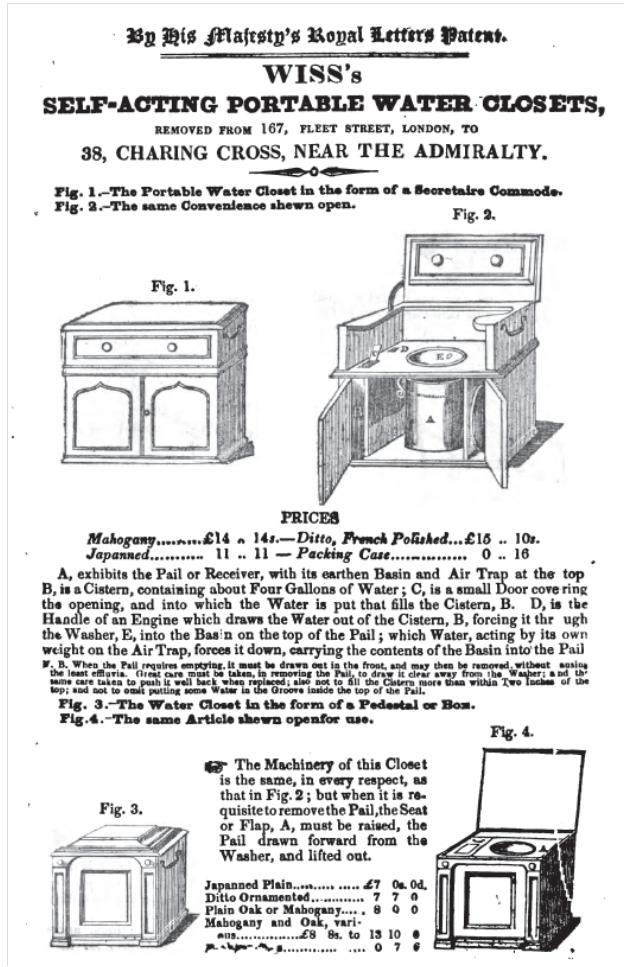
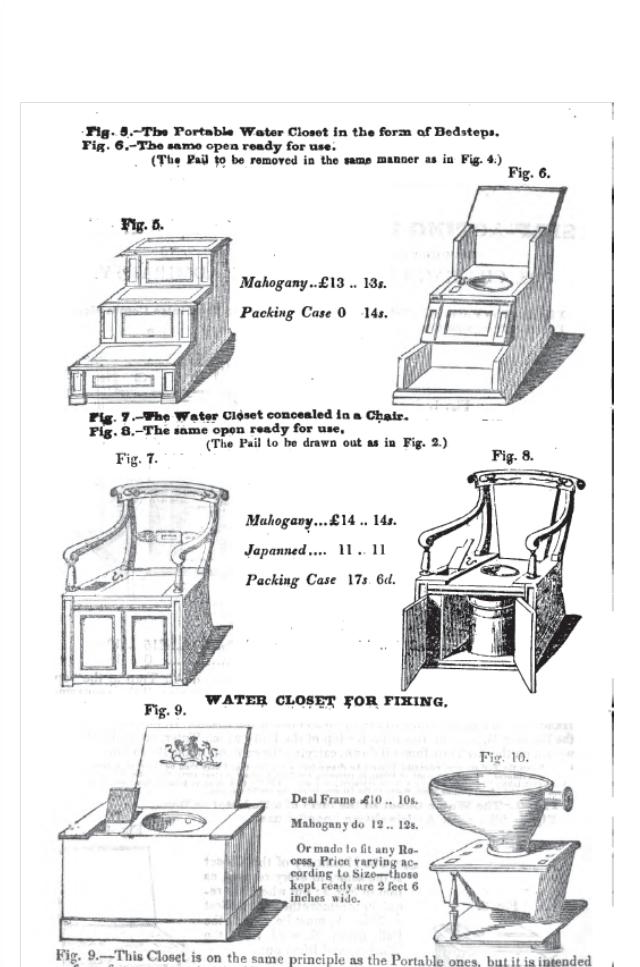
While I’ve had fairly simple, if not quite well thought out, ideas in my head, it seems some commodes were quite complex. Take a look at this advertisement printed in 1831, in both the Edinburgh Review and the Quarterly Review out of London. I am picturing something more like illustrations 3 and 4.

1 2

Thomas Webster discussed a version figures 1 and 2 in his Domestic Encyclopedia: “Portable water-closets are useful when fixed ones cannot be had, and in case of sickness; as they may be placed in a dressing-room, or even a bedroom. If ill constructed, they are a nuisance; but we can recommend the following, patented by wiss, near Charing Cross, London. Fig. 454, a, a, [reprint of figure 2 labeled a to f] is a cistern for water, surrounding the three sides of a box which holds the pan, b; the cistern is filled by lifting up a small lid, c, and pulling the handle of an engine, by which the water is forced into the pan through the washer. This water, by its weight, opens the hinged valve at the bottom of the pan, e, placed beneath. This pail has a cover with a projection that dips into a groove containing a little water, that effectually prevents any effluvia from coming out. The pail can be removed to empty it. This apparatus may be made in a variety of forms, as a seat, an arm-chair, a commode, settee, &c. The same movable box, with the cistern and pan, may be used without a pail, and be more complete, where there is a convenience of connecting it with a pipe to go into a drain or cesspool. In this case there is a curved tube to be joined to the pipe, which, being always full of water up to the dotted line, stops any smell from ascending. [additional small illustration]

Published in: on June 3, 2013 at 5:30 am  Comments (2)  

Summer Series – “Around the House”

I’ve decided the summer series will take a look “Around the House”. To kick this off, lets start with a bit of perspective.  

This passage comes from the “Ladies’ Department” of the June 1860 Genesee Farmer, published in Rochester, New York. Do keep in mind this is the forward thinking “Burned Over District.”

Women’s Occupation – In these days of progress and improvement, not the least among the many evidences we meet with of the triumph of science over difficulties hitherto supposed insurmountable is the invention of the sewing machines. Women need no longer be a mere mechanical drudge, doomed to pass her days forever in the seclusion of home – wasting away her energies, and her life in the everlasting occupation of needle-work. The days when Tom Hood wrote his pathetic “Song of the Shirt” have passed away, and are numbered among the things that were. It may perhaps be said by some, that with the introduction of the sewing machines, women’s occupation is gone. This, perhaps may be true of  many of those who, having been educated in a former age, find that education too limited for the present time, and have no resource to fall back upon, or the ability to adapt themselves to follow new channels of life

So long as the present system of female education is followed, the effect of this loss of her occupation will be to make her still more dependent. But a revolution in the system of education must sooner or later take place, and woman must be fitted – not to be a mere ornament to the house – a gewgaw to be taken around for show, like a little dog led by a golden chain, or as a mere household slave. No! woman must be be  [sic] so educated as to become not merely the companion, but the teacher of man. Her education must be carried out on a sounder and broader basis. She must be taught so as to be fitted to become herself a teacher. She must be fitted to take care of herself, and to feel that she has a mind, and that her mind is capable of being directed into channels of thought – by which she can acquire a position of independence and exercise a greater and better influence than she at present does. She should also become more accustomed to out-door exercises, and should study physiology; and take an interest in the discoveries of science, and what is going on outside of her immediate circle. ~~Progress.

 As I’ve been thinking a good deal about cooking lately, thanks to my little sister, I expected to find a similar passage regarding the leap forward in a stove for cooking. I have not, yet. It seems, period literature is far more concerned about the heat stove than the influence the cooking stove had on the daily life of women. (Or, atleast I should say the pieces of literature I have thus found.) I did find this to share: From Eighty Years of Progress of the United States, by CL Flint (1861) I suggest reading the entire chapter beginning on p245 http://books.google.com/books?id=OiEaAAAAYAAJ

Cooking was performed over an open wood fire; a mode in many respects more laborious and less convenient than the present use of stoves and ranges; but which, if skillfully conducted, gives the food a flavor more perfect and delicate than can be attained in any other manner.

As has been implied, the changes in food have thus been more in the treatment than in the materials of it. The chief of these changes, like those in warming houses, have arisen from the introduction of anthracite coal into use, which has caused the employment of cooking-stoves and ranges, instead of the open fire. Nearly four hundred patents for cooking-stoves and ranges were issued from 1812 to 1847, and great numbers of others have been granted since; the total number of such patents may safely be estimated at not less than six hundred.

An early style of cooking-stove, and quite a favorite ne in its day, was the rotary, whose top could in its day, ws the rotary, whose top could be swiveled round by a crank and cog-wheel geared to a ratchet underneath its edge, so as to bring any underneath its edge, so as to bring any sauce pan or kettle forward to the cook. This variety is, however, now nearly obsolete, and innumerable later inventions have succeeded, each enjoying a brief reputation, usually conferred rather by diligent advertisement than by any real peculiar merits in the stove itself.

The cooking range may be described as a modified stove bricked into a fireplace, instead of standing out in the room. Its oven, instead of being [in] back of the fireplace, as in a stove, is above it; and most patterns, so far back as to render it very hot and inconvenient for use. Some late patterns, however, have brought the oven sufficiently far forward to remedy this objection.

The use of stoves and ranges has rendered cooking much more convenient, but has, in a great measure, substituted the baking of meats in the oven for the better old fashion of roasting. Their advantages, however, are greater than their disadvantages; they are far cheaper and easier in management than an open fire; and in all older portions of the country are necessary, because would could not be furnished to supply the kitchens.


 Just a few other pieces:

If you are interested in perspectives on the duties or position of women entering the mid-century, you may find these of interest:  Woman’s Rights and Duties    Volume 2  and Lectures on the Sphere and Duties of Women 

 Of general, useful interest, I came across this: Hand-books for Home Improvement: Comprising, How to Write, How to Talk, How to Talk, How to Behave, How to Do Business.(1857)

Published in: on June 1, 2013 at 8:00 am  Comments (1)  
Tags:

New Season, New Saturday Series

How is it June already? May simply flew by. With spring turning to summer, the Saturday morning post series will be transitioning from millinery t…… well, I am not really sure. I have yet to decide what the next topic will be.

One idea is women’s involvement in nineteenth-century at social movements. This is a very broad topic.

Another is highlighting good interpretive techniques, activities, demonstrations, etc at events. This would share other’s ideas and accomplishments as well as my own ideas.

A third would be to look at domestic details such as housekeeping advice, the general knowledge most of us would have had.

What are your thoughts? Is there anything you would like to see?

Published in: on May 30, 2013 at 4:00 pm  Comments (2)  

Making a Hat Stand

I know several people found my fabric headform post helpful. Check out this realy nice ‘how-to’ on making a wooden hat/bonnet stand.

Tea in a Teacup

Ever thought a hatbox didn’t do justice to your collection of hats? Ever wanted to display your hat-making skills to the world, or at least to your visitors? Why not try making a hatstand!

After seeing some hatstands at a friend’s house, I have been keen to make a pair to display my Regency bonnets. Having my bonnets on display means that I could spend time admiring and enjoying my handiwork as a decoration, rather than always having them packed away awaiting my next costuming event.

Hatstands, both as larger hall furniture and as smaller dressing table pieces, became popular during the Victorian era. They could be made from wood or cast iron, and could be covered with a fabric, such as velvet. They were also often weighted in the base, which increased the stability of the stand once a hat was placed on the top.

This week I have…

View original post 655 more words

Published in: on May 27, 2013 at 12:38 pm  Leave a Comment  

Fun Fifty’s Bonnet

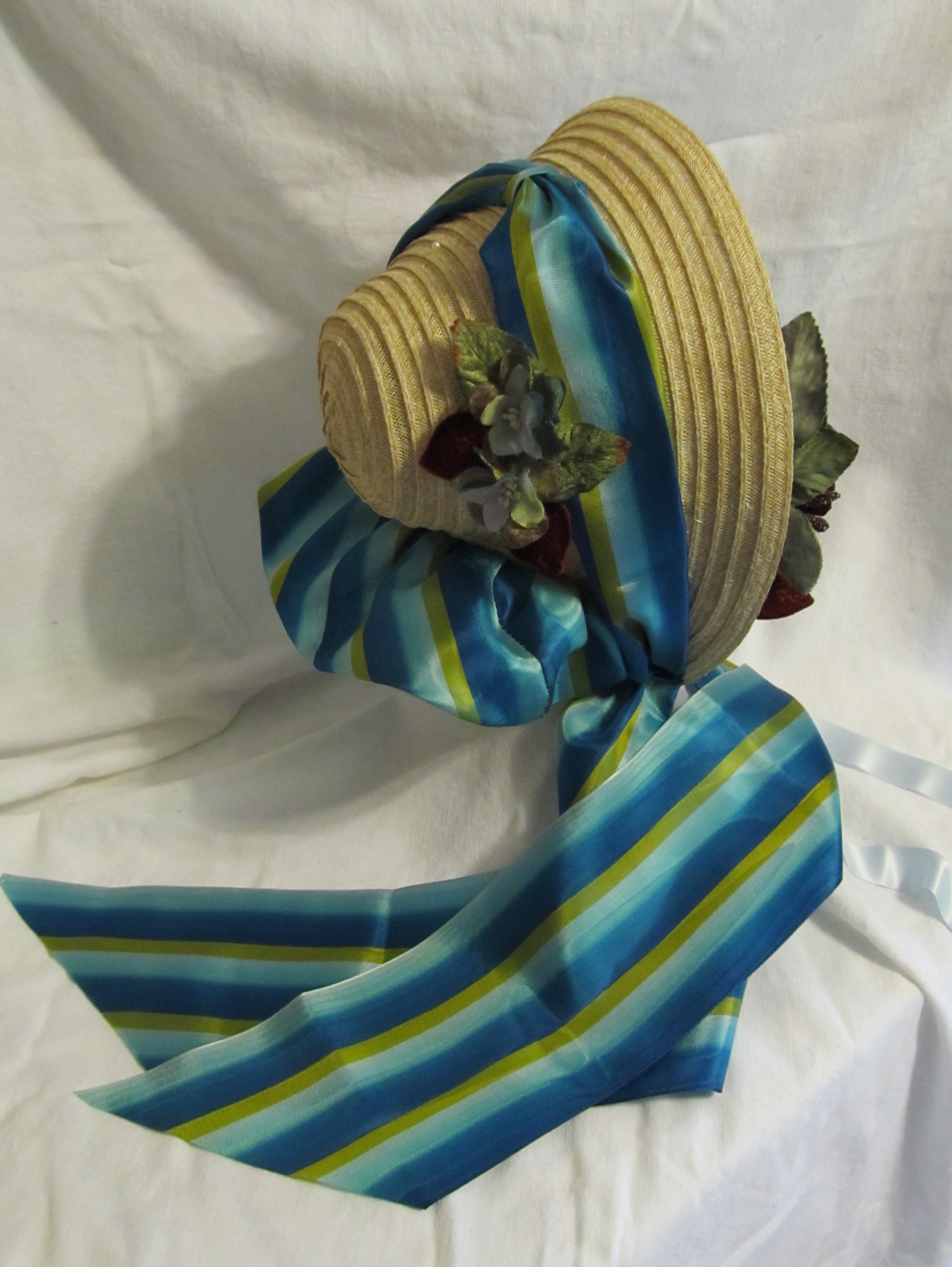
???????????????????????????????I wrapped up a tremendously enjoyable custom bonnet today. The recipient is truly one of those fun customers that you jump to work for. Together we picked out the flowers and ribbons for this 50s bonnet. The amazing striped ribbon is a vintage piece from Italy. The flowers are a combination of vintage and current done in luscious velvet including the strawberries.

??????????????????????????????????????????????????????????????

Thank You, B, for asking me to make this bonnet for you. I hope you enjoy wearing it as much as I enjoyed making it.

The Faux Customer

You already know I enjoy stories of my favorite topics be it travel, shawls or millinery. This story had me do a double take. It comes from  a book I’ve been enjoying, The Diary of a Milliner , by Belle Otis in 1867:

“To illustrate the importance of what I have been saying I will tell a tale of to-day. Those who like to turn every thing to instruction may whittle a moral therefrom

A well-dressed lady came up to me, and asked me to show her some of our handsomest bonnets.

I asked. “Are you looking for any particular style or color?”

“No. I wish to see what will become me best.”

She deliberately took off her own bonnet and commenced trying those that were on the saloon table. One after one she took them up, and put them on her head, till she had seen about thirty casting their differently combined tints over her complexion. She invited my comments and suggestions upon each one. She viewed herself in each in the five mirrors of the saloon, in all the various light she could command, and placed herself in ever conceivable attitude before them.

One thing or another was at fault with every one of them. She had asked the price of all, and cheapened each to the lowest possible fraction for which they could be bought.

She then went to the side-table, and performed the same operation with fifteen or twenty more. There were none that exactly suited.

“Haven’t you put some away in drawers?” she asked. I went the same rounds with a dozen drawers containing six or eight bonnets apiece.

When those were exhausted she pointed to the window, and asked if I would be kind enough to bring here two handsome bonnets that were hanging there.

Something in the inner life, probably it was that attribute of the dual denomination penetration, admonished me that she didn’t wish to purchase a bonnet, but was seeking an afternoon’s entertainment at our expense. Another something, whether it was a spirit tapping, tapping at the inner door I know not, admonished me that there are times when to practice the forbearing policy of the remarkable patriarch, of whom I have been speaking, is to cast pearls before swine. Instead of starting for the desired bonnets, looked at her steadily in the eye while I modulated my voice to a very respectful tone, and replied:

“If you really wish to buy a bonnet, I will go down and get them; but I fear that will suit you no better than the others have done.”

She saw that her role was played to the end and a successful actress she had proved herself. She had confined her audience in the closest attention for about  two hours. The other two bonnets were beyond her reach. With the most inimitable coolness and unconcern she looked me back and replied:

“I don’t wish to buy a bonnet. I bought mine last week.”

If she had struck me in the face I wouldn’t have been more startled and surprised than I was at the exhibition of such boldness. I could scarce refrain from crying out, “O shame, where hides thy blush!”

After a moment, the ease with which she had accomplished her consummate piece of impudence. Moderated by my indignation to a sort of admiration. I would like to know more about you, I thought.

I could conceive of no motive that could induce a lady – so she appeared on the surface – to make so irredeemably mean an exhibition herself. I abnegated self in apparent interest in her affairs, and quietly asked:

“If you didn’t wish to purchase, why have you tried on so many bonnet?”

“I wanted to find out your prices, to see if I got cheated in mine. If I did I’ll never trade at the place where I bought  it again.”

She had told me the truth, but not the whole truth. I like to sift truth to the bottom, so I pursued:

“You needn’t have tried all those bonnets to find out the prices. I would have told you that, with pleasure, if it would have given you satisfaction.

“Oh, I wanted to see, too, if you had a bonnet in your store more becoming to me than mine. My milliner told me if I could find one in the whole city more so I might keep the bonnet and she would give me the money back!”


After extensive internal exasperation for the milliner, the discussion continues revealing the faux-customer had every intention of retrieving her money and leaving the bonnet she purchased as a way of punishing the shopkeeper, claiming “I haven’t worn it but three times, – once to church, once out to Roxbury, and once to the Museum.” and Store-keepers do tell such shocking lies in order to sell their goods, I see no other way but to keep strict watch of them, and bring them up to the mark when they overreach and don’t tell the truth.

Published in: on May 25, 2013 at 8:00 am  Leave a Comment  

Nice Fabric at a Nicer Price

Each day FabricMart picks a fabric to drop the price on. Today they have a fabulous red/brown/black plaid shirting that would look great done up as a dress. (Okay, I Really want this fabric but can’t spare a penny right now.)

http://www.fabricmartfabrics.com/xcart/Plaid-Cotton-Shirting-Cherry-Red-Khaki-Black-SKD3781.html

This 58″ wide plaid is only $2 a yard. With their discount code “Welcome” for new customers, that keeps a dress length of 7 yards under $20 with shipping. They have less than 100 yards left. So, if you want it, grab it quick. I can tell you I have always been happy with their fabrics.

I have pictured in my mind just the dress this fabric wants to be. I will see if I can find it.

Published in: on May 24, 2013 at 8:58 am  Leave a Comment  

Blog Rearranging

Dear Blog Subscribers,

I am doing some rearranging on the blog. My goal is to consolidate the long list of pages and subpages on the right in hope that it will make each topic easier to work through. To do this, I am moving pages to posts, which will be buried a few years back. I notice you may be getting notices of new posts each time I move something. My apologies for the confusion.

Warm Regards,

Anna

Published in: on May 22, 2013 at 11:43 am  Comments (1)  

Recommended Blog

Civil War reenacting friends, if you haven’t discovered it yet, I highly recommend checking out Civilian War Time. This blog transcribes letters and diary/journal entries each day. On the right hand side of the blog is a subscribe space. Enter your email to receive the posts daily.

Published in: on May 20, 2013 at 8:54 am  Leave a Comment  

“Red Day” at GCV

Today was such a lovely day. This was the first time I’ve dressed in mid-19th century clothes for the whole day in almost a year. It felt great.
This is where I spent the day:

image

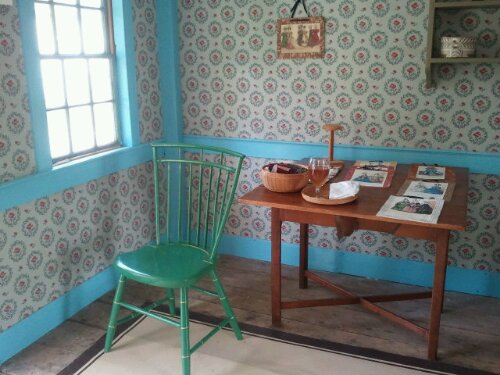
This cute pink building is the Dressmaker’s Shop. It has two rooms and a half story above. With the front & back doors open, the breeze was wonderful and made the day quite comfortable. This is where I sewed for the day as I talked with visitors. This green chair is almost the right height for me.

image

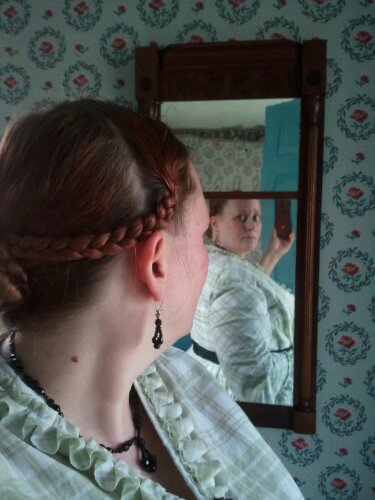
Here is me trying to get a nice photo with the mirror. It doesn’t work so well by myself with a camera phone.

image

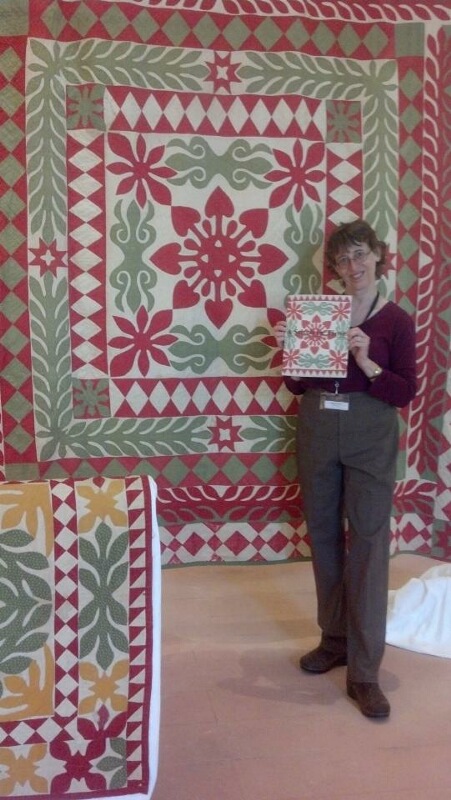
Today was the first of a series of book signings the museum will have this year. (I’ll get a list to share.) The author of Stitches in Time, Elizabeth Davis signed 3 books for me. As this was the quilting project Grandma was involved with, I wanted Mom & Lily to have one. (This is the dress I was working on this week. I am thinking of adding red or pink to the inside of the self fabric trim that goes around the neck, around the sleeves, and will eventually be in circles on the skirt.)

image

image

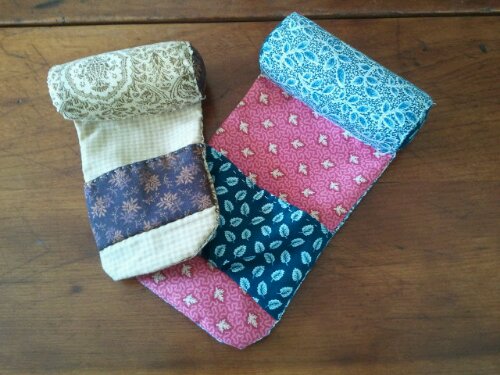
Next time, I need to bring more sewing. I thought this pair of sewing cases would take the whole day. They were done, sans wool pages forgotten at home, by 11:30.

image

I have to say, after getting so sick the last few times I dressed, I was very worried about whether or not I could make it through the whole day. I think it went just fine and I felt good. The only time I felt a little funky was after back from the gallery in the afternoon sun without a parasol. So, I just have to stay out of the sun. Considering the car said it was 86 degrees at 4:30, I think this was a pretty good me test.
I am really looking forward to spending the day in the shop again. I am kicking myself for not doing it sooner. (A certain someone knew it was just what I needed.) I made myself a list of things to bring next time to show and talk about with visitors.
Now, hopefully Dan and dinner will arrive soon.

Published in: on May 19, 2013 at 4:49 pm  Comments (1)  
Tags: