I know one of my blog subscribers like Collignon Chairs. (Last minute post from my phone)
http://rochester.craigslist.org/atq/3938174802.html
Collignon Chair

FanU Cotton Swap – Sign-up Day
Today is the day to sign-up for the FanU Cotton Swap!
To Sign-up, simply comment below with your email and mailing address. (I’ll erase those before approving your comment, so the whole world doesn’t have that info.) You can also email me or send me a message on Facebook.
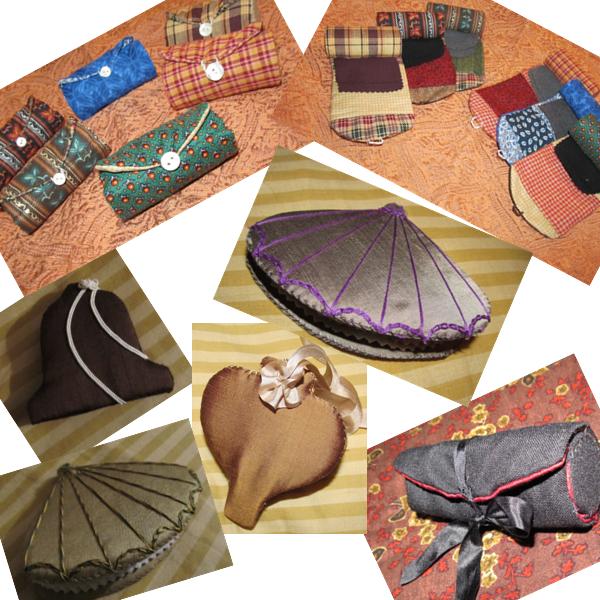
What is a Swap?
This is a chance for to exchange fabric with a small group of people. Each group will have 8 people exchanging pieces of fabric. All you need is a half yard of fabric and envelops along with your copy of Fanciful Utility.
To Participate:
1: Sign Up Day! On sign-up day, groups will be assigned on a first-in basis; the first eight will be the first swap group, second eight in the second group, etc.
Cotton Sign-Up Day: July 15 Silk Sign-Up Day: August 19 Crazy Sign-Up Day: September 23
2: Mail-Out Day: Place a 9×9″ piece of fabric suited to the mid-19th century in envelopes for each of the 7 other people in your swap group, stamp them (be sure to double check at the post office, but the small 9×9″ pieces should mail in a regular envelope with a normal stamp), and send them off no later than the Mail-Out Day. Cotton Mail-Out Day: July 23 Silk Mail-Out Day: August 26 Crazy Mail-Out Day: September 30
3: Get Fanciful! Use your Fanciful Utility templates and techniques to make a project from the book, or copy your own from 19th century sources. We’ll all look forward to seeing your projects! You don’t have to sew right away, but don’t keep us waiting forever to see all the fun things!
(If you need a copy of Fanciful Utility, you can purchase them from the publisher at www.thesewingacademy.com
Fabric Guidelines:
- For the cotton and silk categories, your fabric should be mid-nineteenth century appropriate. (If there is a want for an earlier or later group, we can do that.) Prints and motifs should reflect those available in the 1840s, 50s and 60s. Cotton should be 100% cotton. Silk should be 100% silk.
- To keep the swap and sewing possibilities interesting, please avoid solids as best we can.
- Fabrics that do not work well for sewing cases should not be swapped. These include sheers, gauzes, heavy, thick, easy-to-fray, slippery and stretch fabrics.
- For the “crazy swap” category, think crazy quilt in a sewing case. This could include satins, velvets, textured fabrics. Quality synthetic fabrics are invited.
Q&A
Yes, you can participate in 1, 2 or 3 of the swaps.
Yes, if we end up with multiple groups, you can participate in more than one group to swap more fabric. If you participate in 2 groups, you should swap 2 fabrics.
Yes, you can swap large and small scale prints.
Yes, you can swap now and sew later.
Yes, we would love to see what you’ve made with the swapped fabric.
Yes, you can use your own fabric in your swapped project.
Around the House – Tasty Bits of Food
Okay, these are things that sound tasty to me….
Baked Egg-plant – Parboil it until it is soft enough to stick a straw into; then cut it just in half; scoop out the inside, leaving the hull; shop it up very fine, and season very highly with pepper and salt, a good deal of butter, and crumbs of bread. Mix all well together and return it into the hull; then strew crumbs of bread on the top, and bake it for about an hour. (The Genesee Farmer, September 1860)
Fried or Broiled Egg-plant – Parboil it; cut into slices and season very highly with pepper and salt; fry or broil it (as you do mushrooms.) in a pan with butter. If nicely done, it is very similar in flavor to the mushroom. (The Genesee Farmer, September 1860)
To Preserve Rhubarb – Cut the stalks into pieces an inch or so in length; string and dry the same as apple, and stow away in a dry place for winter and spring use. (The Genesee Farmer, September 1860)
How to Pack – A Carpet-bag and Travelling Reticule
Another in my drafts folder….. From Eliza Leslie’s House Book, (Philadelphia, 1844)
CARPET BAGS – The best carpet-bags are those that are made with large gores at the sides, as they hold much more that when of two straight pieces only . It is well to have the owner’s name engraved on the lock. Articles of dress that cannot be compressed into a small compass, should not be put into a lady’s carpet bag, which should hold the flannel, linen, stockings, night-clothes, shawl, shoes, &c., that she may be likely to want during her journey; those that she will require the first night to be placed at the top, where also she should have a bag containing her comb, hair-brush, &c. For want of a bag, these things may be pinned up tightly in a towel; and she may do the same with her shoes if she has no shoe-bag.
A TRAVELLING RETICULE – A reticule for traveling may be so made, as to contain many useful articles. Get (for instance) three quarters of a yard of the thickest and best colored India silk, such as called senshaw. Divide it into two pieces, about a quarter and a half a quarter in each, but the outer piece a little deeper than the inner. Then lay them together so as to be double, and divide them into four compartments, by making three downward rows of stitching or running: when you have sewed up the side edges of the bag, you will have four divisions. Leave sufficient at the top of the inner lining for a hem; and the outside must rise a little beyond the inside and be hemmed down so as to form a case, to be drawn with ribbons, of broad silk braid. Gather the bottom of the bag, and draw it up as close as possible, so as to finish it with a tassel, or a bow of ribbon at the gathering place. This bag will be found very useful in travelling; as in the different divisions, you may carry a comb, hair-brush, tooth-brush, smelling-bottle, a cake of soup, purse, needle-book, keys, &c., so arranged, as not to interfere with each other inconveniently; leaving the space in the middle of the bag for your handkerchief, which you can take out without bringing the other things along with it. These large reticules will be found less troublesome to carry, and better in every respect than a travelling hand-basket.
How to Pack – A Trunk
I found this buried in my drafts folder….. From Eliza Leslie’s House Book, (Philadelphia, 1844)
To Fold a Dress for Packing – spread the dress, right side out, on a bed; and, taking it by the hem, make the bottom exactly even all round. Next, double the skirt lengthways in half, then fold it lengthways in four, turn up crossways about one-third of the folded lower part of the skirt; then give the remainder of the skirt a fold backwards, terminating at the gathers at the waist. Next, turn the body backwards, with the front uppermost, and the back resting on the folded skirt beneath. Lastly, spread out the sleeves; vie each of them a fold forward at the shoulders, and a fold backward at the elbows, and lay them across each other evenly on the fore-body.
Fold the pelerine right-side out. First, double it in half, beginning down the middle of the back. Next, give the doubled pelerine a fold backwards, then a fold forwards, and then another fold so as to leave the corners uppermost.
A belt-ribbon, for packing, should be rolled on a block, and fastened with two pins.
A lady’s travelling dress should be made to fasten at the side or in front, pelisse-fashion; that, during her journey, she may be able to dress herself without assistance.
It may be well to have a camphor-bag sewed to each of her night-gowns, that she may be less liable to attacks from insects when sleeping in such beds as are frequently met with in travelling.
To Pack a Large Trunk – Have all the things laid out ready, the light things divided from the heavy ones; and keep at hand a quire of soft wrapping paper. Spread a clean thick towel over the bottom of the trunk, and place on it the hard flat things, such as portfolios, music-books, a writing desk, boxes, books for reading, &c,; taking care to fit them well together, so as to be even at the top; and filling up the crevices with small articles that will not be injured by compressment, each of them, however, wrapped in paper, to prevent their scraping of defacing the other things. Never use newspaper for packing, as the printing ink will not fail to rub off and soil whatever it touches. You may stick in a pair of shoes here and there, each laid together as flat as possible, and tied round with their own strings. Some persons have shoe bags made of flannel or cloth, and stitched into compartments, each division containing a pair of shoes. Over the layer of hard flat things in the bottom of the trunk, spread a towel; and on this lay your flannels, linen, &c., filling up the interstices with stockings and gloves. Then cover them with another towel, and put your dresses, the muslin ones uppermost; filling in the corners with pocket handkerchiefs. On the top of your dresses lay your pelerines, collars, and caps, (if you have no other way of carrying them,) &c., finishing with a thin towel over the whole.
No trunk should be packed so full as to strain the hinges. If your trunk has a false top, you can fill that with any articles that may be rolled up tightly. Shoes should on no account be packed without covers, as the colour (particularly, if black)will rub off, and disfigure any white things that may be near them. Avoid putting any eatable articles in a trunk of box that contains things which cannot be washed, as they may be much injured by grease or stains. On no consideration, carry ink, even though locked up in a writing desk. You can always at the place which you are going, buy yourself six cent worth of ink in a small square bottle, which will also serve for an inkstand. It is well, however, to take with you a few sheets of good writing paper folded in the form of letters, each with a wafer stuck on one edge, to be ready, in case you have occasion to write before you reach your journey’s end, or immediately after. It is well to have read tapes nailed across the inside of the lid of your trunk, for the purpose of slipping letters and papers between them.
There are traveling trunks with a sort of movable tray fitting in near the top. This tray can be lifted in and out, and is for the purpose of containing pelerines, collars, scarfs, ribbons, laces, &c. Some very large trunks have a partition at one end, to hold a bonnet or other millinery.
It is best, however, to have a proper bonnet-box, either of painted wood or leather. To keep the bonnet steady, sew to it in convenient places under the trimming, pieces of tape, the other ends of which should be secured with tack-nails to the floor and sides of the box. In the corners, you may lay a few caps, &c., as light as possible.
Leather trunks generally have brass plates on which is engraved the name of the owner. It is now very customary to have the name painted on both ends of the trunk, and also on the bonnet boxes. Besides which, if you are travelling with several articles of baggage, it is well to have them all designated by a piece of red tape or something of the sort tied round the handles of each. A lady, before setting out on a journey, should be provided with a card or paper, on which she has written a list and description of her trunk, box, carpet-bag, &c. Previous to the hour before starting, she should give this list to the gentleman under whose escort she is to travel and it will save him much trouble in finding out and taking care of her baggage.
The best paper for wrapping light articles that are to be packed in trunks, is the thin, soft sheets of light blue, buff, gray, and other colours, that are retailed at six cents per quire. It is well to keep a supply of it always in the house.
For heavier articles, (books, &c.,) the nankeen paper will be preferable to any other, as it is both smooth and strong.
In putting a paper parcel to go any distance over twenty miles, it is better to secure it only with sealing-wax, (putting always a wafer under the seal,) than to tie it round with twine, as in the course of transportation, the twine is very apt to rub and cut through the paper.
When putting up a newspaper or any other printed sheet to go by mail, always leave the cover open at one end.
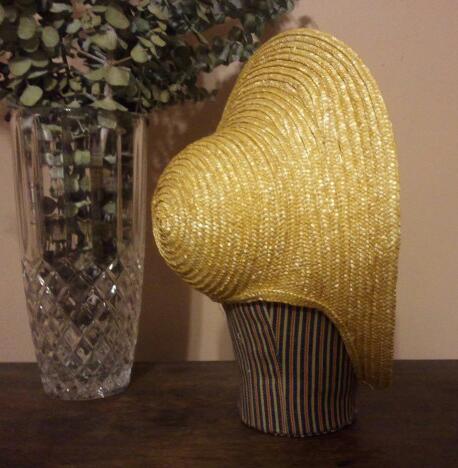
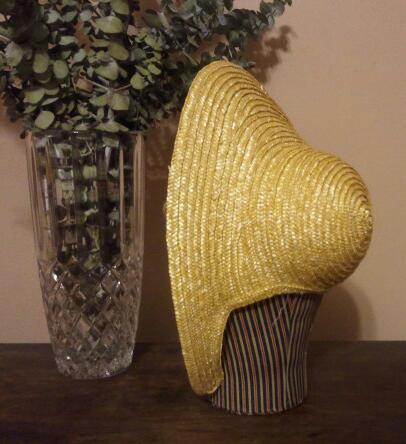
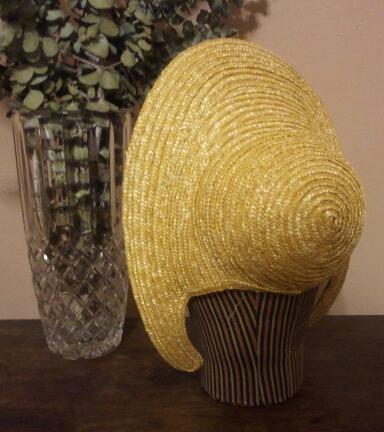
Soft Crown Straw Bonnet Frame
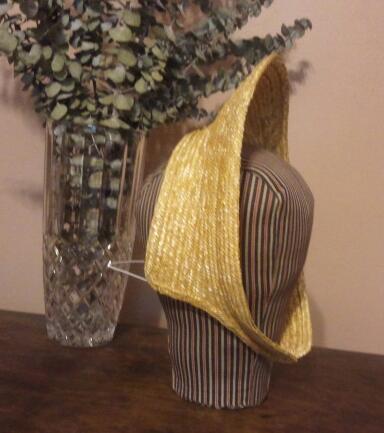
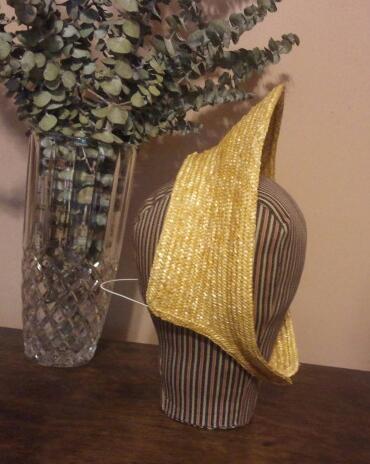
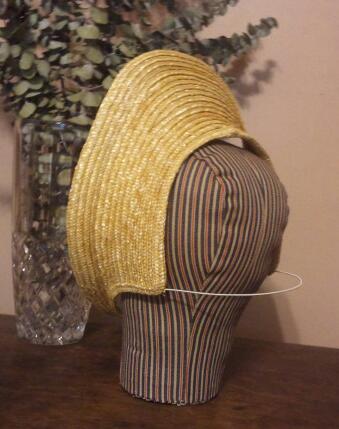
While finishing up the last bonnet, I had the idea of doing something ‘different’ stuck in my head. It was either going to be a soft crown frame or a combination buckram and straw frame. With this being 1863, and 1864 just around the corner, a fashionable soft crown frame it was.
Wow, was this guy fiddly. I really don’t know if I’ll make another, ever. It would take some begging. Anyway.
This is a natural straw plait handsewn. The bonnet is an average to large. The future owner will finish the soft crown with her choice of silk, tacked to the brim of the straw and gathered onto the crown wire. There are several colors I could see this finished with. I am very curious how it would look done with a sheer.



Faniciful Utility Book Signing!!!
Come visit me at the Genesee Country Village and Museum. I will be signing Fanciful Utility in the Dressmaker’s Shop.

This is the adorable pink building I enjoyed spending the day in a couple weeks ago. It is just off the village square. Directly across the road is the Village Merchantile where Fanciful Utility will be available. Stop in to say ‘hi’ and get your copy signed.
Announcing the FanU Fabric Swaps
Love Fanciful Utility? Want more fabrics to play with? Here is just the thing for you – FanU Fabric Swaps!!!
To meet a variety of interests, we’ll have three different swaps – a Cotton Swap, a Silk Swap and a Crazy Swap; sign up for one or more! You can even sign up to be in more than one swap group within each category if you’d like.
What is a Swap?
This is a chance for to exchange fabric with a small group of people. Each group will have 8 people exchanging pieces of fabric. All you need is a half yard of fabric and envelops along with your copy of Fanciful Utility.
To Participate:
1: Sign Up Day!
On sign-up day, groups will be assigned on a first-in basis; the first eight will be the first swap group, second eight in the second group, etc.
Cotton Sign-Up Day: July 15
Silk Sign-Up Day: August 19
Crazy Sign-Up Day: September 23
2: Mail-Out Day:
Place a 9×9″ piece of fabric suited to the mid-19th century in envelopes for each of the 7 other people in your swap group, stamp them (be sure to double check at the post office, but the small 9×9″ pieces should mail in a regular envelope with a normal stamp), and send them off no later than the Mail-Out Day.
Cotton Mail-Out Day: July 23
Silk Mail-Out Day: August 26
Crazy Mail-Out Day: September 30
3: Get Fanciful!
Use your Fanciful Utility templates and techniques to make a project from the book, or copy your own from 19th century sources. We’ll all look forward to seeing your projects! You don’t have to sew right away, but don’t keep us waiting forever to see all the fun things!
(If you need a copy of Fanciful Utility, you can purchase them from the publisher at www.thesewingacademy.com
Fabric Guidelines:
- For the cotton and silk categories, your fabric should be mid-nineteenth century appropriate. (If there is a want for an earlier or later group, we can do that.) Prints and motifs should reflect those available in the 1840s, 50s and 60s. Cotton should be 100% cotton. Silk should be 100% silk.
- To keep the swap and sewing possibilities interesting, please avoid solids as best we can.
- Fabrics that do not work well for sewing cases should not be swapped. These include sheers, gauzes, heavy, thick, easy-to-fray, slippery and stretch fabrics.
- For the “crazy swap” category, think crazy quilt in a sewing case. This could include satins, velvets, textured fabrics. Quality synthetic fabrics are invited.
Q&A
Yes, you can participate in 1, 2 or 3 of the swaps.
Yes, if we end up with multiple groups, you can participate in more than one group to swap more fabric. If you participate in 2 groups, you should swap 2 fabrics.
Yes, you can swap large and small scale prints.
Yes, you can swap now and sew later.
Yes, we would love to see what you’ve made with the swapped fabric.
Yes, you can use your own fabric in your swapped project.
Third Summer Bonnet
Okay, I really need beter titles for these.
This bonnet already has a new home. I happen to love how the shape came together. It has a gentle rise from the tip to the crown. The brim has the very popular spoon shape.
Like all my bonnets, this is hand sewn. It is wire through the brim & cheektabs.
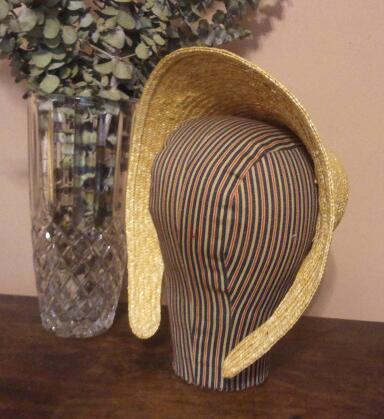
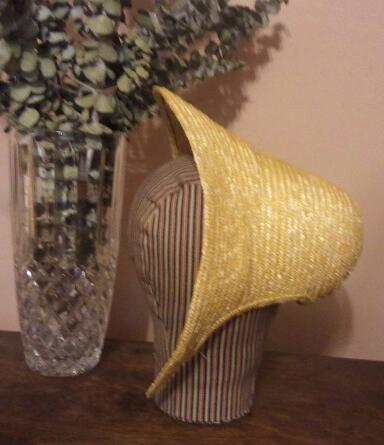
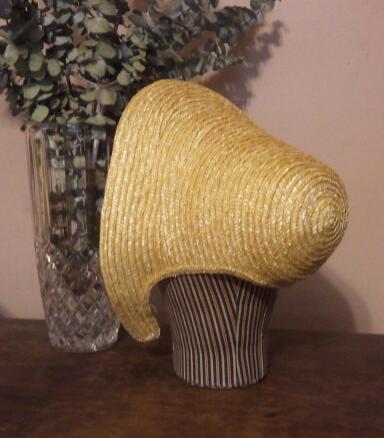
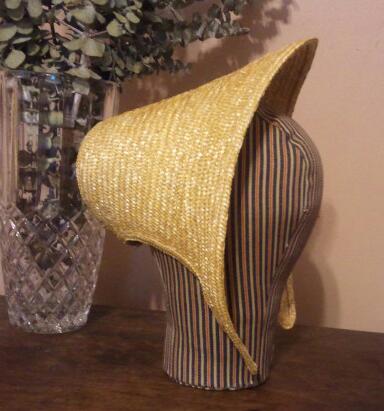
Please visit my Etsy store to see each of my bonnets as they become available.
Second Bonnet of Summer
Here is the second bonnet of this week’s sewing spree. This is the bonnet for someone who want the brim further back from their face. It is a high-brim with a gentle curve to the brim. This is a small to medium size high brim bonnet. It is entirely hand sew. The straw is a narrow whole plait of real straw with a beautiful rage of golden tones. It is wired through the brim and cheektabs.
Please visit my Etsy Store for each of my straw bonnets (and other goodies) as they become available.





 If I Had My Own Blue Box: