Veil 101 – (Version 1)

This look at veils concentrates on the everyday veils of the  mid-19th century, the 1840s through 1860s. It does not include mourning veils.

I am calling this “Version 1” because, despite this post sitting in the drafts folder for well over a year, it does not include everything I want it to, including specific photos.

As some of you know, I have issues with sunlight that can trigger migraines or full-body crashes. So, veils are very important to me. This is very much a “don’t leave home without it” item.

You will notice each of the veils I wear are silk gauze. This is for two reasons. First, when we started exploring veils locally, some years ago, the silk gauze at Dharma was what we felt suitable. Our research has expanded. Second, personally, I find the gauze helps with my light issues nicely. I am kinda afraid to make the change to net. But, I will be giving net a try when I find a net that I feel mimics the feel of those originals I’ve held.

Veil Shapes
wpid-2014-08-30-18.09.42.jpg.jpeg

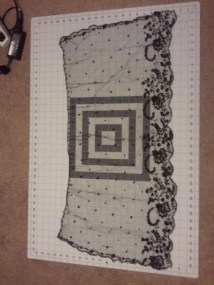
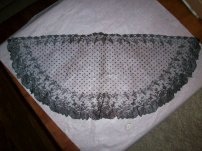
The most common shapes for veils included the wide rectangle and the semi-circle. In each shape, they tended to be wider than they are long, ranging approx from 30″to 40″ wide and 15 ” to 20″ long based on those I’ve been able to see in photos and in person.
il_570xn-642507724_qoqn

Right above: A rectangular net veil, approx 36″ wide by 17″ deep. Right below: A semi-circular veil. I need to double check the dimensions, as I am pretty sure I bought this one but haven’t a clue where I put it.

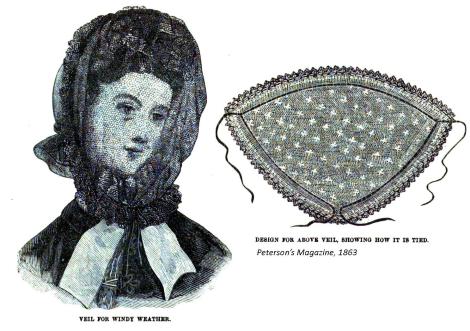
There were some variations to these shapes. This example at the MET may be mid-century. It is a variation on a rectangle with the top and bottom edges curving.  There  is a shape I would call a petal, with two sides each an arc. At the bottom of the page, you will see a quasi-triangle shaped veil meant for windy weather.

Be sure to browse your favorite and local museums to see original veils.

Veil Materials
wpid-2014-08-30-18.10.14.jpg.jpeg

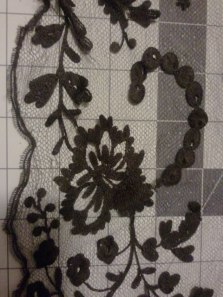
Let me first say I am utterly clueless about lace, or at least entirely lacking confidence in my knowledge of lace. I will leave the details of which lace is which and which is correct to those who have studied lace in depth.

That said. In minimum:

In terms of fibers, silk, linen, wool and cotton all come up for nineteenth century shawls in museum collections.

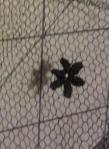
When looking at the net ground of net or net lace, you want little hexagons. You do not want the little rectangles or diamonds.
wpid-2014-08-30-18.10.36-1.jpg.jpeg


Veil Colors

1830s travel program me 1

The most commonly found veil colors for the century are black, white and ivory. We can also find blues and greens. These do tend to appear more frequently in earlier remaining veils then in those of the 40s, 50s and 60s.

To the left is an image of me in an 1820s bonnet with a green veil. This is a dyed silk gauze veil made by Bevin Lynn. I found this green to be gentle on the eyes when out in the sun, given moderate protection. It did not give glare as some white veils can do. It did play with the light giving a streaked color effect similar to what some migraines can produce.

I have also worn white and black veils. I find black silk gauze to give the most protection from the sun. It also gives the most vision dampening of the colors I’ve worn. White give some light protection. I prefer it on moderately sunny day for short walks across the tree filled square.

Attaching a Veil
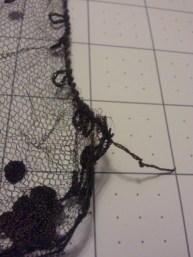
wpid-2014-08-30-18.11.51.jpg.jpegThis is how I attach my veil. Original veils show either a channel at the top of the veil or worked holes, through which a thin cord or ribbon can be drawn. In my veils, I prefer to put a small knot or loop in the end. This helps keep the cord from sliding back through and makes it easy to grab.
IMG_3831

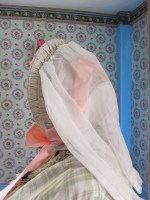
Once this cord/ribbon is drawn up, the veil can be positioned along the brim edge. I drape the veil over the back of the bonnet.

I prefer to pin just back from the edge. With my drawn bonnet, seen here, I pin under the second cane. On my straw bonnets, I pin a row behind the fancy plait or about the 3rd row back. The end pins are pinned upward sorta following the row of cane or plait. In the center top, I pin one or two pins across the veil, trying to catch the cord,

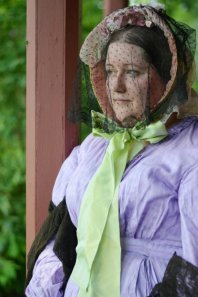
parallel to the cane or plait. (pinning perpendicular to the plait will allow the veil to pull forward or backward as it drapes.) Here you can see how this veil drapes forward and back. This is a silk gauze veil made for me by Bevin. It is trimmed in silk ribbon. It is a little longer than most 1860s veils. Some 1850s images do show a similar length.

Here Betsy Connolly is wearing a semi-circular veil. Notice how she doesn’t have the ends pooling on either side as a rectangular veil would.
wpid-534186_556635881040979_23383459_n.jpeg


Specialty Veils

3


Published in: on May 3, 2016 at 6:00 am  Comments (1)  

Research that makes you whine like a child for ice cream

Yep. That is what I am doing right now. Whining like a child. Okay, ice cream would be good too. But, look at this, here.

This is a transcription of an advertisement in a February, 1813 New Orleans Gazette offering a millinery subscription for a new hat for every Sunday. (Either a second transcription or a transcription of another advertisement can be seen here.)

To the Public

A New Hat Every Sunday for Thirteen Dollars a Year.

The subscriber has the honor to inform the public that he has opened a subscription for persons desirous of having a new hat every Sunday, the dampness and dust of this country is very injurious to hats and but few can keep a clean hat more than 15 days.

This has determined the subscriber to make such a proposition to the public, no person can keep a hat longer than 15 days, and they will be answerable for, all kinds of damages out of shape, stains and all other accidents, and the hat, if it or , found the lining is in any way injured another will be put in at the expense of the wearer. This especially will be kept with the greatest cleanliness and the punctuality, which will be observed induces to hope for its success. This list is limited to a certain number and as a number of persons have already subscribed, but a few will now be admitted.

E. Porte – Hatter

No. 11 St. Louis St.

The whine: I have so many questions…..

I want to see the original.

Is this for men’s hats or women’s? The advertisement is signed “hatter” indicating men’s hats. But, it is cataloged under millinery indicating women’s hats.

Is this more like a library subscription? Borrow and exchange?

Did they take the hats in and just clean them? or did they remake them if they were women’s hats?

Was there any connotation socially to participating in this type of subscription? Did people recognize the hat they wore last month?

Did subscriptions like this appear in other areas?

Was this financially viable for a hatter or milliner? Did the subscriptions cover the cost of new hats, cleaning, remaking?

Whine……

Published in: on May 1, 2016 at 11:00 pm  Leave a Comment  

Where Will I Be This Season?

I am admittedly being cautious entering this season after last summer’s sun incident. I am sticking close to home. Luckily, close to home is one of the best historic villages in the country.

May – How is it May already? Really? I need to double check with Mom. But, I think we’ll be visitors for opening weekend at GCV on Mother’s Day. Btw, I just receive the May GCV newsletter that announced a new interim-CEO, Becky Wehle, granddaughter of founder Jack Wehle. How exciting for the 40th anniversary! Also for the anniversary, the Gallery has an excellent new exhibit called “40 and Fabulous.” Stay tuned for why I’ll be spending more time in the Gallery. Also, the museum has joined the Blue Star Museum program, inviting active duty military and their families to the museum for free.

June – I will be demonstrating the cottage industry aspects of straw millinery at GCV during their War of 1812/Jane Austen weekend. I can be found on Saturday in the Foster-Tufts house on the village square.

July – There’s no place like the Genesee Country Village for the 4th of July. Their Independence Day celebration is a lifelong favorite. I’ll be picnicking and enjoying the festivities. For the GCV Civil War weekend, aka “Mumford”, once again I will have my millinery impression. This year I can be found on the village square in the Insurance Office right next to Ward Hovey. The rest of July will be my little sister’s graduation and going away party.

August – I’m not sure what I’ll do for August. There is a little event in the suburb I work in, that I used to enjoy doing with Lily. It lands on her birthday weekend. I don’t know if I’ll want to do that event or not.

September – I may do an immersion event. While immersion events aren’t a big interest for me anymore (I love talking with visitors), it will be a nice event.

October – tbd

November – The Domestic Skill Symposium…. I can’t say much because nothing is official yet.

EDIT:

To-do list by July:

  • Millinery sign
  • Lots of band boxes with proper paper (okay, 3 more would be nice.)
  • A couple more hat stands or heads (have half of each)
Published in: on April 29, 2016 at 12:10 pm  Leave a Comment  

Today’s Millinery

This evening I offer the first straw bonnet form of the season. This low crown straw form is suitable for 1850s through 1864 impressions. The crown has a gentle low rise to the brim. The tip is slightly oval to hold you coiffure. The straw is wired all the way around and sized to hold its shape. As always, my straw is entirely hand sewn.

Find this bonnet in my Etsy Shop.

Published in: on April 28, 2016 at 4:34 pm  Leave a Comment  

I am having such indecision…. choosing which era…. choosing which fiber….

I want a garment appropriate for interpreting straw sewing in.

In one thought, I am picturing the white/grey/black large scale plaid linen that has been in the stash since I was considering it for a travel impression, paired with a pretty white with black windowpane. Linen should be comfortable and breathe. This would be cut for an 18-teen to early 1820 demo.

But… then….

I need honest thoughts on this long shortgown. It is not a US garment. It would look fabulous in this swoon worthy fabric shown to me. Friesland. Empire-jak met lange schoot en korte mouwen van bedrukt katoen met groene en witte strepen en strakke donkerrode florale banen  Vervaardigingsdatum:	1820 - 1824  Afmeting:	lengte: 91.0 cm  Materiaal:	katoen:

For something for the 1850s, I would need to stick to cottons or wools. I suppose I could use the dark green and brown plaid that has been sitting in the stash for all too long. This would need to be a sacque and petti that matched. Elizabeths Dress fabric


Published in: on April 27, 2016 at 12:05 pm  Comments (1)  

Today’s Millinery

Written about as Clara Rose watches geese and squirrels on the other half of the screen.

Look for this hat in my Etsy Shop.

This straw hat has a high crown and moderate brim. The crown and brim lift in a curvy “V” at center back. I rather love this look. This shape can be worn tilted back as the end of the 18th century rolls into the early 19th.

It may also be worn flat, showing off the back flare. Worn this way, this style could be used for other eras/impressions as well.

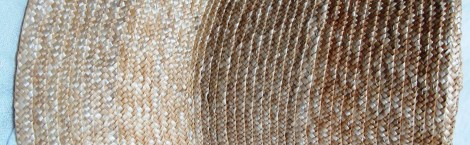
This hat shows the true nature of straw. The plait has three tones, darkest on top and lightest in the brim. This variation was all in the same hank. I didn’t notice it in the dimmer light of the livingroom where I was sewing. I did notice it in the brighter light of the kitchen as I blocked and sized it.

IMG_9345

This hat comfortably fits my average size head both tilted back and flat on my head.

The numbers you’ll want to know:
Inside the crown is 20″
Side to side – 12″
Crown height – 4.5″
Brim depth – 3″ on sides

Some of the inspiration:

L to R:

  • Watercolor, by Anne Frankland Lewis (from A Frolic Through Time)
  • Miniature by Louis-Lié Périn-Salbreux, circa 1790s
  • Honorable Lucy Byng by John Hoppner, late 18th c. (Frick collection – New York City, New York USA)
Published in: on April 23, 2016 at 4:22 pm  Leave a Comment  

UFOs and NESPs

For those not familiar with these terms, these are UnFinished Objects and Not Even Started Projects. The latter can also be called PSIH, Projects Stuck in Head.

As I am sure many readers have noticed, I haven’t been posting informational post as much as I was. This is because there are too many projects stuck in my head and floating about that coherent thought is not working its way out of my fingers well at all.

UFOs:

  • Numerous straw pieces
  • The very important out line someone is waiting for
  • The PITA shell sewing case 2016-03-28-17.47.16.jpg.jpeg
  • Cali’s sewing box 2016-04-03-13.32.02-1.jpg.jpeg
  • The secret velvet project
  • Cali’s time travel dress
  • Pincushion experiment cushions
  • Multiple pieces to the mega project

NESPs/PSIHs:

  • My daisy hat
  • My bandbox sewing box (Don’t even have the box)
  • The spool wagons with directions
  • Tiny wooden pincushion 2016-04-16-10.58.37-1.jpg.jpeg
  • Cali’s sewing tools
  • Additional heads (have linen, need wood and batting)
  • Clara’s hammock
  • Multiple pieces to the mega project
  • Long Regency stays
  • Mae’s necklace (need the tiny cameo setting)
Published in: on April 22, 2016 at 6:00 am  Comments (3)  

Today’s Millinery – Fancy Plait Soft Crown

Happy Spring!!! As today is the first day it has truly felt like spring, I am happy to offer the my first straw bonnet of the season.

This fancy straw plait soft crown is a one of a kind. The fancy plait is an artisan plait called “batwing”. It is a beautiful reflection of historic straw plaiting.

The soft crown and bavolet are a 100% silk taffeta plaid in blues, yellow and white. The crown is lined with 100% cotton voile. The bavolet is lined with 100% cotton net. Inside is a frill of 100% silk organza and white organza flowers. The ribbon is a luxurious double face satin in deep blue. The functional ties are 100% cotton sateen.

The straw is wired around the brim and back. As always, my straw is entirely hand sewn. The bavolet does have some machine sewing to get a nice crisp line.

Look for it in my Etsy shop.


Materials notes as requested:
There are additional photos of the bonnet on the blog post for this piece. https://annaworden.wordpress.com/2016/04/16/todays-millinery-fancy-plait-soft-crown/
The straw plait is a hand plaited artisan plait called batwing.
The blue and yellow taffeta is 100% silk.
The ribbons are Hyman Handler double faced satin.
The flowers are organza, but not silk as it is nearly impossible to get true silk flowers now.

Published in: on April 16, 2016 at 7:31 pm  Comments (1)  

Millinery in Process – Fancy Plait Soft Crown

What happens when I find an Amazing artisan crafted fancy straw plait? I make a soft crown bonnet of course.

This straw is fabulous to work with. The straw artist calls this a “batwing” plait. It is a modern name, while the design is very suitable to historic millinery. It is such a pretty color too.

Originally, I was going to make the crown and bavolet in an ivory windowpane taffeta. But, it seems I imagined that silk into my stash. Instead, I find this pretty blue and yellow plaid to compliment the straw nicely. The colors are light enough to not over power the straw.

2016-04-13-20.29.00.jpg.jpeg

I’ll add photos as I work. (around nursing a recovering feline assistant.) When finished, it will be available in my Etsy shop.

In the meantime, here are a few of the soft crown bonnets I previously made.

Want to know more about soft crowns? Here are a few previous posts.

Published in: on April 14, 2016 at 7:00 am  Leave a Comment  

Today’s Millinery

Here is the earliest straw form I’ve made, yet. This hat was inspired by 1760s-1780s paintings. (see below) I just love how the straw curves on this hat. With the back of the brim flipped up and the front dipping just so, it is incredibly well balance. I’ve been wearing it back and forth to the sewing room. Okay, I am wearing it while I type. I lined it with a great champagne 100% silk taffeta with a great crisp crunch. It is ready for you to add your ribbons appropriately. Look for it in my Etsy Shop.


http://www.sothebys.com/en/auctions/ecatalogue/2015/dillee-dynastie-experts-collectionneurs-pf1541/lot.119.html

http://collections.vam.ac.uk/item/O82022/portrait-of-an-unknown-woman-portrait-miniature-engleheart-george/

http://mintwiki.pbworks.com/w/page/38691834/Fashionable%20Silhouettes:%20Selections%20from%20The%20Mint%20Museum%20Collection

http://www.mfa.org/collections/object/gallerie-des-modes-et-costumes-fran%C3%A7ais-7e-cahier-des-costumes-ffran%C3%A7ais-1ere-suite-dhabillemens-de-femmes-%C3%A0-la-mode-g40-duplicate-femme-de-qualite-en-deshabill%C3%A9-se-promenade-le-matin-%C3%A0-la-campagne-312577

http://www.britishmuseum.org/research/collection_online/collection_object_details/collection_image_gallery.aspx?assetId=1020201001&objectId=3365199&partId=1


Now, I really have to make this one as well….

https://www.indiana.edu/~iuam/provenance/view.php?id=671


Published in: on April 12, 2016 at 8:26 pm  Leave a Comment