Surfing books on Ebay, I stumbled across this blue Victorian velvet autograph book and instantly thought “that could be a great FanU project!”, just bigger. But, should it be a FanU project? Is an autograph book appropriate for mid-nineteenth century interpretation? Did they exist in the 1850s? Where they used? How were they used? Did women use them?
I went looking.
The first article I came across was this. It suggested that yes, indeed autograph books were used in the mid-nineteeth century. They seem to be personal and social at the same time. This passage also suggest they were for men. What about women?
Autograph Books.
There is no good thing on earth that is not abused. Humility becomes, in the hands of Uriah Heep, an instrument for the satisfaction of his own aviaries. Friendship is but too often affected, for the purpose of obtaining, at your hands, valuable favors. Even religion is sometimes used by the knave as a cloak for his selfishness. But the good things of this earth are far more frequently abused, through want of thought, that from intended malice. By one who thus unintentionally errs, especially if his error be practical in its effects, a few practical suggestions will not be taken unkindlly.
Everything that is abused must have its uses. This is implied in the very expression. Let us then examine first the uses of autograph books; and these will appear more clearly for a comparison with the photographic album. Here we have the expression of the heart as portrayed in the countenance. And is it not portrayed there? Do not the features in their varied expression or in their habitual cast, tell of the temporary emotions or of the deep-seated principles of the soul? Hence one component part of the value whic we set upon the likeness of a friend. A second component of its value to us, consists in the pleasant associations connected with it; and our valuation or it varies in proportion to the number or the character of these associations. Again, in it has been presented to us by the friend himself, it has to us a value as a token, a visible sign, of his friendship, an assurance that he cares for us.
In each of these particulars the autographic album has a value only secondary to that of the photographic. The handwriting expresses, perhaps not so well as the eye, yet does express clearly the character of the man. Did you ever notice the habitual hand-writing of your friends, and did it not in almost every case comport with his known character? An energetic man will make his strokes bold and clear; a dandified man will attempt a style of chirography that is full of flourishes, a man that is careless in everything else, will be careless also in his penmanship. True, there are exceptions to this rule; so also is a man’s physiognomy sometime wonderfully deceptive. But both of them, as a general rule, bear witness to a man’s character.
Neither does the autograph fail in its office of bringing before the memory by association, kind recollections of the past. The circumstances of our acquaintance, of the relations which we have borne to each other, of the many kindnesses performed by one or the other, cluster around the autograph as freely as they do around the portrait of a friend. And the value of the autograph is still further enhanced by the fact that it is almost always the gift (non the less valuable because not costly) of the friend himself, bearing on the very face of it as an assurance of respect or of regard.
Thus much for the simple signature. But how much is its value increased when we add to that, expressions of good will, and direct assurances of regard. For we know that these words of friendship are not the hollow, oily professions of those who are actuated only by the desire and expectation of valuable services, whose friendship will turn into indifference or hatred when their selfish ends are accomplished. Have you not felt, my reader, the power of the schoolboy attachments when in college you have met with a former companion? Did you not at once, however slight your previous acquaintance may have been, rejoice even in the midst of college-mates to see a face whose familiarity dated several years back? How much more will college friendships be valued hereafter when in the midst of selfish strangers we look over the autographic momentos of our class-mates. Add yet to this the gentle reminders of scenes of pleasure in which we have mingled, and we shall have a partial idea of the value which in after life we shall place on these manuscript volumes. [continued] (Nassau Literary Review, 1862)
Next, this student lament about autographs. It, too, talks of autograph books owned by men, signed by men. What about women?
Autographs.
I have an excessive hatred of a certain kind of stuff written in Autograph books. It puts a modest mad like myself quite to the blush. To have a classmate tell you in so many wordst that you are a “man of talent,” a “a fine fellow,” and “that there is no one of all the class whose friendship is so much to be desired” – all this, I say, is exceedingly embarrassment to a man of innate modesty. [continued] (The Yale Literary Magazine, 1852.)
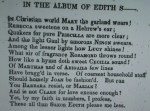
At last, The Works of Charles Lamb… in which we see verses written for women’s autograph books. 9 verses titled “In The Album of….” or “to….”. If these were actually written for women, in their autograph books, then we have women owning autograph books in the 1850s.


What is that you say? Why don’t I just look at autograph books to see who owned and wrote in them?
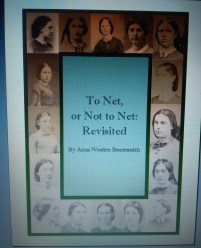
Looking….

![IMGP2067[1]](https://annaworden.com/wp-content/uploads/2009/05/imgp20671.jpg "IMGP2067[1]")

![IMGP1881[1]](https://annaworden.com/wp-content/uploads/2009/05/imgp18811.jpg?w=300&h=200 "IMGP1881[1]")
![IMGP2003[1]](https://annaworden.com/wp-content/uploads/2009/05/imgp20031.jpg "IMGP2003[1]")
![IMGP1913[1]](https://annaworden.com/wp-content/uploads/2009/05/imgp19131.jpg "IMGP1913[1]")

 I have started a monthly project post that I hope to continue through the year. Each one will be something small with some guidance or direction on how to do it your self. They won’t quite be a thorough as the
 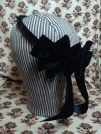 The world of millinery went rather well this year. By the time the snow fell again, I made 57 straw millinery pieces this year. I lost track of the winter hoods. I also added a line of evening headdresses, focusing on simple, classic looks of the mid-nineteenth century.
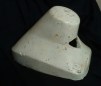 Thanks to some wonderful people, a trio of original bonnet blocks arrived early in the summer. I’ve only been able to really work on one,
 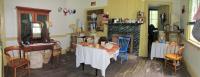 I did make it to a couple events. I am aware that I made it out to the Independence Day celebration in modern clothes. Though, I don’t remember much at all. I did make it to the
 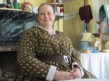 I set up my Millinery Shop and
 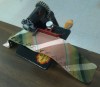 In November, I offered two very different workshops at the Museum’s Domestic Skills Symposium. On Friday, I offered Tools and Trims, a completely different, kinda crazy workshop looking at how to mimic the trims of the later 18th and 19th centuries. I spent much of the year acquiring pinking machines and dies for this workshop. On Sunday, I offered a favorite with a twist: A Pin Cushion Sampler. This year the sampler included Victorian favorites: a strawberry, a walnut, a seashell and and acorn.
 Ah, the ugly. That which dictated much of my 2017. I mentioned in my
  On the other hand…. I did do pretty decent for someone who totally got her butt kicked by a 12mm stone. I actually feel pretty darn good about that. Despite utter exhaustion on many days and this weird pain in my side, I made some pretty great pieces this year, I kept the shop up, and learned a few things.

 I’ve been cutting the materials for my new Exploring the Work-box: Tools and Trims. This is the workshop held on Friday. Next, I have to make sure I have all the samples organized and pretty. Attendees will be making their own sample book filled with trim samples made with the antique pinking tools I am bringing. I hope this will be the first in a series of “Explore the Work-box” workshops. Btw, I think I will be naming the pinking machines.
  The materials for the Sunday’s Pin Cushion Sampler are almost ready. Well, they have to all be put in one box to make their way to the village. We will be making popular pin cushions of the nineteenth century – strawberries, seashells, walnuts, and acorns.
 The weekend following is GCV’s


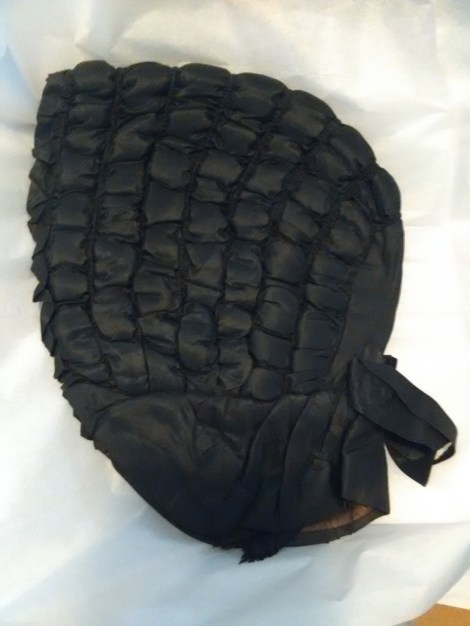

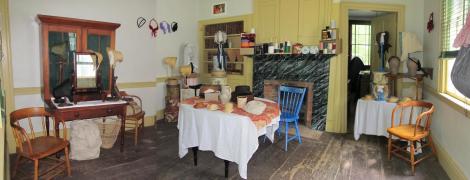
 A few of the millinery pieces found new homes. This coarse straw bonnet, meant for a laboring working class impression, was one I thought would be a long term display piece. Katie came in to say hi and the bonnet somehow ended up on her head. It was absolutely perfect for her and her impression.






 If I Had My Own Blue Box: