I anticipate the weeks transitioning back to school will be accompanied by a scattered brain. With that in mind, I am pre scheduling images for the next several Millinery Mondays. I will write posts when I can.
I anticipate the weeks transitioning back to school will be accompanied by a scattered brain. With that in mind, I am pre scheduling images for the next several Millinery Mondays. I will write posts when I can.

Two weekends ago, I heard several questions about the life of a straw bonnet or hat. Some asked how long one would last. Others asked if they could be remade. These questions wander down a delightful path.
I already addressed the durability of straw in a previous post. Read
While some women could afford to purchase multiple bonnets a year, some women needed their bonnet to last several seasons or even years. Other women were just sensible and/or even crafty.
Straw is a forgiving material allowing old thread holes and markings to disappear fairly well. This meant a straw bonnet or hat could be redecorated from season to season or as the need arised. This could be the floral trims, the ribbons, or the entirety giving it a new bavolet, frill, and trims resulting in a “new” bonnet.
As the shapes of bonnets changed from season to season, the shape of a bonnet could fall out of fashion. Many straw goods merchants offered blocking services. This enabled a straw form to be blocked, or reblocked, to better reflect the newer style. While this would have been more difficult proceeding through the 1850s as the brim rose in height, the changes from the 1840s into the 1850s, then the 1850s into the first half of 1860s as bonnet size shrinking were managable.
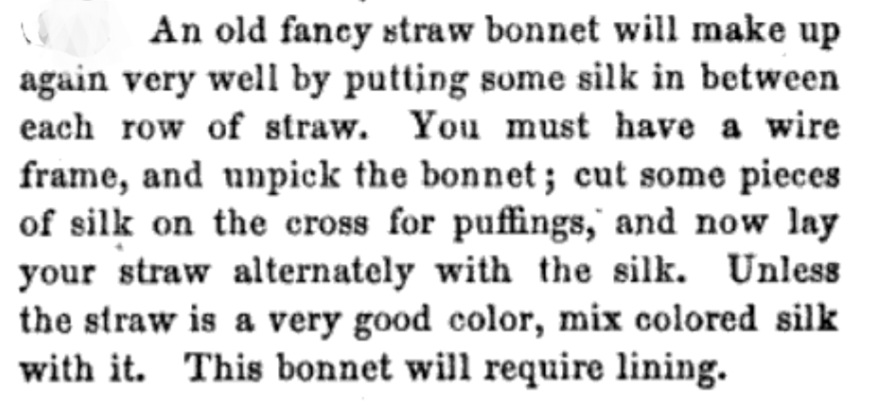
Women with skill could rework a straw bonnet or hat at home. Early in my millinery adventure, I came across a this Godey’s 1856 passage describing how to pick apart a bonnet and resew it alternating straw rows with strips of silk.
Do you enjoy reading my blog? Do you find it helpful? Please consider supporting through Patreon or Sending a Tip.
Actually, the question is usually “Only single women could be milliners. Right?” or “Could milliners be married?”
Many of us were taught married women didn’t work outside of the home or couldn’t work outside of the home for much of the nineteenth century. This is a misconception.
Looking at advertisements, Miss. and Mrs. are used with women’s names. Of course, this could be for public relations purposes.
Looking at census records, milliners have statuses of married and widowed. In 1855 Livingston, New York 47 women’s occupations were recorded as milliner. Of the 47, 7 were married, 5 were widowed, 6 were head of household. 12 were living at home with a parent (listed as daughter to the head of household.) 13 women were living in homes other than their biological family, listed as milliner, assistant, boarder, servant, laborer, and maid.
In New York, prior to March of 1860 a married woman’s wages were legally her husband’s money. In March of that year, a bill went through the legislature and was signed into law giving married women the right to the wages they earned.
A married woman may bargain, sell, assign, and transfer her separate personal property, and carry on any trade or business, and perform any labor or services on her sole and separate
account, and the earnings of any married woman from her trade, business, labor, or services shall be her sole and separate property, and may be used of invested by her in her own name.
The 1860 Act also required a married women to get her husband’s written consent to sell real property but gave ways to do so when a husband was unable to do so. (In New York, married women also retained ownership of businesses owned prior to marriage after the Married Woman’s Property Act or 1848.)
Do you enjoy reading my blog? Do you find it helpful? Please consider supporting through Patreon or Sending a Tip.
For the second year, I was able to focus my millinery interpretation, during GCVM’S Civil War Living History Weekend on women’s employment. Shifting from the “pretty” of millinery to the women and history connected to each part of a piece of millinery allows us to have more indepth, more genuine conversations with visitors.
To prepare for the weekend, the Insurance Office needed to be transformed once again into a millinery shop. Here are before and after looks from the doorway.

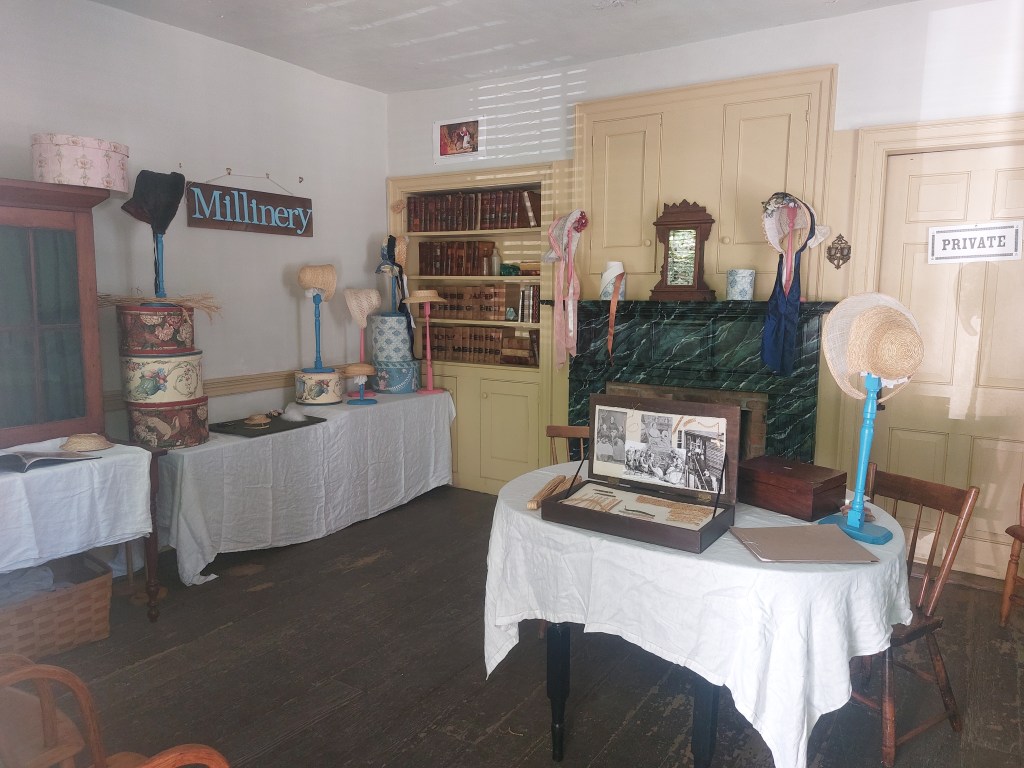
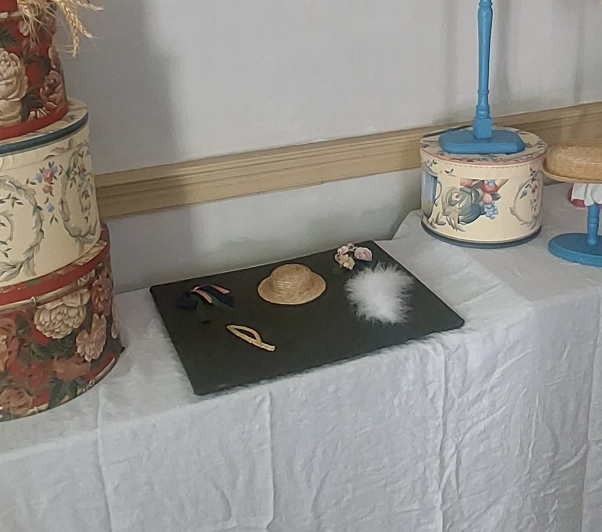
With the focus on education, I brought educational display items in addition to the items for creating the appearance of millinery shop. On the front table is the straw millinery display showing the steps from wheat to straw to plait, with different examples of plait and straw motifs. To the right is a visual resource book filled with illustrations, cdvs, photographs of my millinery blocks, and copies of billheads. Additional reference books are on the shelf beside the mantle. On the side table is a new display board I thought of last minute and plan to develop further. These are touchable items, each representing not only a component in making a hat or bonnet, but also an employment for women or children.

Having resources and visuals available to share with visitors as their questions and our conversations unfolded was extremely helpful. I grabbed the visual resource flip book several times each day to show visitors the illustrations of cottage industry, photos of millinery blocks, and billheads. The copy of Virginia Penny’s Employments of Women was also referenced a few times either to show the multitude of employment opportunities for women or to let a visitor look up a particular job.
This year, visitors came with excellent questions. Some wanted to know how a woman got a job working in a millinery, what kinds of things they did, how much they got paid, and what the work day was like. Some even want to role play in first person. I plan to include some of these questions in coming Millinery Monday posts.
I once again failed to get many photos. I feel good about this trio as it shows I am managing the physical aspects better than I have the past several years. I am not yet as fit as I once was, but hope keep improving.
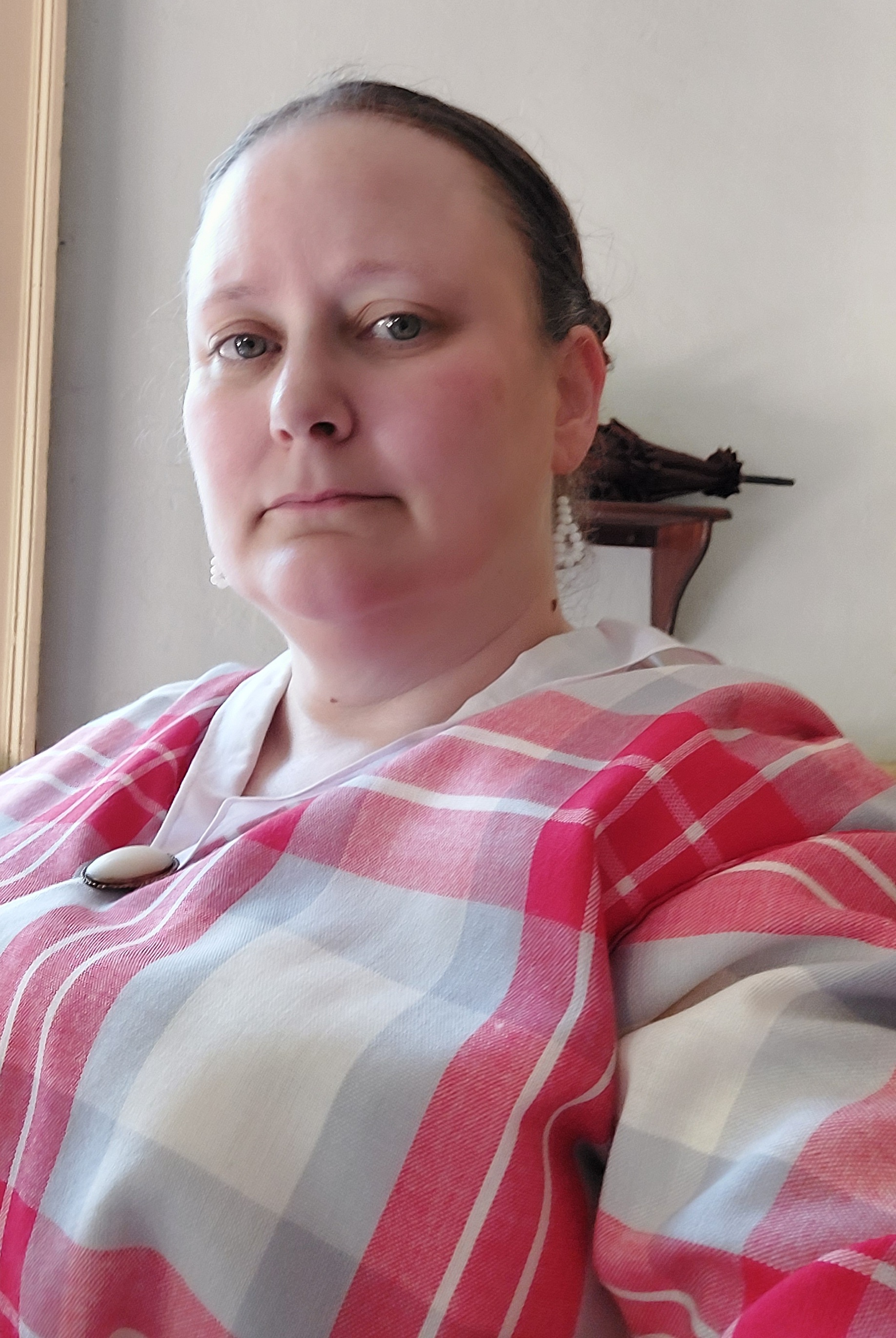
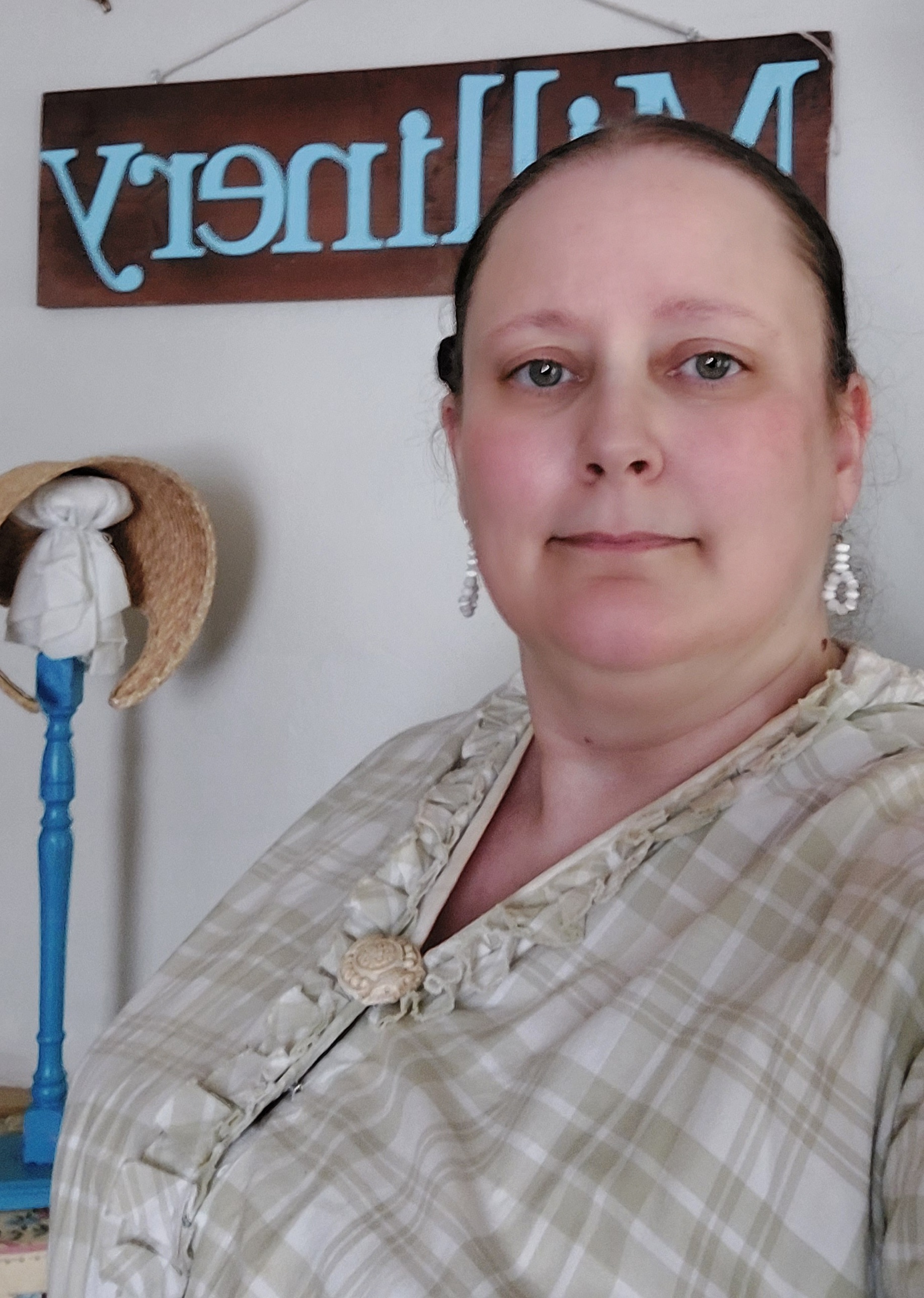
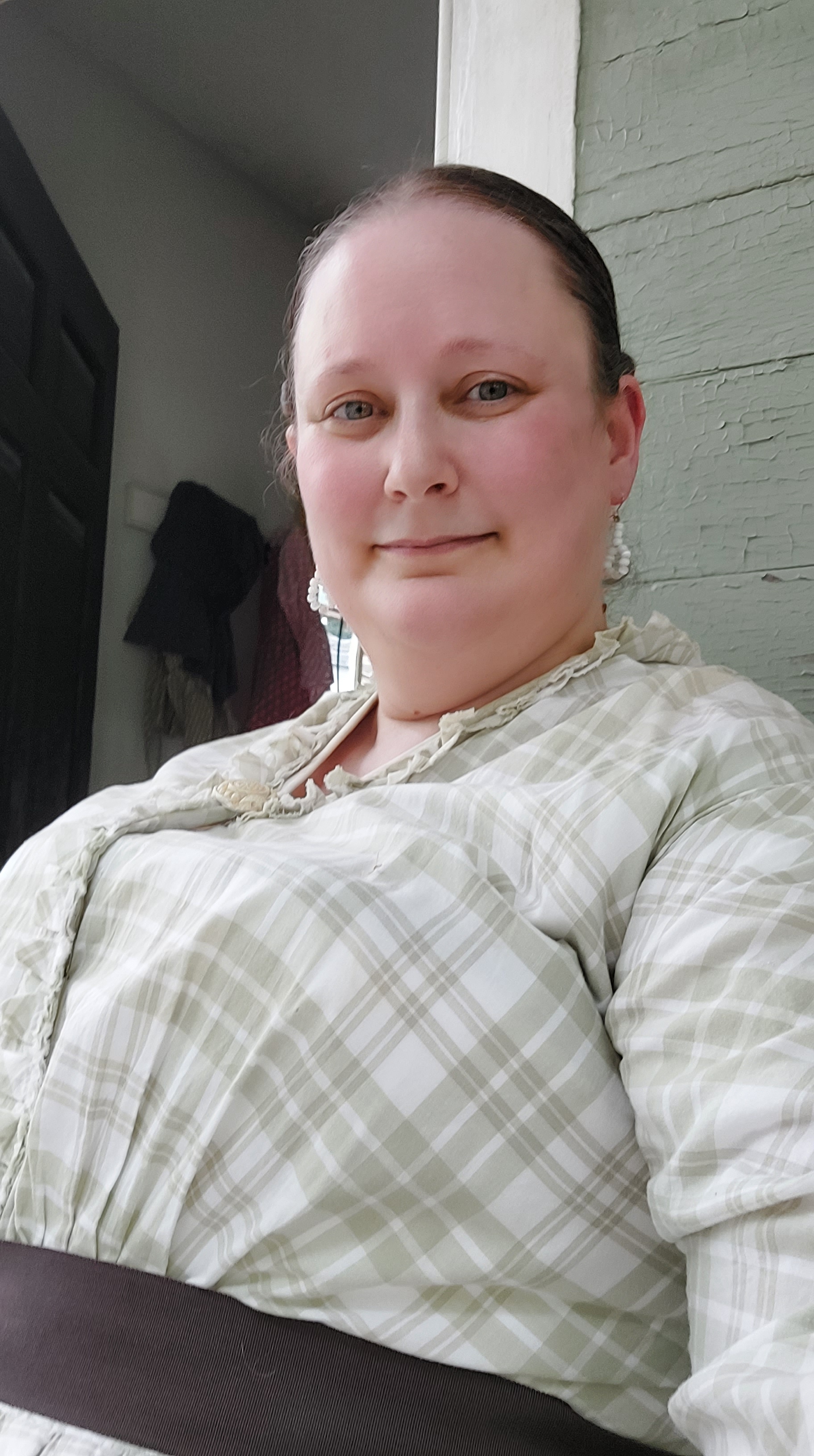
“Isn’t straw delicate” is one of my favorite questions. It shows a visitor is thinking through what I am working with, imagining the fiber itself, and questioning either what they see or what they think.
Straw as a straw is delicate. It can be snapped or shredded with little effort.
Yet, straw once paired together with other straw can be quite strong.
Straw braided and sewn together can hold its shape well. It can be relatively strong. It can also withstand elements better than other contemporary materials.
One of the great things about straw is it can be forgiving, allowing it to be retrimmed or redecorated a number of times.
One of my favorite straw bonnet stories from the nineteenth century tells of a young woman who has the same bonnet for ten years. She redecorates it yearly…… Cite
Advertisements for millineries and straw goods stores often include bleaching and reblocking of straws in their lists of goods and services. Straw bonnets and hats can be reblocked into their original shape with new sizing (stiffening) or, within reason, be reblocked into a newer shape for a more updated style.
Straw can also be repaired. This can be seen in original bonnets and hats with patches of straw plait.
Clients have shared with me a few survival stories over the years. Most recently, is this hat who had a rough journey to its owner. The box suffered significant damage including the dented in side seen here and the opposite side ripped into. The hat within survived with only some mis-shaping from the trauma.


Another hat took an impromptu flight and dip into the ocean while its wearer was on a leisurely excursion. The boat was able circle around while the hat floated in the water. When it was fished out, the hat needed only to dry before it could be worn again.
Now, this isn’t to say straw millinery is invincible. A straw hat or bonnet is unlikely to survive being sat on or trampled. Straw can also be susceptible to mold or mildew if not properly dried after getting wet or damp. Straw can also become brittle if stored too long in a dry area.
Do you enjoy reading my blog? Do you find it helpful? Please consider supporting through Patreon or Sending a Tip.
I have been waiting for months to make these straw bon bon baskets.
When I first saw the illustration for a basket made from straw plait in Godey’s Lady’s Book’s 1858 edition, I was nearly giddy. I had been thinking about baskets made from straw for a while. I had seen splint baskets repaired with straw. I had even repaired one with straw. It just made sense to me to make one with straw. I just needed documentation to place them in the nineteenth century. Ta da!
Let’s start with the morning videos.
This weekend’s set up was fairly simple. I made a couple baskets earlier for visitors to see while I decorated one and sewed a third, then fourth yet to be completed.

The baskets are made very much like the crown of a hat. The straw plait, or braid, is sewn in a spiral creating the bottom of the basket, then turned up for the sides. These bases are blocked just like a hat with a little sizing to stiffen them. The handles and decorative edges are straw shaped separately and added. Two are edged with double braided straw. One is edged with a looped design.

The baskets are decorated with the wheat heads, corn flowers, and poppies described in Godey’s.
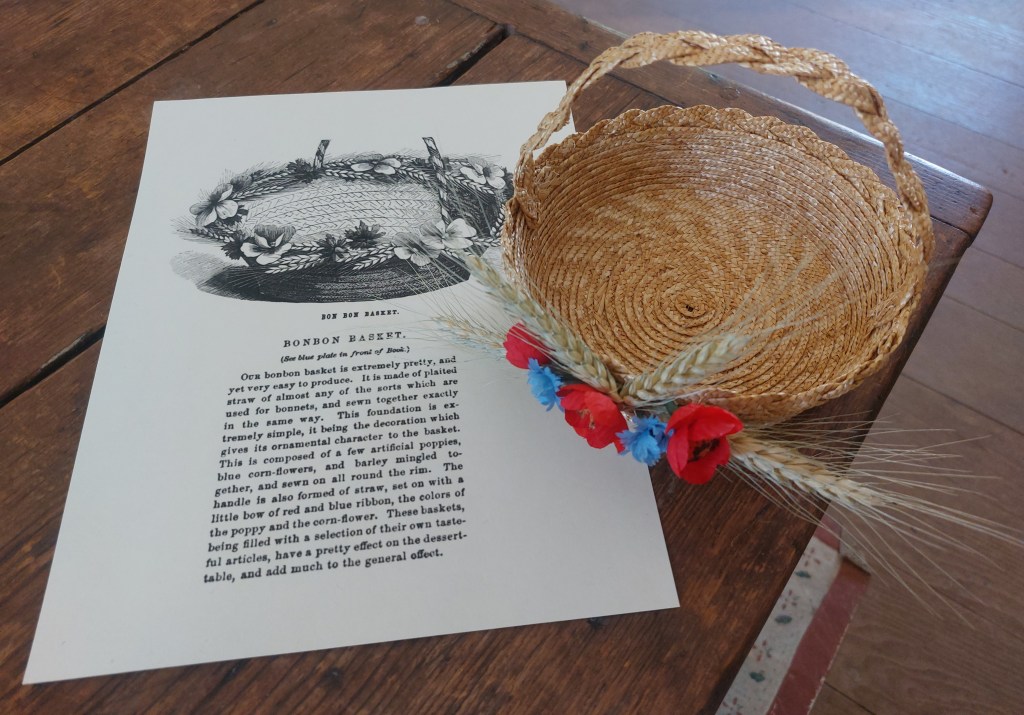


I found I did not like the look or process of sewing the individual flowers and wheat heads as I decorated the first basket. I also found the wheat heads would block ease of reaching into the baskets for the chocolates. Towards the end of Saturday, I tried soaking some of the what heads, or the stalks of them actually. I was able to insert a wire and shape them. This made it possible to wire several Sunday morning and create a garland of wheat and flowers that could wrap around the basket. This needed only a few stitches to secure.

I have since had friends share additional straw basket images with me. Of course, some of these will need to be made as well.

This week’s question comes from a visitor who wants to begin reenacting as a hobby. They are either just starting out or have been reenacting for a short time. In developing their wardrobe, they know they need a bonnet. They ask “What should be my first bonnet?” or “What bonnet should I buy.”
My answer often surprises.
A sunbonnet.
So many women post about just starting and needing a bonnet. They often waste money on a bad fashion bonnet. I would rather see them buy a sensible sunbonnet and save for the right fashion bonnet. But, no. The bad fashion purchase gets worn far too long out of the feeling of remorse for the expense.
A correctly made sunbonnet is a purchase that will last many years. It will protect the wearer’s face, hair, and neck from the sun. It can also protect the fashion bonnet by allowing it to stay “home” in inclement weather.
Do you enjoy reading my blog? Do you find it helpful? Please consider supporting through Patreon or Sending a Tip.

First, I am very grateful to those who helped me purchase this bonnet. When I saw it, I nearly cried because I was sure I would have to pass it up. Your support means I can do the research and work I do.
This bonnet is an excellent example of fine craftsmanship and three braids being set into stripes. The straw braid on the crown is a rich chestnut brown on the outside, a more matte, drab brown on the inside. The straw braid on the brim is a darker brown with a mauve/purple tint to it. This plait has a scalloped edge. Running through the whole of the bonnet is a wider braid with a two tone diamond pattern. I need to get a closer look at this braid. It may be a horsehair or wool. It is tight and fine.
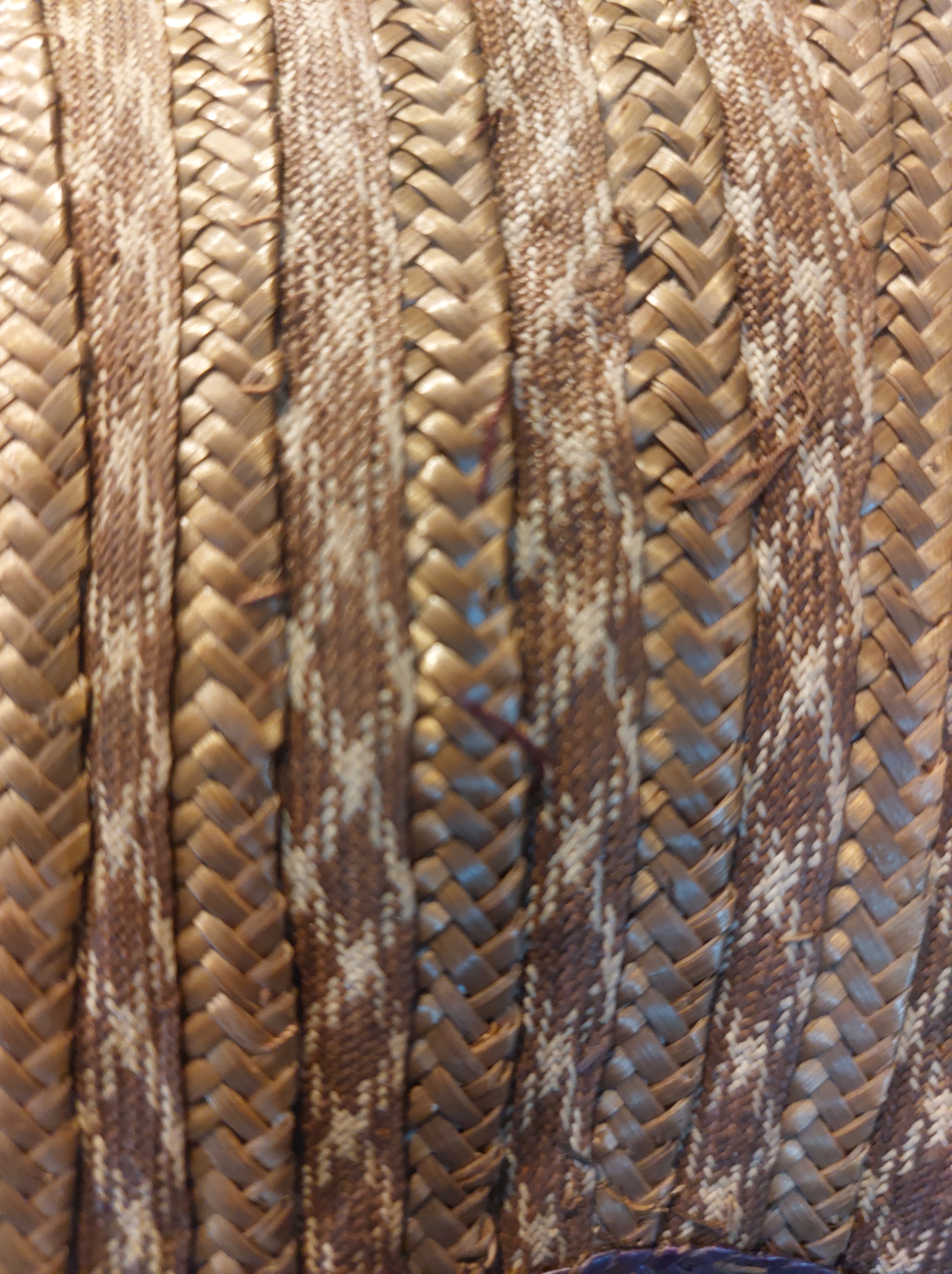
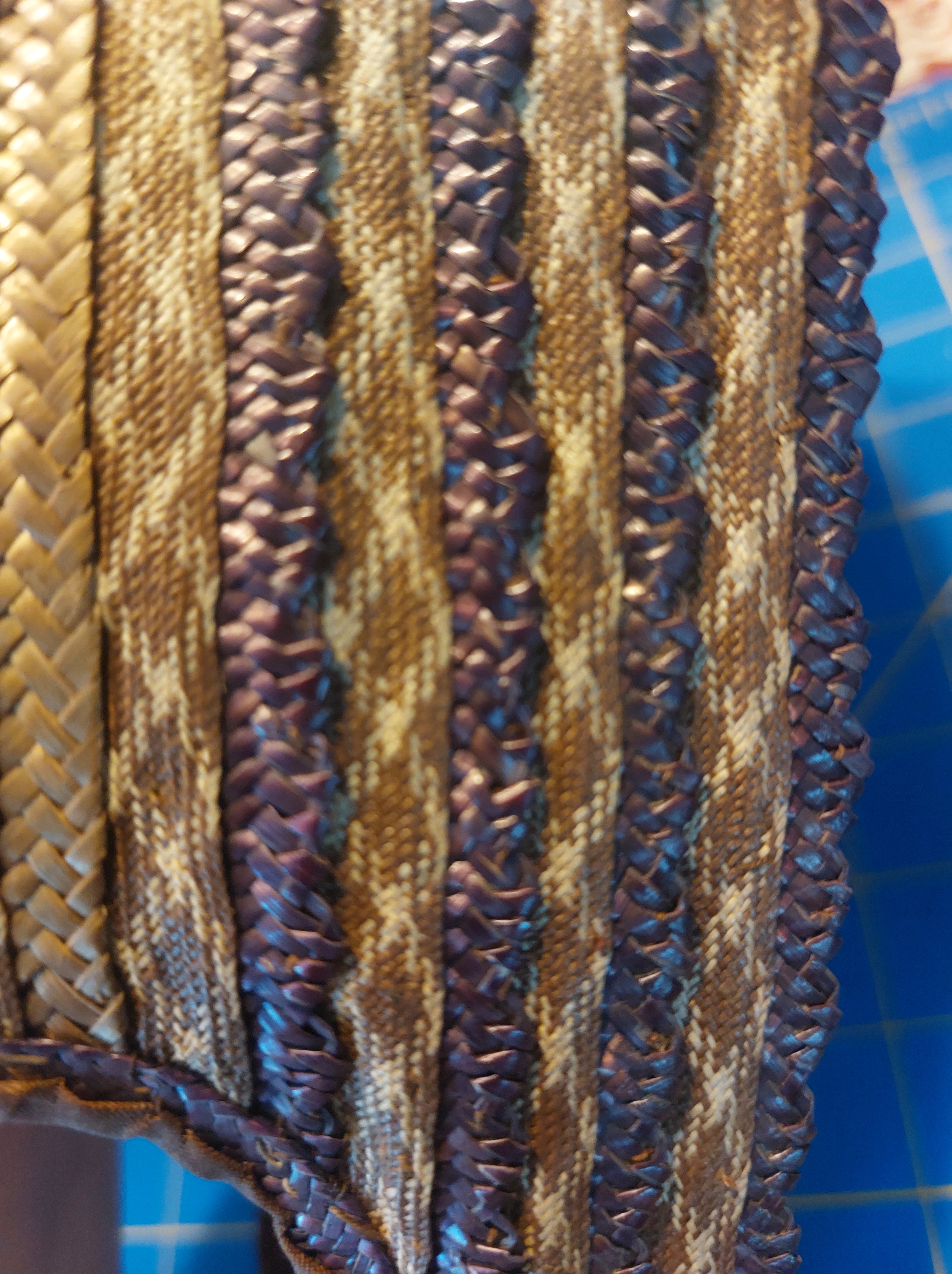
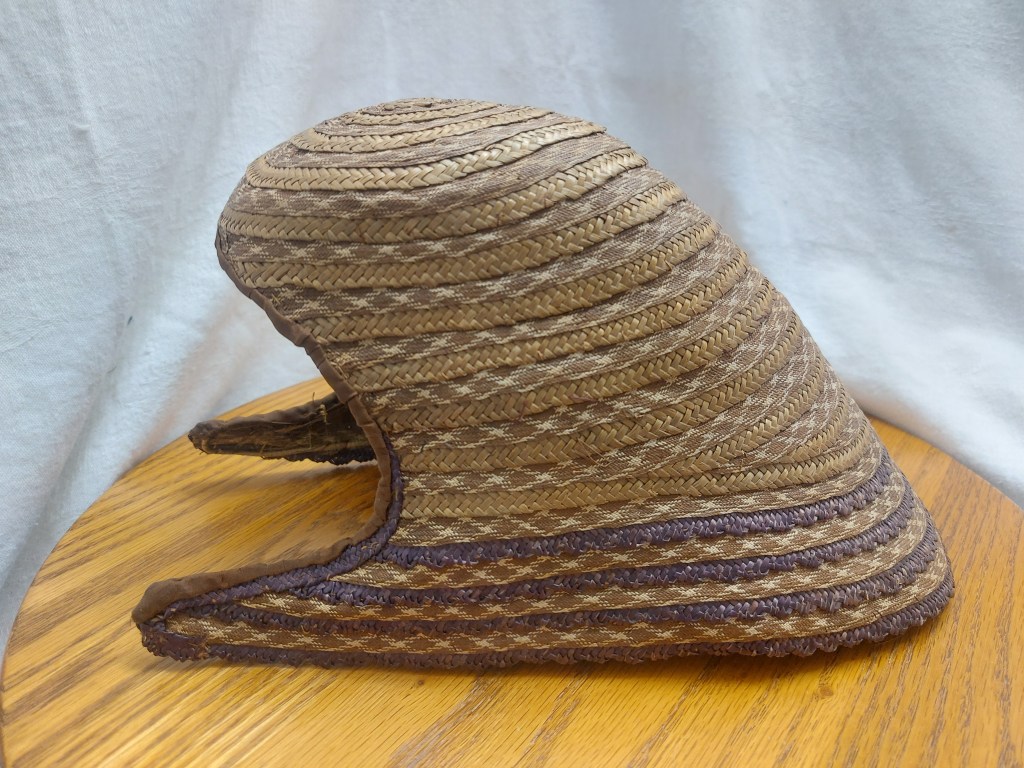
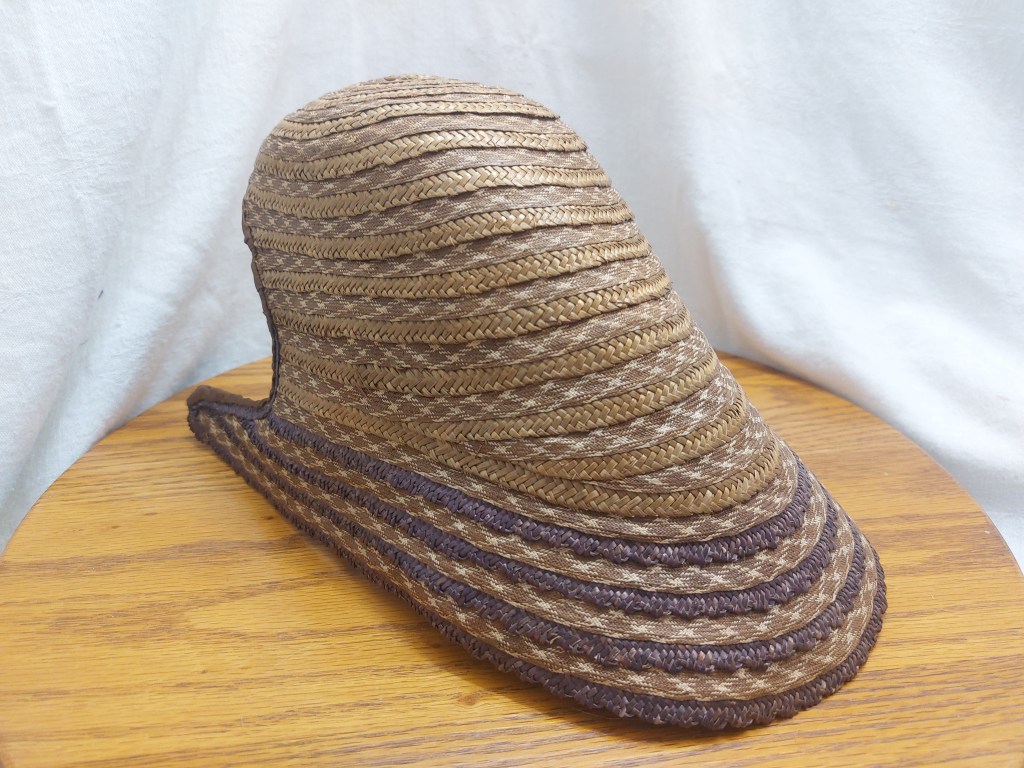

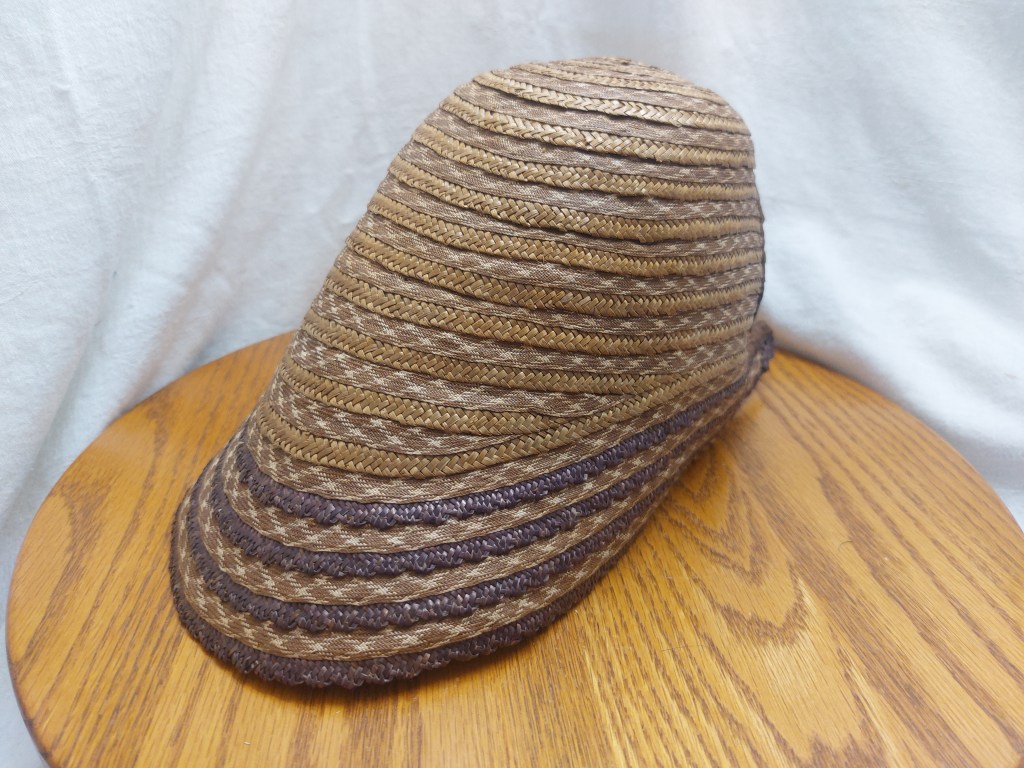
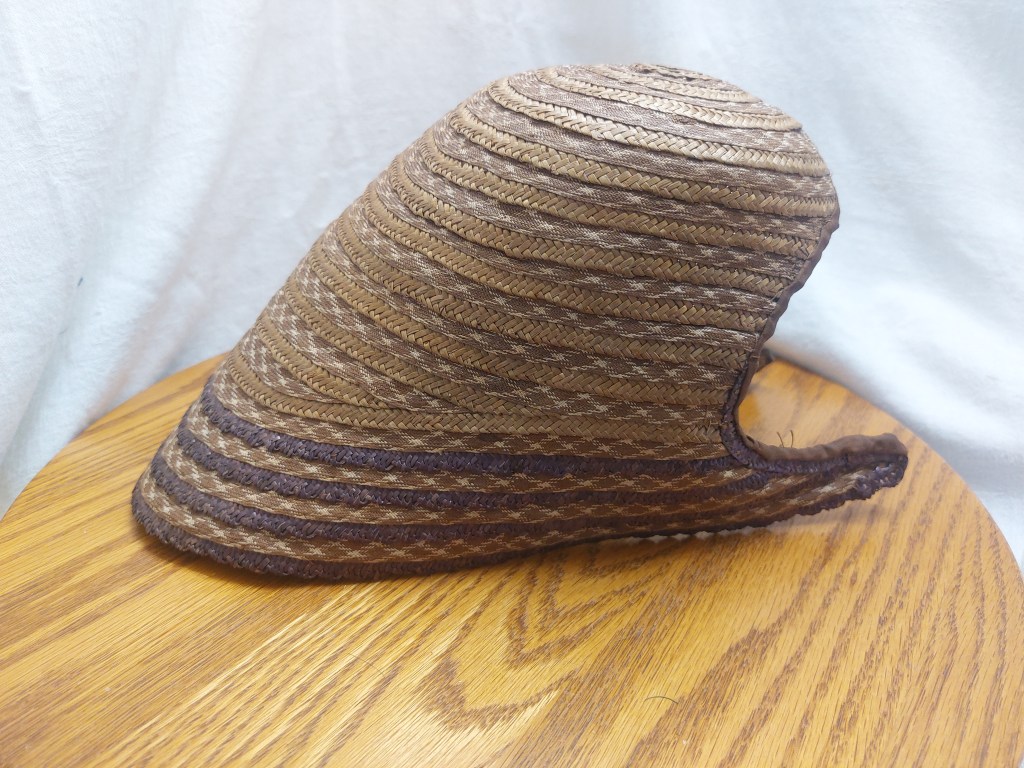
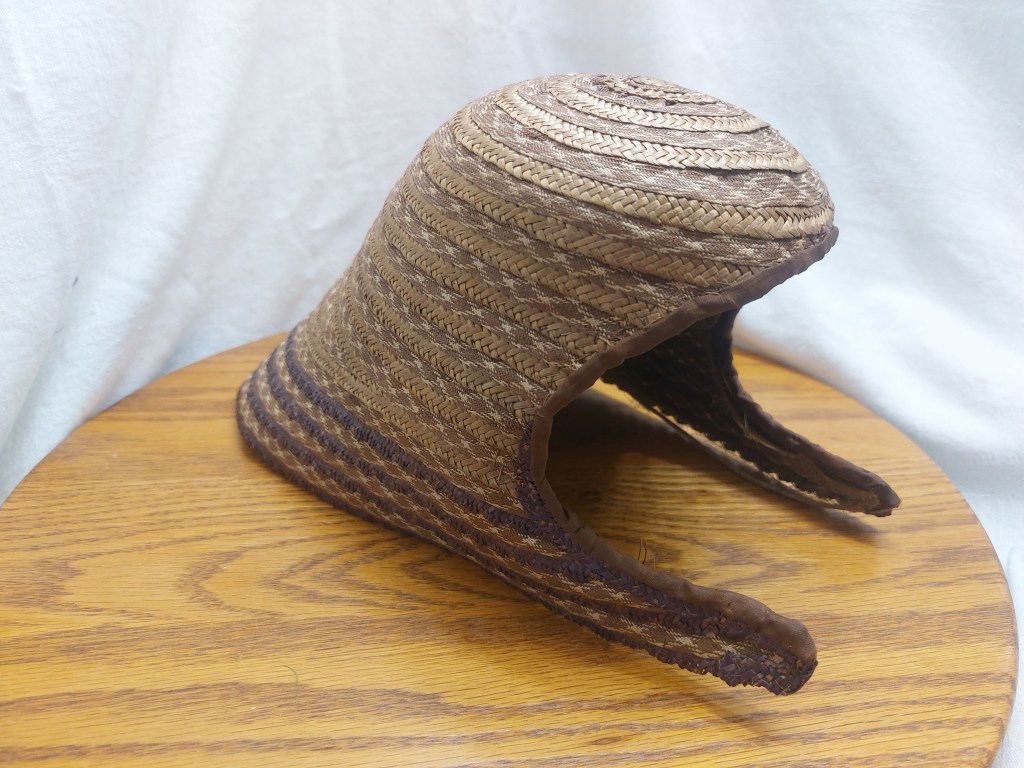

The interior reflects aspects common to the era. The brim, cheektabs, and neck edge are wired with covered wire. The brim and crown are lined with loose weave cotton. Two tags, likely style and sewer, are attached to the back. The neck edge is bound in silk. Less commin but not unseen, the bottoms of the cheektabs have seperate pieces of dark brown plait pieced into the curve.
There are repair points throughout the bonnet where threads previously disintegrated. Additional threads indicate it may have been decorated at some point.
I am trying to write more but the WordPress app keeps crashing.

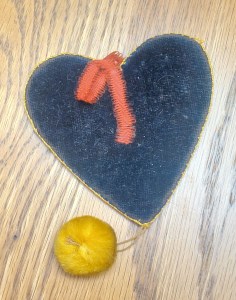
I noticed the local antique shop was open again. (I moved from a town with 5 antique shops to a town with 1.) Turns out there is a new owner. As I wandered, I saw this heart shaped frame in a little basket. It was such a sweet example of Victorian fancy work, I had to have it. Plus, it was only a dollar. Ya. Really.
The heart is 3 1/8″ tall and about the same wide. The 1″×3/4″ opening for the tintype photo sits about an inch above the point of the heart.
It is made of two layers of pasteboard. The back is covered in dark blue velvet. The front is covered in off white silk taffeta that has disintegrated.
The threads pulling the silk and velvet around the pasteboard can be seen through the photo opening as the photo has slipped.
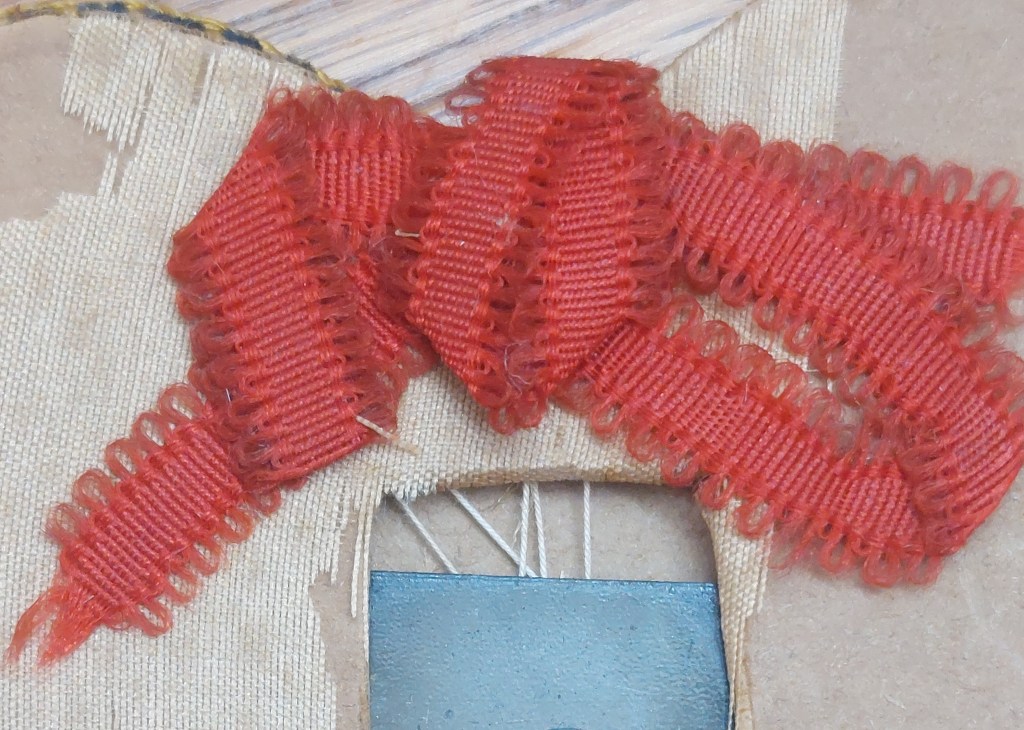
The whole is bound with a bright golden yellow embroidery floss, likely silk, in a blanket stitch.

At the top of the heart is a red ribbon hanging loop and bow. The ribbon is a silk grosgrain with picot edge. At the bottom is a gold silk pom hanging from cord.

I recreated this heart frame from materials on hand. (Directions in pdf coming soon.) I think they came out quite darling.
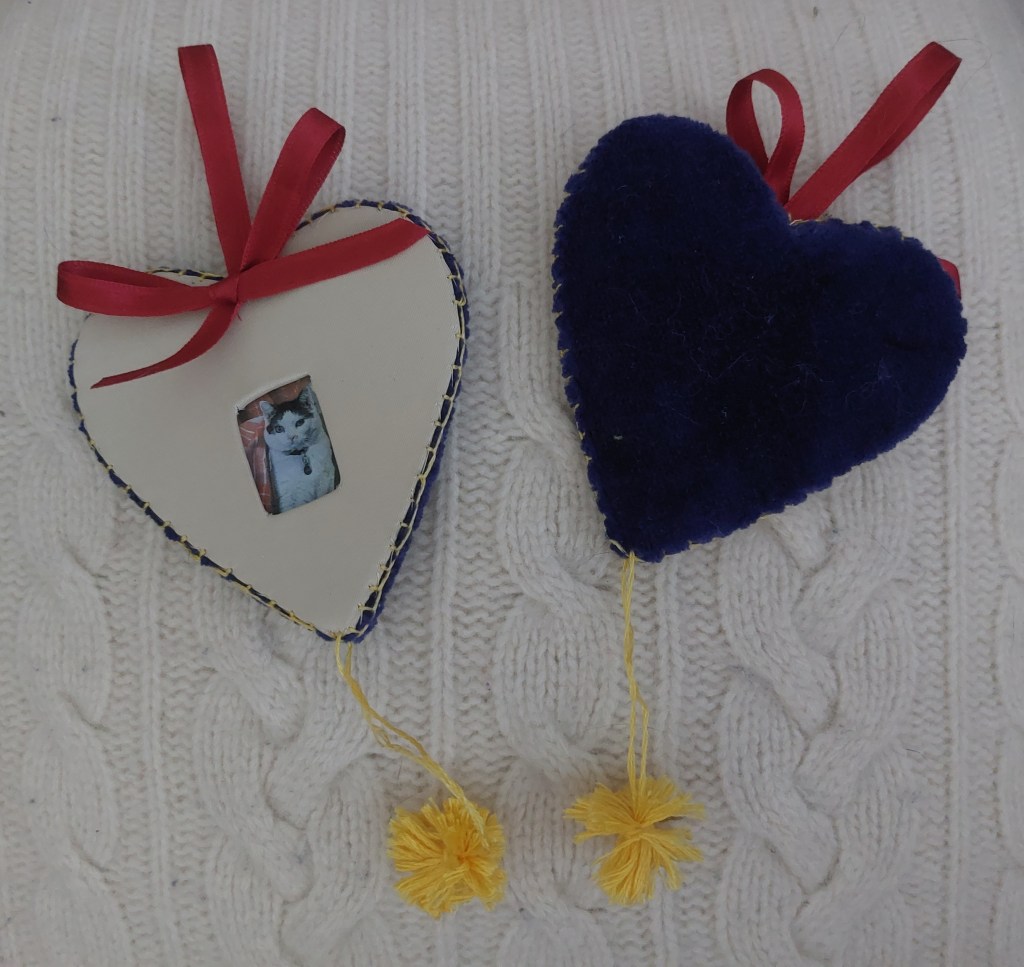

I plan to do a semi-regular Fancy Work Friday series with Victorian fancy work focused posts on Fridays. Sometimes these will look at originals, other times they will be about making pieces from original directions. I may bring back some previous favorites for new readers.
Do you enjoy reading my blog? Do you find it helpful? Please consider supporting through Patreon or Sending a Tip.
This is one of the hardest questions for me to answer. Why? Because I don’t fully know.
Ideally, I would have a big pool of bills/receipts, an assortment of ledgers from many different milliners, and a few dozen diary entries to create a database of prices based on year, region, area, time of year, type of piece, etc.. Then, I would feel like I had a hint of an answer.
But, I don’t have that. I don’t think anyone has that.
I save every 19th century bill/receipt that comes up for sale. I have even bought a few. I note every diary entry.
I try really really hard not to cry at the auction in front of all those people when a dealer out bids me on the stack of ledgers with a milliner’s ledger in it.
Take a moment.
Yes. It happened. I saw them go out the door.
….
Diary entries like these from Caroline Richards of Canandaigua, NY give us a look at the prices she paid for her millinery:
Wednesday, 1854 – Ann Eliza is going down street with us this afternoon to buy us some new summer bonnets;. They are to be trimmed with blue and white and are to come to five dollars. We are going to Mr Stannard’s store also, to buy us some stockings.
April 12, 1856 — We went down town this morning and bought us some shaker bonnets; to wear to school. They cost $1 apiece and we got some green silk for capes to put on them. We fixed them ourselves and wore them to school and some of the girls liked them and some did not, but it makes no difference to me what they like, for I shall wear mine till it is worn out. …
Saturday, 1854 – We got our new summer hats; from Mrs Freshour’s millinery and we wore them over to show to Aunt Ann and she said they were the very handsomest bonnets she had seen this year.
Bills or receipts can show the price of items from particular stores. They can also show the variety of store types as well as methods of keeping track of sales. This bill from 1849 lists several items purchased:
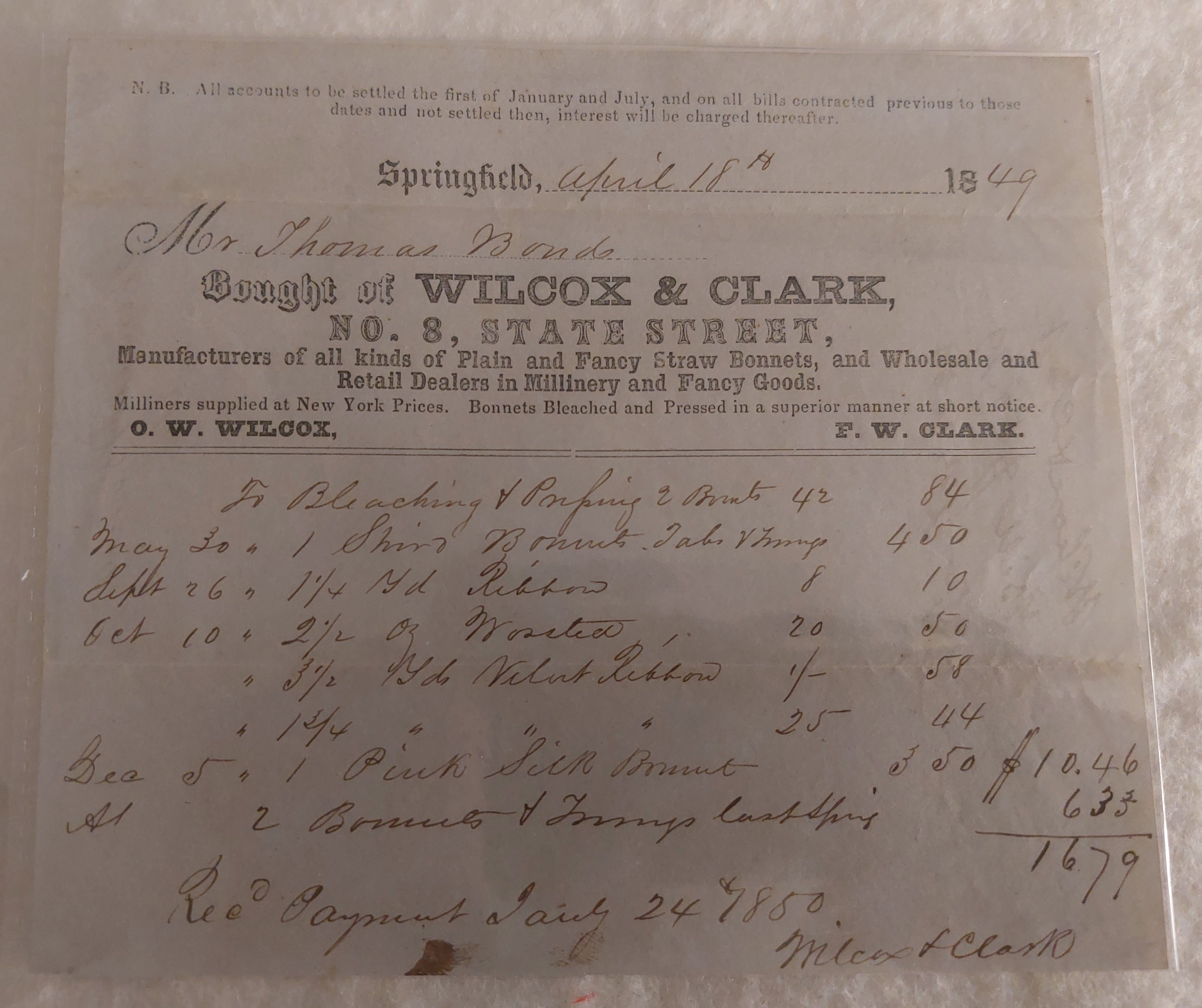
One trimmed bonnet cost $4.50 in May. A pink silk bonnet cost 43.50 in December. Two bonnets and trimmings “last spring” cost $6.35. (This bill also tells us the products and services this shop in Springfield provides, the frequency in which this family of an unknown number of women purchases bonnets, and the delay in payment from “last spring” to April, 1849 for this bill to January, 1850 for the payment.)
If I have to give a price, I can give a window for the mid century of as low as $1 for Shaker bonnets for school to $4.50 for a decorated silk bonnet. But, my answer has holes in that these examples span two different geographic regions and come from two different size cities.
So, the exploration continues…….
Do you enjoy reading my blog? Do you find it helpful? Please consider supporting through Patreon or Sending a Tip.




 If I Had My Own Blue Box: