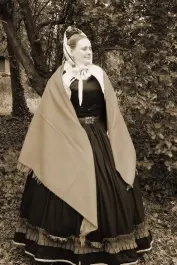
Shawl Basics

For more in-depth information, read Paisley, Plaid, & Purled: Shawls of the Mid-Nineteenth Century
PPandP book cover

—————————————————————————————

Shawls for Historic Interpretation

Kashmir,  Paisley and Paisley-type Shawls

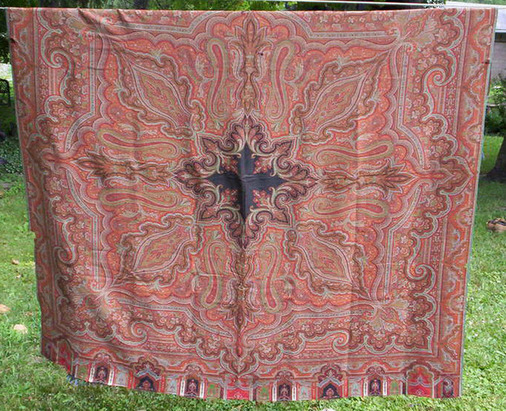
Paisley family shawl, possibly French

Fibers, weave and size: These shawls should ideally be made of hair brushed from the Kashmir/cashmere goat or from a wool and silk blend. The silk should be the warp or blended into the wool in a small amount. Avoid shawls with a rayon or acetate blended with the wool. Original Kashmirs are very light weight because of the tapestry twill weave. I have yet to be able to compare the weights of original and new. Look for sizes around 64 inches square or 64×128 inches as a double square.

Design: When looking for an Paisley shawl, look for a strong cone motif. The cone motifs should radiate out from a center field of black, white or red. These radiating motives create a star or spoked flower appearance from a distance.  The spokes should be connected with ribbon like borders consisting of small floral motives. By our era a newer shawl would have a smallish center. But, the higher cost of these shawls along with their durability means it would not be unlikely for a grown woman to have a shawl with a larger center from her youth. The outer border can be on two or four sides. This borer should be comprised of smaller designs brought together in the border. Kashmir borders will have more independent blocks of design while French borders will visually entwine each block with it’s neighbor.

Two other design options include the striped shawl and the border shawl.

Where to look: There are some nice shawls coming out of India. Many of these are available on online and via Ebay for various prices. When doing an online search use “Paisley Shawl” or “Cashmere Shawl” or “Antique Shawl” for your key words.

(note: I have read several 1990’s news stories regarding the skinning of goats for their under-coat hair, which is used to make shawls, thus endagering the goats. While shopping be sure to find a merchant you are confidant in.)

Woven shawls Red Wool Shawl
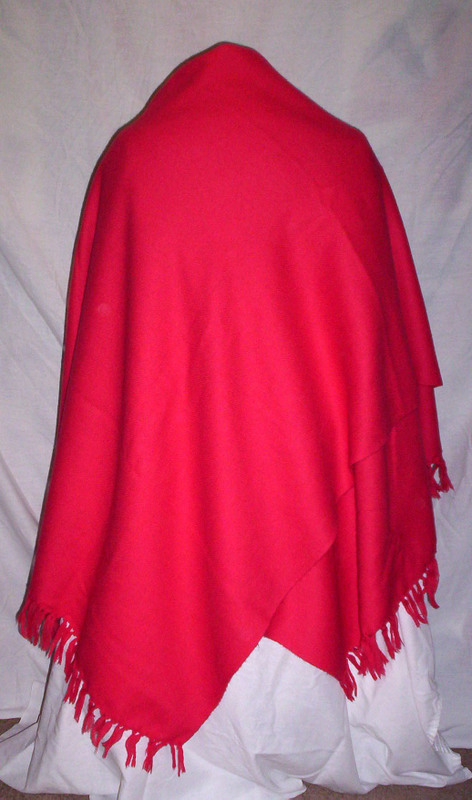
Fibers, weave and size: Wool or wool/silk blends. These should also be 64 inches square or 64 inches by 128 double square. A shawl relatively near these dimensions will look nice. The weave should be a tight plain or twill weave. The shawl can range from light weight to rather heavy if hand-woven.

Design : Look for solids, checks, plaids (preferably symmetrical) stripes and border plaids.
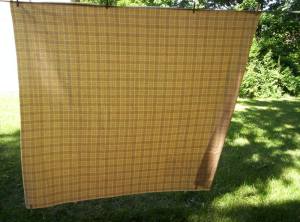
Golden yellow plaid shawl with detailWhere to look: This is a type of shawl you can make yourself. Many Museums offer weaving classes thru-out the year. You can also make a fabric shawl from woven wool lengths. You will need a dress weight to coat weight wool rather than a heavy weight  in a 54 inch to 60 inch width. Plain woven fabric and plaid woven fabrics work well. The yardage can fringed on the end by unravelling the ends by hand. To calculate your yardage, decide if you want a square or double square shawl and how long you wish your fringe to be on the ends. For a square shawl, purchase the width of the fabric plus 6 to 12 inches for fringe. For example: if you want a double square shawl out of 60 inch wide fabric purchase 130 inches for a 120 inch shawl with 5 inch fringe.  (see the article on fringing a shawl)

Printed shawls

Fibers, weave and size: Printed shawls come in wool, cotton and blends of wool, silk and cotton. Ideally, you would find a 64 inch square shawl, but the common 55 inch square shawl is not bad.

Design: Printed shawls vary by region. Look for period motifs and borders.

Where to look:  The Russian Pavlovo Posad company still makes printed shawls in their 19th century designs. There are several sellers listing these on ebay and more on the web. I am still trying to find a direct link to the company. I may have to settle with a regular address and phone number. Use “Pavlovo Shawls” or “Russian Shawls” for your internet search.

Sheer Shawls – Muslin Shawls, Grenadine & Barege

Fibers, weave and size: I still have not found sheer shawls that I like. These were silk, wool or cotton. They frequently had a plain central field and a stripe border creating a plaid motif.

Lawn, Gauze, Voile, Silk Organza & Batiste fabrics can be used to make a sheer shawl. The edges would need to be hand finished with a rolled hem. This isn’t what original shawls have though. You may want to starch the fabric as well. You can add tucks to the border or ribbon to the border or edge.  

Design:: Plain, woven plaids, woven checks, woven border plaids.

Where to look: – Online fabric merchants including Exclusive Silks and Fashion Fabric Club

Silk Shawls

Fibers, weave and size: I have not yet found the ideal silk shawl. Thai Silks has larger white shawls in their scarf section. These are a little smaller than ideal, but may suit your needs.

To make your own shawl, you want a durable silk, in the 64inch square range, no slubs with or without fringing. Look for a taffeta, china or habotai silk. Do not use satin.  I have seen solid color, shot (or changable silk) and patterned silk shawls. A couple of the India, China and Thai merchants sell nice silk shawls. I tend to think play it safe for silk shawls and go for simple. Also, many list as silk but are selling Viscose.

Design:: If you want to embroider your shawl, I highly suggest looking extensively at originals.

Embroidered China Crape

There are some fabulously beautiful embroidered shawls out there… but only a few designs are suitable. I occasionally pick through ebay to see what is out there. It is rare I find something that meets size, design, quality and fiber standards. But it is possible.

http://www.qualinsilk.com/servlet/the-85/Silk-Shawl–dsh–Hand/Detail Has a few that I like. These cost in the $180 area.

http://raspberryberet.com/xlmantons.html I was surprised to find there are a couple shawls I like on the flamanco sites. These are in the $200+ for the larger shawls and $169 for the smaller piano shawls.

Lace Shawls

Sadly, every modern lace shawl I have seen is a synthetic. I may not have found the right maker. I suspect the prices may be quite high.

Crochet and Knitted Shawls

Great thing about these is you can make them your own. There are several patterns available in magazines and guide books. Many of these patterns are available digitally through Accessible Archives and online from various sites.

If you are purchasing a shawl, be sure to ask where the pattern design came from and what fibers the shawl is made out of. The shawl patterns above are worked in wool or silk.

Orenburg Lace Shawls

Fibers, weave and size – These should be 100% wool

Design – See originals

Where to look: – These are available from the same places the Pavlavo shawls are available. But not all are 100% wool. These should be square and very, very fine. The idea is they could fit through a wedding band. Most of the ones I see listed on Ebay don’t look like they have been blocked (set to the square shape.)

Sizes & Shapes:

  • Square shawls should be in the range of 55 inches to 70 inches square with 64 inches square being standard.
  • Long shawls are double squares, sometimes called plaids, which should be 55 inches wide by 110 inches long to 70 inches wide by 140 inches long with 64 inches wide by 128 inches long being the most common.
  • Three-quarter shawls are 3/4ths the width and 3/4ths length of a standard double square shawl. A three-quarter shawl would be 48 inches wide by 96 inches long.
  • Scarves are much longer than they are wide. A shawl 3 feet by 9 feet would be considered a scarf. These were more popular earlier in the 19th century.

The exceptions to these standard sizes include lace, knit or crochet shawls.

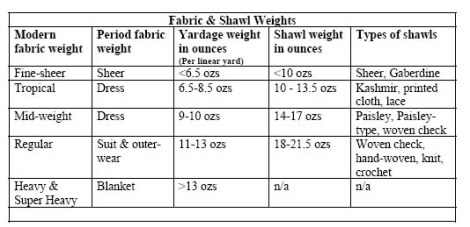
Next, consider weight. One of the mistakes I observe is the use of wool which is more of a blanket weight than a shawl weight. The weight of fabric is determined in ounces per linear yard. If you want to think of wool weights in terms of modern suit weights, a tropical weight is the lightest and regular is generally the fabric worn for a winter suit.
weights-chart

Paisley family shawl, possibly Scottish

Shawl Terms

Border Pattern Pattern that is predominantly in the border area around the field. This pattern is very visible when worn in a triangle over the shoulders.

Cashmire French word for shawls with the pine pattern both of Oriental and European origin.

Chenille Shawl A shawl of Paisley, Scotland invention with a comprised of tufted silk, wool or cotton. This shawl was briefly fashionable in the 1820s but was un-washable. (Reilly, p.34)

Damask Shawl Reversible pattern with alternating colors on opposite sides made with a different color warp and weft. (Reilly p.34)

Diagonal Shawl Square crepe shawls with two different embroidered designs on opposite triangular halves. (Worth p. 52)

Kashmir
1. Providence in India. 2. Shawl made by weavers in the Kashmir.
Kirking Shawl A white centered shawl given as a wedding gift to be worn to church the first Sunday after the wedding.

Medallions Motive combinations located in corners, ends or centers of a shawl.

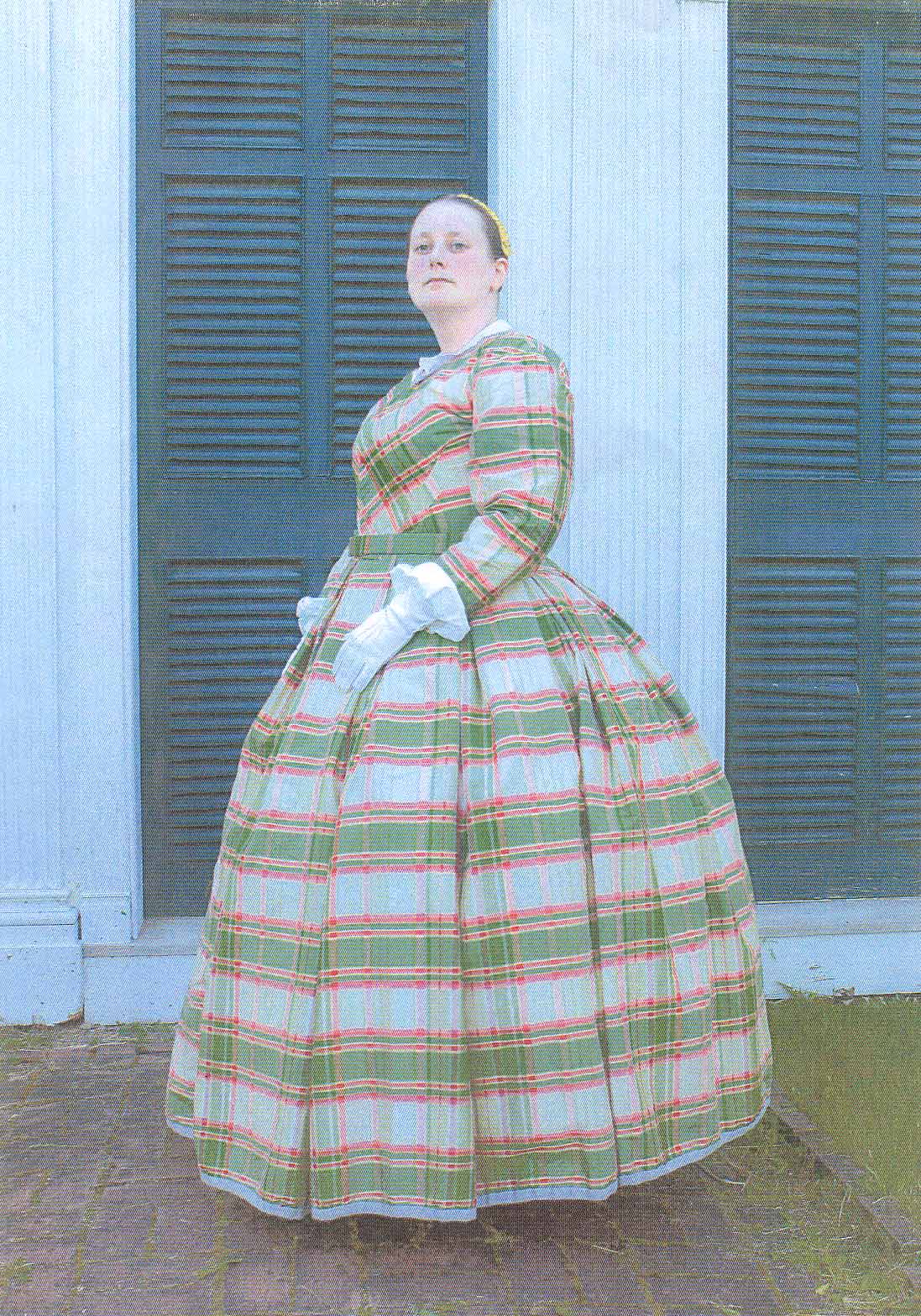
Paisley 1. The town of Paisley in Scotland. 2. The shawl with the cone or pine motif made in Paisley. 3. The individual design of a single pine or cone motif. 4. Overall design comprised of multiple pine motives. Green Plaid Wool Shawl

Plaid 1. Rectangular, double square shawl that came into fashion in the 1840s with the crinoline skirt. “A new size of shawl, called the plaid, was produced.”(Reilly, p8.) 2. Tartan based design of alternating warp and weft threads.

Pine motive or Cone motive Basic flower design surrounded by a border in a tear shape . This is the design we have come to identify as the “paisley”. In India it was call “Buta” meaning “flower”. Kashmir designs tend to have a short, simple, plump pine while European designs became more elongated and stylized.

Point Shawl A triangular half shawl; generally a shawl of lace, knit or domestic make. Some shawls are described as single, double or triple point.

Reversible Shawl A woven paisley type shawl with the same design on both sides. Not being made until 1865.

Standard nineteenth century shawl dimensions “The long shawls being more esteemed than the square ones, and considered articles of luxury, it is by no means unusual for dealers to cut the former in two, in order to evade the higher duty, and to have the two halves fine-drawn together afterwards.” (Scientific American, December, 7 1850).

Scarf or Stole Shawl – Primarily ornamental – 9 feet x 20 inches Square Shawl – Up to 6 feet x 6 feet Handkerchief Shawls – 3 feet x 3 feet (called so due to customs fees) Plaid Shawl or Long Shawl or Double Square Shawl – 10 feet x 5 feet Three-quarter Plaid Shawl – 8 feet x 4 feet

Turn-over Shawl A shawl that when folded in a triangle, shows all four finished borders. This is done by attaching 2 borders on the right side and 2 on the wrong side.

Zebra-Stripe Shawl A striped shawl with a floral or paisley motive in the stripes, which was fashionable throughout the 1800s. (Reilly p. 36)


Published in: on July 1, 2009 at 11:29 am  Comments (2)  

Fringing Shawls

Fringe Frustration
Fringing Your Wool Shawl:

A Guide to Fringing Your Wool Fabric Shawl

My fringe frustration comes after working many hours on my new red shawl. I carefully found the weft grain and fringed for hours, and hour just to find in the end my shawl is not square. Thus, the title fringe frustration.

Most shawls of the early Victorian era were fringed on two or four sides. This applies to wool, silk and cotton shawls. As a shawl’s fringe was often made from it’s warp and weft threads, a squared shawl was fringed on the grain. The shawls I have observed have had fringe ranging from 3 inches to 10 inches in length. Personally, I find the longer fringe pretty but difficult to live with.

Helpful hints before you start
– Make sure you purchase plenty of extra length to work with. I often find merchants do not cut along the grain. If your fabric is not cut on the grain you will lose length on one or both ends.
– Have a lint basket near-by. This works much easier than a bag.
– You might also want a lint brush to clean up with.
– Pick up your favorite movie or audio-book from the library. You will need several hours of video or audio.

Purchasing Your Fabric
For a square shawl, you will need the width of the fabric, plus twice the length of fringe, plus waste.
———- For example: The fabric width is 60″. You want 5″ fringe on each end. There is approx. 1.5″ waste on each end. You will need 60″+10″+3″= 73 inches.
For a long shawl or double square shawl, you will need twice the width of the fabric, plus twice the length of the fringe, plus waste.
——— For example: The fabric is 60″. You want 6″ fringe. There is approx. 1.5″ waste on each end. You will need 120″+12″+3″=135″.
If you are working with a plaid, stripe or check fabric, you may need additional length in order to have a balanced design. Be sure to lay your fabric out on the cutting counter to double check you measurements.

Step One – Find the grain
I find it easiest to work along the grain of the fabric as I fringe. But, as I learned with the red shawl, make certain your fabric is square first.
To do this, snip the fabric at the selvedge about a half inch from the cut end and tear along the weft. This will create a straight line along the weft. Do this at both ends. Lay the fabric out flat. Each corner should form a 90 degree angle. With in the fabric, the weft should run perpendicular to the warp. If there is a small difference consider squaring your fabric. (see below)
At one cut end of the fabric, measure in from the end the desired length of your fringe. Mark your measurements along the width of the fabric. Repeat this at the opposite end of the fabric.
Using a seam ripper or embroidery scissors, carefully snip the weft thread that passes through these markings.
With a thick needle or small crochet hook, carefully remove this weft thread. The space created by removing this thread becomes your measurement guide in the next step. If this line is not easy to see, remove a second weft thread in the same way.
Repeat this process at the other cut end of fabric.
This image shows a green shawl where the weft threads have been removed:

Step Two – Sectioning
It is easier to fringe in sections rather than lengths. Make cuts, dividing the width of the fabric into 2 inch sections. To do this – Cut along the warp threads from the cut end of fabric to the removed weft line you created above. Repeat this on the opposite end.

Step Three – Fringing
Here is the fun part! Put a movie or audio book in the player. Using your fingers, large needle, crochet hook or anything you think might help, remove the weft threads from each section. I find it easier to alternate from working vertically to working horizontally removing threads.

Step Four – Finishing
You can finish your fringe in a few ways; knotting, hand stitching, or working a weft thread back through the fabric.
One of the simplest ways to finish as shawl is to stitch along the fringed edge. Using a matching thread, make a sort-of back-stitch and whip-stich combination along where the fringe meets the fabric. Go forward 5-7 warp threads at the fabric edge, then back three threads and up tree warp threads, catch the stitch and go forward. This sounds much more complicated than it is. Picture to come.
A method used before taking a shawl off the loom is to work the weft thread back through the edge. This process could be attempted if you can save enough of your weft thread. I have not yet tried this.
For knotting your fringe, I suggest an over-hand knot (as you would knot the end of thread) instead of a square knot (as you would start your shoe laces), because a square knot tends to pull threads together creating a puckered look. If you are going to do multiple layers of knots, creating a nice diamond pattern, I suggest starting with an over hand knot than continuing with a square knot for a flat diamond pattern.
This image shows fringe from warp threads that were knotted as the scarf shawl was removed from the loom:

This image shows fringe knotted with an over-hand knot:

Squaring your fabric
You will need a large, flat, traffic free space for this. Double check prior to doing this that your fabric is color fast. Otherwise you may stain the drying surface. At each end of your fabric, snip at the selvedge and tear the fabric along the weft threads. Do this at each end. This will create a straight edge along the weft. Wet your wool fabric. Do not agitate it as this can cause your wool to shrink. Press out excess water. Lay the fabric out flat using a quilter’s rule to square the edges. Place weigh (jars of food work well) on each corner and side. Allow your fabric to dry. Go back to step one.

Published in: on July 1, 2009 at 11:22 am  Comments (2)  
Tags:

Sewing Cases, Needle-books and Housewives

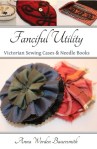
To learn how to make your own sewing case or housewife based on original sewing cases, please see  my new book, Fanciful Utility: Victorian Sewing Cases and Needle-books.

FanU-Cover-Snap

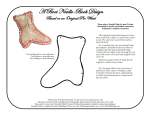
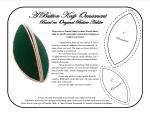
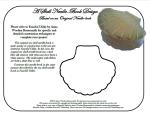
To accompany Fanciful Utility, you will find free templates for additional sewing accessories posted on my blog through the year. Please check out each of these templates as well as those available on the Sewing Academy blog.

Boot Template Keep Ornament shell temp

New Thumbnails scissors case

I am happy to offer sewing cases and needle-books for sale. Please check my Etsy Shop for what is available. I will also custom make sewing cases. (Check out Barbara’s sewing case.)

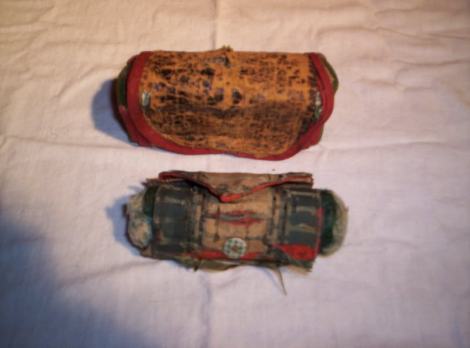
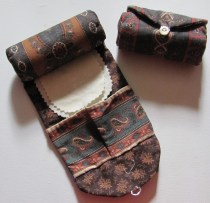
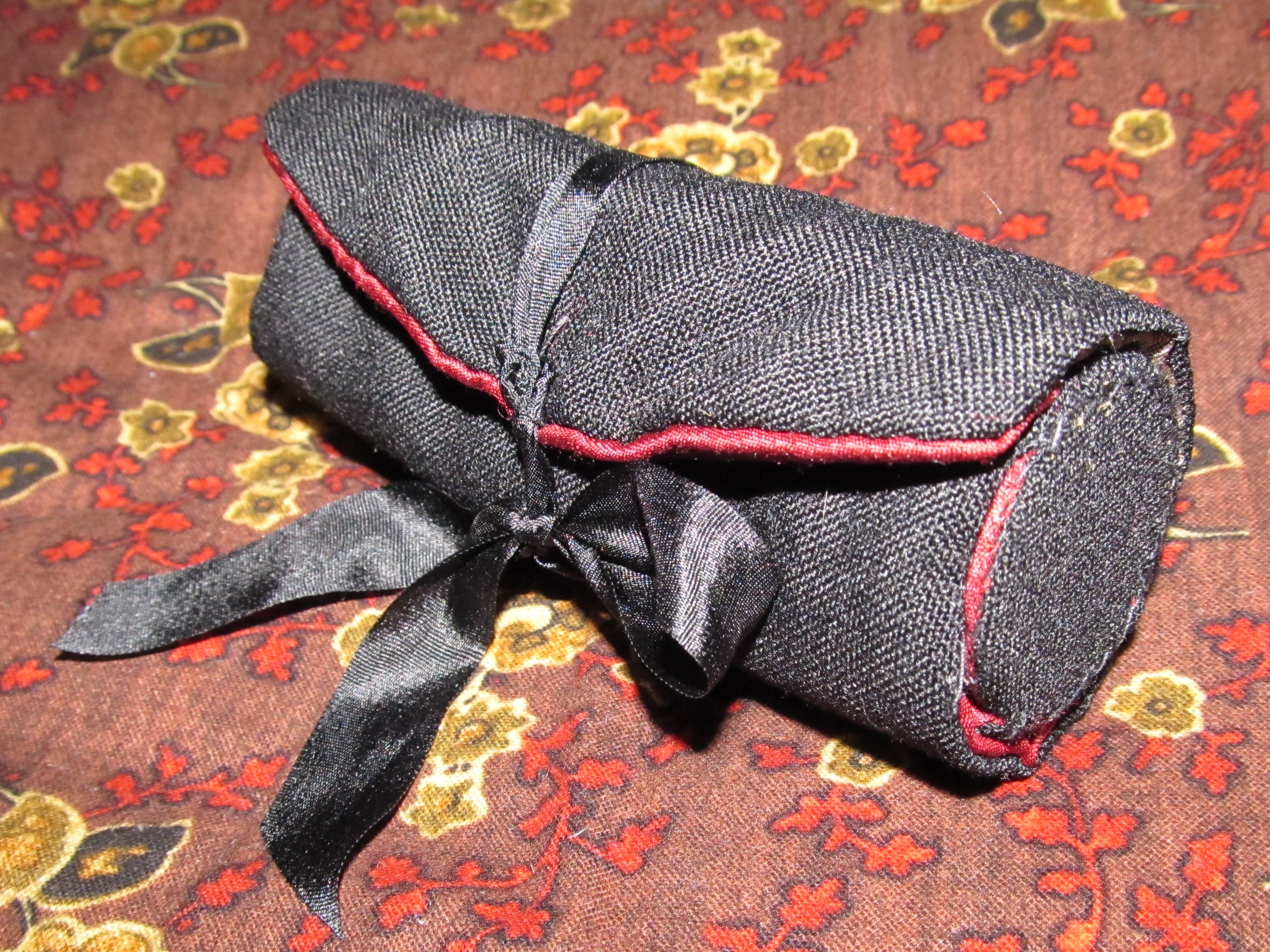
Original sewing cases closed. At the top is the structured sewing case also shown open. At the bottom is a rolled case with a 4” wide ribbon on the outside, silk on the inside and held closed with the calico button.

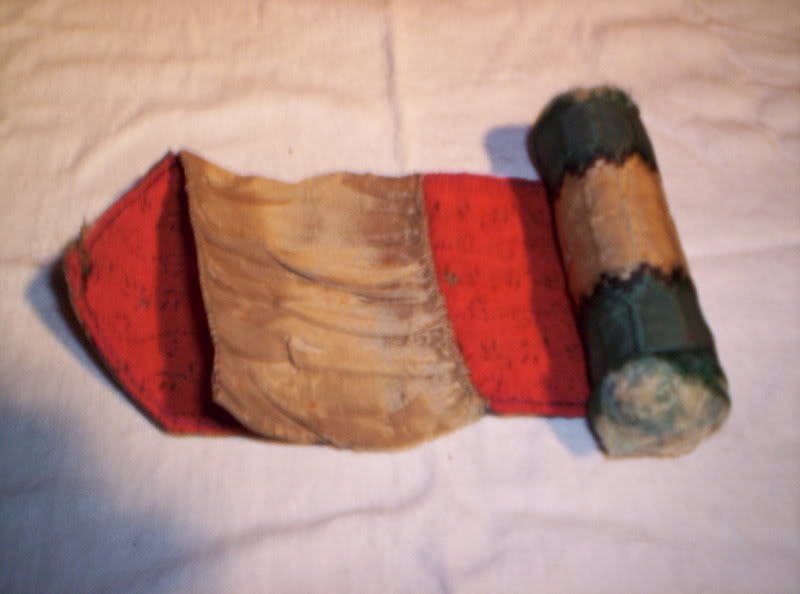
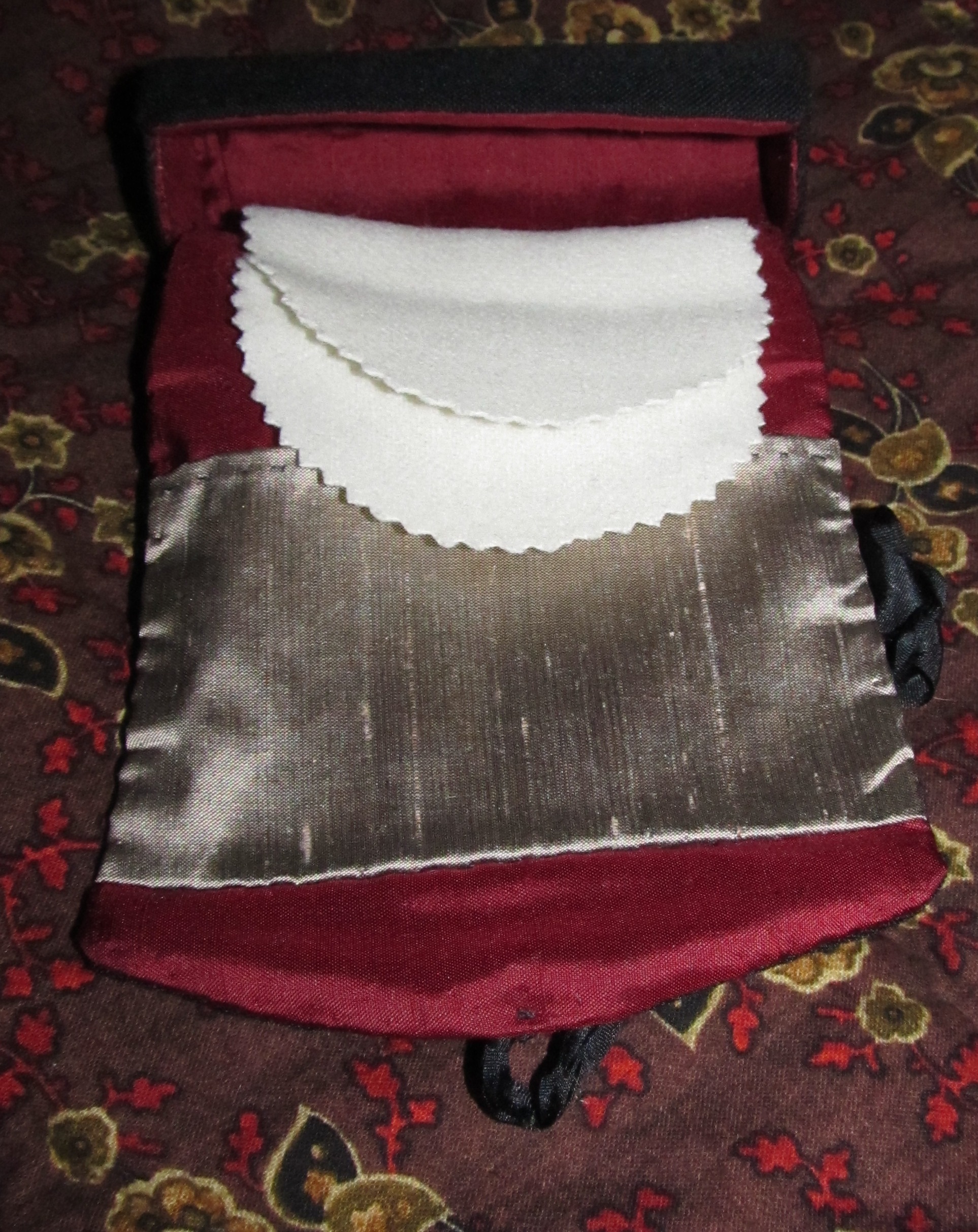
Rolled case shown open. The exterior is a 4″ wide ribbon. The inside is a small print wool with a silk pocket. The needle-pages are missing.

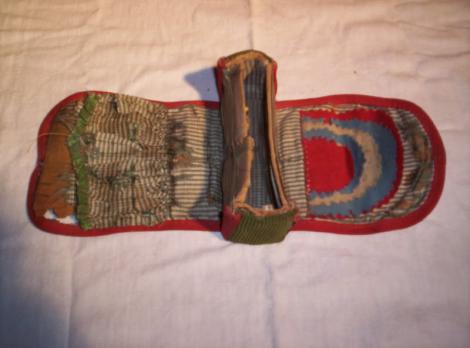
Original fold-over sewing case with a central covered pasteboard box, multi-colored needle pages, and silk pocket. The exterior is a black leather bound with wool tape.

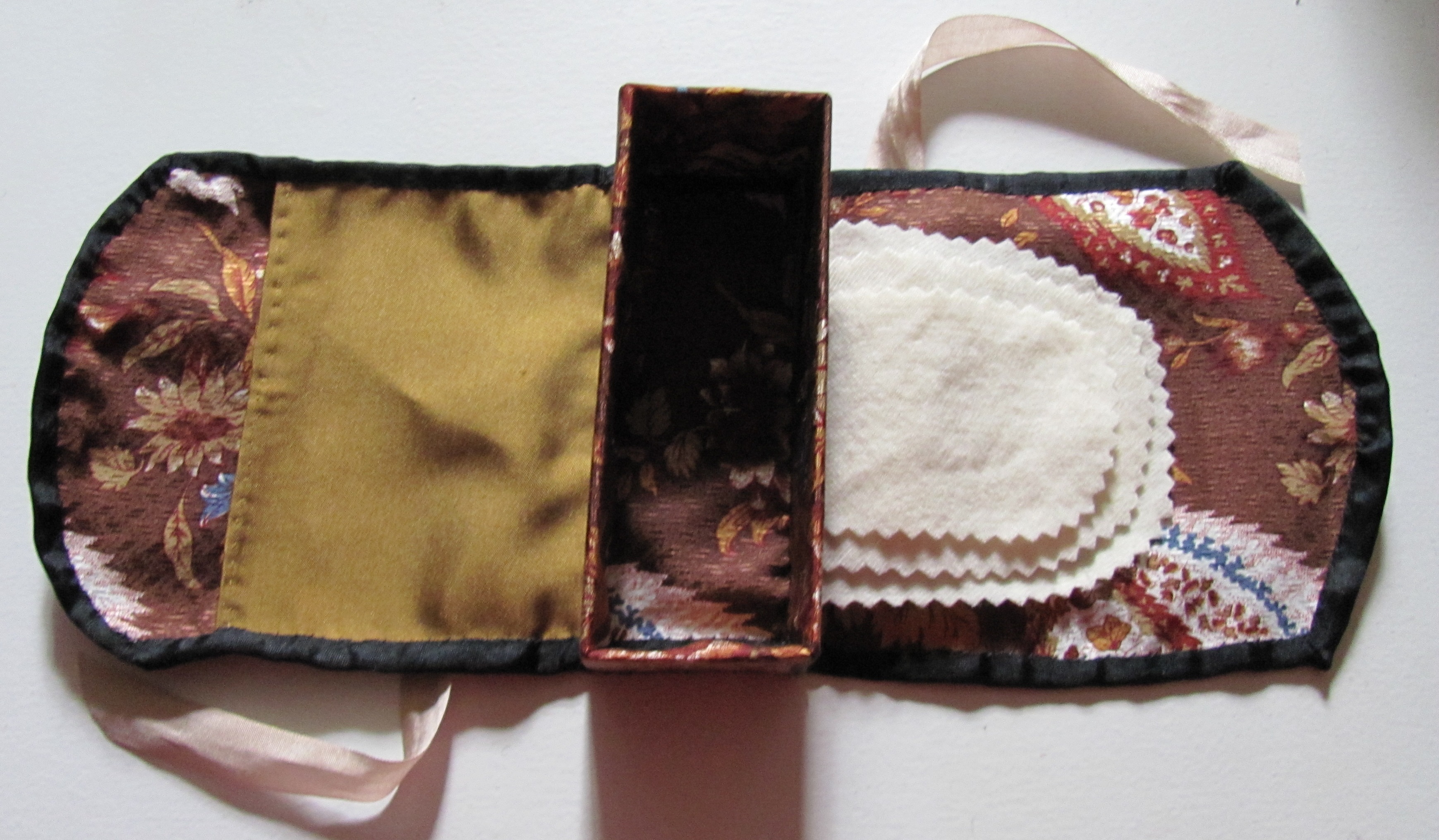
Fold-over style sewing case based on the original sewing case above. This one has a cotton interior and mono-chromatic pages.

Rolled cases in the style of many original cases. These two cases are made of cotton inside and out with wool pages and MOP buttons.

Additional Rolled Cases:

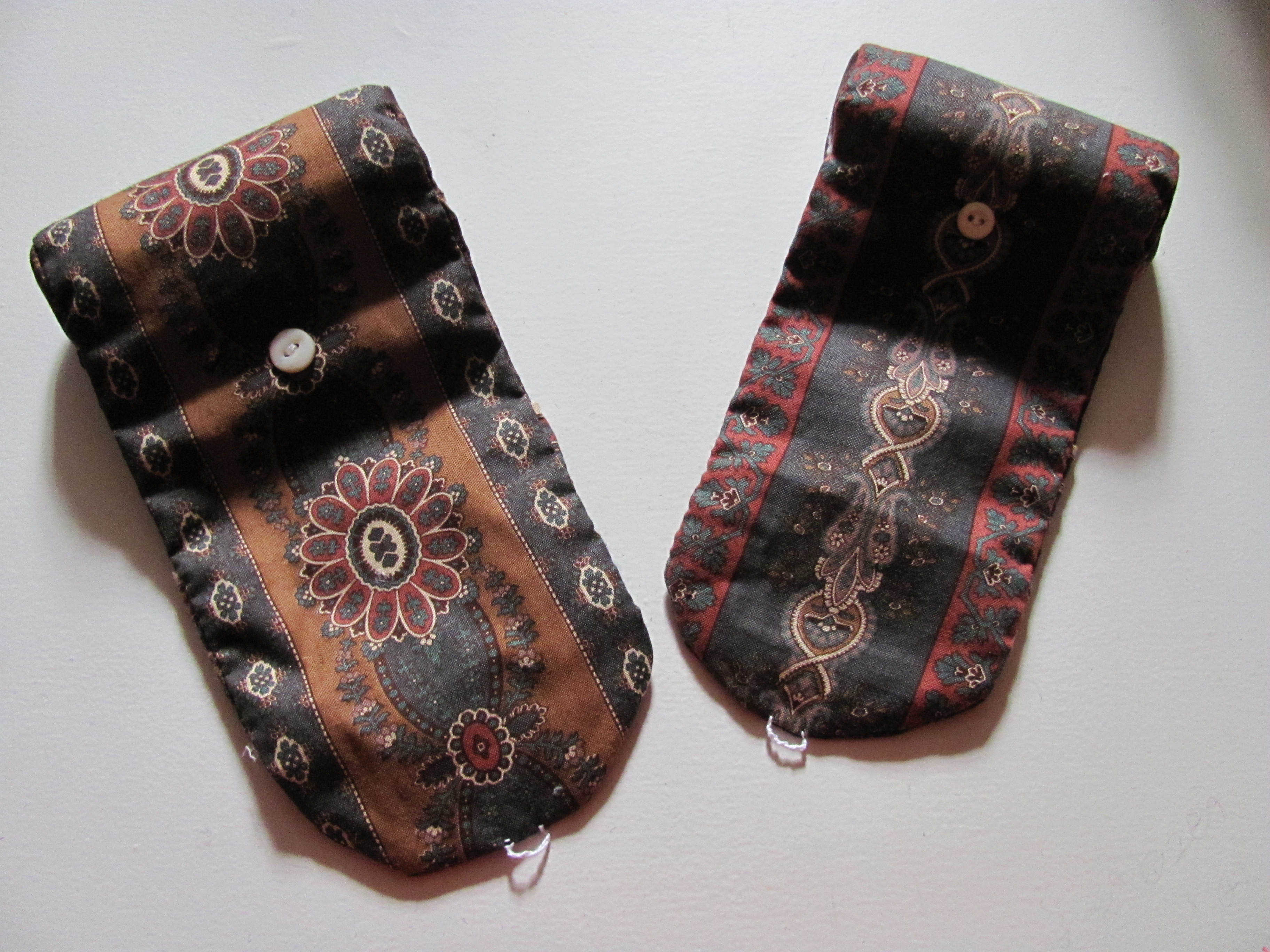
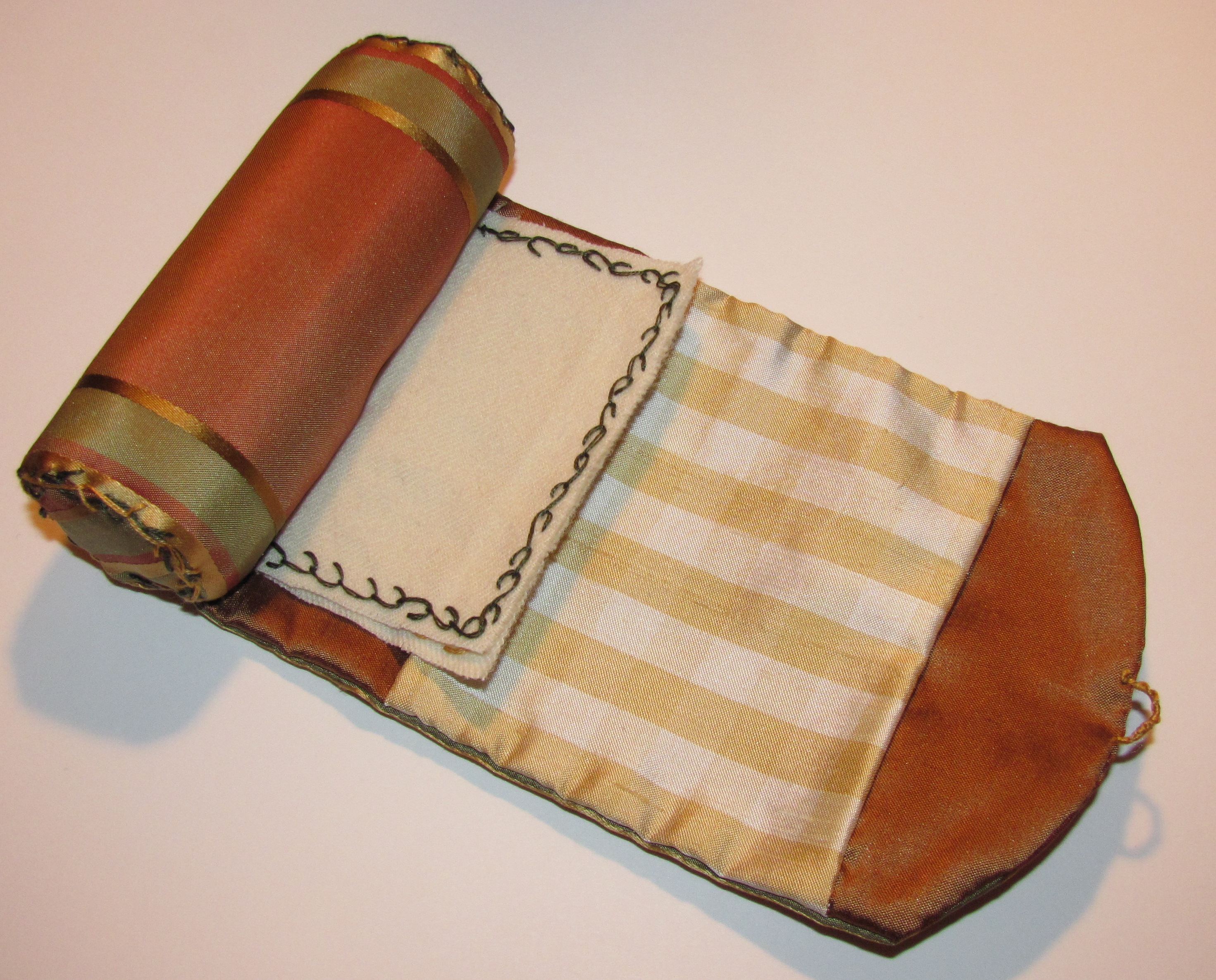
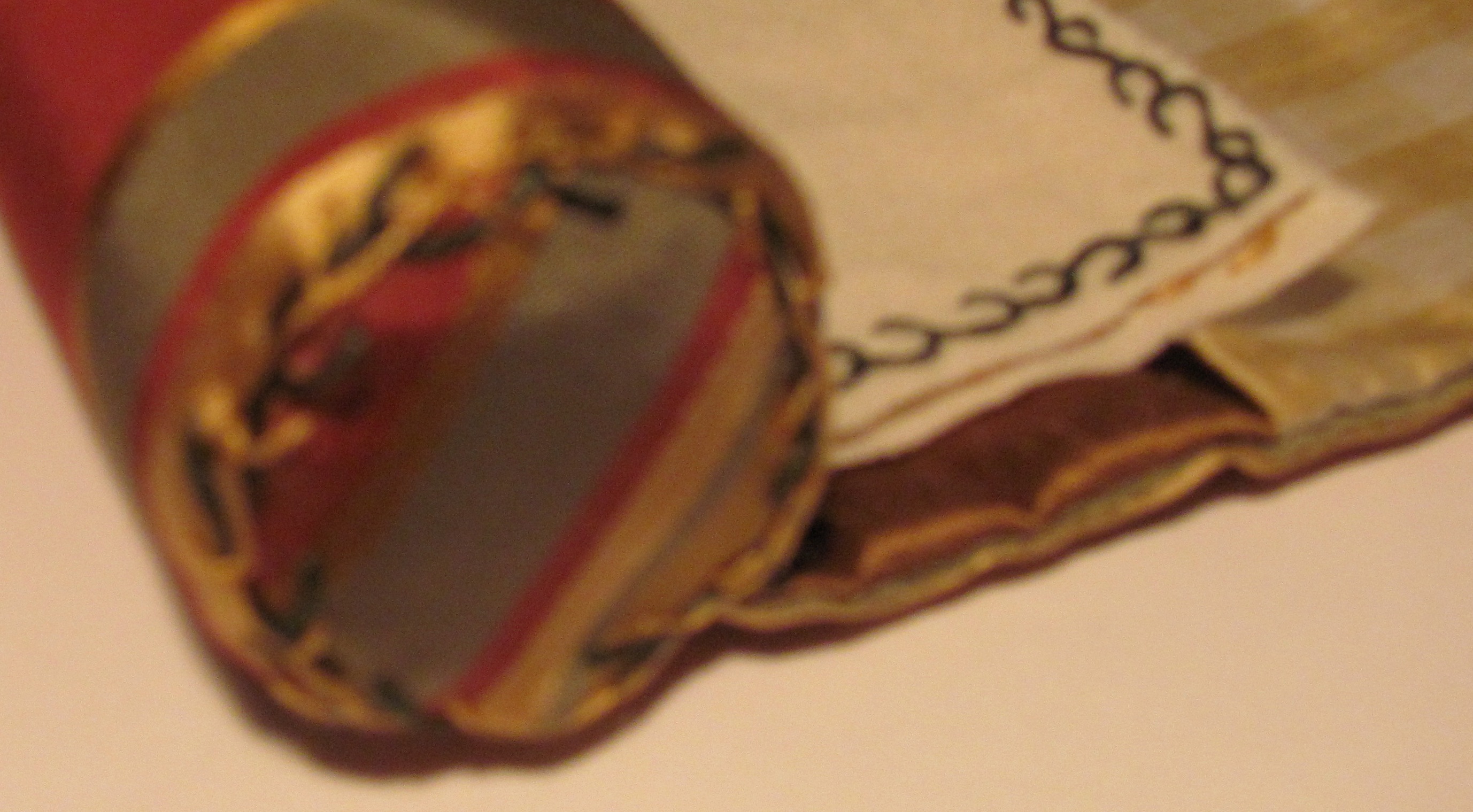
This case is made with a lovely fall toned striped silk on the exterior and a coppery shot silk on the interior. The spacious pocket is a white and golden yellow plaid silk. The two off white wool needle-pages are vine stitched with dark green on the first and golden yellow on the second. The viney stitch is continued on the ends of the cotton batted roll. The case is held closed with a tiny mother of pearl button and loop. This case is entirely hand-sewn and based on an original formerly in my collection and featured in the up-coming  Fanciful Utility. This case took approx. 5 hours to hand-sew.

Published in: on July 1, 2009 at 7:54 am  Leave a Comment  

Travel Updates…. on new blog

Hi Everyone,

I’ve decided to put my non-living history updates on a new wordpress blog called Anna’s Updates…..  http://annasupdates.wordpress.com/

There isn’t much there yet. But, I do have a few things I want to share about the drive from NY to NM which will be there soon.

Published in: on June 27, 2009 at 11:36 pm  Leave a Comment  

How To Wear A Shawl


The What-not; or Ladies’ Handy-book “How to Wear a Shawl”
On the subject of wearing shawls, both long and square, much may be said, on some of our fair readers having  expressed to us their desire that we should publish some details upon the best system to be adopted in wearing shawls gracefully, we purpose doing so to the best of our ability.
In the first place we must premise that, as there does not and cannot exist a universal panacea for effacing wrinkles or making the hair to grow on bald places, there cannot be an absolute system for draping shawls. One substance suitable, or rather inoffensive for some ladies, may be essentially prejudicial to the appearance of others. One fashion of wearing a shawl may appear very graceful on a slender figure, but will transform into a bundle a woman of rounder and fuller proportions.
If the so called long shawl be somewhat shorter than usual it should not be evenly folded, that is to say one end should be left longer than the other, in order that it may fall lower. This is indispensable in the striped shawls, which are now so fashionable for morning toilettes, as they are much shorter than bordered shawls. They should be folded so that one end may not appear exactly over the other. If these two points in fact, were to be placed on the same line, the longer end of the shawl would then be too short. Round the neck, two or three folds should be made, which are fixed in their proper position by a long pin; this is done in order to disengage the head which would otherwise be confined by the folds of the shawl. Nothing looks so ungraceful as to see the curtain of the bonnet in constant and ungraceful contact with the awkward wraps of a badly folded shawl. It is then necessary to be careful that the neck be perfectly free, while, at the same time, it is protected by the folds.
But these rules do not suffice for the graceful wearing of a shawl. To succeed we must have not only the experience that is acquired, but the instinct which is innate. A woman must then know her own figure, and not be led away by illusions in this respect.
Drooping shoulders are those which bear most becomingly the long or square shawl. High and pointed, and consequently narrow shoulders are less adapted for the square shawl. For ladies so circumstanced by nature in the latter respect, we would recommend the long shawl, which being quadrupled over the shoulders, takes off the angular appearance which would otherwise disagreeably prominent.
A thin woman should fold her shawl in such a manner that the upper point may fall in the centre of the back. A woman of a stouter figure should so arrange her shawl that this point may be larger and descend lower, about to the waist. It may be easily understood that this quadrupled shawl augments considerably the volume of the bust. And when the bust is sufficiently full, it is necessary that the upper point should fall lower, so as to envelope the body without increasing the size.
The longer side of the shawl is ordinarily placed to the left, the right arm raising the shorter end; but this depends entirely on acquired habits, and there is no reason why the shawl should not be worn in an inverse way.
Square shawls should be raised on both arms, and a very tall, or very stout woman, ought carefully to avoid folding a square shawl exactly double. One side should be longer than the other, in order to augment the proportions ¡of the shawl, which would otherwise be too short, and consequently ungraceful, if she neglected this precaution.
We may add that all shawls should be as much as possible draped upon the woman who wears them, and sustained by the arms being pressed upon the bust ; but we must also add that we hare displayed to our readers but the material part of this difficult art, and unfortunately it is the only one we can analyze, for grace is not demonstrated, and taste is a natural gift which escapes every definition and all commentary. Wealth cannot replace it, nor can experience supply its want.
Literary Gem 1854 “How to Wear a Shawl”
If a lady sports a shawl at all, and only very falling shoulders should venture to do so, we should recommend it to be always either falling off or putting on, which produces pretty action. Or she should wear it upon one shoulder, and down the other, or in some way drawn irregularly, so as to break the uniformity. One of the faults of the present costume, as every real artist knows, is that it offers too few diagonal lines. Nothing is more picturesque than a line across the bust, like the broad rilibon of the order of the garter, as worn by Queen Victoria, or the loose girdle, sloping across the hips, in the costume of the early Plantagenets. On this very account, the long scarf shawl is as picturesque a thing as a lady can wear. With the broad pattern sweeping over one shoulder, and a narrow one, or none at all, on the other, it supplies the eye with that irregularity which drapery requires; while the slanting form and colors of the border, lying carelessly round the figure, gives that eastern idea which every shawl more or less implies. What Oriental would ever wear one straight up and down, and uniform on both sides, as our ladies often do?—Quarterly Review.
Hurry-Graphs by Nathaniel Parker Willis “Shawl Aristocracy”

The degree to which ladies care more for each other’s opinion of their gentility of appearance, than for the opinion of gentlemen, on the same point, is, at least, equal to the difference between a French shawl and a Cashmere—one worth fifty dollars and the other worth from five hundred to a thousand—for, though no man knows the imitation from the real shawl, as he sees it worn, a fashionable woman without a Cashmere, feels like a recruit unarmed and unequipped. The pilgrimage to Mecca, which entitles to the privilege of wearing the green turban, would not, by the majority of women, be considered too much to undergo for this distinction—recognizable, though it be, by female eyes only. “She had on a real Cashmere” would be sweeter, to numbers of ladies, as a mention when absent, than ” she had a beautiful expression about her mouth,” or  “she had such loveable manners,” or “she is always trying to make somebody happier,” or “she is too contented at home to care much about society.” It is, moreover, a portable certificate of character and position. A lady “with a real Cashmere on,” would be made way for, at a counter of Stewart’s—differently received when introducing herself at a first call—sooner offered the head seat in a pew criticized, as to manners, and very differently estimated in a guesst as to who she might be, in any new city or place of public resort where she chanced to be a stranger. The prices of the best Cashmeres vary from four hundred to fifteen hundred dollars.* There are two plausible arguments in their favor, usually pleaded by ladies—first, that they fall in more graceful folds than any other shawl, and have an “indefinable air of elegance,” and, second, that, as they never wear out, they are heir-looms which can be bequeathed to daughters. The difference between a thousand dollar shawl given to a daughter after twenty years’ wear, and the same thousand dollars invested for a daughter and given to her with twenty years’ interest, puts this latter argument upon its truest ground; but one word as to the superior becomingness of Cashmeres.

There are very few women, out of Prance, who wear any shawl becomingly—for it requires either the taste of an artistic mind, or a special education, to know its effects and arrange it to show the figure to advantage—but a Cashmere, by the very pliability which is subservient to grace, betrays awkwardness or a bad figure just as readily. For a round back, flat chest, or arms held at inelegant angles, there is more concealment in the French shawl, than in the slighter tissue of an India one; but, either way, we fancy, the difference is too trifling to be recognizable by one person in a thousand. As to the beauty of color and texture, we are very sure that, to men’s eyes, the dull complexion of a

Cashmere conveys the impression of a cover-all, grown somewhat shabby, and which the wearer would not have put on if she had “expected to meet anybody.” There is not one lady in a hundred, of those who own Cashmeres, who do not look better dressed, (to most female and all male eyes,) in any other out-of- door covering.

As our city readers know, there has been a three days’ exhibition and auction of Cashmere shawls, in the large hall over the theatre at Niblo’s. The vessel in which this precious cargo was being conveyed to England, was abandoned at sea by the crew, and, an American ship securing the cargo and bringing it to this country, the goods were sold by the British Consul, to arrange salvage and remit the remainder to right owners. The shawls were hung upon lines, up and down the immense hall, and, between these aisles of Cashmere, the fashionable ladies of the city promenaded, with close scrutiny and comparison of opinion— (and with a degree of keen interest .that we should like to see given to a gallery of pictures!) Having, ourself, fortunately secured the company of Mr. Flandin, who was the only importer of Cashmeres to this country for twenty or thirty years, (and whose eye, for better reasons, is familiar with the Parisian grace of a shawl’s wear, and its value in becomingness,) we took the opportunity to enrich our knowledge in the matter. After having all the advantages of the India fabric pointed out to us, however, and hearing, from our well-informed friend, what class were the purchasers, and what made the difference of hundreds of dollars in the cost of shawls which to a common eye would seem of equal value, we came away satisfied that a better present could be made with five hundred dollars, than to bury it in a Cashmere shawl— that things better worth having could be had for a quarter of the money—and that the arbitrary aristocracy, which is based upon the wearing of them, is one of those illusory valuations which this common-sense age is constantly on the look-out to put down.

(* It is a curious foreshadowing of the anticipation of income by which such expensive articles are sometimes obtained, that the finest and costliest of these shawls are made from the down of the lambs taken from the womb before birth.)
 

Published in: on June 23, 2009 at 1:15 am  Leave a Comment  

Where do you put your….gloves, fan, purse, etc….Part 2

 Here are some passages referencing where women put their gloves, fan, purse, etc.: 

(a younger girl) “she fancied how her mamma would smile and kiss her, and how her papa would look pleased; and then she thought she would just take the gloves out of her pocket to see how tidy they were. She put her hand into her pocket, and pulled out first her pocket-handkerchief, and then some pretty colour pebbles which she had picked up during her walk, but her gloves were not there; there was no use feeling quite down to the bottom of the pocket, and turning it inside out, and shaking it – the gloves were actually quite gone; though Helen looked anxiously along the gravel walk and in and out among the raspberry bushes, she could not see them anywhere.”

Blind man’s holiday; or, Short tales for the nursery, by the author of ‘Mia and Charlie’.: or, Short tales for the nursery, by the author of ‘Mia and Charlie’.
By Annie Keary
Published 1860
London

This is a child “…as Effie took out of her pocket her gloves, or pocket-handkerchief, or something or  other, she pulled out at the same time Fritz’s letter and dropped it.” 

 By mrs. Florence Williamson
By William Kirkus
Published 1864
London

 “She [Clara] took the gloves, thrust them roughly into the pocket of her dress, bowed coldly and haughtily to the restorer of them, and turned again towards the party with whom she had previously been conversing.”

Chambers’s Edinburgh journal
By William Chambers, Robert Chambers
Published by W. & R. Chambers, 1853
Edinburgh

 “ ‘That reminds me,’ observed Maria, a young lady with some pretensions to good looks, ‘I had better put on my gloves; I have let my hands grow coarse and brown lately that I am ashamed of them, and just because it was too hot to cover them. I think my gloves must be in my bag;’ and diving into the profundities of a black silk affair which hung from her arm, and which also contained her missal and pocket-handkerchief, she withdrew the gloves, and commenced pulling them on.”

The slave son
By Marcella Fanny Wilkins, William Noy Wilkins
Published by Chapman and Hall, 1854


“She, supposing it to be some slur upon her religion, carelessly slipped it into her pocket and thought no more of it. The following morning, as she was taking her gloves out of her pocket, the piece of paper fell to the ground, and on examining it she found it to be a guinea note.”

The living sacrifice; or, A short biographical notice of Sarah Bentley: or, a short biographical notice of Sarah Bentley, of York ….
By John Lyth, Sarah Bentley
Contributor W. R. Lyth
Published by W.R. Lyth, 1848


“Having carefully rolled up, and deposited her gloves in her pocket, she pulled out a pin-cushion…”

Marriage: A novel
By Susan Ferrier
Published by Harper & brothers, 1847


“Her gloves were rolled up in a little ball in her pocket. She was at an age when gloves are rather a nuisance then otherwise.” [meaning an older age]

The doctor’s wife, by the author of ‘Lady Audley’s secret’.
By Mary Elizabeth Braddon
Published 1864
London


“Confident of success, she talked and laughed with unusual liveliness, and as soon as the meal was over, she went out with the fan in her pocket, and Charles by the hand.” [French setting possible]

Seven Years, and Other Tales
By Julia Kavanagh
Published by Hurst and Blackett, 1860


“‘Have you my fan?’ said Mrs. Quigg. I clapped my hand to the pocket where it should have been. There was no fan there. It was gone.”

The United States Democratic Review
By Thomas Prentice Kettell, Making of America Project, Conrad Swackhamer, D. W Holly, Spencer Wallace Cone, Isaac Lawrence
Published by Langtree and O’Sullivan, 1855

“ ‘Are you too hot, my dear?’ asked her tormentor, taking a fan out of her pocket, and raising as she spoke…”

The inheritance, by the author of Marriage. By the author of ‘Marriage’. Revised by the author
By Susan Edmonstone Ferrier
Published 1841


“Taking a box from her pocket, which she said contained the finest lozenges in the world for the preservation of the voice, she requested that one of the gentlemen would have the goodness to provide her with a glass of water, which was placed by the side of her pocket-handkerchief, the box, the fan, and the smelling-bottle.”

“Modern Accomplishments” Home and the world
By Mrs W Rives
Published by D. Appleton and company, 1857
New York


“It is a good practice to carry a pocket fan even in winter, in case you should chance to feel the heat more sensibly than any other lady in the room.”

The behaviour book: a manual for ladies / by Miss Leslie
By Eliza Leslie, Cairns Collection of American Women Writers
Published by W.P. Hazard, 1853
Philadelphia


“She took a fan from her pocket….”

Autumn hours and fireside reading
By Caroline Matilda Kirkland
Published by Charles Scribner, 1854


“….she stepped into the carriage, took a place beside Madame d’Epplen, and demurely drew from her pocket a large fan, the movement causing the exposure of a pair of strong gauntlet gloves that had been concealed beneath, and which immediately protruded from their hiding-place, to the no small amusement of her companions.”

At Odds: A Novel
By Jemima Montgomery Tautphoeus
Published by R. Bentley, 1863
 London


“‘Dear me, Mrs. Colton, I’m exhausted coming up those vile stairs!’ said Mrs. Fountain, drawing out of her pocket a beautifully carved fan, which she opened and began fanning herself, and displayed at the same time her white hand, which was covered with diamond and opal rings…”

Portraits of My Married Friends, Or, A Peep Into Hymen’s Kingdom: Or, A Peep Into Hymen’s Kingdom
By Uncle Ben, Rhoda Elizabeth Waterman White
Published by Appleton, 1858

“The consciousness of this did not flash upon Mabel until she had drawn the
little silver reticule from her pocket and exposed her destitution …”

Mabel Vaugh by Maria Susanna Cummins – 1857


“Steadying herself against the post of the folding- door, she took a pair of
scissors from her pocket”

 All The Year Round by Charles Dickens – 1862

“She drew an elaborately worked purse of green silk from her pocket and counted out into my hand three pieces of old French gold.”

”John Heathborn’s Tale” Harper’s new monthly magazine
By Henry Mills Alden, Sarah Orne Jewett, Cairns Collection of American Women Writers
Published by Harper & Brothers, 1864


[Queen Elizabeth] “A pocket looking-glass hangs from her side, and a fan is clasped in fingers loaded with precious stones…”

“Curiosities of Fashion, in the Matter of dress”
Eclectic Magazine: Foreign Literature
By John Holmes Agnew, Walter Hilliard Bidwell
Published by Leavitt, Trow & Co., 1863


“A large fan of peacock feathers hung from her wrist….” [fanciful]

“The Toad’s Curse” Graham’s magazine
By George R. Graham, Edgar Allan Poe, John Davis Batchelder Collection (Library of Congress)
Published by G.R. Graham, 1853
Published in: on June 9, 2009 at 11:26 am  Leave a Comment  

Tableclothes – White or More?

Jackie called me yesterday asking about tablecloths. She had a couple plaids she was considering for a large table at the Mumford event. My response was to play it safe and stick to white linen. Of course, since she asked, I had to go find out.

Step one, look through the interior paintings I have saved. In the first painting I opened, my play it safe response went out the window. In Francis William Edmonds’ Barking Up the Wrong Tree (c. 1850-55) a red cloth covers a small table. This cloth has either a yellow or golden double stripe border. This is a modest working class or  lower middle class home.

Looking at the more affluent homes, first is Lady in an Elegant Interior by David  de Noter (c. 1852). This round table in what appears to be a parlor is draped in a red patterned cloth which has colors that remind me of paisley shawls (though I doubt this is a shawl.) The cloth is rather tossed or roughly draped. A small table in Christmas Time by Eastman Johnson (c1864) has another red patterned tablecloth. This one is neatly draping the table. A dark green cloth with a decorative border drapes a parlor table in Lilly Martin Spencer’s Patty Cake. Another lovely green cloth is draped over a round parlor table in Reverend Atwood and His Family (page 5). This cloth has what appears to be a woven in border type design. This is a similar cloth as well.

Kitchen tables, used for work, are shown without clothes. Examples would be The Speculator by Francis William Edmonds (c 1852), The Young Wife: First Stew by Lilly Martin Spencer (c1854), Kitchen Interior by Thomas Hicks (c1865),

One table I am not sure about is in the painting The Song of the Shirt by John Thomas Peele (c1847). The woman is working on her sewing. I don’t know if the yellow fabric with holes draped across the table is a table cloth or simply a piece of cloth.

What about that safe white linen tablecloth? One like what I pictured can be seen in Family Life on the Frontier by George Caleb Bingham (c1845) where it drapes a large table. Another drapes a table in home with more means in The Contest for the Bouquet by Seymour Joseph Guy (c1866). Most still lifes I have saved also show a white cloth (or now cloth). Each of these show tables set with food. A few examples: several by John F. Francis, Fruit Still Life with Champagne Bottle by Severin Roesen (c1848),

A surprise to me is the long cloth-less table in the 1821 painting The Dinner Party by Henry Sargent. That cloth free table goes against everything I’ve read about setting a table.

Now, I haven’t noted which table clothes are found in American homes vs European homes because without looking up the art pieces, I can just speculate. There could be some variation between the two.

In the International Exhibition catalogs a variety of tablecloths are listed. Most are listed under flax (linen); some under wool & woolens and silks as tablecloths, table-cloths and table linens. These tablecloths or table-covers would need to be divided into those put on a table for eating (what I think Jackie wants) or over a parlor table. I suspect a tablecloth is the one that goes on the dining table for the meal while the table-cover goes on the parlor tables or the dining table while there is no meal. This is based on this passage: “….and the table-cover thrown over, and the room restored to its usual order.” (The Book of Household Management) Also keep in mind these are the ‘cream of the crop’ type of examples meant to display the art of each manufacture. Here are some of those listed:

“Damask table-cloth” “Damask table-cover”
“Double Damask tablecloth”
“Tablecloth of damask with heraldic designs”
“Table cloth, embroidered with thread on crimson sarsenet.”
“Mohair table-covers”
“Table-covers:- cotton and worsted, and silk and worsted”
“Crimson and green embossed table covers”
“Victoria table-cloth, made from cotton and worsted, dyed previous to weaving, fast colours.”
“Silk and worsted and cotton and worsted Victoria velvet table-cover.” “The manufactures express their opinion that the Victoria velvet damask and table-cover, are in a style that has not been previously made in this country [England].
“Pictoral mosaic cloth-work table-cover or quilt, comprising 32 compartments exclusive of the centre, which is the arms of England; which being an imitation of some well-known picture, made of coloured clothes, fine-draw together so as to imitate paintings, the features being worked with the needle, the whole surrounded with a border. This work has been the labour of leisure hours for a period of nine years and a half.”
“Double damask table-cloth, with border, roses, shamrocks, and thistles, Irish wolf-dog and harp; cornerpiece, shield of oak leaves, flags, anchors, and a dove encircled in palm wreathes with olive branchl side range, tray-scroll, Price of Wale’s feathers, in oak wreath; and centre range, a temple, British royal arms, vase of flowers, &c.”
“Table cloth of new pattern, to be presented to the Earl of Clarendon by the Royal Society for the promotion and improvement of the growth of flax in Ireland. The centre represents the star of the Order of the Garter, in a union garland of rose, shamrock and thistle, interspersed with flax, and surrounded by the jewels of the Order of the Bath and St. Patrick, with Irish harps in shamrock wreaths. At each end is a presentation piece from the Royal Flax Society, Belfast, 18.”>1, on a group of shamrock and flax, surrounded by the Clarendon arms, incorporating the collar and jewel of the Order of St. Patrick, with the motto and jewel of the Order of the Garter. The border exhibits a rich collection of flowers, drawn from nature. The ground consiste of four large amaryllids around each representation of the arms, with email sprigs of shamrock and flag intertwined, &c.”
“Table cloth of new pattern, designed by John Mackenzie, Government School of Design. The centre consista of a rustic stump and basket of rich flowers, resting on a group of flowers at the base, and supported by an Arum and a Strelitzia, surrounded by a light wreath of flowers, chiefly climbers, and a ground harmonizing in same style. The border represents a rich scroll, each compartment terminating with distinct flowers. The corners represent tin1 rhododendron in flower, the end and side the centres of flowers. The margin represents the hearts-ease, on leaves of the same.”
“Table-cloth, extra double damask, with arms of Goldsmiths’ Company of London for centre, flowers with sprigs filling, in a scroll and flower border.”
“Table-cloth, extra double damask, with arms of Baron Bothacliild for centre, surrounded by various sprigs, and border of flowers”.
 “Table-cloth, extra double damask, with anus of Mr. Wheble for centre, surrounded with »prigs, mid encircled by two flowing scroll borders.”
 “Table-cloth, extra double damask, being pattern of a rich table service of various lengths, manufactured for Her Majesty’s 62nd Regiment of Foot, showing the number in a large star, surrounded by a flowing riband containing the names of the buttles in which this regiment obtained honours, with sprigs, the whole enclosed by a bonier of oak and laurel intertwined.”
 

I am rather disappointed by what I am finding in the household advice and guide books. The authors like to write about laying a cloth on a table but they fail to tell us which cloth. In Beeton’s The Book of Household Management, she mentions a “neat white cloth covered the table” in a story she tells.

 Next steps could be to look at sales accounts, paying attention to  the size of the tablecloth or table-cover compared to the size of tables (dining vs parlor). (Not sure if I’ll get to that.)

Published in: on June 8, 2009 at 8:48 am  Leave a Comment  

Candlelight Tours – GCVM

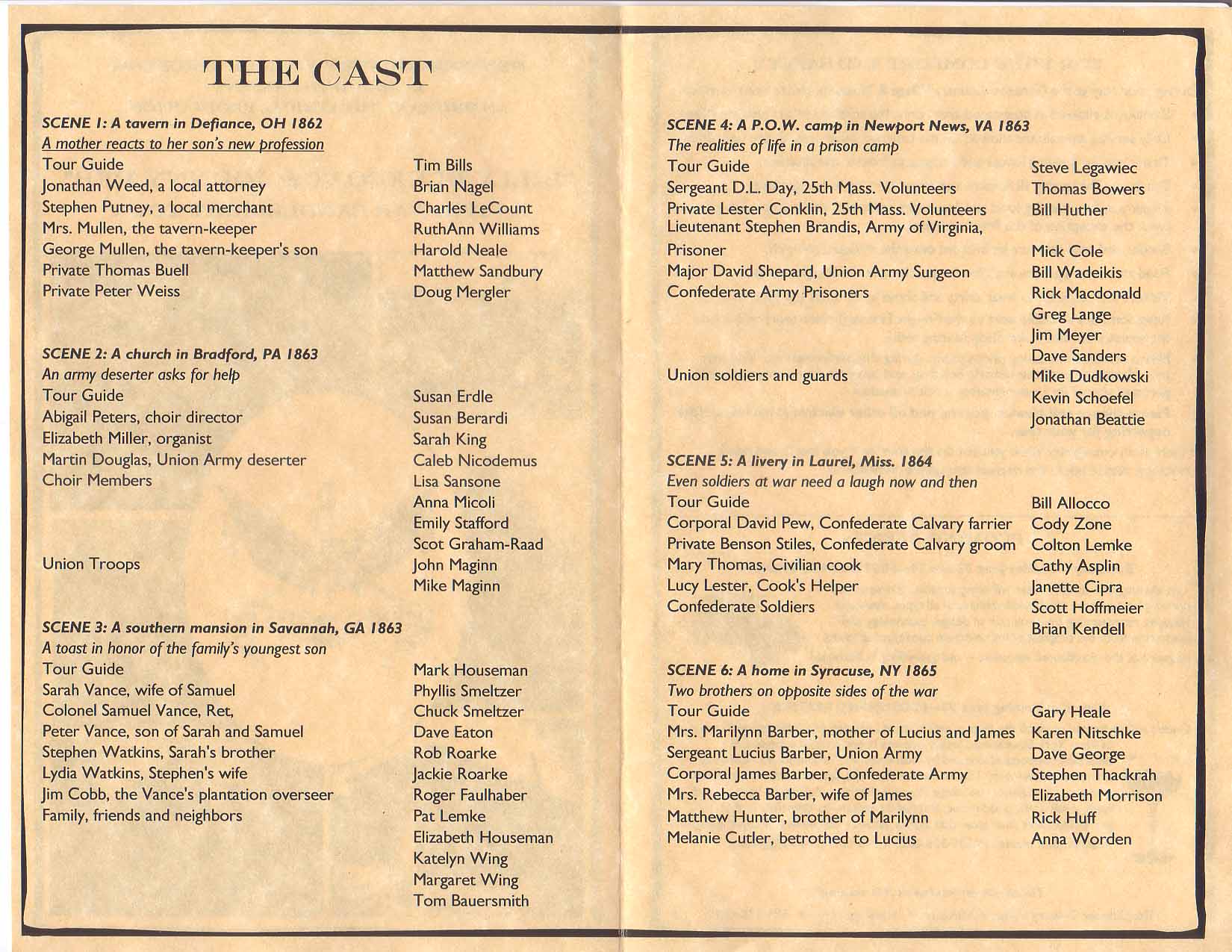
Saturday’s weather was absolutely wonderful for evening tours. (well, up to the very last part of the last two tours when the wind picked up and it started to rain.) I would like to thank Jim for the lovely script. I hope we were able to bring the audience to the edge of the precipice as you described. I appreciated the strength you gave Melanie’s character. Though, as the evening progressed I couldn’t decide if I agreed with her actions or not. I didn’t expect that. Thank you to everyone in our final scene. It was nice to work with all of you. It was especially nice to get to work with Rick for what will be my final event at GCVM for quite some time. For those of you who don’t know, Rick is largely responsible for me beginning CW era reenacting. While working at GCVM and dancing with the McKay Dance Society, he introduced a trio of us to the hobby. I would also like to thank Bevin who stepped up to what became a rather challenging and exhausting task. (I’m sure you slept pretty soundly after all that running.)
Cast list

scan

Published in: on June 1, 2009 at 7:17 am  Leave a Comment  

Bonnet Stories – White Sheer Caned

candlelight2009 004

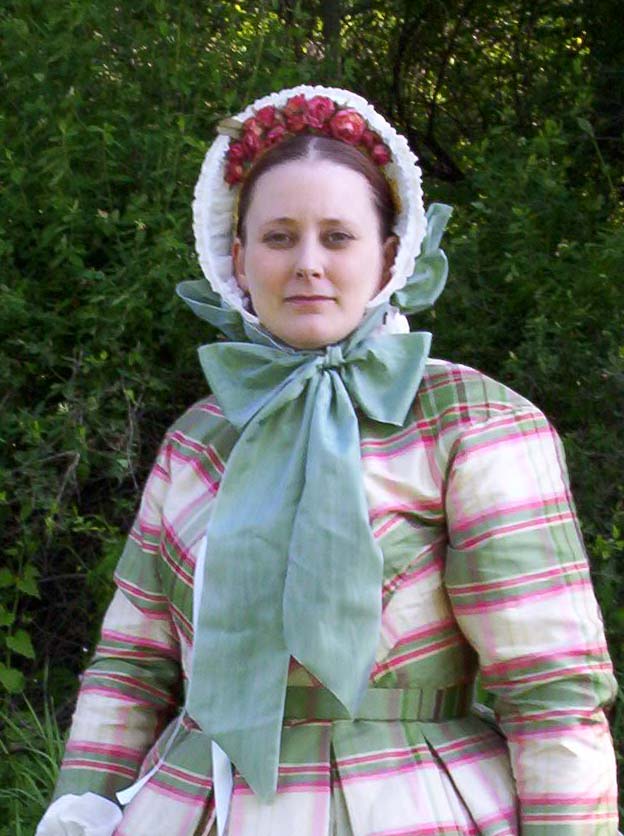
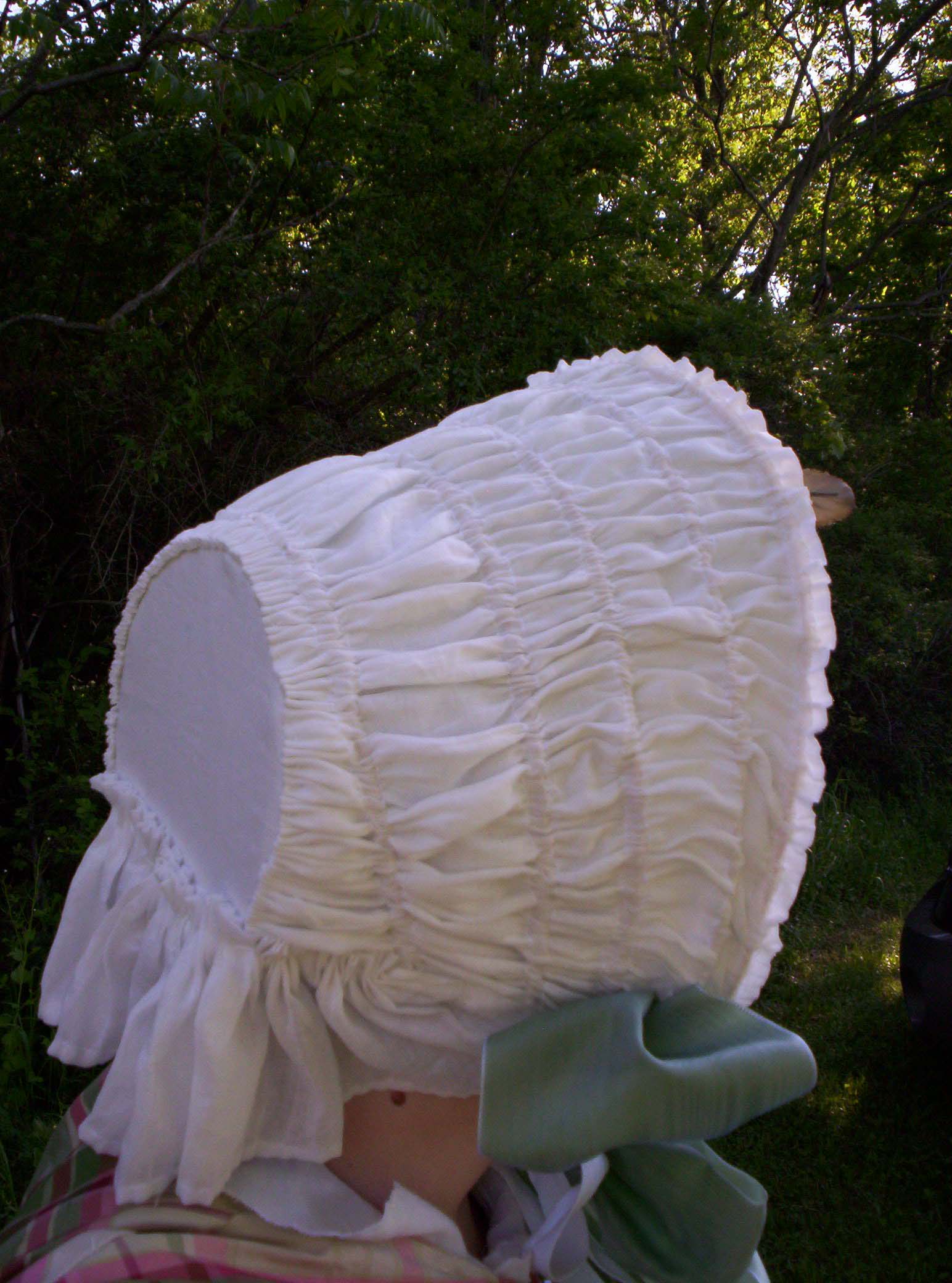
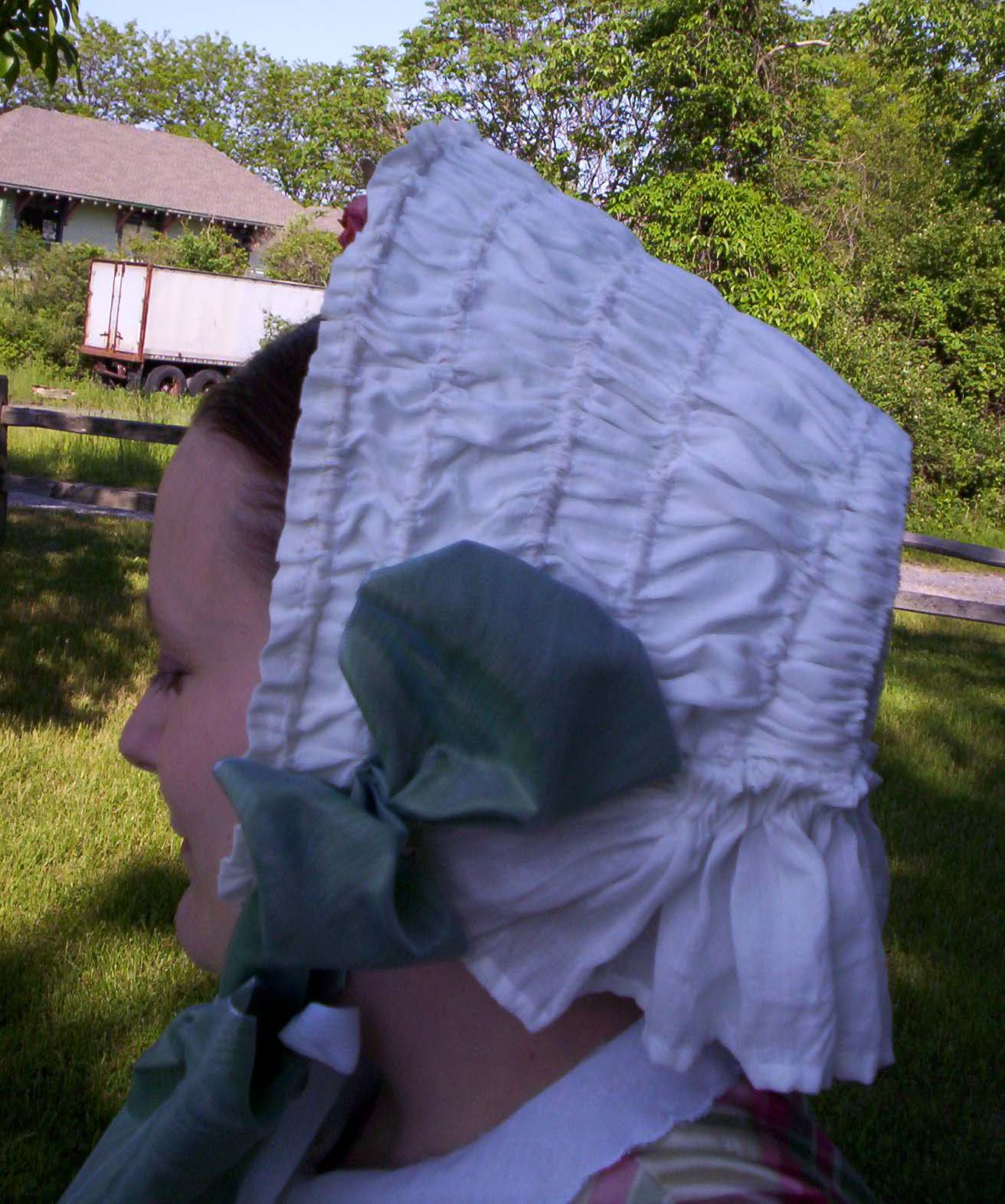
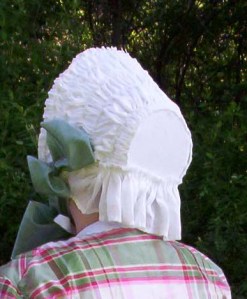
This is a sheer cotton caned bonnet started this past winter. It isn’t quite finished even though I needed to wear it for Candlelight tours. The base is buckrams. The cane is the smallest basket cane. (I think it is #0 or #1) The sheer is a cotton lawn from a yardsale. The flowers are paper flowers. (Sorry I don’t remember where I picked them up.) The ribbon is the 4″ German Moire from the Ribbon Store in sage green.

Things that need to be finished – I want to add a layer of ruche to the inside of the bonnet and add something tbd to the outside. The curtain needs to get removed and reattached with the net. The ties are just last minute make-dos tacked on. (way to long and not the white silk I want.)

candlelight2009 008candlelight2009 010candlelight2009 006 b

I’m noticing I was a little tilted in the pictures. Sorry.

Published in: on June 1, 2009 at 6:58 am  Leave a Comment  

Survey on Working Attire

A couple weeks ago I started collecting images of women wearing corsets while working for the local museum I volunteer at. (see this thread http://thesewingacademy.org/index.php?topic=4833.0) Thank you all very much for sending images. The Director I was working with is very happy with what we put together. While looking for images, I sent a message to Connie at the CC. She found the search interesting and wondered if I could take it a bit further by looking at what women wore while working in the mid-century. So, as a research/writing project to work on once I get resettled, I’ve decided to look at support garments as worn during various types of work/labor in the mid-century and by those currently doing living history. As part of the latter section, I put together a short survey on SurveyMonkey asking about support garment habits of reenactors. (SurveyMonkey limited the number of questions I could ask with a free account. So, the questions are narrowed down from what I started with.) If you would like to participate, the survey is at http://www.surveymonkey.com/s.aspx?sm=jj0CcjV5sg70sWALz6_2bgBA_3d_3d There are questions about what support garments you wear under different situations, about the fit of your corset and what influences when/how you wear it. The survey is anonymous. So, please answer truthfully as possible.

Published in: on May 26, 2009 at 8:36 am  Leave a Comment