Serving Chocolate

While reading, I came across this passage that doesn’t really fit into the article, but I just had to share. The author, John Doran, was discussing the extreamnities of table traits in his book, Table Traits with Something about Them, when he included this rather extreame method of serving chocolate. This is obviously Not how the common American would have drank his or her hot chocolate.

“I will only add that the ceremony of serving chocolate was never such a solemnity in England as in France. In the latter country as late as the days of Louis XVI a man of condition required no less than four footmen each with two watches in his fob according to the fashion to help him to take a single cup of chocolate. One bore the tray and one the chocolate pot, a third presented the cup and a fourth stood in waiting with a napkin, and all this coil to carry a morning draught to a poor wretch whose red heels to his shoes were symbols of the rank which gave him the privilege of being helpless.”

Published in: on July 21, 2009 at 2:33 pm  Leave a Comment  

Chocolate Advertisements

This pair of advertisments appeared regularly in the 1865 Notes and Queries:

Chocolate – Menier

(Manufactured only in France.)

The Healtiest, best, and most Delicious aliment for breakfast known since 1825; defies all honest competition, unadulterated, highly nutritious and pure. Sold in 1/2 lb Packets.

Also, especially manufactured for eating as ordinary sweetmeats, or at Dessert:

Chocolate Creams                   Chocolate Nougat                   Chocolate Praline

Chocolate Almonds                Chocolate Pistaches                Chocolate Pastilles

Chocolate Croquettes and Chocolate Liqueures (very delicate).

Wholesale, MENIER, 23 Henrietta Street, Covent Garden.

Retail, by all responsible houses.


Sold by Grocers and Confectioners.

FRY’S CHOCOLATE

Fry’s French Chocolate for Eating,

in Sticks, and Drops.

Fry’s Chocolate Creams,

Fry’s French Chocolate in Cakes.

J.S. Fry & Sons, Bristol and London.

Published in: on July 21, 2009 at 2:03 pm  Leave a Comment  

Chocolate….

I’m working on an article for the Citizen’s Companion on Chocolate in the Nineteenth Century. What a perfect research topic to appease boredom and chocolate cravings (which I get when I am bored and stressed.) The article will look at chocolate as it became more readily available due to several inventions during the industrial revolution. It will also include a variety of chocolate recipies. Here is a recipe for one of my favorite chocolates:

Chocolate Drops, with Nonpareils. –Have some warm chocolate, as for pistachios; add a little butter or oil to it to make it work more free; make it into balls about the size of a small marble, by rolling a little in the hand, or else put some of the paste on a flat piece of wood, on which you form, and take them off with a knife. Place them on sheets of white paper about an inch apart. When the sheet is covered, take it by the corners and lift it up and down, letting it touch the table each time, which will flatten them. Cover the surface entirely with white nonpareils, and shake off the surplus ones. When the drops are cold they can be taken off the paper easily. The bottom of the drops should be about as broad as a sixpence. Some of them may be left quite plain.” (The Complete Confectioner, Pastry-Cook and Baker)

Published in: on July 17, 2009 at 2:57 pm  Leave a Comment  

Straw Hats – Looking at shaping

I’ve had some hat related questions this week. Here is a blog post regarding the shape of straw hats from a few years back. I’ve also started a Pin board of hats in photos. http://www.pinterest.com/annawordenb/millinery-hats-cdvs/

ORIGINAL POST:
These images are for a discussion on the Sewing Academy. Since I am horribly disorganized at the moment, I am putting the files directly here. If I have included an image of yours you would like me to remove or give credit to, please let me know, I am very happy to do so.

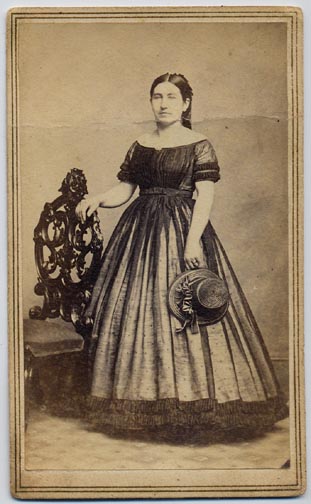
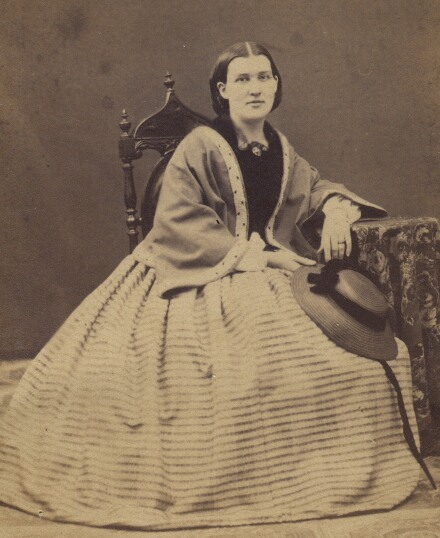
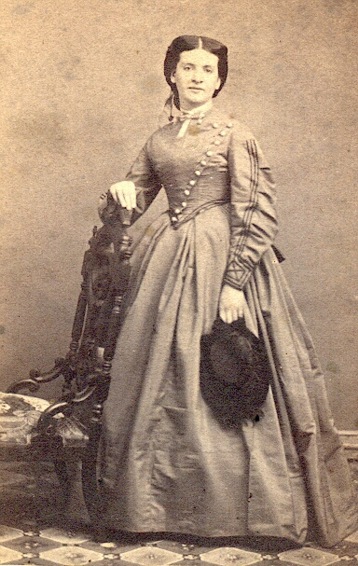
10987654321This angle is nice for showing the difference in the width of the brim comparing the fronts to the sides. The sides also curve down.

2008-09-3019-09-03_0032

 Links:

http://www.flickr.com/photos/josefnovak33/2813904046/

hmmm on chair http://www.flickr.com/photos/piedmont_fossil/2218142840/

 Hats at the MET: 1840mid-century, they say 1860s I say late at best, 1859 (one of the coarser hats I’ve seen), 1850-59, different, also different (bias cut ribbons), 1866-68, 1866-68, late 1860s (woven), late 1860s, 1863-65,      

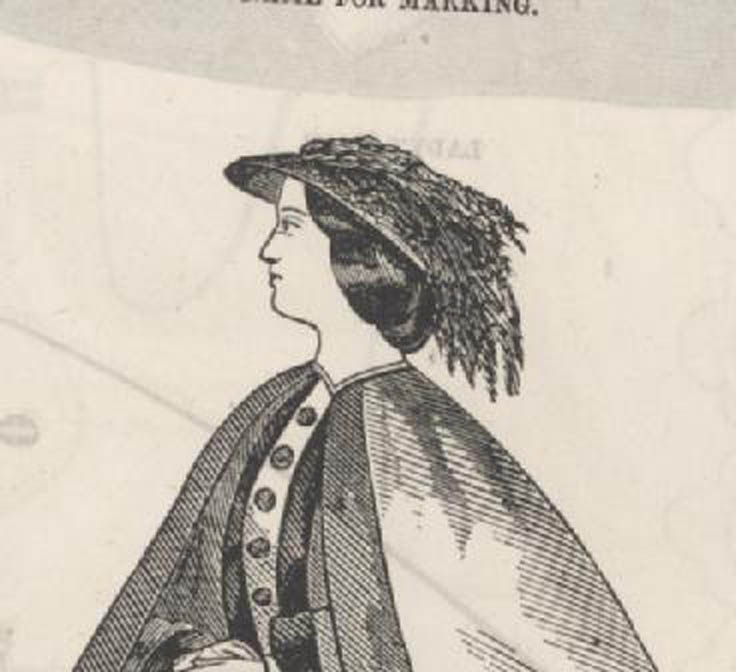
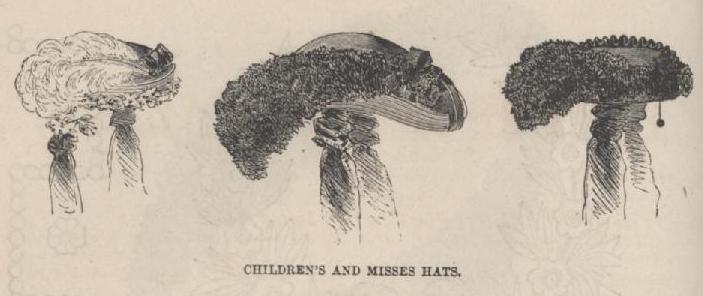
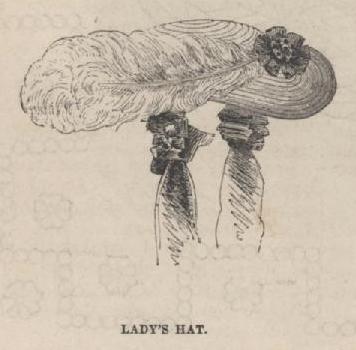
PeteJuly60 from PamPeteJune60 from PamPetersons Aug60Petersons July61 bPetersons July61

Published in: on July 10, 2009 at 2:02 pm  Comments (2)  

What Would You Like?

While adjusting to life in New Mexico and searching for employment, I also find I need a little inspiration or direction for research and writing. I have put together a survey on Survey Monkey to see of anyone has any imput or special requests. I have some questions on what you would like to see on the blog, what you would like me to write for the Citizen’s Companion and what research for larger book/booklet projects.

SURVEY HERE

Published in: on July 7, 2009 at 3:26 pm  Leave a Comment  

How a Shawl Was Worn

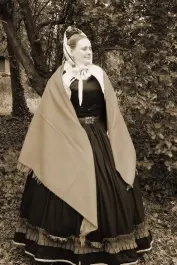
How to wear a shawl

On the shoulders, draped open or held with the hands

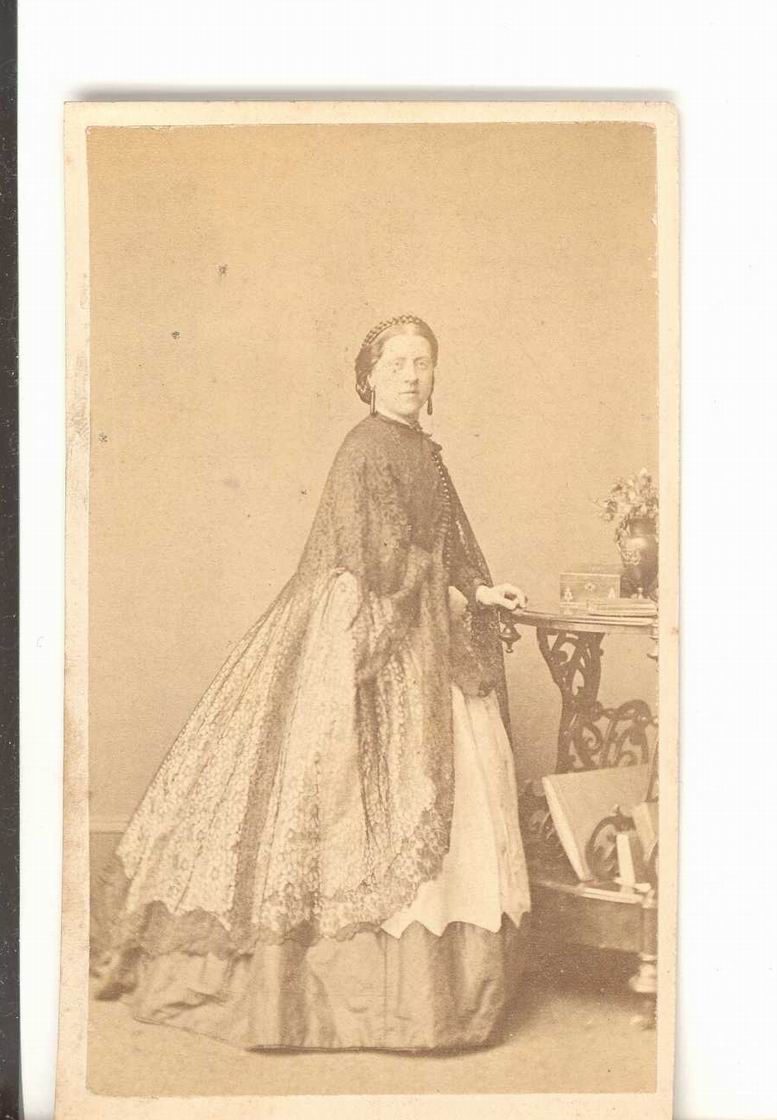
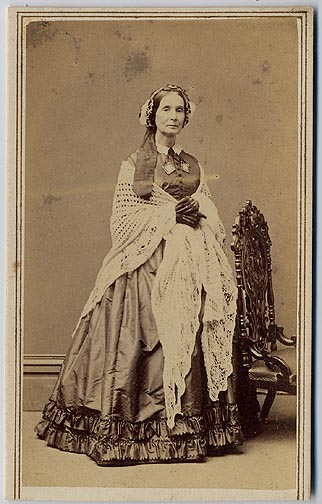
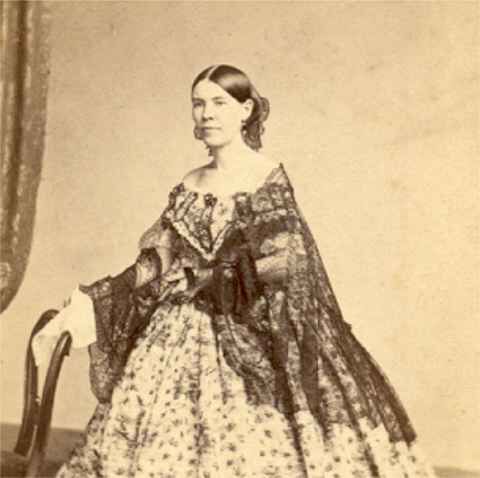
This woman, dressed in evening attire, wears a lace shawl on the edge of her shoulders

This woman wears her shawl high on the shoulders, rather close to the neck. It drapes down the front of her.

This woman wears her lace shawl on her shoulders while holds her dog with the shawl draped through the arms.

This lace shawl is held on the shoulders, fully covering the arms.

This lace shawl is held closed with arms.

This image is harder to see. It appears to me the shawl is held on the shoulders.

This shawl is draped off the back of the shoulders. I believe this is a posed wearing.

These women wear their shawls on their shoulders tucked high under their arms.

Painting, 1860 another painting


On the shoulders, held closed with pin or other item

This lace shawl is held closed at the neck.

This woman is seated, wearing an open neckline dress. The striped silk shawl drapes around her shoulders and is closed at the front.

This lace shawl is worn high on the shoulders to the neck where it appears to be pinned.

This paisley family shawl is folded square and pinned at the neck. It is unusual to see a shawl folded this way.

Just off the shoulders

This woman wears a loosely knit shawl just off her shoulders. She holds it closed with her hands. She appears to be in her 30s or 40s.

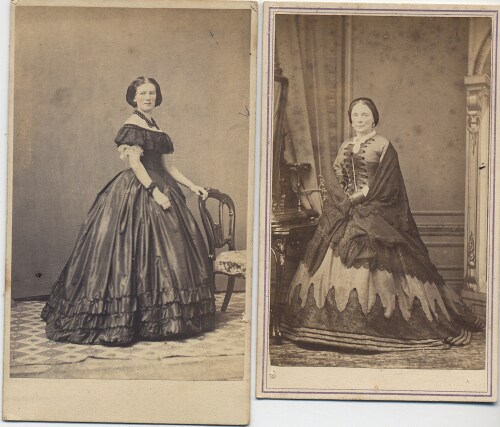
The woman on the right wears her shawl just off her shoulders and holds it closed low as she poses.

This shawl appears to be pinned in place. The woman is Cornelia Van Ness Roosevelt, taken in 1857.  I believe this is a posed wearing.

This woman wears her shawl with a paisley border just off her shoulder with a significant amount draped over her arms.

This shawl is worn just off the edge of the shoulders and held fully with the arms.

This is likely a later 40s or early 50s image based on the dress and bonnet. The shawl is one that could possibly have been made at home.

Woman wearing a knit shawl

Draped on mid-upper-arm

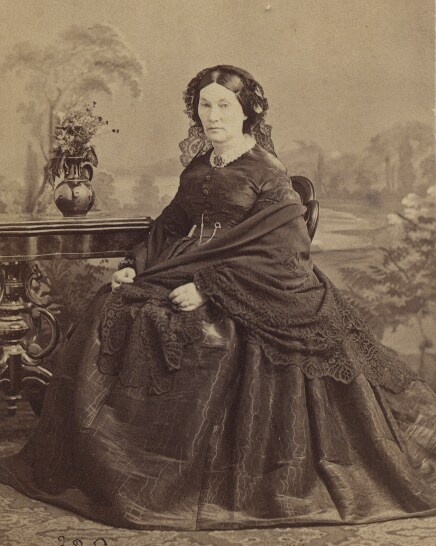
Lace shawl worn by a woman in her 40s or 50s, draped over her upper arms as she is seated.

 This lace shawl is worn on the upper arms. It is possibly a later 60s image based on the neckline.

On the arms/elbows

, draped low on the back, held at the elbows. Woman 20s or 30s.Solid shawl with possible border

This painting shows a woman, likely from the 1840s, in an open neckline day wear dress with her shawl draped around her arms loosely at the elbows.

Published in: on July 1, 2009 at 12:08 pm  Leave a Comment  

Straw for Men

(Update coming soonish)

 This will be a growing list. It will also move to the pages section on Straw Millinery.

1860s

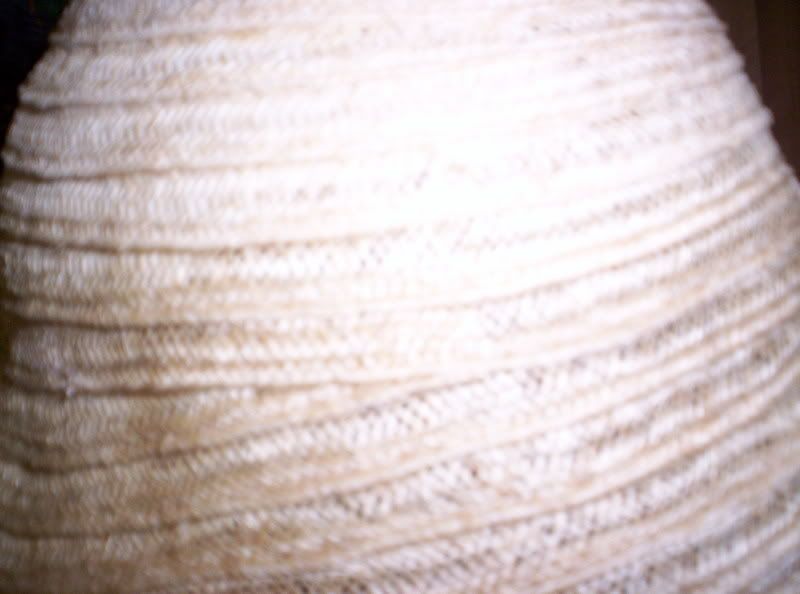
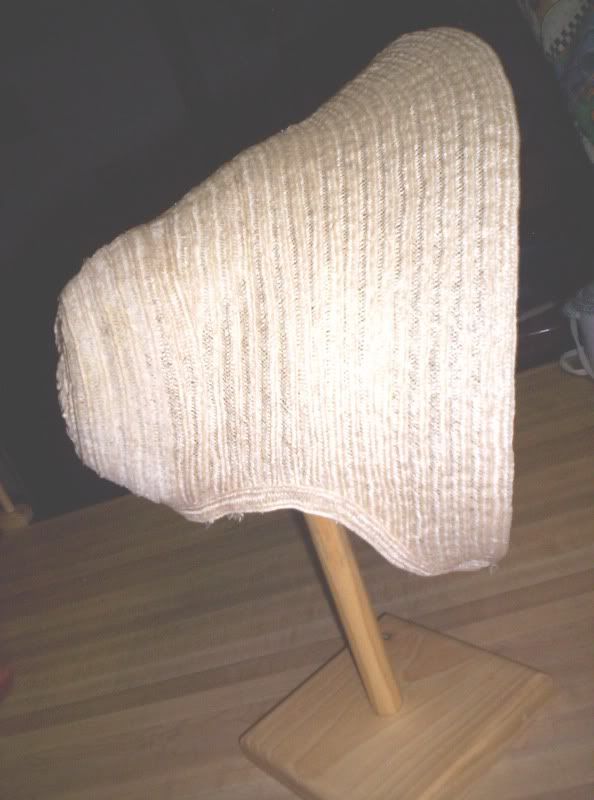
This image shows the interior of a straw  hat in hand.

Man with straw hat, c 1865

Trio of men c 1863, one with a straw hat on the right, possibly a second

I’m not sure if this is straw. I can sorta see lines suggesting it might be.

From Joseph Reed’s FB

 From Joseph Reed’s FB

1850s

MFA hat

Panama hat

I am pretty sure this is straw.

1840s

MFA straw hat

MFA straw hat

MFA 1840s straw hat

MFA hat, date tbd

MFA hat

MFA 1840

Earlier

MFA 1820-40

Later

Undetermined Date

Boy with straw hat in hand

Chris Utley’s straw hats at Southern Union Mills were brought to my attention. From the photos, it appears Chris has a good selection of straw hats for men. The shapes are nice, reflecting those of the mid-century. He uses a quality wheat straw with cotton thread and a pigskin sweatband. He also uses silk ribbon.

Another potential source is History in the Making. Though they have limited photos and examples shown.

There are few here at Optimo Hatworks under HCA that may work.

Published in: on July 1, 2009 at 11:59 am  Leave a Comment  

Straw Hats – Looking at Shaping

These images were originally for a discussion on the Sewing Academy. Since I am horribly disorganized at the moment, I am putting the files directly here. If I have included an image of yours you would like me to remove or give credit to, please let me know, I am very happy to do so.

10987654321This angle is nice for showing the difference in the width of the brim comparing the fronts to the sides. The sides also curve down.

2008-09-3019-09-03_0032

 Links:

http://www.flickr.com/photos/josefnovak33/2813904046/

hmmm on chair http://www.flickr.com/photos/piedmont_fossil/2218142840/

 Hats at the MET: 1840mid-century, they say 1860s I say late at best, 1859 (one of the coarser hats I’ve seen), 1850-59, different, also different (bias cut ribbons), 1866-68, 1866-68, late 1860s (woven), late 1860s, 1863-65,      

PeteJuly60 from PamPeteJune60 from PamPetersons Aug60Petersons July61 bPetersons July61

Published in: on July 1, 2009 at 11:56 am  Leave a Comment  

Pattern Review – Period Impressions’ Straw Bonnet Pattern

Some years back I was asked to revies the Period Impressions’ Straw Bonnet Pattern. These are the notes that were originally shared at that time.

 Initial observations regarding the materials and directions:

– The pattern is drawn for a low and high brim bonnet with a separate tip.

– The materials list includes additional items you will need to purchase – covered wire, thread, Fray Check and glue. Depending on where you purchase these, the cost will be $5-12 for these. 

– The straw plait is extra fine. It is very pretty. I like how the plait can be manipulated. On the brim and body of the bonnet, this plait easily adjusts for tension and width. The plait doesn’t need to be dampened for the body and brim. It does help for the crown coiling.

On a closer look at the plait, I am not sure if this is a period correct plaiting technique or straw splitting technique. Straw splitters make the strands flat to be braided individually or in pairs. The plait is very pretty in design that is fine. The cotton cording on either end is not something I have seen before.

There are some definite advantages to the flexibility of the plait. This is especially true when making the center of the point. But, since it is so fine and fiddly, it could be harder for a first-timer to work with. It would be easier for some one to make the bonnet from plain split straw of the same width. For this reason, I would suggest the buyer to purchase 18 to 20 yards of 1/2″ 5 or 7 strand split straw to use instead. This is more plait than provided by the kit because the amount provided in the kit is barely enough not allowing for error or flaws in the plait.

– I didn’t understand why Fray Check was included in the materials list at first because the plait I have worked with before didn’t fray. As I worked with the plait, I discovered it does fray at the ends. I would rather see the ends stitched together then Fray Check used.

– I like that they suggest dyeing the straw before hand if desired.

– The glue solution works well for a sizing on both the included plait and plain plait.
Notes on bonnet construction: 

– The suggested method of gathering the plait on one side with a running stitch for the crown is nice. The gathering may not work on plain plait. At the same time, I find it easier to coil the crown creating body with plain plait than this plait. This plait is very floppy.

– The directions at row 7 are different than what I do in that area. I start creating height in the brim further back in the crown. I don’t see directions to do this. In the area around row 7 from the front, I would normally pull the sides back a little while pushing the cheek tab forward a little. This usually takes place over 2 to 5 rows.

– It would be helpful for the transitional points to be marked on the pattern; where row 7 should land, where row 16 should land, etc.

– I don’t like how the cheektabs are shaped. They appear to square. (Admittedly, squared cheek tabs were one of my early mistakes.) There should be a graceful curve along the sides of the crown down into the cheektabs. You will want to look at original bonnets to see how the line should change to more of a curve.

– In the final two illustrations and directions, the “fall” doesn’t look to be right. It should reach further along the sides than illustrated. Look at original bonnets to see where the curtain and ties should be positioned.

– I kept pinning the template closed after each row to see how the plait sat. When I work in the round from back to front, I adjust the tension of the plait a good deal. This doesn’t work the same on the template working flat. The back side of each row of plait appeared looser than I would have liked. I started pulling the top/middle of each row a bit tighter.

– I ran a gathering stitch around the back of the body before attaching the back of the crown. This technique gives a nice transition between the two pieces.

– I ran out of plait after binding the raw edges. I would need about 20 inches more to have enough to cover the wire.

– Last but quite significant – When it came to ripping out the interfacing…. frustrated is a gentle word for what I felt. The stitches on the backside need to be very small for the interfacing to come off nicely. 

Additional thoughts:
– This bonnet needs wiring at the brim and sides for sure.

– I am a little worried about the glue sizing and the flexibility of the plait combined with high humidity and/or rain. I think this will be a “no rain” bonnet.

Images:

Prior to sizing

 I added a straw plait to the inner edge to strengthen

Published in: on July 1, 2009 at 11:53 am  Leave a Comment  

Examples of Shawls

Looking at original examples is a great way to train your eye when choosing a shawl for living history. Here are a few to look at. Keep in mind some can fit in multiple catagories. (THIS PAGE IS VERY MUCH IN PROGRESS)


Sheers

Indian, embroidered

Silk gauze printed

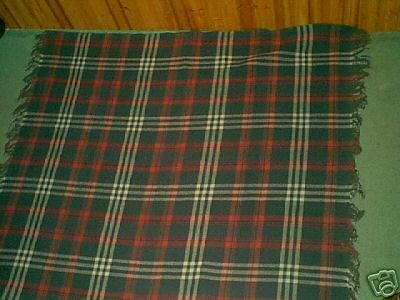
Mon0-tone border plaid

Border-stripe mono-tone

Plaids

Earlier, long/scarf shawl

 1840, British, silk

British, Silk, plaid and damask


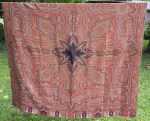
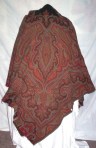
Paisley Family

ca 1870 (I say earlier) Scottish

mid-1800s Scottish

Paisley, Scottish 1830-50s

Scottish, mid-century, smaller motifs

1856, Scottish, Very unusual shape

ca. 1855 French

All over motif, 1850s possibly printed

1851 French, interesting design

1850s French

French, Zebra stripes

French and Indian

Double square, look at the center

First half of century, Turn-over shawl

Long shawl, Indian

Double square, Indian

Blue center

Border on white, Indian

Fold over

Kashmire, square

1840, India, could be mimiced

Kashmire/India

Mid-century Indian

Mid-century

British, mid-century

Great Stripe, Paisley Scotland

Scottish

ca 1866, bordered shawl, could be mimiced at home

British, ca 1850 all-over motif, could be printed

ca 60-65, double square, British

Listed as a mourning shawl, British, 40-50s

Love this one

1840s, Russian, Could be made at home by adding borders to red center

1860-70 paisley family

Listed at 1820. Yellow center with paisley type border. Could be recreated.

Paisley family

1853, stripe, weaver known

1865-69,

1855


Silk – Embroirdered, etc

White silk crepe, embroidered floral


Florals

1859 British, duo-tone

1830 borders

 Technically in the Paisley family, Norwich, England

 Paisley family, possibly French

Printed silk crepe

French printed wool

American printed wool

French or Italian printed on cotton

French or Italian printed on cotton, size suggests a scarf shawl

Lace

Black, American, Triangle, cotton

French, triangle cotton

lace, mid-century

British, 40s

French, cotton

1860s French

Belgian

Silk net and embroidery

Linen net and embroidery

Machine made lace

Printed

This might be printed, British

Later century printed

French printed wool

French printed

Scottish

Norwich, double-square boteh motif

Scottish, printed wool

c1850 printed small motif & border

c1840 printed paisley design

Knit

Knit

Unusual

British

French stripes

Published in: on July 1, 2009 at 11:34 am  Leave a Comment