How a Shawl Was Worn

How to wear a shawl

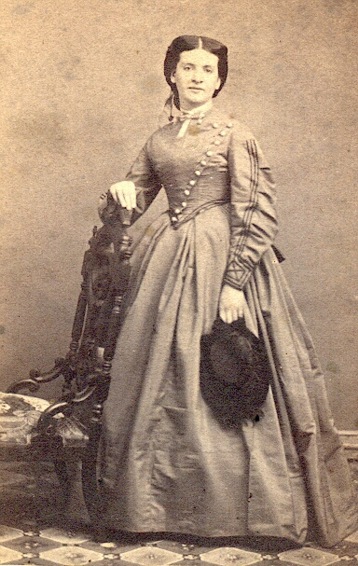
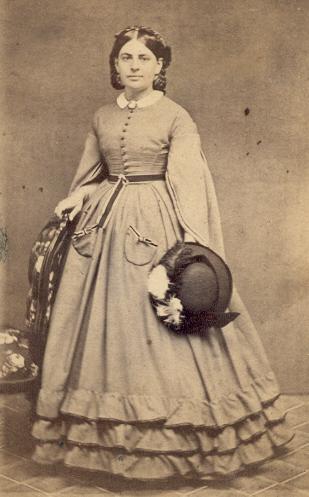
On the shoulders, draped open or held with the hands

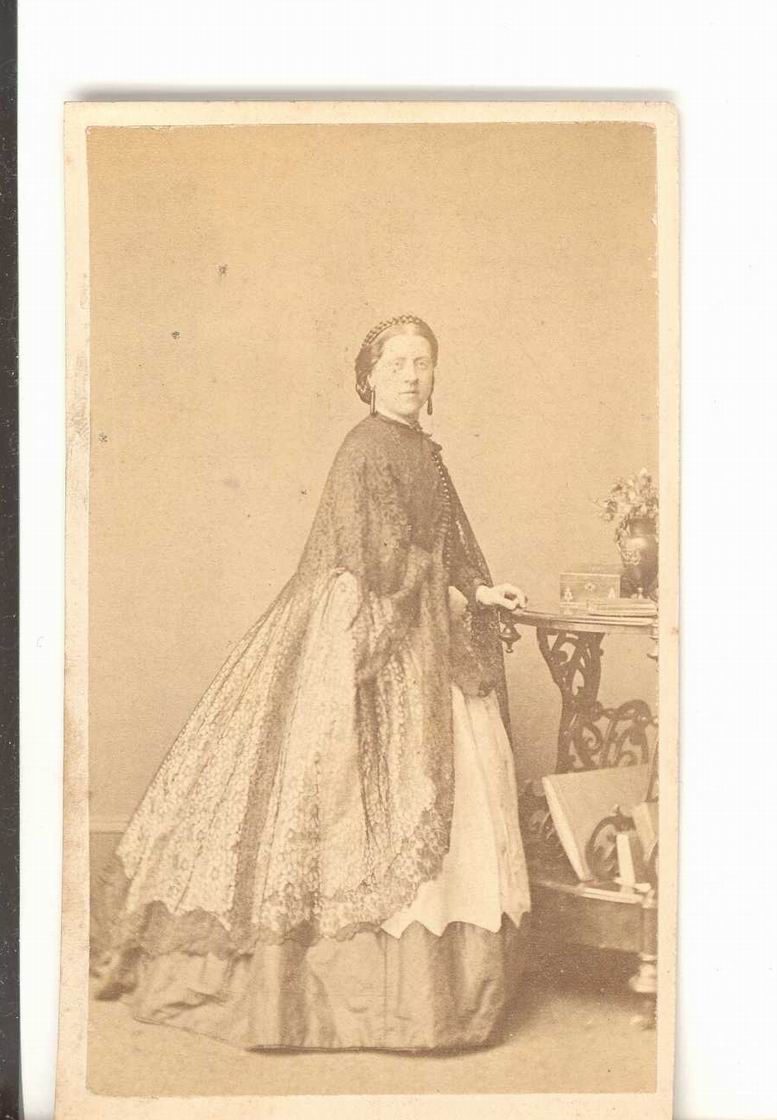
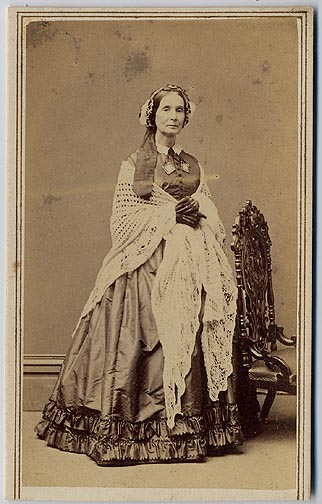
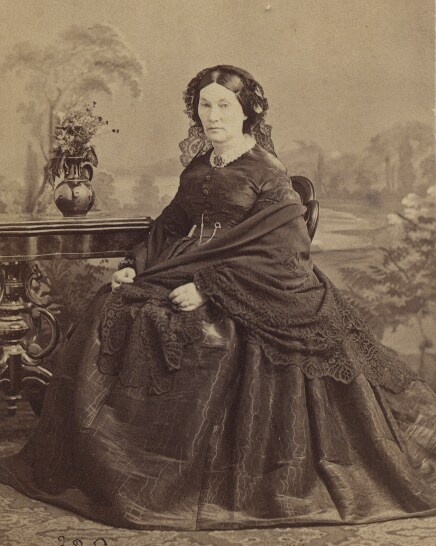
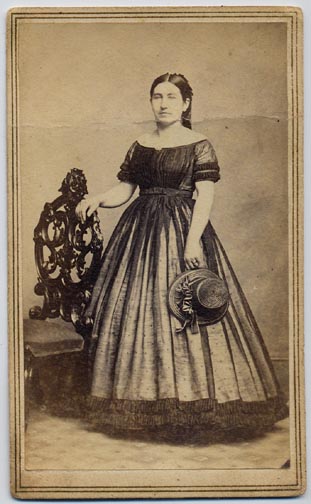
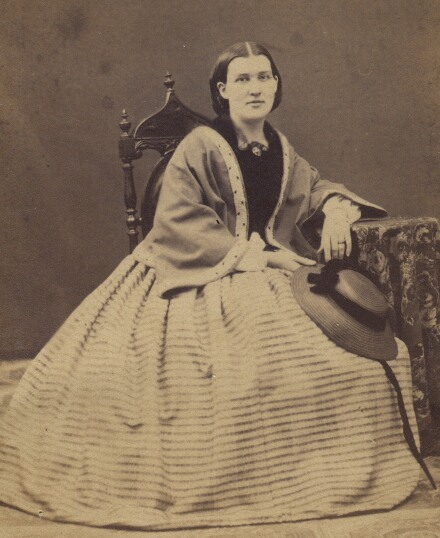
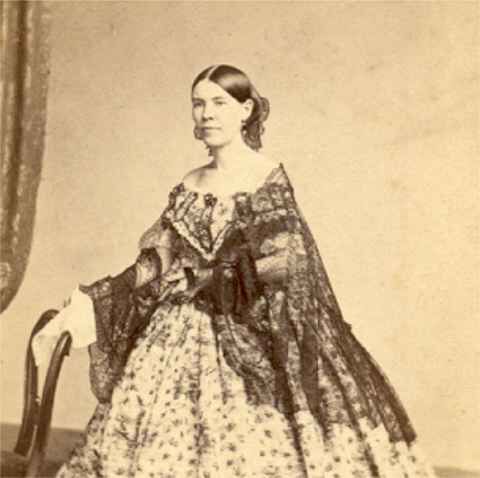
This woman, dressed in evening attire, wears a lace shawl on the edge of her shoulders

This woman wears her shawl high on the shoulders, rather close to the neck. It drapes down the front of her.

This woman wears her lace shawl on her shoulders while holds her dog with the shawl draped through the arms.

This lace shawl is held on the shoulders, fully covering the arms.

This lace shawl is held closed with arms.

This image is harder to see. It appears to me the shawl is held on the shoulders.

This shawl is draped off the back of the shoulders. I believe this is a posed wearing.

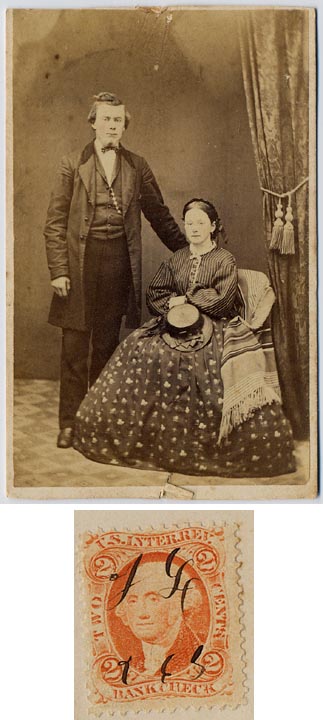
These women wear their shawls on their shoulders tucked high under their arms.

Painting, 1860 another painting


On the shoulders, held closed with pin or other item

This lace shawl is held closed at the neck.

This woman is seated, wearing an open neckline dress. The striped silk shawl drapes around her shoulders and is closed at the front.

This lace shawl is worn high on the shoulders to the neck where it appears to be pinned.

This paisley family shawl is folded square and pinned at the neck. It is unusual to see a shawl folded this way.

Just off the shoulders

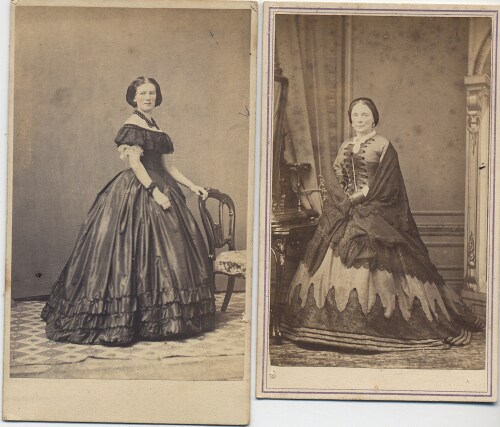
This woman wears a loosely knit shawl just off her shoulders. She holds it closed with her hands. She appears to be in her 30s or 40s.

The woman on the right wears her shawl just off her shoulders and holds it closed low as she poses.

This shawl appears to be pinned in place. The woman is Cornelia Van Ness Roosevelt, taken in 1857.  I believe this is a posed wearing.

This woman wears her shawl with a paisley border just off her shoulder with a significant amount draped over her arms.

This shawl is worn just off the edge of the shoulders and held fully with the arms.

This is likely a later 40s or early 50s image based on the dress and bonnet. The shawl is one that could possibly have been made at home.

Woman wearing a knit shawl

Draped on mid-upper-arm

Lace shawl worn by a woman in her 40s or 50s, draped over her upper arms as she is seated.

 This lace shawl is worn on the upper arms. It is possibly a later 60s image based on the neckline.

On the arms/elbows

, draped low on the back, held at the elbows. Woman 20s or 30s.Solid shawl with possible border

This painting shows a woman, likely from the 1840s, in an open neckline day wear dress with her shawl draped around her arms loosely at the elbows.

Published in: on July 1, 2009 at 12:08 pm  Leave a Comment  

Straw for Men

(Update coming soonish)

 This will be a growing list. It will also move to the pages section on Straw Millinery.

1860s

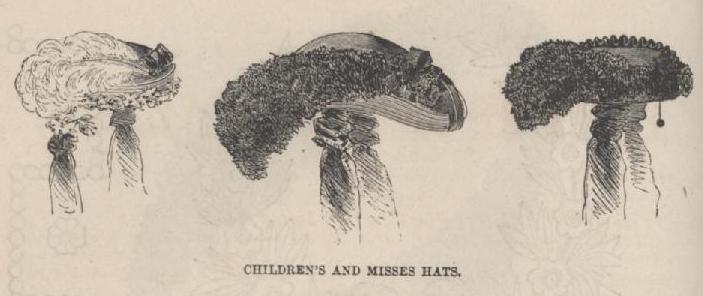
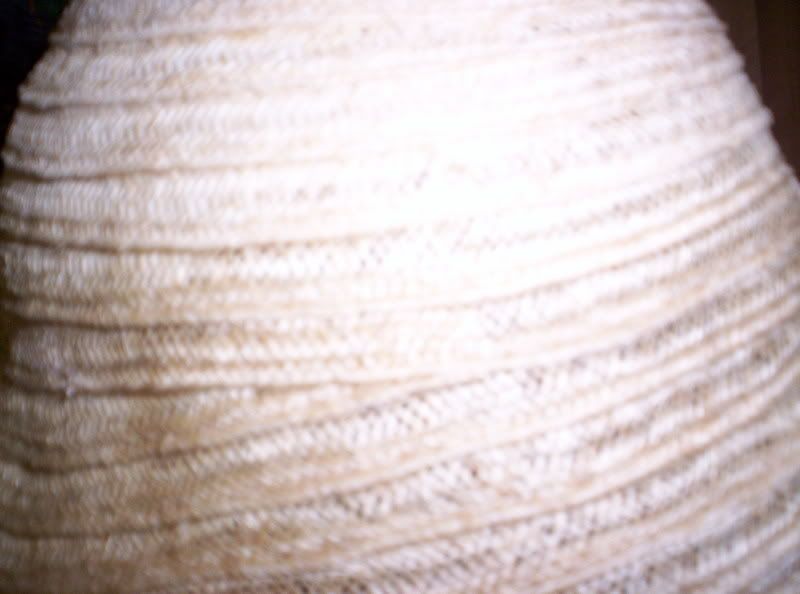
This image shows the interior of a straw  hat in hand.

Man with straw hat, c 1865

Trio of men c 1863, one with a straw hat on the right, possibly a second

I’m not sure if this is straw. I can sorta see lines suggesting it might be.

From Joseph Reed’s FB

 From Joseph Reed’s FB

1850s

MFA hat

Panama hat

I am pretty sure this is straw.

1840s

MFA straw hat

MFA straw hat

MFA 1840s straw hat

MFA hat, date tbd

MFA hat

MFA 1840

Earlier

MFA 1820-40

Later

Undetermined Date

Boy with straw hat in hand

Chris Utley’s straw hats at Southern Union Mills were brought to my attention. From the photos, it appears Chris has a good selection of straw hats for men. The shapes are nice, reflecting those of the mid-century. He uses a quality wheat straw with cotton thread and a pigskin sweatband. He also uses silk ribbon.

Another potential source is History in the Making. Though they have limited photos and examples shown.

There are few here at Optimo Hatworks under HCA that may work.

Published in: on July 1, 2009 at 11:59 am  Leave a Comment  

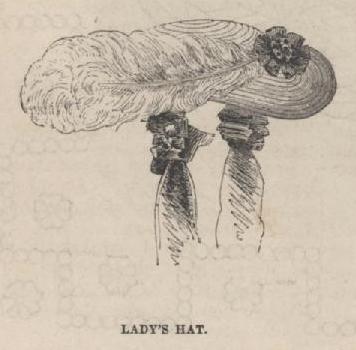
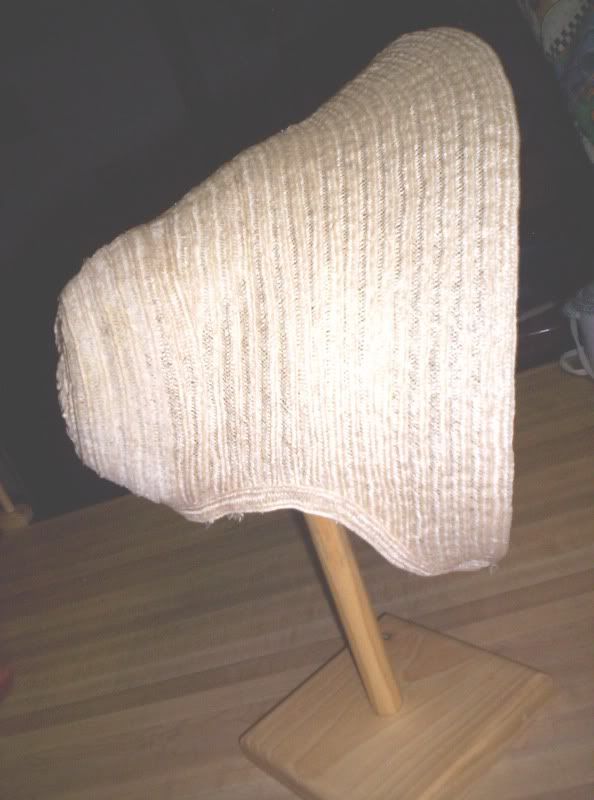
Straw Hats – Looking at Shaping

These images were originally for a discussion on the Sewing Academy. Since I am horribly disorganized at the moment, I am putting the files directly here. If I have included an image of yours you would like me to remove or give credit to, please let me know, I am very happy to do so.

10987654321This angle is nice for showing the difference in the width of the brim comparing the fronts to the sides. The sides also curve down.

2008-09-3019-09-03_0032

 Links:

http://www.flickr.com/photos/josefnovak33/2813904046/

hmmm on chair http://www.flickr.com/photos/piedmont_fossil/2218142840/

 Hats at the MET: 1840mid-century, they say 1860s I say late at best, 1859 (one of the coarser hats I’ve seen), 1850-59, different, also different (bias cut ribbons), 1866-68, 1866-68, late 1860s (woven), late 1860s, 1863-65,      

PeteJuly60 from PamPeteJune60 from PamPetersons Aug60Petersons July61 bPetersons July61

Published in: on July 1, 2009 at 11:56 am  Leave a Comment  

Pattern Review – Period Impressions’ Straw Bonnet Pattern

Some years back I was asked to revies the Period Impressions’ Straw Bonnet Pattern. These are the notes that were originally shared at that time.

 Initial observations regarding the materials and directions:

– The pattern is drawn for a low and high brim bonnet with a separate tip.

– The materials list includes additional items you will need to purchase – covered wire, thread, Fray Check and glue. Depending on where you purchase these, the cost will be $5-12 for these. 

– The straw plait is extra fine. It is very pretty. I like how the plait can be manipulated. On the brim and body of the bonnet, this plait easily adjusts for tension and width. The plait doesn’t need to be dampened for the body and brim. It does help for the crown coiling.

On a closer look at the plait, I am not sure if this is a period correct plaiting technique or straw splitting technique. Straw splitters make the strands flat to be braided individually or in pairs. The plait is very pretty in design that is fine. The cotton cording on either end is not something I have seen before.

There are some definite advantages to the flexibility of the plait. This is especially true when making the center of the point. But, since it is so fine and fiddly, it could be harder for a first-timer to work with. It would be easier for some one to make the bonnet from plain split straw of the same width. For this reason, I would suggest the buyer to purchase 18 to 20 yards of 1/2″ 5 or 7 strand split straw to use instead. This is more plait than provided by the kit because the amount provided in the kit is barely enough not allowing for error or flaws in the plait.

– I didn’t understand why Fray Check was included in the materials list at first because the plait I have worked with before didn’t fray. As I worked with the plait, I discovered it does fray at the ends. I would rather see the ends stitched together then Fray Check used.

– I like that they suggest dyeing the straw before hand if desired.

– The glue solution works well for a sizing on both the included plait and plain plait.
Notes on bonnet construction: 

– The suggested method of gathering the plait on one side with a running stitch for the crown is nice. The gathering may not work on plain plait. At the same time, I find it easier to coil the crown creating body with plain plait than this plait. This plait is very floppy.

– The directions at row 7 are different than what I do in that area. I start creating height in the brim further back in the crown. I don’t see directions to do this. In the area around row 7 from the front, I would normally pull the sides back a little while pushing the cheek tab forward a little. This usually takes place over 2 to 5 rows.

– It would be helpful for the transitional points to be marked on the pattern; where row 7 should land, where row 16 should land, etc.

– I don’t like how the cheektabs are shaped. They appear to square. (Admittedly, squared cheek tabs were one of my early mistakes.) There should be a graceful curve along the sides of the crown down into the cheektabs. You will want to look at original bonnets to see how the line should change to more of a curve.

– In the final two illustrations and directions, the “fall” doesn’t look to be right. It should reach further along the sides than illustrated. Look at original bonnets to see where the curtain and ties should be positioned.

– I kept pinning the template closed after each row to see how the plait sat. When I work in the round from back to front, I adjust the tension of the plait a good deal. This doesn’t work the same on the template working flat. The back side of each row of plait appeared looser than I would have liked. I started pulling the top/middle of each row a bit tighter.

– I ran a gathering stitch around the back of the body before attaching the back of the crown. This technique gives a nice transition between the two pieces.

– I ran out of plait after binding the raw edges. I would need about 20 inches more to have enough to cover the wire.

– Last but quite significant – When it came to ripping out the interfacing…. frustrated is a gentle word for what I felt. The stitches on the backside need to be very small for the interfacing to come off nicely. 

Additional thoughts:
– This bonnet needs wiring at the brim and sides for sure.

– I am a little worried about the glue sizing and the flexibility of the plait combined with high humidity and/or rain. I think this will be a “no rain” bonnet.

Images:

Prior to sizing

 I added a straw plait to the inner edge to strengthen

Published in: on July 1, 2009 at 11:53 am  Leave a Comment  

Examples of Shawls

Looking at original examples is a great way to train your eye when choosing a shawl for living history. Here are a few to look at. Keep in mind some can fit in multiple catagories. (THIS PAGE IS VERY MUCH IN PROGRESS)


Sheers

Indian, embroidered

Silk gauze printed

Mon0-tone border plaid

Border-stripe mono-tone

Plaids

Earlier, long/scarf shawl

 1840, British, silk

British, Silk, plaid and damask


Paisley Family

ca 1870 (I say earlier) Scottish

mid-1800s Scottish

Paisley, Scottish 1830-50s

Scottish, mid-century, smaller motifs

1856, Scottish, Very unusual shape

ca. 1855 French

All over motif, 1850s possibly printed

1851 French, interesting design

1850s French

French, Zebra stripes

French and Indian

Double square, look at the center

First half of century, Turn-over shawl

Long shawl, Indian

Double square, Indian

Blue center

Border on white, Indian

Fold over

Kashmire, square

1840, India, could be mimiced

Kashmire/India

Mid-century Indian

Mid-century

British, mid-century

Great Stripe, Paisley Scotland

Scottish

ca 1866, bordered shawl, could be mimiced at home

British, ca 1850 all-over motif, could be printed

ca 60-65, double square, British

Listed as a mourning shawl, British, 40-50s

Love this one

1840s, Russian, Could be made at home by adding borders to red center

1860-70 paisley family

Listed at 1820. Yellow center with paisley type border. Could be recreated.

Paisley family

1853, stripe, weaver known

1865-69,

1855


Silk – Embroirdered, etc

White silk crepe, embroidered floral


Florals

1859 British, duo-tone

1830 borders

 Technically in the Paisley family, Norwich, England

 Paisley family, possibly French

Printed silk crepe

French printed wool

American printed wool

French or Italian printed on cotton

French or Italian printed on cotton, size suggests a scarf shawl

Lace

Black, American, Triangle, cotton

French, triangle cotton

lace, mid-century

British, 40s

French, cotton

1860s French

Belgian

Silk net and embroidery

Linen net and embroidery

Machine made lace

Printed

This might be printed, British

Later century printed

French printed wool

French printed

Scottish

Norwich, double-square boteh motif

Scottish, printed wool

c1850 printed small motif & border

c1840 printed paisley design

Knit

Knit

Unusual

British

French stripes

Published in: on July 1, 2009 at 11:34 am  Leave a Comment  

Shawl Basics

For more in-depth information, read Paisley, Plaid, & Purled: Shawls of the Mid-Nineteenth Century
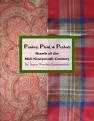
PPandP book cover

—————————————————————————————

Shawls for Historic Interpretation

Kashmir,  Paisley and Paisley-type Shawls
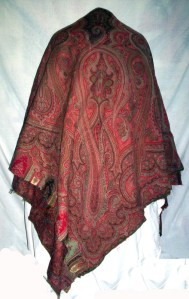
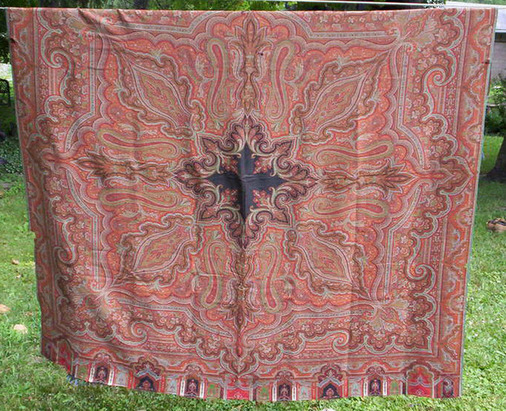
Paisley family shawl, possibly French

Fibers, weave and size: These shawls should ideally be made of hair brushed from the Kashmir/cashmere goat or from a wool and silk blend. The silk should be the warp or blended into the wool in a small amount. Avoid shawls with a rayon or acetate blended with the wool. Original Kashmirs are very light weight because of the tapestry twill weave. I have yet to be able to compare the weights of original and new. Look for sizes around 64 inches square or 64×128 inches as a double square.

Design: When looking for an Paisley shawl, look for a strong cone motif. The cone motifs should radiate out from a center field of black, white or red. These radiating motives create a star or spoked flower appearance from a distance.  The spokes should be connected with ribbon like borders consisting of small floral motives. By our era a newer shawl would have a smallish center. But, the higher cost of these shawls along with their durability means it would not be unlikely for a grown woman to have a shawl with a larger center from her youth. The outer border can be on two or four sides. This borer should be comprised of smaller designs brought together in the border. Kashmir borders will have more independent blocks of design while French borders will visually entwine each block with it’s neighbor.

Two other design options include the striped shawl and the border shawl.

Where to look: There are some nice shawls coming out of India. Many of these are available on online and via Ebay for various prices. When doing an online search use “Paisley Shawl” or “Cashmere Shawl” or “Antique Shawl” for your key words.

(note: I have read several 1990’s news stories regarding the skinning of goats for their under-coat hair, which is used to make shawls, thus endagering the goats. While shopping be sure to find a merchant you are confidant in.)

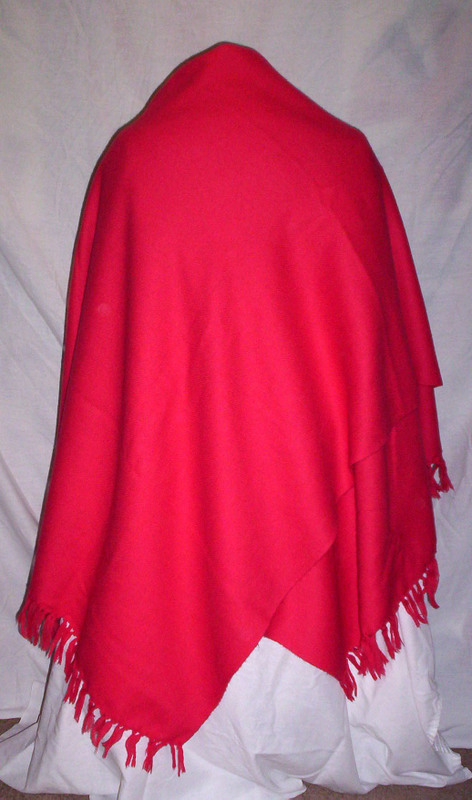
Woven shawls Red Wool Shawl
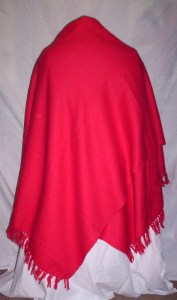
Fibers, weave and size: Wool or wool/silk blends. These should also be 64 inches square or 64 inches by 128 double square. A shawl relatively near these dimensions will look nice. The weave should be a tight plain or twill weave. The shawl can range from light weight to rather heavy if hand-woven.

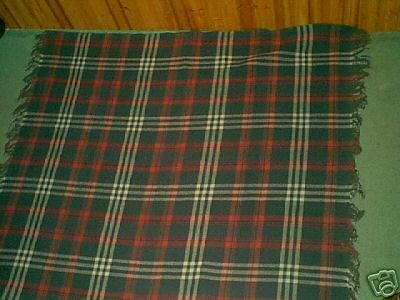
Design : Look for solids, checks, plaids (preferably symmetrical) stripes and border plaids.
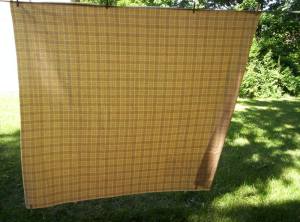
Golden yellow plaid shawl with detailWhere to look: This is a type of shawl you can make yourself. Many Museums offer weaving classes thru-out the year. You can also make a fabric shawl from woven wool lengths. You will need a dress weight to coat weight wool rather than a heavy weight  in a 54 inch to 60 inch width. Plain woven fabric and plaid woven fabrics work well. The yardage can fringed on the end by unravelling the ends by hand. To calculate your yardage, decide if you want a square or double square shawl and how long you wish your fringe to be on the ends. For a square shawl, purchase the width of the fabric plus 6 to 12 inches for fringe. For example: if you want a double square shawl out of 60 inch wide fabric purchase 130 inches for a 120 inch shawl with 5 inch fringe.  (see the article on fringing a shawl)

Printed shawls

Fibers, weave and size: Printed shawls come in wool, cotton and blends of wool, silk and cotton. Ideally, you would find a 64 inch square shawl, but the common 55 inch square shawl is not bad.

Design: Printed shawls vary by region. Look for period motifs and borders.

Where to look:  The Russian Pavlovo Posad company still makes printed shawls in their 19th century designs. There are several sellers listing these on ebay and more on the web. I am still trying to find a direct link to the company. I may have to settle with a regular address and phone number. Use “Pavlovo Shawls” or “Russian Shawls” for your internet search.

Sheer Shawls – Muslin Shawls, Grenadine & Barege

Fibers, weave and size: I still have not found sheer shawls that I like. These were silk, wool or cotton. They frequently had a plain central field and a stripe border creating a plaid motif.

Lawn, Gauze, Voile, Silk Organza & Batiste fabrics can be used to make a sheer shawl. The edges would need to be hand finished with a rolled hem. This isn’t what original shawls have though. You may want to starch the fabric as well. You can add tucks to the border or ribbon to the border or edge.  

Design:: Plain, woven plaids, woven checks, woven border plaids.

Where to look: – Online fabric merchants including Exclusive Silks and Fashion Fabric Club

Silk Shawls

Fibers, weave and size: I have not yet found the ideal silk shawl. Thai Silks has larger white shawls in their scarf section. These are a little smaller than ideal, but may suit your needs.

To make your own shawl, you want a durable silk, in the 64inch square range, no slubs with or without fringing. Look for a taffeta, china or habotai silk. Do not use satin.  I have seen solid color, shot (or changable silk) and patterned silk shawls. A couple of the India, China and Thai merchants sell nice silk shawls. I tend to think play it safe for silk shawls and go for simple. Also, many list as silk but are selling Viscose.

Design:: If you want to embroider your shawl, I highly suggest looking extensively at originals.

Embroidered China Crape

There are some fabulously beautiful embroidered shawls out there… but only a few designs are suitable. I occasionally pick through ebay to see what is out there. It is rare I find something that meets size, design, quality and fiber standards. But it is possible.

http://www.qualinsilk.com/servlet/the-85/Silk-Shawl–dsh–Hand/Detail Has a few that I like. These cost in the $180 area.

http://raspberryberet.com/xlmantons.html I was surprised to find there are a couple shawls I like on the flamanco sites. These are in the $200+ for the larger shawls and $169 for the smaller piano shawls.

Lace Shawls

Sadly, every modern lace shawl I have seen is a synthetic. I may not have found the right maker. I suspect the prices may be quite high.

Crochet and Knitted Shawls

Great thing about these is you can make them your own. There are several patterns available in magazines and guide books. Many of these patterns are available digitally through Accessible Archives and online from various sites.

If you are purchasing a shawl, be sure to ask where the pattern design came from and what fibers the shawl is made out of. The shawl patterns above are worked in wool or silk.

Orenburg Lace Shawls

Fibers, weave and size – These should be 100% wool

Design – See originals

Where to look: – These are available from the same places the Pavlavo shawls are available. But not all are 100% wool. These should be square and very, very fine. The idea is they could fit through a wedding band. Most of the ones I see listed on Ebay don’t look like they have been blocked (set to the square shape.)

Sizes & Shapes:

  • Square shawls should be in the range of 55 inches to 70 inches square with 64 inches square being standard.
  • Long shawls are double squares, sometimes called plaids, which should be 55 inches wide by 110 inches long to 70 inches wide by 140 inches long with 64 inches wide by 128 inches long being the most common.
  • Three-quarter shawls are 3/4ths the width and 3/4ths length of a standard double square shawl. A three-quarter shawl would be 48 inches wide by 96 inches long.
  • Scarves are much longer than they are wide. A shawl 3 feet by 9 feet would be considered a scarf. These were more popular earlier in the 19th century.

The exceptions to these standard sizes include lace, knit or crochet shawls.

Next, consider weight. One of the mistakes I observe is the use of wool which is more of a blanket weight than a shawl weight. The weight of fabric is determined in ounces per linear yard. If you want to think of wool weights in terms of modern suit weights, a tropical weight is the lightest and regular is generally the fabric worn for a winter suit.
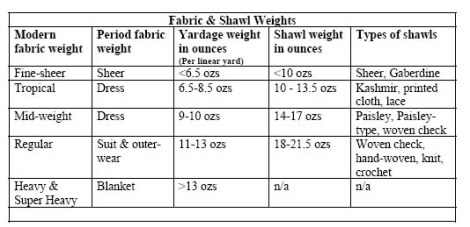
weights-chart

Paisley family shawl, possibly Scottish

Shawl Terms

Border Pattern Pattern that is predominantly in the border area around the field. This pattern is very visible when worn in a triangle over the shoulders.

Cashmire French word for shawls with the pine pattern both of Oriental and European origin.

Chenille Shawl A shawl of Paisley, Scotland invention with a comprised of tufted silk, wool or cotton. This shawl was briefly fashionable in the 1820s but was un-washable. (Reilly, p.34)

Damask Shawl Reversible pattern with alternating colors on opposite sides made with a different color warp and weft. (Reilly p.34)

Diagonal Shawl Square crepe shawls with two different embroidered designs on opposite triangular halves. (Worth p. 52)

Kashmir
1. Providence in India. 2. Shawl made by weavers in the Kashmir.
Kirking Shawl A white centered shawl given as a wedding gift to be worn to church the first Sunday after the wedding.

Medallions Motive combinations located in corners, ends or centers of a shawl.

Paisley 1. The town of Paisley in Scotland. 2. The shawl with the cone or pine motif made in Paisley. 3. The individual design of a single pine or cone motif. 4. Overall design comprised of multiple pine motives. Green Plaid Wool Shawl

Plaid 1. Rectangular, double square shawl that came into fashion in the 1840s with the crinoline skirt. “A new size of shawl, called the plaid, was produced.”(Reilly, p8.) 2. Tartan based design of alternating warp and weft threads.

Pine motive or Cone motive Basic flower design surrounded by a border in a tear shape . This is the design we have come to identify as the “paisley”. In India it was call “Buta” meaning “flower”. Kashmir designs tend to have a short, simple, plump pine while European designs became more elongated and stylized.

Point Shawl A triangular half shawl; generally a shawl of lace, knit or domestic make. Some shawls are described as single, double or triple point.

Reversible Shawl A woven paisley type shawl with the same design on both sides. Not being made until 1865.

Standard nineteenth century shawl dimensions “The long shawls being more esteemed than the square ones, and considered articles of luxury, it is by no means unusual for dealers to cut the former in two, in order to evade the higher duty, and to have the two halves fine-drawn together afterwards.” (Scientific American, December, 7 1850).

Scarf or Stole Shawl – Primarily ornamental – 9 feet x 20 inches Square Shawl – Up to 6 feet x 6 feet Handkerchief Shawls – 3 feet x 3 feet (called so due to customs fees) Plaid Shawl or Long Shawl or Double Square Shawl – 10 feet x 5 feet Three-quarter Plaid Shawl – 8 feet x 4 feet

Turn-over Shawl A shawl that when folded in a triangle, shows all four finished borders. This is done by attaching 2 borders on the right side and 2 on the wrong side.

Zebra-Stripe Shawl A striped shawl with a floral or paisley motive in the stripes, which was fashionable throughout the 1800s. (Reilly p. 36)


Published in: on July 1, 2009 at 11:29 am  Comments (2)  

Fringing Shawls

Fringe Frustration
Fringing Your Wool Shawl:

A Guide to Fringing Your Wool Fabric Shawl

My fringe frustration comes after working many hours on my new red shawl. I carefully found the weft grain and fringed for hours, and hour just to find in the end my shawl is not square. Thus, the title fringe frustration.

Most shawls of the early Victorian era were fringed on two or four sides. This applies to wool, silk and cotton shawls. As a shawl’s fringe was often made from it’s warp and weft threads, a squared shawl was fringed on the grain. The shawls I have observed have had fringe ranging from 3 inches to 10 inches in length. Personally, I find the longer fringe pretty but difficult to live with.

Helpful hints before you start
– Make sure you purchase plenty of extra length to work with. I often find merchants do not cut along the grain. If your fabric is not cut on the grain you will lose length on one or both ends.
– Have a lint basket near-by. This works much easier than a bag.
– You might also want a lint brush to clean up with.
– Pick up your favorite movie or audio-book from the library. You will need several hours of video or audio.

Purchasing Your Fabric
For a square shawl, you will need the width of the fabric, plus twice the length of fringe, plus waste.
———- For example: The fabric width is 60″. You want 5″ fringe on each end. There is approx. 1.5″ waste on each end. You will need 60″+10″+3″= 73 inches.
For a long shawl or double square shawl, you will need twice the width of the fabric, plus twice the length of the fringe, plus waste.
——— For example: The fabric is 60″. You want 6″ fringe. There is approx. 1.5″ waste on each end. You will need 120″+12″+3″=135″.
If you are working with a plaid, stripe or check fabric, you may need additional length in order to have a balanced design. Be sure to lay your fabric out on the cutting counter to double check you measurements.

Step One – Find the grain
I find it easiest to work along the grain of the fabric as I fringe. But, as I learned with the red shawl, make certain your fabric is square first.
To do this, snip the fabric at the selvedge about a half inch from the cut end and tear along the weft. This will create a straight line along the weft. Do this at both ends. Lay the fabric out flat. Each corner should form a 90 degree angle. With in the fabric, the weft should run perpendicular to the warp. If there is a small difference consider squaring your fabric. (see below)
At one cut end of the fabric, measure in from the end the desired length of your fringe. Mark your measurements along the width of the fabric. Repeat this at the opposite end of the fabric.
Using a seam ripper or embroidery scissors, carefully snip the weft thread that passes through these markings.
With a thick needle or small crochet hook, carefully remove this weft thread. The space created by removing this thread becomes your measurement guide in the next step. If this line is not easy to see, remove a second weft thread in the same way.
Repeat this process at the other cut end of fabric.
This image shows a green shawl where the weft threads have been removed:

Step Two – Sectioning
It is easier to fringe in sections rather than lengths. Make cuts, dividing the width of the fabric into 2 inch sections. To do this – Cut along the warp threads from the cut end of fabric to the removed weft line you created above. Repeat this on the opposite end.

Step Three – Fringing
Here is the fun part! Put a movie or audio book in the player. Using your fingers, large needle, crochet hook or anything you think might help, remove the weft threads from each section. I find it easier to alternate from working vertically to working horizontally removing threads.

Step Four – Finishing
You can finish your fringe in a few ways; knotting, hand stitching, or working a weft thread back through the fabric.
One of the simplest ways to finish as shawl is to stitch along the fringed edge. Using a matching thread, make a sort-of back-stitch and whip-stich combination along where the fringe meets the fabric. Go forward 5-7 warp threads at the fabric edge, then back three threads and up tree warp threads, catch the stitch and go forward. This sounds much more complicated than it is. Picture to come.
A method used before taking a shawl off the loom is to work the weft thread back through the edge. This process could be attempted if you can save enough of your weft thread. I have not yet tried this.
For knotting your fringe, I suggest an over-hand knot (as you would knot the end of thread) instead of a square knot (as you would start your shoe laces), because a square knot tends to pull threads together creating a puckered look. If you are going to do multiple layers of knots, creating a nice diamond pattern, I suggest starting with an over hand knot than continuing with a square knot for a flat diamond pattern.
This image shows fringe from warp threads that were knotted as the scarf shawl was removed from the loom:

This image shows fringe knotted with an over-hand knot:

Squaring your fabric
You will need a large, flat, traffic free space for this. Double check prior to doing this that your fabric is color fast. Otherwise you may stain the drying surface. At each end of your fabric, snip at the selvedge and tear the fabric along the weft threads. Do this at each end. This will create a straight edge along the weft. Wet your wool fabric. Do not agitate it as this can cause your wool to shrink. Press out excess water. Lay the fabric out flat using a quilter’s rule to square the edges. Place weigh (jars of food work well) on each corner and side. Allow your fabric to dry. Go back to step one.

Published in: on July 1, 2009 at 11:22 am  Comments (2)  
Tags:

Sewing Cases, Needle-books and Housewives

To learn how to make your own sewing case or housewife based on original sewing cases, please see  my new book, Fanciful Utility: Victorian Sewing Cases and Needle-books.

FanU-Cover-Snap

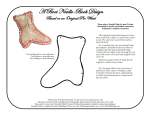
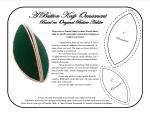
To accompany Fanciful Utility, you will find free templates for additional sewing accessories posted on my blog through the year. Please check out each of these templates as well as those available on the Sewing Academy blog.

Boot Template Keep Ornament shell temp

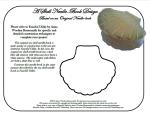
New Thumbnails scissors case

I am happy to offer sewing cases and needle-books for sale. Please check my Etsy Shop for what is available. I will also custom make sewing cases. (Check out Barbara’s sewing case.)

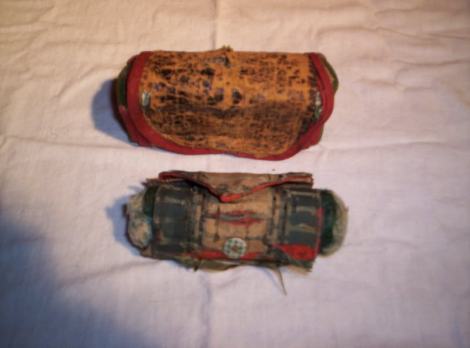
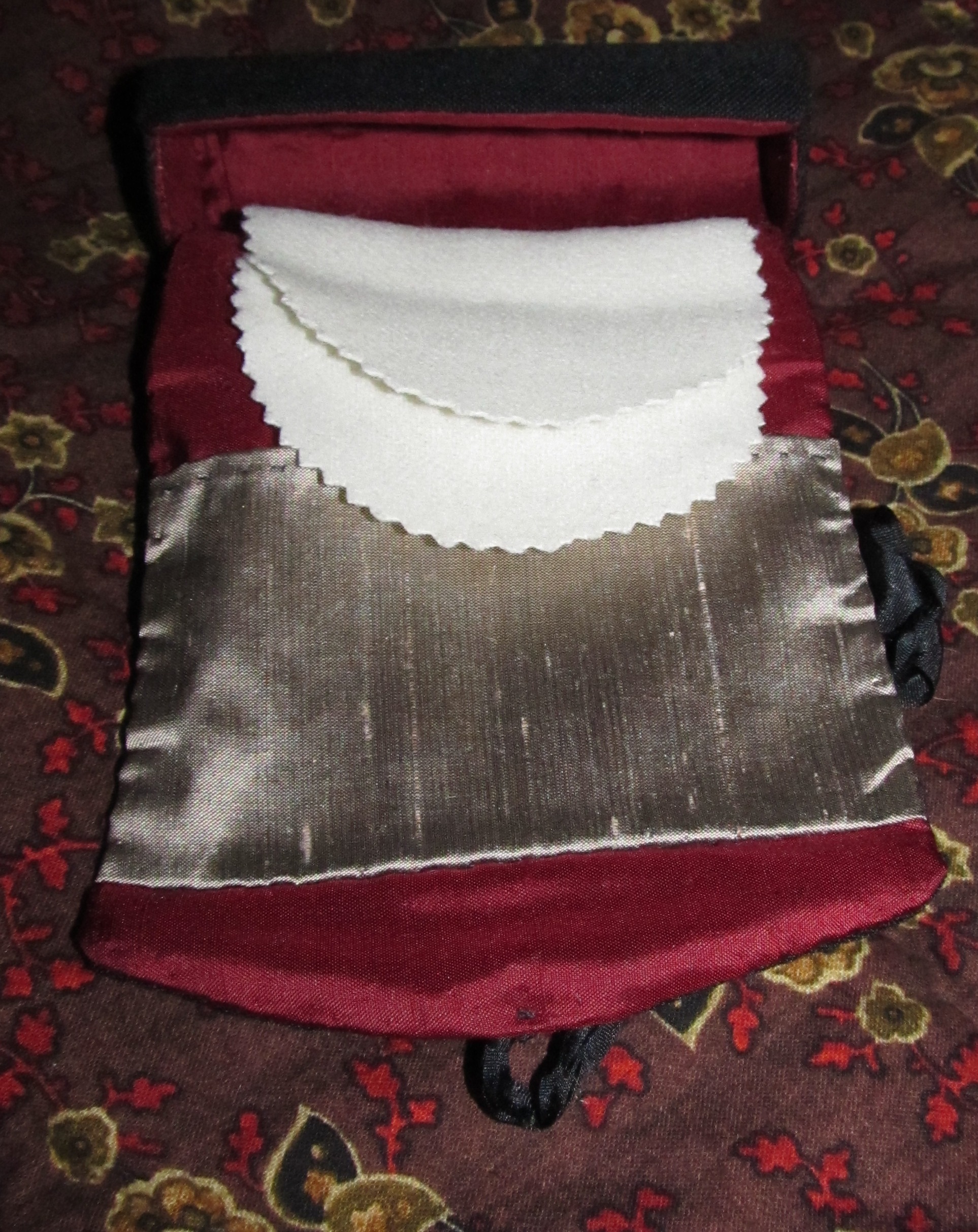
Original sewing cases closed. At the top is the structured sewing case also shown open. At the bottom is a rolled case with a 4” wide ribbon on the outside, silk on the inside and held closed with the calico button.

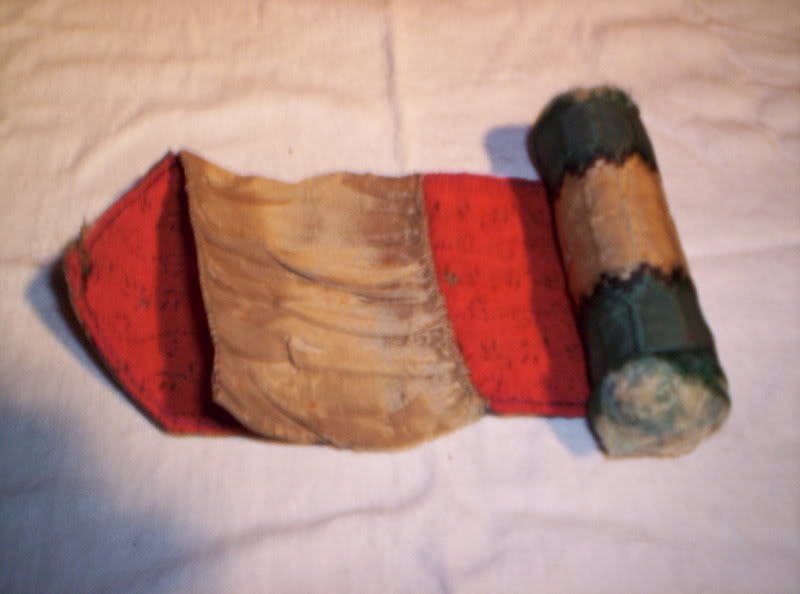
Rolled case shown open. The exterior is a 4″ wide ribbon. The inside is a small print wool with a silk pocket. The needle-pages are missing.

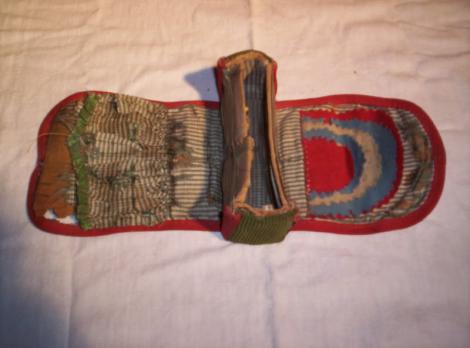
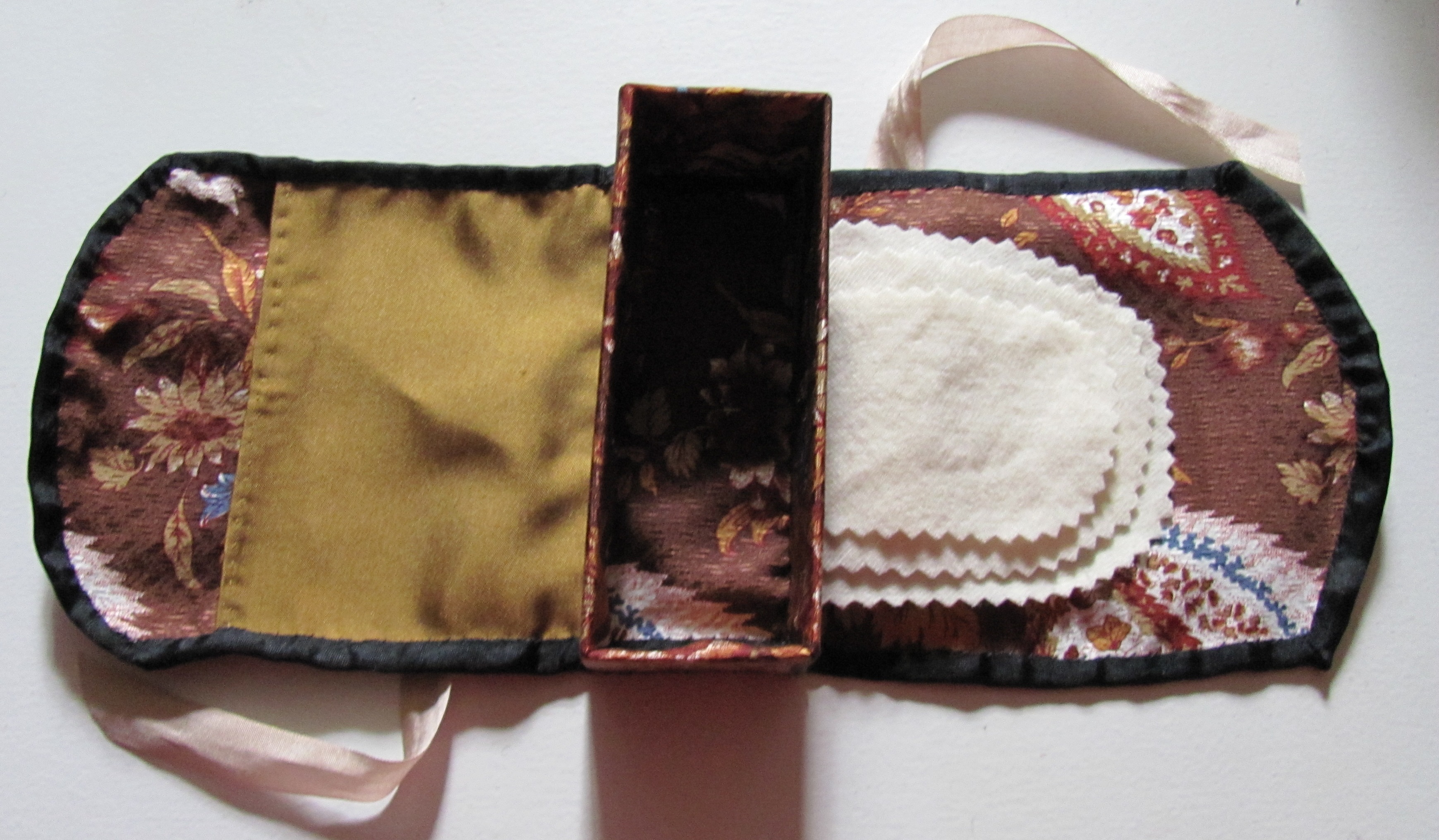
Original fold-over sewing case with a central covered pasteboard box, multi-colored needle pages, and silk pocket. The exterior is a black leather bound with wool tape.

Fold-over style sewing case based on the original sewing case above. This one has a cotton interior and mono-chromatic pages.

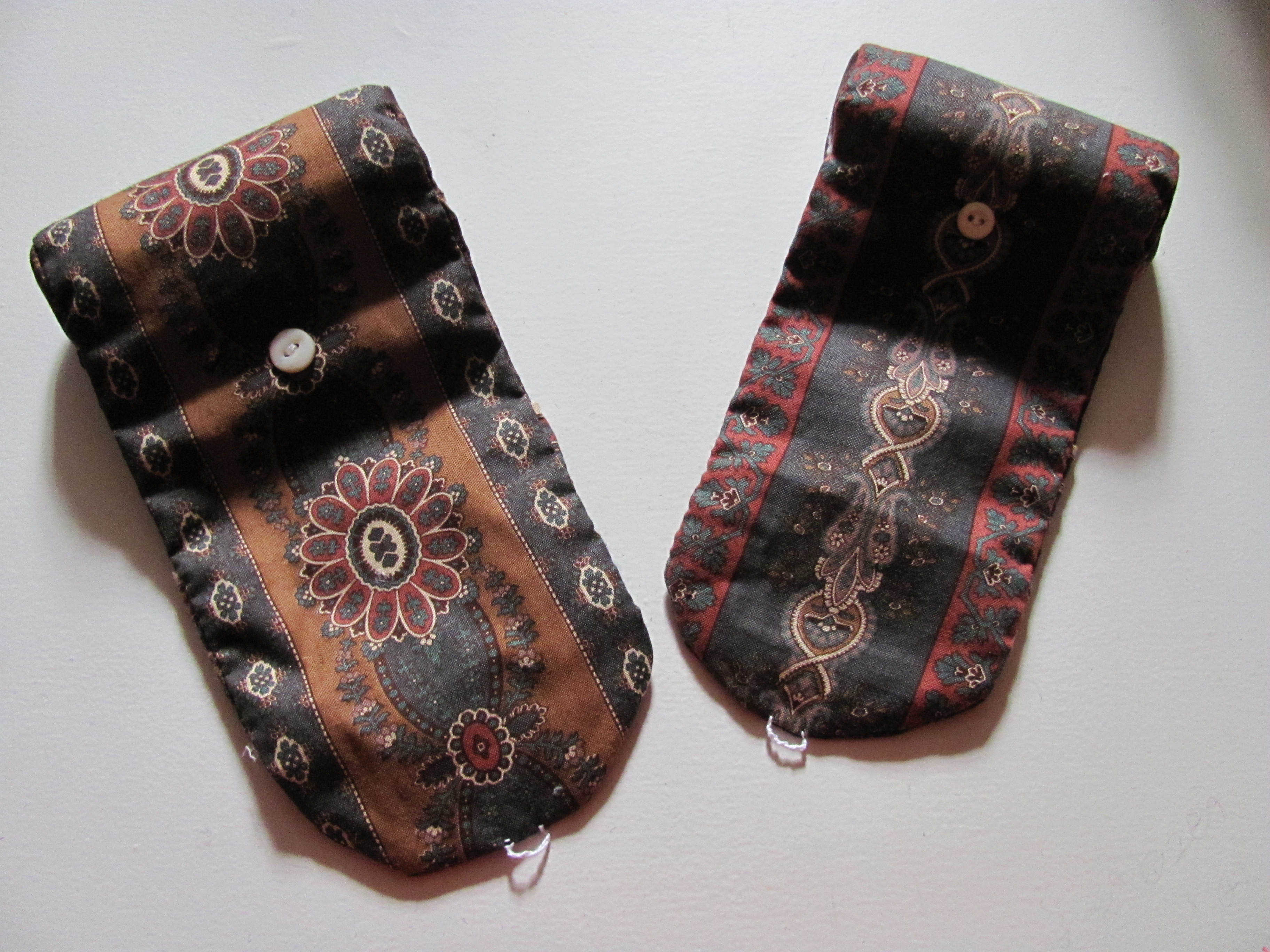
Rolled cases in the style of many original cases. These two cases are made of cotton inside and out with wool pages and MOP buttons.

Additional Rolled Cases:

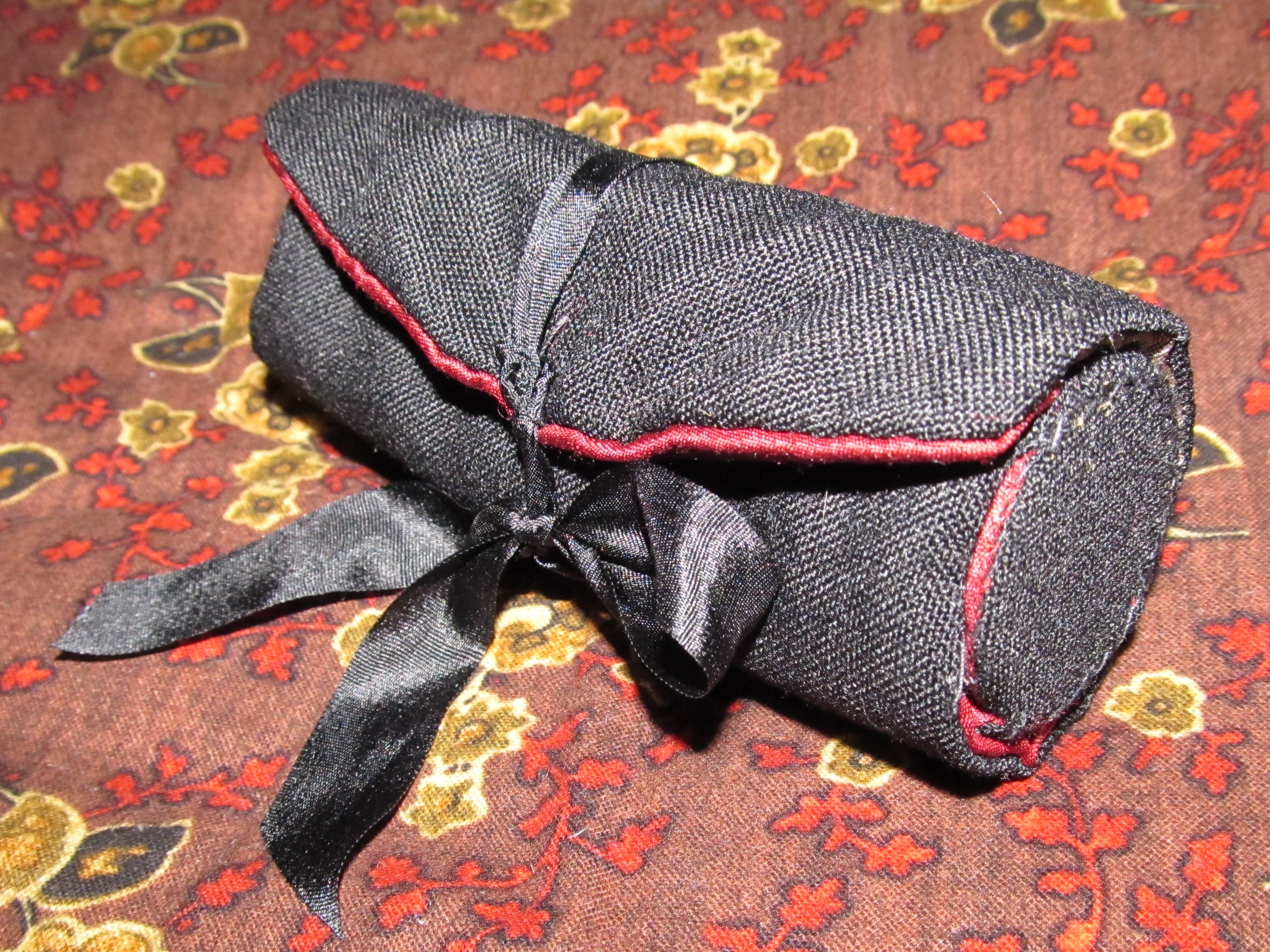
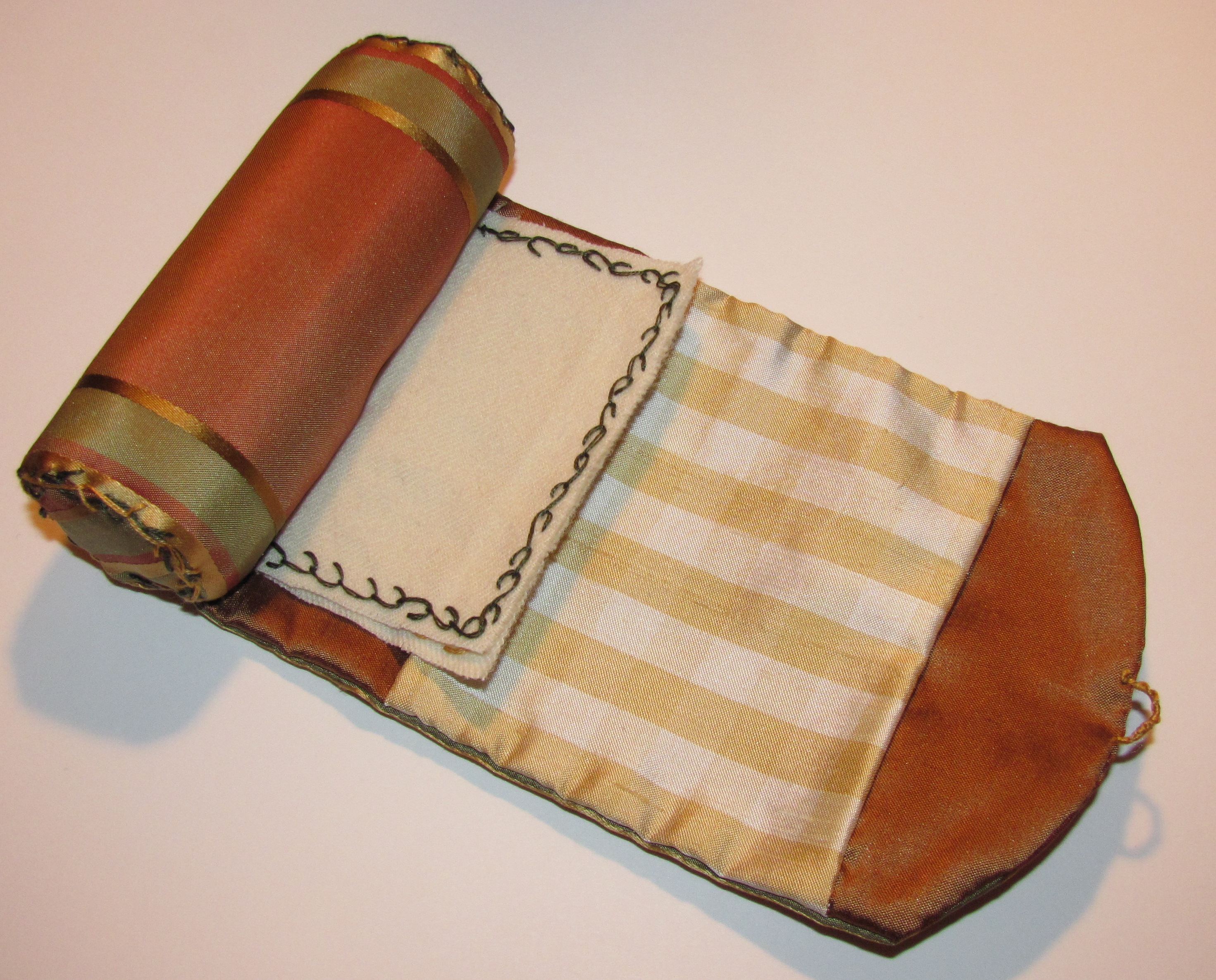
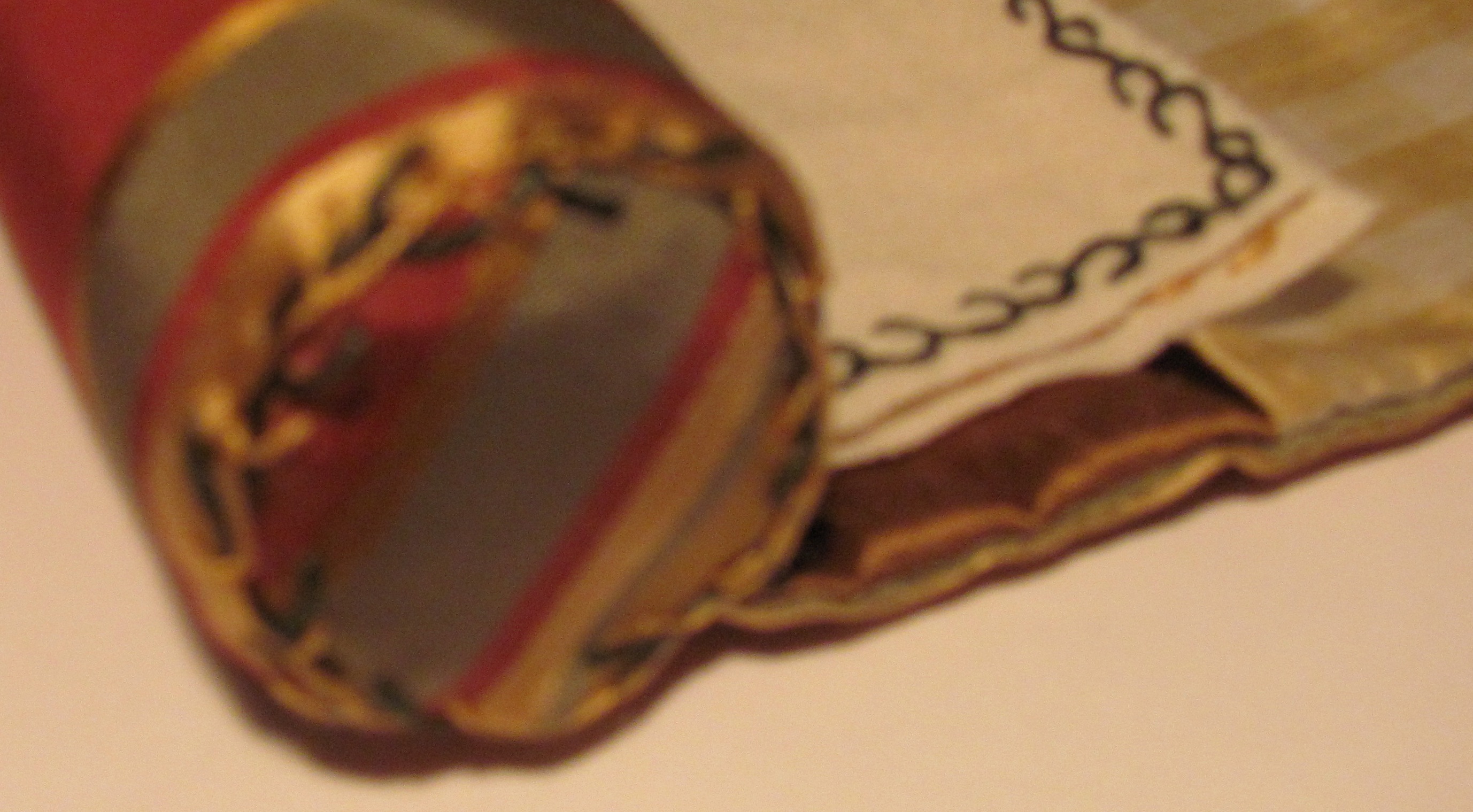
This case is made with a lovely fall toned striped silk on the exterior and a coppery shot silk on the interior. The spacious pocket is a white and golden yellow plaid silk. The two off white wool needle-pages are vine stitched with dark green on the first and golden yellow on the second. The viney stitch is continued on the ends of the cotton batted roll. The case is held closed with a tiny mother of pearl button and loop. This case is entirely hand-sewn and based on an original formerly in my collection and featured in the up-coming  Fanciful Utility. This case took approx. 5 hours to hand-sew.

Published in: on July 1, 2009 at 7:54 am  Leave a Comment  

Travel Updates…. on new blog

Hi Everyone,

I’ve decided to put my non-living history updates on a new wordpress blog called Anna’s Updates…..  http://annasupdates.wordpress.com/

There isn’t much there yet. But, I do have a few things I want to share about the drive from NY to NM which will be there soon.

Published in: on June 27, 2009 at 11:36 pm  Leave a Comment  

How To Wear A Shawl


The What-not; or Ladies’ Handy-book “How to Wear a Shawl”
On the subject of wearing shawls, both long and square, much may be said, on some of our fair readers having  expressed to us their desire that we should publish some details upon the best system to be adopted in wearing shawls gracefully, we purpose doing so to the best of our ability.
In the first place we must premise that, as there does not and cannot exist a universal panacea for effacing wrinkles or making the hair to grow on bald places, there cannot be an absolute system for draping shawls. One substance suitable, or rather inoffensive for some ladies, may be essentially prejudicial to the appearance of others. One fashion of wearing a shawl may appear very graceful on a slender figure, but will transform into a bundle a woman of rounder and fuller proportions.
If the so called long shawl be somewhat shorter than usual it should not be evenly folded, that is to say one end should be left longer than the other, in order that it may fall lower. This is indispensable in the striped shawls, which are now so fashionable for morning toilettes, as they are much shorter than bordered shawls. They should be folded so that one end may not appear exactly over the other. If these two points in fact, were to be placed on the same line, the longer end of the shawl would then be too short. Round the neck, two or three folds should be made, which are fixed in their proper position by a long pin; this is done in order to disengage the head which would otherwise be confined by the folds of the shawl. Nothing looks so ungraceful as to see the curtain of the bonnet in constant and ungraceful contact with the awkward wraps of a badly folded shawl. It is then necessary to be careful that the neck be perfectly free, while, at the same time, it is protected by the folds.
But these rules do not suffice for the graceful wearing of a shawl. To succeed we must have not only the experience that is acquired, but the instinct which is innate. A woman must then know her own figure, and not be led away by illusions in this respect.
Drooping shoulders are those which bear most becomingly the long or square shawl. High and pointed, and consequently narrow shoulders are less adapted for the square shawl. For ladies so circumstanced by nature in the latter respect, we would recommend the long shawl, which being quadrupled over the shoulders, takes off the angular appearance which would otherwise disagreeably prominent.
A thin woman should fold her shawl in such a manner that the upper point may fall in the centre of the back. A woman of a stouter figure should so arrange her shawl that this point may be larger and descend lower, about to the waist. It may be easily understood that this quadrupled shawl augments considerably the volume of the bust. And when the bust is sufficiently full, it is necessary that the upper point should fall lower, so as to envelope the body without increasing the size.
The longer side of the shawl is ordinarily placed to the left, the right arm raising the shorter end; but this depends entirely on acquired habits, and there is no reason why the shawl should not be worn in an inverse way.
Square shawls should be raised on both arms, and a very tall, or very stout woman, ought carefully to avoid folding a square shawl exactly double. One side should be longer than the other, in order to augment the proportions ¡of the shawl, which would otherwise be too short, and consequently ungraceful, if she neglected this precaution.
We may add that all shawls should be as much as possible draped upon the woman who wears them, and sustained by the arms being pressed upon the bust ; but we must also add that we hare displayed to our readers but the material part of this difficult art, and unfortunately it is the only one we can analyze, for grace is not demonstrated, and taste is a natural gift which escapes every definition and all commentary. Wealth cannot replace it, nor can experience supply its want.
Literary Gem 1854 “How to Wear a Shawl”
If a lady sports a shawl at all, and only very falling shoulders should venture to do so, we should recommend it to be always either falling off or putting on, which produces pretty action. Or she should wear it upon one shoulder, and down the other, or in some way drawn irregularly, so as to break the uniformity. One of the faults of the present costume, as every real artist knows, is that it offers too few diagonal lines. Nothing is more picturesque than a line across the bust, like the broad rilibon of the order of the garter, as worn by Queen Victoria, or the loose girdle, sloping across the hips, in the costume of the early Plantagenets. On this very account, the long scarf shawl is as picturesque a thing as a lady can wear. With the broad pattern sweeping over one shoulder, and a narrow one, or none at all, on the other, it supplies the eye with that irregularity which drapery requires; while the slanting form and colors of the border, lying carelessly round the figure, gives that eastern idea which every shawl more or less implies. What Oriental would ever wear one straight up and down, and uniform on both sides, as our ladies often do?—Quarterly Review.
Hurry-Graphs by Nathaniel Parker Willis “Shawl Aristocracy”

The degree to which ladies care more for each other’s opinion of their gentility of appearance, than for the opinion of gentlemen, on the same point, is, at least, equal to the difference between a French shawl and a Cashmere—one worth fifty dollars and the other worth from five hundred to a thousand—for, though no man knows the imitation from the real shawl, as he sees it worn, a fashionable woman without a Cashmere, feels like a recruit unarmed and unequipped. The pilgrimage to Mecca, which entitles to the privilege of wearing the green turban, would not, by the majority of women, be considered too much to undergo for this distinction—recognizable, though it be, by female eyes only. “She had on a real Cashmere” would be sweeter, to numbers of ladies, as a mention when absent, than ” she had a beautiful expression about her mouth,” or  “she had such loveable manners,” or “she is always trying to make somebody happier,” or “she is too contented at home to care much about society.” It is, moreover, a portable certificate of character and position. A lady “with a real Cashmere on,” would be made way for, at a counter of Stewart’s—differently received when introducing herself at a first call—sooner offered the head seat in a pew criticized, as to manners, and very differently estimated in a guesst as to who she might be, in any new city or place of public resort where she chanced to be a stranger. The prices of the best Cashmeres vary from four hundred to fifteen hundred dollars.* There are two plausible arguments in their favor, usually pleaded by ladies—first, that they fall in more graceful folds than any other shawl, and have an “indefinable air of elegance,” and, second, that, as they never wear out, they are heir-looms which can be bequeathed to daughters. The difference between a thousand dollar shawl given to a daughter after twenty years’ wear, and the same thousand dollars invested for a daughter and given to her with twenty years’ interest, puts this latter argument upon its truest ground; but one word as to the superior becomingness of Cashmeres.

There are very few women, out of Prance, who wear any shawl becomingly—for it requires either the taste of an artistic mind, or a special education, to know its effects and arrange it to show the figure to advantage—but a Cashmere, by the very pliability which is subservient to grace, betrays awkwardness or a bad figure just as readily. For a round back, flat chest, or arms held at inelegant angles, there is more concealment in the French shawl, than in the slighter tissue of an India one; but, either way, we fancy, the difference is too trifling to be recognizable by one person in a thousand. As to the beauty of color and texture, we are very sure that, to men’s eyes, the dull complexion of a

Cashmere conveys the impression of a cover-all, grown somewhat shabby, and which the wearer would not have put on if she had “expected to meet anybody.” There is not one lady in a hundred, of those who own Cashmeres, who do not look better dressed, (to most female and all male eyes,) in any other out-of- door covering.

As our city readers know, there has been a three days’ exhibition and auction of Cashmere shawls, in the large hall over the theatre at Niblo’s. The vessel in which this precious cargo was being conveyed to England, was abandoned at sea by the crew, and, an American ship securing the cargo and bringing it to this country, the goods were sold by the British Consul, to arrange salvage and remit the remainder to right owners. The shawls were hung upon lines, up and down the immense hall, and, between these aisles of Cashmere, the fashionable ladies of the city promenaded, with close scrutiny and comparison of opinion— (and with a degree of keen interest .that we should like to see given to a gallery of pictures!) Having, ourself, fortunately secured the company of Mr. Flandin, who was the only importer of Cashmeres to this country for twenty or thirty years, (and whose eye, for better reasons, is familiar with the Parisian grace of a shawl’s wear, and its value in becomingness,) we took the opportunity to enrich our knowledge in the matter. After having all the advantages of the India fabric pointed out to us, however, and hearing, from our well-informed friend, what class were the purchasers, and what made the difference of hundreds of dollars in the cost of shawls which to a common eye would seem of equal value, we came away satisfied that a better present could be made with five hundred dollars, than to bury it in a Cashmere shawl— that things better worth having could be had for a quarter of the money—and that the arbitrary aristocracy, which is based upon the wearing of them, is one of those illusory valuations which this common-sense age is constantly on the look-out to put down.

(* It is a curious foreshadowing of the anticipation of income by which such expensive articles are sometimes obtained, that the finest and costliest of these shawls are made from the down of the lambs taken from the womb before birth.)
 

Published in: on June 23, 2009 at 1:15 am  Leave a Comment