Where do you put your….gloves, fan, purse, etc….Part 2

 Here are some passages referencing where women put their gloves, fan, purse, etc.: 

(a younger girl) “she fancied how her mamma would smile and kiss her, and how her papa would look pleased; and then she thought she would just take the gloves out of her pocket to see how tidy they were. She put her hand into her pocket, and pulled out first her pocket-handkerchief, and then some pretty colour pebbles which she had picked up during her walk, but her gloves were not there; there was no use feeling quite down to the bottom of the pocket, and turning it inside out, and shaking it – the gloves were actually quite gone; though Helen looked anxiously along the gravel walk and in and out among the raspberry bushes, she could not see them anywhere.”

Blind man’s holiday; or, Short tales for the nursery, by the author of ‘Mia and Charlie’.: or, Short tales for the nursery, by the author of ‘Mia and Charlie’.
By Annie Keary
Published 1860
London

This is a child “…as Effie took out of her pocket her gloves, or pocket-handkerchief, or something or  other, she pulled out at the same time Fritz’s letter and dropped it.” 

 By mrs. Florence Williamson
By William Kirkus
Published 1864
London

 “She [Clara] took the gloves, thrust them roughly into the pocket of her dress, bowed coldly and haughtily to the restorer of them, and turned again towards the party with whom she had previously been conversing.”

Chambers’s Edinburgh journal
By William Chambers, Robert Chambers
Published by W. & R. Chambers, 1853
Edinburgh

 “ ‘That reminds me,’ observed Maria, a young lady with some pretensions to good looks, ‘I had better put on my gloves; I have let my hands grow coarse and brown lately that I am ashamed of them, and just because it was too hot to cover them. I think my gloves must be in my bag;’ and diving into the profundities of a black silk affair which hung from her arm, and which also contained her missal and pocket-handkerchief, she withdrew the gloves, and commenced pulling them on.”

The slave son
By Marcella Fanny Wilkins, William Noy Wilkins
Published by Chapman and Hall, 1854


“She, supposing it to be some slur upon her religion, carelessly slipped it into her pocket and thought no more of it. The following morning, as she was taking her gloves out of her pocket, the piece of paper fell to the ground, and on examining it she found it to be a guinea note.”

The living sacrifice; or, A short biographical notice of Sarah Bentley: or, a short biographical notice of Sarah Bentley, of York ….
By John Lyth, Sarah Bentley
Contributor W. R. Lyth
Published by W.R. Lyth, 1848


“Having carefully rolled up, and deposited her gloves in her pocket, she pulled out a pin-cushion…”

Marriage: A novel
By Susan Ferrier
Published by Harper & brothers, 1847


“Her gloves were rolled up in a little ball in her pocket. She was at an age when gloves are rather a nuisance then otherwise.” [meaning an older age]

The doctor’s wife, by the author of ‘Lady Audley’s secret’.
By Mary Elizabeth Braddon
Published 1864
London


“Confident of success, she talked and laughed with unusual liveliness, and as soon as the meal was over, she went out with the fan in her pocket, and Charles by the hand.” [French setting possible]

Seven Years, and Other Tales
By Julia Kavanagh
Published by Hurst and Blackett, 1860


“‘Have you my fan?’ said Mrs. Quigg. I clapped my hand to the pocket where it should have been. There was no fan there. It was gone.”

The United States Democratic Review
By Thomas Prentice Kettell, Making of America Project, Conrad Swackhamer, D. W Holly, Spencer Wallace Cone, Isaac Lawrence
Published by Langtree and O’Sullivan, 1855

“ ‘Are you too hot, my dear?’ asked her tormentor, taking a fan out of her pocket, and raising as she spoke…”

The inheritance, by the author of Marriage. By the author of ‘Marriage’. Revised by the author
By Susan Edmonstone Ferrier
Published 1841


“Taking a box from her pocket, which she said contained the finest lozenges in the world for the preservation of the voice, she requested that one of the gentlemen would have the goodness to provide her with a glass of water, which was placed by the side of her pocket-handkerchief, the box, the fan, and the smelling-bottle.”

“Modern Accomplishments” Home and the world
By Mrs W Rives
Published by D. Appleton and company, 1857
New York


“It is a good practice to carry a pocket fan even in winter, in case you should chance to feel the heat more sensibly than any other lady in the room.”

The behaviour book: a manual for ladies / by Miss Leslie
By Eliza Leslie, Cairns Collection of American Women Writers
Published by W.P. Hazard, 1853
Philadelphia


“She took a fan from her pocket….”

Autumn hours and fireside reading
By Caroline Matilda Kirkland
Published by Charles Scribner, 1854


“….she stepped into the carriage, took a place beside Madame d’Epplen, and demurely drew from her pocket a large fan, the movement causing the exposure of a pair of strong gauntlet gloves that had been concealed beneath, and which immediately protruded from their hiding-place, to the no small amusement of her companions.”

At Odds: A Novel
By Jemima Montgomery Tautphoeus
Published by R. Bentley, 1863
 London


“‘Dear me, Mrs. Colton, I’m exhausted coming up those vile stairs!’ said Mrs. Fountain, drawing out of her pocket a beautifully carved fan, which she opened and began fanning herself, and displayed at the same time her white hand, which was covered with diamond and opal rings…”

Portraits of My Married Friends, Or, A Peep Into Hymen’s Kingdom: Or, A Peep Into Hymen’s Kingdom
By Uncle Ben, Rhoda Elizabeth Waterman White
Published by Appleton, 1858

“The consciousness of this did not flash upon Mabel until she had drawn the
little silver reticule from her pocket and exposed her destitution …”

Mabel Vaugh by Maria Susanna Cummins – 1857


“Steadying herself against the post of the folding- door, she took a pair of
scissors from her pocket”

 All The Year Round by Charles Dickens – 1862

“She drew an elaborately worked purse of green silk from her pocket and counted out into my hand three pieces of old French gold.”

”John Heathborn’s Tale” Harper’s new monthly magazine
By Henry Mills Alden, Sarah Orne Jewett, Cairns Collection of American Women Writers
Published by Harper & Brothers, 1864


[Queen Elizabeth] “A pocket looking-glass hangs from her side, and a fan is clasped in fingers loaded with precious stones…”

“Curiosities of Fashion, in the Matter of dress”
Eclectic Magazine: Foreign Literature
By John Holmes Agnew, Walter Hilliard Bidwell
Published by Leavitt, Trow & Co., 1863


“A large fan of peacock feathers hung from her wrist….” [fanciful]

“The Toad’s Curse” Graham’s magazine
By George R. Graham, Edgar Allan Poe, John Davis Batchelder Collection (Library of Congress)
Published by G.R. Graham, 1853
Published in: on June 9, 2009 at 11:26 am  Leave a Comment  

Tableclothes – White or More?

Jackie called me yesterday asking about tablecloths. She had a couple plaids she was considering for a large table at the Mumford event. My response was to play it safe and stick to white linen. Of course, since she asked, I had to go find out.

Step one, look through the interior paintings I have saved. In the first painting I opened, my play it safe response went out the window. In Francis William Edmonds’ Barking Up the Wrong Tree (c. 1850-55) a red cloth covers a small table. This cloth has either a yellow or golden double stripe border. This is a modest working class or  lower middle class home.

Looking at the more affluent homes, first is Lady in an Elegant Interior by David  de Noter (c. 1852). This round table in what appears to be a parlor is draped in a red patterned cloth which has colors that remind me of paisley shawls (though I doubt this is a shawl.) The cloth is rather tossed or roughly draped. A small table in Christmas Time by Eastman Johnson (c1864) has another red patterned tablecloth. This one is neatly draping the table. A dark green cloth with a decorative border drapes a parlor table in Lilly Martin Spencer’s Patty Cake. Another lovely green cloth is draped over a round parlor table in Reverend Atwood and His Family (page 5). This cloth has what appears to be a woven in border type design. This is a similar cloth as well.

Kitchen tables, used for work, are shown without clothes. Examples would be The Speculator by Francis William Edmonds (c 1852), The Young Wife: First Stew by Lilly Martin Spencer (c1854), Kitchen Interior by Thomas Hicks (c1865),

One table I am not sure about is in the painting The Song of the Shirt by John Thomas Peele (c1847). The woman is working on her sewing. I don’t know if the yellow fabric with holes draped across the table is a table cloth or simply a piece of cloth.

What about that safe white linen tablecloth? One like what I pictured can be seen in Family Life on the Frontier by George Caleb Bingham (c1845) where it drapes a large table. Another drapes a table in home with more means in The Contest for the Bouquet by Seymour Joseph Guy (c1866). Most still lifes I have saved also show a white cloth (or now cloth). Each of these show tables set with food. A few examples: several by John F. Francis, Fruit Still Life with Champagne Bottle by Severin Roesen (c1848),

A surprise to me is the long cloth-less table in the 1821 painting The Dinner Party by Henry Sargent. That cloth free table goes against everything I’ve read about setting a table.

Now, I haven’t noted which table clothes are found in American homes vs European homes because without looking up the art pieces, I can just speculate. There could be some variation between the two.

In the International Exhibition catalogs a variety of tablecloths are listed. Most are listed under flax (linen); some under wool & woolens and silks as tablecloths, table-cloths and table linens. These tablecloths or table-covers would need to be divided into those put on a table for eating (what I think Jackie wants) or over a parlor table. I suspect a tablecloth is the one that goes on the dining table for the meal while the table-cover goes on the parlor tables or the dining table while there is no meal. This is based on this passage: “….and the table-cover thrown over, and the room restored to its usual order.” (The Book of Household Management) Also keep in mind these are the ‘cream of the crop’ type of examples meant to display the art of each manufacture. Here are some of those listed:

“Damask table-cloth” “Damask table-cover”
“Double Damask tablecloth”
“Tablecloth of damask with heraldic designs”
“Table cloth, embroidered with thread on crimson sarsenet.”
“Mohair table-covers”
“Table-covers:- cotton and worsted, and silk and worsted”
“Crimson and green embossed table covers”
“Victoria table-cloth, made from cotton and worsted, dyed previous to weaving, fast colours.”
“Silk and worsted and cotton and worsted Victoria velvet table-cover.” “The manufactures express their opinion that the Victoria velvet damask and table-cover, are in a style that has not been previously made in this country [England].
“Pictoral mosaic cloth-work table-cover or quilt, comprising 32 compartments exclusive of the centre, which is the arms of England; which being an imitation of some well-known picture, made of coloured clothes, fine-draw together so as to imitate paintings, the features being worked with the needle, the whole surrounded with a border. This work has been the labour of leisure hours for a period of nine years and a half.”
“Double damask table-cloth, with border, roses, shamrocks, and thistles, Irish wolf-dog and harp; cornerpiece, shield of oak leaves, flags, anchors, and a dove encircled in palm wreathes with olive branchl side range, tray-scroll, Price of Wale’s feathers, in oak wreath; and centre range, a temple, British royal arms, vase of flowers, &c.”
“Table cloth of new pattern, to be presented to the Earl of Clarendon by the Royal Society for the promotion and improvement of the growth of flax in Ireland. The centre represents the star of the Order of the Garter, in a union garland of rose, shamrock and thistle, interspersed with flax, and surrounded by the jewels of the Order of the Bath and St. Patrick, with Irish harps in shamrock wreaths. At each end is a presentation piece from the Royal Flax Society, Belfast, 18.”>1, on a group of shamrock and flax, surrounded by the Clarendon arms, incorporating the collar and jewel of the Order of St. Patrick, with the motto and jewel of the Order of the Garter. The border exhibits a rich collection of flowers, drawn from nature. The ground consiste of four large amaryllids around each representation of the arms, with email sprigs of shamrock and flag intertwined, &c.”
“Table cloth of new pattern, designed by John Mackenzie, Government School of Design. The centre consista of a rustic stump and basket of rich flowers, resting on a group of flowers at the base, and supported by an Arum and a Strelitzia, surrounded by a light wreath of flowers, chiefly climbers, and a ground harmonizing in same style. The border represents a rich scroll, each compartment terminating with distinct flowers. The corners represent tin1 rhododendron in flower, the end and side the centres of flowers. The margin represents the hearts-ease, on leaves of the same.”
“Table-cloth, extra double damask, with arms of Goldsmiths’ Company of London for centre, flowers with sprigs filling, in a scroll and flower border.”
“Table-cloth, extra double damask, with arms of Baron Bothacliild for centre, surrounded by various sprigs, and border of flowers”.
 “Table-cloth, extra double damask, with anus of Mr. Wheble for centre, surrounded with »prigs, mid encircled by two flowing scroll borders.”
 “Table-cloth, extra double damask, being pattern of a rich table service of various lengths, manufactured for Her Majesty’s 62nd Regiment of Foot, showing the number in a large star, surrounded by a flowing riband containing the names of the buttles in which this regiment obtained honours, with sprigs, the whole enclosed by a bonier of oak and laurel intertwined.”
 

I am rather disappointed by what I am finding in the household advice and guide books. The authors like to write about laying a cloth on a table but they fail to tell us which cloth. In Beeton’s The Book of Household Management, she mentions a “neat white cloth covered the table” in a story she tells.

 Next steps could be to look at sales accounts, paying attention to  the size of the tablecloth or table-cover compared to the size of tables (dining vs parlor). (Not sure if I’ll get to that.)

Published in: on June 8, 2009 at 8:48 am  Leave a Comment  

Candlelight Tours – GCVM

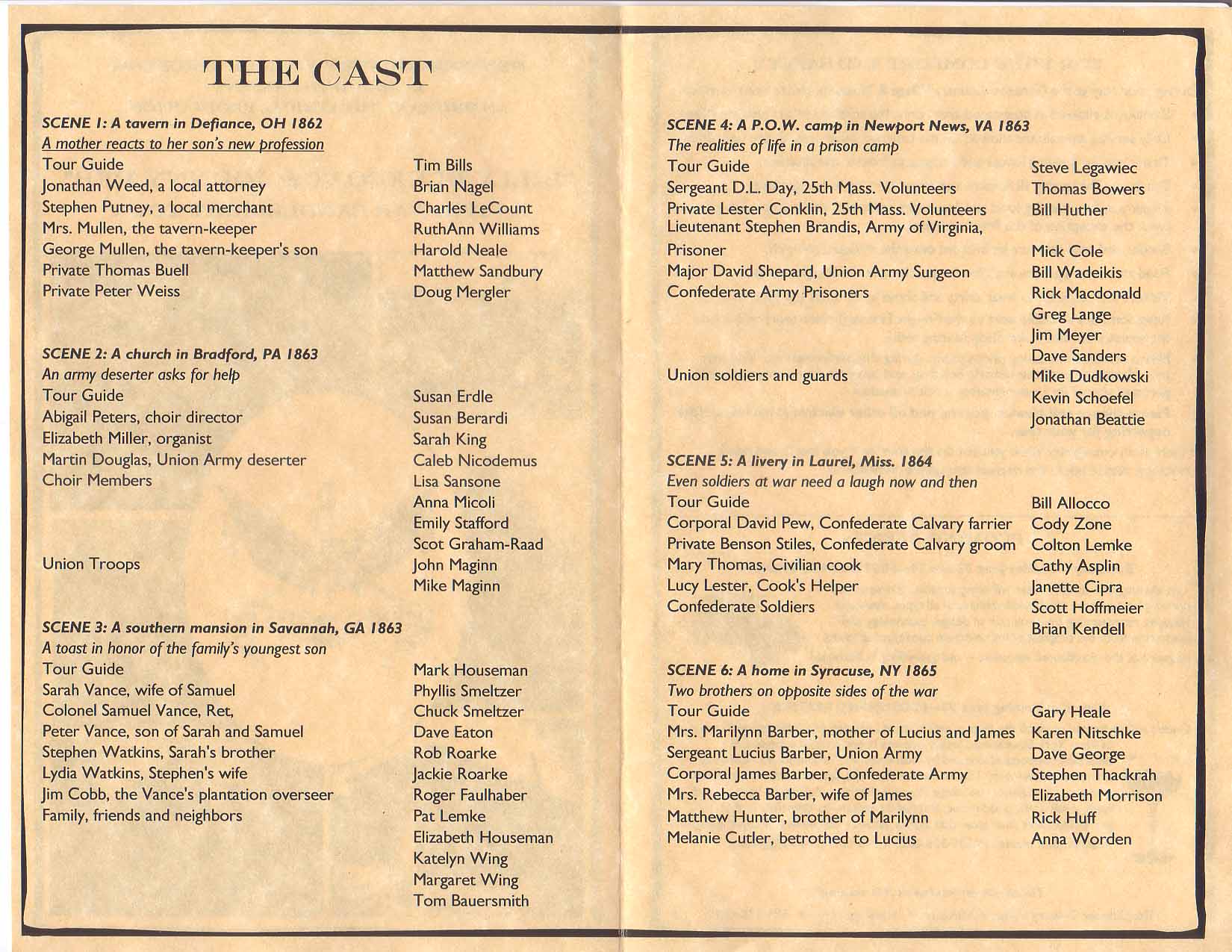
Saturday’s weather was absolutely wonderful for evening tours. (well, up to the very last part of the last two tours when the wind picked up and it started to rain.) I would like to thank Jim for the lovely script. I hope we were able to bring the audience to the edge of the precipice as you described. I appreciated the strength you gave Melanie’s character. Though, as the evening progressed I couldn’t decide if I agreed with her actions or not. I didn’t expect that. Thank you to everyone in our final scene. It was nice to work with all of you. It was especially nice to get to work with Rick for what will be my final event at GCVM for quite some time. For those of you who don’t know, Rick is largely responsible for me beginning CW era reenacting. While working at GCVM and dancing with the McKay Dance Society, he introduced a trio of us to the hobby. I would also like to thank Bevin who stepped up to what became a rather challenging and exhausting task. (I’m sure you slept pretty soundly after all that running.)
Cast list

scan

Published in: on June 1, 2009 at 7:17 am  Leave a Comment  

Bonnet Stories – White Sheer Caned

candlelight2009 004

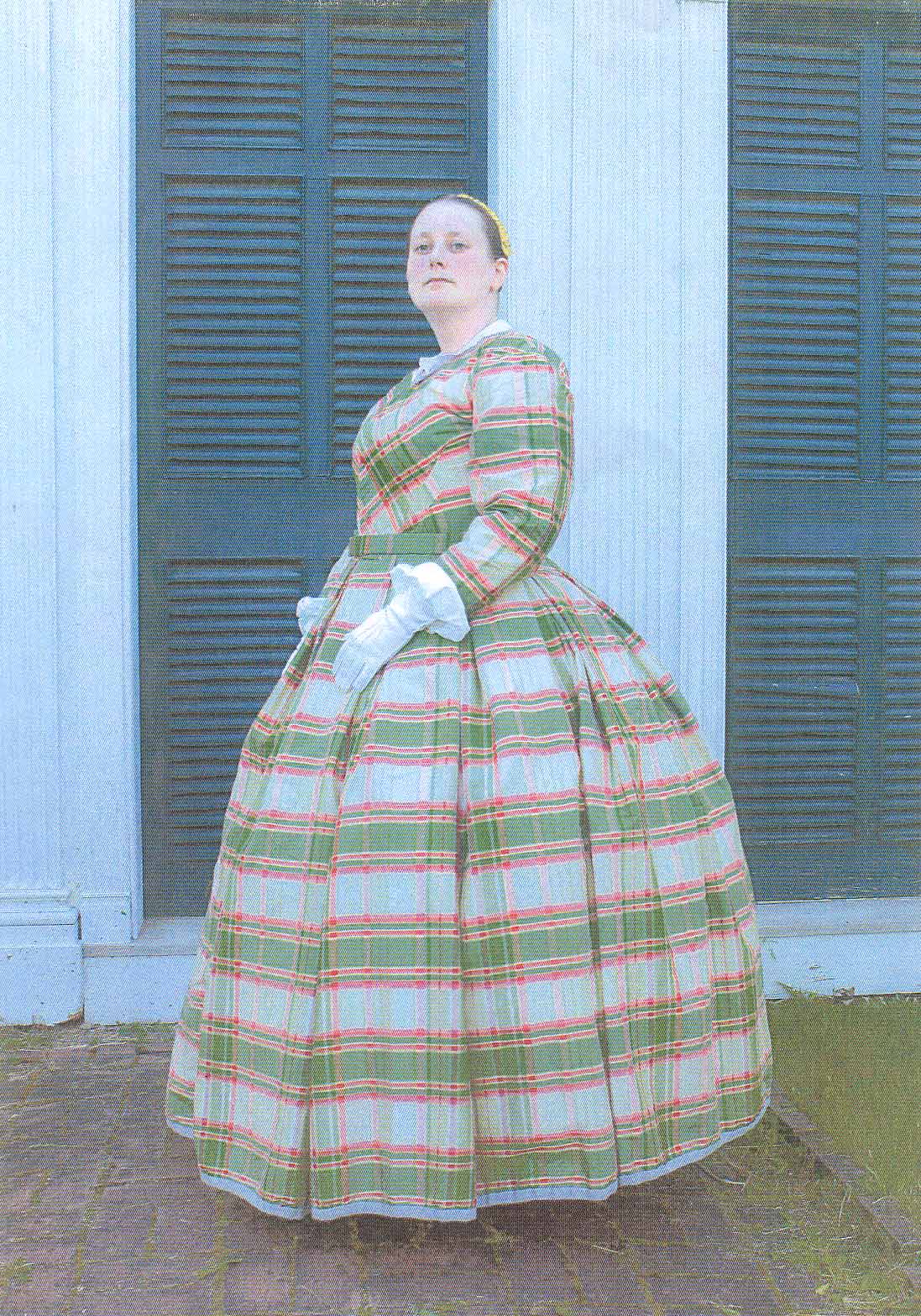
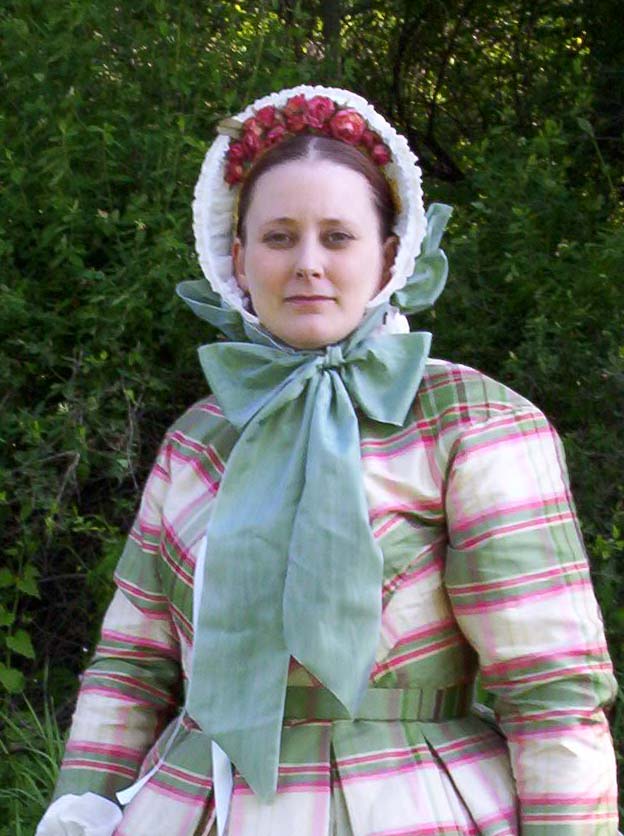
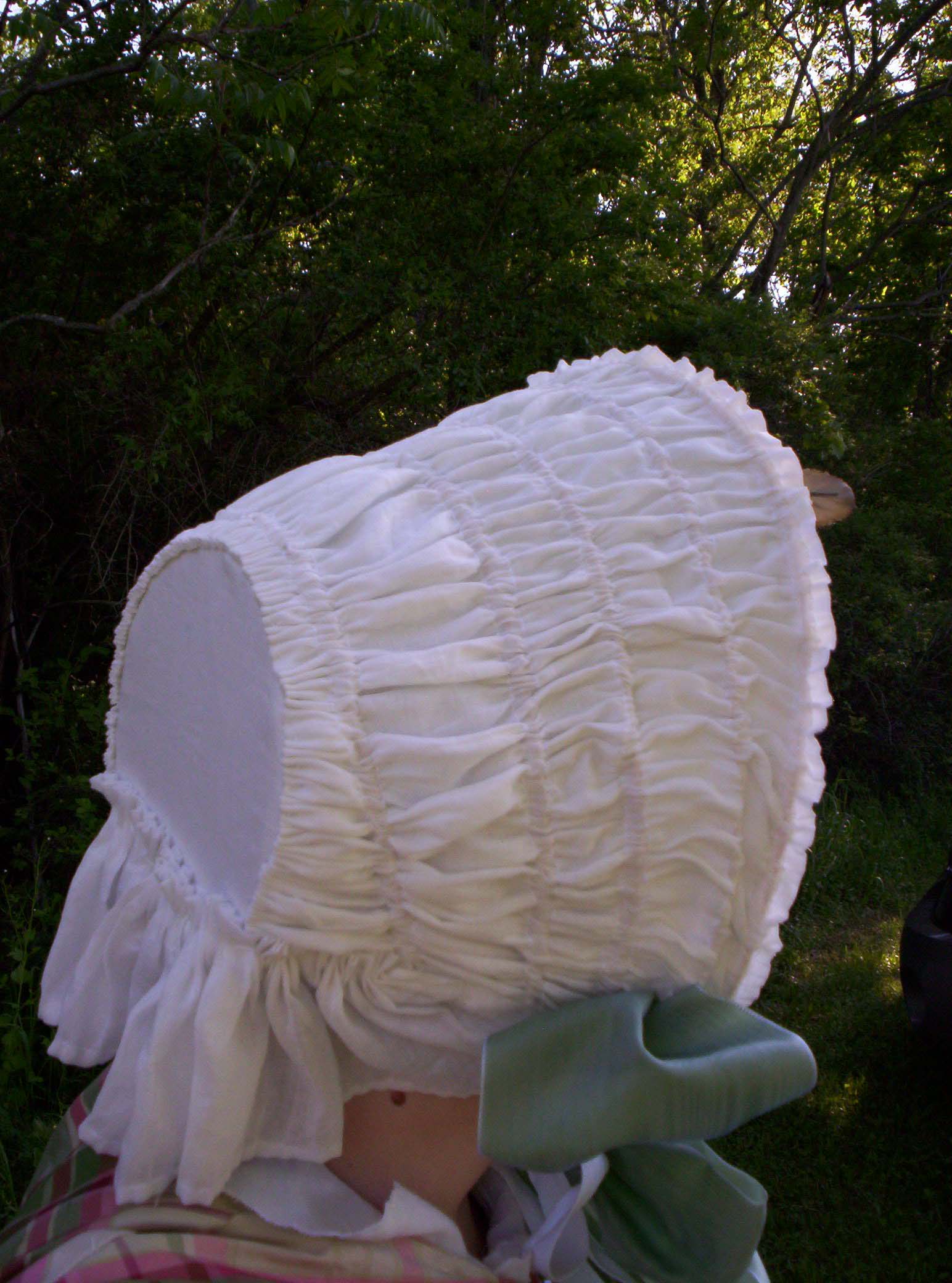
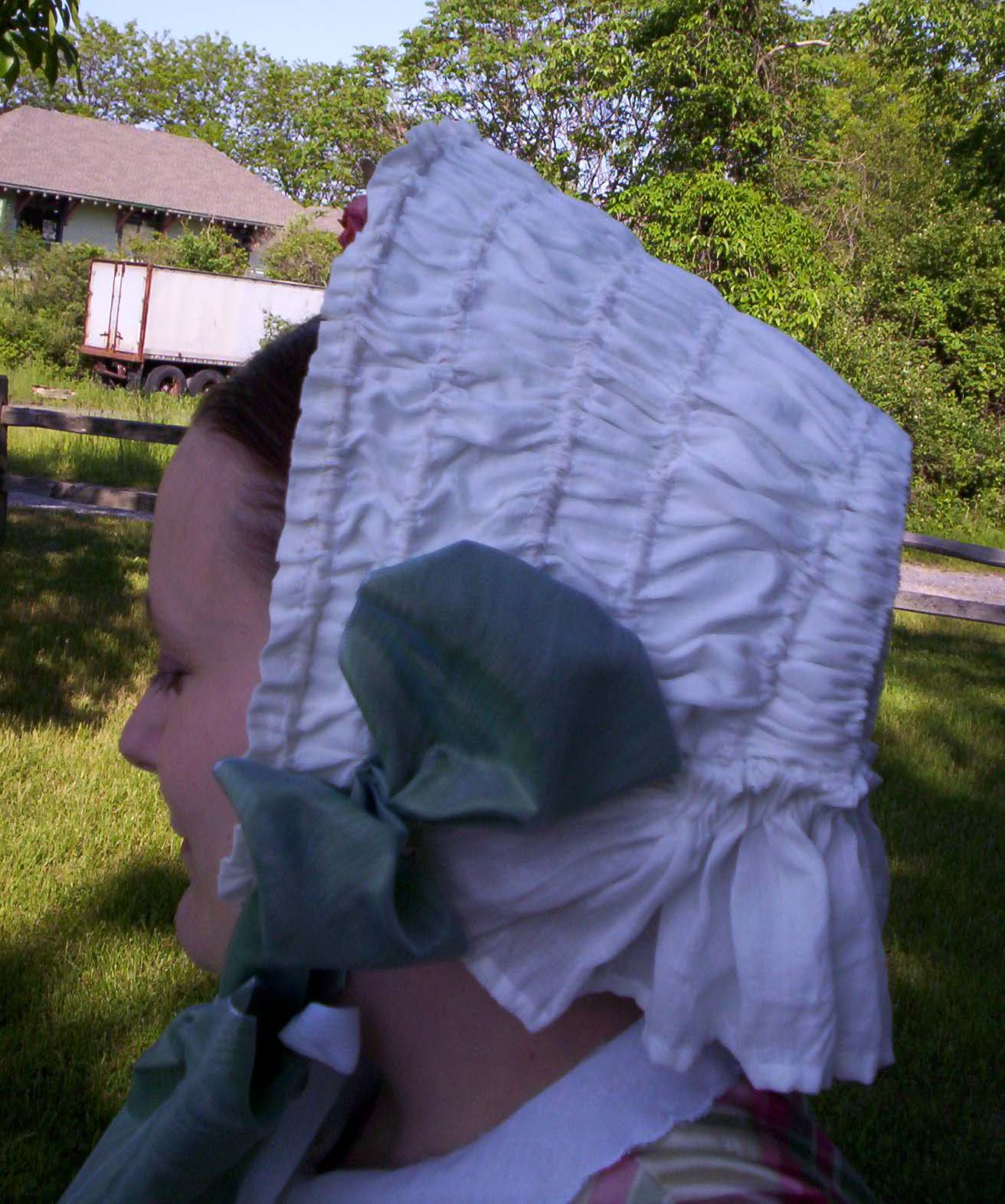
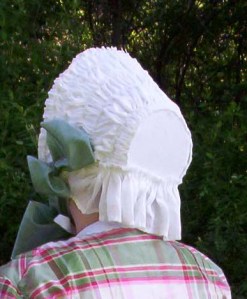
This is a sheer cotton caned bonnet started this past winter. It isn’t quite finished even though I needed to wear it for Candlelight tours. The base is buckrams. The cane is the smallest basket cane. (I think it is #0 or #1) The sheer is a cotton lawn from a yardsale. The flowers are paper flowers. (Sorry I don’t remember where I picked them up.) The ribbon is the 4″ German Moire from the Ribbon Store in sage green.

Things that need to be finished – I want to add a layer of ruche to the inside of the bonnet and add something tbd to the outside. The curtain needs to get removed and reattached with the net. The ties are just last minute make-dos tacked on. (way to long and not the white silk I want.)

candlelight2009 008candlelight2009 010candlelight2009 006 b

I’m noticing I was a little tilted in the pictures. Sorry.

Published in: on June 1, 2009 at 6:58 am  Leave a Comment  

Survey on Working Attire

A couple weeks ago I started collecting images of women wearing corsets while working for the local museum I volunteer at. (see this thread http://thesewingacademy.org/index.php?topic=4833.0) Thank you all very much for sending images. The Director I was working with is very happy with what we put together. While looking for images, I sent a message to Connie at the CC. She found the search interesting and wondered if I could take it a bit further by looking at what women wore while working in the mid-century. So, as a research/writing project to work on once I get resettled, I’ve decided to look at support garments as worn during various types of work/labor in the mid-century and by those currently doing living history. As part of the latter section, I put together a short survey on SurveyMonkey asking about support garment habits of reenactors. (SurveyMonkey limited the number of questions I could ask with a free account. So, the questions are narrowed down from what I started with.) If you would like to participate, the survey is at http://www.surveymonkey.com/s.aspx?sm=jj0CcjV5sg70sWALz6_2bgBA_3d_3d There are questions about what support garments you wear under different situations, about the fit of your corset and what influences when/how you wear it. The survey is anonymous. So, please answer truthfully as possible.

Published in: on May 26, 2009 at 8:36 am  Leave a Comment  

From Field To Fashion

UPDATE MARCH 2015:

From Field to Fashion is now available as an Ebook!

With rising printing costs, I have decided to make From Field to Fashion: The Straw Bonnet available in an electronic format. In the new format, I have been able to price From Field to Fashion at a fraction of the printed price. My hope is this will make FFtF easily accessible as well as informative.  Please visit my Etsy store to order your From Field to Fashion.

bookletscanUPDATE 2011: Out of Print

From Field to Fashion is a 46 page booklet with the following sections:
– Straw Bonnets and the Straw Bonnet Industry
– Straw, Harvest and Preparation
– Straw Plait
– Straw Cloth
– The Straw Bonnet Base
– Industry and Labor
– Finishing the Straw Bonnet
– Who Wore a Straw Bonnet When?
and an Appendix:
1 – Original Bonnets Online
2 – Bonnet Production in Massachusetts, 1855
3 – Millinery Establishments by State, 1860
4 – Straw Bonnet Shapes
5 – Fashion Quotes from Harper’s Monthly & Weekly
6 – Fashion Quotes from Godey’s Ladies Book
7 – Straw bonnet quotes from fiction
8 – Wheat and Rye produced, 1850 & 1860
9 – Straw Industry Statistics
10 – Straw and Bonnet Related US Patents

Published in: on May 21, 2009 at 10:53 am  Comments (10)  

Increasing Spectator & Civilian Interaction

Inviting Spectators to participate 

It is important to offer an opportunity to try an activity to a spectator or visitor. Inviting them to participate opens the door for a more complete experience. Since live historical interpretation differs significantly from traditional museum and gallery displays, visitors may not know what to expect or what opportunities to make the most of. Often guests will be interested in trying what you are doing but will either be to shy to ask or unsure of what is acceptable. This is why it is important to invite spectators to participate, clarifying the possibilities of the experience for them.


Spectator friendly activities

  • Sewing – Invite spectators to try working on sample sewing and handiwork projects.  If you are working on a treadle or hand-crank sewing machine, invite them to try the machine. If you are quilting, have an extra needle and thread started for them to try. If need be, you can remove the stitches at the end of the event.
  • Spinning and Weaving – If you are working with fibers, have a drop spindle or small loom on hand for them to try. Children will benefit from the tactile experience of feeling the wool, silk or cotton fibers and comparing them to the finished yarns.
  • Knitting – Have an extra ball of yarn and a set of needles for spectators to try.
  • Food – Have them churn butter. (This is one of the few food related activities that are allowable.)
  • Laundry – If doing a partial laundry impression without the hot water and caustic chemicals, spectators can participate. Scrubbing wet clothes and hanging them can be a favorite for children.
  • Games – Almost every child and many adults love to play with period games. If your children are playing, invite a visiting spectator family to play as well. This will give the adults plenty of question and answer time as well. Parlor games are fun and often new to adult spectators. Invite them to join your game of conundrums or tableax vivants.

Potential Spectator Hazards

  • It is generally best not to have spectators handle original items outside of control situations with the proper surface and gloves.
  • Spectators should not be allowed to handle or taste food.
  • Spectators, though very interested, should not be allowed handle sharp or hot objects.
  • Spectators should not be allowed to handle loaded firearms.
  • Spectators should be kept a safe distance from fires.

Working with School Groups & Encouraging Student Interest

  • Younger spectators relate better to the character, personalities, and personal stories of people rather than facts, details and technical concepts.
  • Presenting a concept, event or series of events from the perspective of a character helps a student connect and develops a story-line.
  • Give students the opportunity to think critically and voice their perspectives on issues and events.
  • Link past events with present day experiences kids can relate to. Example – Soldiers’ aide groups gathering supplies for CW soldiers compared to student groups gathering items for care packages for soldiers.
  • Provoke curiosity and creativity.
  • Themes that can work well with students include
    • Choosing between different options, right and wrong
    • Dealing with pressure from peers and superiors
    • Needs, wants and problems solving – ex. How to provide food for your family if there wasn’t any available to purchase? What would a soldier do if he saw a cool stream of water during a hot day of marching?  


Tips for Teaching the Civil War

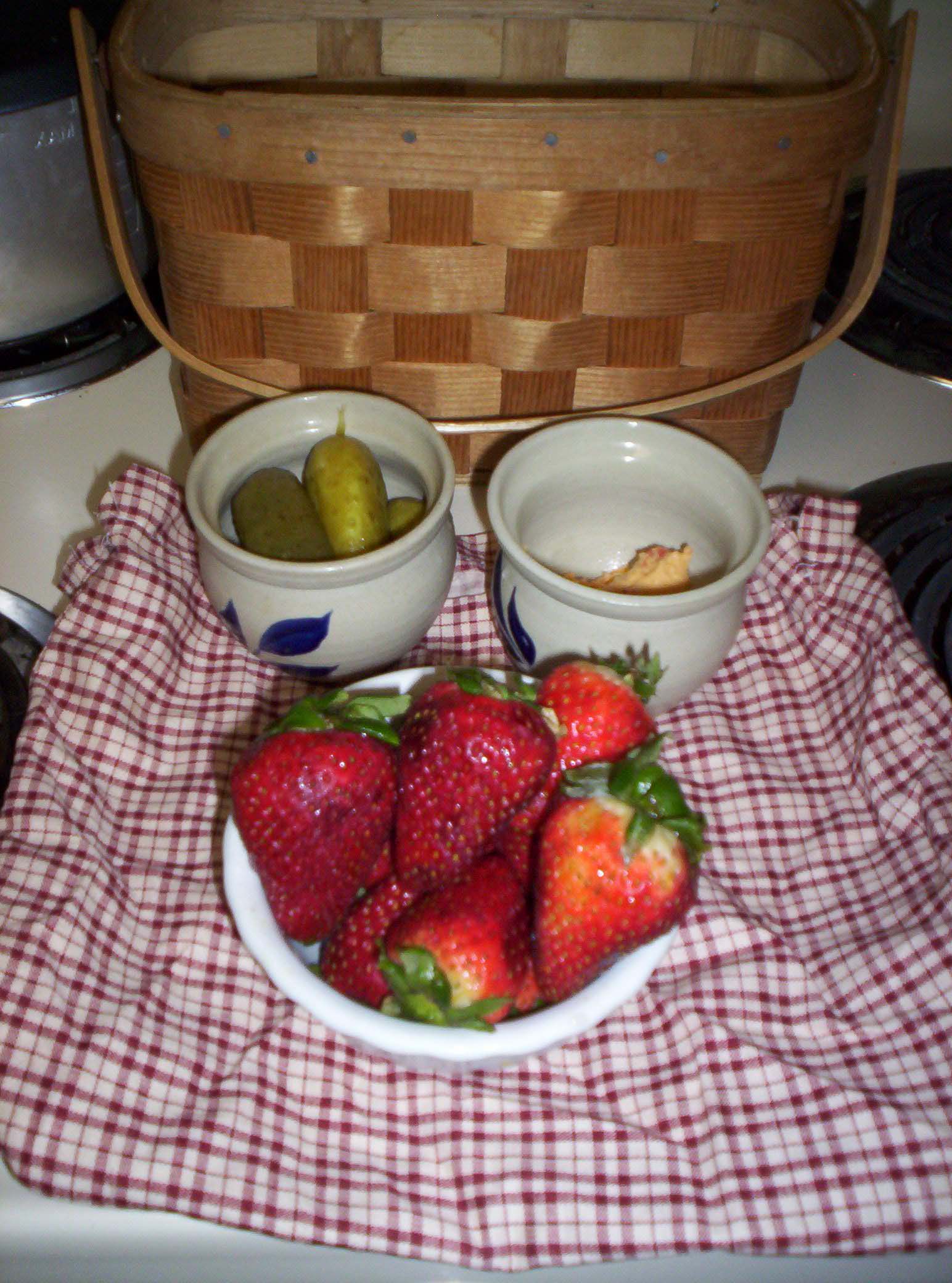
Picnic lunch

volunteer day 001

Published in: on May 11, 2009 at 1:51 pm  Leave a Comment  

22nd Virginia Volunteer Day at the Genesee Country Village & Museum

work day 5-9-09This past Saturday 14 of us spent the sunny part of the day volunteering at the Genesee Country Village and Museum in Mumford, New York. Our day started with moving one of the wagons filled with corn down to the Pioneer Homestead from behind Hosmer’s Inn.

IMGP2067[1]

volunteer day 002

volunteer day 003


Next we unloaded the corn from the wagon to the new corn crib. We filled pails, pans, our aprons and our skirts….IMGP1881[1]

volunteer day 006

We spent the rest of the mid-day building fences. We learned about fence construction in the process.

IMGP2045[1]IMGP2029[1]IMGP2003[1]IMGP2000[1]IMGP1913[1]IMGP1911[1]

In the end we had some nice fences and a little bit of rest…

IMGP2041[1]

Published in: on May 11, 2009 at 8:57 am  Leave a Comment  

Straw for bonnets

I am moving. Where I am going my straw plait will dry out. I don’t think it will do well in storage either. So……. I have 8 to 10 lengths of straw plait for bonnets. I think $12 per bonnet length should let me ship them priority mail. The plait is just under 1/2 inch wide. This is a good width for making a first bonnet yourself.

Send me an email or comment if you are interested.

I’ll be thinning out my excess reenacting stuff a little faster than I thought. So, I’m hoping to still get things up on a yardsale page. I know there are a several smaller wooden bowls I found in a box of stuff I forgot I owned. If there is something you know I have that you really want, send me a message.

Published in: on May 4, 2009 at 10:43 am  Comments (1)