Event Reflections: GCVM Civil War 2019

I want to start with the infamous question: “Are you hot?”

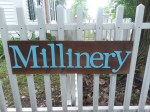
This event, every last one of us, visitor, reenactor, and staff were Hot. As the days progressed closer to the event, weather alerts increased, warning people of the heat and heat index reaching 110 degrees. This is quite hot for for the Finger Lakes region. The museum took great care to make sure visitors and reenactors were as comfortable and healthy as possible. They set up cooling stations, emphasized which buildings have air conditioning, and had active emts on hand. This is one of the cooling stations behind the millinery.

Leading up to the event, I did start getting worried about the heat and how my body would respond. I’ve had a couple heat issues in the past and my body has been unpredictable the last few years. I am very relieved to report that other than a little sun headache on the way home Saturday, I feel good. I am the normal level of “day at the museum tired.” This is such a nice feeling for me. I credit this to drinking, drinking, and staying out of the sun.

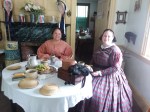
Elyse joined me this year to be my assistant. I like to have an assistant because in previous years the building will fill with guests and it is nice to be able to run out to the outhouse or such.

Because it was so hot on Saturday, visitors were lighter than usual. This also meant more time to actually see friends. (normally I can not see past the front door.)

I may have shifted into camp director mode a few times in Saturday. I saw many people who worried me because of the heat. I may have reminded a few to drink water, asked a couple to sit down, and escorted one to the emts. I may have also gone out into the sun and watered soldiers.

Setting up the Millinery

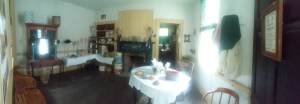
Here are the before and after shot of the Insurance Office becomes Millinery Shop as it looked Friday before some Saturday morning changes:

Here are some arrangement photos.

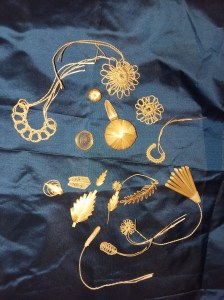
I have a few millinery pieces that will be available as soon I get them unpacked and listed on Etsy:

Published in: on July 21, 2019 at 7:31 pm  Comments (1)  

GCVM Civil War Event Videos

I am too tired and hungry at the moment to do the post I want to. But, I also want to share the video from Thursday and this morning. All in all, yes it was hot but I had a nice time. Other than a sun headache, I feel pretty good.

Published in: on July 20, 2019 at 6:10 pm  Comments (2)  

Meet Bonnie, the Bon Bon Doll

This weekend, GCVM is Celebrating Chocolate! The historic village will be filled with tasty chocolate recipes.

Bonnie, the Bon Bon Doll will be happy to greet you with chocolates of her own.

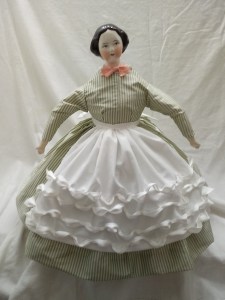
Bonnie is a Bon Bon doll inspired by the dolls of Godey’s Lady’s Book. She stands 19 inches tall with a reproduction head. Bonnie is handsewn, using period techniques (see below).

Bonnie’s apron is draped in ribbon, each loop holding a tasty chocolate. A wreath of sugar gum flowers circles her head. She wants to say thank you to her Museum friends for making that for her.

Bonnie’s Background

Godey’s Lady’s Book is filled with curious doll projects from pincushions, to Santas, to lamp covers. The May 1870 edition includes directions for a Bon Bon Doll.

I have yet to find another Bon Bon doll illustrated or described in detail in nineteen century publications. I am convinced I have not looked in the right place or with the right words because the artist Alan McDonald got the idea for his Madame Le Bonbon from somewhere.

Building Bonnie

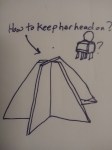
The original Godey’s description had their Bon Bon doll made of cardboard, wire, and paper standing 8 inches tall and twenty inches wide. These odd proportions would have made Queen Victoria look tall and slender. Upon closer inspection, I decided the description did not match the illustration. Trying to work with the combination of cardboard and wire, I ended up with several sketches like this.

Regardless of construction, it came down to How to keep her head on? I wanted a construction that would last for more than one event. I also wanted her to stay in one piece so people setting her up wouldn’t have to fuss with her top on her bottom just right or some such fiddliness. Getting the bon bons set was going to be fiddly enough.

So, after much debate, literally months, I opted for the basic construction Godey’s uses for several of their pincushion dolls and is used for some peddler dolls.

Bonnie has a cloth body with a “normal” torso and bell shaped lower body. She is weighted with wood and has a wood dowel up her center. She stands more than double the Godeys description at nearly 19 inches and 15 inches diameter at her base before her skirts. Her head and arms are porcelain, a reproduction set. The arms were a tough decision because I really liked the idea of making almond paste hands.

Bonnie currently has a single cotton petticoat. Her dress was draped for her. You may notice her shoulder plate is slightly tilted. While this shows her personality, the asymmetry did make fitting her dress a challenge. Her collar was from the ribbon box as it seems I donated the narrow laces. Her “bow” is a little piece of cotton sateen ribbon.

Her appron is a premium cotton muslin that ties in the back. The swags of ribbon are a white cotton sateen. The rows alternate 1w and 11 loops. Each was hand pleated and stitched to the apron. The loops act as chocolate hammocks.

Published in: on July 13, 2019 at 8:14 am  Comments (3)  

Invention: Pinkers

This week was Inventions & Inventors week at GCVM. Today, I demonstrated the pinking machines. This post is going to be more of a reflection on how it went.

To be completely honest, I find demonstrating the pinking machines to be difficult. The come in late in my interest timeline and hit their heyday later. This means I don’t have clothes that match the dating of my easiest to demonstrate machines.

So, I already feel disconnected when I try to search for ways to connect guests with the machines. So far, I am working with three concepts:

  • What is it?
  • What does it do?
  • How does it work?

For “What is it?” the hopeful connection is a memory of or usebof pinking scissors/shears. I find only a portion of people have a visual memory of pinking scissors/shears, while fewer have a strong enough memory to feel a connection. Those that do immediately connect the concept with stopping fraying.

Next is “What does it do?” While “make trim” was the initial goal, “cuts” was about as far as most guests you and old got. This was totally my fault. I assumed a based of knowledge/experience. With modern everyday fashion, people don’t have much experience with trims. Formal attire doesn’t even use trim much. Without a personal reference, the connection isn’t going to happen. While I did have samples of pinked silk gathered and pleated in different ways, I should have had a couple finished examples. At the very least, I should have had additional dolls showing more examples in miniature.

I found I had more constructive conversations about “How does it work” compared to the others. Discussing the die and anvil pressure verses sharpness prompted more of a physical response, spontaneous nodding, then other conversations.

Beyond these components that I am reflecting on, there were a few other things from the day that stand out:

  • It turns out the Gem and Clean Cut machines do not fit on the table. I had to use the bench, which is too light to turn the handle on.
  • Early in the day, one of the kids in a camp group asked if he could call me auntie. I said that would be okay with me. He and his group continued to call me Auntie. This was a first.
  • I had another camper kid who was very freaked out my the doll I brought. It turns out he had watched that newer horror movie with a doll in it. He was 10 or 11.
  • Later midday, the doll focus changed. I had three different groups of kids I insist I look like the doll. This was sweet.

Now photos, I know you like photos. I kinda got carried away with photos of me…

Published in: on July 12, 2019 at 6:16 pm  Leave a Comment  

Grandma Would Have Liked That

You know when you get an idea stuck in your head and you just can’t shake it? Or, when you have an idea of exactly what you want for something, yet can not tangibly illustrate it for others?

Well, circling between those two mental states is where I’ve been for the last week and a half.

I hadn’t had time or energy to think through what I wanted to do new with the millinery display this year beyond shifting the main table to the right. Then, the morning after school was out, I woke with the idea:

I need a ribbon shelf.

Not just any shelf would do. It had to be the shelf. And….. it had to fit the era… it had to fit the space…. it had to be easy to transport safely…. it had to be in a tiny budget. Oh, and it had to be found within a week of the coming event because I hate changes last minute.

I spent the first week of my summer recess telling myself “today I am going to stay home working,” yet, I would find myself heading to just one more antique shop. I tried each of the ones in town. I tried 7 in Mt Morris. I nearly passed out in one too hot. I almost got hit by a truck crossing the road. I gave the search one last shot at the flea market.

No luck.

Every shelf I saw was too big, too small, too heavy, too painted, too oily, too late, too pricy….. too this, too that.

After Sunday’s walk about the flea market, I resigned myself to not getting a shelf. I would make a tower of hat boxes in the corner instead. I started thinking through my band boxes, which to bring, which were not the right paper, it’s too late to buy paper, it is too expensive to buy good paper, should I paint some…

Hey, have I mentioned I am an obsessive planner and run through every detail over and over?

Yup. I am.

Then, today was my much needed massage appointment. After a quick run to the cemetery and museum, I was 20 minutes early to my appointment. Right next door is a lovely antique shop.

This happens to be the location of one of my favorite antique shops where the own used to allow me to spend time looking at the original pieces she got in. She has since retired. When the shop was gone, the building seemed so lonely. Now that it is an antique shop again, it is much happier.

I decided to pop inside just for a quick look just in case but highly doubtful since they sell really nice things.

I told the owner what I had been looking for. She said they had just sold the perfect thing, but they might have something else. As I browsed, she told her husband what I was looking for. He disappeared into the back room. He was gone for a bit, so I figured it was another no.

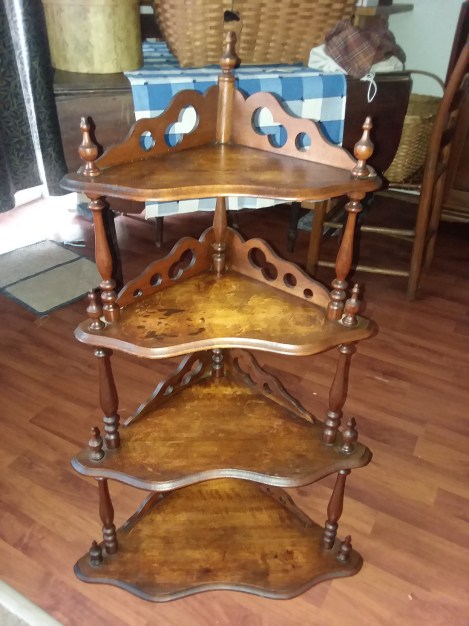
He came back out with a corner shelf.

My first thought was “Grandma would have liked that.”

With that thought, I was done.

It was tall, yet not too tall. It was light weight. It was a Victorian style, yet not too late. It had shelves that would hold lots of ribbon and show them off…

I was happy and sad at the same time. It was pretty with its turned spindles, finials, hand done bits, and wanting to glow wood. Yet, I was sure it would be too much.

I took a breath and asked how much.

It was in budget!!!!

I pulled out my summer allowance and bought the shelf.

While I had my massage the owners cleaned up my shelf. She was set on getting off a spot of paint and a mark of paper. He was set on dusting it well. Above and beyond.

They asked me to take a photo when it has all the ribbons on it. Of course, I will be happy to.

Published in: on July 11, 2019 at 2:46 pm  Comments (7)  

A Post of Lists…

Works in Progress (WiP)

  • Bonnie’s clothes
  • Pink silk pinking project (silk enroute, needing to be washed before which form the project will take is decided.)
  • Hemming runners and table cloths

Projects in Waiting (PiW)

  • Pink silk plaid dress
  • Recover a parasol (need a different frame)
  • Hood book
  • Doll book
  • Directions for awesome blue sewing case

Projects in My Head

  • Pin cushions
  • Ribbon display
  • Silk bag or crazy quilt bag
  • Gift bags

Things I Haven’t Seen Since Moving

  • Brown light cotton sacque
  • New petticoats
  • Period spoons ordered just before packing
  • The tiny doll size pitcher we found in the garden
Published in: on July 8, 2019 at 11:59 am  Leave a Comment  

A Surprise Unboxing – There is Nearly Squealing

I stopped at the Post Office to mail some packages today. I almost didn’t check my box because I wasn’t expecting anything. I am so glad I did. This is what was inside….

(please excuse the grey out area)

WeVideo version

https://www.wevideo.com/view/1424115704

YouTube version

Published in: on July 1, 2019 at 12:32 pm  Leave a Comment  

July To-Do List

Today was the last day of school. Time to write a to-do list!

  • Make a minimum a of 15 bonnets and hats
  • Make all of Bonnie’s clothes – chemise, petticoat, dress (needed for the second weekend of the month)
  • Find which fabric to cut for a pinking demo (for next week)
  • Make my brown wool skirt (for next week)
  • Get my collar on my dress (for this coming week)

  • Draft a new bodice pattern for my pink silk dress
  • Make my pink silk dress (needed for the third weekend of the month)
  • Find the China a home
  • Prep for the display shop
    • Pull out all the ribbons, and boxes and such….
    • Fix my fashion plate pictures. Find them.
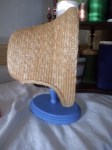
    • Wire and decorate the woven bonnet for display. (fingers crossed)
    • Find a frame for my door sign.
    • Get to G’s to pick up my big sign if it is ready.
  • Write the things

Additions:

  • Fan box
  • Ribbon display box
Published in: on June 28, 2019 at 4:48 pm  Leave a Comment  

GCVM’s War of 1812 weekend

When I woke up Saturday morning, I thought I was crazy for time traveling in the midst of Regents exams. Now, I am very glad I did.

Here is a little video from before I was fully awake and not quite functional…

This was the first weekend for me to use my new frail. It nicely fits a millinery block, dampened straw, a display hank, and four bonnets. The frail made it very easy to carry everything into the village.

This unpacks and sets up like this:

This has become my standard straw sewing clothes for this era. I am working on a set of straw sewing, labor-doing clothes for the 30s and 50s.

We had a few non-human guests. The turkeys came to visit Saturday. The kitty cam to visit Sunday morning. He was quite determined to do his job of inspection rounds and had little ti e for me.

I nearly completed the bonnet for the weekend. I was about 3 yards short of prepared straw. I had planned to make the same style as my 2 display pieces to emphasize the cottage industry aspect. But as I got going, I discovered the straw wanted to make a higher, shaped crown. Here is the progress.

Random me… Proof of my giddy tired state Saturday morning…

This is a brief post because I am incredibly tired. I don’t want to wait until tomorrow tomorrow post because I suspect I will be just as tired after 4 exams.

Did you know… Several buildings offer the work of the artisans and crafters from around the village?

Published in: on June 23, 2019 at 6:30 pm  Comments (2)  

Ramblings on Color

This is a new kind of post for me. I am quite literally going to be rambling. I’m using the speech to text feature in my phone so I can post while sewing. We will see how this goes, because as most of us know, text to speech doesn’t always hear us correctly. This means this could get very interesting or at least a bit funny.

So… color…

As most of you know I am working on straw plait of a variety of colors this season. I currently have the green straw in my hands. This is actually a color that was available last year but it is a favorite.

Of course, working with straw of different colors brings about the question: “What colors did they have?”

Reading the different history books on the straw industry it appears up through the 1840s colors primarily stuck to natural straw, white, black, Gray, and the dark blue. It was 1850s and the coming of aneline dyes then brought about additional colors for straw. Now of course none of the industrial history writers seem to find important enough to tell us which colors. Here is Straw Hats, and the History of Their Manufacture, an 1922 publication focused on the Luten, England production, to give you an idea of how that looks.

The Useful Arts Employed in the Production of Clothing, an 185q publication looking at the clothing industry, gives more clarity on colors with these notes on blue, yellow, and red.

Turning to advertisements, we have a little more help and a lot more vagueness.

Nashville Union and American, July 31, 1857

Holmes County Republican, May 31, 1860

Thanks to Vicki Betts’ research.

Thanks to Vicki Betts’ research.

Advertisements such as these tell us that straw hats and bonnets were available in different colors, and dining services are available. Specific colors mentioned seem to be limited to Browns, greys, black, and white, lots of whites. We also we also see they at stripes and polka dots we’re available as well.

Fashion descriptions are a bit more helpful. Godey’s lady’s book and the English women’s domestic magazine and I’m drawing a complete blank on this other publication I want to talk about oh yeah Madame Demarest, give us a little more insight.

Fig. 1. – A Neapolitan braid, gray and white….. (Godey’s —–)

Then there’s this one …. dear editor “um, what? Could you possibly be less clear?”

Some times we forget books we’ve read. And, sometimes, we are reminded in the oddest ways. While looking at fashion descriptions in 1861 Godey’s I found a little passage on the sulfer bleaching process in the “Chemistry for Young” section….

This little clip reminded me of my old friend Scientific American. The September 1st, 1855 edition offers us this rather lovely column describing the processes for dyeing straw in many colors, including shades of purple, green, yellows, reds, pinks….

One thing I should be talking about is: Where are all the extant original straw bonnets in different colours?

The absolute vast majority of remainingmid-19th century bonnets and hats are natural straw. There are a few black a few white. I can specifically recall only one green, and that’s a green grey, in a digitized museum collection. Working with the different straws, I have definitely come up with a theory: dyed straw was simply too fragile to last. I have had one Hank of black straw that I refused use because it felt like it was disintegrating in my hand. This wasn’t even an old Hank of straw. This is a new Hank. A straw bought from a current millinery Supply. (Don’t worry it’s different than the one I use now.) If that straw with supposed modern technology and dye processes couldn’t hold up through my hand sewing, I just can’t imagine dyed straws lasting decades.

These are just ramblings while I sew, with a few images saved on my tablet. For more indepth research and discussion, please read From Field to Fashion.

Published in: on June 15, 2019 at 9:21 pm  Comments (1)