The Newest “Must Have” Books for Your Christmas List

Whether shopping for the perfect gift for someone special or making your own wish list, there are some great new books out this fall that ought to be on your Christmas list.

For the needle-worker, seamstress and quilter, there is Fanciful Utility: Victorian Sewing Cases and Needle-books by Anna Worden Bauersmith. This book shows step-by-step how to make an assortment of well researched sewing cases, housewifes and needle-books. Filled with templates and color photographs, this book is sure to keep the hands busy all winter long.

Everyone who dresses for the Civil War era will want Dressing the Victorian Civil War Lady: A Guidebook to Dressing the 1860s by Joy Melcher of the Civil War Lady. This book is filled with original photos, illustrations and tips for interpreters, reenactors, seamstresses and stage costumers.If you love to dance, you will have to have the West Side Soldiers Aide Society’s release of  The Ball-Room Manual of Belfast, Maine from 1863. The facsimile book has page after page of period contra dances acceptable to “the Young, as well as the Old Folks at Home”.

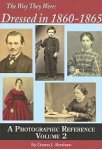
I was very excited to see this second volume available. The Way They Were: Dressed in 1860-1865, Volume 2 by Donna Abraham. Volume 2 takes a closer look at the details of the clothing women, men and children wore through newly published photographic images magnified for an indepth study.
The following books aren’t brand new, but if you don’t already have them, you should have them on your wish list:

Anyone making their own mid-century clothing, or just looking to understand it better should own The Dressmaker’s Guide by Elizabeth Stewart Clark.

Donna Abraham’s The Way They Were: Dressed in 1860-1865 is packed full of original CDV images. I just love this book as my copy is filled with notes and arrows.

What else is on my wish list? Well, I need to learn more about men’s clothing so I can make my husband a full set of civilian attire. (I also need to convince him this is a great idea.) With that in mind, on my wish list we find The Victorian Tailor by Jason Maclochlainn as well as Mr. Ruley’s digital version of Louis DeVere’s 1866 Handbook of Practical Cutting on the Centre Point System.

How I Made the Hood Veil

Many people have asked about the veil I made for the hood last week. I’m happy to share. But first I must say the person who has done the research along with the trial and error on veils is Bevin Lynn. She’s done a good deal of research and working with different shapes, materials and colors. I keep waiting and hoping that she will put all of her great work into an article. But, now she has herself incredibly busy. So, we shall see.

In the meantime…..

The veil I made was a request from a client to go with her black taffeta winter hood. She wanted both some sun/glare protection for her eyes and face protection from the cold winter wind.

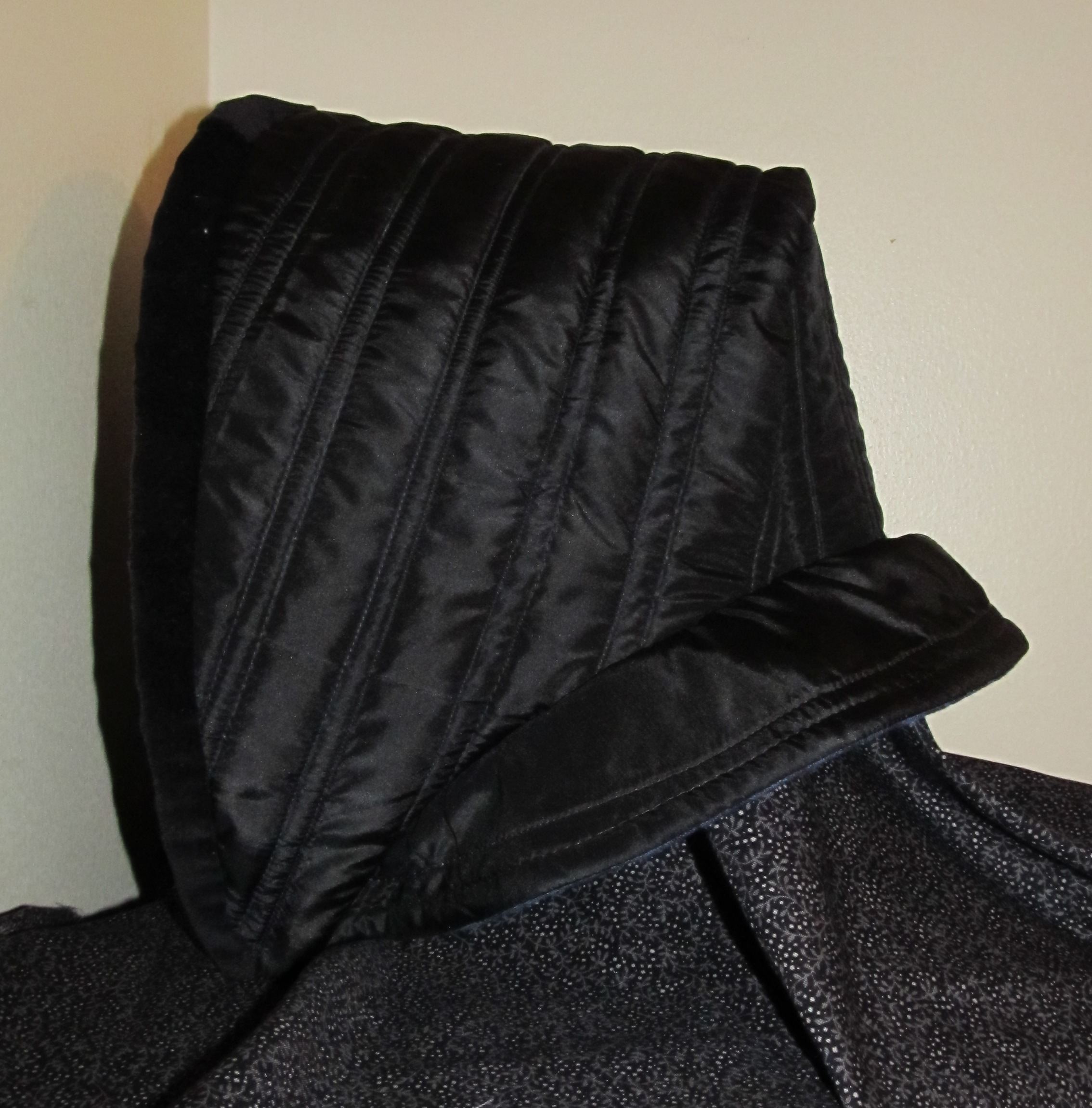
This black silk hood is edged with black velvet and is draped with a veil. Commission/Sold

I used the 3mm silk gauze from Dharma which Bevin determined to work nicely. I chose black. They have a white which can be dyed. Bevin determined plain white actually makes the sun glare worse. Dharma’s gauze comes 45″ wide. The selvage is there but barely so, therefore usable. I do not know if there is a comparable net to originals at an affordable price.

 
For this veil I went back and forth deciding between a simple rectangle or the semi-oval/fruit wedge shape. Since I had not worked with this incredibly fine gauze before, I opted for hemming the straight lines for the rectangle. (The hemming wasn’t bad at all. So, the curve should be quite doable.) I cut the gauze in half to get a piece 36″ by 22.5″ giving a veil approx 35″ by 21″, which is in the realm of the original sizes I looked at online. One tip for working with this gauze, this slippery gauze – find your cutting line and draw out a thread from the weave. This is easy enough to do slowly and gently. The drawn thread will provide a cutting line when laid against a contrasting surface.
 
I do not have the skill to do the incredibly beautiful lace work on the edge. I used a simple rolled hem, which I rolled over three times rather than twice. The hem is about 1/8th of an inch wide. I tend to use a technique where I dampen the edge of fine fabric for a hand-rolled hem. Liz has a technique where she presses the first turn, trims it and uses a stitch to grab the edge and draw it into the hem.(I’ll grab that link when I re-find it.) The gauze did hem nicely to the point where I stopped dampening the silk because it turned quite nicely without much fraying. This hem went on both sides and the bottom edge.
 
For the top, which is where I put the selvage, I turned under a half inch hem with enough space to draw a cord through. On either end of the cord, I made a loop. I was really guessing here since I didn’t want to bug Bevin on her way to Zoar. Another option would have been to gather the veil onto a ribbon (example). I wanted my client to have the flexiblity of moving the veil to her other bonnets or hood as she needed, making the flexiblity of the drawn cord a better option.
 
The veil is simply drawn up on the cord, centered on the hood and pinned in place.


Published in: on September 27, 2011 at 8:51 am  Leave a Comment  
Tags: ,

A Story of A Hood

I came across this passage in Peterson’s that I just had to share. Not only does it talk about a type of hood, it says a bit about society and fashion in a small town. The article is called “A Story About Peterson’s” by “A Minister’s Wife”, from the November, 1862 edition.

“Rigolettes, as they are called, were not in fashion: that is, they had not penetrated to Woodstock, there being as I have hinted, only one Peterson in the place, and that was mine. When the women did not wear their best, they generally came out in homely cape-bonnets, which, if they were plain, did not improve their looks, and, if they were pretty, almost deformed them. I saw a beautiful pattern in Peterson, and, as I always considered it a duty to look as well as I could, I forthwith devoted my spare time to manufacturing one of the aforesaid rigolettes. (By-the-way, that isn’t a pretty name for them.) I knit it in plain colors, blue and drab, I believe, and, when it was finished, it was really an exquisite thing, at once convenient and becoming.

“What! Are you going  to dare wear that to the prayer-meeting?” asked Ward, after he admired it sufficiently to suit even my fastidious taste.

“To be sure I am. What could possibly be neater?” was my reply.

“Nothing – if you are prepared to be victimized. It is new, and the Woodstockers resent every innovation. Besides, you look so provokingly pretty, that they will be jealous, even of the minister’s wife!”

“Let them say and think what they please,” was my rejoinder. “I shall not care. When I put my dress on, whatever it is, there is and end of it – it never enters my mind again. If they are weak-minded enough to allow distracting thoughts of any kind to disturb them in such a place, that is their fault, not mine. To be sure, I shall wear my new, pet head-gear.” And I did. Some were foolish enough to stare – no doubt others made invidious remarks, but it did not vex me in the least.

The next day, pretty Annette Sawyer, one of the sweetest girls in the church, came over to the parsonage.

“I must see that beautiful hood, – no, not exactly hood – you wore last night, “ she said, after her good-morning kiss. I brought it for her inspection. She tried it on, and had enough human nature to be pleased with the sweet pink and white face, whose freshness was enhanced by the rich shades of the rigolette.

“It’s just the thing. Where did you get it? If I only had the pattern, I’d make one right off. Haven’t you the pattern?”

“My dear, I paid two dollars for the privilege of using it.” I said, quietly.

“You did? Oh! Dear me; then I can’t have one!”

“Oh! yes, you can. Come over here with your materials, and I’ll show you all about it.”

“Thank you – how kind you are! the best minister’s wife I ever saw.” I knew by the emphasis on the I, that she had heard some disparaging remarks about me, but forbore to question her. She was a constant visitor for the next week, and there were soon two rigolettes to be seen in Woodstock. From that time they multiplied. Cape-bonnets were discarded in summer; and in winter, pumpkin hoods were replaced by warm, thick, but lighter and more convenient wool.


Published in: on September 27, 2011 at 6:05 am  Leave a Comment  
Tags:

Update on the Hood Pattern

Thank you to the many of you who voiced an interest in having my hood pattern available.

I am focusing this week on getting the text, illustrations and pattern pieces in a publishable state. My goal is to have it available for those who will want to make a hood for this winter. Fingers crossed there since this is both a matter of preparation and funds for publication.

I would also like to pull together the hood workshop some of us discussed.

For the published pattern, here is what I have in mind:

  • Pattern pieces for an adult hood in two depths (I was going to include the child’s hood but am having difficulty fitting that.)
  • Directions that are short and easy to understand using a combination of illustations and photos, including information on quilting.
  • An explanation of this type of quilted hood along with observations of extant hoods.
  • Tips on a successful hood in terms of materials and techniques.
  • Passages from Godey’s, Peterson’s, etc regarding quilted hoods and bonnets.
  • Ideas for how to trim your hood based on originals and extant hoods.
  • I’m hoping for a price point between $10 and $15, which will be based on what my print shop can do for me. (they are great.)

Muddle Thoughts – Weekend Event Reflection

I have such a mix of thoughts on this past weekend that they really are a muddle of thoughts. This weekend was Hull Family House’s candle-light tours and living history. It also combined into the mix the final of my 1830s travel at GCVM.

Before I get into all those muddled up thoughts, I do want to say I absolutely loved how the weekend was for Dan and I. I really enjoyed my husband and our time together this weekend. It was so very nice. We didn’t have any spats over any of the things we normally do like packing, setting up, arranging. We relaxed, spent time together, chatted with friends old and new. Somehow this may be a favorite time for me.

One of the prevailing mixes of thought is while I’m doing something I love, I’m tired of feeling lousy. This whole season I’ve had problems with being able to sleep and feeling utterly miserable by early afternoon. I get this feeling like every bit of energy has been drained out of me along with either a headache or inability to focus. This weekend did me in for both the sleep and the feeling awful. I wasn’t able to sleep at all Saturday night despite my husband being in the same tent as me. For the life of me I couldn’t get comfortable on my cot where I used to sleep oh-so soundly. Without my ticking and being on an incline I slid down to the point where my back was right on the seam across the cot where it was repaired. Oh, does my back still hurt from that. The drainedness was accompanied by down right nausea through most of the day. There were points where I think the only reason I stayed upright was because my corset held me up. This whole thing is so disconcerting to me. I don’t know how much is me health wise and how much is the way of doing an event is so very different for me this year. In years past, I was ready for an event well in advance right down to the food heavy with vitamins and water. During an event I had a comfortable home base that was mine or mine and Jackie’s either at a home or under Jackie’s fly with our tents attached. We watched out for each other food, drink and activity wise. She often had to play mom to make sure I didn’t drop because I don’t always know when to stop or when my face gets too red. This season I haven’t had the right water pitchers and glass out; I haven’t had my tins and crocks with pre-planned food; I haven’t had that deep night’s sleep; I haven’t taken my infamous battle-time nap; I haven’t know every minute of the day what activity I am going to be doing; I also haven’t had that much of a purpose. So, obviously I have to get myself back on track.

One would think having the weather turn out to be simply beautiful, warm and sunny, rather than the cold rainy weather predicted would be a good thing, right? I know, it should be. It helps with attendance. But, I have to be honest I was counting on cold weather because cold weather would prompt people to buy warm clothing like hoods. I had three hoods up on Etsy over the weekend and two in Pat’s tent in hopes that they would sell so we can pay for storage due and Sprint due this week. With the sunny warm weather, no one needed a nice warm comfy hood.

This one might make a few people upset. Leaving the museum, I drove as quickly as I could to Hull House thinking I would be doing a guide roll. Not the case. This isn’t a big deal on a personal level; I was fine with not having to be a guide. I do think there were some major communication problems. To be honest, I don’t think it was on the side of the Hull House. They had this great system down. I was very impressed watching and listening to the women and men doing the great many things they pulled off. (Yes, even when I’m a physical wreck with myself completely tuned out I still can’t help observing these things.) They volunteers of Hull House went above and beyond making reenactors comfortable for this weekend. I really feel sorry for the organizers on that end because I got the sense information on the tours was not given to them in a timely fashion either. Seeing what the HH volunteers do for the reenactors makes me want to be able to bend over backwards for them including giving them an outstanding level of pre-planning.

As I said this weekend was also my last travel program for GCVM. I’ve enjoyed talking with Bevin and Matt about the visitor experience in such a focused way. I’ve definitely determined I prefer an interactive program to a presentation mode program. It is very beneficial knowing the diversity in audience/visitor preferences. With my own muddle of thoughts, I can only imagine what Matt has to sort through. In between performances I was able to finish up the set of carpet bags, getting their handles on. They really do look nice with the handles on, finally looking like bags. As nice as they look, as functional as they will be, I don’t think I will ever make bags out of real carpet again. (I hope to do a post about my thoughts on carpet from this experience.)

I guess that completes my muddling of thoughts, or at least the ones I can put together enough to communicate. This week I’m planning to get a good chunk of the hood pattern together. There seems to be a good deal of desire for that based on the FB responses I received. I have a few other things to do as well that I’m hoping will be doable if I get enough gas money together.

Published in: on September 26, 2011 at 9:08 am  Comments (5)  

Article on Williams Clothiers on the Fit of Men’s Trousers

There is an excellent new article over on the Williams Clothiers notebook. “How to Wear Trousers Properly and Avoid Gaposis” includes numerous images and informative text. Take a look!

Published in: on September 18, 2011 at 5:12 pm  Leave a Comment  

A Bit of Velvet

This weekend’s hoods each got trimmed with some black velvet. Several period magazines suggest velvet trim for quilted hoods and bonnets in their fashion columns. This velvet seems to add a nice warming touch.


Published in: on September 18, 2011 at 3:43 pm  Leave a Comment  

Agricultural Society Fair Entries

I still have all the ribbons I won at the Genesee Country Village and Museum’s Agricultural Society Fair. Believe it or not I actually won a blue ribbon for my handwriting. Go figure.

This year I’m entering a variety of sewn goodies.

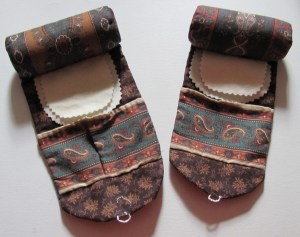
First is my pair of sewing cases, also called housewifes. I do like this little pair. They will be entered under the sewn items category.

Under the “Quilted Projects” category, I’ll have a pieced article of clothing and a quilted article of clothing. For a pieced item, I’ll be entering my quilted pocket.

The quilted article of clothing entry will be the quilted hood I am working on.

For my sewn article of clothing I keep changing my mind between one of my little purses or the capote hood I teeter-totter from liking to disliking.


Published in: on September 16, 2011 at 8:11 am  Leave a Comment  

Hood Observations

I should say quilted hood observations focusing on those which are shaped to resemble bonnets as there are so many kinds of winter hoods from the mid-century. You can find soft hoods which drape the head and shoulders, fluffly soft hoods which wrap around the head, shaped hoods which look similar to bonnets, those which are moderately shaped to cover the head and shoulders, and a multitude of combinations. Right now, I’m just looking at those which are shaped like a bonnet. (Yes, forcing myself to focus.)

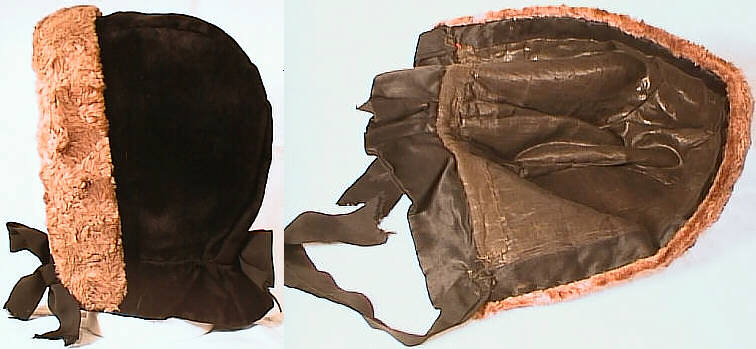
Lets start with lining. I assumed incorrectly that I would see the majority of the interiors done in silk. As it turns out the vast majority of the linings are cottons. Some are solids, others are prints. Some are polished cottons, others are un-polished.  Here you can see the brown polished cotton on the interior:

Image A - From "The Graceful Lady" site - A black velvet hood trimmed in fur with a polished cotton interior and black silk facing.


Shape

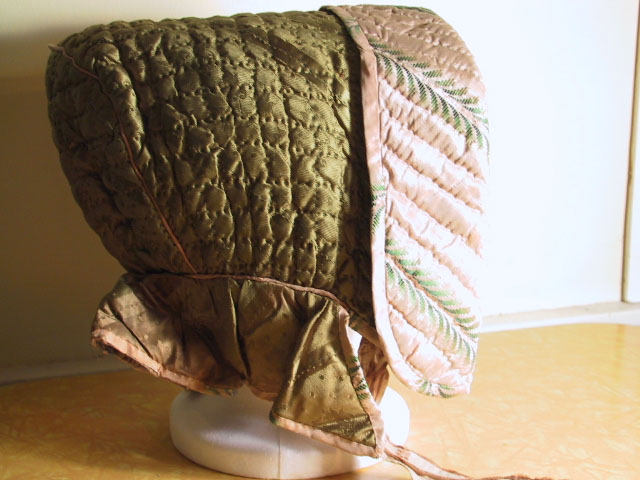
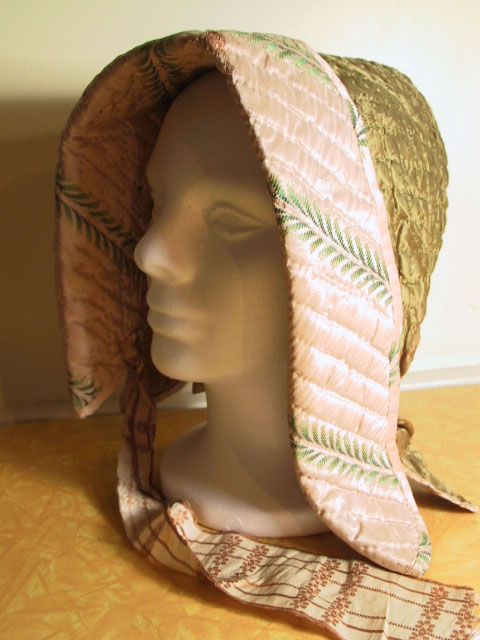
The shape of quilted hoods seems to range from mimicing the shape of bonnets right down to the shape of the cheek tabs to roughly suggesting a bonnet shape, more following the shape of the head in order to hug it with widened or shallowed cheek tabs. This green hood from MFA has rather distinctive cheek tabs. This quilted hood has a roughly follows the lines of a bonnet with a shallower brim, fitting closer to the face and cheektabs which are wider:

Image B - From "The Graceful Lady" site - Silk quilted hood with a bonnet-like shape which fits closer to the shape of the head. The turn back is of an accent fabric, as is the piping and binding.

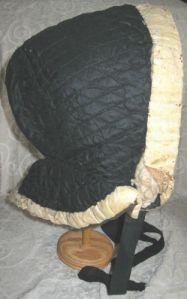
The tips found in extant bonnets include both circular and those with flat bottoms. Someone also shared with me an ‘ugly’ style hood with a tear-drop shape tip.) Image B, above is an example of a tip with a flat bottom to which the bavolet attaches directly. This black silk bonnet from the MET collection is an example of a circular tip.

The bavolets, or curtains, are most often quilted though at times with a lesser fullness or thickness than the body of the hood. The shapes appear to include both straight pieces gathered to fit the neckline as well as curved pieces shaped to the neckline. The fronts of the bavolets appear in hoods both in attached and not attached states. The bavolet in image B is unattached, while those in image A, the green MFA hood and the black MET hood are all attached to the cheek tabs.

Materials

Exterior materials appearing in extant hoods include a variety of weaves of silks, velvets and light weight wools. I have heard word of cotton hoods as well, but have yet to see them in person. The silks include very fine silks to those that may have been considered inferior at the time with varigation in the dye and fiber/thread thickness. Some are woven stripes using taffeta, twill and satin weaves (Image B is a woven stripe). Some are printed fabrics including stripes and floral-stripes. Plaids are also seen. The exterior material is seen both set on the grain and on the bias. I have yet to determine which is more frequent and whether an angle or direction of the bias stripes or plaids is more common than other placements.

Trims

Extant hoods show a number of trims including fabric trims, fur and feathers. In this hood, the facing and possibly the lining is an accent silk set on the bias and turned out acting as a trim. On the green hood from the MFA collection  we see a complimenting, nearly same colored fabric being used as a pleated trim around the brim and bavolet. On the black silk MET hood we see a self fabric trim pleated and placed around the brim, bavolet and tip. This hood also demonstrates the placement of ribbons. On this hood we see where the fur or down trim had encompassed the brim:

Image C - from Ebay - Black silk hood trimmed in fur or down. (currently for sale as of posting)

Wadding and Structure

Inside the hoods, the wadding has included cotton, wool and down. In the above image C, you can see some of the wadding revealed. Thicknesses seem to range from under a half inch to almost an inch. (The hoods known as ‘uglies’ are much thicker.) Whether this thickness has compacted over time is unknown.

The extant hoods I’ve looked at thus far have included those which are completely soft with no structure and this with structure in the brim or tip. The green hood from the MFA collection  is caned through the brim giving the brim support. A hood in the Greene collection at GCVM has a woven straw in the tip for support.

Some of the hoods are assembled with piping, same fabric and contrasting/complimenting, others are seen without piping. The same can be said for binding along the brim and bavolet.

Additional Links

This appears to be a black silk hood with a white or off white cotton interior. (who’s hood this was)

This little one is likly a child’s or doll’s.

Published in: on September 14, 2011 at 8:45 am  Comments (1)  
Tags:

How to Dress for a Photographer

This is a guest post thanks to Jenna Theissen. She shared this piece from the May 27th, 1865 edition of  All the Year Round, Weekly Gazette & Comet out of Baton Rouge, Louisiana. Thank you to Jenna for sharing this interesting piece of information.

A lady or gentleman, having made up her or his mind to be photographed, naturally considers, in the first place, how to be dressed so as to show off to the best advantage. This is by no means such an important matter as many might imagine. Le me offer a few words of advice touching dress. Orange color, for certain optical reasons, if photographically dark. Blue is white; other shades or tones of color are proportionally dark or lighter as they contain more or less of these colors. the progressive scale of photographic color commences with the lightest. The order starts thus: White, light-blue, violet, pink, mauve, dark-blue, lemon, blue green, leather-bound, drab, cerise, magenta, yellow-green, dark-brown, purple, red, amber, maroon, orange, dead-black.


Complexion has to be much considered in connection with dress. Blondes can wear much lighter colors than brunettes; the latter always present better pictures in dark dresses, but neither look well in positive white. Violent contrast of colors should be especially guarded against. In photography brunettes possess a great advantage over the fairer sisters. The lovely goelden tresses lose all their transparent brilliancy, and are represented black; whilst the bonnie blue theme of rapture to the poet, is misery to the photographer; for is put entirely out. The simplest and most effective way of removing the yellow color from the hair is to powder it nearly white, is is thus brought to about the same photographic tint as in nature. The same rule, of course, applies to the complexions. A freckle quite invisible at a distance is, on account of it’s yellow color, rendered most painfully off tint when photographed. The puff box must be called inot the assistance of art. Here let me intrude one word of general advice. Blue, as we have seen is the most readily affected by light, and yellow the beast! It, therefore, you would keep your complexion clear and free from the tan freckles whilst taking your delightful rambles as the seaside, discard by all means the blue veil, and substitute a dark green or yellow one in its stead. Blue tulle oiler, no more obstruction to the actinic rays of the sun then white. Half a yard of yellow net though perhaps not so becoming, will be more efficacious and sonsderably chaper then a quart of kalydor.

This additional piece comes from the reverse side of a card from Flynn’s Gallery in Salem, N.Y.


“Some simple facts concerning Color will be useful to many, especially ladies, when deciding how to dress for a Photographic picture. Dark brown, dark green, maroon and plaind black goods, without gloss, will take a rich black color. Silks of the same will take considerably lighter, because they are glossy. Snuff-brown, dark blue, drab, scarlet, cherry, dark orange, crimson and slate, will take a very rich look. Violet, blue, purple, pink and magenta, will take very light and should be used dressing for photographs. The prevailing style of Plaids will take well. The hair should never be very wet or glossy.”


Published in: on September 13, 2011 at 8:54 am  Leave a Comment