Fichu Pattern Pre-Sales

Announcing my new pattern!

Pre-orders are now being taken through November 25th. Pre-ordered patterns will be shipped on December 1st or 3rd. As this initial printing will entirely depend on the number of pre-orders, be sure to order early. Please visit my Etsy Store to place your order.

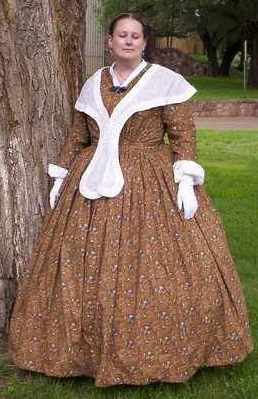
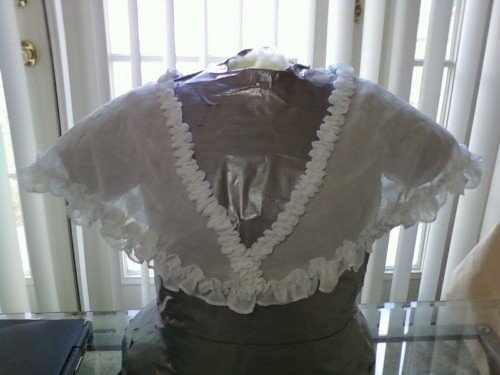
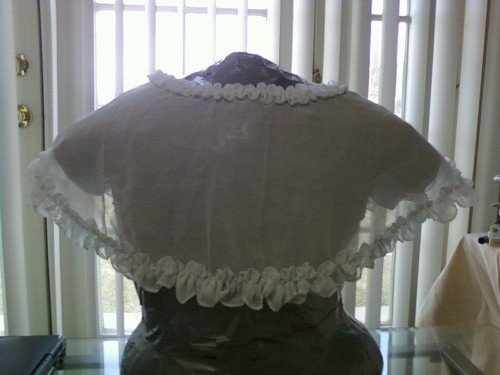
Whether for a ball or a summer day, a fichu is a lovely accessory. From light and airy to soft with hints of color, fashionable fichus were worn with day wear as well as evening and dinner wear. This pattern will guide you in making a fashionable fichu extending the versatility of your Civil War era or antebellum, 1850s wardrobe. With the four popular shapes of the era included in this pattern along with the many variations of embellishment described in the pattern directions booklet, you can make an almost endless variety of era accurate fichus.

Each pattern includes:
A single sheet pattern with four fichu styles
A directions booklet with observations of fichus, directions and fashion descriptions.

Please visit my Etsy Store to place your order.


Since several people are looking to make a fichu as a gift, I thought it would be nice to get them started with some fabrics while we wait for the pattern to ship.


Published in: on November 15, 2012 at 4:39 pm  Leave a Comment  
Tags: ,

Fichu Pattern Coming Soon!

EDIT: November 2014: My Fichu Pattern is officially out of print and sold out (the last copy left the Genesee Country Village earlier this month). I plan Not to reprint this pattern due to the cost of doing so. 

I finally sat down and put the fichu pattern together. Okay, I’ll admit, it was getting to the printer to get the main pattern scanned that was the hurdle. From there, the layout for the directions booklet fell right into place. This pattern follows the same format as my quilted hood pattern – a pattern page and a booklet containing observations, directions and fashion information accompanied by photographs and illustrations.

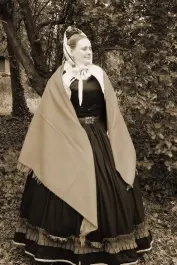
Here I am wearing one of the variations of the pattern. The pattern offers three different shapes for the lappets as well as multiple ways to embellish the fichu.

This is another version of a fichu, without lappets.

Published in: on November 13, 2012 at 4:13 am  Leave a Comment  
Tags:

Brrrrr…. Its Getting Cold Out There

I think by now we are all feeling the chill of the changed season. Sadly, some of us are dealing with a shockingly bad version of this seasonal transition.

This is a link heavy post, filled with seasonal favorites for you to puruse. You will find hints for keeping warm as well as contemporary readings for Christmas. You will also find a fun project.

Let’s start by keeping the body and home warm with “Keeping Warm this Winter” and last year’s “A Practical Look at Winter Clothing.” For an event prep list, check out “Are You Ready.”When thinking about winter clothing, you know I would love you all to make up my Quilted Hood Pattern. *wink* But, if you happen to be focusing on the 1840s, do give the pattern developed by Bevin Lynn for the Genesee Country Village a try.

Do you have gift making in mind? Last year, my series on the 12 Homemade Gifts seemed quite popular. (I’ll be sharing a couple passages from mid-century magazines and books for making more gifts and ornaments in the upcoming weeks.)

A few mid-nineteenth century readings…

The First Christmas Tree , an 1869 publication translated from the French – http://books.google.com/books?id=gcMBAAAAQAAJ&pg=PP6&source=gbs_selected_pages&cad=3#v=onepage&q&f=false

The Christmas Tree: A Story for Young and Old, translated from the German in this 1866 version – http://books.google.com/books?id=C6cDAAAAQAAJ&printsec=frontcover#v=onepage&q&f=false

A Present from Germany: The Christmas Tree, 1840, by E. Perry. http://books.google.com/books?id=TccNAAAAQAAJ&printsec=frontcover#v=onepage&q&f=false

The Christmas Tree and other stories, for the Young, by Mrs. Lovechild, 1863 – http://books.google.com/books?id=m6AXAAAAYAAJ&printsec=frontcover#v=onepage&q&f=false

I would be remiss if I did not include Charles Dickens’ Christmas Books with the well known “Christmas Carol” – http://archive.org/stream/christmasbooks00dickrich#page/n15/mode/2up

Household Words – Christmas Stories: 1851-1858  by Charles Dickens http://books.google.com/books?id=W8xbAAAAQAAJ&printsec=frontcover&source=gbs_ge_summary_r&cad=0#v=onepage&q&f=false

 And to close, a way too fun project:  

Check this out – Christmas village! http://archive.org/details/SantasChristmasVillage

Published in: on November 6, 2012 at 2:16 am  Leave a Comment  
Tags:

“Painted like an apple, plum, or peach”

For those wondering “can I make these for….”, here is a follow up to the strawberry emery post.

This is a clip from the 1833 edition of A Girls Own Book, by Lydia Child:

This comes from Eliza Leslie’s 1831 American Girl’s Book:

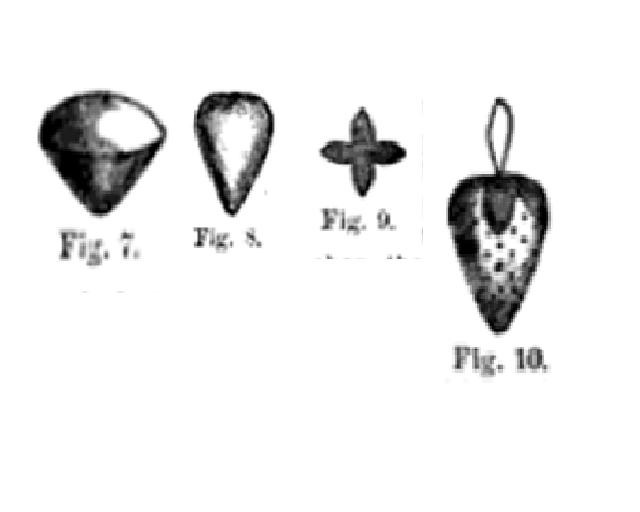
“This pincushion is made of a piece of coarse linen, about half a quarter square, cut into two triangular or three-cornered halves, stuffed with bran and covered with scarlet cloth; which cover must be sewed neatly on the wrong side, and then turned. The top or broad part must be gathered so as to meet all round, and concealed by sewing on a small round piece of green velvet, scalloped in imitation of the cap of green leaves that surround the stem where it joins the strawberry. The stem must be imitated by sewing on a small green silk cord. To represent the seeds, the strawberry must be dotted over with small stitches, made at regular distances with a needle-full of yellow silk, and close to each yellow stitch must be a stitch of black.

Emery bags are often made in this manner, but of course much smaller; not exceeding the size of a large strawberry.”

From Godey’s Lady’s Book in 1869, we have this pear:

Published in: on October 25, 2012 at 2:15 pm  Leave a Comment  
Tags:

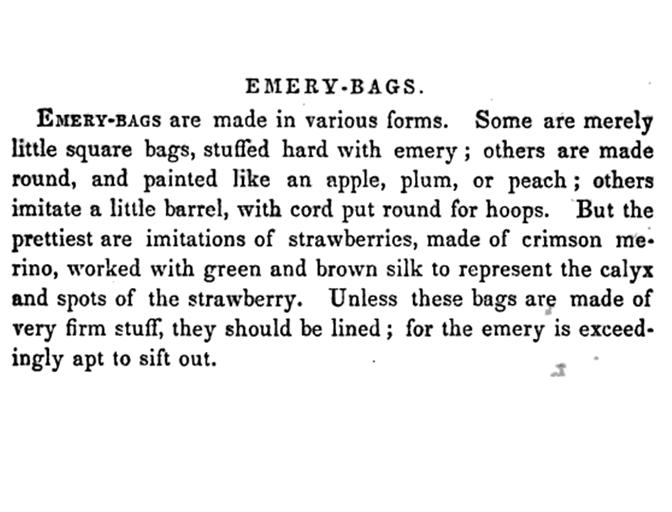
Strawberry Emory

Most of us have grown up with the tomato pin-cushion from which dangles the strawberry emery. This fruit and veggie pair seems to be the strongest survivors of almost tasty looking fruit and vegetable shaped pin-cushions that appear to have peaked in popularity towards the end of the nineteenth century. Often made of velvets, silks and wools, these take shape as apples, pears and carrots to name just a few. These fruit and vegetable shapes are an occasional curiosity of mine. So, when I stumbled upon this fun description of the strawberry emeries, I had to share it with you.

“She was just telling me she had finished stitching the strawberry seeds into the emeries, and wanted another job. She made most of the emeries. I cut out the strong cotton bags, and let her sew them up over a similarly shaped woolen sack filled with emery. She made the red silk sacks, and fastened them on, ready for the green leaves and the cord. She stitched in the seeds with yellow saddler’s silk. I think they are very pretty, and she is delighted with them.”(American Agriculturalist, December 1867)

By the way, this conversational passage, which goes on, was followed by this nifty little labyrinth:

UPDATE

Here is another strawberry emery, knit, found in both Peterson’s and Godey’s in 1859:

A Sampling of Fanciful Utility

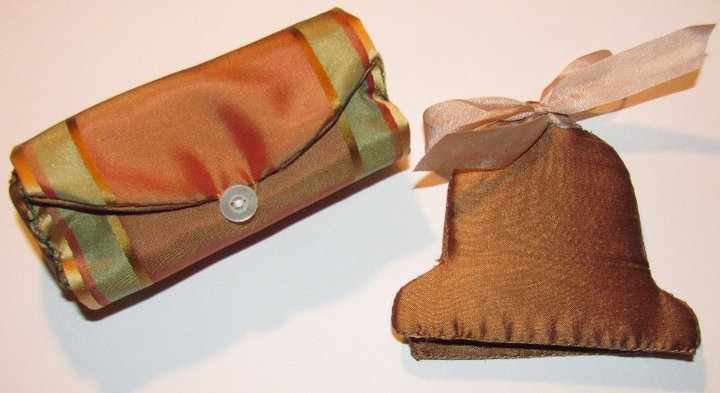
As I anxiously await seeing what the first readers of Fanciful Utility: Victorian Sewing Cases & Needle-books create, I would like to share with you a sampling of pieces I made. Each of these can be made with the directions and templates found in Fanciful Utility.

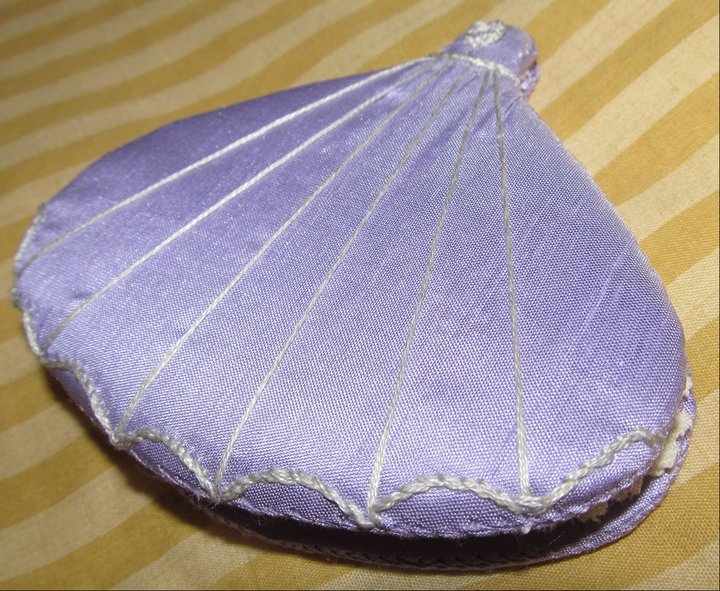
This shell shaped needle-book is one of my favorite shapes to work with. Shell and shell shaped needle-books appear frequently in nineteenth century magazines and guide books.

This bell shaped needle-book shows the effect a variated silk can add to a piece.


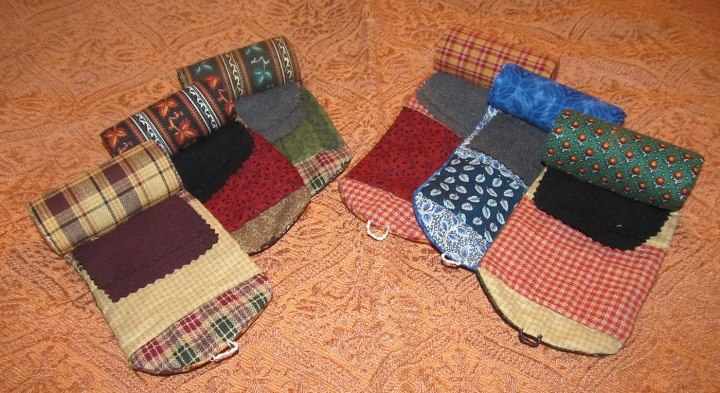
These cotton rolled sewing cases are those popularly recognized in Civil War reenacting as “Housewives” or “Huswifes”. These little cases can hold a great deal.

The same case can be done in silk as well. Rolled cases were also often made with leather, oiled silk or painted canvas exteriors fo men.

This structured sewing case is made of silks and wools. The central box of the case can easily hold thread, scissors, thimbles and other sewing notions.

This case, another personal favorite style, has a place for just about everything. The looks are almost endless depending on the combination of materials you use.

Published in: on October 22, 2012 at 2:00 pm  Comments (2)  
Tags:

Household Decorative Art – Embroidery

Cassell’s Household Guide: Being a Complete Encyclopedia of Domestic and Social Economy Volume II, 1869 (published in London and New York.) While this is the final part of the entry, to me it seems like it should be the first or the second.

Nearly all embroidery is, when circumstances will permit, best worked when stretched in a frame, and lengths which are too great when stretched at one time, may be put in the frame in successive pieces. The best kind of frame for canvas is one in which the material is secured by blunt points, attached to the sides and covered with a wooden bar, cut half round, and having a groove, of a same width as the points, running along it; the canvas is stretched and the sides secured by screws. But all other materials would be injured by being fixed by such points, and must, therefore, be secured to the frame by being sewn to webbing. A frame capable of holding a piece of work three feet square is a convenient size, and costs about 10s. 6d. It is better that the frame should exceed the size of the work by some inches, and it is well, to secure a good purchase, that the material should be sewn to the extreme end of the webbing on either side. The selvage sides of the material should be sewn to the webbing, so as to leave an equal space at either end, with strong, double thread, in stitches of six to an inch, and a piece of tape to secure them, stitched along the wool ends of the material. The frame is then put together, stretched and secured by its pegs, and the woof ends are in their turn secured by sewing through the tape through the tape and over the opposite bars with twine.

In working at the frame, there will, at first, be some difficulty experienced in using the left hand simultaneously with the right, and particularly in bringing up the needle from beneath in the exact spot. The power of doing this can only be attained by perseverance, and the beginner should practice till the needle can be used as well with the one hand as the other. The worker should sit in as upright position as possible, and the frame should be fixed accordingly; as regards to light, a side light is best. In doing long stitch or gold bullion embroidery, both hands are rarely required above the frame; in couching, one hand guides the silk along the material, while the other sews it down, and in applying nearly all edging cords, the hands are occupied in the same way. While working with floss-silk it is necessary to keep the hands smooth, or they will catch it, and It is not well, for the same reason to wear rings. Perfect cleanliness of the hands is, of course, indispensable.

The implements required are needles, which should be large in proportion to the silk they have to carry, and with large, round eyes; from 7 to 9 are the sizes most often in use; the former few sewing-silks, and the latter for crochet and other coarse silks. Nos. 8, 9, and 10 are good sizes for gold bullion. Pins of a small size will be found requisite. As both hands are employed, two plain silver thimbles should be provided, scissors, &c.  A stiletto will be required, and a steel piercer rounded and pointed at the end, and then becoming flat-sided, will be useful for regulating gold bullion, passing, pearl-purl, &c.

The embroidery paste, of which we have spoke is made by adding to three tablespoonfuls of flour as much resin as will lie on a shilling, mixing them smoothly in a half pint of water, stirring, mixing them smoothly allowing them to boil five minutes, when the paste should be turned out and left till cold.

The silks to be used are floss, Dacca, Berlin, three-cord, crochet-twist, and seedling. In the best old work, floss is the silk chiefly employed, either in vertical lines kept down by cross rows of fine gold thread, or split fine for flesh and hair; sometimes a thick line of it is used for outlines, while at others ,rows of twisted silk sewn down with it are used for that purpose. Dacca is a floss-silk , so made as to be easily divided into two filaments or plies, which can again be subdivided to any extent which is necessary, besides being more easily split than floss. Dacca is made in more shades; the English is he best, the French being deficient in softness and brilliancy. Berlin has a smooth, loose twist, and is well adapted for flat masses of colour, as also for scrolls and leaves. Three-cord is a close-twisted silk of three plies and best simulates gold bullion. The apricot shade is very beautiful, but, as it turns white, the more metallic yellows are to be used in preference. Three-cord is made in other colours that gold, but not in such variety as Dacca or Berlin; the French is not equal to the English. Crochet-twist is also of three piles, but is coarser and less tightly twisted than the above. It is most valuable of larger designs to be used in imitation of gold, and may be either applied in modern embroidery over card, or couched, either single or double, by stitches of purse silk, or it may be used as a substitute for cord in edging appliqué. Purse-silks are of three sizes – coarse, medium, and fine. The first is used in places where three-cord would be too clumsy; the second when a strong, even, and tolerably fine silk is needed; the third for such purposes as couching crochet-silk on an even surface. In sewing-silk, there is only one first-class quality, which should always be used (drapers’ silk on reels is value-less), and the best is bough in hanks, of from half an ounce to an ounce. Passing, that is gold thread, should be couched with sewing-silk.

Where twist-silk is being used, it is not possible to fill gaps with extra stitches, as in using floss; every stitch must, therefore, be laid with regularity, the piercer being constantly used to keep it in place; care should be taken that the stitches are of uniform tightness, and a needleful should never be gone on with when the silk dulls or strains, but another should be taken at once.  A large-eyed needle should be used, and never too great a length of silk – twenty-seven inches is a very good length for a needleful.

Pearl-purl is gold cord , which resembles a close string of beads, and is used for edging bullion embroidery; it should be sewn down with single silk, previously waxed and the stitches concealed. Spangles are frequently useful for enriching embroidery; they are made both flat and concave, the latter have the best effect. Passing is a bright, smooth thread, formed by silver-gilt wire spun round yellow silk. Generally speaking, it should not be pulled through material, but should be couched and sewn down with colored silk.

At present day, an important employment for the various kinds of embroidery we have described, is the decoration of church furniture; for which, indeed, such methods of work are alone properly applicable. The number of domestic purposes to which, also, it is now growing fashionable to apply them, is very large, some of the most favourite being, as borders for curtains and tablecloths, as hangings for mantelpieces, and, in narrow strips, to be affixed to various articles of furniture.

Published in: on October 21, 2012 at 1:14 am  Leave a Comment  

Fanciful Utility with a Christmas twist

Thank you to everyone who has purchased a copy of Fanciful Utility as well as those of you who will be in the future.
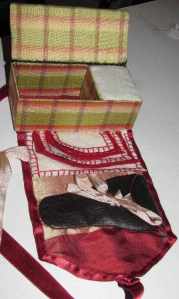
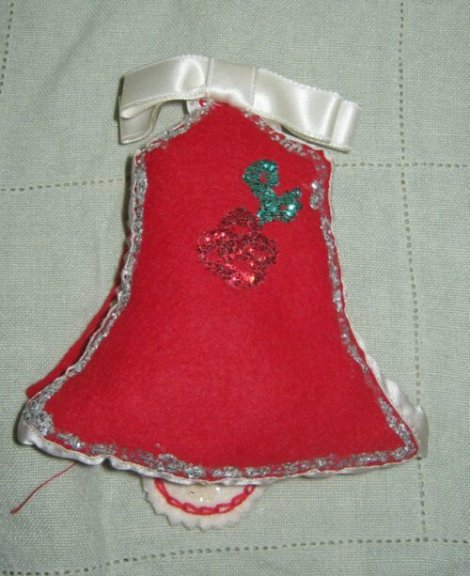
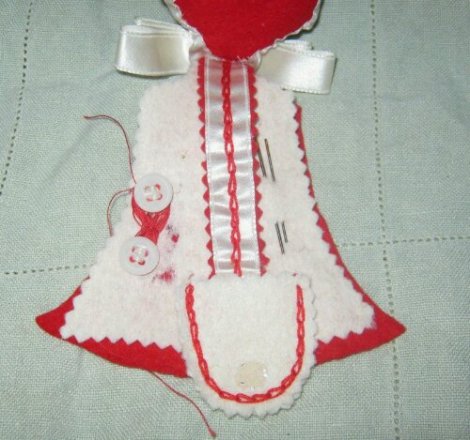
As Christmas approaches, I wanted to point out that the techniques in Fanciful Utility work nicely for gifts. You can make beautiful needle-books and sewing cases using holiday colors. Here is a vintage example currently on ebay:

image

image

You can also use the needle-book template shapes in Fanciful Utility to make ornaments.

Published in: on October 19, 2012 at 11:27 am  Leave a Comment  
Tags:

Household Decorative Art – Embroidery

Cassell’s Household Guide: Being a Complete Encyclopedia of Domestic and Social Economy Volume II, 1869 (published in London and New York.)

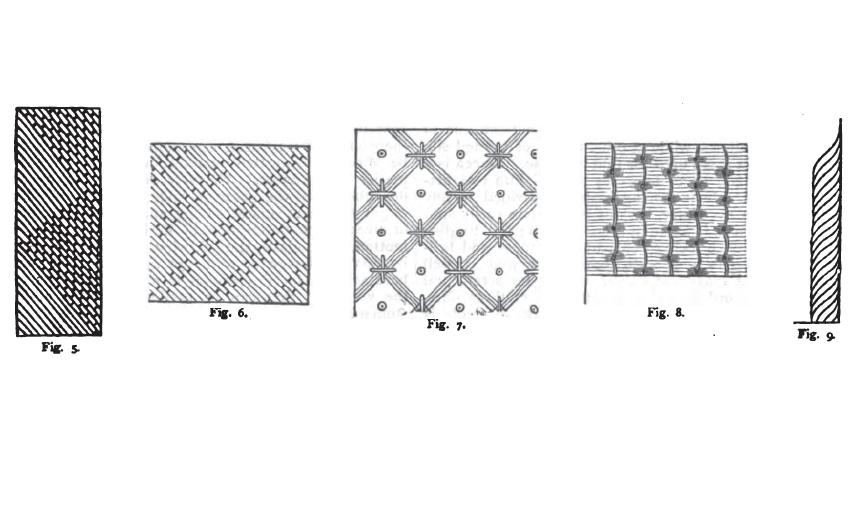
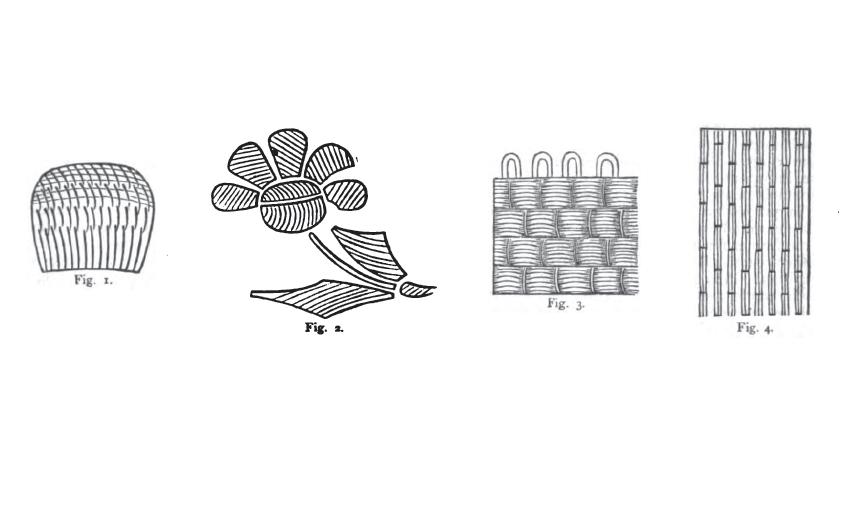
Of all the stitches used in embroidery, the long stitch is that in most general use, and all shaded work be done in it. In the somewhat fashionable “Brenton work,” however, shaded forms are filled in with short stitches taken promiscuously, instead of long stitch. In using it, all stitches should be taken from the outside edge of the figure, and worked towards the centre. In a figure of equal sides, the first stitch should be taken from the very centre of the edge, and the work proceeded with from first one and then the other side of this stitch. In working leaves and scrolls, the stitches ought, invariably, to be take in a slanting direction. The lighter parts of the leaves are first worked in from the edges, and the darker shades towards the central veins filled in afterwards, the veins themselves being put in last; gold should not be applied till after the silk-work is done. The last thing is to put a neat and careful outline to the leaves. In shaded work, the upper side of the design, upon which the light would be supposed to fall, should be worked in the lightest shade, and the high lights should not be so dark by four degrees as those shades next to them. In leaves, scrolls or conventional forms, a small number of shades, and those arbitrarily used look best, but more may be introduced with good effect in draperies. In fig. 1 we give a diagram of shading in long stitch, from the petal of a flower, in old English embroidery. Satin stitch is most useful for making raised leaves, &c, as in Chinese conventional flower, fig 2. The chain stitch, which is an imitation of the old tambour stitch, is formed by carrying the thread at the back of the fabric, catching it through, and laying it along the surface with a fine crochet-hook, which is, under a modern name, the same instrument as the old tambour-needle. Basket-stitch (fig 3) is formed by laying any even number of rows of twine, from four upwards, upon the foundation, and securing them there; the silk, &c, is carried over these two at a time. This is useful for borders. Couching was much used in old work. Passing or gold thread is frequently applied in this way, being laid over the ground and secured by short stitches in coloured silk over each single thread. These last are sometimes introduced promiscuously; sometimes so arranged as to form a variety of diapers and patterns, as in figs 4, 5, 6 and 7. Sometimes, as in fig 8, instead of these short stitches passing over every thread, the couching is accomplished by other threads crossing at right angles, and secured by stitches. Twist-stitch is produced by working equal stitches diagonally, one behind the other on an  even line, as in Fig 9. French knots are frequently used and pretty for forming the centres of flowers and in diapers, they are supposed to be introduced in several of our designs. They are made by first bringing the needle through the material, taking the tread and holding it with the left hand midway between the needle and work, and with the right hand twisting the needle round the silk in such a manner as to form a loop; this having been slipped down to the point of the needle, the latter can be repassed through the stuff, close to the place where it came through, and while it is drawn down by the right hand, the silk is held by the left, till the loop settles into a knot upon the surface.

Published in: on October 19, 2012 at 1:06 am  Leave a Comment  

Household Decorative Art – Embroidery

Cassell’s Household Guide: Being a Complete Encyclopedia of Domestic and Social Economy Volume II, 1869 (published in London and New York.)

In ordinary flat embroidery, no applied materials, as of pieces of fabric, cord, or spangles are used, nor is any part of the pattern part of the pattern raised by cardboard, or other packing beneath it, and the design depends entirely for its effect upon the coloured stitches used in it. This was the kind of work most in vogue in the days of our grandmothers, and it is, as admits of shading, the most delicate and beautiful, if not the most striking kind. The beautiful Eastern embroidery – Indian, Chinese, and Japanese – is mostly of this class, and may, In arrangements of colour, form good examples for imitation.

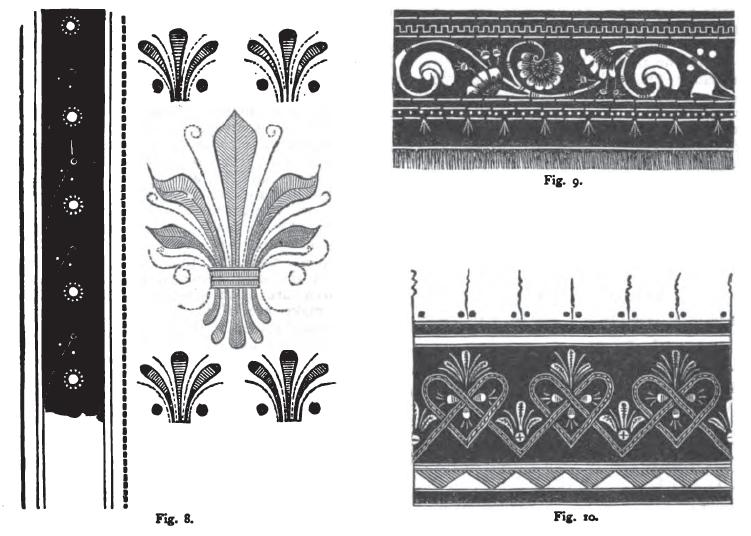
In raised embroidery, different substances are placed over the material to give it the effect of relief to the stitches. An approved modern method of working, is by taking cardboard – that known as thin mounting-board is good – tracing upon it the design to be raised, and cutting it out, care being taken to leave sufficient points of attachment in the more delicate parts of the design. The pieces of card have then to be sewn strong in their places, upon the material which is to from the ground, with cotton, and the bits of cardboard left for support cut away. If the design is to be still further raised, as would be recommended in working the large fleur-de-lis in fig 8, a line of even twine should be sewn down over the center of the figure, and over this a silk or gold thread can be worked. More than one row of twine should not be used, or the effect will be spoilt; and the thickness of it must depend upon the amount of relief required. If the figure is to be worked in gold or gold colour, the card beneath it should be coloured with gamboges. Fig 8 is a design for an embroidered curtain-border, with an edging of velvet, the principal parts of the pattern to be worked in relief; this will look very handsome if the fleur-de-lis is worked in gold thread or gold-coloured silk. Fig 9 is a mantelpiece hanging, in which the fan-shaped flowers are also in gold, raised upon card, the line of twine being near their outer extremity; they may, however, if preferred, be worked in coloured silks; the ground should be dark velvet. In fig 10, which is intened for the border of a table-cover, the raising of the embroidery is effected by merely laying on the coloured cord up the centre of the running pattern, and sewing it down.

Published in: on October 17, 2012 at 1:27 am  Leave a Comment