Readings for Rural Life

From Moore’s Rural New-Yorker in Rochester, NY

Aug 27th 1864

Dried Fruits for Soldiers

The following letter from a lady to the New York Tribune, who has been an army nurse needs no endorsement – it needs only to be read.

“I noticed with pleasure to-day your remarks calling attention to those living in the country to a simple way of drying currants, &c., for the use of the soldiers, both sick and well. This matter should receive wide attention – acid fruit being a necessity for those who live on the unvarying “ration” in a warm climate, also counteract the brackish water they are often obliged to drink. Currants, raspberries, blackberries, gooseberries, whortleberries, grapes, plums and pie-plant, cut into pieces and stewed in its own juice, are all equally good saved in this way, and more desired than jellies and preserves, besides being easier made and cheaper now, considering the price of sugar, so that there is every reason why all our good women should take hold of this work.

“When dried, the fruit is saved in strong paper bags, or those made of old muslin. A little of the dried fruit put in his tin cup and hot water poured on, with a trifle more sugar, makes a home-like relish for the hard tack to the weary and worn soldier after hard service in the field of on picket. Would that all “the boys” laying in the trenches before Petersburg could have a supply of what they so much need for health, and which every woman would gladly prepare where the idea suggested to her. In neighborhoods where a profusion of the small fruits can be had for the picking, not a quart of them should be allowed to go to waste while this war lasts. Thousands of valuable lives would be saved could the men have what they so greatly crave, “something sour.”

The good ladies in Orange county also prepare a refreshing drink from currant juice, which is a next to lemons in value. To one quart of currant juice add one pound of sugar, and boil and skim; this keeps all the year in bottles or kegs. Other acid juice, also, could be prepared with little trouble, and raspberry vinegar is eagerly asked for by female nurses for their wounded patients in Southern hospitals.

 

Published in: on August 27, 2014 at 6:01 am  Leave a Comment  
Tags:

A Summer I’m Rather Fond Of

I hope you all don’t mind a more personal post.
With school starting back up next week, my summer season is wrapping up. I can’t help but reflect fondly.
This summer, I……
– got my groove back. I felt wholy me, myself more than I have in a long, long time.
– enjoyed every moment I could with my husband. This was truly a delightful, fun and playful summer for us. (I think this is why I most do not want the summer to end.
– sewed until 1 am, woke in the mornings and napped in the afternoons.
– made 18 bonnets (the goal was 1 a week) that went near and far.
– let a little research project explode into a big huge research project with a life of its own.
– enjoyed sunshine, corn I could eat, neighborhood cats and squirrel friends, train rides, and parks.
– had a blast in a little shop surrounded by color and texture and people.
We didn’t get to do everything we wanted; not everything turned out as we thought. But, it has been such a good summer; such a summer to be fond of.

Published in: on August 25, 2014 at 4:51 pm  Comments (1)  

A Year in Millinery Fashion – 1864

In bonnets, bombazine, crape Maretz silk covered with crape, and all crape with crape ruche inside, are the only styles admissible for deep mourning.

There is no dress that requires more discretion in the choice and arrangement than that called second mourning, but it is one of the most elegant, when well selected.

For half mourning at this season of the year, Mme. Demorest is making black grenadine richly trimmed with flutings and silk, or ribbon quilled and laid on in various designs, while an endless variety of chine grenadines, lustiness, crapes, and Mozambiques, in black, gray, and lavender, give ample scope for a display of taste in all the gradations of mourning dress.

Some very beautiful designs in shawls have been exhibited this summer, in black grenadine with a border composed of white and violet stripes edged with a heavy silk fringe.

Basquines and circulars made in lusterless silk, and without trimming, are in light mourning.

For a half mourning bonnet black tulle puffed and trimmed with violet; or, for full dress, white crape covered with black lace and trimmed with violet flowers and violet strings; the latter is very much admired as a reception bonnet.

One of the most elegant bonnets we have seen this season was composed of a new material having the appearance of fine Tarleton and velvet woven together to form small diamonds; the bonnet was covered plain with the material, while a simple, trailing vine of black ivy leaves, veined with white, fell over the crown and cape inside; white and black flowers and white strings. (Godey’s, August, 1864)


The Fit

For many of us who do historical impressions, gloves, particularly leather ones, are one of those items we keep an eye out for at yard sales.
For those who are new to the hunt, I am certain the thought “they are so small!” has crossed through your mind, possibly many times.
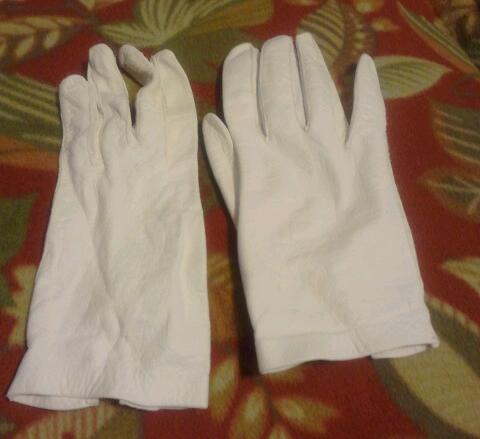
Yes. They look small. But! Here is visual proof that leather gloves do stretch.
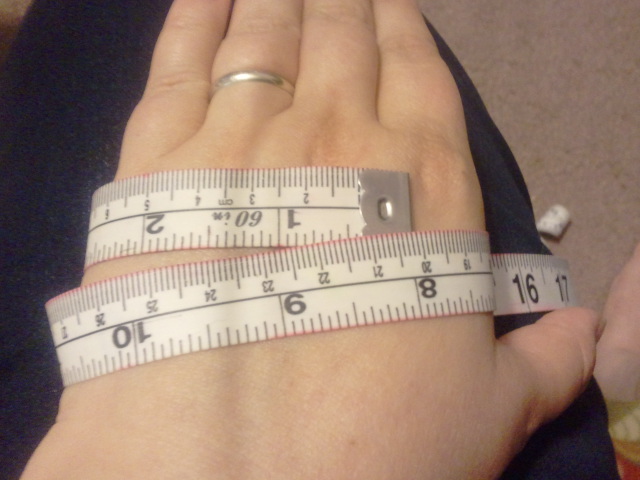
To start – I have wide hands and short, thick fingers. My hands are size 8. (A swollen 8 today after a week of heavy sewing. Usually, they are 7.5.) I put a photo showing how to measure hand size below.
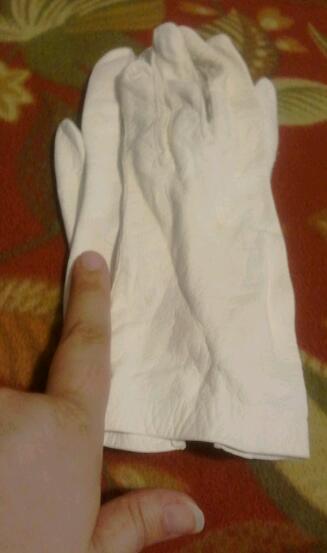
Here are the gloves. On the left is the left glove as it was bought today. It is 3 1/4″ wide at theback of the palm. The one on the right is the right one after some stretching. It is 3 3/4″ wide across the back of the palm. It fits nicely on my hand, except for a long thumb.

image

Here you can see the unstretched glove on top of the stretched glove:

image

See how the stretch is a full finger width in difference?

Of course, I don’t suggest trying to stretch a glove around your hand at a shop or sale. You need to buy it first. So, how do I decide whether to buy?
– First, price. In this area, I don’t see the need to pay more than $5 for wrist length gloves. (Honestly, the $2 I paid for each item surprised me at today’s particular sale when I heard the prices others were paying.)
– Condition of the leather. The leather needs to be soft and pliable. Dry leather will likely be a pain to deal with at best.
– Condition of the gloves. Check that the stitches are sound. If you can’t fix it, skip them. Check that there are no wear holes or worn spots. Check staining. Staining can be corrosive.
– Guesstimate fit. My rule is if I can easily slide my fingers, from the knuckles forward into the gloves, I’ll give them a try.
There are specifics for different eras. Generally, for the 19th century, skip snaps. Frankly, besides being incorrect, they are rust and tear spots. For Regency era, long gloves are needed. Prices will be notably higher for these. Okay, remarkably higher. The arm part of these do stretch nicely. If you have wider hands or those with joint issues, opt for a pair with an open inner wrist that buttons back up. I couldn’t do without those.

Sizing – If you are lucky enough to find gloves with size markings, it is helpful to know your glove size. Simply wrap a tape measure around your palm. Mine here is an 8. (I’ve only seen sizes by the half inch -7, 7.5, 8, 8.5.)

image

Hope that is helpful.

Published in: on August 22, 2014 at 4:24 pm  Leave a Comment  

Survey!

I need your help. I need to get familiar with Google’s “Forms” in their Google Drive for work/school.

I decided to multitask. I created a survey “form” with several questions to help me plan for the next several months in terms of blog writing, my shop and a new publication.

Please take some time to fill out this survey.

Published in: on August 21, 2014 at 11:38 am  Leave a Comment  

Readings for Rural Life

From Moore’s Rural New-Yorker in Rochester, NY

August 20th, 1864

What Makes a Lady

When Beau Brummel was asked what made the gentleman, his quick reply was, “Starch, starch, my lord!” This may be true; but it takes a great deal more to make a lady; and though it may to some seem singular, I am ready to maintain that no conceivable quantity of muslin, silk or satin, edging, frilling, hooping, flouncing, or furbelowing, can per se, or per dressmaker, constitute a real lady.

Was not Mrs. Abbot Lawrence just as much a lady when attired in twelve-cent calico, in Boston, as when arrayed in full court dress at St. James, London? “As Mrs. Washington was said to be so grand a lady,” says a celebrated English visitor, (Mrs. Troupe,) “we thought we must put our best bibs and bands, so we dressed ourselves in our most elegant ruffles and silks, and were introduced to her ladyship, and don’t you think we found her knitting, and with her check apron on! She received us very graciously and easily, but after compliments were over she resumed her knitting. There we were without a stitch of work and sitting in stat, but, Gen. Washington’s Lady, with her own hands, was knitting stockings for her husband.” Does that not sweet republican simplicity command your admiration?


Published in: on August 20, 2014 at 6:00 am  Leave a Comment  
Tags:

A Year in Millinery Fashion – 1864

Fig. 4 is a black crinoline bonnet, with loose crown of white spotted tulle; the crown is divided from the bonnet by a shaped piece of pink silk, edged at the bottom with a narrow black velvet and a jet fringe, and having in the centre a group of white roses, rose-buds, and a few tufts of grass; the front edge of bonnet is finished by a narrow guipure lace turned back. The curtain of pink silk edged with a black velvet and jet fringe; the strings are of pink silk, and the cap is of blonde or tulle, trimmed with white roses, buds, and a few fullings of black lace. (Godey’s, August, 1864)

1

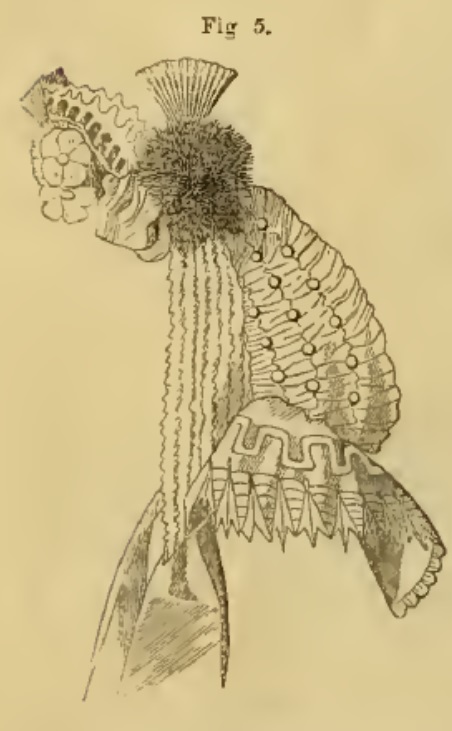
                         Fig. 5 is a dress bonnet, composed entirely of fullings of white tulle, those on the crown being formed into a species of boullions, divided lengthwise at intervals by small artificial pearls; at the top of front, rather towards the left side, is a group of green leaves, with a tuft of white silk or feathers; the curtain is formed of broad white lace. The strings are of white silk, and the cap is of blonde, trimmed at the top with a group of large white flowers. (Godey’s, August, 1864)

 2

 Fig. 7 is a Leghorn bonnet; the front trimmed with a shaped piece of maize silk, plaited like a fan towards the top; at the top is a plume of maize ostrich feathers. Strings of maize silk, and blonde cap with a few roses and rose-buds. (Godey’s, August, 1864)

 3

The List

Usually, many of us reflect on “The List” at the close or start of a new year. I’m a little early in my reflection as my summer is winding down and I’m transitioning into the school year and the fall sewing season. My list is two fold, what didn’t get done this summer and what is on the future list.
What did not get done this summer:
– Writing the new book
– Making the awesome green plaid 20s dress
– Finishing my uber-nifty, secret millinery project
– Making a new cage
– Making coats of the white wool/silk
– Recover parasol (and recover previously recovered)

On the upcoming list:
– All of the above
– Red/brown plaid Regency dress for everyday wear
– Ag Fair project 1
– Ag Fair project 2
– Continue/finish Ag Fair project 3
– Come up with Ag Fair project 4
– FanU cases for a Christmas sale
– Small cute things for Peddler’s market
– New corded sun bonnet for me (items loaned out)
– New apron for me (items loaned out)
– A new coat (it is past time)
– At least one additional dress to make a dent in the stash
– Find & figure out if I can alter my ball gown to fit. If not…???
– Lily’s list – Get her to make her own set of underpinnings
– Modern items – Dan’s chair & kitchen curtains
Non-sewing, regular sewing
– Fix the writing slope
– Fix the hole in the tent
– Measure & make wood for new to us canvas

It seems so much more managable when it is written down.

Published in: on August 17, 2014 at 9:33 am  Comments (3)  

A Year in Millinery Fashion – 1864

Fig. 2 is a bonnet of white chip, with loose crown of spotted tulle; all round the upper edge of crown is a band of plaid ribbon, and on the top part of crown is a half diamond of tulle, edged with a plaid ribbon, and a chenille fringe to match the plaid. The curtain is of white lace, and has in the centre a small square of plaid ribbon, edged at the bottom and sides by chenille fringe. The strings are of white silk, and the cap is of blonde or tulle, and is trimmed with roses, rose-buds, and bluets. (Godey’s, August, 1864)

 2

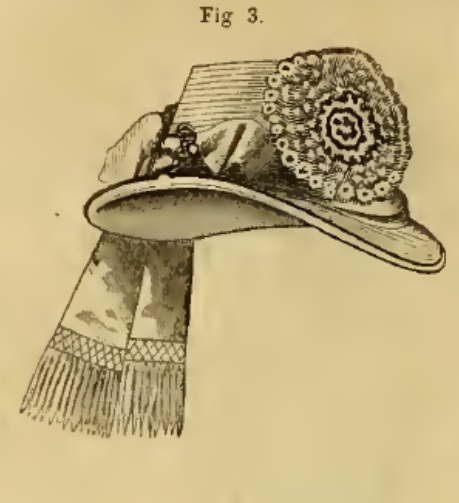
                          Fig. 3 is a Monsqueraire hat of Leghorn or white straw. Round the hat is a scarf of blue ribbon, with a large bow and long fringed ends at the back; in front is a rosette of black and white speckled feathers, surrounded by an edging of blue flowers or bluets. The brim is edged with black velvet. (Godey’s, August, 1864)

1

Published in: on August 11, 2014 at 1:01 am  Comments (1)  
Tags:

Late War Bonnet

Karen 3This is my first late war straw bonnet. It is a special request for the spring of 1865. We wanted a respectful look in an appropriate shape and style while suiting the wearer in shape and color. I am happy with how this came together.

Overall, the bonnet is smaller than the early war bonnets. This one has a gentle rise to the brim retaining the flattering spoon shape. The drop from the back sides to the cheektabs is more angular and abrupt. It is hard to see the shape of the sides and back with the ribbon wrapping around. Underneath that ribbon is a raised tip which is a semi-circle. The neckline transitions in a flat line from the tip to the sides rather than with the curve we see earlier in the war years. This was the hardest area for me to wrap my mind around because I like those gentle curves.

Karen 4

The straw is the black plait from England I like. The ribbon is a 5″ wide antique moire. This ribbon has some pleasing characteristics. It is rather flat in terms of light reflection, which means it would suit a mourning bonnet if need be, or in this case looks lovely while being respectful. When held up to the light, it shows itself to be semi-sheer. Because it is so fine, I was really worried about it wrinkling and holding the wrinkles. But, it bounces back nicely. (I did suggest the new owner to stuff the puffs in the back with tissue paper for storage. I sent it along to her with those packing airbags tucked inside each.)

Karen 6

The frill is silk organza, a double layer in box pleats. I do like how this can show the nice ripples or be fluffed for fullness. The flowers include petite white roses, blue roses, buds of each and little red berries. Karen 7

Published in: on August 7, 2014 at 12:20 pm  Leave a Comment  
Tags: