This Week’s Bonnet – 1841 Inspiration

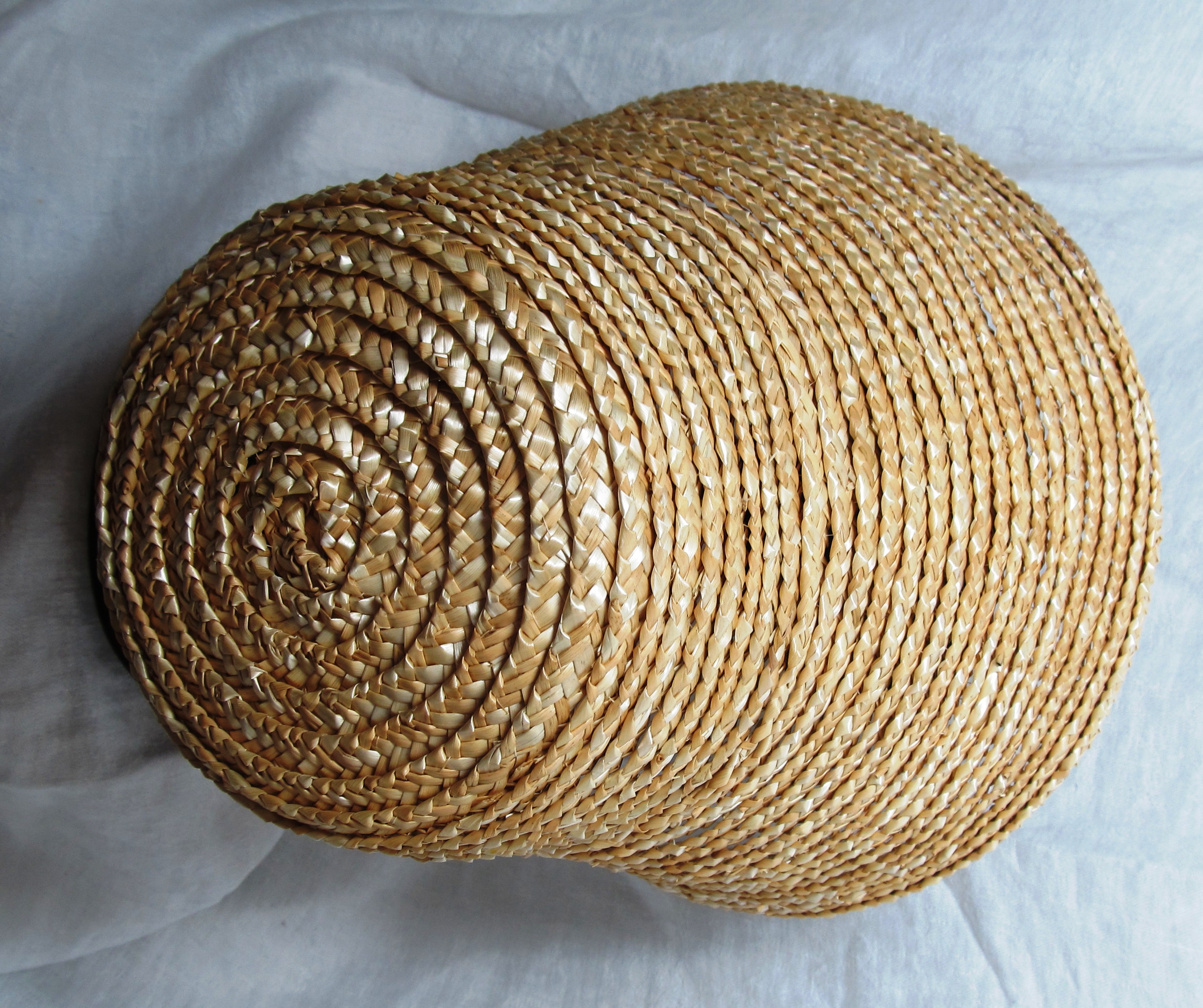
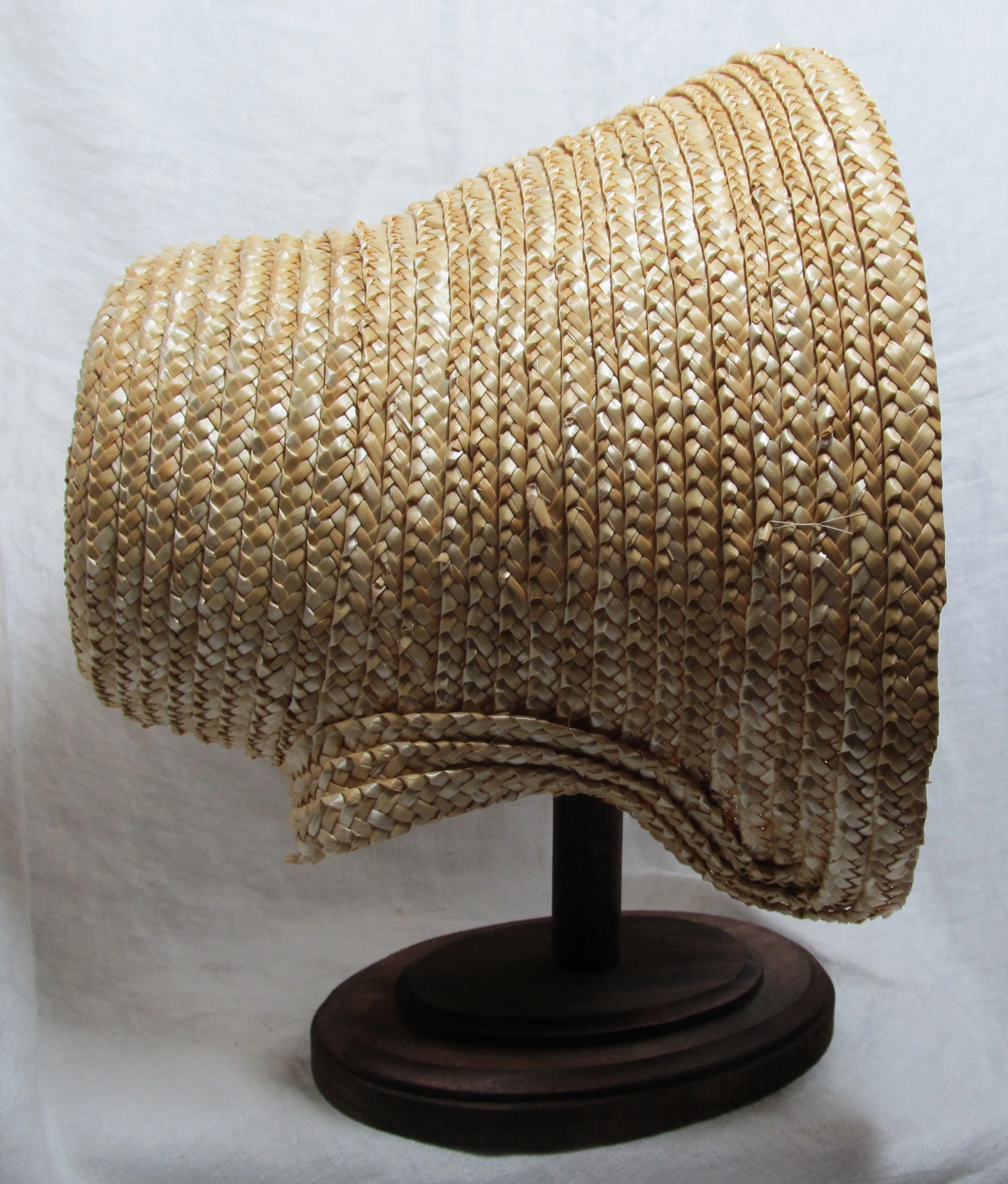
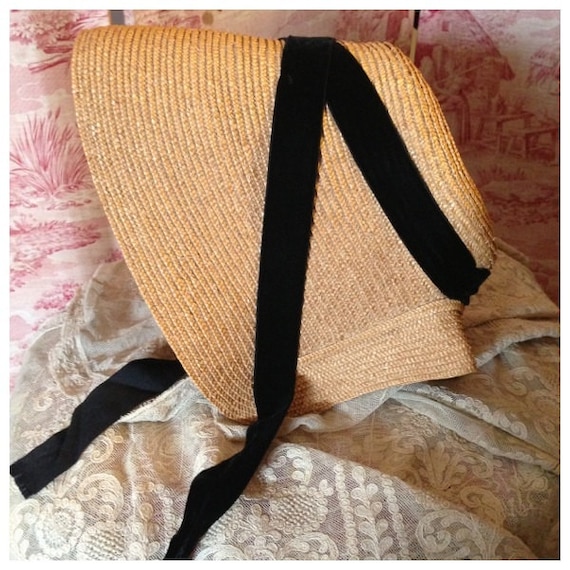
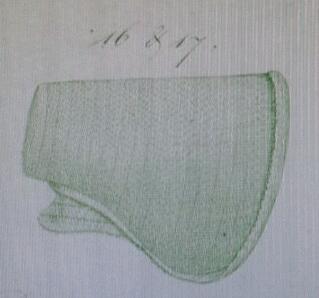
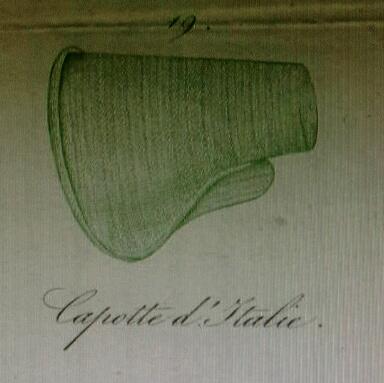
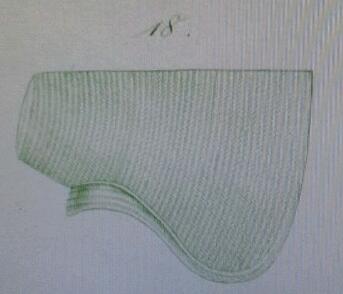
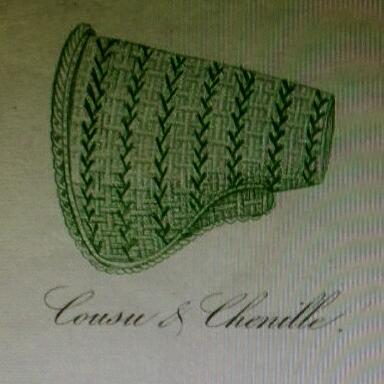
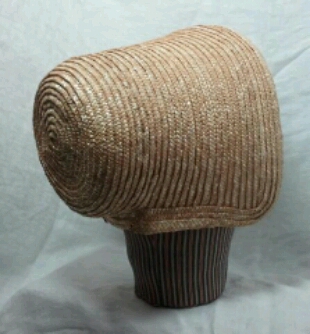
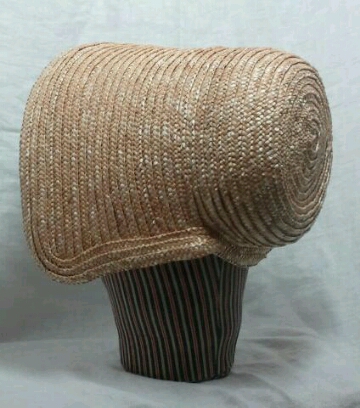
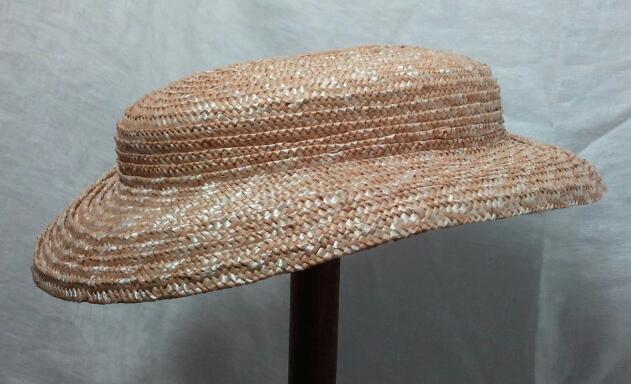
IMG_6392bHere is the bonnet I’ve been working on this week. It started with a page of 1841 bonnet illustrations (see Getting Pokey.) It is made with the coarse straw plait. I need to do this shape again in the Milan plait. My favorite angle is to the right. I really like the curves and lines straw can make.

This bonnet is currently available at my Etsy Store.

IMG_6387IMG_6383IMG_6373

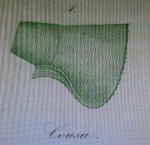
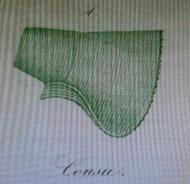
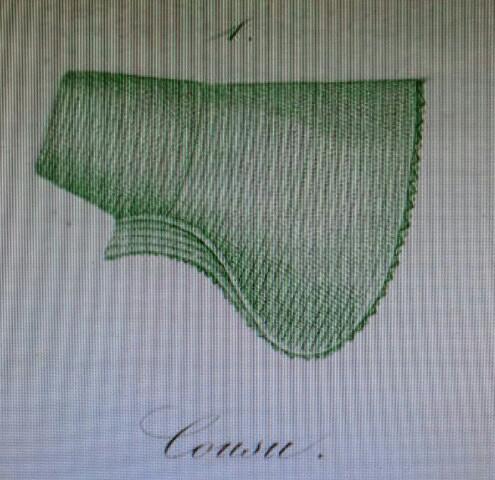
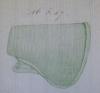
Here is the inspiration image I was playing off of. It is dated 1841:

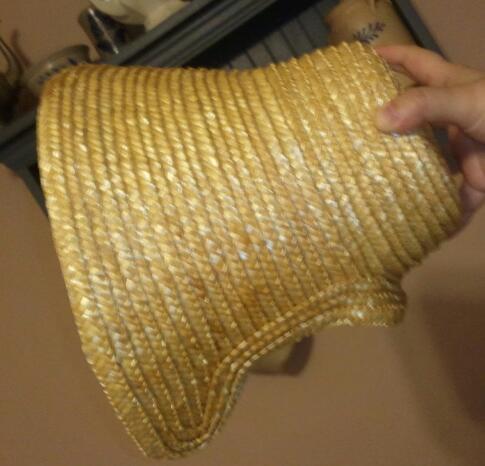
This 1840s bonnet shows a similar angle from crown to brim:

This one has a subtle change from crown to brim:

This bonnet has a brim rise that arcs further forward. I find this a pleasing look that may need to be added to the list:

Compared to this earlier 1820’s style, we can see the difference in the angle of the crown and tip which reaches more vertically on the diagonal. (although, this one does seem to be photographed at an odd angle.)

Published in: on May 8, 2015 at 5:59 pm  Leave a Comment  

Millinery Vocabulary

With so many new people asking basic millinery questions, I realized it would be a good idea to have a go-to spot for millinery vocabulary. This list focuses on the parts of a bonnet and the materials. This is going to be one of those “work in progress” posts as most of this is off the top of my head typed with my thumbs.

***Note: Terms that are not necessarily period but we tend to use in modern discussion will be in this color.

Bavolet  – The pleated or gathered fabric that goes along the neckline of the bonnet. Most commonly this is silk or silk ribbon, often set on the bias with a lining of net. Sometime lace was placed over the bavolet. The bavolet appears in the Romantic era and disappears in the later 1860s. Also called the Curtain.

Blonde – A silk bobbin lace originally natural in color, later in black. The motifs, frequently floral, are worked in a silk thread heavier than the ground.

Bobbinet – Machine made cotton or silk netting with hexagonal figures.

Brim – (1) The front part of a bonnet that encircles the face mostly vertically. (2) The bottom part of a hat the encircles the head horizontally.

Brussels Net – Plain net originally from Brussels.

Buckram – A cotton construction material that is woven and stiffened. Often a foundation that is wired and covered with fashion fabric.

Cane –  Long woody strips used in drawn bonnets. These can be round, semi-circular or flat. Also used in basket making. (try defining cane without saying cane.)

Cheektabs – The section of a bonnet that comes along the side of the head, curving downward along the jawline framing the cheek. Also called ______

Chip – Thin wood fibers plaited or woven to make a bonnet or hat.

Crepe – A puckered/crinkled fabric frequently associated with mourning when black. Modern crepe and 19th century crepe are not the same.

Crown –  The part of a bonnet or hat that sorta encompassed the head.

Leghorn – (1) A plait of Italian straw. (2) A shape/style of bonnet.

Lining – A material fully or partially covering the interior of a bonnet that protects the bonnet from the hair and the hair from the bonnet.

Net – Net is frequently found in two spots on a mid-19th century bonnet – a stiff cotton net lines the bavolet. A finer, softer, yet still crisp net in cotton or silk is used for the ruche.

Organdy – A thin, sheer plain weave silk or cotton with a crisp hand. (we tend to say organdy for cotton and organza for silk now.)

Plait – A braid of straw or horsehair.

Ribbon – Please see my ribbon page for information on ribbons.

Ruche-  The box pleated white ruffle just inside the brim around the face. Often a net, lace or sheer material in silk or cotton. “At some factories, ruches are made entirely by machinery. They are not as well nor as neatly put together, and do not sell as high as those made by hand.”(Employments of Women, Virginia Penny. 1860.) Also called the frill or cap by some.

Ties – Narrow (~1″) ribbon used to tie a bonnet on securely. These ties take the stress of wear rather than the wider decorative ribbons. Sometimes referred to as “utility ties” or “functional ribbons”.

Tip – The top most or back most part of the crown. It can be flat or rounded depending on the style.

Willow

For a better understanding of the fabrics, I suggest a good textile dictionary.

Published in: on May 7, 2015 at 4:00 pm  Leave a Comment  

Show Your Millinery Give-Away!!!!

I’ve been a bit grumpy and stressed lately. Time to cheer things up!

It is time for a Give Away!!!

1878 natural form editThe Prize: Making its debut this weekend… GCV is releasing its Centuries of Fashions Cards–!!! Each set includes 12 high quality photos of fashion from 1790 to 1912 worn by the museum’s models. The winner will receive one of these very first sets. Future sets will include pieces from the Greene Collection!

The Deadline: Friday, the 22nd of May

The Ways to Enter:

wpid-2015-02-21-13.22.02.jpg.jpegFirst, Show Me Your Millinery! Take a photo of you wearing a piece of millinery I made and Share it on Facebook, Twitter or in the Comments below. Be sure link it back to this give-away and to tag me so I see it. (Don’t own a piece of my millinery yet? If you have a friend who will let you enter with her bonnet or hat, you can enter that way too.)

wpid-2015-02-21-13.21.54.jpg.jpegSecond, Inspire Me! I love the inspiration the world around me offers. The color, the texture, the beauty of the natural world provides a palette of inspiration for when I sit down to work. Take a photo of something you think will inspire a beautiful bonnet or hat. Share it on Facebook, Twitter or in the Comments below. Be sure link it back to this give-away and to tag me so I see it. 
I will compile all the photos to share in a blog post that will announce the winner.

Spring straw bonnet banner 2015Third, Buy Millinery! Stop by my Etsy shop. For each purchase, you will be entered. 

The winner will be randomly selected on Friday, May 22nd!    

Published in: on May 6, 2015 at 4:10 pm  Comments (1)  

Show Your Millinery Give Away!!!

I’ve been a bit grumpy and stressed lately. Time to cheer things up!

It is time for a Give Away!!!

1878 natural form editThe Prize: Making its debut this weekend… GCV is releasing its Centuries of Fashions Cards–!!! Each set includes 12 high quality photos of fashion from 1790 to 1912 worn by the museum’s models. The winner will receive one of these very first sets. Future sets will include pieces from the Greene Collection! (Image created by Tantalo Studio, Rochester, NY)

The Deadline: Friday, the 22nd of May

The Ways to Enter:

Spring straw bonnet banner 2015First, Show Me Your Millinery! Take a photo of you wearing a piece of millinery I made and Share it on Facebook, Twitter or in the Comments below. Be sure link it back to this give-away and to tag me so I see it. (Don’t own a piece of my millinery yet? If you have a friend who will let you enter with her bonnet or hat, you can enter that way too.)

wpid-2015-02-21-13.21.54.jpg.jpegSecond, Inspire Me! I love the inspiration the world around me offers. The color, the texture, the beauty of the natural world provides a palette of inspiration for when I sit down to work. Take a photo of something you think will inspire a beautiful bonnet or hat. Share it on Facebook, Twitter or in the Comments below. Be sure link it back to this give-away and to tag me so I see it. 
I will compile all the photos to share in a blog post that will announce the winner.

Third, Buy Millinery! Stop by my Etsy shop. For each purchase, you will be entered. 

The winner will be randomly selected on Friday, May 22nd!    

Published in: on May 6, 2015 at 4:00 pm  Comments (2)  

I’m Drooling

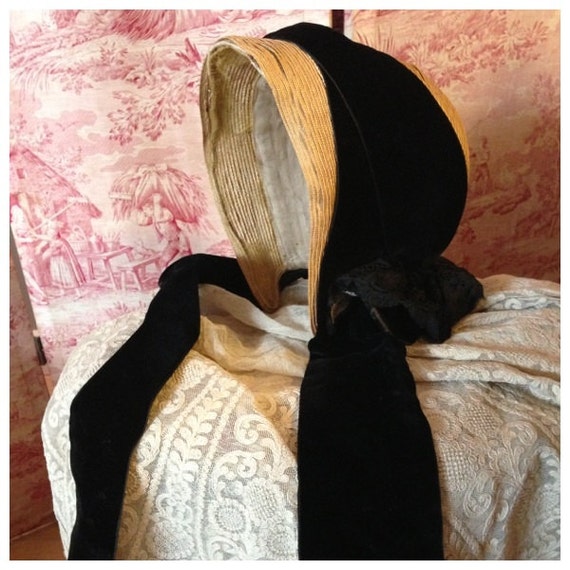
I rarely post items from Ebay or Etsy that aren’t part of a topic specific blog post. But, these two straw bonnets are swoon worthy.

You know what I was saying the other day about the curves in poke bonnets? The first one hasthat same type of beautiful curve in construction I love so much. The simple velvet ribbon wrapping around the tip and crown seems to fit those curves so well. This tempts me to do the same in the future.

The second appears to be a decade to a decade and a half later to me. Check out that wide velvet ribbon!! There is something about black velvet on natural straw. I am curious as the seller says the bavolet is wired. The quad-photo in the listing gives a nice look at wiring and one way of lining.

Published in: on May 6, 2015 at 6:03 am  Leave a Comment  

Veils

(I had been planning to do a post on veils. But, life has been crazy, photos have not been taken, and the discussion has come up in a FB group. I’ll do an actual real post at some point.)
Here is one of my original veils.
wpid-2014-08-30-18.09.42.jpg.jpeg
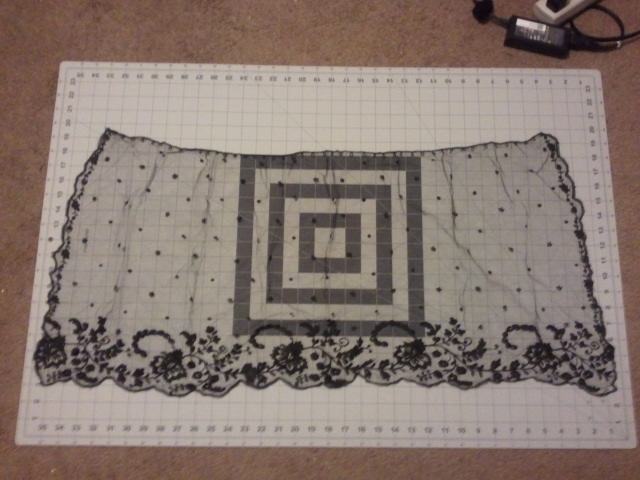
This is the gauze one Bevin made me. I need to double check, but I think it is the same dimensions or a little wider. I know my black gauze is about 36″ wide by 20″ long. These are a must for me to function at many events.
wpid-img_38321-1.jpgA random interesting quote:

The principal feature in the new bonnets [Empire?] is the veil, which has now become the all-important item for bonnets and hats. It is unhemmed black or white illusion spangles with gold, figured net, crepe lisse, or else the regular made veil. It is either caught on the side of the bonnet by a fancy ornament, or is fastened just over the crown. The length varies from three-quarters of a yard to one yard. (Godey’s Lady’s Book, January 1866)

My pinboard for veils.

Published in: on May 5, 2015 at 8:02 pm  Leave a Comment  

Getting Pokey

wpid-2015-05-01-13.37.43-1.jpg.jpeg

I’ve had this thing about poke straw bonnets lately. It is sort of a curiosity. Looking from the mid-century back…They aren’t the prettiest of bonnets. They aren’t the most fashionable of bonnets. They aren’t the most flattering of bonnets. wpid-2015-05-01-13.37.43-2.jpg.jpegBut, there is something about the lines the straw makes as the shape develops. There are curves and bends in this family of shapes that are just fascinating to me right now. I have oodles of images in my phone that I zoom in on as I play with my straw.wpid-2015-05-01-13.37.34-1.jpg.jpeg The illustrations to the right are some of them. They are from an 1841 French advertisement with several illustrations.
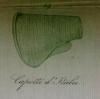
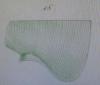
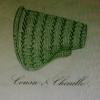
wpid-2015-05-01-13.37.34-2.jpg.jpeg

Let’s look at what a poke bonnet is. Modern costume dictionaries tend to define a poke bonnet with reference to a round brim and/or a brim that projects forward.

“Poke bonnet, poking bonnet (F)

Period: 1799 to end of 19th century

A bonnet with an open brim projecting forward over the face. The term was applied to a large variety of styles, the ‘poke’ often very slight.” (The Dictionary of Fashion History. Cumming, Cunnington & Cunnington.)

Turning to the nineteenth century, this definition from Bartlett’s appears to be a common definition in 19th century dictionaries.

Poke-Bonnet. A long, straight bonnet, much worn by Quakers and Methodists. (Bartlett’s Dictionary of Americanisms, 1859.)

Later in the century, we have an additionally descriptive definition.

Poke-bonnet , n. A bonnet having a projecting front of nearly conical form, worn about the beginning of the nineteenth century and later.” (The Century Dictionary and Cyclopedia.1897)

Variations of the ‘poke’ run through much of the century, from the beginning into the mid and drizzling out as bonnets and hats got smaller. This article “Bergere and Bonnets” has several nice examples of Regency era in the first half of the post. Here are examples as we proceed through the decades – 18151815-18201845, 1848, 18501850, 1865 (I have this theory on the development of poke styles I am still sorting out.) In many stories, the poke bonnet seems to be a go-to descriptor for Quaker women. It is also frequently used for describing young women from the country.The frequency in use of the poke bonnet in fictional writing seems to peek from the latter 1820s through the 1840s.

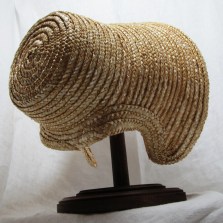
I’ve been working on a couple poke bonnets.Two I can not show you yet because they need to make their debute. I should be able to show one of those next week. This one is an early Regency shape. It was my first. The straw is a fine Milan plait. The crown has a flat tip that rounds to the sides. The crown to brim transition is flat with a very minimal lift. The cheektabs are barely there being a very slight dip on each side. The front of the brim is flat.
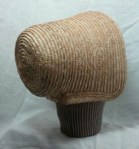
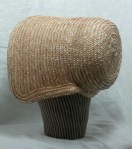
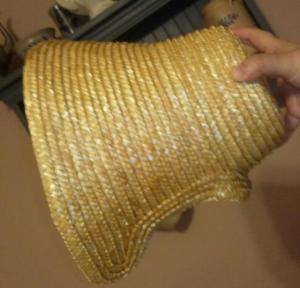
wpid-2015-02-08-09.20.36-1.jpg.jpeg wpid-2015-02-08-09.20.21-1.jpg.jpegwpid-2015-05-07-08.26.42-1.jpg.jpegHere is one of the poke shapes made with the later 30s and early 40s in mind, looking at the illustration to the left, out of coarse straw due to the abundance of 1830s references to coarse straws being worn for morning attire. I made this bonnet with a large flat tip. The crown rises at the slightest of angles to the brim. The cheektabs are short and wide with a nice rounded curve wrapped by the rows of plait that create the straw curtain at the back of the neckline.

[[[[[PHOTOS AS SOON AS IT DRIES]]]]]] I’m in patient. Here is one shot as it is still wet:
wpid-2015-05-07-06.15.28-1.jpg.jpegClose Cousin or the Same??

The phrase coal scuttle bonnet is also used to describe a bonnet with a deep brim. Looking at both nineteenth century references and modern ones, at times poke bonnet and coal scuttle bonnet seem to be different and at other times seem to be used interchangeably. According to the Merrieam-Webster dictionary, a coal scuttle bonnet is  “A woman’s bonnet with flat back and stiff projecting brim somewhat resembling a coal scuttle.” This definition seem quite like that of the poke bonnet with the description of the tip as a “flat back” being added. The 1897 A Dictionary of Slang, Jargon & Cant  has an even more similar definition: “Coal-scuttle (American), a nickname for the peculiar bonnet worn by Quackeresses, which was exactly the shape of an old-fashioned coal-scuttle. Some years ago coal-scuttle bonnets were worn in England.” Here is an example of an original coal scuttle. In that 1840s example, the slight difference appears to be the shaping of the brim’s edge, the coal scuttle having a little curve reaching forward on the sides rather than the arching curve of the poke of the same era. In fictional texts,the phrase ‘coal scuttle bonnet’ seems to appear most frequently in the 1830s and very early 40s.

Another word I saw used in place of poke, was Neapolitan. I have to look into this more. Considering the first passage to come up when I started looking was an 1850s fashion description about a “Neapolitan bonnet made of Leghorn”, my head quickly angled sideways. (the later 60s and 70 Neopolitans are quite small & very different than poke bonnets.)

They are calling it poke….

….but I don’t think so. You know how we now like to put names on things but we don’t always agree with each other or with the original time period? Well, this is one of those cases. The way I wrap my head around ‘poke’ conflicts with some of the other bonnets being called ‘poke’. In the 1830s there was a bonnet with a high, tallish crown and large dramatically diagonal brim. Some refer to this as a poke. Here is a Victoria and Albert Museum example. Technically, the brim does project forward over the face. But, it is not a long straight bonnet by any means. Similarly, the MET is calling this bonnet a poke as well. To me, those are leghorn bonnets which is a whole other complication because technically leghorn is a type/variety of straw.

My thoughts & perspective

This has been a post with much of my own speculation. It is highly likely well other well researched individuals will have a different perspective and different thoughts.
Published in: on May 5, 2015 at 5:00 pm  Leave a Comment  

Hats – Which, When, Where?

wpid-2015-04-08-16.06.22-1.jpg.jpegI am trying to refrain from calling this post “Yet Again” or “The Ever Reoccurring” hat question because this question really does come up every year as early spring finally breaks free to full sun and flowers. This year it is seemingly every week or even twice a week some form of the hat question comes up… “can I wear this?”, “Is this shape correct?”, “how can I decorate this?”, and on.

2014-05-22 16.36.06-2 Some are looking for face protecting hats with brims offering shade. Some are looking for an inexpensive head-wear option. Some are looking for a fashionable accessory. Admittedly, not everyone is always happy with the responses they receive. It isn’t as easy as a pretty hat or even a correctly shaped hat.

When choosing a hat, it isn’t just the shape of the hat that needs to be considered. We must al2014-03-29 17.47.54-1so consider several factors including ~who is wearing the hat, ~where the wearer lives and if from, ~what the situation/scenario is for wearing the hat, ~when the hat is being worn in terms of both year and time of year.

An exercise I have envisioned lately, that I believe will help is this: Print several dozen of women wearing hats. I suggest small, but not too small, 2-3″.  Include photographs, paintings and illustrations. On a large piece of paper or your cutting matte, mark sections for Fashionable, Recreation/Picnics/Parks, Recreation/Seaside, Utilitarian along the top of the paper or matte. Along the side, make age groupings such as child, teen, young lady, middle age, mature. Take the printed images and lay them out on the paper or matte where they belong. Notice any trends in the hats you are seeing. (hopefully, this will help.)

Another exercise to help you find an accurate hat that you like is to choose three to five original images of hats, be it photos, paintings or illustrations. Enlarge them to a full 8.5″x11″ page and print them. Now, take a pencil and trace over the lines of the hat just the hat – get the rise of the crown, the shape of the tip, the width of the brim, the curve of the brim. Repeat this with a marker or felt pen that will make the lines stand out. Lay your tracings out across the room where you can see them (maybe up on the bookshelf or around the tv.) Leave them there for a while. Let the lines stand out and sink in. This should help you develop an eye for these shapes, bringing the shapes and construction to the front of your mind when looking at hats.

Here are three previous articles/posts addressing the shape of hats as well as when and where to wear them:

In addition, take a look at this nice collection of images of women wearing hats in The Barrington House Educational Center. (I think I need to make this hat.)

Published in: on May 4, 2015 at 4:00 pm  Leave a Comment  

A Bonnet Cover

This came up in a discussion last week. I could remember reading about the bonnet cover. I forgot that I wrote about it. (No, I didn’t get around to make one.)

If I Had My Own Blue Box:

Ooops. This wasn’t supposed to post until this weekend. But given the weather I am about to venture out into, I’ll leave it.

From Eliza Leslie’s House Book, (Philadelphia, 1844)

A BONNET-COVER – When travelling in dry weather on a road that is likely to be dusty, you may effectually protect your bonnet from injury, by taking with you a cover for it. To make this cover, get a yard of white glazed cambric muslin, and cut it into the form of a large straight hood; gathering it close at the back of the head upon a small circular piece about the size of a half-dollar. Slope it away at the sides of the neck, and put a case with a drawing-string of fine tape along the edges of the front: the string to tie at the side.

If you commence your journey by water, you can roll up this…

View original post 399 more words

Published in: on May 4, 2015 at 11:51 am  Leave a Comment  

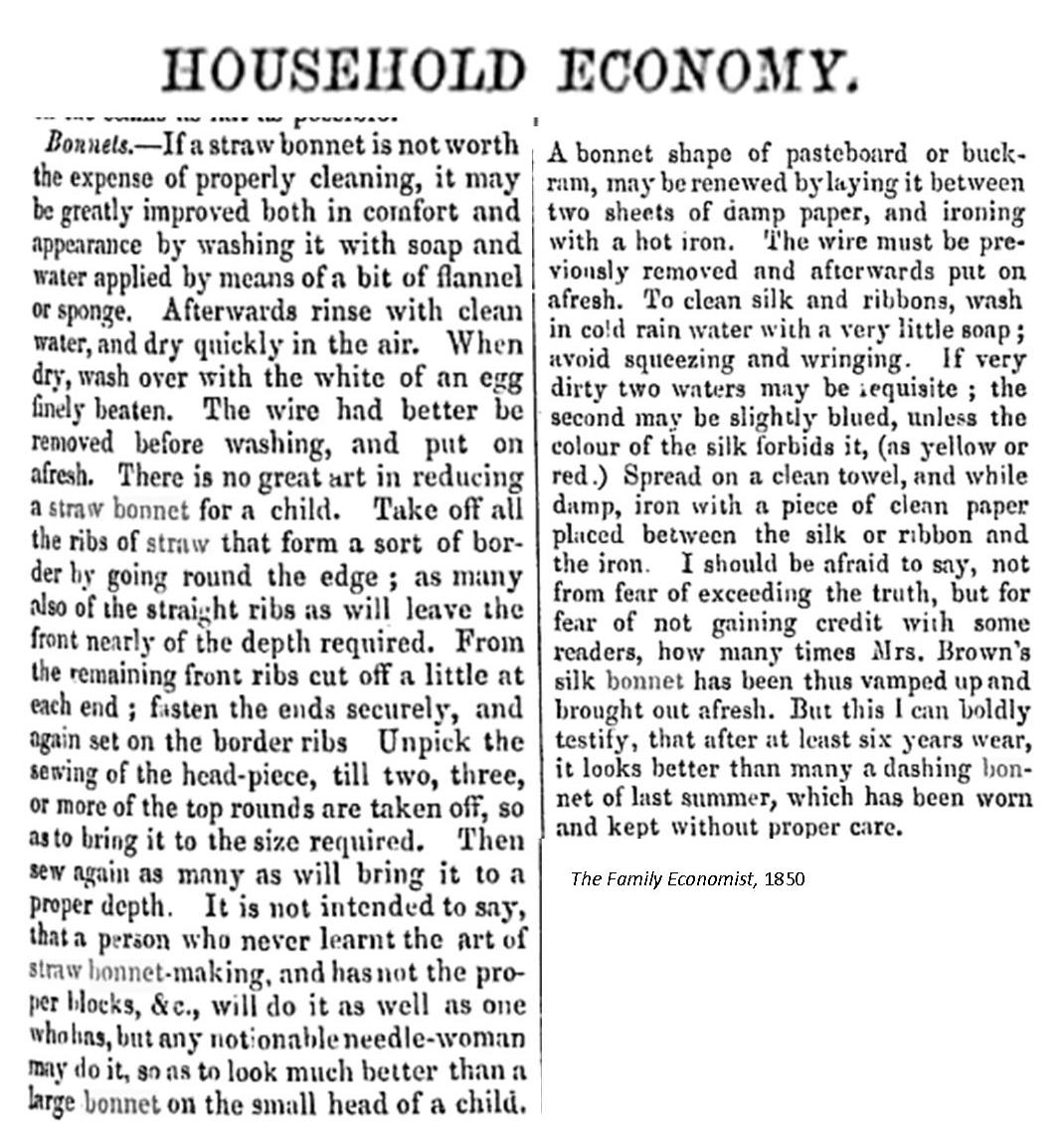
Life of a Straw Bonnet – Cutting Down

Cleaning bonnet Family Economics 1861insert image of cutting down text

Published in: on May 3, 2015 at 6:00 am  Leave a Comment  
Tags: