My current wish to-make list. It only seems challenging when it is to be finished by Thanksgiving.

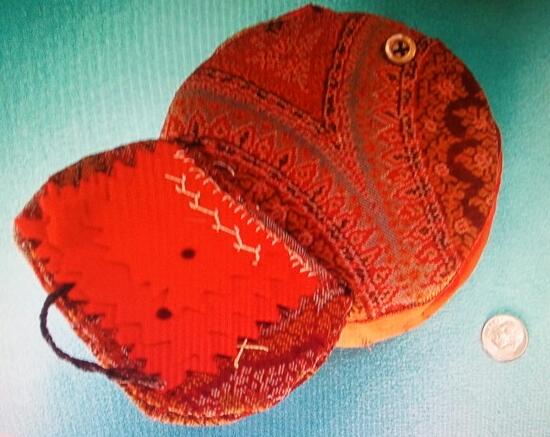


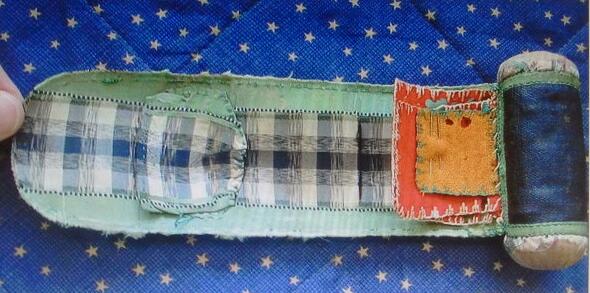

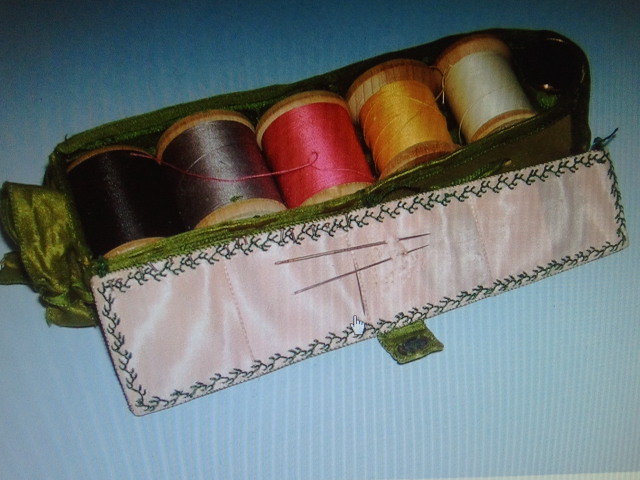
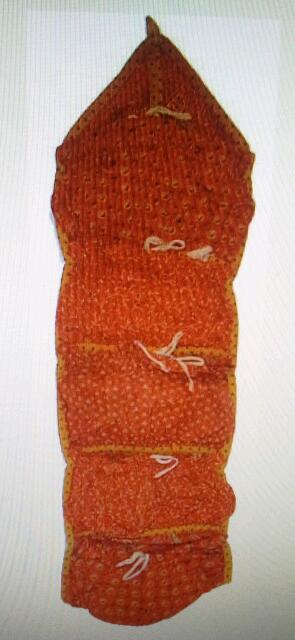


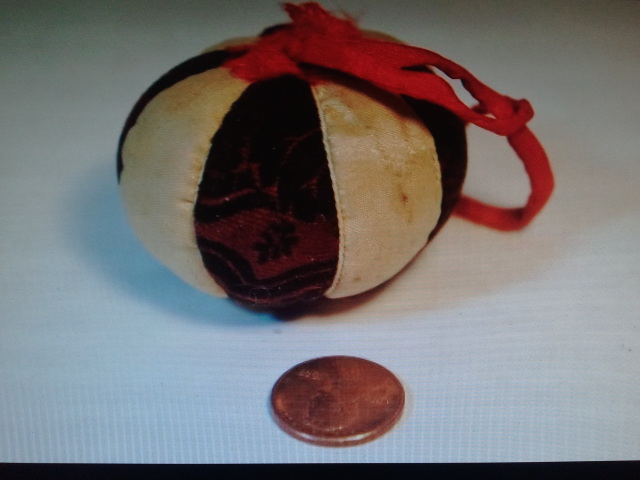
My current wish to-make list. It only seems challenging when it is to be finished by Thanksgiving.

As many of you know, I am working on a not so little project. I have been trying hard (really, really hard) to keep quiet about what I am doing and what I am finding. But, I am horrible at keeping my own secrets. I’ve slipped. I’ve hinted. I’ve nearly screamed out-loud, jumping up and down, “you’ve got to see this!”
This has very much become a project of “Yet.”
In a world where we look for common construction techniques and norms in materials, it is rather exciting to be working on something where all sorts of materials and construction techniques.
I really feel as though when I say “I have not seen that yet“, “yet” is truly a “I just might see that” or an “it wouldn’t surprise me if” or a “let me see it”, rather than a “that wasn’t common” or a “they really didn’t do that.”
How fun is this:
Cotton batting/wadding… yep Wool batting/wadding ….yep TBD wadding… yep Paste-board… yep Paper… yep Woven straw… yep Cotton cording… yep Stiff paper cording… yep Silk…. yep Cotton… yep Wool… yep Fur …. yep Beads… yep Ribbon… yep Drawn… yep Gauged… yep Gathered…. yep Piecing… yep Selvages… yepNow, this said, I am one who loves patterns, trends and tendencies. I would love to chart out the years, the regions, the urban to suburban, the age of maker/sewer, and anything else I can to get an even better understanding.
If you follow me on Facebook, I’m sure you’ve heard me whine about the last Ag. Fair entry that wasn’t to be. This last item was to be something in the “Quilted Garment” by hand category.
Prior to September, I had it in my head I was going to quilt a little quilt, something in the “Household” category. When the deadline for the entry form came, I decided a quilt, no matter how small (unless it was a doll quilt), was not going to happen. I determined I would make a yet to be determined quilted garment.
I should back up and say…. If only I hadn’t done the seams in my quilted petti with a machine. 😦
At first, I figured I could make a quilted bonnet in one of the nifty different shapes I have been looking at. Quilted bonnets are fun. I enjoy them. I think what sub-consciously squashed that was that I entered quilted hoods a couple years ago. To be personally satisfied, I would need to draft a completely new pattern from an original soft bonnet for this entry. I just didn’t get that far.
A few weeks rolled by…..
A few ideas came to mind….
and were quickly forgotten…..
As of mid-day Wednesday, I had it in my head I would hurry home to draft a baby bonnet pattern and make a silk baby bonnet. After all, I have plenty of friends and family with babies in belly or recently from belly. Ah….. nope….. Staring at the silks, none said ‘baby bonnet’ to me other than the black silk which is for something else.
I officially called the last entry a ‘fail’.
(mind, I still have the second to last entry to finish)
As of this moment, mid-day the day before I have to drop them off….. I am still toying with the idea of actually pulling something off. Insane…. yeap
While warding off the potential insanity, let’s look at some of the quilted garments that were not to be… at least this year….

I will be teaching two Fanciful Utility workshops at the Genesee Country Village and Museum’s Domestic Skills Symposium. 
The Symposium takes place on Saturday, November 1st, with Workshops on Friday and Sunday. This is an incredibly affordable program at $75 for Saturdays Symposium with 4 full presentations.
Key lectures include:
Friday and Sunday Workshops cover domestic skills such as:
 The only bad thing about teaching workshops is missing attending the others. “Sit not in Idleness” sounds like so much fun. I’ve really wanted to get Lily a trivet. I would love to have a hand-bound notebook for when I set up the millinery. Um, Yum, Cheese! And, a basket too?! It would be great to know more about taking care of tin. Plus, I loved the little tin nut grater we had when I was a kid.
 I hope to see many of you there. The museum is just outside of Rochester, NY; about an hour from Buffalo/Niagara Falls and 2ish hours from Syracuse. There is a beautiful B&B right down the street. There are several nice hotels in Henrietta too.
The full description of the program along with registration information is on the museum’s site: www.gcv.org
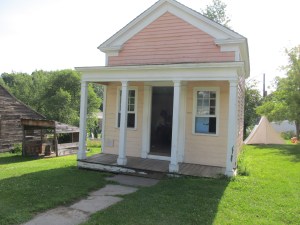 This was my second year in the Dressmaker’s Shop at the Genesee Country Village for their Civil War Encampment. As you can see Saturday morning was pleasant and sunny. You can also see the soldiers struck camp right up to my back door. While I was thinking this might make for some fun interaction, after-all I was prepared to say all my firewood was stollen as well as my wooden head forms. But, in the end, they kept to themselves. Well, except for eating all the beautiful black raspberries I was eyeing the night before.
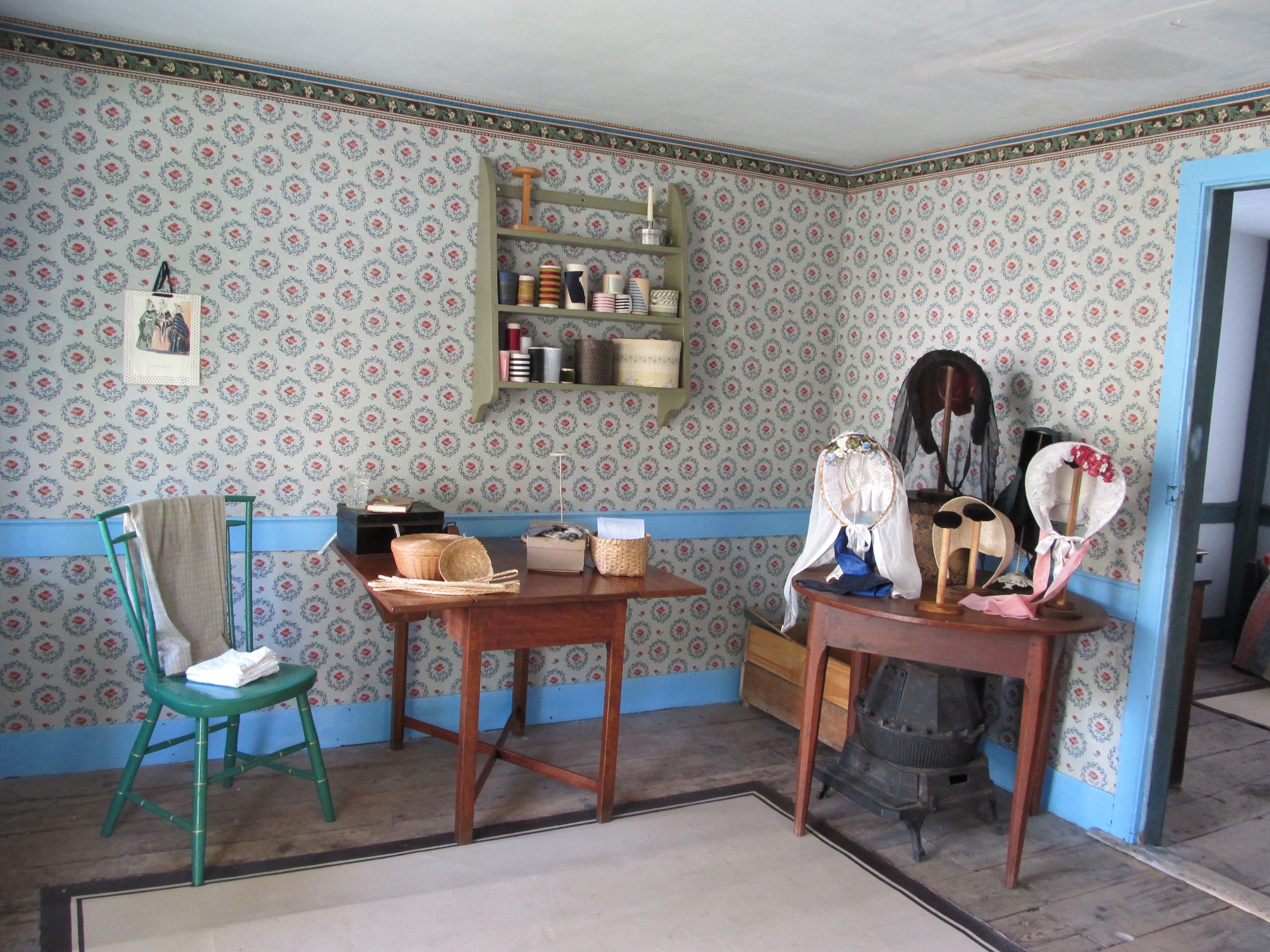
Rather than interpreting the pretty pink building as a dressmaker’s shop, I dressed it as a Millinery. The blue and rose print interior makes for such a pleasant place to work in. You can see the working table and display table. (Yes, we did put it right over the stove. No firewood, no need for a stove.)
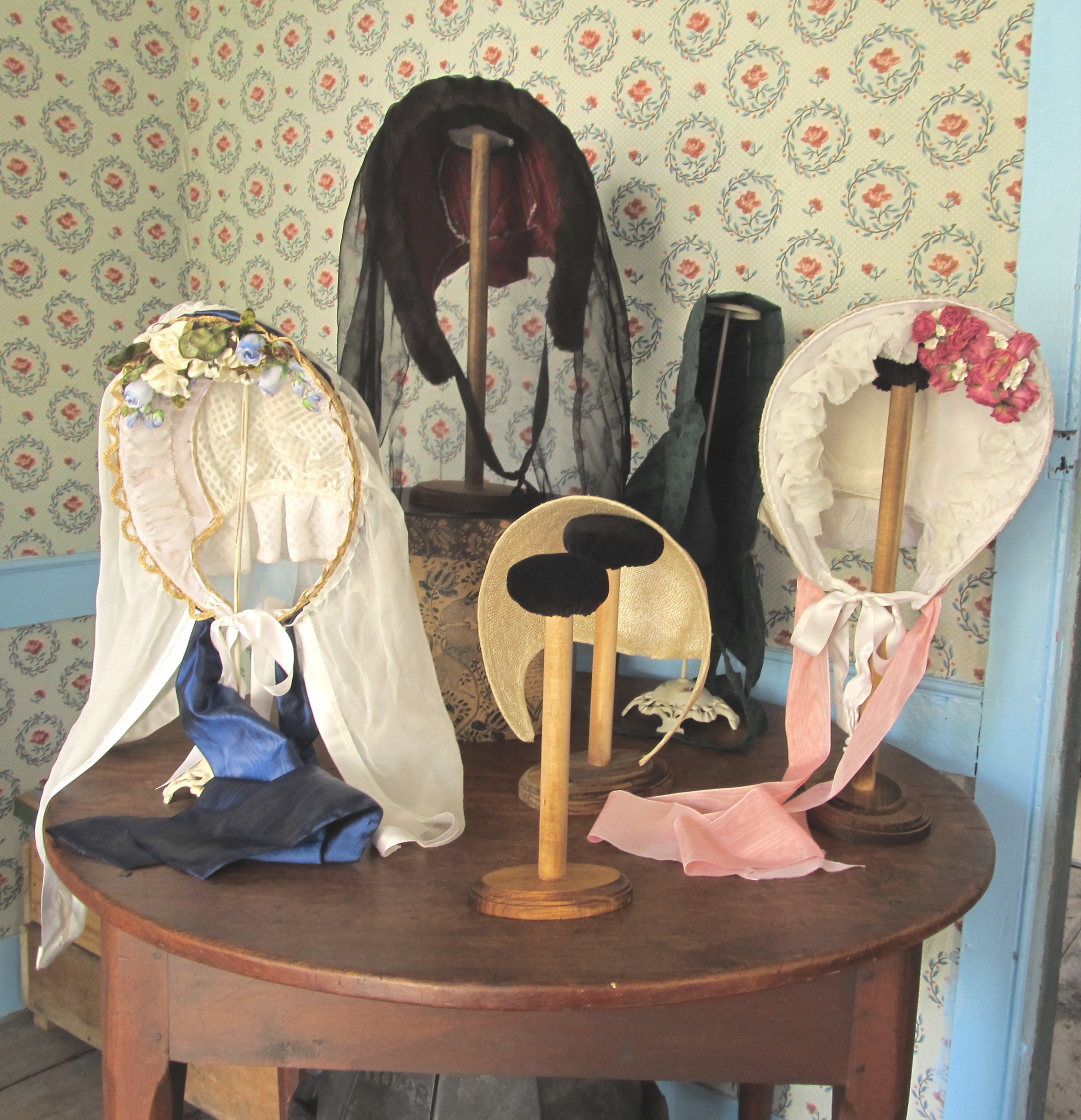
I wanted to bring a basic sampling of bonnets to show visitors. As I was working on a straw plait form, I would compare that to the woven straw in the middle, Vivian Murphy’s work. Then I would discuss the two finished fashion bonnets, left and right. We would also talk about the winter bonnet in the back and the sun bonnet just below. Many people asked about the veils. This was a good teaching point to explain the differences in the mourning veils and every day veils. (An interesting set-up/interpretation note – There was notably more touching this year than with with last year’s set up. This is good to know for determining what display pieces to bring and place where. The pink and grey was the most touched followed by Lily’s green when it sat on the empty stand.) Oh. Those wooden stands are the ones I made on Wed/Thursday last week. I’m rather pleased.
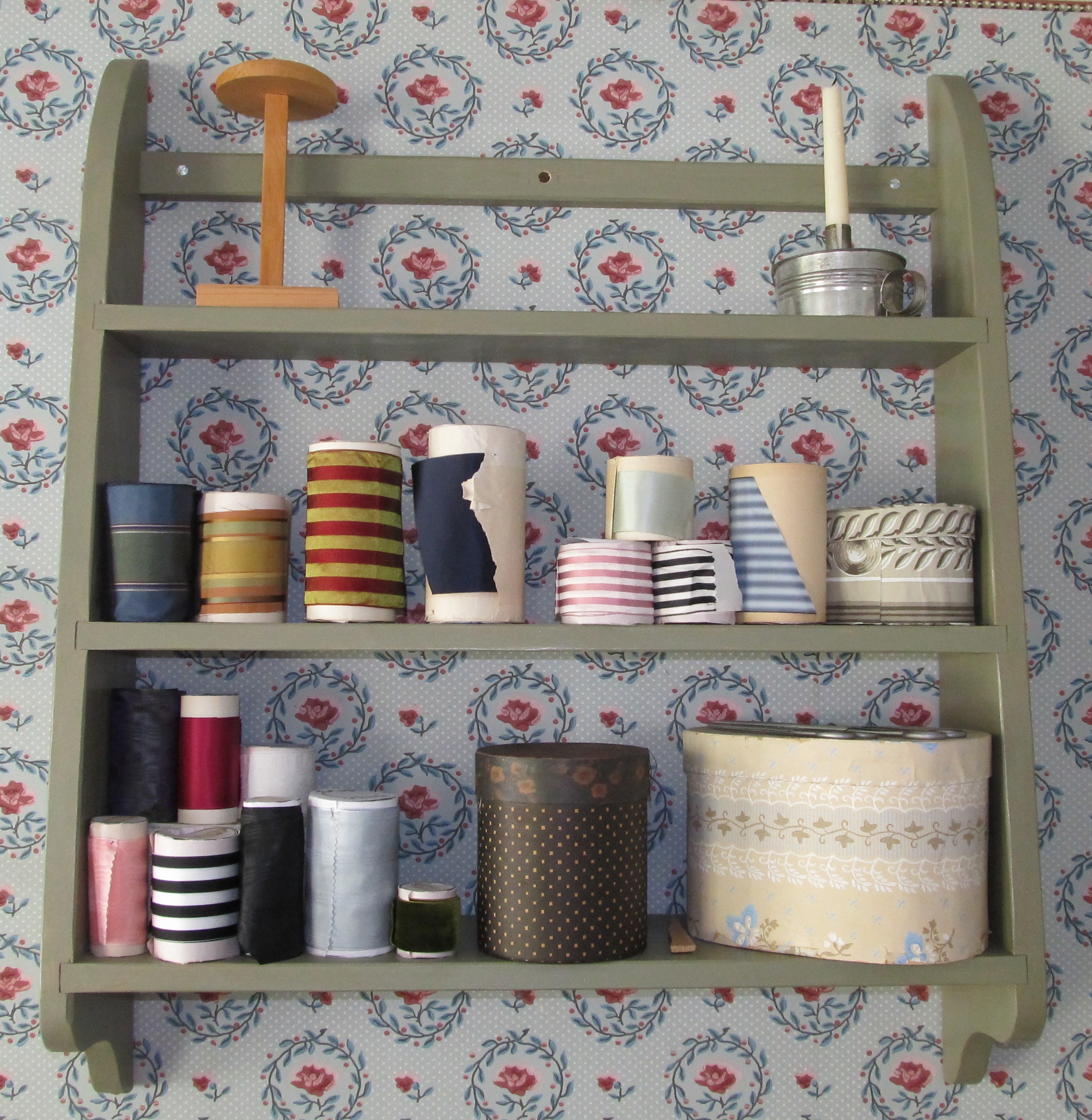
Here are the faux spools of ribbon I have been working on. I was excited to see them on the shelf. They aren’t quiet where I want them look-wise. I need to come up with a better way of doing the ends with the labels. That is why they are all up on end. Each roll is faked by using only a short piece of ribbon, usually 5-6″ but as short as a 3″ trapezoid, around a roll of original or mocked paper. I’m also planning to take my original ribbons, reproduced on white silk ribbon via the printer and make faux rolls out of those. In the works as well are sample cards. I started a set, but was not happy with the look… at all. So, back to the drawing board on those.
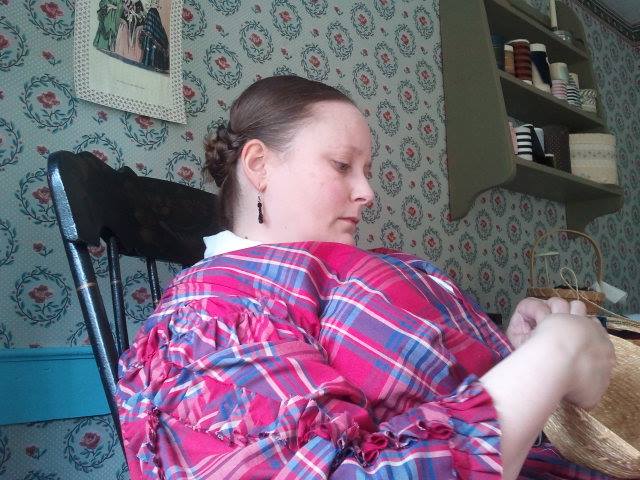
This was the “home” area for the weekend. The little day bed is napping suitable. The large cabinet is truly ideal. It reminds me a lot of the cabinet Dad had stripped for me when I was little. Those cabinets hold everything. It made storing food, supplies, etc very easy. It was okay if visitors opened the top because everything was period containers. We really didn’t need to have food out on the table at all. It did help as a reminder to actually eat though. 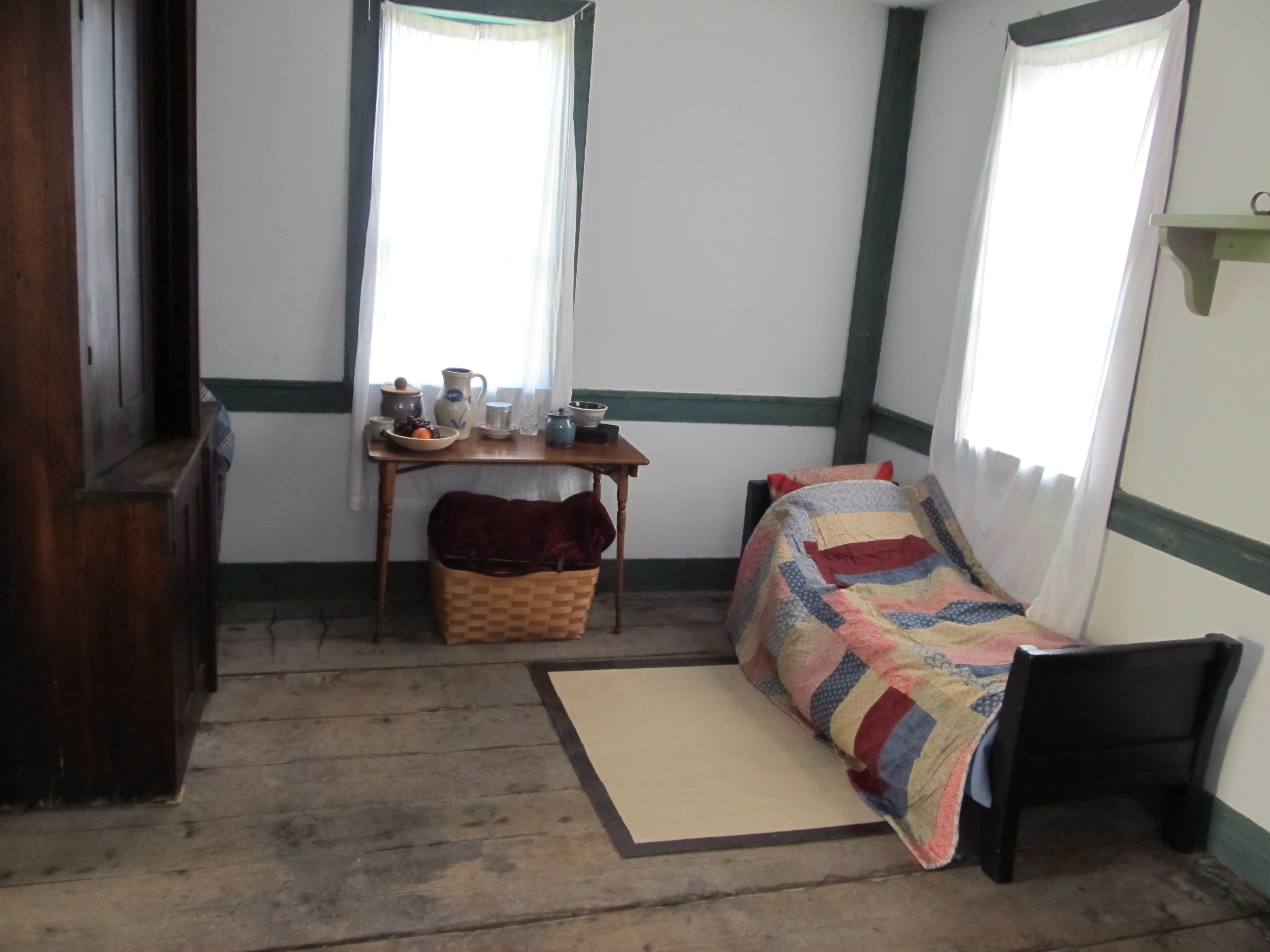 I am utterly lacking in actual impression photos, worse than usual. All I have of myself are these “selfies” I played around with while it was raining in the morning. The bonnet is a coarse straw, meant to represent those made cheaply, worn by poorer women or those institutionalized. This can also be the “last remnants” straw of late war.
 aka New Drawn Bonnets!!!
If you read the post a few weeks ago on Drawn Bonnets, you may have noticed a black and white check and a blue and white check. There was just something about these bonnets that screamed “make me!”


The black and white is a taffeta silk with approx 1/6″ checks. The silk is drawn on cane over a light weight wired buckram. The slightly flared brim is prettily flounced. The fashion ties are a high quality double faced satin and the functional/utility ties are a silk taffeta. It is lined in cotton voile. The frill is a silk organza. The interior decoration pulls directly from the inspirational original that was done in ribbon and lace. This one has handmade ribbon petals and delicate white violets set on a wire and tacked into the bonnet. I really was quite giddy when I finished the exterior of this bonnet. I was so please with how it came out.
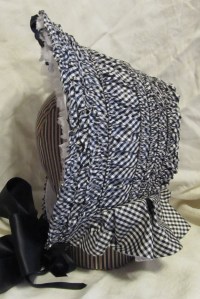


Since my silk merchant had a blue check in a shade that nearly matched an original blue check, I just had to make that one as well. This check is a tissue taffeta with a tiny check. It is also drawn on cane over a buckram bonnet, with one drawn section over a wire. The interior is cotton voile lawn with an organza frill. On the inside are blue paper flowers. On the outside is a garland of small velvet blue blossoms. The utility ties are an ivory silk taffeta and the fashion ties are a German moire.


I had just enough of the black check taffeta left. It really wanted to be a soft crown.
This is a straw plait brim with the black and white silk taffeta soft crown. The interior is lined and has an organza frill. The fashion ribbon is a black German moire while the utility/functional ties are a narrow black silk taffeta. I was so very tempted last night to trim this out in peacock feathers and black velvet berries. I wasn’t sure that people would like that, so I held off.


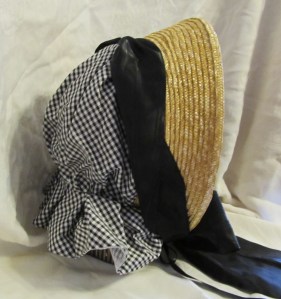
Here is a sampling of checked drawn bonnets:


I’ve been having so much fun sharing the millinery pieces from this spring with you, I decided to share this little bonnet. This really has been a forgotten about bonnet. It made it as far as some so-so photos for Etsy, then got tucked away to the back of the display table.
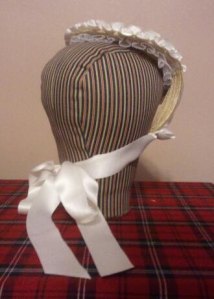 In the middle of the 1860s we see a transition from the fashionable spoon and cottage bonnet shapes to the hat and smaller bonnet shapes. There were a speckling of styles that show the transition from one millinery era to the next. My bonnet pulls mostly from this first example. The crown drastically shrinks, flattening out, while the cheektabs try various positions framing the sides of the face rather than coming down to the jaw line.

 As you can see, the decorations and ribbon tend to encircle the crown and fall down along the remains of the cheektab.

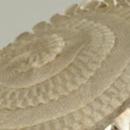
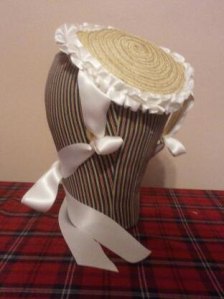 I used the last of my hemp plait for this bonnet over the winter. The box pleating encircling the crown is a silk ribbon slightly narrower than the silk ribbon used for the ties. Just under the brim is a frill of fine net.

It is amazing how our belated spring has come in full force. I, for one, Love it!! It seems like over night the trees are green and blooming in white and pinks. Beautiful.
Inspired by the warmth and color, I dove deep into some new spring millinery. (okay, I finally got the Mother’s Day Fashion Show dresses done at the same time flowers and trims starting coming in.)
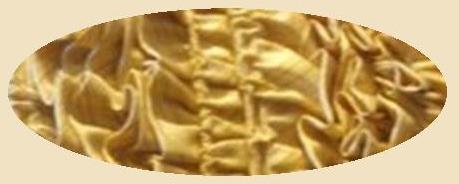
Here are some tiny sneak peeks of the three of the pieces I am currently working on. The only one not spoken for is the organza.


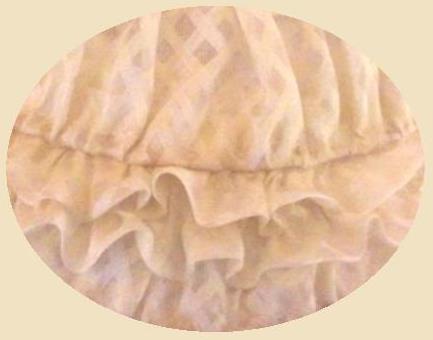
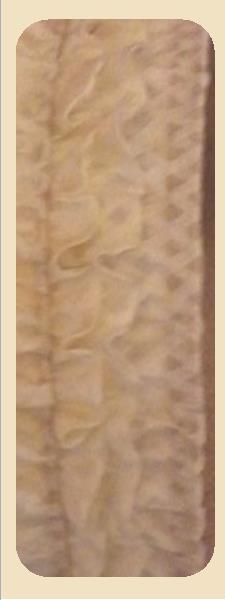
I am currently reading “‘Another Domestic Beast of Burden’: New England Farm Women’s Work and Well-Being in the 19th Century“. The author, Linda Borish, brings together several descriptions of farm women’s daily life and chores. From kindling a fire to laying soot on raspberries to pounding potatoes for the hogs, she gives us a hint of what went into a woman’s day in the first half of the 19th century.
My challenge to each of my friends and readers who are interpreters, reenactors or just want a writing challenge….
From the mindset of a woman you interpret, write, in detail, what your day would have been from the time you wake to the time you sleep again.
I will work on my response and share below. Either add your day in the comments below or give us a link to it.
While I patiently wait for the photos of this weekend to come out of my sister’s camera, I’ll share with you the story of the sleeve. While this sleeve did not go well in the making process, I am okay with the end result.
I knew I didn’t want another open sleeve as that is what I used for both green sheer and semi-sheer dresses from last year. I wanted something with shape. Looking at this inspiration sleeve,

this is what I came up with: 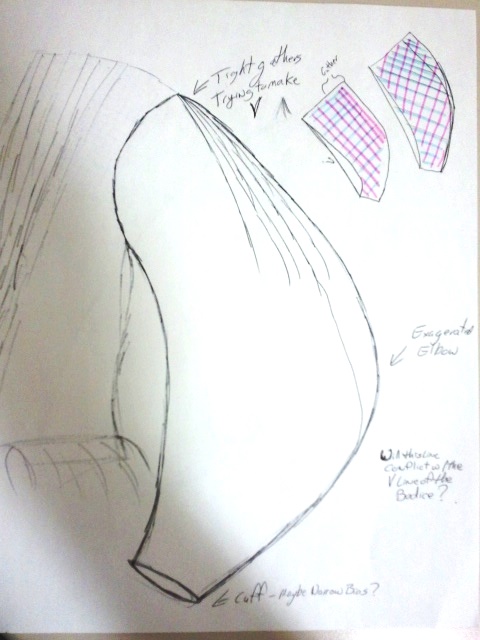
After the sketch, I added a bias cut, double gathered ‘puff’ to the top. I liked the idea of the extra drop before the fullness.
In the drafting, I wanted to make sure I had a good length and a nice curve into the enlarged elbow. I thought this is what I had. It looked pretty good.
 Well, not so much…
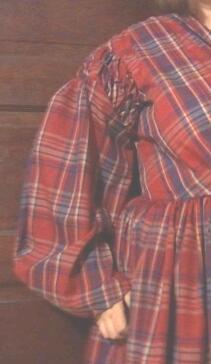
Full, yes. But, way too long. (do ignore the corset-less state.) So, I took off the bottom sleeve. Cut 2 inches off. Re-gathered. Re-attached. Oh, I also rotated the sleeve, moving the gathered fullness towards the back and added some trim.
Two inches should have worked. Right? …… Wrong. It was still too long:

Oddly, it actually looks longer. Doesn’t it?
To make matters worse…. there was this screaming blue horizontal stripe that was driving me crazy. (again, please ignore the corset-less, dress over the clothes state.)
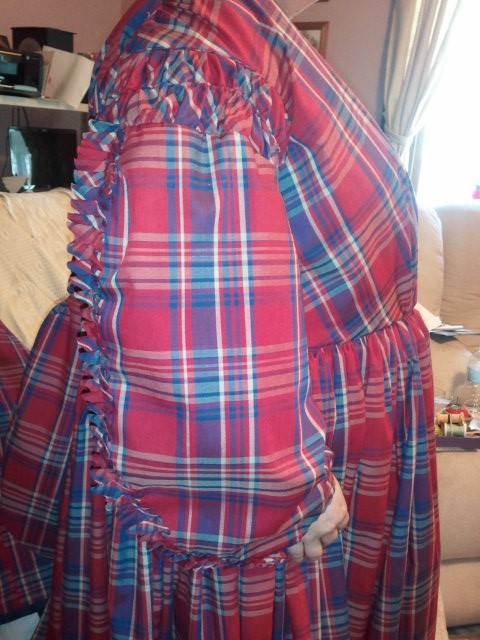
So, what do I do? What any over-tired, over-hungry, cranky person would do…. I got out the scissors and hacked off the lower part of the sleeves. One big crescent shape. Yeap. And the moment I did, I knew I did bad.
I lack photos of the hacking and the hacked state. I decided it was time to put the dress down and go eat something.
After a few moments away, the sleeves told me they were going to be an open sleeve after all; they were even going to make use of the odd, dipping V in the opening created from the hacking. As such, I finished off the edges and trimmed away… down the outside of the sleeve and around the new opening. I added a second vertical piece trying to play with the curve and down play that blue line. In the end, I am okay with how it came out.
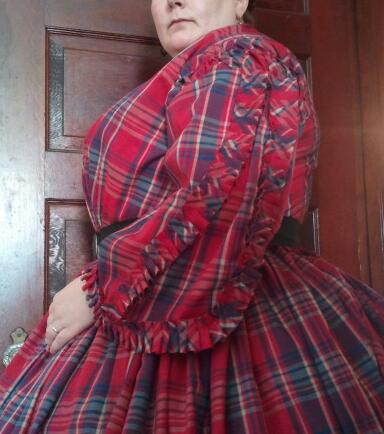 At one point, I thought I would use this sleeve for the show, then make a new one more like the sleeve on Lily’s dress, just longer (these are ‘matching’ adult vs teen dress comparisons). But, after wearing it on Sunday, finding it comfortable, I may just leave it as is. We’ll see what the other photos say.