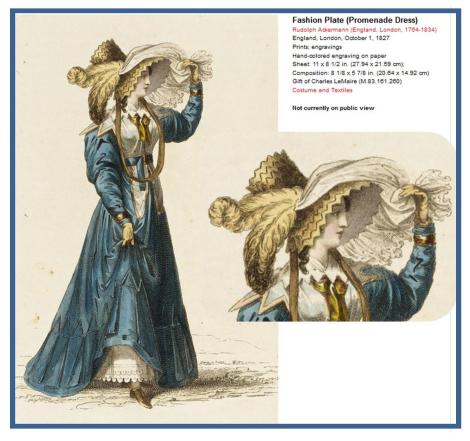
Anatomy of a Straw Bonnet

Each of these points are general for fashionable bonnets made of straw, primarily straw plait, from approx 1858 through 1863. Finer points adjust with each season’s prevailing fashion.

General Construction – Straw bonnets were sewn by hand in the round. Plaits ranged from 1/8″ split straw to wider whole straw and fancy plaits. Woven straw was also used.

Anatomy 1

Tip – The back section of the crown is the tip. On a straw bonnet this can either be domed, flattened at the back curving to the side of the crown. It should not have a sharp angular transition from the back to the sides.

Crown – The crown of a straw bonnet should create a smooth transition from the crown to the brim. Much of the shaping in the bonnet will be created in this transition area.

Brim – The brim of a straw bonnet will vary according to fashion. The brim’s edge should be a single or double row of straw plait. It should not have raw edges needing to be bound.

Cheek-tabs – The cheek-tabs should have a gentle curve coming from the neck edge of the crown along the side of the bonnet dropping down to roughly your jaw line meeting the brim edge. This is a graceful line, not a straight edge or angular transition. There is a variation in the twist of the cheek-tab from the fifties into the sixties. The cheek-tab is part of what helps hold a bonnet in place.

Binding – The binding on a straw bonnet should be straw plait. Raw edges were covered on the exterior and sometimes the interior along the back of the cheektabs, sides and tip. Multiple rows were used as well.

Lining – A lining is a functional layer of light weight, open-weave cotton covering most of the interior of the bonnet. It aids in keeping the straw from snagging the hair while worn. The lining can not be seen when the bonnet is worn.

Frill/Cap/Ruche –This decorative layer of gathered cotton or silk fills the inside of the brim. This is very fine most often net, lace or organza. The full frill aides in holding the bonnet in place.

Facing – Some bonnets have a facing of silk from the edge of the brim through the first couple inches of the interior brim.

Bavolet/Curtain – The bavolet is attached to the binding edge on a straw bonnet along the sides and crown. This silk piece should be lined with net to give it more body. The bavolet may be a single piece of fabric, most often on the bias and occasionally on the grain, or pieced from bias cuts of ribbon. The bavolet may also be decorated.

Functional Ties – The functional ties are attached to the interior of the cheek-tabs or under the decorative ties. These are narrower ribbon to hold the bonnet in place.

Decorative Ties – Decorative ribbons are wide, 3″-8″ based on a wide survey I did years ago. They are on the grain, not bias. Tied, they do not take the support of the bonnet.

Interior Decoration – Interior decoration also helps hold the bonnet in place.

Anatomy 2

I am having a moment of “OH, Wow! I need to make that hat!!!”

make

At the  Los Angeles County Museum of Art (LACMA)

I think, I hope I still have the right straw. May need more.


Published in: on May 11, 2017 at 6:00 am  Leave a Comment  

Millinery in Context

I recently wrote a program for a local group of 1860s civilians looking at millinery in terms of context. Since then, millinery in context has come up in several different online conversations.

When looking at millinery in terms of social, situational context, we see a different picture of which millinery was worn when, than we did twenty years ago. Looking at very large pools of images, including impromptu in-situ group photos, then clustering them together into the particular situations, we see patterns emerging within the situational groupings. No longer is it a simple matter of “young fashionable women wore hats, older women wore bonnets”, because this was simply not the case, nor was head-wear that unvaried.

While I would like to put together a thorough, detailed blog post filled with corresponding images, many of you know I am currently dealing with a cranky medical issue that is making my dedicated millinery and blogging time inconsistent. I don’t know when I will pull together what I have in mind because I want to have all the image rights in order.

What I have done in the meantime is reorganize some of my Pinterest board into groups of Millinery Context. Each is labeled with a “MIL CONTEXT” preface. My hope this will ease discussion and get people headed in the right direction for their interpretive situation. The boards currently developing include: (please keep in mind this is just a rough start of a massive reorganization.)

Published in: on May 9, 2017 at 12:00 pm  Leave a Comment  

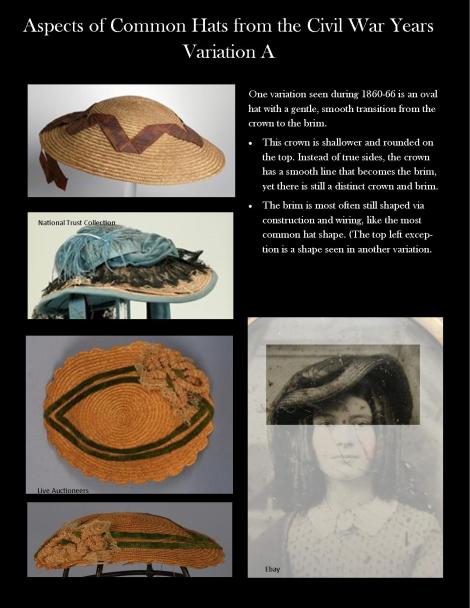
Today’s Millinery – Shallow Crown in Black Straw

This evening’s hat is a fashionable Civil War era hat with a shallow crown. This is a petite hat meant to be worn very, very high on the head with the crown just cupping the crown. See the aspects below. 

This crown is barely 17″ around while rising a mear inch and a half, to sit very high on the head. The brim is 10.5″ across with a subtle curve dipping front and back. 

Find this hat in my Etsy shop. 

Published in: on May 8, 2017 at 6:35 pm  Leave a Comment  

Today’s Millinery – Black High Crown Hat

 Today’s hat is a fashionable Civil War era hat in black straw with a high crown and narrow brim. The brim is stylishly curved, dipping front and back. The oval  crown tapers just a bit.

This hat will fit an average to large head with a crown circumference of 21.75″. The crown is 3 1/2″ tall, while the brim is 2″ wide, making the hat 11″ in diameter. 


I would love to see this hat finished of in this simple period manner with a favorite plaid ribbon. Find this hat in my Etsy Shop.


Published in: on May 6, 2017 at 6:07 pm  Comments (1)  

2017 Spring Sew Along – A Rolled Sewing Case – Week 4

Welcome to the 2017 Spring Sew Along – A Rolled Sewing Case!

Be sure to read the previous 4 posts for this Sew Along.

——–

This week we are finishing our Rolled Sewing Case by making and attaching the ends, and adding the pages as well as ties.

img_20170310_200643.jpgFor the end caps, you need the tin circles, exterior and interior fabric. You may also want batting for pin cushion ends, and pasteboard or cardstock if that is your preferred method from Fanciful Utility.

Cover each tin end with your favorite technique from Fanciful Utility. You are simply using tin instead of pasteboard as your base.

I chose to use wool batting on the outside of my ends for pin cushions. I also used cotton batting for the inside in the covering process. *I do not suggest this latter part with the cotton batting because it did not create an ideal tight & smooth surface.*

Use a couple pins to run through the edge of one end in alongside the tin. Using a whip stitch, secure the end to the tube. I suggest whipping in one direction and back to the beginning. Do a wiggle test to check the security.


If you chose to include needle pages, assemble your needle pages and decorate as desired. Whip stitch them into place in your sewing case. (or use a running stitch through just the lining.)

Cut a length of ribbon that will wrap around your rolled sewing case and tie. Fold the ribbon 12″ from one end. Secure this fold to the closing end of the sewing case.

Congratulations, you have completed your Rolled Sewing Case!

Please, join us for future Sew Alongs.

Published in: on May 1, 2017 at 12:00 pm  Leave a Comment  

Keeping a Hat in Place

I was asked to put together some information on how to keep a hat in place. This may not be the best post as I am dealing with a medical issue just now that has me on a bit of a roller coaster. I did start a Pinterest board of original hats. In some images the ties or elastic is visible. In others, we can see that the hat is being held in had by something not fully discernible. In these cases, I speculate that what is being held may be ties or an elastic.

What we see when we look at originals is A) narrow ribbon or other ties set inside the hat where the crown meets the brim, B) wide ribbon ties set inside the hat where the crown meets the brim, C) narrow elastic set inside the hat where the crown meets the brim, D) ribbon decorations set inside the hat on the brim that do not tie, E) nothing.

This straw hat trimmed in lace at the MET has a pair of narrow ties set inside the hat. These ties would have likely been tied behind the head under the hair. This hat at the National Trust, dated slightly post war, has a black elastic attached to the interior of the hat. (It is possible it was added later.) This elastic would be place behind the hair for wear. This smaller hat at the MET has an elastic that was likely white originally. It would have held the hat to head by running behind the head, under the hair.

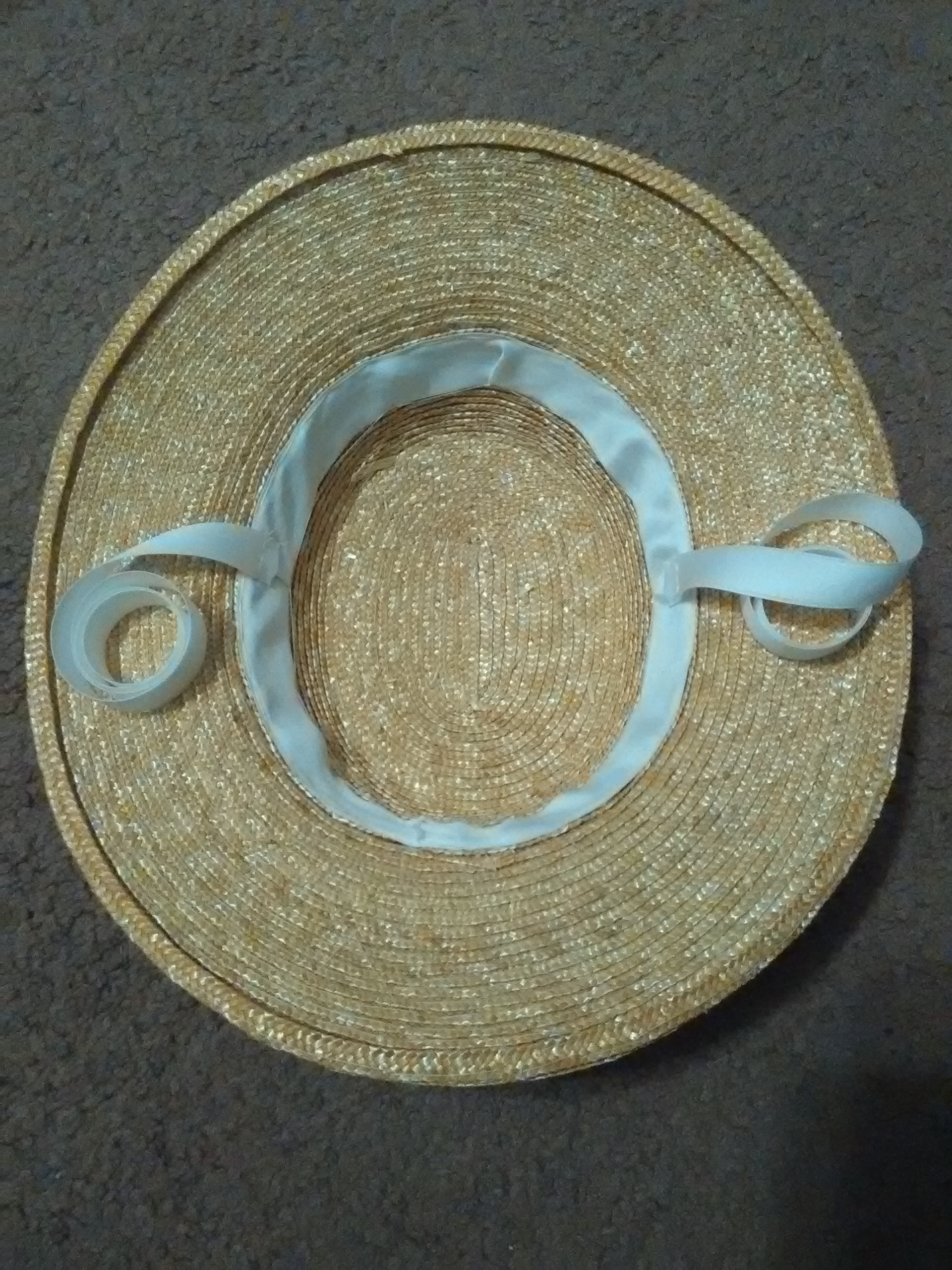
In recreating the function of ties or an elastic, placement on the hat is important. I find attaching the ties or elastic to the inside of the crown, just before where the crown meets the brim best reflects what I see in originals. Placing these just above the ears or just forward of this point seems to give the security needed. This gives a nice angle, passing behind the ear and behind the head under the hair.

Here is an example of where I would place the ribbon ties for a hat:

I would place elastic in the same place.
 

Published in: on May 1, 2017 at 9:21 am  Leave a Comment  

2017 Spring Sew Along – A Rolled Sewing Case – Week 3

Welcome the the 2017 Spring Sew Along!

Be sure to read the first three weeks of this Sew Along.

———-

This week we will be binding the interior to the exterior.

I had trouble deciding whether to stitch the binding over the tin tube or to do the binding first and slide the tube in. Given the angle required for stitching the binding to the inside of the tube, I opted to do the binding first and slide the tube in. I figured this would be the least frustrating for a wide range of sewing skills that may be participating. Do note, this does not make the tightest fit on the corners.

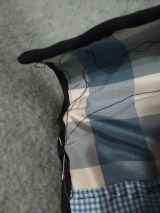
Lay the interior section on top of the exterior material, wrong sides together. Baste the layers together.

At the tube end, fold the binding ribbon over pinning or clipping in place. Do so for each long side 3″ up on each side. Using a blind or whip stitch, catching the selvage edge of the ribbon, attach the ribbon the interior fabric. Be sure not to catch the exterior fabric. Press as needed.

20170310_211553.jpg

Slide the tin tube inside the layers with the curve opening towards the interior side. This takes a bit of fussing and convincing.

img_20170310_192558.jpg

img_20170310_192603.jpg

Fold the rest of the ribbon binding around the rest of the perimeter of the sewing case, pinning or clipping in place. Sew the binding to the silk as above. Press as needed.

.

Completion of this weeks steps has most of the body of the sewing case together.

img_20170310_194711.jpg

Next week we will assemble the end pieces and attach the pages as well as ties.

Published in: on April 24, 2017 at 12:00 pm  Leave a Comment  

Millinery Thoughts: Things you may not know are used for straw millinery

When I mentioned using powered tools last weekend, it surprised a few people. So, I thought it could be fun to talk about some of the behind the scenes things used for straw millinery. This is very much the things I use at home, not those for a historic setting.

  • Blocks. I use a few different types of blocks, aka shapes to shape bonnets and hats over. I love original blocks. They can be hard to find and pricey. I also make my own from foam and wood. The foam blocks don’t last long, maybe a season depending on how many pieces are made on it. Wood blocks are much more difficult to make but last longer. 
  • Palm sander. I use a palm sander to sand and shape some of my blocks. I would love to have a lathe so I could turn some round blocks. I need to get braver and better with saws and chisels. 
  • Dremel. I use a dremel for marking blocks and for smaller, doll size pieces. 
  • Paint brushes. I paint my sizing combination on. No more clogged spray bottles. 
  • Icy Hot and Unkers. Icy Hot patches cut in half wrap nicely around the hands or wrists when they start spasming. Unkers is nice to rub in before bed. The rubbing helps too. 
  • Back massager. The back massager fits well around the hand or wrist when there are knots or the swelling needs to be worked out. 
  • Iron stone pitcher. The pitcher from my pitcher and basin set has become the parking place for straw. 
  • Clara. Clara is in charge of time management . She reminds me when it is time to take a break or to go eat. She is also a nice heating pad. 
  • Crocks and baskets. Hanks of straw seem to stand up nicely in large crocks and tall baskets. 
  • Washing machine. The washer has become the drying surface because it is cleanable compared to wood surfaces. 

Published in: on April 19, 2017 at 6:07 pm  Leave a Comment  

Today’s Millinery 

I am rather pleased with this fashionable high crown Civil War era hat. The lines and proportions came out nicely. This is one I would like to make a permanent block for in two sizes, and possibly an oval one as well. I really do need a wood working shop. 

This hat is suitable for an average to smaller head. The crown is 20″ around and round, not oval. It sits high on my head. So, I recommend ties inside. 

The crown is 3 3/4″ tall in the front. The shaped brim is 2″ wide, 10 3/4″ diameter side to side, 10″ front to back with the curve. 

Find this hat in my Etsy shop. 

Published in: on April 18, 2017 at 1:53 pm  Comments (1)