Today’s Millinery – Aged Copper Brown Hat

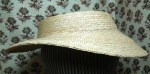
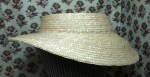
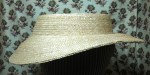
This hat has a beautiful aged copper brown color straw. It is a fashionable shape with a curved brim. 

Suitable for an average to large head, blocked on the “Delia” crown. . The crown is 20.25″ around and a shallow1.5″ high on the sides. The brim is petite, 10″ across and 11″ front to back. 


Note: The stitching is visible on this hat up close. 

Find this hat in my Etsy shop. 

Published in: on April 17, 2017 at 12:15 pm  Comments (1)  

2017 Spring Sew Along – A Rolled Sewing Case – Week 2

Welcome to the 20117 Spring Sew Along – A Rolled Sewing Case!

Be sure to read the first two posts  for Materials and Week 1.

——–

This week we are going to be working on our interior materials.

I chose to make a sewing case with a single pocket. You may have a scissors pocket or other pockets as well. Be sure to consult your edition of Fanciful Utility for guidance on these.

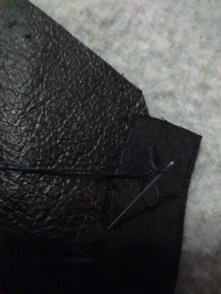
For my pocket, I cut my silk to 5″ wide by 3″ deep.  I hemmed the top and made a box pleat in the bottom for a roomy pocket. img_20170310_180404.jpgI laid the pocket right side down on the lining where I wanted it to be. (My plaid helped make that easy.) Using a running stitch, I attached the pocket. Then folded it up into place. I basted the pocket along the edges.

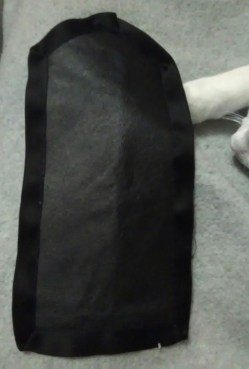
I have come to like the batting or lining used in some originals because it seems to give the sewing case more support when made of silk. I lined my interior fabric up on top of my batting and basted into place.

20170310_211612.jpg

Next week, we will bind the interior to the exterior and add the tin tube.


Published in: on April 17, 2017 at 12:00 pm  Leave a Comment  

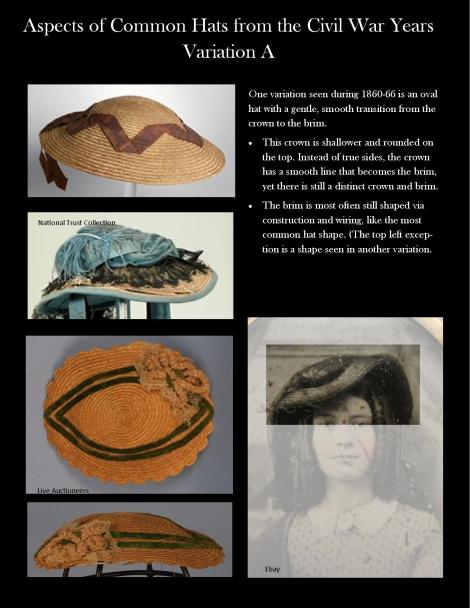
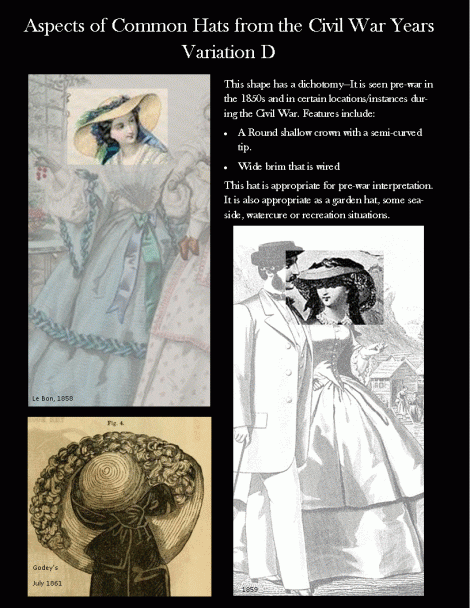
Common Hat Shapes for 1860-1865

Common hat shapes during the American Civil War era.

There are 2 main componants to a hat from this era: the crown and the brim. Both thd crown and brim were particularly shaped to reflect the styles of the time.

When selecting hat for an 1860-1865 impression, please keep in mind the situation you are in as well as your impression. In many cases hats had specific purposes and places. These include those for the seaside, watercures, the garden*, and recreation. There are seperate posts for these. I welcome you to explore these. There are also hats appropriate to those of poorer situations, institutionalized or previously so situations, and blockaded situations. I will be adding a post looking coarse straw and the use of palm and other make-do fibers. (*note: a gsrden hat is different than one for gardening.)

common 1

common 2

common 3

common 4

This next style is called a “Mousquetaire” hat or a “Postilion” hat.
Mousquetaire hats have tapered crowns that rise about four to five inches, not quite double the height of other fashion hats of the early 1860s. The brim is shaped, with a curve dipping front and back. This brim is narrow, only a few inches wide. The decorations are primarily at the center front, reaching the height of the crown. A ribbon may or may not circle the crown with a bow or arrangement in the back.

Additional variations to be covered soon:

  • Smaller hats (Fashion)
  • Torque (High fashion without brim) and porkpie (High fashion with little upturned brims)
Published in: on April 13, 2017 at 6:20 am  Comments (1)  

Tonight’s Millinery 

This hat has a flat top crown keep nice and shallow, 2″ tall in front and 1.5″ on the sides. The front of the brim curves down in front, while the back is curved just a little. This the “Delia” crown, 20.5″ around. The brim is 11.5″ wide. 


Find this hat in my Etsy shop. 

Published in: on April 10, 2017 at 5:51 pm  Comments (2)  

2017 Spring Sew Along – A Rolled Sewing Case – Week 1

Welcome to the 2017 Spring Sew Along – A Rolled Sewing Case!

img_20170310_162317.jpgPlease be sure to read the Announcing post with directions for ordering your Tin Tube, made by the Genesee Country Village and Museum’s Tinsmiths and suggested materials list.

——————————

This week we are going to cut our materials and prepare the exterior material. (Your tubes should be arriving about now.)

First, decide what you want your Rolled Sewing Case to hold. This will determine what kinds of pocket you will want and how long your case will need to be. I recommend sketching out on a piece of paper what you will want in your sewing case. It may be helpful to cut a strip of 4″ wide paper for doing this. Leave 3 inches at one end to go around the tin. Here are some ideas:

I decided to have a simple case with one pocket and a pair of small pages. (Okay, the fact that I had pre-cut my leather years ago decided the size of my sewing case.)

Next, shape one end for the closure. This can now become your template for your materials. Redraw it if necessary.

Cut 1 layer of exterior material.

Cut 1 layer of interior material.

Cut your needed pockets – Remember to leave a seam allowance and hems for these.

Cut 2 circles 2″ in diameter for the outside of the ends and 2 circles __” in diameter for the inside of the ends. You may also want to cut 2 pasteboard or cardstock circles the size of the tin ends.

img_20170310_163412.jpgI am going to assume most of us are using an exterior material that is more difficult to sew through.

You may find it easier to pre-drill the holes in your material with either an awl or a sewing machine. These holes should be 1/4″ in from the edge.

img_20170310_164437.jpgStarting at the center of the closure, lay your ribbon binding on the exterior of the exterior piece, with about half overlapping. This should like the selvage up so it just covers the holes you made. Sew the ribbon around the perimeter of the exterior material. All the way around. Be sure to miter corners tightly.

Finish the ribbon by folding the raw end under. Some may wish to press the ribbon over to the other side. (I have not done this because I used leather and don’t know what will happen.)

Some may wish to have their feline assistant approve their work.

20170310_211407.jpg

Next week we will be creating the interior.

Published in: on April 10, 2017 at 12:00 pm  Leave a Comment  

Today’s Millinery – A Little Blue

This fashionably shaped Civil War era hat has a little something extra – rings of blue straw around the crown and brim. 

Blocked on the “Delia” crown, it has a rounder crown 21.5″ in circumference. The brim is 11.75″ in diameter. 

Find this hat in my Etsy shop. 

Published in: on April 5, 2017 at 6:15 pm  Leave a Comment  

Today’s Millinery – Shallow Crown 

Shaped following an original 1850s-1860s hat in the LACMA collection and an 1865-1870 hat from The National Trust Collection, this shallow crown hat has soft lines. It can be decorated simply or more lavishly. 

Find it in my Etsy shop. 

Published in: on April 5, 2017 at 6:07 pm  Leave a Comment  

Wearing the Mid-Nineteenth Century Hat

2016-03-16-13.23.13.jpg.jpegWearing nineteenth century clothes, we find they fit differently than our modern clothes. The waist is in a different spot. The bust sits differently. Seams are used to accent or de-accent parts of the body. The fit feels different and moving in the clothes is different. The same is true for hats and bonnets. In previous posts I’ve talked about bonnets and perch. Here, we are going to look at how a hat was worn and how it “fits”.

In the 1850s and 1860s, hats were worn much higher on the head than we are accustom to in the twenty-first century. Think about when you wear your modern beach or garden hat. You know that line across your forehead where it sits after a long hot day? You do Not want that. A mid-nineteenth century hat sat higher, at the top of your forehead, at your hair line, or even higher. Take a look at these fashion illustrations from 1860-1862. Notice where each hat sit. In a few illustrations, the front hairline is obviously below the crown line. In others, the crown sits just at this line. The hat sits atop the head, not encompassing it. The curve of the brim is what dips to the eye line, not the hat itself.

examples


What does this mean for you when picking a size?

There are two factors for finding a comfortable fit: Size and shape.

The difference in wear or placement means we measure for a mid-nineteenth century had differently than we do for a twentieth or twenty-first century hat. The modern hat is measured just above the eyebrow. (This is also where many of us measure for bonnets. We want to keep you on  your toes.)  For mid-nineteenth century, we measure higher, at the hair line.  In this illustration, we can see the difference between where the two measurements would be.
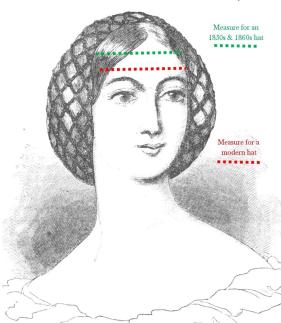
measure

These higher, hairline measurements are often smaller than those taken at the eyebrow. A hat worn at this point can be slightly smaller to slightly larger for comfort. So, add and subtract an inch to your hairline measure.

For example: I am 22.5″ around at my eyebrows and 21.5″ at my hairline. The vast land of the internet tells me that the average woman’s head measures 22.5″ to 22 5/8″ around at the modern measuring point. So, I am about average.  I comfortably wear a mid-nineteenth century hat that is 19.5″ to 21.5″

General guidelines I use:

  • Small = Less than 21″ at the hairline (crown less than 20″)
  • Average = 21″-22.5″ at the hairline (crown 20-21.5″)
  • Large = Greater than 22.5″ at the hairline (crown greater than 22″)

Just like every head measures a bit differently, they are each shaped a bit differently.
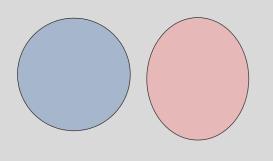
 

round oval

When looking from above, some people have rounder heads while other have more oval heads. Both of these shapes to the right can have a circumference of 22.5″. Yet, the same hat would fit each head differently.

I will try to indicate which hats have rounder crowns or more oval crowns. I am in the process of naming the crowns. Hopefully, that will help.

Published in: on April 5, 2017 at 6:00 am  Leave a Comment  

Today’s Millinery 

A fashionable Civil War era hat with a shallow,flat crown and shaped brim. 

This is blocked on the “Delia” crown and will nicely fit an average head (21″-22.5″ around at the hairline.) Crown is 20.5″ around and 1.75″ deep. The brim is 11.5″ in diameter 

Find it in my Etsy shop. 

Finishing ideas 

http://www.metmuseum.org/art/collection/search/98117?rpp=20&pg=8&ao=on&ft=hat&deptids=8&when=A.D.+1800-1900&pos=160

http://www.metmuseum.org/art/collection/search/113110?pos=398&rpp=20&pg=20&ft=*&deptids=62%7C8&what=Hats

Published in: on April 3, 2017 at 5:09 pm  Leave a Comment  

Because Sometimes We Have Absolutely Insane Ideas We Need to be Talked Out of…

Published in: on March 30, 2017 at 4:19 pm  Comments (2)