PEC, Holiday Season, and Winter Millinery

I first became aware of PEC (Post Event Crash) after the 135th Gettysburg event. The day after returning from the event, I found myself sitting on the floor utterly exhausted and at a complete loss for what I needed to do next. The months of planning and preparing built up to a nearly week-long event experience – sights, sounds, people, ideas, followed by a massive adrenaline drop.

Years later, I still feel this “Post Event Crash” after some events. The tiredness is still there, maybe more so with age. The daze is still there, though changed as it has an added sense of accomplishment. “Events” are no longer about just going. Each has some aspect of personal challenge, whether it is skill based, presentation based, or physically for myself. A new aspect of PEC has developed over the years; a combination of contentment and self-separation. The contentment is a calm awareness of balance and self. The self-separation is packing an essential part of myself away in a little box until the next event.

Another aspect of PEC is the “what is next?” Back in my early 20s, the answer to that was “the next event”, which was usually just a week or two away. It was wash, repair, prep, repack. Now, with fewer and rather different events, there is a much greater shift in the doings for the next.

This current shift is from summer straw millinery and fun Ag Fair sample pieces to winter wear and holiday shop pieces. (The catch being I still have some straw pieces to make)

Usually, I prefer to have one type of project going at a time. This is a matter of space and materials management. Straw in straw time. Wool in wool time. Silks in silk time. Nice. Neat. Orderly. When Straw and wool and silks and all the little bits are out on the work surface at the same time chaos ensues.

Thank goodness for pretty stackable band boxes.

One for pincushions. One for penwipers. One for ribbons…..

Holiday Season

It may seem early to most, but, today begins what I am calling my “Holiday Season” to prepare for a trio of: the Domestic Skills Symposium with my straw surgery workshop, “Preparing for the Holidays” also at GCVM, and filling my Etsy shop with gift goodies.

I picked up the cutest stocking shaped needle-book to take a pattern from and make into this season’s holiday project for you. I will put together directions to make it up as the needle-book but also as a pin-keep and ornament.

I plan to “open” the Etsy Holiday Shop right after the Domestic Skills Symposium, just like I did last year. I currently plan to make pin cushions, pin-keeps, and some special gift sets.

By request, I will make a point to have straw millinery available. In past years, I’ve had husbands and boyfriends send messages in mid-December asking about straw hats and bonnets to give as gifts. Please let your loved ones know well in advance if there is a piece you want.

I have also been asked to offer some of my pen wipers. While initially I had planned just to make these for fun, it turns out they are a bit too much fun to make. So, I will offer a few.  I won’t be able to offer the parasol pen wipers or needle-keeps until I find or make new handles.

Oh! Ornaments! Do people want an ornament this year?

Winter Millinery

I have had a great many questions about winter millinery in the past few weeks. I figure I should talk about that for a little while.

I still haven’t completely decided whether to make winter hoods this season or how to pull that off. I find it very difficult to work with both types of millinery at the same time. This is a space issue, a mind-set issue, and a type of sewing issue. To make winter hoods, I need to have cutting and basting space to work with the layers. This is the space currently occupied by the big big basket of straw and assorted trims that currently have my attention. The sewing is different – Straw takes long, strong stitches with a heavy, sharp needle that I hold one way. Quilting silk needs small, even stitches with a fine, sharp needle that I hold a different way. One I can do while watching tv in varied light. One needs to be watched while listening in bright light.

That said, I do have a beautiful array of silks in a tote marked “silks for hoods’ and another tote filled with local wool batting for hoods.

I also hear those wanting a third winter hood pattern. I have picked out which one I want to do next. I just have to do it.


Published in: on October 7, 2019 at 6:30 am  Leave a Comment  

Ag Fair – Brought to You by the Letter “P”

This year, I decided to set myself a little rule for my Agricultural Society Fair entries:

All entries must begin with the letter “P”.

The idea was to make myself focus. Instead of a vast endless array of possibilities, I would make myself focus on just those entries that began with P and fit into the entry categories.

  • Pocket
  • Parasol
  • Petticoat
  • Pellise
  • Purse
  • Paltot
  • Pink
  • Pinking
  • Purple
  • Pocketbook
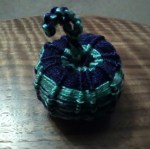
  • Pumpkin

Before I knew it, focusing on “P” entries became a mental game of finding all the things that could begin with “P” and how many things could I make that began with “P”.

Kinda counter-productive.

But, Fun!

Friday afternoon I dropped off the “P” entries of:

  • Pieced Pocket (Pieced article of clothing) (DM-2A)
  • Appliqued Pocket (Appliqued article of clothing) (DM-4A)
  • Quilted Pocket (Hand-quilted article of clothing) (DM-6A)
  • Embroidered Pocket (Embroidery: Embellished Article of Clothing) (DM-35)
  • Pieced Pocket of Pockets (Pieced household article) (DM-1A)
  • Quilted Pocketbook (Hand-quilted household article) (DM-5A)
  • Corded Petticoat (doll) (Handsewn article of clothing – corded) (DM-17A)
  • Petticoat (doll) (Handsewn article of clothing) (DM-18A)
  • Penwipes: Doll, Parasol, and a trio (Handsewn household articles) (DM-19) (5)
  • Doll Pincushion with Parasol Pin Keep (Handsewn Fancy articles) (DM-19)
  • Pink and Purple Corded Pinball (Display of Domestic Manufacture (DM-37A) (which I forgot at home.)

There were a number of P items on my entry form I aspired to make when I sent it in a month previous, but I simply ran out of time to make….

  • A Pink Plaid Pinked Parasol (Display of Domestic Manufacture)
  • Purse (Crochet household goods) (DM-11)
  • Pocketbook (Appliqued household article) (DM-3A)
  • Embroidered Pocket of Pockets (Embroidery – Embellished household article) (DM-34)

Photo gallery entries:

For more information on each project, please visit these posts. Some are on If I Had My Own Blue Box and some are on Don’t Paint the Cat (links are fixed now):

Published in: on October 5, 2019 at 12:01 pm  Comments (2)  

Parasol Pen Wiper

20190930_133204.jpg

I’ve been wanting to make a parasol pen wiper for quite a while now. Between the few originals (far below) and the directions in Godey’s (below), they have been a temptation because of their whimsical fancy while being utterly practical.

The directions call for a “fancy stick” or a wire wrapped in silk. At this point, I can not tell you why I went on my search for broken crochet hooks, but I did. I spent months thinking broken crochet hooks would be easy to find. Nope. Not even with excellent merchants of miscellaneous sewing items just a click away on social media. Eventually and with effort, I acquired 4 and began sanding the broken end to as much of a point as I could. I do have other ideas for “fancy sticks” in mind for future parasols, either pen-wiper or pin-keep.

The parasol top is densely fulled wool. Initially, I thought quarter circles would be about right. Nope. The illustrations are closer to 45 degrees or an eighth of a circle. Mine are closer to a sixth of a circle, making a fuller top.

I opted to bead the wool rather than embroider it because I like the look of the beaded wool on the originals better. I did the beading after the assembly was complete. This was a little tricky. I don’t know that I would advise that for everyone. This technique did let me get the alternating purple and green beading right.

Originals

Published in: on October 5, 2019 at 12:00 pm  Leave a Comment  

Child’s Corded Winter Hood

I have decided to share select pieces from my winter hood/bonnet collection. Every few days, I will post a new piece. My collection currently spans most of the 19th century, though lightly at the very beginning and end. The pieces I share will be from the early and mid-Victorian eras, roughly 1830s through the 1870s. All but one of my pieces originate from the United States.

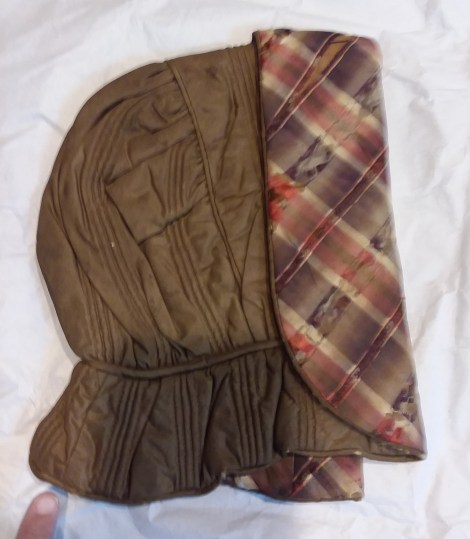
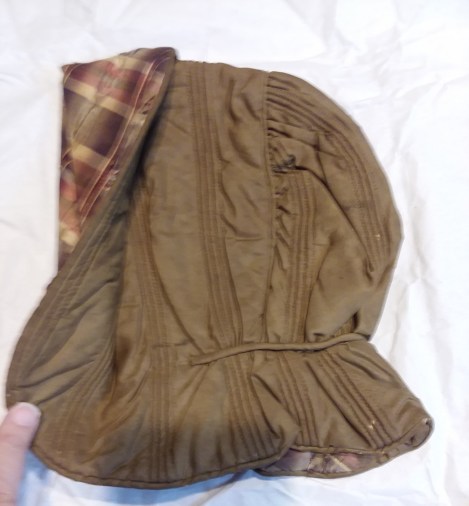
Today’s winter hood is a child’s size, ca 1840s-1880s. The exterior is a solid brown wool. The exterior is quilted with sets of three narrow rows. These narrow channels may have cording in them, tbd. The seam between the crown and brim is piped. The seam connecting the crown and bavolet may have the cord applied on top. I need to look closer. The brim folds back to show a plaid which is constructed from ribbon.

This may also be made from two pieces – a single brim and bavolet, with a crown piece. I need to look closer to see if I can find a seam connecting the bavolet to the brim, because I did not see one at first looks.

Notice there is no easily visable seam along the bavolet area. It may be skillfully hidden in the quilting. Or, there may not be one.

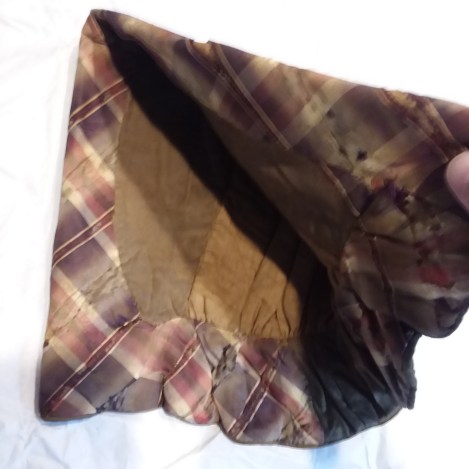
The interior is made with two solid fabrics, tbd. The whole of the brim and bavolet are lined with the pieced plaid silk ribbon.

I am pointing to the only seam along the bavolet I’ve found. This is nearly center back. (there is a bias piecing seam towards the front.)


Note 1 – Additional Winter Millinery can be found in posts from September though November, 2019 using the search term: Winter Millinery Series or clicking here.

Published in: on October 2, 2019 at 6:00 am  Leave a Comment  
Tags:

Antiques Straw Motifs

I am feeling a bit sad this evening. So, I decided to work on a pick-me-up project that had been waiting to be done.

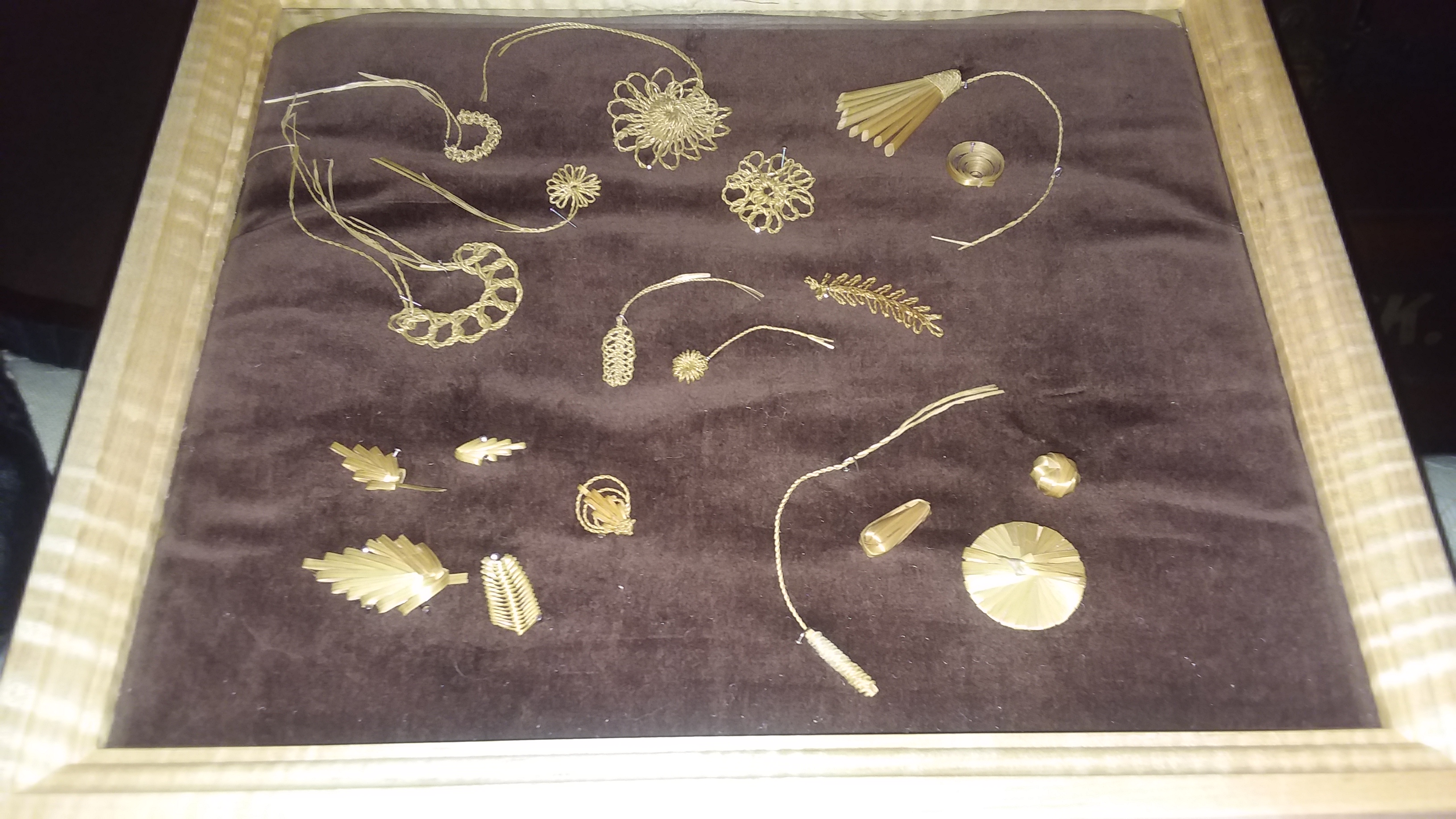
Some months ago, I got talking with an Etsy merchant in Italy who had an assortment of antique and vintage millinery goods. She told me about these antique straw motifs she had. As I’ve been aspiring to learn to make some of these for a display, I jumped at the idea of having original pieces.

I was very excited to find this beautiful case made by the same local craftsman who makes my Shake style boxes. I really like how the wood is pale with a grain that nearly matches the straw. I also like that the box has no visible hardware; the back slides out as the opening. I can hang the box, but I am afraid of it being knocked off the wall.

I pinned each straw piece in place so it wouldn’t slide around. The heads of the pins are bent to bracked the pieces as best as possible. I may label them with little letters or number. I may do a map label instead. Tbd.

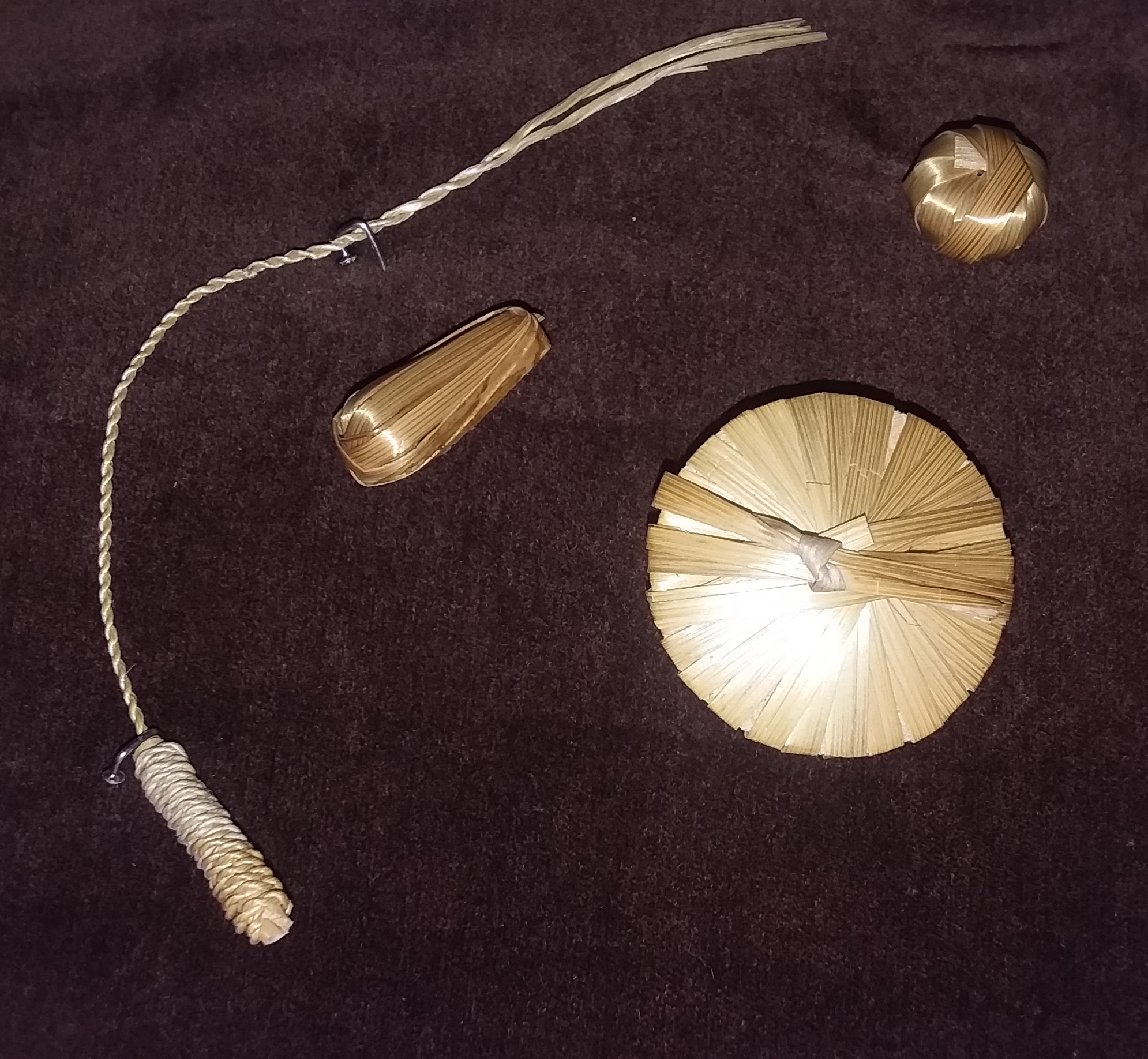
These are each leafs made with splits straw. I’ve learned to make the plain leaves. They are called Spreuerli. I am going to try the leaf with the thread loops next. The bottom right is called a Halmenschüfeli. It represents a head wheat.

These are made with straw threads. The straw is split finely and twisted into threads.

These are types of buttons. The split straw is wrapped around a core that can be wood or wool. The teardrop one is called a Grelot. I don’t know if the one made from straw threads has a name.

*Names of the straw motifs come from the old Straw Museum website on the Swiss Straw Lace page.

Published in: on October 1, 2019 at 5:52 pm  Leave a Comment  

September Reflections

Ack! Somehow it is nearly the end of September and I feel I have nothing much to say about the month.

With it being back to school, I find it all quite the exhausted blur. I can say my fabulous time, eating, and exercise routine seems to have gone out the window as I come home from work most afternoons and want to just curl up with a blankie. This certainly does not work since I some how need to fit in 3 to 4 hour of millinery, a 1 to 2 mile walk, healthy food consumption, care of the house, and personal sewing, all between the hours of 4 and 8, assuming I complete all errands in a timely manner.

Okay, enough complaining.

The vast majority of this months sewing can not be written about until next month’s posts about the Agricultural Society Fair. All I will say is there is a particularly fun assortment this year.

Millinery

For millinery, I focused on decorated pieces this month.

Coming up

I have started a blog series looking at winter hoods and bonnets from my collection. I will share about a dozen pieces over the next several weeks.

The Agricultural Society Fair at GCVM is next weekend. I will be posting about that.

In November, I will be at the Domestic Skills Symposium teaching a workshop on how to care for and repair straw millinery.

I also plan to open the Holiday section of my Etsy shop in November.

Published in: on September 29, 2019 at 12:00 pm  Leave a Comment  

Quilted Winter Bonnet

I have decided to share select pieces from my winter hood/bonnet collection. Every few days, I will post a new piece. My collection currently spans most of the 19th century, though lightly at the very beginning and end. The pieces I share will be from the early and mid-Victorian eras, roughly 1830s through the 1870s. All but one of my pieces originate from the United States.

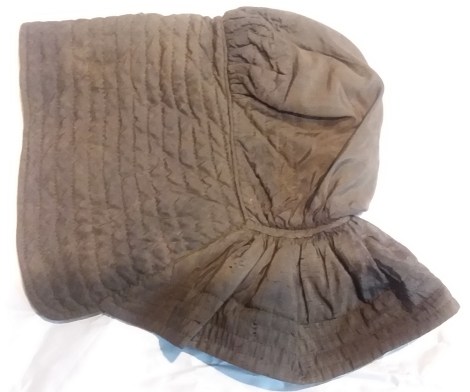
This adult size winter bonnet is a quilted piece, ca. 1840s-1870s. The exterior is a brown silk which has some staining. The interior is a cotton in a slightly lighter shade of brown on the brim and bavolet, while the crown has a darker polished cotton. The batting is not visible at any point, leaving it undetermined, likely a wool.

The bonnet is constructed of three main pieces, typical of many winter hoods of this era. These pieces include the crown, brim, and bavolet. The brim was cut on the bias, while the bavolet was cut on the grain. The shape and construction could classify this as a winter bonnet rather than a hood.

The quilting is is by hand with a running stitch. The front most edge around the brim having a narrower and slightly thicker section. The quilted rows appear to be done by eye rather than being fully traced out. This can be seen in the cheek area (below) as the rows curve and narrow imperfectly.

There is evidence that this piece was either made from fabric taken from a previous garment or the quilting was redone. In this photo you can faintly see the holes from former threads.

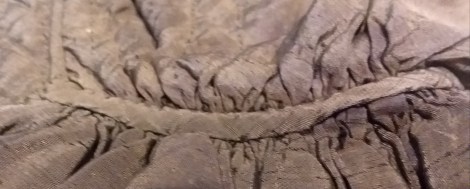
The gathered seam along top of the bavolet where it meets the crown.

The interior seams are treated in multiple ways. The neck edge where the bavolet is gathered to a gathered crown, the seam is covered with a darker fabric. This may or may not have been a later addition/change. Often this neckline has a channel for drawstring to assist with fit. The seam where the bavolet meets the brim is turned under. The seam where the brim and crown meet was trimmed and overcast


Note 1 – Additional Winter Millinery can be found in posts from September though November, 2019 using the search term: Winter Millinery Series or clicking here.

Published in: on September 25, 2019 at 6:00 pm  Leave a Comment  
Tags:

Winter Hood Patterns

As the earth’s orbit moves us into Autumn, many of us are looking ahead to fall and winter events. These some times chilly, some times down right cold events often call for warm head wear.

I currently offer two winter hood and bonnet patterns. Hopefully another is on its way… once I decide which from my collection to offer.

quilted-winter-hood-pattern-2016-cover-image

First is a long hood based on originals in my collection, one made up with silk on the outside and one made up with wool on the outside. Both are in the same green with pink color ways.

This hood is great for light warmth, while blocking wind and rain or snow. My first time wearing the sample, I found myself caught in quite the driving rain/sleet storm. My head was perfectly cozy while my face was protected as I walked through the village.

il_570xn-281752989

Next is my first winter bonnet pattern. This makes up with more structure, making it fit more like a bonnet than a hood, a snuggly warm bonnet. The original it is based on was made up with a silk exterior with silk ruche trim. Filled with warm wool batting, this winter bonnet will keep your head warm at the coldest of events. It is great for Yuletide events as well as working in the sugar camp.

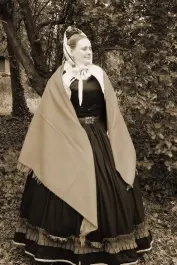
Since we are talking about being ready for colder weather, don’t forget your shawl. You can read up on mid-nineteenth century shawls in Paisley, Plaid, & Purled.

Will I be making winter hoods and bonnets this season?

I haven’t yet decided. I have plenty of silk and wool batting as well as dozens of originals to copy…. I just have to be in the mood. So… Maybe.

Published in: on September 23, 2019 at 5:15 pm  Leave a Comment  

Corded Pin Ball

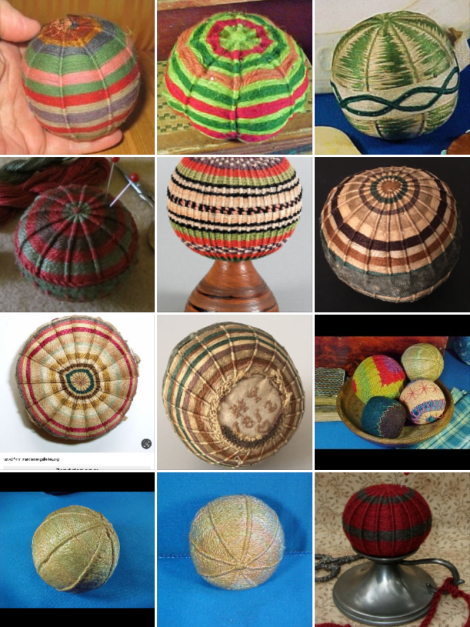
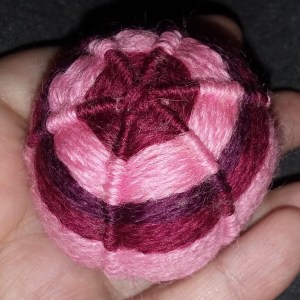
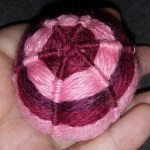
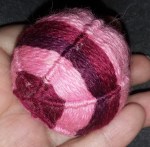
Every so often, I come across one of these ball shaped pin cushions I have come to call Corded Pin Balls. I find them fun and playful between the layers of colors and intertwining of threads.

Years ago, I made a few of these corded pin balls weaving the threads over a sewn canvas ball. This was based on original directions from An American Girls Book (below.) I found the process to be imperfect, as the ball wasn’t as firm as I wanted.

For many weeks now, I’ve been toying with another approach, working right over a tightly wound ball of wool.

This weekend, having caught the funky virus going around school, I am not really up to the tiny stitches for another [on a deadline] project, but, of course, I can’t manage actually resting. Instead, I found myself giving this method a try. I am glad I did because I find it has a very nice rhythm to it.

The steps:

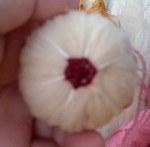
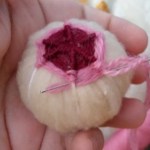
Wind a tight ball of wool about the size of a small clementine. Roll it firmly so the end doesn’t come loose. Using a long sharp, yet strong needle, run crochet cotton through the center creating even partitions. (This is the one challenging part. You may find pliers are needed to pull the needle through the center.) With wool, silk, or cotton*, start at one end weaving around the crochet cotton as you would a Gods-eye as a child. Be sure to keep the threads snug up on the cord, but not so tight as to pull them. Work about a third of the way down. Then repeat on the other side. Do your best to even up the sides s along the cords so the center is even all the way around. Finish weaving the center.

*There isn’t a large enough pool of examples to determine what was the most common fiber for the color threads at different points in time. So far, from the couple dozen I’ve seen, wool, silk, and cotton were used during what may be a 100 year span from the early 19th century through the early 20th century.

A Corded Pincushion

Cut out two round pieces of linen. Sew them together, and stuff them with bran, so as to form a round ball. Begin on the very center of each side, and with a large needle lay coarse thread or cotton all across down to the middle of the pincushion where the binding is to come. These threads must spread out from the centre in every direction like rays; the space between them widening of course as it descends. Make them very even, and do not allow them to be loose or slack. Then take a needle threaded with sewing silk or fine crewel, and, beginning at the centre from which all the coarse cotton threads diverge, (they may be called cords) work the pincushion all round by passing the needle twice under each cord, taking the stitches very close, even, and regular, and completely covering with the sewing silk both the cords and the space between them. The stitches, of course, become gradually longer as you go down towards the seam that divides the two sides of the pincushion. Supposing that you begin with pink silk, you may, after a few rounds, take another colour, for instance green, then yellow, then blue, and then brown. In this manner your pincushion will be handsomely striped, and the cords will give it a very pretty appearance, if evenly laid and well0covered. When both sides are finished, cover the seam with a binding of dark-coloured ribbon, and put on a strin and bow of the same. Always begin and fasten off in a place that is afterwards to be worked over. (The American Girl’s Book, 1831)

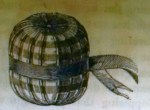
Example at the Manchester Art Galleries.

Published in: on September 21, 2019 at 3:13 pm  Leave a Comment  

August Reflections

I am going to call my August a pop-up month. It has been filled with pop-up thunderstorms complete with wind and hail. It has also been filled with pop-up miscellaneous projects.

One night I made a new seam ripper with a mother of pearl handle because I think my first one plunged into the depths of the trash can. Since I had to dig into the jewelry stuff for the glue, I made a couple pairs of earrings. Not my skill set, but functional.

I had another spur of the moment doll purchase. Duchess arrived and Clara instantly claimed her.

In preparation for the Literary Weekend, I went on a Regency turban hunt because I realized I didn’t have a straw Regency bonnet anymore and didn’t have time to make on.

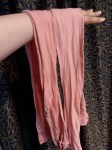
The maroon scarf above caused a little mischief when I accidentally dyed a load of laundry pink. I was quite pleased with my newly pink silk stockings.

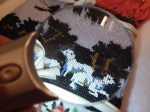
I spent a day in the collections staring at the tinest beads. I discovered I could take photos through a magnifying glass.

Fiddlers’ Fair Pin Holders

I also worked on some projects for the coming Agricultural Society Fair. But, you can’t see those yet.

Millinery

This was another busy millinery month. I made 13 or 14 straw millinery pieces, several of them decorated.

Published in: on August 30, 2019 at 11:02 pm  Comments (3)