A few years ago we looked at how some original women wore their bonnets perched on the backs of their heads as well as how we can also do so. If you missed it, the post was called Got Perch?
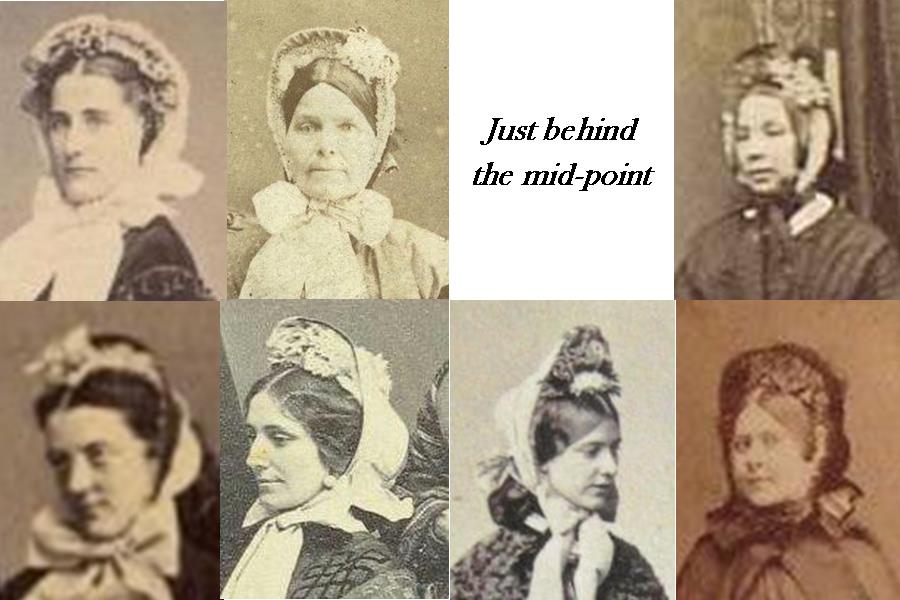
This was only one of several ways women wore their bonnets. Today, I would like to look further at how mid-century women wore their bonnets. Let us start with more examples of the bonnet being worn behind the mid-point of the head.
You will notice some variation in how far back the bonnet is worn. The two women on the lower left appear to have their bonnet furthest back among the group. These two also happen to have their bonnets angled more than the others. From the views/positions we have, the third woman from the left on the bottom row appears to have a nearly vertical position to the brim and tip. We can not say for certain with the other women; though I suspect the top left may also be nearly vertical. We can also see that most of these women have their flowers reaching further forward than the brim edge of the bonnet. The position of these flowers may help hold the bonnet in place. In the lower right, the flowers can be seen cupping the top of her head. Take a particularly close look at the woman on the lower left. There is a piece photographing white sitting below the flowers/decoration. This may or may not be a stay.
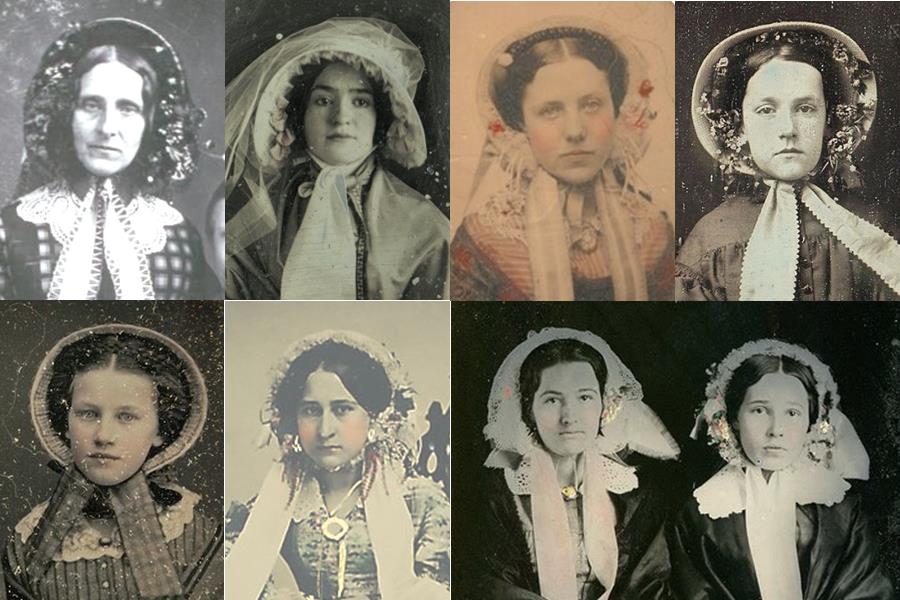
This next group of women are wearing their bonnets at or just forward of their mid-point.
We see greater variety in the angle of which these bonnets are worn, seeing them worn nearly vertical, angled slightly forward and angled slightly backward. The bottom right and bottom left images show the further forward reach of the spoon bonnet while displaying noticeable difference in the depth, angle and shaping of the crown and tip. In the top left and top right images, we can see how the frill aids in holding the bonnet on. Again, the flowers are aiding in securing the bonnet to the head. In the bottom row, third from the left, you can see the woman’s flowers reaching down over the hair line. (The lower right image could be considered as wearing her bonnet quite forward.)
In this next group, we see the bonnet worn quite forward of the mid-point.
Many will notice these women each look more mature. I do not know if this is a coincidence or if there is truly a connection between age and mode yet. I will look further into this. While these bonnets are worn further forward and a couple are rounder, the fashionable spoon shape is present. The bonnet with the daisies, second on the bottom row, demonstrates well how the flowers can hug the top of the head. In several cases, the flowers sit forward enough to reach to or even beyond the hair line. If there is a connection between age and this mode of wearing, there could be further speculation that this positioning of flowers could conceal a thinning part.
The following group was collected as I was looking at untied or partially tied bonnets. These are late 1840s through early 1850s examples. Each either has the ribbons simply looped over each other without a bow or completely untied. Many, if not most, of the women above would have worn their bonnets in this style ten to twenty years previous.
As we become more aware that there were many types of headwear in the mid nineteenth century, we have to ask “what did women wear in different situations?”
This post will focus on the 1850s through about 1865 with further focus on situations most commonly interpreted. At this time, the most common options for headwear included:
A fashion bonnet (silk, sheer, straw)
A fashion hat (of which there were a variety)
A sunbonnet (slat or corded)
A fashion cap (evening and formal wear)
A “house” cap
Nothing
Specialty headwear (riding hats, swimming hat, etc.)
When deciding which piece of headwear is appropriate, we must look at what the women of the era did. This can be through visual references such as situational photographs, paintings, and illustrations, as well as textual references, bith fiction and non-fiction. These resources will help us understand the tendencies for one (or more) types of headwear for a particular situation over others, and the factors that contributed to those choices. In my ongoing research, I find there is a two key factors influencing/determining headwear choice:
Personal or Public Space (Location)
Fashionableness of the Woman
First and foremost, in my opinion, is Personal vs Public Space as this will determine the question of headwear or no headwear in most instances. If you are in a personal space such as your home or your place of business, you do not need to wear anything on your head. Let me repeat that: You do not need to wear anything on your head.
If you are confused and thinking “but I was told I must always have something on my head”, let me assure you that by the 1850s and into the 1860s visual evidence shows that the vast majority of women did not wear anything on their head when at home, sans hairdressing items such as pins and a net. A simple or decorative cap may be seen on some older women or those who simply choose to, but these women are in the minority. Reenacting/interpreting women may have other reasons for choosing to wear a cap. This could include the need to conceal modern hair styles, be it cut or color, a lack of confidence in their ability to dress their hair, or to protect their head.
The next factor, Fashionableness of the Woman, is the greatest for determining which type of headwear is worn. It simply comes down to: the more fashionable a woman is, the more types of headwear she is likely to own. The less fashionable a woman is, the fewer types of headwear she will own. A less fashionable woman of modest means may have an everyday bonnet and a nice bonnet, both sensible yet flattering to suit her. A more fashionable woman may have more pieces of millinery reflecting current styles, as her income allows. Of course family income and societal expectations play their parts. A fashionable woman may or may not have the finances to purchase all the current, fashionable styles she wishes. In this case, she may need to get creative in her restyling or selecting. Vice-versa, a woman of comfortable means may not be as fashionable, of more modest fashion desires. She may have only as many millinery pieces as expected of her societal station.
Now, let’s look at some common situations. (I will add additional images as I assemble them.)
At Home – Sewing, Reading, Receiving Company, Etc.
Your home is your private space. Here, you do not have to wear anything on your head. You may simply dress your hair with or without a plain net**. No cap, bonnet, or hat should be worn at this time.
If someone comes to visit or make a call, you do not need to put anything on your head. Your visitor would leave their headwear in place for the duration of a short visit. If the visit were longer and/or more involved, for example working of comforts or taking a meal, their bonnet or hat could be removed.
At Home – Cleaning and such inside
As with the above situation, your home is your personal space, you do not need to wear any headwear.
If your activity is a particularly dirty one, including a lot of dust or dirt or such, you may choose to protect your hair with a cap or kerchief. If you choose a cap, choose one that may be cleaned easily. If choosing a kerchief be sure to learn the appropriate ways to tie it.
At Home – Outside – collecting eggs, gardening, etc.
The spaces around your home are also your personal space. This can include your yard, gardens, orchard, etc.. As such, these personal spaces do not require headwear. Selecting to wear something on your head is a choice. Of course, from a modern perspective we know it is advisable to protect the head, face, eyes, and neck from the sun.
The most common protective headwear garment women had was the sunbonnet. The vast majority of women (dare I say nearly all) owned either a slat or corded sunbonnet. This is the go-to choice for protective wear.
I am often asked whether a woman would have worn a plain straw hat instead. While I can not say absolutely not, I am also hesitant to say yes. The type of hat (domed, oval crown with a wider, shapeless brim) many modern women are picturing didn’t actually exist. The fashion hats for women were rather small in the 1860s. These were not good for sun protection. The fashion hats of the 1850s were much larger, but they were also very fashionable and not likely owned extensively. Men’s hats were primarily blocked in shaped styles, in men’s larger sizes. These larger sizes would slip and shift uncomfortably on the average woman’s head. Between these aspects, I just don’t think what people are picturing actually happened much.
Making a Social Call, Visiting
If you are visiting or making a social call, you have left your own personal space, you are entering someone else’s space. You would leave your home with a fashion bonnet or hat on your head. This would be selected based on your fashionablity. When you arrive at your destination, you would leave your hat or bonnet on for the duration of your stay. The exception would be if the visit was something more involved such as a meal, a sewing circle, working on comforts.
A Society Meeting
A meeting such as a benevolence society, lady’s aide, a mite society, a temperance society, etc. is a public space. As such, you would leave your bonnet or hat on. This goes for a presentation as well.
Shopping in Town
Any excursion or walk through town, be it for shopping or other pursuits, is in a public space. Headwear is expected for this situation. Depending of your fashionablity and the weather, you may select a fashion bonnet, fashion hat, or sunbonnet. Photographs of town streets show women with a wide assortment of headwear from sunbonnets to out of fashion fashion bonnets to high fashion fashion bonnets.
Church
Church is a public space where headwear is expected. Some will insist a fashion bonnet is the only exceptable option. I respectfully disagree. Photographic evidence shows women in both bonnets and hats in church. These photographs may be in more fashionable areas. At the same time, less fashionable or affluent areas could not rightly turn women away if they chose to wear a sunbonnet.
Recreational Activities- Public Gardens, Seaside, Watercure, etc..
I have previously written about hats worn in recreational situations as the fashions for each did evolve on their own. In short, most recreational activities were public, unless they took place on private property. As such, headwear was expected at the onset of the activity. This could be a fashion bonnet or hat. We do see in photographs and paintings that some women chose to remove their hat or bonnet as the activity became more relaxed.
Traveling
Traveling, of course, takes place in public and a bonnet is necessary. I will offer a few notes regarding headwear selection for travel. If Traveling by rail, it is strongly advisable to not wear a white or otherwise light color bonnet. The soot from the engine will spot the fabric. Similarly, dusty travel will soil light color bonnets. Any travel with a length of time spent in high back seats will result in resting the head back. As such, a soft crown bonnet will be far more comfortable than a structured crown. A veil aides not only in protecting the face and eyes from soot and dust, it also allows some privacy from strangers and the relaxation of the eyes.
**A note regarding hair nets:A hair net, particularly a plain net, is part of you hair dressing items, not an item of headwear. In the context of this article, a plain hair net is considered part of your hair dressing, there for “nothing” on your head.
I was just reading a post in one of the FB groups about which fabric to buy for a dress. This particular time, the poster was at a big box craft shop with the initials HL looking at plaid fabrics. As it has been a while since I wandered any of the big box craft stores, I was curious what the prices currently are.
So, I decided to look….
A nice gray plaid “homespun cotton at HL is $6.99 when not on sale. Normally, I would recommend buying 7 yards of 45” wide fabric for a basic dress, with coat sleeves and no self trim. Given the tendency of “homespun” fabric to shrink, an extra yard is advisable. This would make 8 yards for $55.92 plus tax. Not bad. You will also need a lining fabric for the bodic, hem facing, hem tape if possible, narrow cord for piping, and closures. You will want to wash and dry a couple times before cutting.
Hoping over virtually to a big box craft store with the initials JF, I also see plaid cotton called “homespun.” Here it is $8.99 a yard. With the same considerations for shrinkage, 8 yards for a basic dress, again with coat sleeves and no trim, would cost $71.92. This too should be prepared and dried a couple times before cutting.
Out of curiosity, I want to compare this the the Family Heirloom Weavers Fabrics sold by smaller merchants such at The Button Baron. Their light and medium weight cottons are similar in weight to mass produced homespun but have a more stable weave in my opinion. Their cotton fabric runs 57 inches wide pre-shrunk. After washing this shrinks to 54″ generally. This fabric is $12 a yard for the cotton. (I see now cotton/wool blends are also available.) With this wider width, a basic dress, again with coat sleeves and no self trim, can be made for $60.00.
This places the “per dress” cost of a length of Family Heirloom Weavers fabric in between the costs of lengths from common big box craft stores.
I do not intend to persuade readers in one direction or the other in their choices. I simply want you to be aware of the options available to us.
My experience withmass produced home spun:
Long ago and not so far away….. College student me picked out a plaid fabric from our local craft/fabric store. It was 100% cotton in a small, symmetrical plaid. I thought it was a decent choice. I think I may have even prewashed it, once. I was determined to hand sew an entire dress. I did, every inch inside and out. I was proud of my dress. I even put “hem tape” on it. I don’t recall whether I wore it for an event or wore it for work (then at a museum.) Either way, I wore it hard enough I needed to wash it. It shrunk. And I mean it Shrunk. Luckily, I knew enough back then to run all the fabric in the same direction. This meant the fabric mostly shrunk in length rather than width. The waist sat a good three to four finger spans above my waist while the hem rose to just below my calf. I estimate I lost a good 4 to 5 inches per yard in length. That works out to be 28 to 35 inches in the dress length.
One of my favorite blog series from over the years also happens to be one of the most under read. Maybe it is because it is just that: lots to read.
When I first came across the digitized Moore’s Rural New Yorker at the Rochester Public Library, I was was delighted to find the publication to be well rounded with sections for farmers alongside gardeners, and the whole family. As I continued to read, I was captivated by a column of letters and responses, often from an Aunt Betsey. These volleys primarily dealt with the domestic life of women, what work was like, what was best to wear while working, how to raise daughters, etc.. I was eager to share what I was reading, quite convinced others would be just as captivated.
Well, not so much according to my stats.
Here we are, some years later. I will link here the tag I had given these transcriptions:
Recently, with my focus on hats, I have been asked a several times “where can I wear that hat?”
This is an excellent question. I love that people are asking. It means they are thinking about when and where they can appropriately wear a particular hat. It also means I don’t have to worry as much about one of my hats appearing in an inappropriate scenario. (Yes, I worry about such things.)
I want to cover the background to the answer(s) rather than just the answer.
First, where do we look to find out what situations are appropriate for different types of hats? We need to look at visual references for context. This will include context based photographs (cdvs, sterioviews), illustrations and paintings. This will show us the scene, the type of hat, the wearer and the clothing it accompanies. We should also include textual references, keeping in mind the written descriptions can misinterpreted due to various reasons.
Second, we need to keep in mind the chronology and geography of references. What was common in the 50s may not have been common in the 60s. What may have been common in an urban area may not have been common in a rural area. What may have been common in New England may not have been common on the Gulf coast.
Let’s look at some images. (Just as start. I’ll try to come back and add more.)
This pair of images I recently found after completing the violet velvet hat. These women are from a family photo that I lack citation details on. The daughter is holding a croquet mallet, indicating a recreational situation. Both women are wearing straw hats with brims that curve down all the way around, providing some sun protection. The hats appear to be simply decorated with ribbon. The clothing suggests a date between 1860 and 1863/4.(the link provided does not agree, estimating the photo is just post-war.) I estimate the girl to be in her young to mid teens, the mother in her 40s.
Continuing with the recreational scenario, this shot from a Lily Martin Spencer painting depicts a picnic on the 4th of July. The hat is a larger hat. It has a wide brim that would shade the face. The crown is shallow, maybe 2″ high. It is simply decorated with a ribbon and possibly a ribbon or flower arrangement in the front, bow in the back.
This stereoview, A Charming spot for a Country Home, shows what appears to be a small town or rural garden of a comfortable family. Dated 1865, this image is from New Jersey. We can see a woman seated in the chair with her back to us, wearing what appears to be an undecorated straw hat (with little blocking in my opinion.) This hat reminds me of this description of a well worn, favorite garden hat. Near the fence is a pre-teen girl in a wide brim, low-ish crown hat with a simple bow. Hats to do seem to fairly common in photos of people in the yards or gardens (upper working class, leisure class homes.)
This next stereoview, View of grounds at Newport, is estimated to be 1860, taken in Herkimer, NY. This can also be considered a recreational image as the woman stands in a field alongside a haystack. Her hat is smaller, with a very shallow crown and brim that reaches just about the depth of her face. (meaning the brim comes about as far forward as her nose.) This is a fashionable shape for a hat that I believe would be appropriate for a walk in a village as well. Compare it to the hats to the right from June of 1850, which have significantly larger brims.
One can not mention recreation without touching on seaside. I don’t think many of us truely get to do impressions that spend time seaside. I think large, shady hats often come to mind when thinking seaside recreation. But, as we see in these late and post war paintings (English), smaller hats were worn seaside.
As a general rule of thumb, formal occasions were not appropriate for fashionable or casual hats. This includes church. This stereoview clip suggest there were some exceptions, in this case a baptism. (I’ll see if I have the whole scan saved elsewhere.)
Scenario Specific Hats (I really ought to find time to write more about):
It is 5 weeks to Opening & Mother’s Day Weekend…. Aka my first event of the season.
This means Things Must Get Done!
Normally, this is smooth sailing. But, this year I feel about a month behind. Between school/work and life and weather and a germy 5 day sleep, I am definitely feeling behind.
Here is the list:
4 fully decorated millinery pieces. (12-16 hours)
The kerchief doll needs a body and a name. I also need to order a second kerchief. Then I need to drape her bodice and plan out cutting the kerchief. (?5 hours?)
I need to finish my wool dress, which means I need to start my wool dress. (?12 hours)
Prep “Tools of the Trade” for the second event of the season later in May. (no idea)
I must get some pieces made for the shop. This is an absolute budget must. (10×10 hours)
A new collaborative project with a local friend that isn’t technically 19th century, though it is 19th century inspired and on the same time line of to-do. (5ish hours)
A certain feline must have known I need to get a move on. She woke me up far earlier than I wanted to wake up. Since then, I have fed her (the feline priority) and cut & pressed 4 linings, 4 bavolet nets, 4 facings, and 4 frills. That stack of bonnets is ready to get dressed.
Is it super weird that I’ve been keeping the extra hat/bonnet stands in the car because I ran out of room? I only have the antique ones plus one pink inside.
I think I am going to work on this black bonnet to the point where it needs to be blocked. Then on to linings. I may cut out a doll body first.
In like a lion, out like a lamb? Well, maybe. That is if in with a roar of plans and out with a sigh counts. While I planned for the month to be packed full of Mousquetaire hat, miniature millinery, and some other goodies, much of the month was full of math.
I managed to get about half the March millinery done that I had in mind.
I enjoyed participating in the “History in Her Hands” challange by sharing an original item in my collection (nearly) each day of the month. I fizzled put at the end of the month when I caught a germ and basically slept for four and a half days.
Looking ahead, April will be a dash to finish a several pieces and get them to their homes. Then it is one to events in May.
On this 30th day of #historyinherhands , I offer this thought. When I first brought strawberry emeries make, I did not expect the stong connection visitors had with the strawberries. They shared their stories, their memories, of these fabric fruits, each filled with a tone of comfort.
This leaves the question: How to develop connection with discomfort.
For this 29th day of #historyinherhands , I offer this heart pin cushion in purple silk. This useful heart is made from a pair of triangles under the guidance of the children’s book An American Girl’s Book, by Eliza Leslie. Like many young girl’s projects, pin cushions such as these could be made of materials from the scrap bag and embellished to show the maker’s skill.