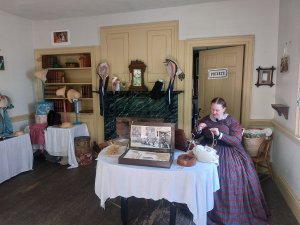
For the first time in years, I took a personal day for personal enjoyment. This allowed me to go to the museum Friday morning to set up the millinery shop prior to opening. It also meant, I was their as students arrived for their field trips. I miss field trip days. These kids and teachers did too. It was nice to see such happy and excited faces bouncing around the village.
Saturday morning was a surprise turn for me. When I checked the weather app Friday morning, it said 10% chance of rain. Saturday morning, it said 90%. I grabbed my umbrella. I should have opted for a not sheer dress or grabbed my coat. It pretty much rained all day.
Saturday morning video….
One of my favorite questions of the weekend came from a young visitor. They asked about what to do if the straw mildews or gets moldy. What a great question, especially on a rainy day. Mold and mildew are a threat to straw. If a straw hat or bonnet gets wet and does not dry fast enough, it can develop mildew or mold. As bleach will weaken or dissolve the straw, I try spraying the straw with diluted vinegar. If need be, use an old toothbrush to work the mildew or mold free.
On Sunday, a troop of Girl Scouts were my first visitors. They had many good questions while being excellent listeners. They reminded me of some of the types of programming I really miss doing.
What a difference a day makes…
I discovered there are some notable changes for me when setting up the millinery in May rather than in July. Among them….
School is still in session. This means my preparation time is completely different. I had developed a two week staging process with a samples making build up spanning about a month. Neither of those were feasible with school in session.
Food via roadside stands is not a possibility in May. Strawberries aren’t ready. Raspberries aren’t ready. Basically, stands here are starting to have plants. That is it.
Eating leading up to the event isn’t a concern for most people. Given my digestive and migraine issues, I have to be careful. In July, I graze of vegetables and fruit with some sage carbs and protein the handful of days before an event. This doesn’t work when I need to be at work, taking lunches. I’ve discovered I am freaking hungry!
The weather is completely different. Wednesday morning, I had a thick layer of ice frost on my car. It was a cold 34 degrees on the drive in. Setting up Friday morning was quite pleasant, though, being in the 50s with a breeze. If anything, I forgot to drink enough water as I worked.
Congratulations! You have a reproduction hat. It may be one of mine. It may be one made by another talented milliner. In either case, you are ready for the next step.
This post is for you. This post will cover the most common topics and questions about reproduction straw hats for the 1850s and 1860s. Some of these answers will apply to other eras as well.
My hat is too big.
Good news – this is a fairly easy adjustment. If a hat is just a bit too big, meaning it wiggles but doesn’t flop, a lining ribbon or a lining can help it fit better. A cotton sateen or petersham ribbon around the inside is generally recommended for comfort anyway. Adding a thin layer of cotton or wool batting behind the ribbon can thicken the reduction while adding soft comfort. Adding a lining to the crown or crown and brim can also improve the fit. Choose a silk taffeta, silk organza, or cotton organdy. Light gathers will bring the size in a little, while denser gathers will bring it in even more.
My hat is too small.
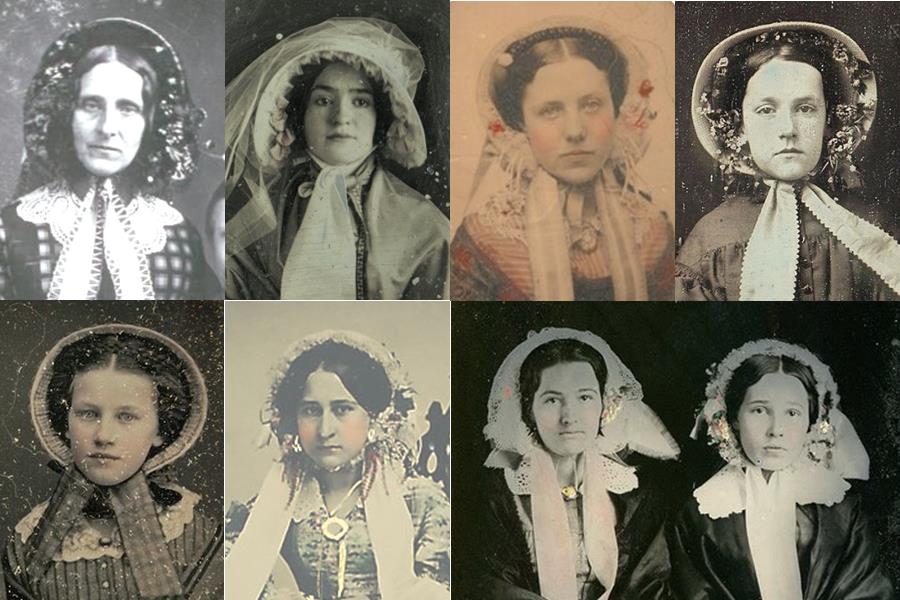
First, double check how you are wearing your hat by comparing to original images. In the modern era we tend to wear hats lower on our head, coming down onto the forehead. In the mid-19th century, hats were worn much higher on the head. This can make a hat feel too small while it is actually the right size for you.
If you find a hat is truly too small, consider passing it along. A straw hat can be stretched a small amount with the aid of a hat stretcher and mist bottle. This will likely effect the shape of the crown, possibly distorting it from its blocked period shape.
I want to decorate my hat.
This is the fun part. Be sure to spend some time looking at original images before starting. You will find period fashion illustrations show densely decorated hats while period photographs show a little more restraint. Elements most often include ribbon, flowers, and feathers either center front or to one side with the ends of ribbon to the back.
Use a strong, sharp needle and thread to tack trims in place. Use large stitches that are secure yet removable. This way you can change the trims as desired. Please do not use glues on straw. Floral arrangements can be made in whole or pieces prior to attaching to the hat. They can be tacked in place with thread or with pins.
Line the interior of the crom for added comfort. This can be done with a cotton sateen or petersham ribbon around the crown edge or a silk taffeta, silk organza, or cotton organdy lining the crown or crown and brim. The lining can be added before or after the trim. Each milliner does it differently.
My hat won’t stay on my head.
As hats of the era were worn higher on the head, they often do not feel secure. Original hats show an elastic cord or ribbon ties was placed where the brim and crown meet, approximately just above the ear area. This cord or ties would go behind the head, securing under the hair arrangement. I find quarter to half inch wide cotton sateen or cotton petersham work well for this as they tie and untie easily without getti g stuck on the hair.
Period photographs show some hats also had wide, decorative ribbons sitting over the ear area, just in front of where these ties would be. These ribbons can be fairly wide, often plaid or striped. Rosettes or bows can be seen in front of the ears.
Can I wear a hairnet with a hat?
A plain hairnet is a hair accessory, an item used in arranging or dressing the hair. As such it was worn with a variety of millinery items, including hats. Remember, these nets were light weight and fine, made of silk threads or hair. Decorative nets, such as those made of woven ribbons, are also see in illustrations worn with hats. Ribbon headdresses, such as those on a foundation with pleated or ruched ribbon may not combine well with a hat as the hat will crush the ruche or the ruche will cause the hat not to sit properly
Hat FAQ Video
This video contains several helpful pieces of information on hats:
My hat might not be right.
Sadly, sometimes merchants or other reenactors sell hats that are not considered accurate. The reality is a great deal of progress has been made in understanding the fashionable hat of the 1859s and 1860s over the past two decades. Thanks to the surge in easily accessible resources, such as period fashion illustrations, photographs, and originals, we now know more about who wore hats, when they wore them, and what those hats look like. This also means that hats produced years ago are no longer considered as correct as they once were.
If you find yourself with a hat that may not be accurate, take some time to look at period images and original hats. Look at their shape and their proportions. Then go back to your hat. Honestly decide whether the hat can be improved and if you have the time, skill, and resources to do so. For some, this can be a challenge project. For some, this can be an added frustration.
Improvements can come in the form of wiring a hat’s brim edge, removing rows of plait from the edge, or shortening the crown at the base. Each of these can feel simple or overwhelming to a person. Please keep in mind sewing straw is different from sewing fabric. It may or may not be something you are comfortable with. If the answer is “no”, pass the hat along to a local theater or use it for something else.
Are you one of the many readers enjoying my millinery blog posts? Consider becoming a Patreon patron. Doing so helps support my work and helps me write more useful articles. https://www.patreon.com/AMillinersWhimsy
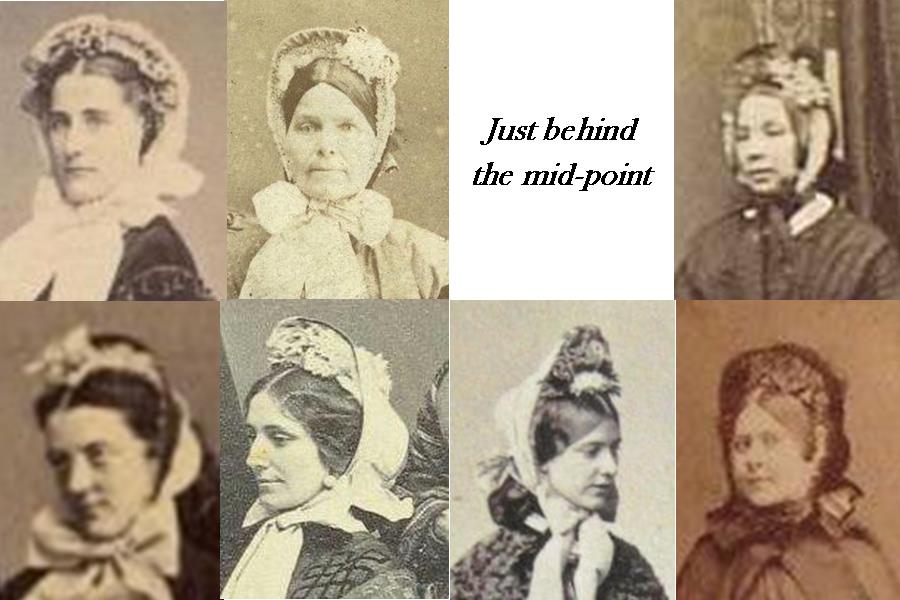
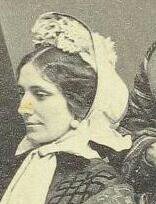
A CDV recently appeared that brought up how women wore their bonnets perched on the backs of their heads from 58ish to 63/4ish. (I want said cdv & will be bidding. Fingers crossed.) Here is a close-up:
See how the bonnet sit further back on her head? Her interior flowers land almost at her mid-line.
The question I am hearing is “how did they do that?’
There as a few aspects that help:
– A bonnet stay. This is a ribbon, strip or even wire inside the bonnet, positioned to act like a headband holding the bonnet in place. (These need to be fitted to the wearer.)
– The frill and interior decoration. The placement and fullness of these act like a catch or a band to help hold the bonnet.
– Balance. The front to back balance of the bonnet needs to put more weight in the brim and forward crown area of the bonnet rather than the back.
The placement of the hair can also be a contributing factor.
This is my first straw bonnet, years & years ago. While it has some early issues, it shows what a stay can do. These photos were taken after a parade marching into 40 mph winds that ended in a hail storm. During this walk, the force of the winds actually snapped a bone in my cage. But, the bonnet stayed put.
Here is Lily in the same bonnet. It sits further back on her. But, stays pretty well. (It finally got to retire after this.)
This next bonnet is a different shape, drawn. Instead of a stay, it holds put thanks to the frill and flowers. The frill is gathered like ruching in this one. The back edge sorta stands fluffed, holding against my hair.
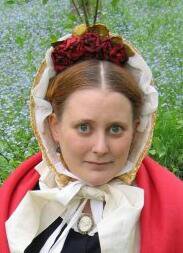
This is my bonnet from last year. (How awful is my facial expression?) I think you can see the position of this one. This stays with the work of the frill and my hair.
Here is how I often wear my hair:
Now, Lily’s bonnet from last year does need a stay as she does have some issue with I staying put. Granted, se is also showing kids how o play with games including stilts much of the time. She also has far better posture than I do. Now that I think about it more, she has less hair in the back too.
Here is a photo of both of us from last month with the same two bonnets. (different ribbon on mine) This shows the fullness of the frill pretty well.
Tomorrow, I’ll be wearing my new soft crown. It has the ruched frill but no stay. Of course, the weight will be at the top. I will likely be wearing my veil turned back over the bonnet most of the day. I will report back on how well it stays.
Betsy Connolly sent me some beautiful photos showing excellent perch. (The photos are so pretty, I’m not going to crop them.) She says some have stays, some do not. She agrees that staying put is about balance.
Here is Lisa Springstube Lindsey in a mourning bonnet with the full frill helping hold it and a Marie Stuart:
Here is Beth Chamberlain with two good examples:
If you have a good ‘perch’ photo & would like to share it, please let me know (I think if you link it in the comments, I can grab it. Otherwise, email or message me.)
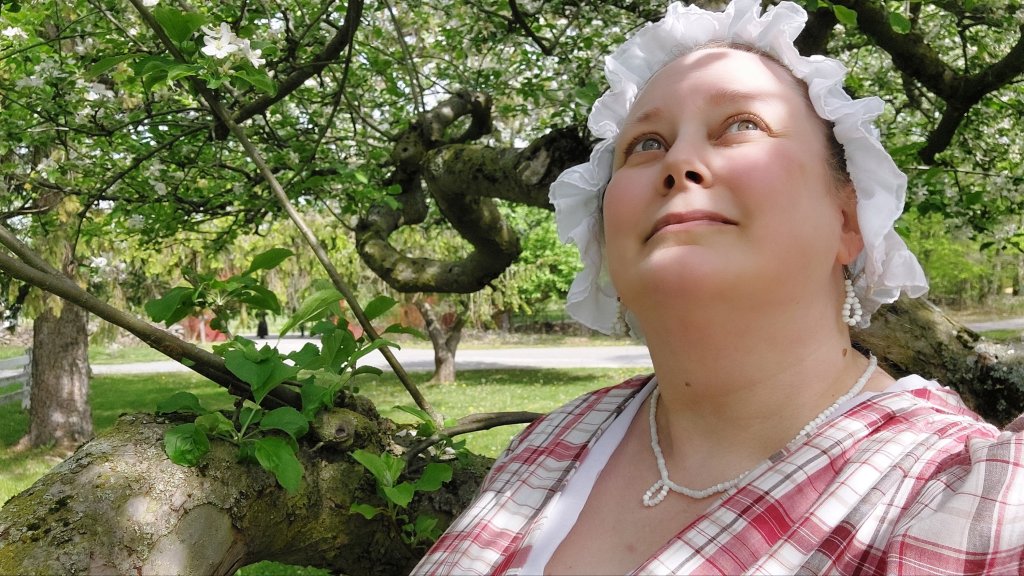
I spent today in the nineteenth century. As I walked into the historic village, I felt the tension leaving my body and soul. I had to stop for a moment to truly embrace it.
It was an absolutely perfect day to spend at the museum. (FB reel) The birds were chirping, sheep baaa-ing. Even the sound of the bees in the apple blossoms was enjoyable. (FB reel)
Today I was doing something a bit different: talking about dolls as fancy work.
When I started falling down the rabbit hole that is doll collecting, they were never supposed to be a part of my history life. After a bit, one would tag along on occasion to help accent some aspect of some of my interpretations. Then I got a phone call asking if I would talk about dolls for this weekend. Of course, I was willing.
Today’s program was in two parts. For most of the day, I chatted with visitors about dolls as fancy work in the dining room of Foster. In the afternoon, I offered a talk in the Gallery: The Little Companions of Ladies: How Childhood Playthings Became Adulthood Helpmates.
In the presentation, I explored how dolls as toys were viewed in the nineteenth century and how they were made into pin cushions, pen wipers, and other useful items.
To see more about Theo’s adventures while at the museum, hop over to Don’t Paint the Cat.
What does one do on a sunny, cool morning when a hat isn’t dry? A veil light study of course.
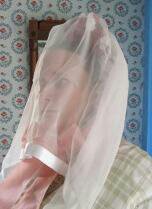
My uber scientific method includes a straw bonnet with a deep brim, a stand, camera and assorted original and reproduction veils. Put bonnet on stand. Drape bonnet with veil. Slide camera up underneath. Take photos. While this doesn’t give an exact reflection of what light control the wearer feels,it is a start.
The backyard without a veil.
Original hat veil. Fiber undetermined.
Black silk gauze, made by me
White silk gauze, made by Bevin.
Original silk net with light dots.
Silk net trimmed in lace made by me.
When I unwrapped the one antique veil, I realized I have another somewhere in the house.I don’t know where. Hopefully, I was good and put it in one of the archival boxes with the winter bonnets. When I find it, I will try to replicate the photos, but the sun will be different.
Another in would have liked to photograph through is Bevin’s green silk gauze veil.
Personal Observations
So far, I think I prefer the black silk gauze. I will have to wear both the gauze and the net a few more times to be sure. The gauze seems to soften the light more. The net seems to be a shade for the light. The white gauze softens some in low sun light. But, in bright sunlight it creates glare. The silk net has notably more body than the original, which is nearly as soft as the gauze. I was much more aware of it feel wise when I first put it on, compared to the gauze. The net was less disturbed, moved by the wind when I walked.
The photos suggest more obscuring of vision than I find to be the case when wearing them.
There are two factors for finding a comfortable fit: Size and shape.
Size
The difference in wear or placement means we measure for a mid-nineteenth century had differently than we do for a twentieth or twenty-first century hat. The modern hat is measured just above the eyebrow. (This is also where many of us measure for bonnets. We want to keep you on your toes.) For mid-nineteenth century, we measure higher, at the hair line. In this illustration, we can see the difference between where the two measurements would be.
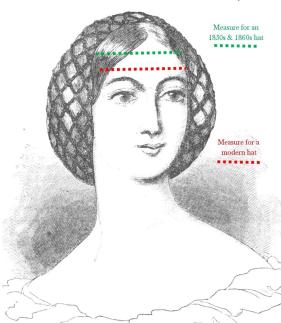
These higher, hairline measurements are often smaller than those taken at the eyebrow. A hat worn at this point can be slightly smaller to slightly larger for comfort. So, add and subtract an inch to your hairline measure.
For example: I am 22.5″ around at my eyebrows and21.5″ at my hairline. The vast land of the internet tells me that the average woman’s head measures 22.5″ to 22 5/8″ around at the modern measuring point. So, I am about average. I comfortably wear a mid-nineteenth century hat that is 19.5″ to 21.5″
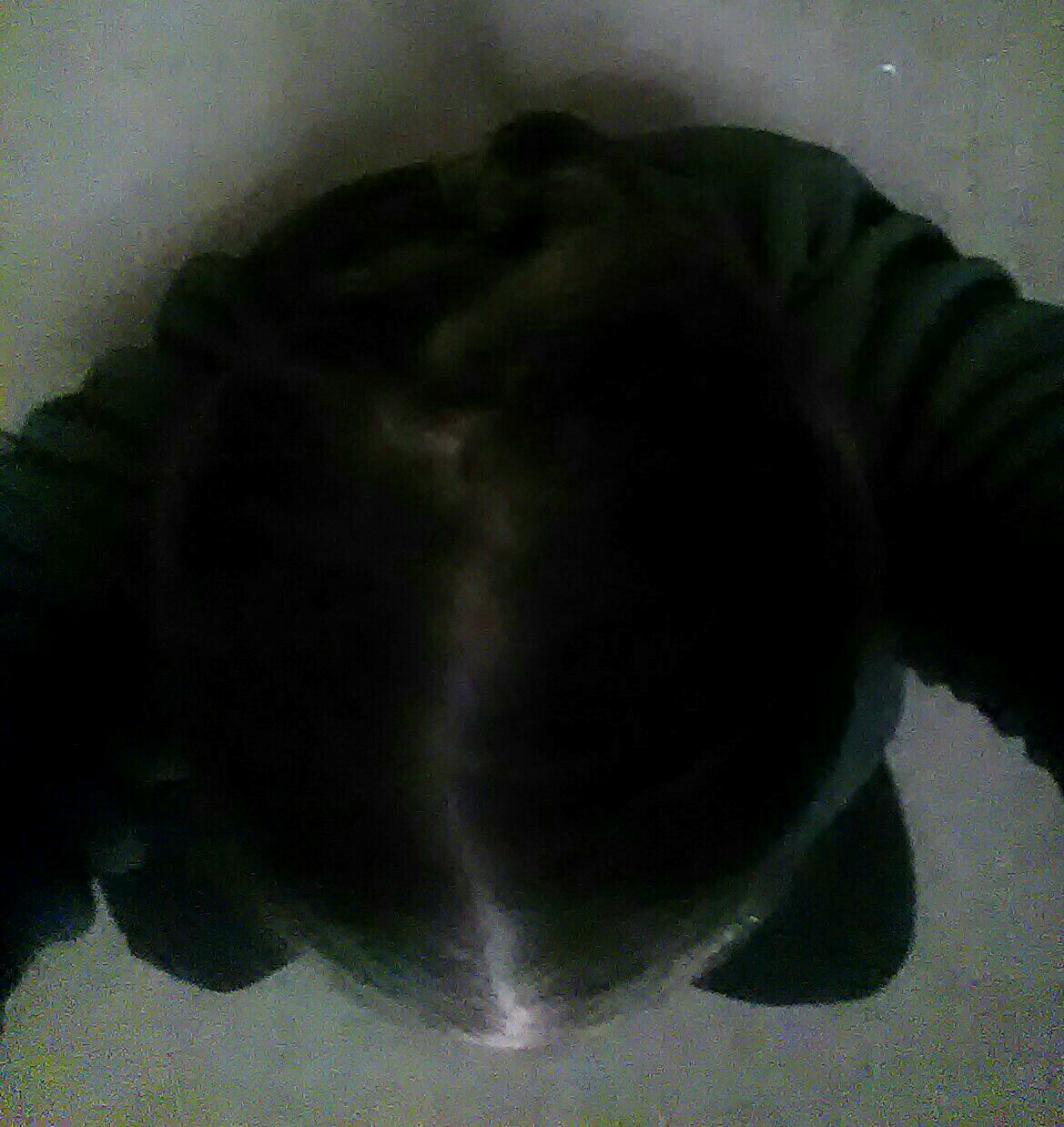
Here is my head with the tape showing where to measure. This is where I wear most CW era hats. This is the circumference of my head. My measurement is 21 1/2″. (Note: this is a full inch smaller than the modern measurement take lower.)
General guidelines I use:
Small = Less than 21″ at the hairline (crown less than 20″)
Average = 21″-22.5″ at the hairline (crown 20-21.5″)
Large = Greater than 22.5″ at the hairline (crown greater than 22″)
Shape
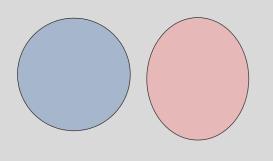
It is helpful to know whether your head is more round or more oval.When looking from above, some people have rounder heads while other have more oval heads. I have an average oval head. Very round hats don’t work for me without adding to the lining.
Hat blocks can be more round or more oval with the same circumference. To illustrate: Both of these shapes to the right can have a circumference of 22.5″. Yet, the same hat would fit each head differently.
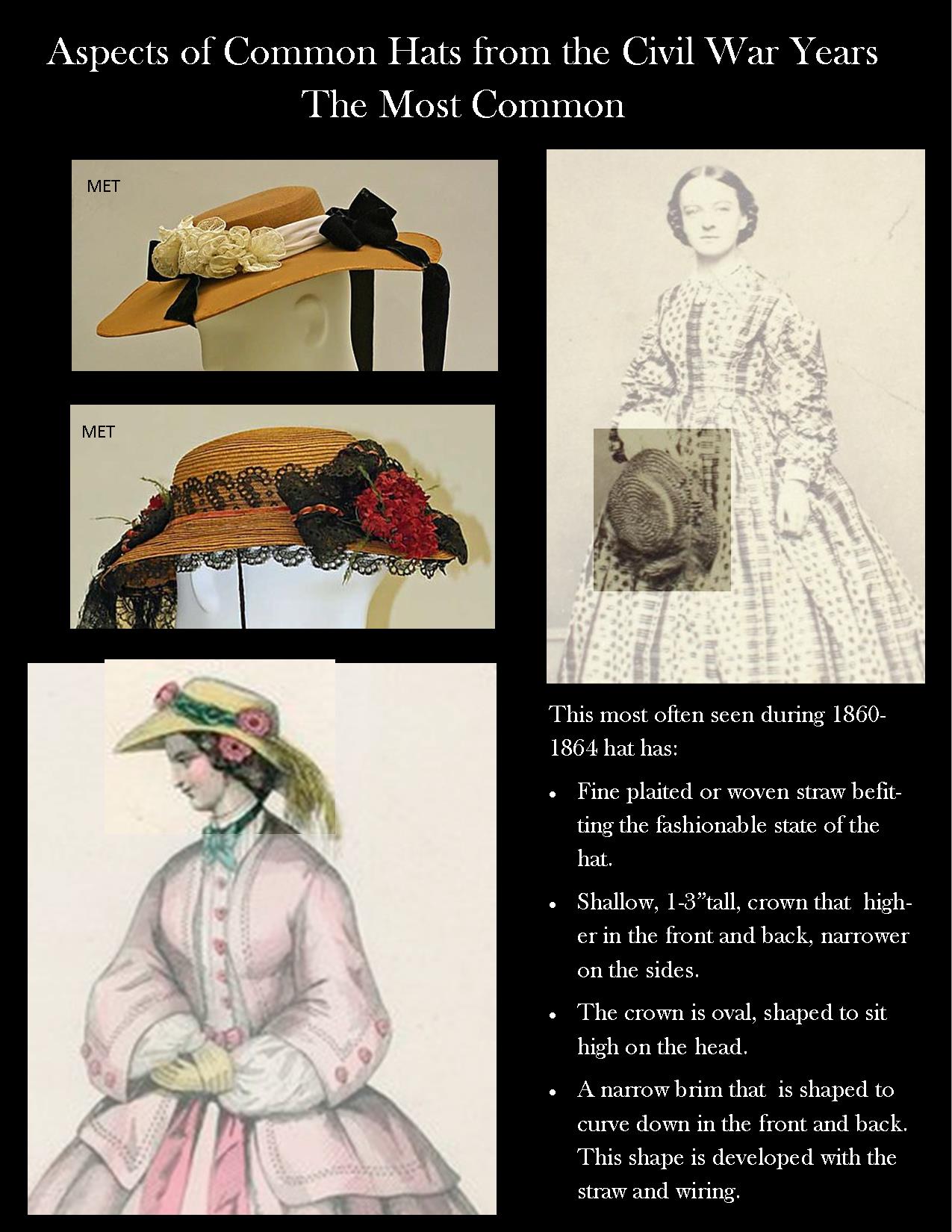
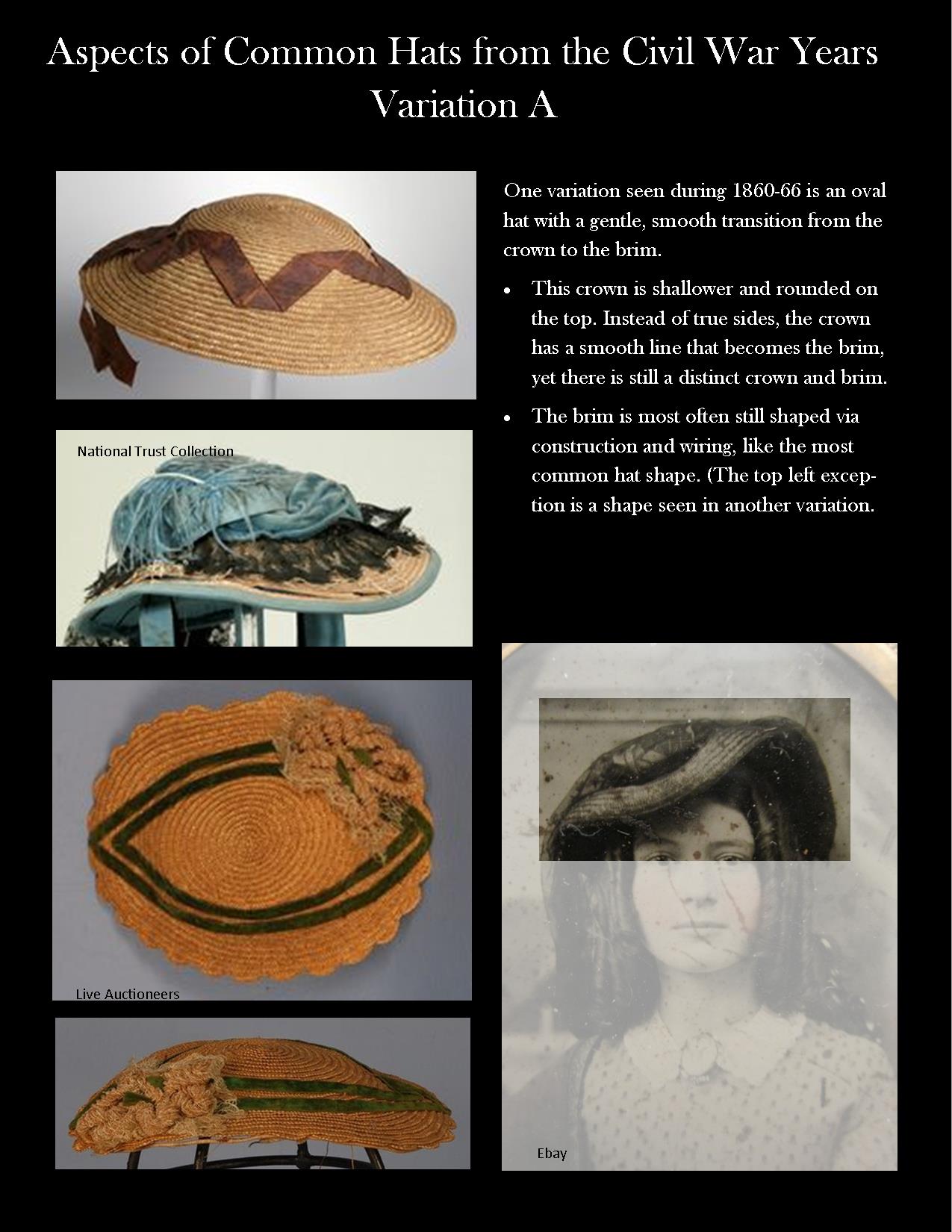
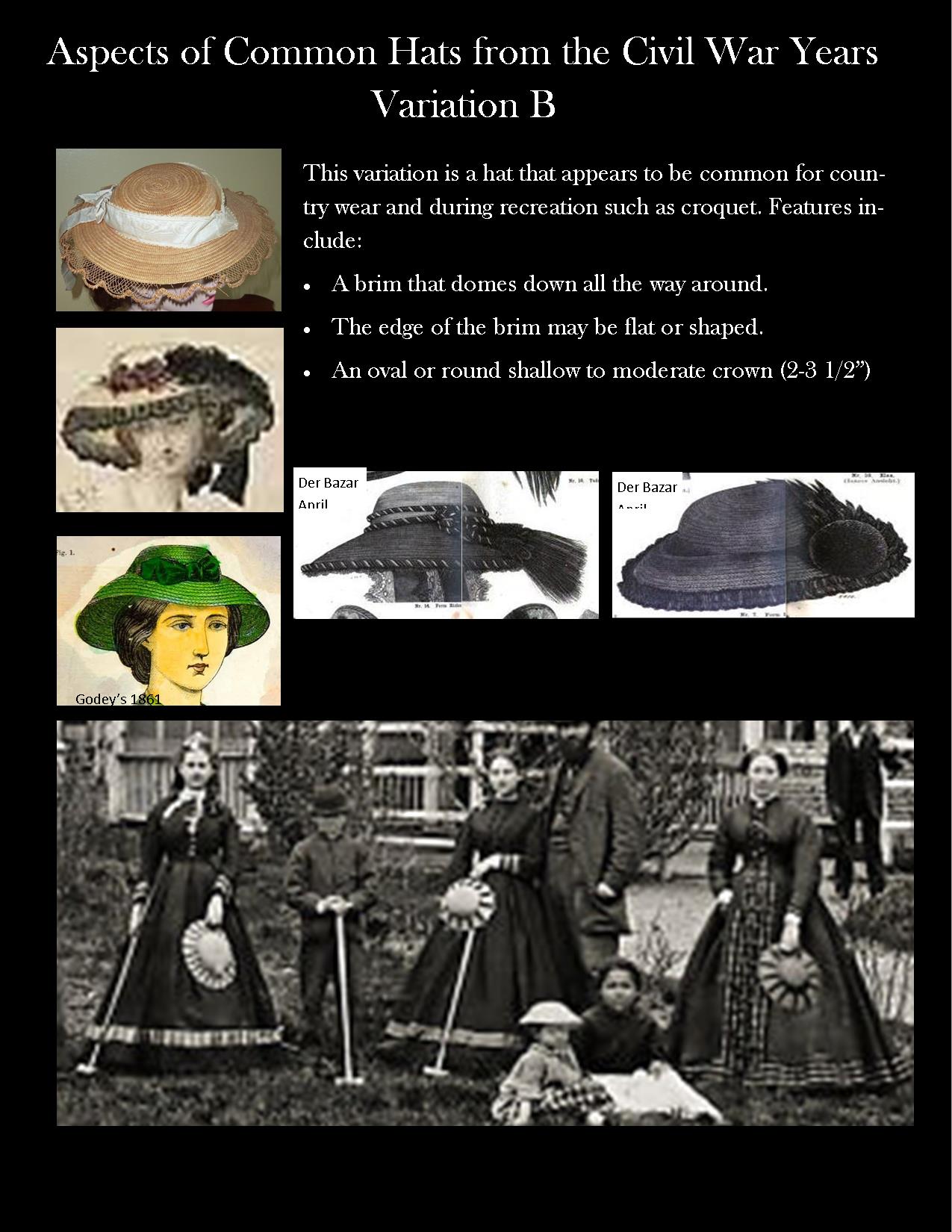
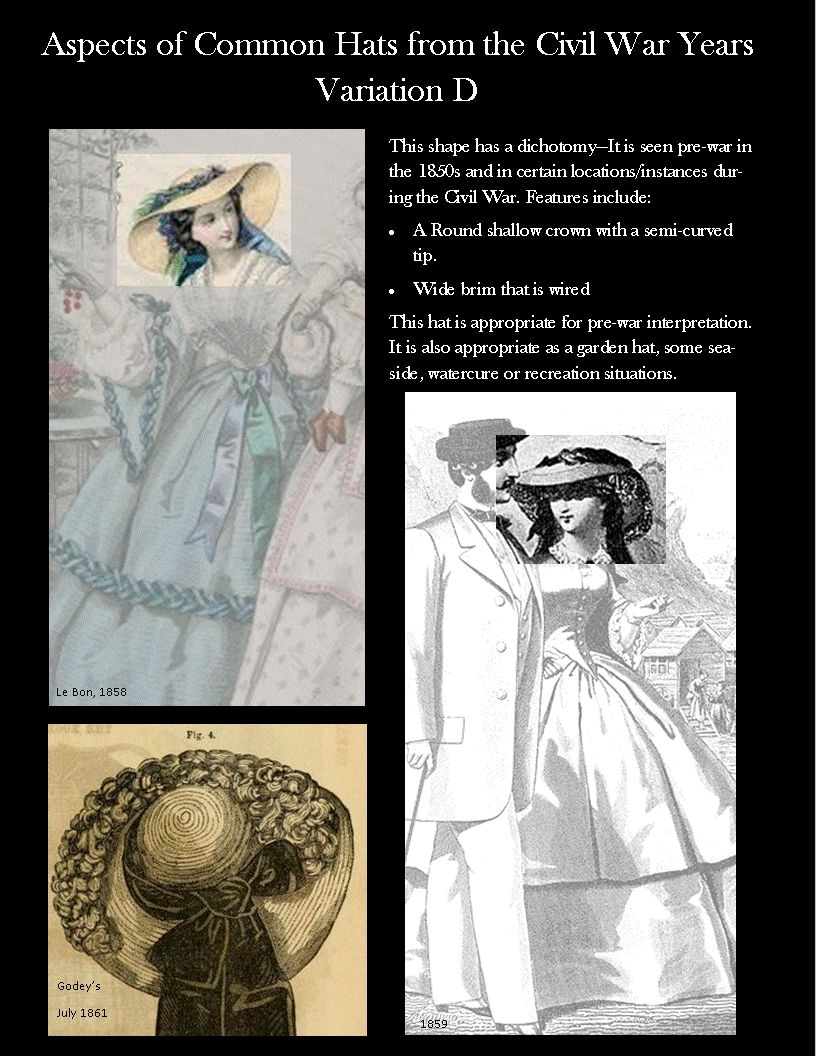
Common hat shapes during the American Civil War era.
There are 2 main componants to a hat from this era: the crown and the brim. Both thd crown and brim were particularly shaped to reflect the styles of the time.
When selecting hat for an 1860-1865 impression, please keep in mind the situation you are in as well as your impression. In many cases hats had specific purposes and places. These include those for the seaside, watercures, the garden*, and recreation. There are seperate posts for these. I welcome you to explore these. There are also hats appropriate to those of poorer situations, institutionalized or previously so situations, and blockaded situations. (*note: a garden hat is different than one for gardening.)
This next style is called a “Mousquetaire” hat or a “Postilion” hat. Mousquetaire hats have tapered crowns that rise about four to five inches, not quite double the height of other fashion hats of the early 1860s. The brim is shaped, with a curve dipping front and back. This brim is narrow, only a few inches wide. The decorations are primarily at the center front, reaching the height of the crown. A ribbon may or may not circle the crown with a bow or arrangement in the back.
Additional variations (I have yet to make graphics for):
I am preparing for two upcoming events, two very different upcoming events.
In two weekends, I will be discussing how dolls were used in Victorian Fancy Work. The day will be spent demonstrating how a broken doll can become a pen wipe or pin cushion. I will wrap up the day with a presentation “The Little Companions of Ladies: How Childhood Playthings Became Adulthood Helpmates.” This discussion looks at how dolls transformed from childhood playthings to adulthood helpmates as pin cushions, pen wipers, and other forms of fancy work. We will explore the workbasket pages of popular women’s literature and original pieces of fancy work.
The very following weekend, I will be doing my Women’s Employments interpretation. With the very quick turnaround and timing being while school is in session, I have a new twist. Instead of fully transforming the insurance office into a millinery shop, I plan to be unpacking the new millinery shop through the weekend while searching for a millinery assistant. The latter gives a chance to discuss the qualifications and role for the position. The former allows for stacks of bandboxes and not as many finished pieces.
I have two more events in the active thinking and preparing stages. 🤔 I will share information on those soon.
This weekend, I am hoping to have all the materials for the first event out and ready.
I also hope to sell three millinery pieces and ten copies of To Net, or Not to Net, which I put on sale for the end of the month. Fingers crossed.
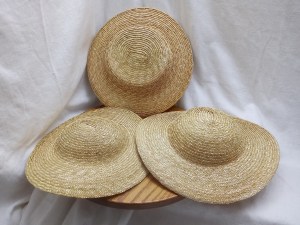
This straw had a mind of its own. As I worked the vining around the brim. The brim curved into this pretty dome shape. I rather love it. I hope you do too.
The crown is 20.25″ around the inside, suitable for an average head.