From Vicki Betts’ newspaper research:
NASHVILLE DISPATCH, October 24, 1863, p. 2, c. 2
“About Stockings.
The Empress Eugenie, having established crinoline, has allowed her imagination to take a lower flight, and aspire to set the feminine world its fashion in the matter of stockings. She has discarded white stockings, and wears blue and white striped, though she should have added a third color, namely, red, and then she should have the tri-color just where the legitimists would to have it like under her foot. Can her hostility to white stockings be based on the circumstances that white is the old Bourbon color, if white can be called a color? Certainly the change she has introduced cannot be held an improvement, white stockings being for woman the prettiest things in which they can put their pretty feet. “A white stocking is infinitely more effective than a black one,” says Mr. Hawthorne, speaking with express reference to young women’s feet, and so forth; and few will dissent from his opinion. It is better than any other kind of stocking. James II, when Duke of York, preferred to green stockings, on an interesting occasion, as readers of Grammont will recollect; but he was not a disinterested judge. Blue stockings are objects of prejudice, though Francis Jeffrey said that it mattered little how blue the stocking is, provided the petticoats be long enough to hide it; but long petticoats are a nuisance, and petticoats never can be tolerated long anywhere. Black stockings ought to be worn only under peculiar circumstances. Flesh-colored stockings are open to the charge of being delusive. The yellow stocking belongs properly only to English charity boys; and the red stocking should be confined to very young people, or to persons old enough to be in their second childhood, or to cardinals. Pink stockings are nice in their places, which are the feet of young women, but they do not show well on either middle-aged or large ladies, who are often very handsome, and therefore should have handsome footings. In fact, the pink stocking is fit for girls only. Grey stockings go well with grey hairs. Mixed, or speckled, or spotted, or ringed, or streaked stockings can be used for show only by children, though some of them answer for a change. But none or all of these can displace the white stocking, which is an old favorite, and not to be put down, though occasionally it may be thrown into the back ground. Like the hoop, it is never long out of fashion. The French Empress will find that she has “put her foot into it” by taking it out of the white stocking, which is to women what to the garden is the white rose.”
MEMPHIS DAILY APPEAL [MEMPHIS, TN], March 3, 1861, p. 1, c. 2-3
“Ladies’ Dresses in Muddy Weather.
It is an unpleasant sight to see the ladies on the streets, on rainy days, allow their dresses to rail in the mud. This is unpardonable. There is no impropriety in raising the skirts high enough to keep them out of the dirt. There is a very unladylike prudery in refusing to raise them slightly when cleanliness requires it. It is not necessary, however, for any lady to hold her dress with her hands to keep it out of the mud. The English woman, says an European writer, understanding these things better than we, go out walking in rain and mud, wearing long dresses, and without taking their hands from their muffs, come home with the clothing as clean as when they started. How do they do it? They wear skirts that do not reach lower than the ankle; short enough, in fact, to keep clear of the mud without any lifting. The dress is worn long, but is looped up when the lady is in the street. The loops are a late invention, and are now the fashion in Great Britain. A woman who should go out in muddy weather without them would be considered a prude. They are made thus:
There is a belt of black ribbon, three quarters of an inch wide, and long enough to go around the lady’s waist, with a hook at one end and an eye at the other, as a fastening; a piece of the same kind of ribbon, three yards long, is attached to the end and the middle of the belt. The belt is now put on with the hook and eye in front; and hanging down on each side is a loop of black ribbon, three quarters of a yard long. When a lady is about to go out, she puts on her belt, and puts a part of the lower portion of her dress through each loop, which is thus raised into four festoons, and all of it is above the lower edge of the petticoat.
She then walks out with her hands free, her dress clear, and her conscience at ease; and if she wishes to enter a house, she can take her dress out of the loops in an instant. The looped dress is not only clean but graceful, and it shows a white petticoat, one of the most beautiful articles of ladies’ apparel, to much advantage. In England, however, a white petticoat is not considered indispensable; on the contrary, scarlet woolen petticoats are much worn by most fashionable people, as are also red woolen stockings. Indeed the white cotton stockings are the exception, and not the rule for London wear in winter. Wool is ordinarily worn, sometimes scarlet, or scarlet with black stripes, or plaid with a variety of colors. And then, the shoes are not of thin cloth with paper soles, but Balmoral boots, with heavy uppers and thick soles, lacing up in front, as if they were made for beings of flesh and blood, bred on roast beef, and good for real service, hard work, sturdy health and long life. Our American women are too much in the habit of following bad fashions, and neglecting good ones. If they will just adopt the healthful practices, as well as the expensive luxuries, of European aristocracy, it will be far better, as well as more creditable to them. We are glad to see, however, that a correct taste is being exercised by our ladies. They study health and comfort more than the fashions, and we may expect to see them as rosy-cheeked and robust as any of our English cousins.—Home Journal.”
DAILY CONSTITUTIONALIST [AUGUSTA, GA], April 14, 1861, p. 3, c. 2.
“Protection for Woman’s Foot.—Women must go much in the open air at all seasons of the year, or become pale and feeble. But in order to do this, their boots must be radically changed.
As preliminary to this greatly needed reform, we must first get rid of the strange hallucination that where a strong man needs cowhide, a feeble woman needs only morrocco; that where a strong man needs an inch of hard, impervious sole, a feeble woman needs only a quarter inch of soft, spongy sole; that where the strongest Irishman needs thick woolen socks, a delicate, consumptive lady needs only a gauzy silk stocking. This singular madness must be first scattered.
But surely one need not seriously discuss such a matter. If women must go much in the open air at all seasons of the year, (and no one with five grains of common sense doubts it,) then it needs no argument to show that women should wear as much protection on their feet as men find it necessary to wear. Neither can it require much argument to show that those rubbers which prove so pernicious to the feet of men, must, to say the least, be quite as unhealthy for women.
Prescriptions for a Fashionable Lady.—Madame, allow me to prescribe for you. I have had a long experience in the management of delicate women, and believe I can give you some important advice. For the present, I prescribe only for your feet:
1. Procure a quantity of woolen stockings, not such as you buy at the store, under the name of lamb’s wool, that you can read a newspaper through, but the kind that your Aunt Jerusha in the country knits for you, thick as a board, that will keep you dry and warm, in spite of wind and weather.
2. If you want to be really thorough, change them every morning, having the fresh ones hang by the fire during the night.
3. Procure thick calf skin boots, double uppers and triple soles, and wear them from the first of October until the first of April. Make frequent applications of some good oil blacking.
4. Avoid rubbers altogether, except a thick layer, which you should have cemented to the bottom of the soles.
5. Hold your feet in cold water an inch deep, five or six minutes before going to bed, and have them rubbed hard with some one’s naked hand.
6. Now, Madame, go much out of doors at all seasons, and believe me not only will your feet have a good circulation, but, as a consequence, your head will be relieved of its pain and congestion, and your heart be relieved of its accumulations.—Boston Journal of Physical Culture. ”
(Hmmm… found the text limit when posting from my phone.)




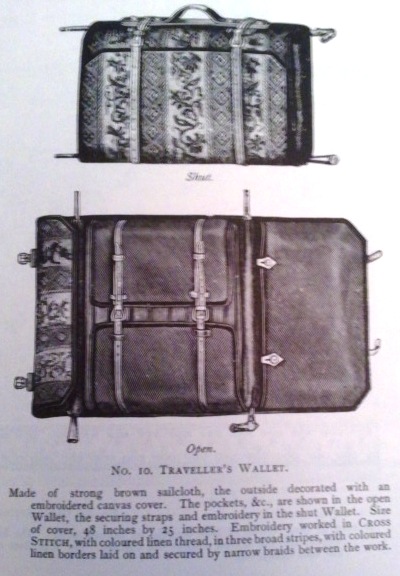


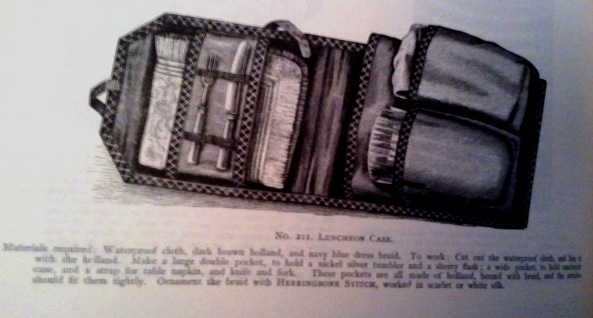
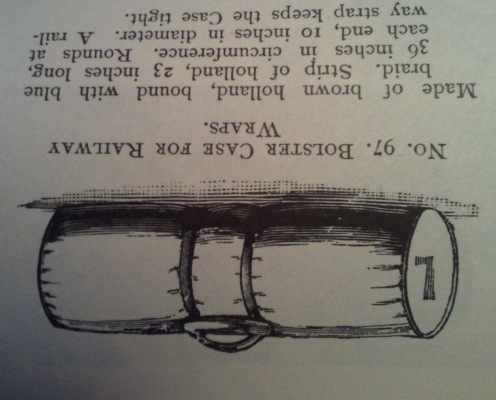

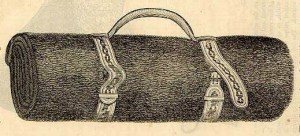 0s. This particular one comes from Godey’s in November of 1860. The description reads: “We direct the attention of our lady reads to a little article which will be found an extremely useful travelling companion, and which, by the exercise of female taste and industry, may be rendered no less elegant than useful. We allude to the worked plaid strap of which we furnish two illustrations; one with the plaid, and the other without. Plaid straps made of plain leather have long been used by gentlemen, and their utility is fully acknowledged by travellers. These straps are much used by ladies, who impart to them a superior degree of elegance by various kinds of ornamental work. They are available not merely for plaids or shawls, but for securing together umbrellas, parasols, and other small articles, which, in the hurry of railway travelling, changing carriages, etc. are liable to be dropped and lost. The strap from which our engraving is copied is made of Danish leather, and the ornaments are executed in beadwork, or embossing in colored silk.” Nifty? Yes. Practical? Maybe. I don’t know if I want to fuss with strapping together my parasol, umbrella, shawl, etc if there is a chance in departing one of the articles may be needed with no place to easily unstrap and restrap. I would rather take them out of a bag. Since many of the similar items are described primarily for shawls, I am concerned about keeping the shawl dry and clean. Yet this could be useful. So, it sits firmly in the maybe-maybe not category.






 If I Had My Own Blue Box: