Well Now…..

What are your thoughts on these?

The Metropolitan Museum of Art – Accessory set.

I hadn’t seen these before. As over shoes go, if these were common, I would love to have a pair.

The MET has them listed as an 1825-30 accessory set – “By the 1820s, ankle boots were becoming the favored daytime footwear for ladies in both the United States and Europe, especially for outdoor wear. Like the shoes of the time, however, fashionable boots were often constructed of thin and flimsy materials, which made walking on cobbled or unpaved roads torturous. As a minor concession to utility, this pair of thin-soled boots is paired with a matching set of pattens which provide a heavier sole for walking. Pattens were basically utilitarian, hence it is somewhat unusual for them to survive in good condition, and even rarer to find a pair matching the boots with which they were worn.”


Published in: on April 9, 2013 at 8:35 am  Comments (3)  

Very Inspiring Blogger Award, Thank You!

I’ve been so wrapped up in my current millinery obsession and planning for the Netherfield Ball, I nearly missed Quinn recognizing me for the Very inspiring Blogger Award. I am so very flattered. Thank you, very much Quinn. It is quite nice to know I’ve been inspiring people with my posts.  If you have not yet seen it, head over to Quinn’s blog The Quintessential Clothes Pen.

As with these awards, we have some rules….

Here are the rules: 1- Display the award and link back to the person who nominated you; 2- State seven facts about yourself; 3- Nominate 15 blogs for the award; 4- Notify the winners.

Seven things about me. Lets see. 1. I love spicy food, at time ridiculously spicy. Just this past Sunday, Dan had to open the kitchen windows because the three dozen jalapenos I was cleaning and cutting for salsa were filling the apartment with capsaicin. 2.  Similarly, I use sriracha chili sauce like most people use ketchup. 3. I lack a cat. My dear feline friend has been living with a dear human friend since we still can’t have pets. Sadness. 4. I love tea, but hate coffee. Icky. 5. I have a teeny temperature comfort window anymore. Below 60, too cold; above 70, too hot. 6. I love the smell of jasmine and lavendar and mints and rose and orange blossom.  7. I enjoy listening to thunderstorms.

There are several blogs and bloggers I find inspiring. I nominate….

  • First I would like to re-recognize Quinn’s blog. I always enjoy her detailed progress posts with all the great photos.
  • Anna in Technicolor is by another Anna, who looks at historic, vintage and modern clothing. Her posts are always a sprout of life.
  • The Pragmatic Costumer is sorta my escape into eras I will likely never do, but love to drool over.  
  • Mixing historic costuming and cosplay, In the Long Run always has an interesting project going.
  •  In my opinion, Bygone Glamour is all about depth of though and research each time she picks up a topic.
  • When the header photo itself inspires with the thought “I don’t have that one”, you know you’ve got something. Such is the case with Women, Words, and Wisdom.
Published in: on April 8, 2013 at 8:00 pm  Comments (2)  

“On the Suitability of Colours for Lining Bonnets.”

From The Handbook of Millinery, by Mary J. Howell. London: Simpkin, 1847

No one article in the whole range of female costume is more important in its effects than that comparatively small piece of satin, silk, or other material, that forms the lining of a bonnet. “From little causes great effects arise”; and the saying is applicable in its fullest sense to the case in point. Let the outside trimming of your bonnet be elegant or tasteless, it only proves more or less the judgment of the wearer; it is the lining that exerts an influence on the complexion.

Hence, our fair readers cannot be too careful in their selections, and should pause before adopting any peculiar shade that may strike their fancy, and ask themselves what effect it would produce. They should remember that the lining, particularly of a close bonnet, throws its hue directly upon the face, and that as much advantage may be derived from the judicious application of a desirable tint, as positive detriment to their appearance is to be apprehended from an ill-directed choice of colours. Take as an instance, one of those ruddy beauties to whose cheeks a superabundance of healthful vigour has imparted that over degree of colour which your fashionable ladies, who give the preference to gentility over nature, would style couleur de rose; you would not give her a pink nor a cherry-coloured bonnet, to increase the fault already too prominent,—in spite of Will Honeycomb’s advocacy of this somewhat homoeopathic system,’ —but sooner follow the precept of an old poet, who says with much naivete:

“The ruddie nymph most charms our wond’ring sight, When, like the leaves of spring, in green she’s dight.”

And either the green advocated by the poet, or dark-blue, would soften down the exuberant bloom that otherwise would have found no corrective to mitigate its effects; while the pink or cherry-coloured lining would throw a slight tinge on a pale cheek, and redeem it from its lifeless appearance; whereas, green or blue would render it void of animation—a charm that Bulwer says is the “best counterfeit beauty possesses.11 Linings, therefore, as well as transparent bonnets, have a great effect on the complexion: they must not be considered only as the frame that is best suited to the picture, but rather as the drapery that is to give it proper light and shade so to supply the tint that is deficient in the face, and steal away any harsh or over-prominent hues. But this must be done artistement, as the French would say; you must perceive the effects without seeing the machinery. We should take care not to overpower what little colour may be found in a lily cheeked blonde, by too glaring a contrast of pink or red. To obviate falling into such an error, we would recommend that the bonnet front should not widen after the fashion of the shape that now goes by the name of Pamela. All bonnets indeed that widen are apt to possess the disadvantage of impairing rather than aiding the complexion, by the very contrast that we advocate.

We would therefore advise that whenever fashion peremptorily compels the adoption of large and wide bonnets, that ample trimmings be inserted towards the edge, as this will tend to diminish the vacant and unbecoming appearance which size is apt to impart; and because the interposition of flowers and tulle of suitable tints will have a softening influence. The latter especially, if tastefully managed, has something light and graceful about it, suggestive of elegance and simplicity.

It is not our purpose in a work so slight to enter into a discussion upon the theory of colours. Our readers are well aware that there are but three primary ones in nature, viz.: yellow, red, and blue; and that all the gorgeous variety of hues that we admire, whether in a rich sunset, or in the exquisite plumage of the feathered tribe, are but so many different combinations where the same tints preponderate in a greater or lesser degree.

On these simple facts a clever modern writer has built a whole system, tending to shew that a due attention to the harmony of colours would be the most certain guide for treating a complexion properly. Thus, according to our author, yellow to a pale face produces a livid hue; red would impart a greenish tint; while blue would render it positively sallow: in which latter assertion we heartily concur.

According to the same authority, all such colours must be entirely discarded for purposes of reflection on the above-mentioned faces. Yet we think not entirely, since the unfavourable tinge may be redeemed by the flowers or ribbons that adorn the inside; and as it would be scarcely reasonable to expect that a lady would wear one particular colour incessantly, even though ever so becoming, some means of this kind must be occasionally resorted to, in order to break through the monotony of one eternal hue—almost as trying to the patience of. the wearer and her friends, as toujours perdrix to the abbe’s palate. Without, therefore, adopting all the conclusions of the clever author alluded to, nor advocating those elaborate classifications which would savour of pendantry when applied to dress, we quite agree with the sweeping precept, that light colours are best suited to the blonde, and dark colours to the brunette; and the reason is obvious. The contrast of a dark colour tends to make even a dark complexion seem fairer by comparison, by the aid, for instance, of a black or somber coloured bonnet; while a fair person who does not require to be rendered more blanche, appears to greater advantage in the lightest colours. That the truth of this system is not universally admitted we are well aware, and that even a directly contrary notion is prevalent, we gather from the preference that fair persons usually shew for black. Thus, in one of Kotzebue’s comedies, a flippant widow, in reply to the remark made by one of the characters, that the length of time she has worn mourning is a proof of her sincere regard for the departed, is made to answer: “Are you not aware that blondes look best in mourning?” And centuries before Kotzebue lived and flourished, Ovid adhered to the same opinion; and in his strictures upon taste (which certainly form a more complete code than a dozen modern handbooks on the toilet or on etiquette), he thus lays down the law:

“If fair the skin, black may become it best;
In black the lovely fair Brise is drest;
If brown the nymph, let her be clothed in white;
Andromeda so charm’d the wond’ring sight.”

In spite however of all authorities, whether ancient or modern, we prefer experience; and let those who doubt us, simply give us a fair trial before that most impartial judge—a looking-glass.

Some of the colours adopted for bonnets allow a great degree of latitude in the choice of trimmings; we mean as regards the hues of the flowers or ribbons selected for that purpose. Rich colours do not allow of much variety in their decorations; grave or sombre ones of still less. Delicate colours are more susceptible of contrast than variety. Dove and pink, oiseau, and the palest of pale blues, or a very light green mixed with lilac, are samples of a pleasing contrast, presenting “not harmony but agreement.”

With regard to the selection of trimmings for bonnets or head-dresses, whenever these are of a dull cast, we should advise the former, whether they be ribbons, flowers, or feathers, to be chosen of what is termed relieving colours. A black bonnet should invariably be lined with some vivid hue; the same as the uniformity of a white one requires being broken by some delicate coloured flowers or ribbons. These trimmings should, however, be rather sparing than profuse, especially when intended for the youthful, who are generally “when unadorned adorned the most.” Nor should these relieving colours be employed otherwise than sparingly, as when too prodigally lavished they are distinctive of each other’s effect.

Were such the case, instead of deserving the name of relieving colours, they would tend to be overpowering ones, and bring to recollection those gaudy mixtures of a celebrated modern painter’s pallet, which he is occasionally facetious enough to pass on the world of connoisseurs for a picture. A well-managed contrast throws up the colour relieved, while opposition would entirely spoil it.

A little attention on the part of our readers to the subject we have been treating, will soon reduce it into a regular system, which will sink into their minds and enable them, at no distant period, to judge all such questions without the aid of a book, and to become adepts in the laws of taste.

Enjoy this article? Consider one of my straw bonnets available through Etsy.

Published in: on April 6, 2013 at 8:00 am  Comments (2)  
Tags: , ,

Millinery Opening Day

It seems I nearly missed “Opening Day”. (I confess, this post is back dated a bit.)

If not from time immemorial, for some years at least, the first Thursday in April has been associated in the minds of all bonnet-wearing humanity hearabouts, with the Spring opening of fashionable millinery. Of all days in the memory of that venerable personage, the oldest inhabitant, yesterday was they day for such an occasion. The weather was delightful, and he must have been a callous observer indeed, whose fancy was not pleased by the life and gaiety presented in our streets. At an early hour the tide of beauty and fashion commenced flowing in upon the various milliner establishments of our city. The displays made by the latter were, as a whole, highly credible. Those of the following houses we may designate as particularly attractive: Mrs. M. A. King’s, formerly at No. 27 South Second street, now at No. 1026 Chestnut street; that by the Misses O’Brien, No. 914 Chestnut street; Miss S. T. Morgan’s, No. 403 Arch street; Mrs. M. A. Kinnear’s, No. 1208 Chestnut street; and Mrs. H. Wright’s, at No. 137 Pine street.

Of course, the popular old house of Wood & Cary, (formerly Lincoln, Wood, & Nicholes,) at No. 725 Chestnut street, figured conspicuously in the general éclat. The preparations of this firm for the “event” had evidently been made on the grandest scale. Their capacious Retail room – the first floor of their handsome business edifice – was profusely, though tastefully, decorated with fashionable head, and as the morning progressed, by some low more readily appreciated than explained, it became a grand eddying centre for the ladies who had turned out for the day. For two hours the throng in their rooms increased, attaining its climax at high noon. Just about then we tried to gain a professional glimpse of what was going on inside; but for reasons which it might seem ungallant in us to give, the effort did not result in more than a tip-toe glance from the pavement. The fact is, it would just then have required something of a reportorial myth to have made a round of inspection among that throng of admiring, chattering, bustling crinoline. Between one and two, however, through the courteous assistance of a member of the house, we were enabled to assert our prerogative in a practical way, the crowd – if the ladies will excuse that epithet – having sufficiently subsided to afford us reasonable facilieties for seeing the “opening” It was a most beautiful display. To give a minute description would consume more time and space than we have at our disposal to devote to it, however agreeable such a take might be, in these times of wholesale rebellion and local disasters. (Philadelphia Press, April 4, 1862. http://digitalnewspapers.libraries.psu.edu)

The author does continue for three paragraphs describing the trends and fashions of the day…

Published in: on April 5, 2013 at 12:53 pm  Leave a Comment  

Mad Hatter Bonnet Update

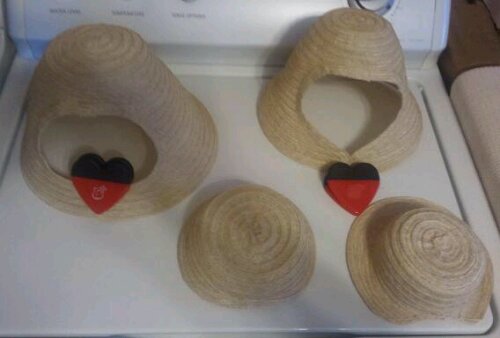
This week has been quite the straw filled week. I can show you the bonnets that are for sale. I can’t show you what is already spoken for because owners get to see that progress first.

This is an 1850s bonnet for a slightly smaller head.

Moving into the 1860s… Here is a child’s bonnet

 Here is the Marie Stuart several people asked for. This was quite to fussy shape to work with.

These are a pair of 1880s bonnets that were my first adventure into the era.

Published in: on April 4, 2013 at 3:21 pm  Leave a Comment  

Mad Hatter Week update

I’m a little behind schedule, well my ‘hoped schedule’, by three quarters of a day. I have 4 bonnets drying and 2 bonnets getting wired as of this afternoon.
The slight delay is a combination of the freak weather causing yesterday’s errands to take longer, one cranky bonnet giving me symmetry issues and the silly notion that I would throw a Marie Stuart into the mix.

image

Here is the batch drying – A mix of eras including a 50s commission, late 50s/early 60s, and two 80s, one from an advert and the other an original.

Published in: on April 3, 2013 at 5:37 pm  Leave a Comment  

The Rival Bonnets

From Trials and Confessions of an American Housekeeper. Philadelphia, 1854

I Have a pleasant story to relate of a couple of fashionables of our city, which, will serve to diversify these “Confessions,” and amuse the reader. To the incidents, true in the main, I have taken the liberty of adding some slight variations of my own.

A lady of some note in society, named Mrs. Claudine, received a very beautiful bonnet from New York, a little in advance of others, and being one of the rival leaders in the fashionable world, felt some self-complacency at the thought of appearing abroad in the elegant head-gear, and thereby getting the reputation of leading the fashion.

Notwithstanding Mrs. Claudine’s efforts to keep the matter a secret, and thus be able to create a surprise when she appeared at church on the next Sunday, the fact that she had received the bonnet leaked out, and there was some excitement about it. Among those who heard of the new bonnet, was a Mrs. Ballman, who had written to a friend to get for her the very article obtained first by Mrs. Claudine. From some cause or other a delay had occurred, and to her chagrin she learned that a rival had the new fashion, and would get the eclat that she so much coveted. The disappointment, to one whose pleasures in life are so circumscribed as those of a real fashionable lady, was severe indeed. She did not sleep more than a few hours on the night after she received the mortifying intelligence.

The year before, Mrs. Claudine had led the fashion in some article of dress, and to see her carry off the palm in bonnets on this occasion,

when she had striven so hard to be in advance, was more than Mrs. Ballman could endure. The result of a night’s thinking on the subject was a determination to pursue a very extraordinary course, the nature of which will be seen. By telegraph Mrs. Ballman communicated with her friend in New York, desiring her to send on by the evening of the next day, which was Saturday, the bonnet she had ordered, if four prices had to be paid as an inducement to get the milliner to use extra exertions in getting it up. In due time, notice came back that the bonnet would be sent on by express on Saturday, much to the joy of Mrs. Ballman, who from the interest she felt in carrying out her intentions, had entirely recovered from the painful disappointment at first experienced.

Saturday brought the bonnet, and a beautiful one it was. A few natural sighs were expended over the elegant affair, and then other feelings came in to chase away regrets at not having been first to secure the article.

On the day previous, Friday, Mrs. Ballman called upon a fashionable milliner, and held with her the following conversation.

“You have heard of Mrs. Claudine’s new bonnet, I presume V

“Yes, madam,” replied the milliner.

“Do you think it will take?” asked Mrs. Ballman.

“I do.”

“You have not the pattern?”

“Oh, yes. I received one a week ago.”

“You did!”

“Yes. But some one must introduce it. As Mrs. Claudine is about doing this there is little doubt of its becoming the fashion, for the style is striking as well as tasteful.”

Mrs. Ballman mused for some moments. Then she drew the milliner aside, and said, in a low, confidential tone.

“Do you think you could get up a bonnet as handsome as that, and in just as good taste?”

“I know I could.” In my last received London and Paris fashions are several bonnets as handsome as the one that is about being adopted in New York, and here also without doubt.”

“I am not so sure of its being adopted here,” said the lady.

“If Mrs. Claudine introduces it, as I understand she intends doing on Sunday, it will certainly be approved and the style followed.”

“I very much doubt it. But we will see. Where are the bonnets you spoke of just now?”

The milliner brought forth a number of pattern cards and plates, and pointed out two bonnets, either of which, in her judgment, was more beautiful than the one Mrs. Claudine had received.

“Far handsomer,” was the brief remark with which Mrs. Ballman approved the milliner’s judgment. “And now,” she added, “can you get me up one of these by Sunday?”

“I will try.”

“Try won’t do,” said the lady, with some excitement in her manner. “I must have the bonnet. Can you make it?”

“Yes.”

“Very well. Then make it. And let it be done in your very best manner. Why I wish to have this bonnet I need hardly explain to you. I believed that I would have received the bonnet, about to be adopted in New York, first. I had written to a friend to procure it; but, by some means, Mrs. Claudine has obtained her’s in advance of me. Mine will be here to-morrow, but I don’t mean to wear it. I wish to lead.”

“If you were both to appear in this bonnet, the fashion would be decided,” said the milliner.

“I know. But I have no wish to share the honor with Mrs. Claudine. Make me the bonnet I have selected, and I will see that it puts her’s down.”

“You will remember,” said the milliner, ” that her’s has been already adopted in New York. This will be almost sure to give it the preference. It would be better that you did not attempt a rivalry, than that you should be beaten.”

“But I don’t mean to be beaten,” replied the lady. “I have taken measures to prevent that. After Sunday you will hear no more of the New York bonnet. Mine will go, and this, I need not tell you, will be a feather in your cap, and dollars in your pocket; as I will refer to you as the only one who can get it up. So do your best, and improve the pattern we have selected, if it will bear improvement.”

The milliner promised to do her “prettiest,” and Mrs. Ballman returned home in a state of considerable elation at the prospect of carrying off the palm, and humiliating her. rival at the same time.

Mrs. Claudine, though a little vain, and fond of excelling, was a woman of kind feelings, and entirely superior to the petty jealousies that annoyed Mrs. Ballman, and soured her towards all who ‘succeeded in rivalling her in matters of taste and fashion. Of what was passing in the mind of the lady who had been so troubled at her reception of a new style of bonnet from New York, she was entirely ignorant. She was not even aware that Mrs. Ballman had ordered the same article, nor that she had suffered a disappointment.

Saturday came. Mrs. Claudine was busy over some little article of dress that was to add to her appearance on the next day, when an Irish girl, who had formerly lived with her, entered her room.

“Ah! Kitty!” said the lady pleasantly. “How do you do?’

“I’m right well, mum, thankee,” replied Kitty, with a courtesy.

“Where do you live now, Kitty?” inquired Mrs. Claudine.

“I’m living with Mrs. Ballman,” said the girl.

“A very good place, I have no doubt.”

“Oh, yes, mum. It is a good place. I hain’t much to do, barrin’ going out with the children on good days, and seein’ after them in the house; and I get good wages.”

“I’m very glad to hear it, Kitty; and hope you will not give up so good a home.”

“No, indeed, mum; and I won’t do that. But Mrs. Claudine—”

Kitty’s face flushed, and she stammered in her speech.

“What do you wish to say?” inquired the lady, seeing that Kitty hesitated to speak of what was on her mind.

“Indade, mum,” said Kitty, evincing much perplexity, “I hardly know what I ought to do. But yez were good to me, mum, when I was sick, and didn’t send me off to the poor house like some girls are sent; and I never can forget yez while there’s breath in me body. And now I’ve come to ask yez, just as a favor to me, not to wear that new bonnet from New York, to-morrow.”

It was some moments before the surprise, occasioned by so novel and unexpected a request, left Mrs. Claudine free to make any reply.

“Why, Kitty!” she at length exclaimed, “what on earth can you mean?”

“Indade, mum, and yez mustn’t ask me what I mane, only don’t wear the bonnet to church on the morrow, because—because—och, indade, mum, dear! I can’t say any more. It wouldn’t be right.”

Mrs. Claudine told Kitty to sit down, an invitation which the girl, who was much agitated, accepted. The lady then remained silent and thoughtful for some time.

“Kitty,” she remarked, at length, in a serious manner, “what you have said to me sounds very strangely. How you should know that I intended appearing in a new bonnet to-morrow, or why you should be so much interested in tbe matter is more than I can understand. As to acting as you desire, I see no reason for that whatever.”

This reply only had the effect of causing Kitty to urge her request more strenuously. But she would give no reason for her singular conduct. After the girl had gone away, Mrs. Claudine laid aside her work—for she was not in a state of mind to do any thing but think—and sat for at least an hour-, musing upon the strange incident which h%d occurred. All at once, it flashed upon her mind that there must be some plot in progress to discredit or rival her new bonnet, which Kitty had learned at Mrs. Ballman’s. The more she thought of this, the more fully did she become satisfied that it must be so. She was aware that Mrs. Ballman had been chagrined at her leading ofl’ in new fashions once or twice before; and the fact, evident now, that she knew of her reception of the bonnet, and Kitty’s anxiety that she should not wear it on Sunday, led her to the conviction that there was some plot against her. At.first, she determined to appear in her new bonnet, disregardful of Kitty’s warning. But subsequent reflection brought her to a different conclusion.

The moment Mrs. Claudine settled it in her mind that she would not appear in the new bonnet, she began dressing herself, hurriedly, to go out. It was as late as five o’clock in the afternoon when she called at the store of the milliner who had been commissioned by Mrs. Ballman to get the rival bonnet.

“Have you the last fashions from abroad?” enquired Mrs. Claudine.

“We have,” replied the milliner.

“Will you let me see them?”

“Certainly, ma’am.”

And the patterns were shown. After examining them carefully, for some time, Mrs. Claudine selected a style of bonnet that pleased her fancy, and said—

“You must get me up this bonnet so that I can wear it to-morrow.”

“Impossible, madam!” replied the milliner. “This is Saturday evening.”

“I know it is; but for money you can get one of your girls to work all night. I don’t care what you charge; but I must have the bonnet.”

The milliner still hesitated, and seemed to be confused and uneasy. She asked Mrs. Claudine to sit down and wait for a little while, and then retired to think upon what she had better do. The fact was, Mrs. Claudine had pitched upon the very bonnet Mrs. Ballman had ordered, and her earnestness about having it made in time i to wear on the next day, put it almost beyond

her power to say no. If she were to tell her that Mrs. Ballman had ordered the same bonnet, it would, she knew, settle the matter. But, it occurred to her, that if both the ladies were to appear at church in the same style of bonnet, the fashion would be sure to take, and she, in consequence, get a large run of business. This thought sent the blood bounding through the milliner’s veins, and decided her to keep her own counsel, and take Mrs. Claudine’s order.

“She’s as much right to the bonnet as Mrs. Ballman,” settled all ethical questions that intruded themselves upon the milliner.

“I will have it ready for you,” she said, on returning to Mrs. Claudine.

“Very well. But mind,” said the lady, “I wish it got up in the very best style. The hurry must not take from its beauty. As for the price, charge what you please.”

The milliner promised every thing, and Mrs. Claudine went home to think about the important events of the approaching Sabbath. On Sunday morning both bonnets were sent home, and both the ladies fully approved the style, effect, and all things appertaining to the elegant affairs.

At ten o’clock, Kitty, who was a broad-faced, coarse-looking Irish girl, came into the chamber of Mrs. Ballman, dressed up in her best, which was not saying much for the taste and elegance of her appearance.

“Are you all ready?” asked her mistress.

“Yes, mum.”

** Very well, Kitty, here’s the bonnet. Now, remember, you are to go into the pew just in front of ours. The Armburner’s are all out of town, and there will be no one to occupy it.”

Kitty received the elegant bonnet which had come on express from New York, and placed it upon her head.

“You really look charming,” said the lady.

But Kitty was not nattered by her words, and evinced so little heart in what she was doing, that Mrs Ballman said to her, in a half threatening tone, as she left the room—

“Mind, Kitty, I shall expect to see you at church.”

“Oh, yes, mum; I’ll be there,” replied Kitty, courtesying awkwardly, and retiring.

Not long after Kitty had retired, Mrs. Ballman, after surveying, for many minutes, the effect of her new bonnet, becoming more and more pleased with it every moment, and more and more satisfied that it would “take,” left her room, and was descending the stairs for the purpose of joining the family, who were awaiting her below. Just at that unlucky moment, a servant, who was bringing down a vessel of water, slipped, and a portion of the contents came dashing over the head and shoulders of the richly attired lady, ruining her elegant bonnet, and completely destroying the happy frame of mind in which she was about attending public worship. No wonder that she cried aloud from the sudden shock and distress so untoward an event occasioned; nor that she went back weeping to her chamber, and refused to be comforted.

Mr. Ballman and the children proceeded alone

to church on that day. On their return home, they found the lady in a calmer frame of mind. . But Mr. Ballman looked grave and was unusually silent. Kitty came home and gave up her elegant head-dress; and when her mistress told her that she might keep it, she thanked her, but declined the present.

“You went to church, of course,” she said.

“Oh, yes, mum,” replied Kitty.

“And sat in the Armburner’s pew?”

“Yes, mum.”

“Alone.”

“Yes, mum.”

“Was Mrs. Claudine there?”
“Yes, mum.”

“Did she wear her new bonnet?”
“Yes, mum.”

“It was exactly like this?”

“Oh, no, mum, it was exactly like the new one you had sent home this morning.”

“What!” The face of the lady flushed instantly. “Wasn’t it like this?”

“No, mum.

Mrs. Ballman sunk into a chair.

“You can retire, Kitty,” she said, and the girl withdrew, leaving her to her own feelings and reflections, which were not of the most pleasing character.

The appearance of Kitty at church, fully explained to Mrs. Claudine the ungenerous game that had been played against her. Her first thought was to retaliate. But reflection brought other and better feelings into play. Instead of exposing what had been done, she destroyed the bonnet received from New York, and made an effort to keep what had occurred a secret. But Kitty’s appearance at church in such an elegant affair, naturally created some talk. One surmise after another was started, and, at last, from hints dropped by the milliner, and admissions almost extorted from Mrs. Claudine, the truth came out so fully, that all understood it; nor was Mrs. Ballman long left in ignorance on this head.

As to the fashion, Mrs. Claudine’s bonnet became the rage; though, as might be supposed, Mrs. Ballman refused to adopt it.

Who will be the successful rival next season, I am unable to predict. But it is believed that Mrs. Claudine intends giving Mrs. Ballman an advance of two weeks, and then coming in with a different style, and beating her in spite of the advantage.                                      

Published in: on March 30, 2013 at 8:00 am  Leave a Comment  
Tags: ,

Ladies’ Luggage

A bit of baggage humor from Punch, November 19, 1859:

“Ladies’ Luggage; or Hard Lines by a Brute”

How happy is the single life
Of all those priests and monks!
Not one of whom has got a wife
To bother him with trunks,
And bandboxes, a load to gret
For man or horse to bear,
Which railways charge for, over-weight.
And cabs ask double fare.
 
Fell care as with your bride you post
Distracts your anxious mind,
Lest this portmanteau shall  be lost,
Or that be left behind;
Ther baggage as you travel down
Life’s hill, weighs more and more,
And still, as balder grows your crown,
Becomes a greater bore.
 
Outstretched by Fashion vile and vain,
Hoop-petticoats and vest,
Now British females, to contain,
Require no end of chests.
To which bags, baskets, bundles, add,
Too mumerous to name,
Enough to drive a poor mad mad,
A job with rage inflame.
 
The cab keeps awaying o’er your head,
With luggage piled above,
Of overturn you ride in dread,
With her whom you should love;
Then you, the station when you gain,
Must see that lumber stowed,
And fears about it in the train,
Your heart and soul corrode.
 
Thus does your wife each journey spoil
Of yours that she partakes,
Thus keeps you on the fret and broil,
Your peace and comfort breaks.
With all these boxes, all her things,
(How many!) to enclose,
The fair Encumbrance on you brings
A waggon-load of woes.


Published in: on March 30, 2013 at 7:00 am  Leave a Comment  
Tags: ,

Finds For Mae

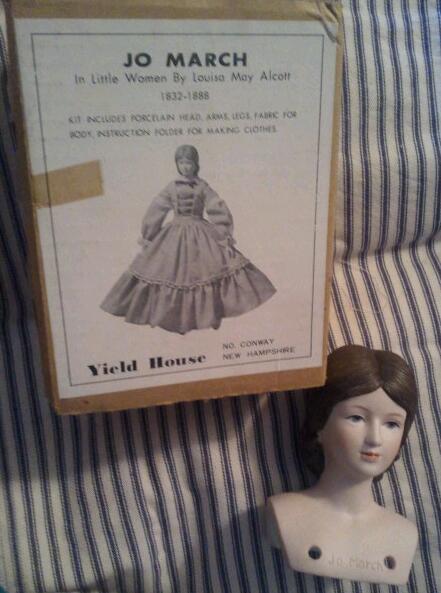
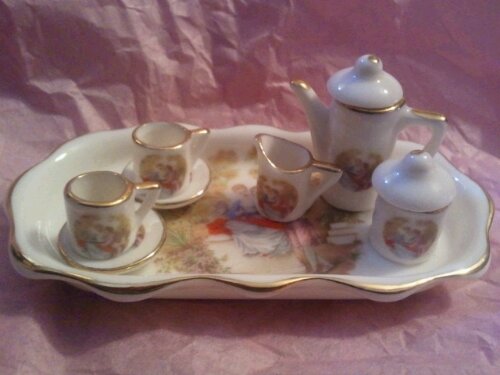
With today being a rare Friday off, we headed over to a favorite craft shop in hopes of finding some flowers for millinery and other needed things. While the initial list was a flop, I did find a pair of goodies.
This Jo Marc doll kit will become a nice new friend for Mae.

image

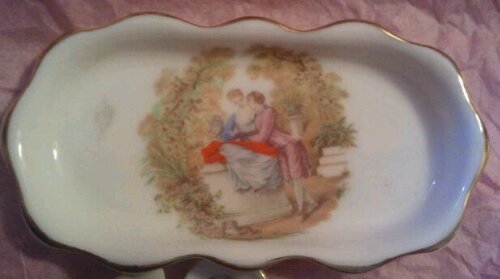
Then, the two of them can have tea together with this pretty little tea set.

image

image

Published in: on March 29, 2013 at 7:48 pm  Leave a Comment  

Patriotic Embroidery Patterns

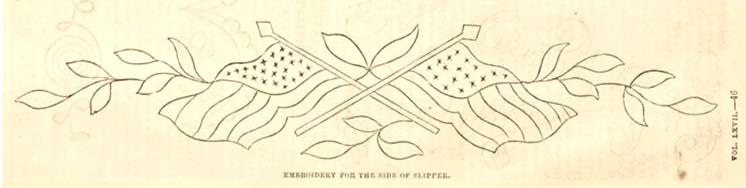
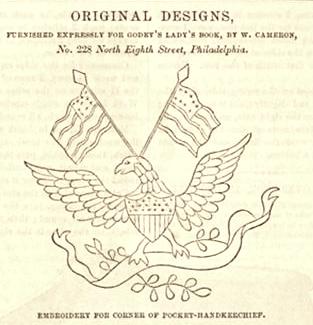
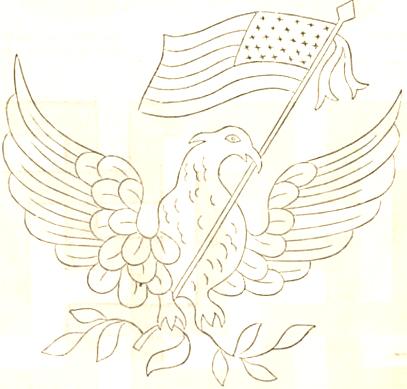
I know several groups are looking at depicting displays of patriotism this season be it individually or an organized festivity. This trio of images comes from Godey’s 1863.

g63c g63a

g63b

Published in: on March 28, 2013 at 6:00 pm  Leave a Comment