Readings for Rural Life

From Moore’s Rural New-Yorker in Rochester, NY

June 4th, 1864

Woolen Under Clothing Best for our Variable Climate.

I was much pleased to see those articles in the Rural on wearing woolen under clothes, copied form Dr. Ball’s excellent periodical, the Journal of Health. Cotton goods had been so cheap among us for many years previous to the two last, that they had gradually displaced much woolen.

If the latter were more universally adopted by both sexes, colds, fevers, rheumatism and consumption, and all diseases superinduced by them, would be greatly lessened throughout our country. I have not a doubt that the average of life thereby would be extended fully five years, and the average of deathe lessened in early life at least one-fifth.

Our climate is an extreamly variable one, and requires to be closely watched and guarded against, a particularly by females and children. Nothing will do this more effectually than wearing woolen under clothers summer as well as winter. Moreover, by so doing, we greatly benefit our flock masters and manufacturers, and adopt a truly patriotic course.

If Cottton be King, let Wool be President. The latter si the more appropriate style of ruler for our Republican Government and variable climate. A.B. Allen. New York, May, 1864


Woman’s Wages

Why is it that women are so poorly recommended for their labor? If a man hires for a week with a farmer, at the very lowest rates, he will receive six dollars and board for that length of time. But if a frial woman hirse to work in his kitchen, she must be content with one dollar or consider herself well paid if she receives one dollar and a quarter! She is not expected to complain if the fatigueing task of milking, churning, baking, washing, ironing, scrubbig, and “cooking for hands” is almost too much for her strength less than the man? Or, has she a greater amount of strength than he, so that less effort is necessary on her part? If not, why this difference? Why is it that she must rise earlier, and work later, than he? As a general thing the man is not required to be at work before six o’clock in the morngin and is allowed to quit at six in the evening, with an interval of an hour for dinner.

Now we repeat, why is this? You may say “she does not do as hard work as a man.” It is just as hard for her. The man does not work as long as she does; he has the hours from six in the evening, ‘till time for him to retire to rest; also a time for repose in the mornign, which she is denied. Her work begins with the day, and lasts until it is high time she should be resting her tired limbs on a comfortable bed.

If the man is so minded, he can spend these hours in mental improvement, with a view to bettering his condition in life; or, he may spend them with aged and infirm parents, comforting them with his presence; and, they in turn encouraging him with kind words of hope-cheer; or, if he has a family he can spend them with it. He can be free from other people’s work, long enough for his mind and body, both, to rest; she is expected to take the care as well as the labor. He can support a parent, a delicat sister, or both if required, and still have enough to supply her with nexassary clothing. “Hardly,” did we say? it is positively not enough; besides, if she is taken sick, what is to become of her? Few, if any, of her employers would nurse her and pay a doctor’s bill for her; but, as is too ofthen the case, she might find a home among some poor, but kind friends; and when health returned she might deny herself some necessary articls of clothing, in order to pay her doctor’s bill. And thus she must toil week after week, with no hope of ever bettering her condition by her own exertions!

How often, too, does she support a feeble parent, brother, or sister, by her labor and kind self-denial, and toil on ‘till the end of the week, hoping to go to them and spend the Sabbath – the poor man’s gift from God – with them; but in this too she is too often disappointed; for, “she can’t be spared – going to have company home from church and go right into work.” And thus the poor girl is cheated our of what God has given to every one alike; for does he not say, “Thou, nor thy man servant, nor thy maid servant,” &c? Who ever heard of a white man having to work on a Sabbath as hard, and sometimes harder, than any other day? and yet white girls do it, often, very often. You may talk of slavery, but what is this? May Godd speed the day when woman shall be rewarded as she deserves for her labor, and no one dare to point thr finger of scorn at her because she dares to work for her living, and to “earn her bread by the sweat of her brow.” May the ablest pens of our land agitate this subject and show forth the world the wrong that is perpetuated on woman. Libbie Linwood. Cadiz Branch, 1864.


Published in: on June 4, 2014 at 5:59 am  Leave a Comment  
Tags:

My Blue Scallops

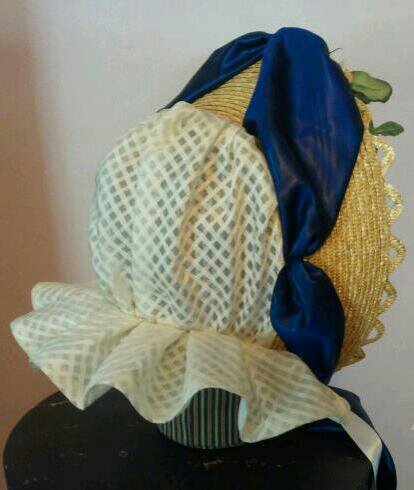
I finally finished my scallop brim straw bonnet. I’m rather pleased with how it came out.

image

The straw is the French straw plait with that beautiful golden straw. This is the first scallop edge I did. There have been several since then with a more refined, smooth connection. The shaped and scalloped straw edges from the 1850s and 60s are quite decorative, often with very fine straw. This is the simplest of scallop. I look forward to creating more.

image

The soft crown is a white and ivory windowpane check silk organza (This is the left overs from the drawn organza I share a week ago. This gives you an idea of how long I was working on each of these.) The bavolet is lined with cotton English net.

image

The ribbon is a dark blue German moire.

image

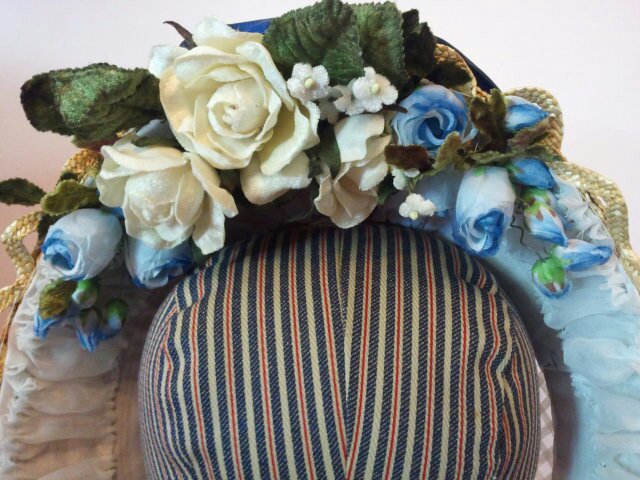
The flowers are ivory velvet roses and smaller, light blue fabric roses. I rather like the little rosebuds because they dangle nicely.

image

image

Published in: on June 3, 2014 at 6:00 am  Leave a Comment  
Tags:

A Year in Millinery Fashion – 1864

(Wedding reception attire)
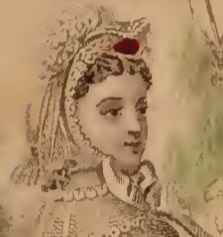
Bonnet of white crepe, trimmed with very light feathers and point lace. A fall
of the latter drops over the brim in the Marie Stuart style. The inside
trimming is of tulle and cerise flowers.

1

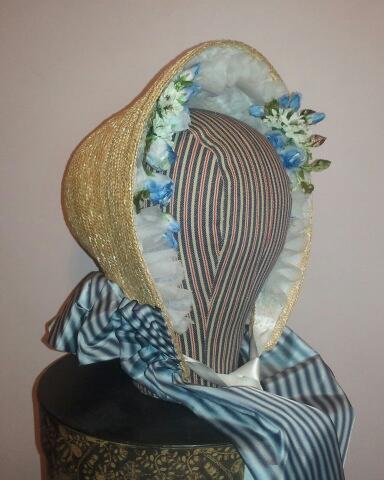
1850s French Straw with Clouded Stripe Ribbon

This is the bonnet that made me squeel this morning as the new owner put it on. It fit her so beautifully, I really did squeel.
2014-05-19 17.59.11-1
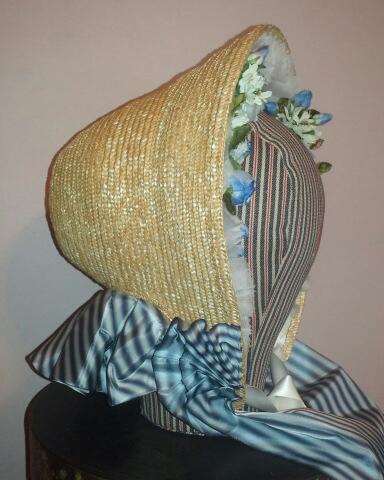
I enjoyed making this bonnet so much. I love the 1850s to begin with. When I came across this ribbon, it just had to be her’s. While it is grey and white, it is also a bluey-purple. It was wonderful to work with. The bias bavolet plays with the clouded stripes wonderfully.
I am so glad we picked these blue and white flowers because they work beautifully with her complextion. They frame her face just right.
2014-05-19 17.59.39-1
This bonnet is made with the French straw plait I enjoy working with. I opted to line this straw bonnet because I know it will be work frequently. (While most original straws show they were not lined, lining can protect the straw.) The frill is silk organza. She has both silk functional ties and the fabulous ribbons.
2014-05-19 17.59.52-1

2014-05-19 18.00.53-1

Published in: on June 1, 2014 at 5:08 pm  Leave a Comment  
Tags:

Mrs. Bright’s and Mrs. Blank’s Journals – December

I stumbled across something I found to be a fun read in the 1866 American Agriculturalist. The Ladies Column included a full year through the eyes of two women. I’ll share each month for the next two weeks (ish) side-by-side. (The excerpts are a bit challenging to read.)

December


Straw Hats – Looking at shaping

I’ve had some hat related questions this week. Here is a blog post regarding the shape of straw hats from a few years back. I’ve also started a Pin board of hats in photos. http://www.pinterest.com/annawordenb/millinery-hats-cdvs/

If I Had My Own Blue Box:

These images are for a discussion on the Sewing Academy. Since I am horribly disorganized at the moment, I am putting the files directly here. If I have included an image of yours you would like me to remove or give credit to, please let me know, I am very happy to do so.

10987654321This angle is nice for showing the difference in the width of the brim comparing the fronts to the sides. The sides also curve down.

2008-09-3019-09-03_0032

 Links:

http://www.flickr.com/photos/josefnovak33/2813904046/

hmmm on chair http://www.flickr.com/photos/piedmont_fossil/2218142840/

 Hats at the MET: 1840mid-century, they say 1860s I say late at best, 1859 (one of the coarser hats I’ve seen), 1850-59, different, also different (bias cut ribbons), 1866-68, 1866-68, late 1860s (woven), late 1860s, 1863-65,      

PeteJuly60 from PamPeteJune60 from PamPetersons Aug60Petersons July61 bPetersons July61

View original post

Published in: on May 30, 2014 at 8:29 am  Leave a Comment  

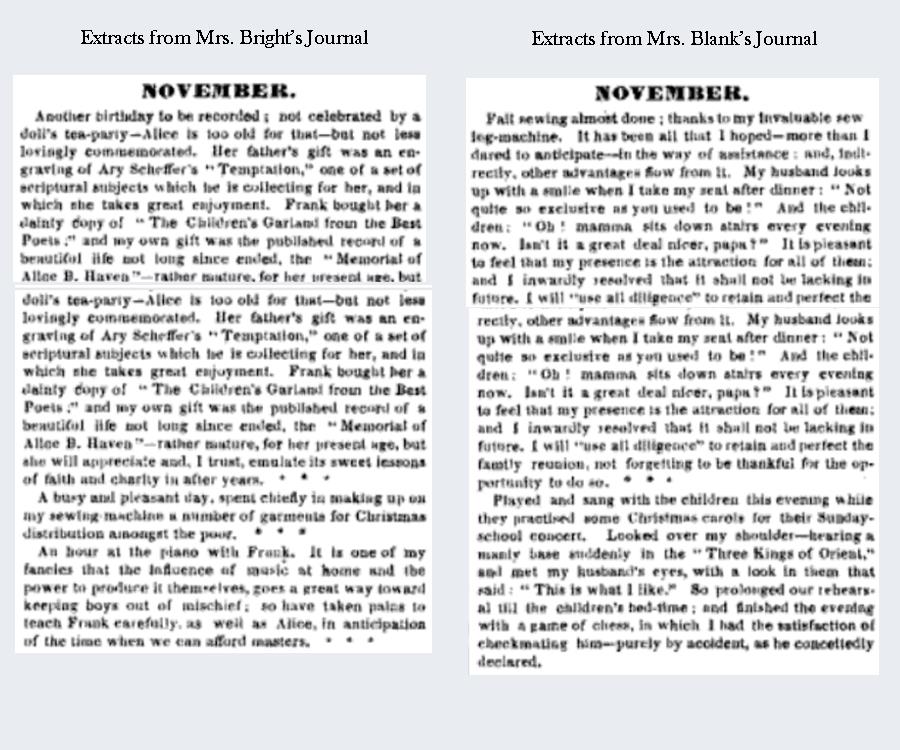
Mrs. Bright’s and Mrs. Blank’s Journals – November

I stumbled across something I found to be a fun read in the 1866 American Agriculturalist. The Ladies Column included a full year through the eyes of two women. I’ll share each month for the next two weeks (ish) side-by-side. (The excerpts are a bit challenging to read.)

November

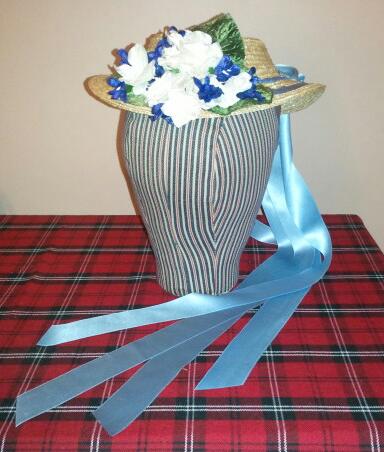
Just the Right Blues

It looks like many of you enjoyed the Green Velvet Straw Hat I shared on Tuesday. Thank you. (Be sure not to miss “Violets in Early Spring” a sheer organza bonnet)

Here is another hat I finished just prior to that one. This one is all about the right blues and right greys. To find just the right blue and grey, I requested a swatch of every blue and grey silk my fabulous ribbon supplier had. I know it is hard to see, but the tails of this hat show the blue and grey we picked.

2014-03-29 17.46.55-1

For the ribbon on the brim, I looked to several original straw hats for inspiration and technique. This one in particular, I like. The Vs in the front and back help allow the green velvet ribbon to lay flat. One of the keys is a narrow ribbon. Since we were only able to get the blue and grey colors in slightly wider ribbons, I needed to fold the ribbon to get the right width. I rather like the softness a folded ribbon give.

2014-03-29 17.47.54-1

2014-03-29 17.48.12-1The flowers are all velvet. I just love the texture of velvet against straw.

2014-03-29 17.48.23-1

Mrs. Bright’s and Mrs. Blank’s Journals – October

I stumbled across something I found to be a fun read in the 1866 American Agriculturalist. The Ladies Column included a full year through the eyes of two women. I’ll share each month for the next two weeks (ish) side-by-side. (The excerpts are a bit challenging to read.)

October

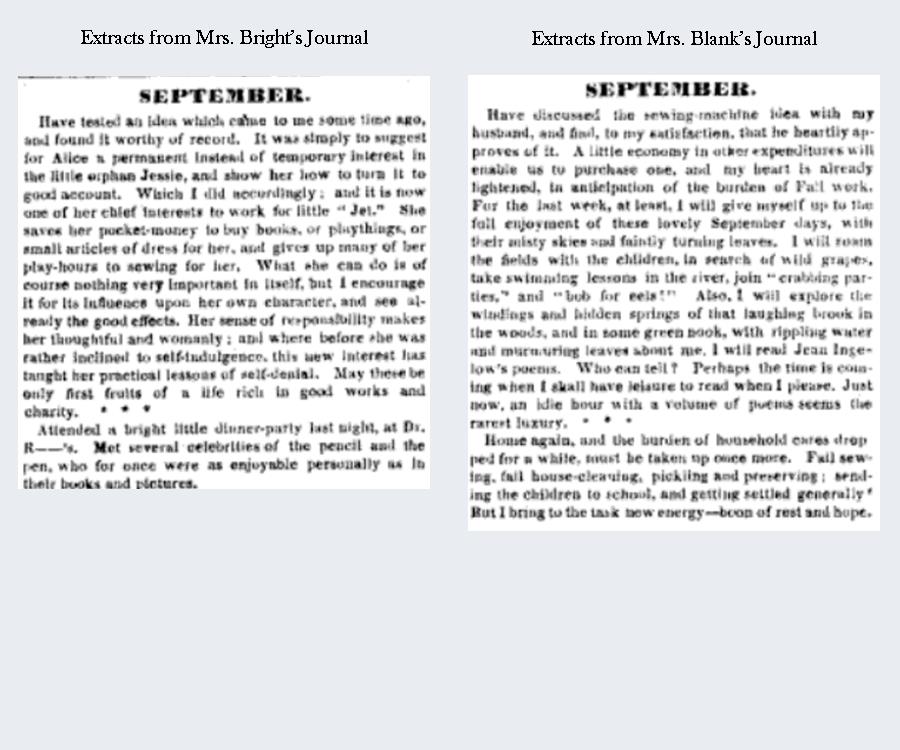
Mrs. Bright’s and Mrs. Blank’s Journals – September

I stumbled across something I found to be a fun read in the 1866 American Agriculturalist. The Ladies Column included a full year through the eyes of two women. I’ll share each month for the next two weeks (ish) side-by-side. (The excerpts are a bit challenging to read.)


September