Readings for Rural Life

From Moore’s Rural New-Yorker in Rochester, NY

May 28th, 1864

Out-Door Etiquette – A gentleman meeting a lady should always take the right of the walk
A gentleman meeting another, should always pass to the right.
A lady, as a general rule, should not take a gentleman’s arm in the street in the day time. However, it is not improper when the walk is thronged with passengers.
A gentleman meeting or passing a gentleman and lady should pass on the gentleman’s side.
A gentleman should never fail to salute a lady of his acquaintance when within a proper distance, unless she wear a veil, in which case it would be highly uncivil to recognize her.


Reply to “The Unprotected Female.”

That any person in this enlightened age – the year of our Lord 1864 – should write such sentiments as those contained in the article on the “Unprotected Female,” passes my understanding. I was shocked more than words can express upon first perusing it! And the subject occurred to my mind again and again; the more I endeavored to banish it, the more it wouldn’t go; and that the author was the victim of a strange hallucination, and optics sadly obscured, as though seeing darkly, through smoked glass, and with mental vision in the same unfortunate predicament, would continually suggest itself.

Nevertheless, to relieve my mind, I will use a woman’s privilege, and express my opinion. It may seem egotistical, but Dr. Winship remarks: – “In every man’s experience – that of the humblest, even – there is something of value to the race;” therefore, I conclude there must be in every woman’s.

I, for one, believe it to be a man’s prerogative and pleasure to protect a woman whenever necessary; she being physically the “weaker vessel,” custom sanctions it – and every refined, intelligent person must approve it. In some cases, however, it is quite uncalled for. Alas, when she loses her shrinking modesty, and so far unsexes herself as to be seen striding in “male attire,” stamping around with a cigar in her mouth, she should not “demand any more interest or sympathy than an unprotected male,” but can insure the hearty contempt and disgust of every right-minded one.

I have yet to be convinced that fashion required us to be encumbered with “many boxes and bundles.” Doubtless many take more baggage than necessary, but in my travels I have observed but comparatively few who have not availed themselves of the express to take charge of their trunk or trunks, troubling themselves only with a small traveling bag, when the distance made it necessary, which could be carried on the arm, leaving “both hands free.” I have seen many travel hundreds of miles with noting save the above mentioned trunk, which being in the hands of the express need be no trouble or care to any one, and which niceness would render indispensable a the journey’s end. I have further known ladies to visit the city of New York and sister cities, and, without ignoring fashion, remain at a hotel a whole week, with by a small basket containing only necassaries for the toilet, and wearing their traveling dress during the time.

It seems wonderfully pertinent (?) comparing the quantity of a gentleman’s baggage with that of a lady’s, with their different style of dress; for did neither take a useless article and indulge equally in the luxury of cleanliness, a lady would absolutely require far more. It is a notorious fact that gentlemen need only changes of linen; and it may be a slander of the sex, but I never supposed a little dirt, more or less, would effectually disturb their equanimity.

Aside from the exaggeration conspicuous in every paragraph, the writer betrays an entire ignorance of “fashon.” Allow me to ask if it is not the fashion to wear stockings and boots, rivaling men’s in warmth and thickness?

And the hoop skirt, that many of the masculine sex raised such a hue and cry about, and with their usual consistency concerning anything pertaining to ladies’ dress, were unwilling wife or daughter to appear without, has been growing “small by degrees, and beautifully less,” until none need now complain of their dimensions, which it is to be hoped will continue the same. Without dwelling on their gracefulness or excellence in making a handsome dress appear to the best possible advantage, they are indispensable in a physiological point of view. Women need their powers of locomotion assisted rather than impeded. In the words of the editor of the Scalpel, “We consider the modern hooped skirt one of the most admirably artistic and health-giving devices of our time.”

And, pray, is it not the day of “Garibaldi’s,” “Zouave,” and other kindred jackets, that leave the waist in perfect freedom? It strikes me as being an exceedingly lame, one-sided argument because it is a deplorable fact that some, through ignorance, carelessness, or folly, injure themselves with tight-lacing, that the corset should be discarded. It is useless to mention that they are necessary to insure a perfectly fitting dress, and essential to that distinction of style which marks the well-bred lady; for I trust the author referred to is above any little weaknesses of any kind’ and I fully believe a French corset scientifically adapted to the figure, to be conducive to health, as many of our best physicians assert; so loose when laced as to readily place the hand under, and with whalebones so this as only to be perceived by the delightful feeling of support they give. Many with weak sides and irresistibly inclined to stoop have been permanently benefitted by them. Suppose wine should be abandoned as a medicine, because so many unfortunately became intoxicated? What if an unbeliever should bring forward as conclusive evidence against the need, the power of Christianity, that in a fit of religious phrenzy some have committed suicide?

Perhaps because tight dresses are sometimes worn, they had better be rejected altogether! Indeed, although the present style (without apparently knowing what that style is) was sweepingly condemned, as nothing better was suggested, I am at a loss to determine whether the writer considered it preferable to return to the primitive state of our first parents, or don masculine habiliments which seemed to find much favor in her eyes. As dress, in a measure influences character, likely the next innovation would be chewing, smoking and swearing; for, without the provocation of “trailing skirts,” far too many of the “sterner sex” in our small villages and cities, as well as in far-famed Gotham, seem to cultivate and esteem the latter as an accomplishment.

It is a painful thought that any woman can have perverted views, such questionable delicacy and modesty, as to advocate such a change. The Bible expressly forbids it: “The woman shall not wear that which pertaineth unto a man.” I well recollect the effect of the first “Bloomer costume” I ever beheld. It was at the “Crystal Palace,” and attracted more attention than any of the miracles of workmanship and art exhibited there. Is such conspicuousness pleasant? – that sort of notoriety desirable by a refined, cultivated, judiciously educated, or even by a modest woman?

Sufficient exercise in the open air, with regular hours and habits, would go far toward restoring the health and strength so greatly heeded. As “seeing is believing,” I can show Miss (or Mrs.) “Amanda Roberts Keyser” a woman past “her sixteenth year,” and dressed for the last three years with considerable “regard toe the dictates of fashion,” who has not been troubled for an instant during that period to “draw a natural breath.”

I would also assure her that for some time past, it has not been the “fashion” to let the skirts trail in the dirt, but to wear them looped up. I certainly admire the queenly gracefulness of the long flowing skirt, which has the prestige of antiquity; was worn and admired by the haughty Grecian and Roman ladies. But I consider other place more appropriate for the trail than the dirty streets of New York.

It seems equally reprehensible to follow every varying phrase of fashion, or excite undue notice by the ridiculous outer appearance that must inevitably follow an entire disregard of the prevailing mode. Among the multiplicity of designs, something genteel and pretty can always be selected, which will occupy no more time in making than would the most singular, uncouth costume that could be imagined. I believe it woman’s duty to make herself pleasing, and dress according to the station in which she may be placed; nor do I believe she could perform other more important duties, by a disregard of this. Nor need a person gratifying a fine aesthetic taste by dressing in a becoming robe, necessarily neglect the preparation of the immortal soul for the life to come, more than if poorly clad in somber hues, – any more than one’s a better Christian for wearing such a gloomy, sour, woe-begone visage as to frighten children, and cause them to think religion something terrible.

There will always be pratting about the inferiority of women by a certain class of men, whose morals are fearfully out of repair, and where brains are decidedly at discount; and probably some women will, too, parrot-like,  repeat their opinion. The writer has the advantage of me, however, if she has ever heard anything more silly emanating from the lips of women than men.

In closing, I can not forbear giving, for future consideration, the injunction of Horace, Sumite materiam vestris, qui scribitis, acquam Viribus. Lancillotti.


(translation of the last line – let those who write fix on a subject to which their force is equal)


Published in: on May 28, 2014 at 6:00 am  Leave a Comment  
Tags:

A Perfect Green & a Perfect Fit

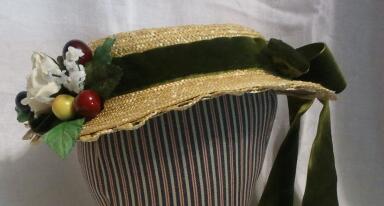
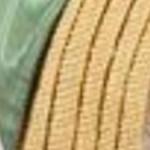
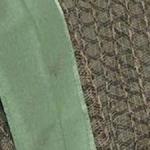
I was beyond excited when the photos of the new owner of this hat came through just moments ago. Between the perfect fit or the perfectly happy smile on her face, I am estatic.

This shape hat just called for a scallop edge. The dip and curve of the brim are highlighted with the scallops.

The client had the incredible satin back velvet ribbon and the beautiful berries. It was amazing how well the two went together, playing with each other and bringing out the gold of the straw. The ribbon feels awesome too. (Check out my post from last week, “why green”, for more information on green.)
2014-05-22 16.36.06-2

2014-05-22 16.36.11-1

2014-05-22 16.37.34-1-1

2014-05-22 16.37.38-1

2014-05-22 16.38.13-1
I just loved making this hat. I am so glad the new owner enjoys it.

Published in: on May 27, 2014 at 4:10 pm  Comments (2)  
Tags:

A Decoration Day Divided

I’ve been so absorbed in millinery lately, I haven’t spent as much time as I would like on the commemorative/memorial project. This post from Memorial Day, yesterday, reminded me that I really need to give it more attention to have enough together and ready for programs. Check out the vivid assortment of commemorative cards she shares.

streetsofsalem

The holiday which we now commemorate as Memorial Day has its origins in the immediate years after the Civil War, when late-May rituals of remembrance and decoration of veterans’ graves emerged and evolved spontaneously and separately in both the North and the South. Given the prominent role played by the Grand Army of the Republic (G.A.R.) in the official adoption of the holiday in the North in the later 19th century, a rather divided commemoration continued all the way up to World War I, which united the nation in remembrance, and widened its circle to encompass American veterans of all conflicts. In 1971, Memorial Day was declared a national holiday by an act of Congress and placed on the last Month of May. And thus we have our national commemoration and commencement of summer (although weather-wise, the latter might apply only to the North). When tracing the earlier history of…

View original post 129 more words

Published in: on May 27, 2014 at 8:24 am  Leave a Comment  

Mrs. Bright’s and Mrs. Blank’s Journals – August

I stumbled across something I found to be a fun read in the 1866 American Agriculturalist. The Ladies Column included a full year through the eyes of two women. I’ll share each month for the next two weeks (ish) side-by-side. (The excerpts are a bit challenging to read.)

August

A Year in Millinery Fashion 1864

It is said that, as regards to invention, one milliner does more in a month than the world architects in a score of years. We are forcibly reminded of this while walking, lately, through the show rooms of Mme. N. Tilman, of 143 East Ninth Street, New York. At this establishment we are constantly surprised with novelties; nothing pretty or new appears in Europe in the millinery line, but is to beyond at the Maison Tilman.

An entire novelty consists of straw guipure, equal in appearance to the finest lace. Straw ribbons are also something quite new, and just introduced on the new spring bonnets. Mother of pearl, of which we have already spoken as being worn on coiffures and ball dresses, is now adopted for bonnets, and, in contrast with trimmings of rich velvet, produces an admirable effect. We are able now to speak with certainty of the spring style bonnets, as announced by the most distinguished artistes.

Scotch plaid, in silk and velvet, is very much in vogue; but we notice that Mme. Tilman uses is sparingly, and only in the finest and choicest patterns and combinations. The following will serve as examples. –

A rich wrought Neapolitan, the braids an inch apart, and each displaying a fine cord-like edge of blue, green, and crimson plaid. The curtain was composed of a shell of plaid silk upon blonde, also in a shell pattern. A puff of ribbon and meadow grass, tipped with dew, constituted the decoration, which was placed high on one side of the brim.

Trimming of all kinds is used very moderately, but it must be of the very best, whether in flowers, lace, or ribbon. It is no longer masses on the top of the brim, but is arranged on the top or side of the crown, or across the side of the brim from its tip to the crown. The shape is perfect, neither too large nor too small, but serving as a modest frame for a fair face. It is still rather high in the front, very much compressed at the sides, and slopes low behind to the base of the crown, which is wider than formerly, in order to allow for the present style of coiffure.

A charming novelty imported by Mme. Tilman consists of fine white and black Neapolitans embroidered in flowers and trailing branches in a fine jet. The design is so delicate and graceful, the workmanship so exquisite, that there is nothing of the ordinary appearance which is frequently objected to in embroidered bonnets. On the contrary, in black upon white, and black upon black, we have rarely seen anything so elegantly effective. Very little trimming, in addition to the cape of velvet or lace, and the decorations of the interior, is required for these bonnets.

Fringes of crystal and jet now replace the feather fringes, and are arranged to fall over the front of the bonnet and shade the interior. (Godey’s, May 1864)

Violets in Early Spring

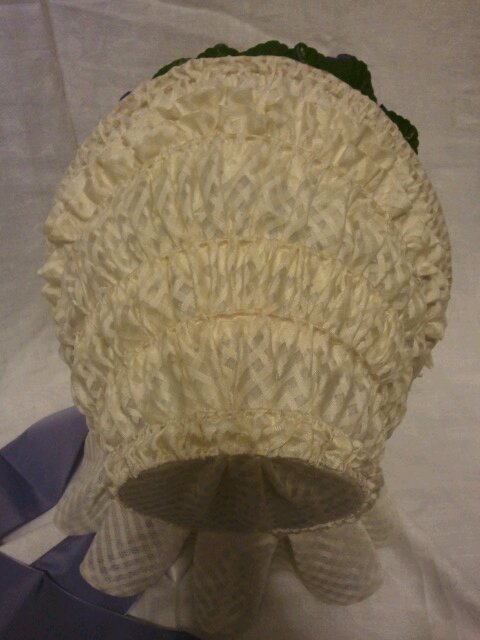
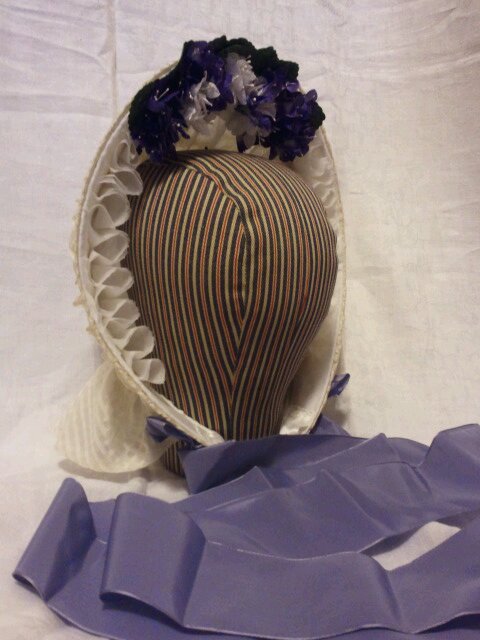
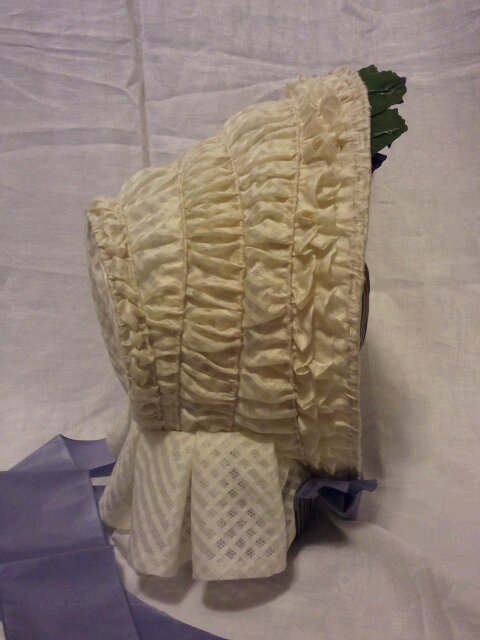
This bonnet is one I have slowly been working on for a while. It really does remind me of those tiny violets that peek up in the early spring. Sometimes they are a speckle of color in the grass; sometimes a speckle in the lingering spring snow. (Btw – I’m amazed by the abundance of white violets in our yard. So, I was glad I had white violets to mimic that too.)
image

This bonnet is a white and ivory organza silk organza woven in a windowpane check design, drawn on cane over light weight buckram. The brim also has some fluffy flounces.
image

The lilac purple silk ribbon comes from Italy. It is a beautiful ribbon both in looks and feel. The edge is particularly lovely. (I need a photo of that edge.)
image

image

You can find this bonnet on Etsy this morning with sideways photos. (Phone issues.)
image

image

I have a few other millinery pieces I am anxious to share with all of you. As soon as their new owners have them in hand, I can share.

Published in: on May 25, 2014 at 9:57 am  Comments (1)  
Tags:

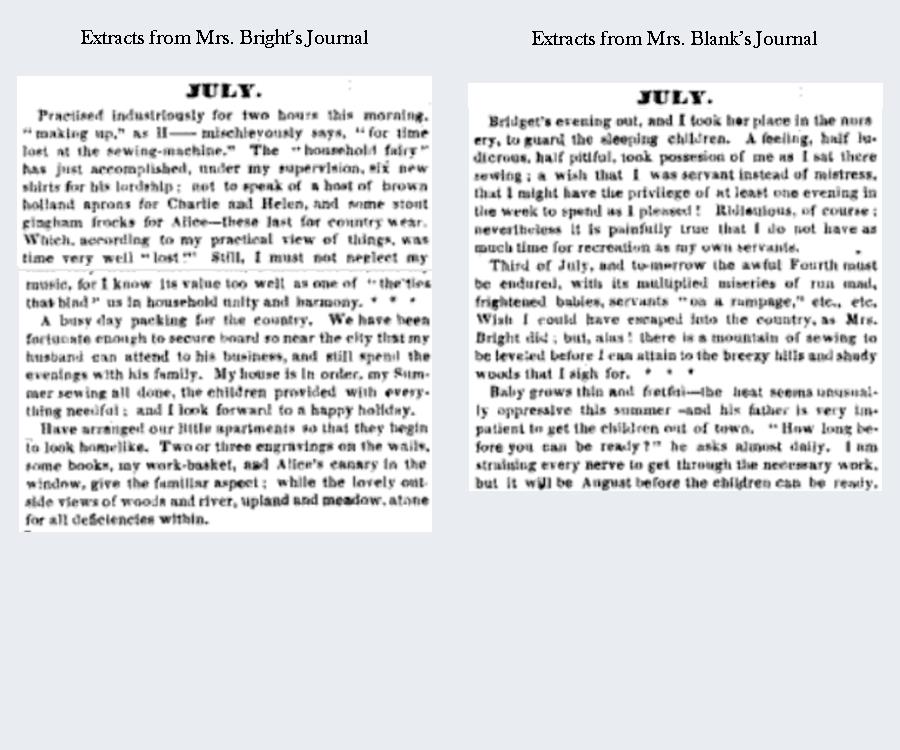
Mrs. Bright’s and Mrs. Blank’s Journals – July

I stumbled across something I found to be a fun read in the 1866 American Agriculturalist. The Ladies Column included a full year through the eyes of two women. I’ll share each month for the next two weeks (ish) side-by-side. (The excerpts are a bit challenging to read.)

July

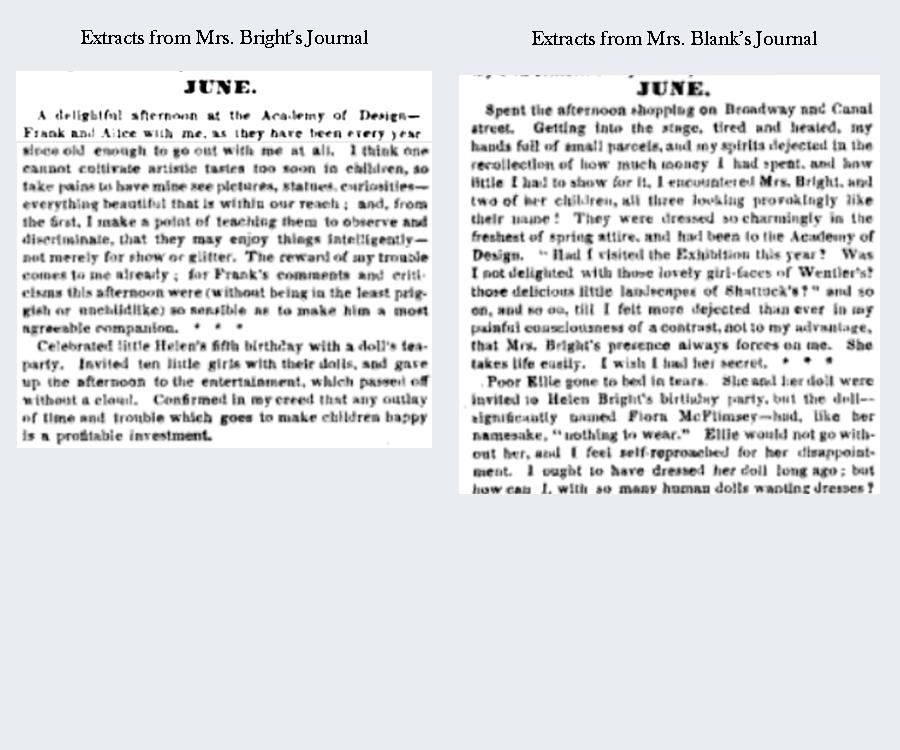
Mrs. Bright’s and Mrs. Blank’s Journals – June

I stumbled across something I found to be a fun read in the 1866 American Agriculturalist. The Ladies Column included a full year through the eyes of two women. I’ll share each month for the next two weeks (ish) side-by-side. (The excerpts are a bit challenging to read.)

June

Why Green?

This week I had the pleasure, rather joy, of truly seeing why green was used as often as it was with straw. I was applying this vintage satin back velvet ribbon in an olivey-green shade to a straw hat that is being mailed today. (I’ll share those photos once the recipient receives it.) As I stitched, I was caught by how the green brought out the golden richness of the straw. The hat was pretty before. But, the green ribbon made it almost glow.

After seeing numerous green ribbons on straw bonnets over the years, I finally saw what they saw. I saw how the green worked with the natural straw. It just works and work really well.

What does the original cast say of green for millinery?

For fair-haired women “A green bonnet is advantageous to fair or rosy complexions. It may be trimmed with white flowers, but preferably with rose. A rose-colored bonnet must not be too close to the skin; and if it is found that the hair does not produce sufficient separation, the distance from the rose-color may be increased by means of white, or green, which is preferable. A wreath of white flowers in the midst of their leaves, has a good effect.” (“Color and Ornament”, Home Circle. Nashville, Tenn, 1856)

The main relations of color to be borne in mind are these: Green is the opposite, and the complement, to red; green, therefore, reddens adjacent hues, and red adds a green tinge to them; but green and red set off each other to the best advantage when placed side by side – the green looking greener, the red redder – and this is, of course, most thoroughly the effect when the two colors are alike in depth of tone. What green is to red, yellow is to violet, and blue to orange. In the same way it may be said that the yellow tints of green suggest their compliments and opposites, the violet-reds; the yellow-oranges contrast with violet-blues, and the orange-reds with blue-greens.

Thus the pink of the complexion is brought out by a green setting in dress or bonnet; and any lady who has a fair complexion, that admits of having its rose tint a little heightened, may make effective use of the green color, but it should be a delicate green, since it is of importance to preserve harmony of tone. When there is in the face a tint of orange mixed with brown, a brick-red hue will result from the use of green; if any green at all used in such a case it should be dark.  (“Something for the Ladies About Color“, Harper’s New Monthly Magazine, November, 1854)

A green bonnet is advantageous to fair or rosey complexions. It may be trimmed with white flowers, but preferably with rose….. A green bonnet is suitable to fair and light rosey complexions; rose, red, or white flowers are preferable to all others. (“How to Choose Colors in Dress“, Peterson’s Magazine, 1855)

Worded another way in the London Quarterly Review: A delicate green is favourable to all fair complexions which are deficient in rose, and which may have more imparted to them without inconvenience. But it is not favourable to complexions that are more red than rosy, nor to those that have a tint of orange mixed with brown, because the red they add to this tint will be of a brick-red hue. In the latter case a dark-green will be less objectionable than a delicate green. (1855) (you can tell there was plenty of quoting and paraphrasing going on.)

thumb 6 thumb 5 thumb 4 thumb 3 thumb 2 thumb 1


Published in: on May 23, 2014 at 12:25 pm  Comments (1)  
Tags:

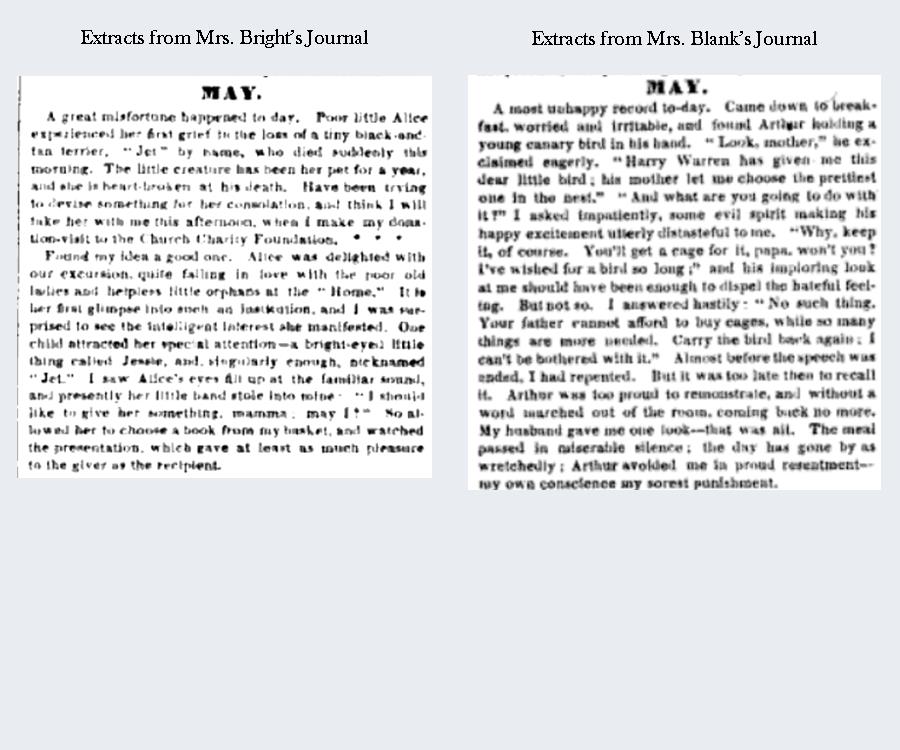
Mrs. Bright’s and Mrs. Blank’s Journals – May

I stumbled across something I found to be a fun read in the 1866 American Agriculturalist. The Ladies Column included a full year through the eyes of two women. I’ll share each month for the next two weeks (ish) side-by-side. (The excerpts are a bit challenging to read.)

May