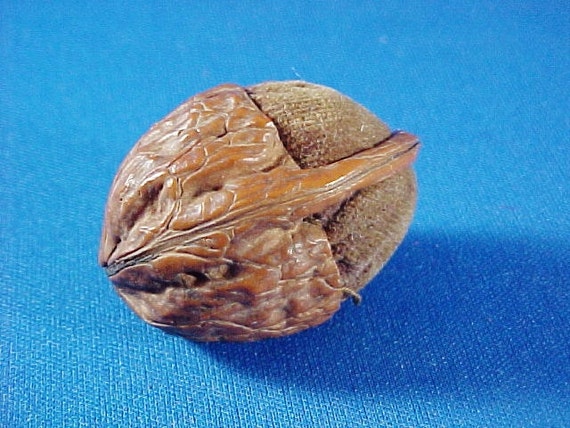
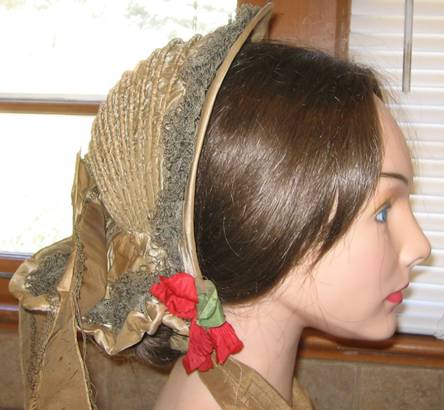
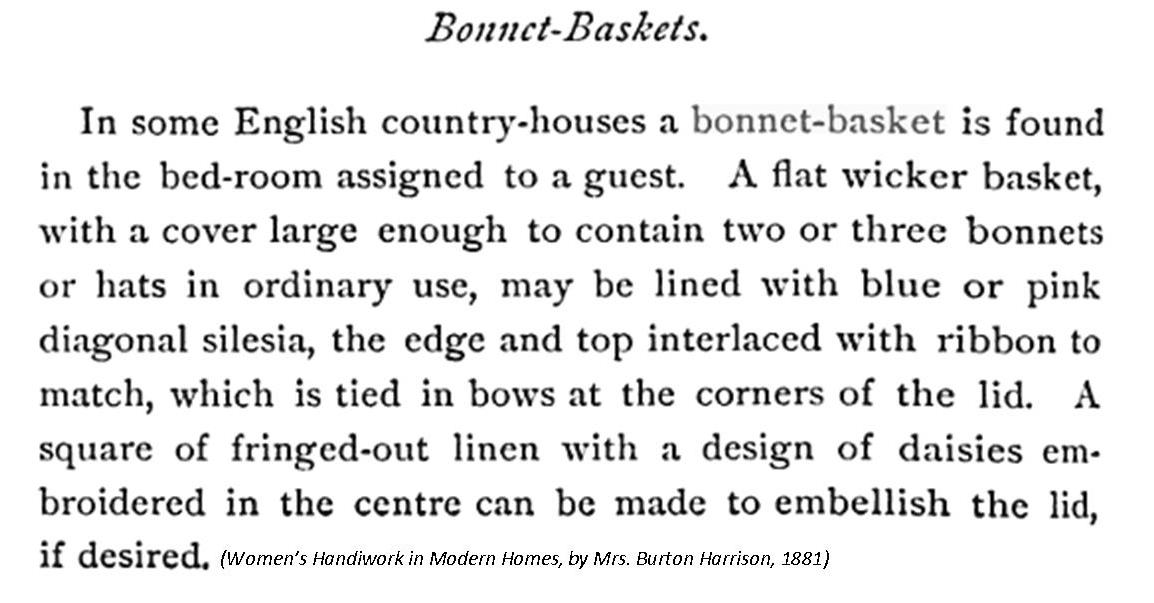
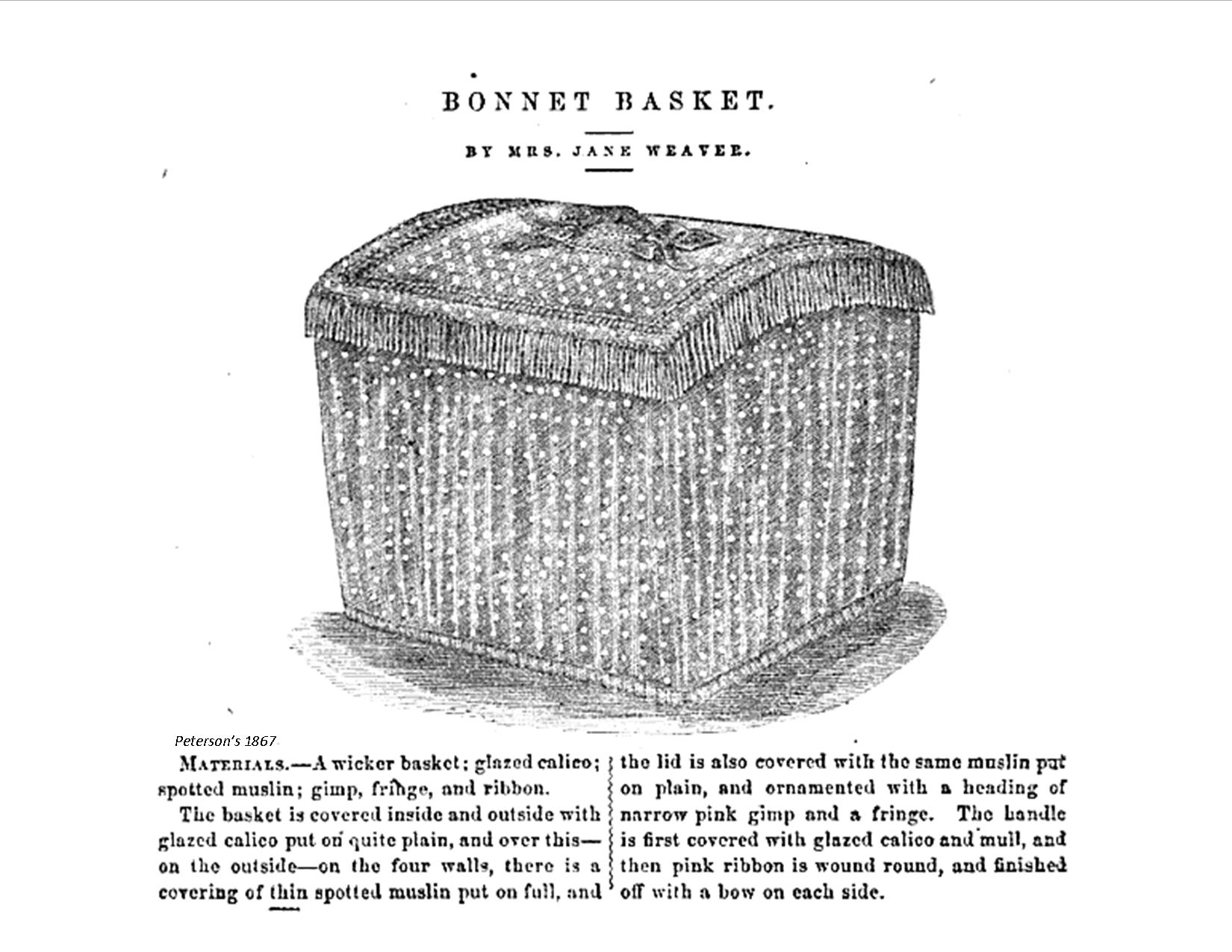
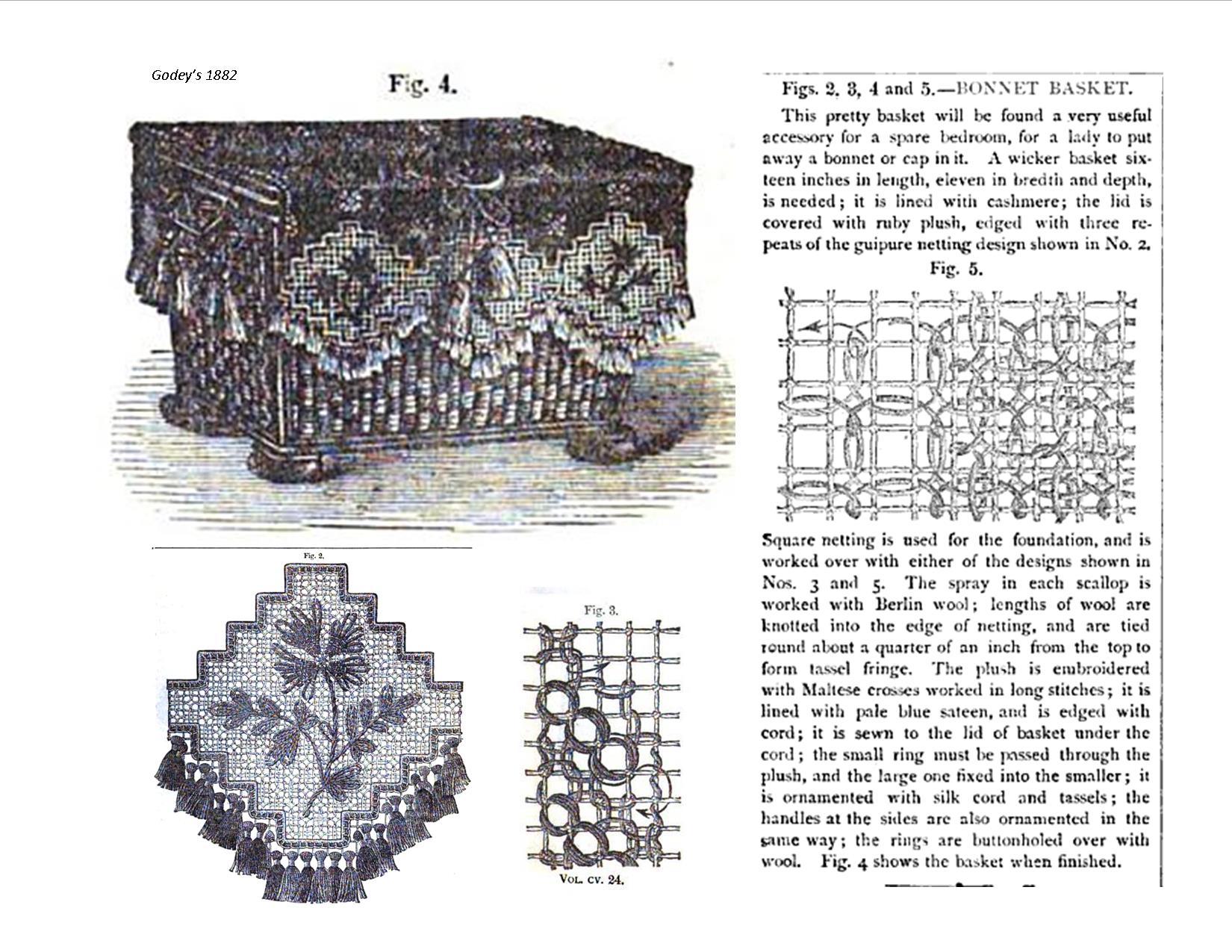
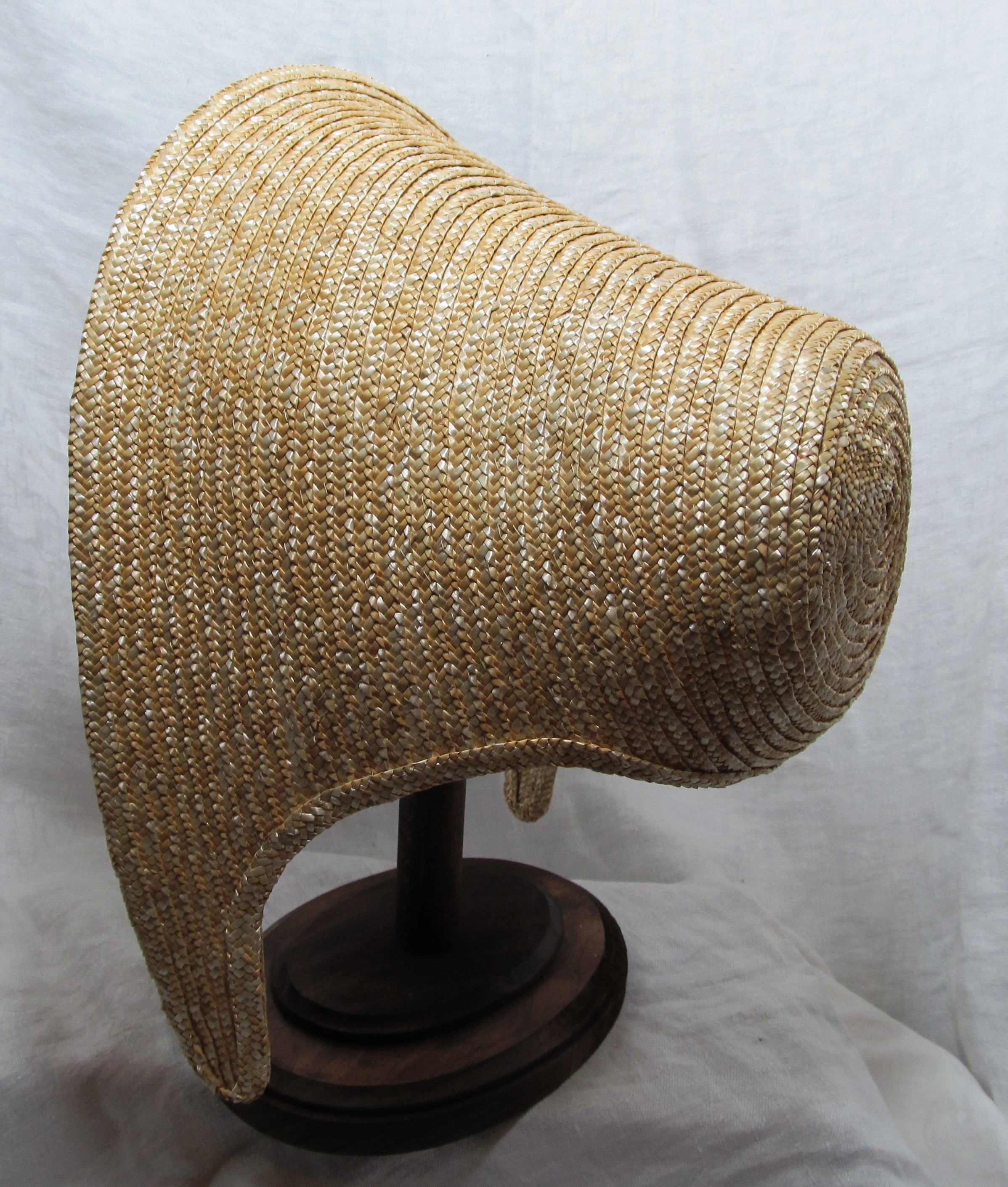
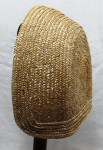
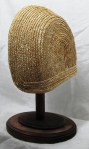
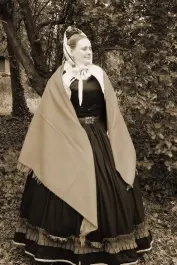
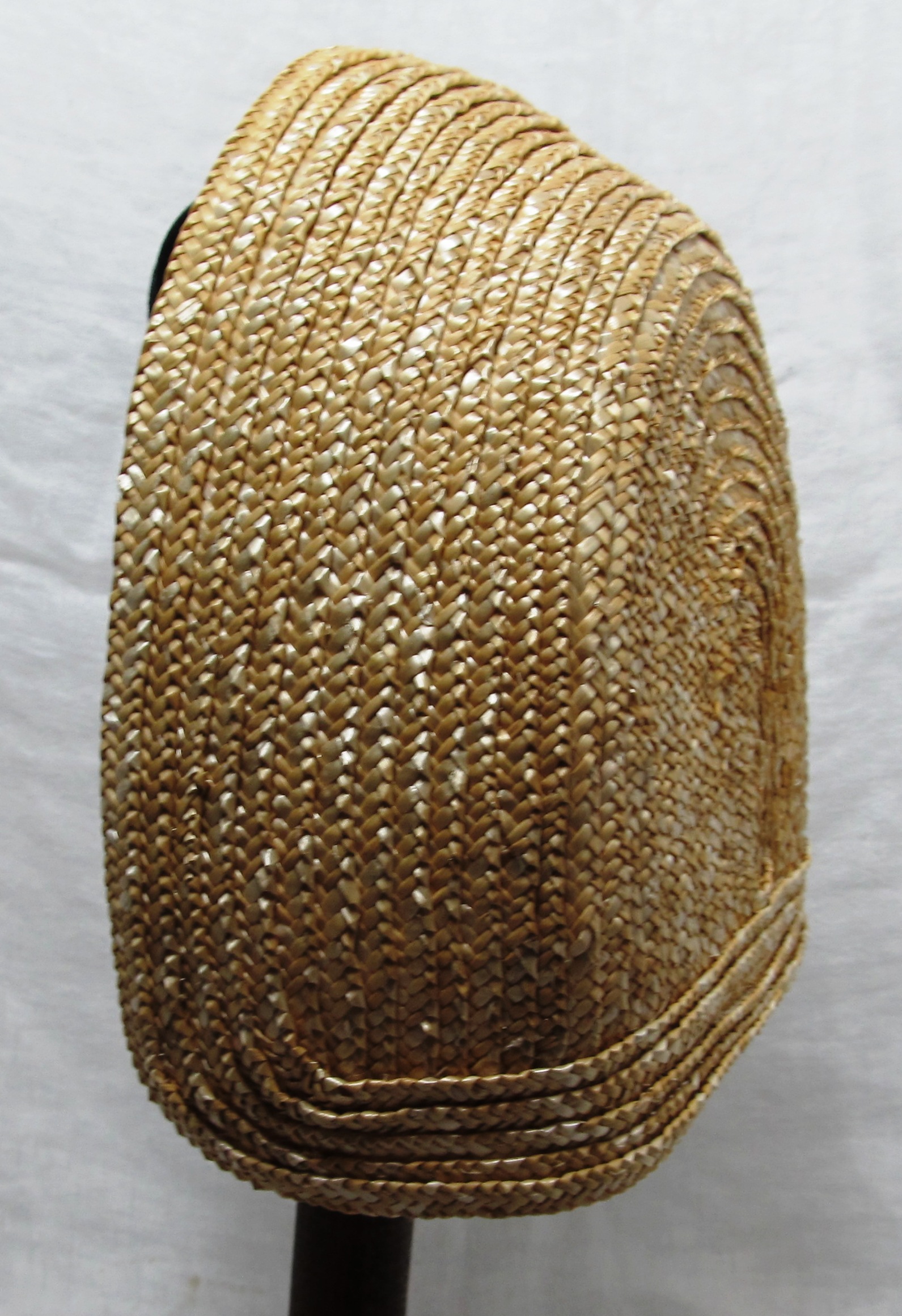
Nifty something that just has to get made. (Peterson‘s 1867)
Ask the Milliner #3
“When do you sew?”
I rather like this question. Part of the answer is ‘when ever I can’.
The reality is I try to squeeze an hour or two in each night after work and before making dinners and lunches. If I can get in two hours, this often means skipping the, um, cleaning of the house stuff. (Thank you to a friend who said “I can do one thing really well.” as this idea has kept me sane.) During February recess, Spring break and Thanksgiving, I try to sew as much as I can. I adopt a different sleeping schedule (often I feel better with this 9 am to midnight or 1 am schedule than I do with the 6 am to 9 pm schedule.) Summer is when I do the bulk of my sewing. I used to have an incredible summer history camp program that I miss a lot. Sadly, that is gone. Bad for kids. Good for clients. Now, I sew. If I do summer school, I drive into suburbia for the mornings, then sew from 1 or 2 pm until I fall asleep. I would like to spend more time sewing in the historic village this year. I’ve found 10 or 12 hours is my wall.
“Why did you start making these to sell?” MaryAnne
I think this was something Dad urged me to do. I started with the research that became From Field to Fashion first. I made some bonnets for myself. Then we did a local workshop. I think it just tumbleweeded from there. When I look at photos from early on (we are talking the late 90s and early 2000), I think they were a decent start but…. (see next question)
“If you could go back to when you started and give yourself one piece of advice as you started millinery, what would it be?” MaryAnne
The first thing that came to mind was “spend more time with Dad”.
In terms of practical construction, I would say:
- Start with smaller plait.
- Save the fancy plaits because it is really hard to find more.
- Learn to wire flowers early on. (sadly, in the first few bonnets I used glue on real flowers.)
“I am curious to how you would prefer your customers store and care for them?” Georgiana
I would love everyone to have enough space for each bonnet to have its own cloth head and box to go over it. Oh, wait, I would love me to have enough room for each bonnet to have its own cloth head and a box to go over it. 
The reality is we all have space and budget issues. For at home storage, I would suggest a spacious tote/box with a support inside to hold the bonnet. There is a Sterilite tote currently made that nicely fits 2 bonnets standing up on cloth heads or hat stands. They can also fit 3 bonnets nested together if you have to. I suggest the head forms or stands because bavolets tend to crush and wrinkle horribly over time. Stands will help prevent that. Give these a try. Now that I think more about it, if I had more heads I would try to secure them to the bottom of the tote so they would shift when moved.
Ask the Milliner #2
For the second “Ask the Milliner”, I’ll answer some questions on shape.
How do you look at an original bonnet and know what you need to do to get the brim shape and height, the correct crown shape, etc? Betsy
I would love to have a precise scientific answer to this. But, I don’t. When going from an original to a repro, so much of it is trial and error; talking with the straw, trying to get it to do what you want. Vague, huh?
To be a little less vague, I have to look at the bonnet as a whole and as parts. These parts are not always the same parts I’m going to talk about below. I have a sort-of mental categorization for bonnets and hats as to how they are generally built. Each segment constructed and contributing to the whole. When looking at each segment, I can think about what it takes to make that part. Looking at each part, it has its own shape, angles, curves and size. I know tight tension can keep one area flat, while loose tension can add loft; or playing with the tension on each side of the plait can create a flare. Then the pieces go back together in my mind. Sometimes I will mentally construct a new pieces over and over in my head, often as I fall asleep.
Now, when it comes to making a shape for a particular person, I find it so much easier if I know the person, if I’ve seen their face, how they move, their coloring and personality as well as what their impression or impressions will be. This is why I prefer not to do many commissions. Something has to catch me about someone or their request. For me, making a bonnet for someone is as much art reflecting a person as historical reproduction.
What are some quick tips for getting the right shape/interpreting the original bonnet’s shape? Betsy
Regardless of era, I think it is essential to look at lots and lots and lots of originals. Look at the years you are focusing on. Then look at those bonnets just before and just after. Break the shapes down into the components – the tip, the crown, the brim, the cheektabs. What shapes do they have? Where to the sit on the head? Where do they sit compared to the rest of the bonnet? How does the shape work with the hair of the time? What makes sense? What doesn’t make sense?
If you are overwhelmed, print a few dozen out in small card size prints. Make a little game for yourself. Sort the images by similarities in shape. You will likely see some patterns arise. You will likely see that no single shape matches a year. Instead, you will likely see that a couple different shapes are fashionable, maybe even competing with each other, while some other shapes are still worn.
Where do you think modern reenactors go wrong with bonnets, and how to correct it. Simple tips to “fix up” your millinery. Clarinda Ann
I think we a prey to shapes that are easy to make and sell cheap when we start out. Often for the mid-century and Civil War era, these tend to have low brims, shapeless crowns and short, fat cheektabs.
Brim – For the mid-century, the bonnet’s brim should frame the face, high-lighting it. It should not trap the face inside. (there are very few, specific exceptions to this.) If you’ve unknowingly bought a bonnet that traps your face, see if it will fit a younger girl. With a little steaming and reshaping, this may be an expense rescue.
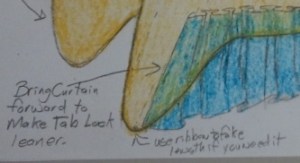
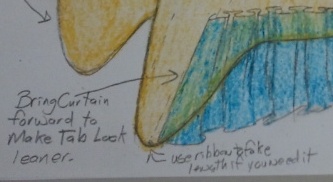
Cheektabs – The cheektabs of the late 1850s and early 1860s are generally lean and long, coming down the sides of the face and under the chin. In the 50s, they appear to curve backwards. In the 60s, the curve is more a twist inward. Remember you want to frame the face. When I say lean, I mean at the very most 2″ wide at the top narrowing greatly. If you unknowingly bought a bonnet frame with wider tabs, you can try to fool the eye into seeing narrower tabs with how you place your bavolet. Here is a little sketch I did for someone else needing to do this.
Next time, tbd.
Spring Break Bonnets
I’ve been busy sewing away this “spring break”. (Spring break in quotes because it does not seem spring like out side and does not seem break like inside.)
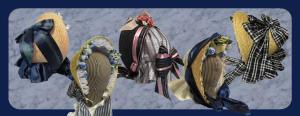
The first of the week found a new home over the weekend. It is a soft blonde straw made up with a low brim and gently rising crown.

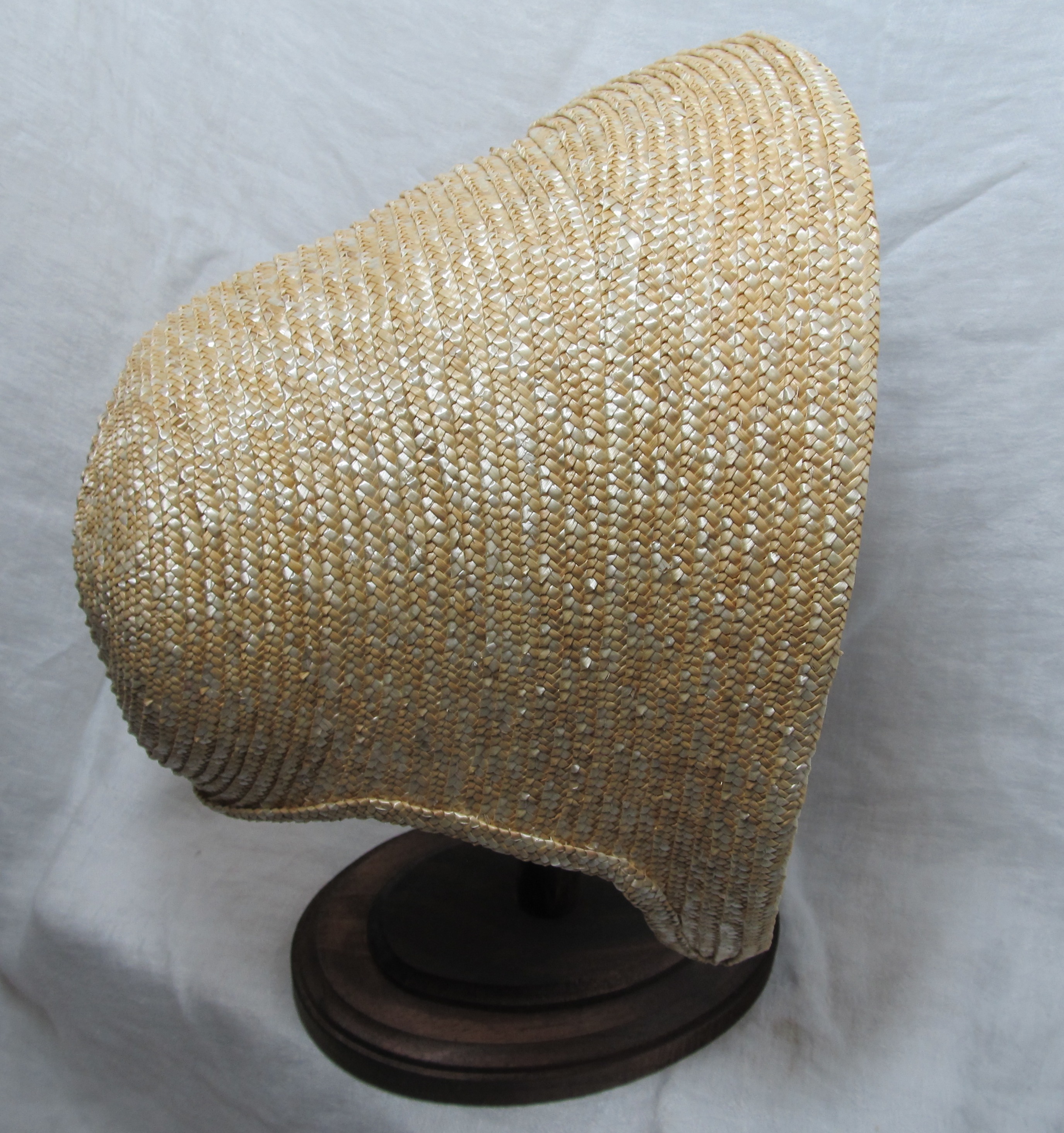
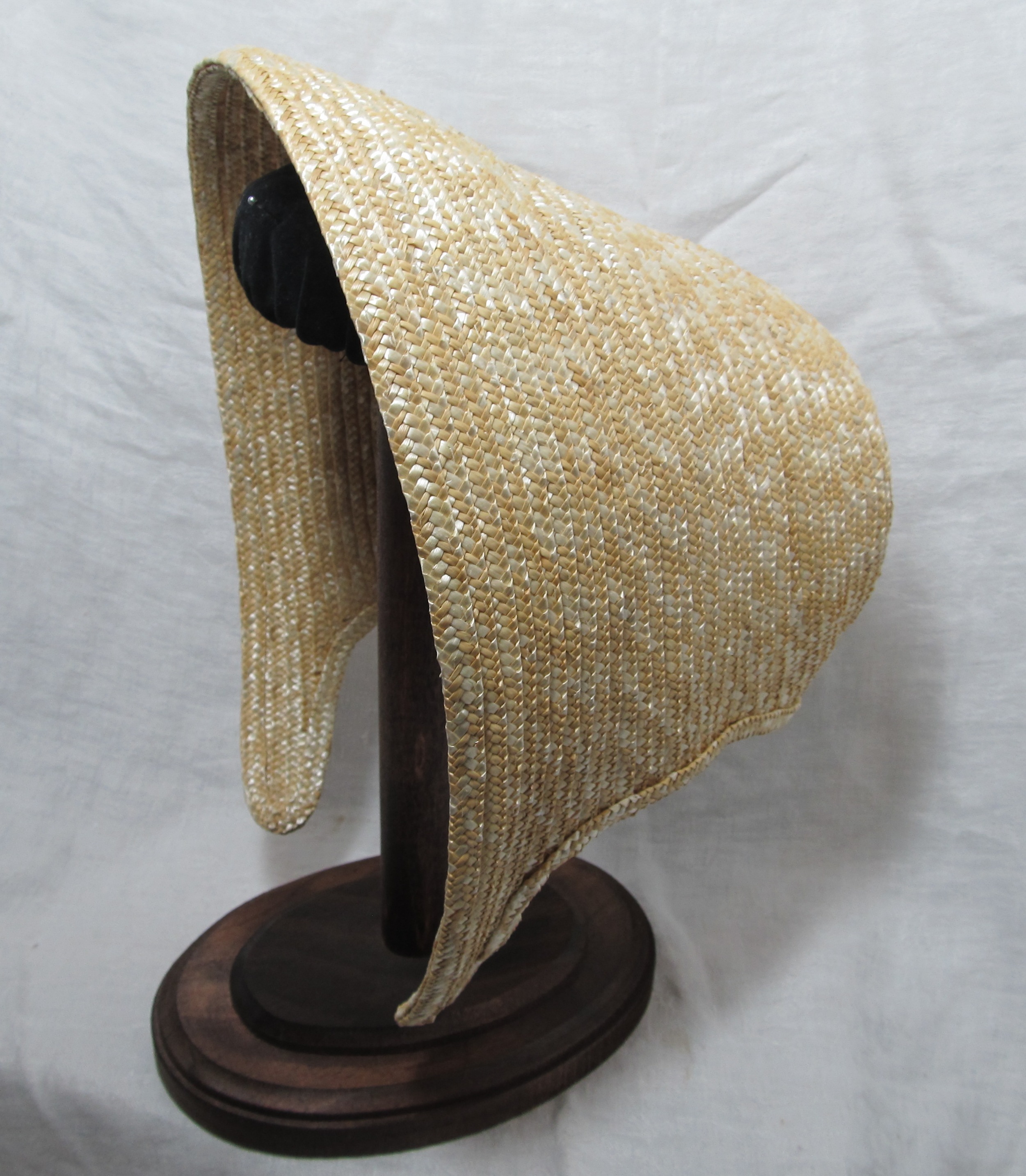
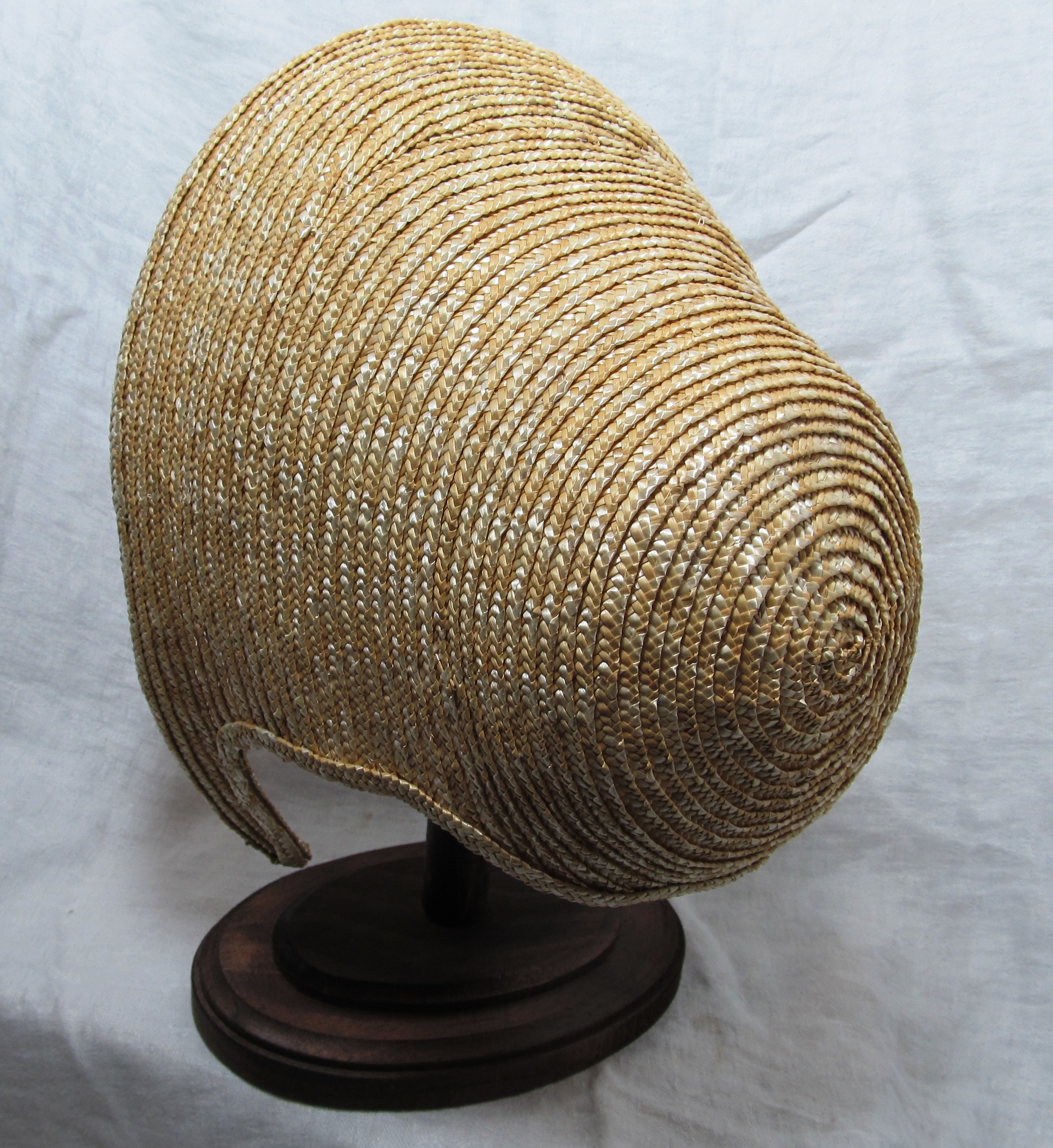
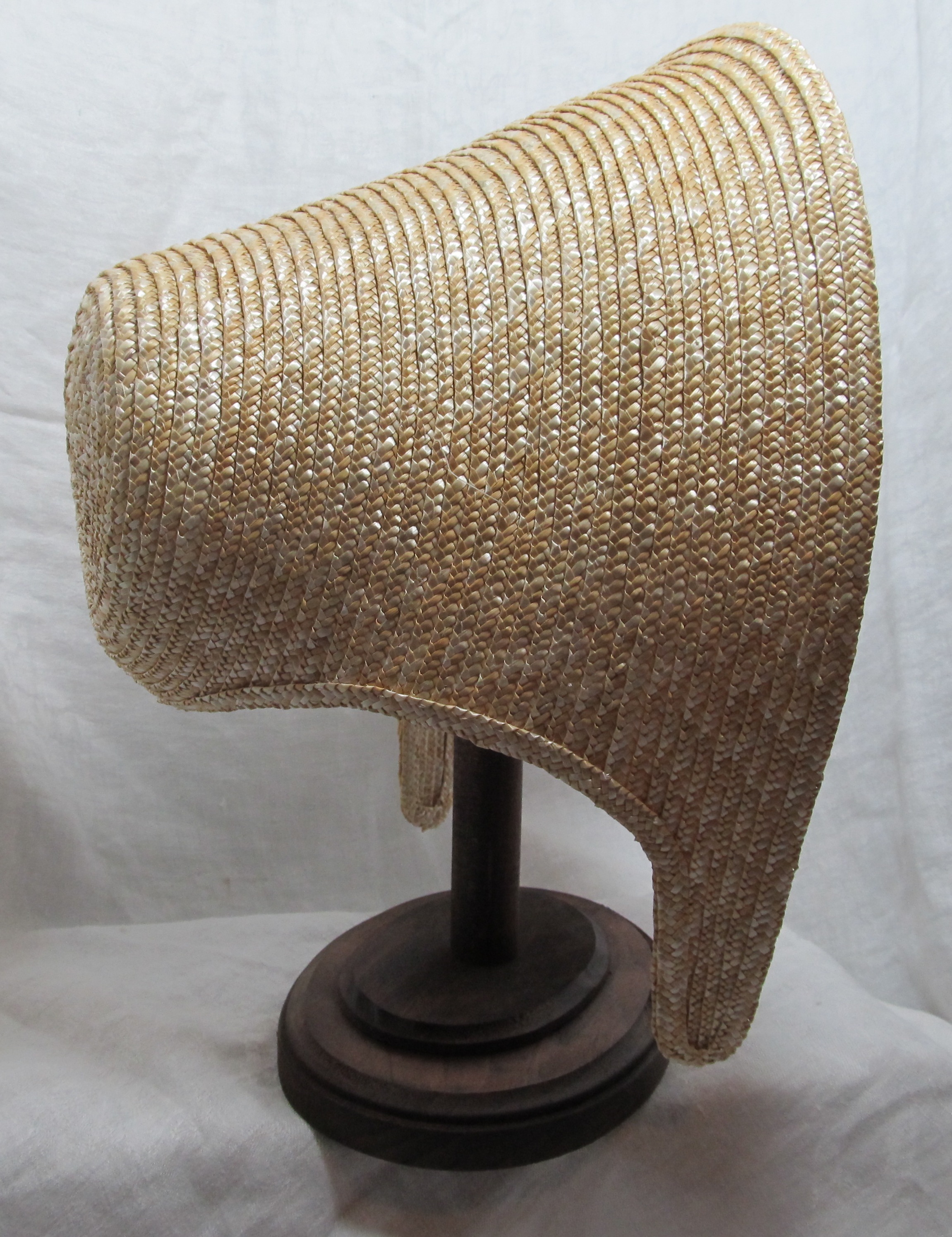
This natural straw plait form wraps up the 1850s with a round brim and cheektabs that curve backward. The crown rises gently from a flat tip. Available on Etsy:

This one isn’t quite dry yet. It is right on that turn into 1860 with a low, round brim and cheektabs that curve in rather than back. Available on Etsy:


Lastly, well lastly for now, is this later Victorian shape that has been stuck in my head for several nights. Available on Etsy:


Ask the Milliner #1
For a while now I’ve been toying with the idea of an “Ask the Milliner” post. I hestitated because I though it would seem silly or self-centered. Then, this past week, a friend asked a question that told me this “Ask the Milliner” idea was something I should go ahead with. I mentioned the idea on Facebook thinking I would get a couple easy questions I could put together in a cute post. Well, the questions are so good, it looks like I will be doing several “Ask the Milliner” posts.
Let’s start with that persuading question:
“Do you sew all this by hand, or can you do this on a machine?” Babette
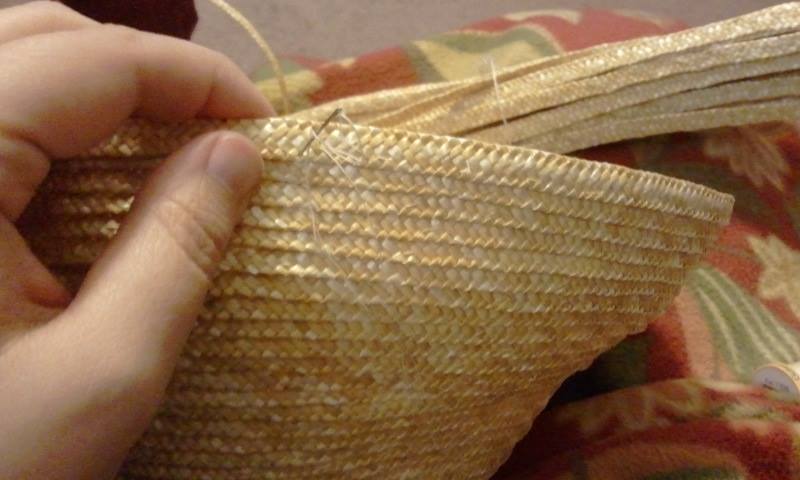
Every inch is by hand. Or, I should say every half inch, as that is the stitch length. I love the smell of straw. I find it very calming. Sometimes, it is so calming I lull myself to sleep mid-stitch.
The tip and the wiring are the parts that take the most hand strength. The tip, being a continuous coil takes a lot of control. This tires the left hand. Wiring is my least favorite part. I’ve wacked myself in the face a few times. Binding is where I tend to stab myself and break needles.The crown and brim are easier on the hands unless there is a tension control for shape. I used to be really obsessive about hiding the stitches in the plait itself. I still have to tell myself they didn’t worry about it and I shouldn’t worry about it.
When I decorate, sometimes I will machine sew one seam on the bavolet so I can get a crisp line. Otherwise, that is all by hand too.
“Do you use a thimble? Or a sailor’s palm? What sort of thread do you use? What sort of needle?” Babette
I kept these together since they really do go together.
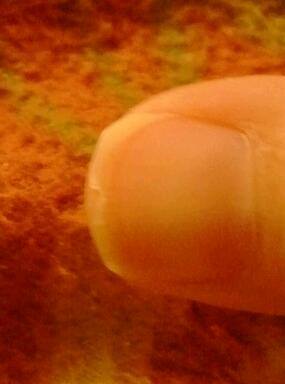
I don’t actually use a thimble. Some straw plait is really tight. Some straw is dense. This means the needle can get stuck in the straw. It takes a bit of strength and grip to get the needle out. That is a big part of it. Another is that I’ve found I’m not an ‘end pusher’. I push the needle from the sides as I grip it. There is very little finger injury from that. The finger and hand injury I do get is more from running the thread along my nails or bending my nails from holding the needle. The side tips of my fingers get tender and my nails split from that. The actual snags and pokes from needles happen when I am tired, distracted or holding something funny.
I prefer straw millinery needles. These have flat heads, strong length and are very sharp. I am a needle bender when I sew. I am learning to catch them before a snap them.
I’ve been using Gutermann’s 100% cotton thread the last couple years. I found a shade that nearly disappears into the natural straw. I find it has decent strength (I am a tense sewer that pulls tightly) while not tangling too bad. When it hasn’t disappeared into the depths of the couch, bees wax is helpful.
Next, I’ll do a few questions on shape.
Rural Papers

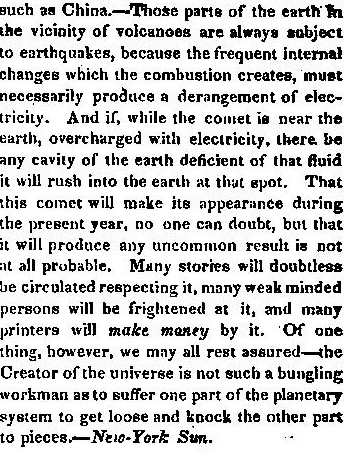
I rather enjoy reading rural papers. When reading those from my area of New York, I feel more of a connection to what I am reading. I can only imagine others feel a similar connection to those papers from their area as well. Many, though not all, have a domestic section and/or a ladies’ department or section. These are packed full of useful tidbits, from local residents’ thoughts on clothing, to household tips, to receipts. While some parts are taken from other publications, much of the contents are local and current. The example to the right is that of a comet’s expected passing and the concerns over what it will bring. I love this sort of context and perspective.
Here is a short list of those I am aware of currently.
Moore’s Rural New Yorker – Out of Rochester, NY. Links to 1861-1865 – Also, 1859 and 1854.
The Rural Repository – 1830 publication out of Hudson, NY
The Genesee Farmer – approx 1837-1863
Pennsylvania Farm Journal – 1851-2, 1854
These are different, being annual publications, but very interesting, okay fascinating in some areas: The Illustrated Annual Register of Rural Affairs.
Please, add your local publications in the comments below. I know there are many others, ie the Massachusetts Ploughman…
Btw, Other additions to the reading list:
Employments
Excerpts from: Gift Book for Young Ladies, Alcott. 1853:
“The word employment, indeed, in a very general sense, included everything which intelligent creatures can do. But there is a more particular sense, in which we frequently use it, viz., to designate or distinguish those avocations, or duties, or exercises, in which we habitually engage, in order to obtain our reputation or our livelihood.
“God has kindly made it necessary for mankind to labor, in order that they may eat and drink. That which many regard as a curse, in thus converted into a blessing. It is a blessing, because it prevents idleness, and its long train of dangers. It is a blessing, because it conduces to health; and this, in a thousand ways.
You are one of those who labor for a support, and who consequently, if you labor right, receive the blessings which are annexed. By means of this labor, you have escaped a thousand temptations and a thousand dangers. You have escaped also many diseases to which you would otherwise have been subjected, as well as much suffering which would have fallen to your lot, had not the diseases with which you have already been afflicted been greatly mitigated in regard to their severity, by your habits of exercise in the house and in the garden.
“Some young women have been less fortunate. Their employments have been assigned to them by parents who did not understand their temperaments, or their tendencies to disease. Perhaps they ought to have been house-keepers; but they have been made milliners or seamstresses. Their temperaments and diseased constitutions require active exercise and free space; but they have been deprived of both.
“Others, predisposed to scrofula or consumption, to whom active exercise, in the open air, is more necessary, if possible, than to any other class, are plunged into the factory. There, in a vitiated, overheated atmosphere, they spend twelve, fourteen, or sixteen hours of each day, and hardly breathe a better atmosphere when they return to their boarding-houses, and retire to their sleeping-rooms.
“Here again, you have been peculiarly fortunate. Had you been consigned, at ten, twelve, or fourteen years of age, to a hot, murky, foul air of a tailor’s shop, or the factory, or what is but little better, the confined and often very impure air of a millinery, you would probably have been laid in your grave seven or eight years ago. Or had you survived, your life would have been of little value to yourself, or to those around you.
“And yet your constitution is as well fitted for sedentary employments as hundreds and thousands, who are trained to them. But observe, if you please, that not all who are trained to an employment pursue it as a means of earning a livelihood. Not a few fall into their business, at least if they do not cripple themselves so as to be unfitted for any other.
“That a few die, as a result of a wrong choice of occupation by the parent, (for it is on parents and masters that the blame must, after all, principally fall,) though a great evil, is an evil not half so great as another which I could name – and which, indeed, I must advert to briefly , in order to complete my plan.
“I refer to the deterioration of the race, to which we belong. Now it is alike a doctrine of scripture and reason, that none of us live or die to ourselves. Indeed, such is the structure of society, that we cannot do so, if we would.
“Suppose a young woman goes into a factory as well ordered as those of Lowell. Suppose that by virtue of a good constitution, she does not actually become sick. Suppose she is even able to remain six, or eight, or ten years.
“Will any one say that because she does not die at the factory, or does not come out of it crippled for life, therefore no great mischief is done? Has the question ever yet been settled, which is the greatest actual loss to society, one person killed outright, or ten, or twenty, or forty injured; some of them greatly injured, for the rest of their lives?
“And as a whole tendency of the whole thing is and must be downward – that is, to the deterioration of successive generations – has it ever been ascertained how much more one life is worth in the present generation, than one in the next, or third? To explain a little. Suppose a course to be taken in life with regard to employment, which, while it permits the individual to linger out half her days or more amid many ills, yet with entire certainty entails an offspring the possibility – aye, the necessity – of dying prematurely, and of being good for nothing, except by being a burden to try the patience, and faith, and love of others. Is it settled that such a course is right?
“As the cultivation of our mother earth, in a rational manner, is, after all, the most honorable and most useful employment for our sex, so the kindred occupation of taking care of the house, and feeding the bodies, minds, and hearts of its occupants, is the noblest employment – the blessed prerogative, may I not call it – of your own.
The Art of Easy Living
Expert from: Orange Blossoms, a Gift-book, by T.S. Arthur
“I can’t, for the life of me, see how you get on so easily, Mrs. Jones,” said merry Ellen, to her mother’s nearest neighbor; “your family is larger than ours, and you have less help – but you are always in time. Come when I will, I find things in good order – no bustle, fuss, or confusion. Now, we are all at work from morning till night at our house, and our work is never done. There must be a witch-work about it – some secret – do tell us, won’t you?”
“Why, Ellen, I don’t know that there is any great secret about it; all I can tell is, I don’t seem to work very hard, but somehow I do get along very easy, as you say, with all that seems to fall to my lot.”
“Well, we all know that, Mrs. Jones; and we know, too, that you do more reading and writing than any one of us can, and you visit the sick more, and find time for everything that is good. Oh! There is some secret, and you must tell me all about it.”
“Yes, Ellen, I will tell you all I know about it, for you’re a clever girl, and will make a first rate wife for Fred some day; but you must promise to try and make my secret of practical use to yourself, and teach it to everybody else.”
Ellen blushed, and almost wished she had not been so impertinent. But Ellen was a good, sensible girl, and was impressed with the idea that Fred would want a wire somewhat resembling his mother in domestic matters; so she stooped down and tied her shoe, to hide her confusion. Mrs. Jones laid down her strainer, (for it was yet early in the morning, and she had still a long day before her,) took her babe on her knee, and picking up a basket of green peas that were to be shelled for dinner, she sat down to nurse her little infant to sleep, take the peas out of their pods, and tell her story.
“Well, Ellen, my secret is just this: When I go out to shake the table-cloth, I always bring in a bundle of wood; I seldom take two steps where on will answer, and try to do everything the shortest way. I pulverize saleratus enough to last a month at a time, keep it in a convenient vessel, and then it is always ready for use; – no untying papers, scattering them over the cupboard-floor; no board, rolling-pin, or mortar to clean but once. Instead of beating by eggs with a knife or a spoon, I have a whip made of wire, bent in an oblong shape like a tassel, and tied with a bit of twine to a hickory handle, and I can beat the whites of six eggs to a standing form in two minutes as easily as you would in half an hour with a knife. Anybody can make a egg-whip that can whittle a stick, of find a piece of wire, if they cannot afford to buy one. I only mention these things as samples of time-saving. But if you will not be offended, I will tell you a little story.”
“Offended! Not. I. It’s the silliest thing in the world to get offended, particularly with those who wish us to do good.”
“Well then, Ellen, I was out taking tea with a neighbour last week, and we went into the dairy and cheese-room to see the cheese; and as we came back we stopped a few minutes to chat in the kitchen. The lady told her daughter she might make some flannel-cakes, or griddle-cakes, as some call them, for supper. She started off to fulfil the appointed task. First she ran down to the cellar and brought up the buttermilk-jar, holding almost a pailful; then she ran back for the eggs, untied a half-pound of saleratus, scattered one spoonful on the floor and another on the table, rolled it, and tied it up; next turned her buttermilk out, and spattered a new dress at the waist; -splashed it over the table on divers things, and said, “oh, pshaw!” – picked up the saleratus from the floor, cleaned her dress, and brought a plate; rant to the store-room, and came back with a heaped-up plate of flour; put it into the pan, and stirred away, backwards and forwards, till it was all submerged and all lumps! There was not flour enough; away she ran again, and brought more; still there was not enough; a third journey had to be made for it; then it was dashed in, and she stirred away till her face glowed like a peony. All at once she thought of her eggs, and broke them into the batter. She had forgotten the salt, and ran a fourth time into the store-room. Now her batter was too thick, and more buttermilk had to be used, and consequently the saleratus paper had to undergo another untying. Finally, after much labour and toil, and an expenditure of much time, and waste of material, the lumpy batter was ready for use. But here was a new trouble; the fire that was just right half an hour before, was now exhausted; the griddle, which had been set upon the stove at first, burned rough; the kitchen and anti-room were full of unpleasant smoke and odour of burnt grease – the cakes stuck fast to the iron – two messes were wasted before the griddle could be rubbed smooth; the dish-cloths were in sad plights; and the young lady had expended as much labour as would have prepared the whole meal, and set the table in order.”
“Oh dear! That was I myself; anybody might know the picture! But how would you have managed?”
“I should have taken my pan and spoon; put my saleratus into the pan; gone down to the cellar, and with my cup, which I keep in the jar for this purpose, dipped the buttermilk, without spattering it, into my pan; then broken the eggs while I stirred in the flour; dropped in a little salt; and returned to the kitchen, all in five minutes, without having one thing out of place, except the egg-shells, and those I should have removed some other time. So you see instead of four journeys to the cellar, two to carry back, and four to the store-room, I should have done the whole work, saved my strength, saved the wear and tear of my shoes, saved the soil of my dress, saved the fire, the annoyance, and a good half-hour for something else, and had a better mess of cakes for a supper into the bargain. And this is only one half-hour saved, in getting one meal, by one hand. It took three people longer by half to prepare supper that night, than it would have taken me to have got it ready alone.
“But, look! Here’s the baby fast asleep, and the peas are all shelled, so my story must be wound up, for it’s time to whey off the curd. If this bit of experience does you any good, I will tell you another story some day.”
About the “Egg-Whip”:
The American Home Cook Book, 1864
“Home”Excerpt from The Young Lady by Anna Fergurson
Let what will be said of the pleasures of society, there is after all, “no place like home.” How beautiful are the relationships of home! How exquisitely touching to feelings! All are linked to each other by the most intimate and endearing ties; – a power like that of electricity; so that one cannot enjoy pleasure, without the others participating therein; one cannot sorrow, but all must mourn; nor one be honored, but all must share the joy.
And as home is that place which has the strongest ties upon the feelings, so it is the place in which woman has the power of exerting her influence in the greatest degree. This is her true and proper station; the duties of home are peculiarly hers; and let it not be thought that, in assigning home as the appropriate sphere for her action, we are assigning her a mean and…
View original post 793 more words
Today is the FanU “Blue Swap” Sign-up Day
Today is the day to sign-up for the FanU The Blue Swap!
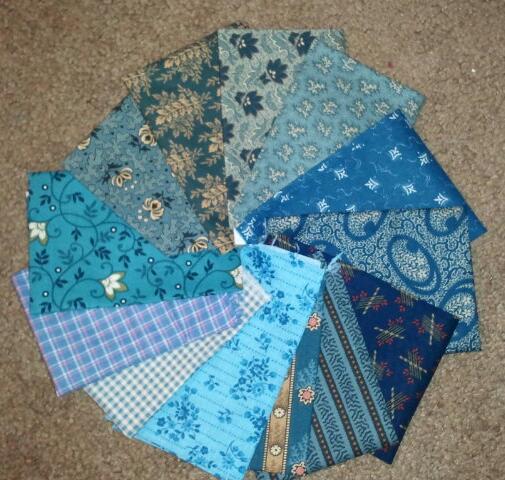
For Blue Swap, we will exchange Blue color fabrics from the 19th century.
We will mail our fabrics on March 30th
Please read all the details below.
To Sign-up, simply comment below with your email and mailing address. (I’ll erase those before approving your comment, so the whole world doesn’t have that info.)
What is a Swap?
This is a chance for to exchange fabric with a small group of people. Each group will have 8 people exchanging pieces of fabric. All you need is a half yard of fabric and envelopes along with your copy of Fanciful Utility.
To Participate:
1: Sign Up Day!
On sign-up day, groups will be assigned on a first-in basis; the first eight will be the first swap group, second eight in the second group, etc. **Please be certain you will be able to fully participate by mailing your fabrics on the Mail-Out Date.**
The Blue Swap Sign-Up Day: March 20th
2: Mail-Out Day:
Place a 9×9″ piece of fabric suited to the mid-19th century in envelopes for each of the 7 other people in your swap group, stamp them (be sure to double check at the post office, but the small 9×9″ pieces should mail in a regular envelope with a normal stamp), and send them off no later than the Mail-Out Day.
The Blue Swap Mailing Day: March 30th
3: Get Fanciful!
Use your Fanciful Utility templates and techniques to make a project from the book, or copy your own from 19th century sources. We’ll all look forward to seeing your projects! You don’t have to sew right away, but don’t keep us waiting forever to see all the fun things!
(If you need a copy of Fanciful Utility, you can purchase them from the publisher at www.thesewingacademy.com
Fabric Guidelines:
- For the cotton and silk categories, your fabric should be early to mid-nineteenth century appropriate. (If there is a want for an earlier or later group, we can do that.) Prints and motifs should reflect those available in the 1840s, 50s and 60s. Cotton should be 100% cotton. Silk should be 100% silk.
- To keep the swap and sewing possibilities interesting, please avoid solids as best we can.
- Fabrics that do not work well for sewing cases should not be swapped. These include sheers, gauzes, heavy, thick, easy-to-fray, slippery and stretch fabrics.
- For the “crazy swap” category, think crazy quilt in a sewing case. This could include satins, velvets, textured fabrics. Quality synthetic fabrics are invited.
Swapper Guidelines:
- Please be certain you can fully participate in the swap before you sign-up.
- If something arises after you sign-up that will effect the date you are mailing your fabrics, please email your group so everyone is aware.
- If you fail to fully participate in a swap, you will not be able to sign-up for future swaps. (We do understand medical and family emergencies. I need to be able to ensure swappers will receive fabrics when they send fabrics out.)
Q&A
Yes, you can participate in 1, 2 or 3 of the swaps.
Yes, if we end up with multiple groups, you can participate in more than one group to swap more fabric. If you participate in 2 groups, you should swap 2 fabrics.
Yes, you can swap large and small scale prints.
Yes, you can swap now and sew later.
Yes, we would love to see what you’ve made with the swapped fabric.
Yes, you can use your own fabric in your swapped project.