What’s Inside – The Pin Cushion Experiment

***Note- This post will be updated as I test more fillings from the t0-do list.***

Squishing filling into a pin cushion one day, I started to wonder what a fun game it would be to stuff a bunch of pin cushions with different fillings and see if people could guess which was which.

As weird thoughts go, this one kept rolling round in my head… Over the years, then and now, what all have people tried to stuff their pin cushions with? How did each one act? What worked? What didn’t? What really didn’t? …. This rolling became a “must try this.” I had a bunch of pin cushion circles left from the workshops didn’t? Yep….

Let’s first look at the history:

What did “they” fill their cushions with? I have seen a few materials inside pin cushions and sewing cases.  There are others I not experienced in person but know to have been used. These include:

  • bran
  • raw wool
  • scraps of wool threads such as those pulled from fabrics
  • straw or flax
  • sawdust and wood shavings
  • emery

For the ‘experiment’, I used both materials that would have been used in the 19th century and modern use ones. I thought it would be an interesting comparison. Factors I looked at included easy of stick-ability, weight, compression and effects on pins over time. Each of the cushions are made with quilt weight cotton and crochet cotton. The crochet cotton helps determine how the filling compacts.

What I stuffed with:
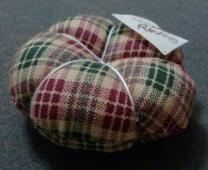
wpid-2015-11-16-20.39.54-1.jpg.jpegWool batting/roving – This seems to provide the softest/squishiest of the wool fillings. It is firmer than the poly-fil. While it compacts, it does so evenly with a moderate amount of pull on the string.

The cushion is fairly light weight. Pins stick easily with a slight depression before going through the fabric. As wool roving and batting are easily available, this is an inexpensive and accessible, period correct option.

wpid-2015-11-17-18.16.54-1.jpg.jpegRaw, cleaned wool – This seems to provide the densest, least squishy of the wool fillings. The raw wool I used was fairly tightly wound to itself in clumps. I think this made stuffing the cushion easier. I can feel some of those twists inside. It compacts consistently with a little more pull on the string than the roving did. Some areas do feel less dense than others. The pins stick easily with a slight depression before breaking through the fabric.

The natural lanolin in the wool is said to be good for the needles. Raw wool may be easily available for some but not others. If available, this is an inexpensive period correct option.

wpid-2015-11-17-18.16.41-1.jpg.jpegWool scraps – The scraps for this cushion were threads pulled from about 8-9 square inches of heavy weight wool that had been washed and lightly felted. This cushion compacts consistently and evenly. It is not as dense as the raw wool. The pins stick easily with a slight depression before breaking through the fabric.

If someone regularly works with wool, this is a free stuffing option as scraps would abound. It does take some time to pull the threads apart.
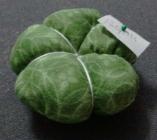
wpid-2015-11-16-20.40.29-1.jpg.jpegPoly-fill – This is the softest and lightest of the cushions I have here. It is also the squishiest of the bunch. I found this cushion to compact unevenly and inconsistently. You can see this in the segments in the photo that are  misshapen. (I did make a second cushion to recheck my process.) This cushion takes compression before the pin will break through the fabric.

This is an inexpensive option for filling a modern pincushion. I would like to note, this fill made my eyes burn.

wpid-2015-11-16-20.38.48-1.jpg.jpegWalnut hulls with lavender – This cushion is filled with a commercial product for making pin cushions. It is ground hulls with lavender inside. The hulls are about the size of coarse salt on soft pretzels, maybe a little bigger. This filling was easy to fill with, though a bit messy (each hull could be picked up by hand.) The cushion is one of the heavier of this batch. It will not roll or slide. This would be a good option for a weight. There compression is even and consistent. Pins go right in with a rather pleasing ‘crunch’ feel.

The bag I have cost about $5. I expect it will make a half dozen pin cushions this size. I need to investigate the authenticity of this option.
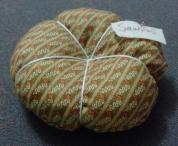
wpid-2015-11-16-20.39.16-1.jpg.jpegSawdust – The sawdust I used was somewhere between dust and shavings, some was little, soft curls of wood. This made a weighty cushion that is quite as heavy as the walnut hulls. Pins go into this cushion nicely without much depression. The cushion compressed consistently but with some uneven areas.

If you have a wood shop, this is a free option for filling that is period correct. Be sure to pick clean, dry shavings. I do not know if any particular woods would be better or worse, or if any would turn corrosive over time.

Those I still need to do:

Sand – Need to get some

Emery – It is here, somewhere….

Cotton battingYawn

Bran – Need to get some

Rice – Need to just make it

Human Hair – Not sure I’m going to do this or not. 

Those I did not try:

Silica beads – Though several websites say silica makes a nice pin cushion, I am somewhere between skeptical and hesitant. I think of silica in connection with moisture control, that the packets attract moisture. I really don’t want a pin cushion that attracts moisture. All I can picture is the damp-rid bins we use in storage – ewy-goowy messes.

Graphite – How I laughed at this one. I do not want any additional ground or powdered graphite in my house. Husband tracks enough home on a daily basis. *In all seriousness, I simply can not picture a graphite filled cushion going will when working with white silk.

Others also mentioned on various sites and discussion boards…. pencil shavings, rock salt, small pet bedding, vase filler , foam wrapped in batting,

What do we like in our pincushions?

Liz Clark “The one in my little FanU sewing box is filled with wool roving, and it’s my favorite. I don’t sew with pins on the machine, but I do sometimes use a few for handsewing and the wool keeps them nicely!”

Gail Kellogg Hope“I have sevearl. My least favorite is the modern tomato. Not enough weight & I chase it across the floor a lot. My Fat Lady, who is larger, weighted and filled with polyfill. My great-grandmother’s woven, which is filled with sawdust fo some kind…. I like the weight. Weighted is important to me. That way I’m not knocking it across the room when all I want to do is put a pin in it. It shouldn’t take two hands to put it in.”

Eileen Hook” I have 1. a sand filled pin cushion (one of those pin cushions with a bag attached for little bits of thread), 2. a poly filled one, and 3. a wool raveling filled one. The sand filled one is good because it’s solid and heavy enough that it doesn’t slid across the table. Poly fill is light and easy to find in qntitty, but it is pretty light and the cushions aren’t as ‘solid.’ The wool ravelings are period appropriate and I used them for my period pin cushions. I can stuff quite a lot of wool into a pin cushion!! It feels more substantial than the poly fill.”

Carolann Schmitt – “I use a magnet pin cushion on my sewing machine, ironing board and cutting table. I use a fabric pin cushion stuffed with wool batting when I’m hand-sewing. The wool batting helps prohibit rust and moisture building up on the pins. And I always have an emery bag at hand to remove the protein buildup on pins and needles.”

Others Talking about Stuffing:

Published in: on January 6, 2016 at 7:00 am  Comments (13)  

Paisley, Plaid, & Purled – Q&A

PPandP book cover

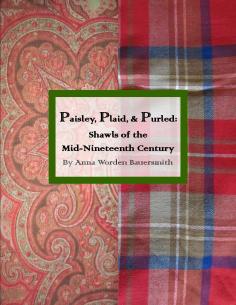
Now Available. Paisley, Plaid, & Purled: Shawls of the Mid-Nineteenth Century

Why an E-book and not a printed one? I decided to publish PP&P as an e-book because it would be easily accessible for readers. As soon as it was purchased, it was there for them. No wait. 

Going with an e-book also meant not having the additional cost of printing and shipping. A printed version would have to have been $25-30 plus shipping, which increased notably in 2016. 

Does PP&P have patterns? PP&P includes original directions for over 30 shawls, both knit and sewn. Right now, the quilted shawl particularly appeals to me. 

Does PP&P have photographs? Yes. I included over two dozen CDVs in color, several with close-ups. The great thing about an e-book as a PDF is you can zoom in too. I also included photographs of original shawls. (I really need a nice studio to take photos of more I would like to share.)

Why $15.00? It was really hard coming up with a price for Paisley, Plaid, & Purled. I wanted the book to be easily affordable. But, I also needed to cover my costs. What I ended up doing is taking the expenses I had (LOC, ISBN, original shawls, CDVs, ILLs, copies/printing, etc) and dividing by 100 (a hopeful number of books. That number became the price. This does mean that I don’t actually make any money on PP&P until after I sell 100 books. (Oh, I also realized I wasn’t very good at keeping track of the little expenses such as museum fees, materials, etc.) 

Published in: on January 1, 2016 at 12:41 pm  Leave a Comment  
Tags:

Paisley, Plaid, and Purled: Shawls of the Mid-Nineteenth Century

PPandP book coverNow Available!!!

Exclusively as an Ebook in my Etsy Shop!!!

At long last, I offer you Paisley, Plaid, and Purled: Mid-Nineteenth Century Shawls. I am very excited to finally share my extensive research on mid-century shawls began over a decade ago.

PP&P is 120+ pages long looking at each of the shawls worn during the mid-nineteenth century, including the Civil War era. Learn about the types of shawls, where they came from and how they were worn along with much, much more.

PP&P includes over two dozen CDVs displaying period shawls, photos and illustrations. It also includes over 30 original directions for shawls including sewn and knit shawls.

Contents:
1. Introduction & Methodology
2. Shawl Culture
3. The Shawls
4. Domestically Made Shawls
5. Shawls for Living History
Bibliography & End Notes
Appendix Including a Glossary of Terms, Manufacturing, Production, and Tariff Statistics, and Exhibition Examples.

Published in: on January 1, 2016 at 1:00 am  Comments (5)  
Tags:

A Little TBT and Year in Review

I honestly am having trouble picturing what I actually did and made this past year. It was a bit of a trying year due to the whole rough health “sun shocking” mess. So, this one combines a little “Throw Back Thursday” and photos of the upside of the year, to make me feel better about myself

Proof to self that I actually could be outside and actually work outside…. in the sun. This day we built fences, moved a wagon sans-horses and moved corn.

Outside…. recreationalesque….

Pre-candle-light tours (left) and post wild weather Memorial Day parade (40+ MPH winds and Hail)

Even some slightly disarray time in the southern NM summer sun.

05ff1d8ca5ff732bee66eb59eaef250c

Some local fun with friends and little sister.

Now…. 2015…..


Published in: on December 31, 2015 at 12:00 pm  Leave a Comment  

Paisley, Plaid, and Purled…..Coming New Year’s Day

PPandP book cover

Published in: on December 28, 2015 at 4:16 pm  Comments (3)  
Tags:

For a while now, a long while, I have found benevolent fairs to be fascinating. I am sure this can be partially blamed on the ladies fair we depicted years and years ago for Yuletide. The combination of fundraising, women in public, thematic decorating, making little items to sell and pagentry… well, fascinating.

The thesis I recommended pre-flu, on miser purses added a whole nifty twist to the fair fascination. “Women’s ‘immoral’ behaviour at fairs.” Yep.

Check this out. Laura L. Camerlengo, in her discussion of miser purses in social context through the symbolism in literature and paintings says this:

Thackeray’s sarcastic remark about fancy fairs relates to larger society’s criticisms of this method of fundraising and the women who frequented these fairs. These criticisms, as we will see, were reflected in contemporary artworks, and directly relate to the role of the miser’s purse as a foreshadower of marriage in literature and paintings. Although contemporary women’s publications, particularly of the mid-century, favored this method of fundraising, many writings by and for men criticized fancy fairs and the women who hosted them. Gary R. Dyer reflects in “The ‘Vanity Fair’ of Nineteenth-Century England: Commerce, Women, and the East in the Ladies’ Bazaar,” that “bazaars…became integrated with misogynistic notions of feminine corruption and duplicity, the discursive tradition surrounding them implies that lust, greed, and
deceit are women’s essence.”
She continues to quote Doyle’s Bird’s Eye Views of Society, Dickens’ Sketches by Boz and discuss the painting At the Bazaar, or, The Empty Purse:
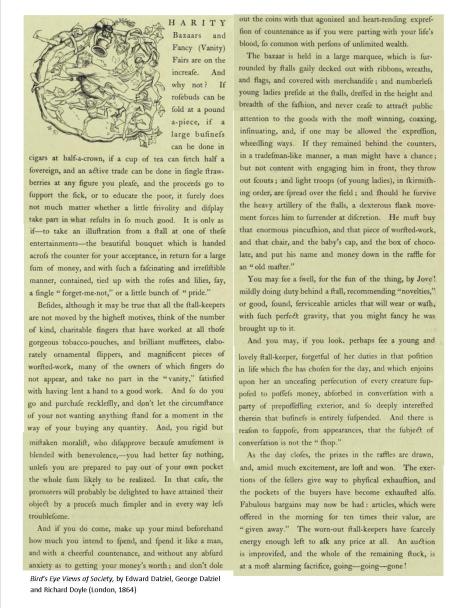
The bazaar is held in a large marquee, which is furnished by stalls gaily decked out with ribbons, wreaths, and flags, and covered with
merchandise; and numberless young ladies preside at the stalls, dressed in the height of fashion, and never cease to attract public
attention to the goods with the most winning, coaxing, insinuating and if one may be allowed the expression, wheedling ways. (Doyle)
Aspiring young ladies, who read flaming accounts of some ‘fancy fair in high life,’suddenly grow desperately charitable; visions of admiration and matrimony float before their eyes; some wonderfully meritorious institution, which, by the strangest accident in the world, has never been heard of before, is discovered to be in a languishing
condition…and the aforesaid young ladies, from mere charity, exhibit themselves for three days, from twelve to four, for the small charge of one shilling per head! (Dickens)
Brain Candy!!!
(**Side note – I never looked at the woman in At the Bazaar as possibly being a prostitute because she is looking directly at the viewer. That is a whole other topic.)
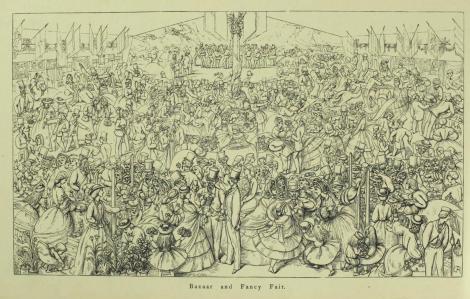
Of course, I have to know more….Hop over to check out Bird’s Eye Views of Society…. Here is the illustration of the Bazaar and Fancy Fair:
Publication1
As the image is overwhelming with business, here are some cropped images that may be alluding to what the authors perceived as immoral behaviour for women:


The section on charity bazaars in full:Publication1

The article she mentions, “The ‘Vanity Fair’ of Nineteenth-Century England: Commerce, Women, and the East in the Ladies’ Bazaar” can be found here. The author, Dyer, opens with the origins of a Bazaar for aiding disadvantaged women:
“Early in 1816 John Trotter, having made a fortune supplying the army

during the Napoleonic Wars, turned his warehouse on Soho Square in London into what he called a “bazaar,” where women, particularly widows and orphans of army officers, could sell items they had made, renting counter space for three pence per foot daily.”
He continues to say
“From the first, English bazaars were sites of conflict among cultural and moral values.”
Dyer surmises that while Trotter made money from the bazaar, he did have supporters who saw the society benefits and did not consider the bazaar to drive women from their homes. By providing sources of income locally, “The bazaar would thus strengthen the traditional British family and fight prostitution by cutting off its supply of desperate young women.” (page 198) Despite the support, suspicion or anticipation of immoral behaviour seemed to almost be a given because what else would happen if women were allowed to assemble in one place. Oh, my. Take a look at the rules to prevent such immorality on page 199.
Dyer mentions George Cruikshank’s “A Bazaar”, a satirical illustration. I went searching for a clear copy of this because each, well most, of the characters are saying something…. and, I want to read the little cartoon bubbles myself.
Well, humph. It seems there isn’t a decent copy, or at least not to my liking, online. Here it is at The British Museum, in color, just not clear enough to read myself. *pout* (Btw, I happen to think this other illustration of his, “A London Bazaar” appears to be far more scandalous.)
I did end up finding this paper: “Fashioning Femininities: Sartorial Literacy in English Domestic Fiction, 1740-1853” by Stephanie Robinson Womick. While it does not have a readable image, I am going to have to go back and read it.
In the second quarter of the century, bazaars became those fairs for charitable fundraising. These are more along the lines of what I visualize when I think of a bazaar or fair. The twist is, according to Dyer, while the women selling wares at these fairs were fashionably dressed middle and upper class women rather than those needing to support themselves and children, the women themselves were what were truly for sale, not the material items. “People perceived the women working in these temporary bazaars as the real merchandise; indeed, many unmarried young women evidently did see a fancy fair as a means to display themselves.”
Yet, everything thus far has been solely focused in England. I want to know more about the fairs in the US and the perceptions of those…..
Additional Reading:
*****Side note – What material objects I see in “The Empty Purse” left to right:
  • Embroidered slipper ready to be cut
  • Doll or doll pin cushion
  • Three prints – one of Jesus carrying the cross, one portrait, one unknown
  • Two undetermined bottles – One tall possibly with a wicker woven exterior, one short with possibly an elephant on the label
  • Embroidered braces/suspenders with a rose motif
  • Feather duster with wooden handle
  • Hat, possibly straw on a hat stand – trimmed around the brim with ribbon and feather trim, possibly a gold metal button in the front.
  • An empty hat stand
  • Print or painting of flowers against the wall
  • A brown wooden box with a white and blue label that may say “bricks”
  • A ball or ball pin cushion triangle pieced of red and black.
  • A framed portrait – small
  • A folding fan
  • A domed planted flower potted – (Fernery)
  • A squared bottle with something white inside
  • A small reticule that appears to have a shaped base, silk bag and decoration.
  • A short, squat decorative jar

In her hands is a miser’s purse and possibly a ring that may or may not go to the purse.

Published in: on December 23, 2015 at 4:06 pm  Leave a Comment  

Santa?

A comment made by a friend made me realize I don’t know much at all about Santa. Really. I don’t.

I was that child who didn’t get to believe in Santa despite her siblings and her friends all believing in Santa. (I suspect there is some deeper mental and psychological developments connected to this. But, that would be another story.) We had our own traditions; Santa came to visit; I knew Santa was Larry. As I grew I picked up bits here and there about other’s traditions, I learned about other celebrations Solstice, Yule, etc. But, I never bothered to read up on “Who is Santa?”

So, here is some poking around to figure out who the Americanized Santa is….

Starting in the early 1800’s, here is a passage from Washington Irving’s 1809 Knickerbocker’s History of New YorkChapter IX

At this early period was instituted that pious ceremony, still religiously observed in all our ancient families of the right breed, of hanging up a stocking in the chimney on St. Nicholas Eve; which stocking is always found in the morning miraculously filled; for the good St. Nicholas has ever been a great giver of gifts, particularly to children.

I am moreover told that there is a little legendary book somewhere extant, written in Low Dutch, which says that the image of this renowned saint, which whilom graced the bow-sprit of the Goede Vrouw, was elevated in front of this chapel, in the center of what in modern days is called the Bowling Green—on the very spot, in fact, where he appeared in vision to Oloffe the Dreamer. And the legend further treats of divers miracles wrought by the mighty pipe which the saint held in his mouth; a whiff of which was a sovereign cure for an indigestion—an invaluable relic in this colony of brave trenchermen. As however, in spite of the most diligent search, I cannot lay my hands upon this little book, I must confess that I entertain considerable doubt on the subject.

I’m a little puzzled by this 1821 “The Children’s Friend” poem as some source say it was published anonymously and others attribute it to Clement Clark Moore who was long said to have written “T’was” but now, it seems may not have. It also seems to have a second name as well, “Old Santeclaus

Old Santeclaus with much delight
His reindeer drives this frosty night,
O’er chimney-tops, and tracks of snow,
To bring his yearly gifts to you.

The steady friend of virtuous youth,
The friend of duty, and of truth,
Each Christmas eve he joys to come
Where love and peace have made their home.

Through many houses he has been,
And various beds and stockings seen;
Some, white as snow, and neatly mended,
Others, that seemed for pigs intended.

Where e’er I found good girls or boys,
That hated quarrels, strife and noise,
I left an apple, or a tart,
Or wooden gun, or painted cart.

To some I gave a pretty doll,
To some a peg-top, or a ball;
No crackers, cannons, squibs, or rockets,
To blow their eyes up, or their pockets.

No drums to stun their Mother’s ear,
Nor swords to make their sisters fear;
But pretty books to store their mind
With knowledge of each various kind.

But where I found the children naughty,
In manners rude, in temper haughty,
Thankless to parents, liars, swearers,
Boxers, or cheats, or base tale-bearers,

I left a long, black, birchen rod,
Such as the dread command of God
Directs a Parent’s hand to use
When virtue’s path his sons refuse.

Clement Clarke Moore‘s “A Visit From St. Nicholas” also know as “T’was the Night Before Christmas” was written in 1823.

‘Twas the night before Christmas, when all through the house
Not a creature was stirring, not even a mouse;
The stockings were hung by the chimney with care,
In hopes that St. Nicholas soon would be there;
The children were nestled all snug in their beds;
While visions of sugar-plums danced in their heads;
And mamma in her ‘kerchief, and I in my cap,
Had just settled our brains for a long winter’s nap,
When out on the lawn there arose such a clatter,
I sprang from my bed to see what was the matter.
Away to the window I flew like a flash,
Tore open the shutters and threw up the sash.
The moon on the breast of the new-fallen snow,
Gave a lustre of midday to objects below,
When what to my wondering eyes did appear,
But a miniature sleigh and eight tiny rein-deer,
With a little old driver so lively and quick,
I knew in a moment he must be St. Nick.
More rapid than eagles his coursers they came,
And he whistled, and shouted, and called them by name:
“Now, Dasher! now, Dancer! now Prancer and Vixen!
On, Comet! on, Cupid! on, Donner and Blitzen!
To the top of the porch! to the top of the wall!
Now dash away! dash away! dash away all!”
As leaves that before the wild hurricane fly,
When they meet with an obstacle, mount to the sky;
So up to the housetop the coursers they flew
With the sleigh full of toys, and St. Nicholas too—
And then, in a twinkling, I heard on the roof
The prancing and pawing of each little hoof.
As I drew in my head, and was turning around,
Down the chimney St. Nicholas came with a bound.
He was dressed all in fur, from his head to his foot,
And his clothes were all tarnished with ashes and soot;
A bundle of toys he had flung on his back,
And he looked like a pedler just opening his pack.
His eyes—how they twinkled! his dimples, how merry!
His cheeks were like roses, his nose like a cherry!
His droll little mouth was drawn up like a bow,
And the beard on his chin was as white as the snow;
The stump of a pipe he held tight in his teeth,
And the smoke, it encircled his head like a wreath;
He had a broad face and a little round belly
That shook when he laughed, like a bowl full of jelly.
He was chubby and plump, a right jolly old elf,
And I laughed when I saw him, in spite of myself;
A wink of his eye and a twist of his head
Soon gave me to know I had nothing to dread;
He spoke not a word, but went straight to his work,
And filled all the stockings; then turned with a jerk,
And laying his finger aside of his nose,
And giving a nod, up the chimney he rose;
He sprang to his sleigh, to his team gave a whistle,
And away they all flew like the down of a thistle.
But I heard him exclaim, ere he drove out of sight—
“Happy Christmas to all, and to all a good night!”
I’m rather enjoying this site, the St. Nicholas Center, as it seems to dig a little deeper into the localized (NY) traditions and who brought them from where and why/how.
And, by comparison, Father Christmas.
Published in: on December 22, 2015 at 5:15 pm  Comments (1)  

Illustration: “Female prisoners’ own clothes store at Tothill Fields Prison” 1862

This came up on FB. Please see The Museum of London’s description: http://collections.museumoflondon.org.uk/online/object/801173.html

Book illustration showing the female prisoners’ own clothes store at Tothill Fields Prison, from page 363 of ‘The criminal prisons of London and scenes of prison life’ by Henry Mayhew and John Binny. “At Tothill Fields prison the warders in charge of the prisoners’ own clothing are wont to indicate the female characters incarcerated there by the style of bonnet intrusted to their care.” So, for example “This silk and blond … trimmed with ruches and with roses, and geraniums inside, is in for pickpocketing, and this purple velvet one, with feathers at the side, has got twelve months for shoplifting”. The warders point out “a grand Leghorn, with a fall of bugles” which belongs to an actress “who has four calendar months for stabbing her husband”. All the clothes were fumigated before storage, causing the colour to fade, but the warders reported they were as careful as possible “for it would be hard, indeed, if we spoilt their clothes when they came here, as very few that we see in this place have more than they stand up in.”

Of similar interest:

Published in: on December 21, 2015 at 2:49 pm  Leave a Comment  

Miser Type Purses

While getting ready for the local, Genesee Valley Sew Along making pin balls, the topic of Miser’s Purses came up.  Thinking this might be a nice Sew Along project, I started poking around.

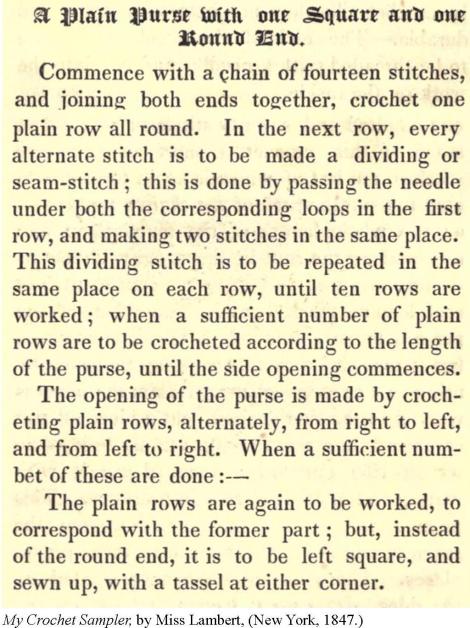
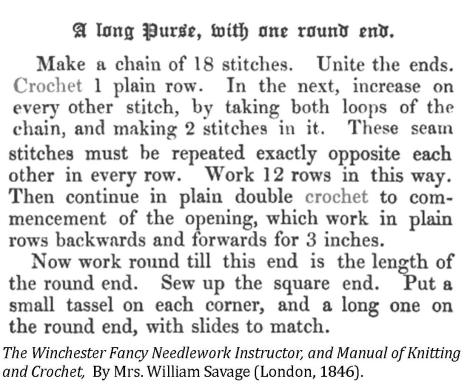
Lady’s magazines and needle-work books from the first half of the 19th century were filled with illustrations and directions for miser’s purses, aka crochet purses, stocking purses, ring purses, long purses (or, so I thought.) I was saving directions/image combinations and pinning away, when I came across this goodie: A Thesis on Miser’s Purses: THE UBIQUITOUS MISER’S PURSE**, by Laura L. Camerlengo 2010. Squeee! (**Link updated to go to the abstract rather than the pdf that stopped working. Click on the second file, the PDF.)

Read, read, read folks!

I couldn’t possibly touch what Laura did in information collecting for a simple Sew Along option. Here is a dabbling of the image & directions I put together before finding the thesis.

Of course, the question is…. Do we want to do this as a sew along??? (I’ll confess, I am awful at following crochet directions.)

2016a

2016b

2016d

2016c

This last one, is technically not a “miser’s purse” per the perimeters in the above thesis. It is a very interesting purse though. (I may have to try to make it.)

2016e

An example at the MFA.

Additional Directions:

Additional Reads:


Published in: on December 14, 2015 at 4:30 pm  Comments (5)  

Blog Anniversary

anniversary-2x

WordPress just told me this is my 7 year anniversary for blogging with WordPress. How nifty is that?

I feel like I should do something special…. hmmmm…..

Shall we do a give away???

Tell me what your favorite article has been over the past 7 years in the comments section below.

I will pick a winner at random and send them a surprise gift.

(I should add a deadline. Let’s say Sunday night, the 13th.)

Published in: on December 10, 2015 at 6:00 am  Comments (12)