What Shall I Call Thee?

We often call the rolled and folded sewing cases a “Housewife” or “Huswif”. Here is a perspective that considers the phrase to be old-fashioned. (Yes, the name is still used through the era. There just may be a connotation we are not yet understanding.)

There is an old-fashioned kind of pincushion, which looks rather clumsy, but it is extremely convenient for a journey. The cushion is nearly an inch thick; no pasteboard is put on the outside, in order that there may be more room for pins; the inside is a piece of cardboard, covered with silk; a round hole is cut in it, and a piece of cardboard, just big enough for a thimble, let in. Little bars, stitched across on each side of the thimble-hole, form places for scissors and bodkin. All this should be arranged before the stuffing is put in, and the bit of silk for the outside fitted; it is very inconvenient doing it afterwards. The pincushion forms but half of the establishment. Flannel leaves are put in for needles, and the outside is of covered silk, with a little pocket for thread. This pocket consists of a plain piece of silk, nearly the size of the pasteboard, fastened to the outside by means of little gores at each end.

What used to be made in old times, and called housewives, are similar to the travelling pincushion. These had a piece of silk, the same width as the cushion, and a little more than a quarter of a yard long, neatly stitched into compartments to answer the purpose of thread papers. This was rolled round the cushion, and fastened by a small loop and button. Housewives were very useful things, but they are out of fashion now.(The Girl’s Own Book)

This is in both the 1858 edition (here) and the 1833 edition (here).


Published in: on March 11, 2016 at 6:00 am  Comments (2)  

Finishing a Straw Bonnet

Godey’s, November 1856

Straw Bonnets.—Straw bonnets generally require some sort of lining, crape, muslin, or a thin silk. Very few are now worn with a plain lining. It requires just the same quantity to make a little fullness, which is more becoming. I will explain to you how to make a plain lining or a plain bonnet will take just the same quantity; or, if any difference, the plain requires more than the full. I think I hear my readers say this if very strange. You are aware that, in cutting out a plain bonnet or lining, there are several small pieces cut out to the shape. The piece make the fullness, for the material is used on the straight when put in the easy and on cross-way when plain, which compels you to cut pieces off , which on the straight and put in full, is not required. A head lining of silk or muslin should be put in after the lining to make all neat and clean when the bonnet is worn. Straw curtains are worn; but a great many ladies prefer a silk curtain made of the ribbon to match the trimming. The curtain is best cross-way with a narrow straw on the edge. The curtain will not quite take a yard of ribbon; three and a quarter or three and a half are sufficient to trim a bonnet. Plain colors on a straw are neater than mixed, such as primrose, light or dark blue. Sarcenet ribbon is better than satin. It is a good plan to sew narrow strings on the bonnet at the same time you sew the wide tie; the narrow first: it keep the bonnet more firm on the head. When I say narrow ribbon, I mean an inch and a half wide. An old fancy straw bonnet will make up again very weill by putting some silk between each row of straw. You must have a wire frame, and unpick the bonnet; cut some pieces of silk on the cross for puffings, and now lay your straw alternately with the silk. Unless the straw is a very good color, mix colored silk with it. This bonnet will require a lining.

Published in: on March 7, 2016 at 6:00 am  Comments (2)  
Tags:

Today’s Doll Millinery

Today, I have two doll millinery pieces to offer in my Etsy shop. The first is a fashionable hat in pale straw. Second, a dome shaped hat similar to the one I just offered yesterday in a human size.

Here, Cali models the first hat. This is a fashionable style suited for the 1850s or early 1860s. Cali says this will be best for a doll with an 8″ to 9″ circumference head. Her head is just a bit over 9″

The second hat is era versatile. The round, dome shape appears in multiple eras including the 1840s and early 1860s. Cali suggests this hat is best for a doll smaller than she is, with a head that measures between 7″ and 7.5″. The hat stand displayed measure 7.5″

Published in: on March 6, 2016 at 11:26 am  Leave a Comment  

Sew Along – Purse (post 2)

Have you selected your purse? If so, please share below in the comments or in the FB group.

I selected a simple crochet long purse (aka ‘miser’ purse) that I am working in the round rather than lengthwise in rows.

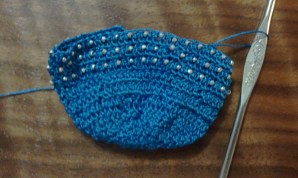
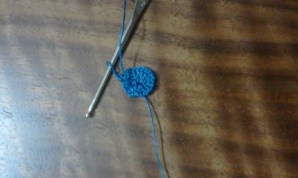
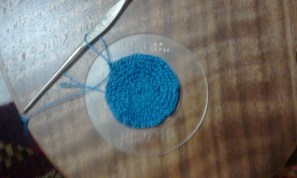
Here is some of the progress I have made:

I pre-threaded the silver beads onto the blue silk thread. I figure I’ll thread the gold ones from the other end. (I hope that works)

I started with a loop with ten crochets chained on. (sorry about my less than correct crochet terms.)

2016-02-07-19.21.41.jpg.jpeg

I worked around and around in single crochet, increasing between each stitch. (In this case, I increase by stitching a single crochet, a chain, then a single crochet, a chain, etc. rather than what seems to technically be an increase where I would work two single crochets in a single loop. The loops simple were not big enough to to to that and that isn’t how I learned to do it as a kid. Habits are hard to break.)2016-02-07-19.44.17.jpg.jpeg

The first night I made it to the inside of my circle. These were all single crochet. Then I switched to a half-double crochet through the outside of the circle (1.5″.)2016-02-07-20.49.33.jpg.jpeg

It seems I either failed to get a photo of the 1.5″ diameter or accidentally deleted it.


Lessons learned:

  • More light is needed for working with the blue silk, especially with the very bottom when the single crochet stitches are so tight.
  • My single crochet and half crochet stitches are very tight. This is bad for the sanity. Good for keeping coins in. This can lead to funkiness.
Published in: on March 6, 2016 at 6:00 am  Comments (3)  

Today’s Millinery

Currently available in my Etsy shop.

Add a lace or net veil around this brim, and this hat will give excellent sun dimming for the eyes.

2016-03-04-06.20.10-1.jpg.jpeg

2016-03-04-06.20.06-1.jpg.jpeg

It isn’t very often I include photos of myself with the hats I offer. But, I think this helps give a good idea of the look. I measure 21.5″ at my hairline, where this hat sits. The brim reaches over my eyes. From the front, you can see I can still see easily without the brim covering my face. (If I tilted the hat further forward, I would have even more coverage.)

Here is an assortment of images showing this shape with varied depths of the brim.

Illustrations – Godey’s Magazine 1862. Photographs – circa 1840s.

display_image

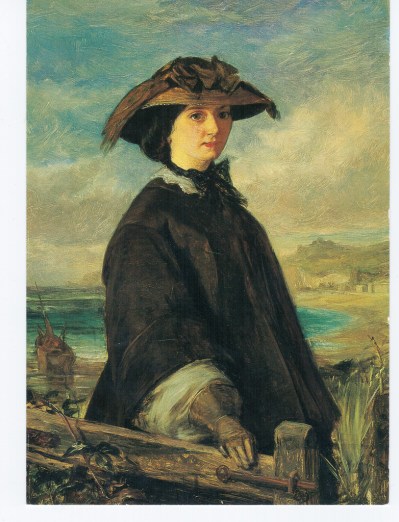
A Walk on the Beach, Augustus Leopold Egg, 1855-60.

Published in: on March 5, 2016 at 8:21 am  Leave a Comment  

Common Pin Cushions

Standing in my sewing room tonight I was kinda dazed by current events. I pulled out one of the carry totes that had packed up since last fall. Opening it, I found I had an abundance of pincushion pieces.
2016-03-03-07.35.46-1.jpg.jpeg

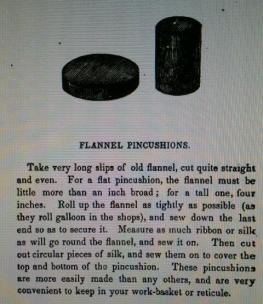
American Girl’s Book, Eliza Leslie, 1854.

One set in particular stood out. They were the pieces for a common pincushion of the mid-nineteenth century. They are flannel filled centers wrapped in ribbon, some with pasteboard. Directions can be found in two of the popular girls’ books, The Girl’s Own Book and American Girl’s Book.

At the right, are the directions from Eliza Leslie. The simple cushion calls for the flannel interior to be rolled tightly.

Below, are the directions from Mrs. Child. Her version calls for covering pasteboard circles first. Then cutting the flannel interior layers in the shape of the pasteboard. This is the version I have many pieces cut out for. In my case, I did opt for layers of cotton and wool batting instead of using the harder to find wool flannel. If I had all the time in the world, I would paint the silk sides as she suggests.

The forms into which pincushions have been manufactured of late, are without number. The most common consists of two circles of pasteboard, covered with silk, with narrow ribbon sewed between , and stuffed with bits of flannel cut to the size of the pasteboard. Cotton is very bad for stuffing, because the pins enter it with difficulty; and, when the cushions are of such shape that they can be stuffed with flannel, it is much preferable to wool. When sewed with silk of a very decided colour, and the stitches taken with great regularity, an edge, resembling delicate cord, may be produced.

Some cut the pasteboard into oblong pieces, and then paint rabbits or squirrels, of a size suitable to cover each side, and, after the cushion is made, they paste them on; the place for the pins then comes between the two rabbits. Others paint a cat seated, for each side, and make a cushion of such a shape as will fit in well. Some cut the figures of the cats in black velvet, and put little spangles for eyes. I have seen butterflies painted and pasted on each side, in the same way. Some do the paintings on rice-paper and put them on cardboard, cute out precisely in the shape of the figure. They look rather rich , but are more easily injured. A very pretty pincushion may be made in the shape of a small easy chair. (The Girl’s Own Book, by Mrs. Child. Child, Lydia Maria. 1858.)

Very worth mentioning is what Child calls “bachelor’s pincushions.” I see what are often called pinwheels in antique shops. They range from simple circles to pretty shapes. I’ve always found these to be a nice option for carrying pins in a traveling sewing case. Knowing that at one point, they were considered appropriate for men to carry in their pockets is quiet interesting.

What are called “bachelor’s pincushions,” are made very thin, so that gentlemen can carry them in their pockets with convenience. No margin of ribbon, or taste, is put between the bits of pasteboard, in making these cushions. Two round pieces of pasteboard are covered with silk, and neatly sewed together with one or two thin pieces of flannel between them. Of course, merely one circle of pins can be put in. (The Girl’s Own Book, by Mrs. Child. Child, Lydia Maria. 1858.)


Published in: on March 3, 2016 at 6:00 am  Leave a Comment  

SEW ALONG – Purse

Welcome to my second open Sew Along of the year. For this sew along we are each making a purse in a style and era of our choosing.

For the sake of this Sew Along, we are defining a purse as that which holds money. I am pulling this definition from the miser purse dissertation I shared weeks back.

Purse Ideas:

I have a board started with various purse ideas. In general, you will notice purses were small items, smaller than ‘bags’. Here is just a sampling:

Top R-L- Coin purse ca 1799-1820, Pence Jug ca 1830-60, miser style purse 1800-20, Bottom R-L – long purse 18th century, Christmas purse from Peterson’s, String purse 1880s. (I am really tempted to do that first one too…. and a jug)

A museum full of purses and bags (European.)

**If you want an original miser style purse to copy, I’ve saved a few to an Etsy Treasury. There is a wide range of eras in the Treasury. All are under $100 though.**

Resources:

Knots Indeed has given those who are interested in knitting, netting or crocheting a purse a jump start with this page filled with links to directions.

The blog, With My Needle’s Eye, shares eye candy from Amsterdam’s Purse Museum.

There are several period books with netting, knit, and crochet projects that can be found on Google Books, Archive.org and Hathi Trust. Here is a sampling:

My Purse Project:

I am crocheting a blue and cream silk miser style purse. (Something like the simpler side of this example, without the incredible designs on the right.) My materials include 200 yards of blue silk thread in size E, vintage cream silk I have in size D, teeny silver and gold steel beads (btw 4oz is about a tablespoon. I may need more.), and a pair of steel rings.

I am sticking with a simple purse, crochet round rather than flat as it seem so many of the directions indicate. This is so I can get the hang of this and because I do not read crochet directions well, okay, at all. I’m aiming for 9 inches in length as that seems to be a common recommendation for ladies purses in the 40s and 50s. I want to do one end silver and one end gold. I still haven’t found an image to tell me which end should be which though.

I thought I would be sewing the beads on after, which made a pattern like this 2016-02-02-08.13.33.jpg.jpegappealing. It turns out, the beads are strung on first. Look at the method below. I fear my beads may be too tiny my thread. I’m not even sure I have a needle small enough just now for them. We shall see.

2016-02-02-08.15.59-1.jpg.jpeg

My Materials (If you want to make what I am making):


Other Materials you might like:

I would love, love these original rings Vintage Victorian metal sliders for an Antique Misers Purse, vintage steel cut bead supplies, antique metal sliders, steampunk supplies. Okay, I am really tempted to buy them. But, this is becoming a pricey little purse.

I find these and these 6mm Ring Blank - Stainless Steel Ring, Ring for Stamping - Blank Ring - Stainless Steel Stamping Ring Comfort Fit Ring Decorated Edge (116) to be potential wider modern options.


Logistics:

We currently have two Facebook groups going, the larger Sew Along group and the small, closed, local group. I was going to go with just the one group. But, I’ve now decided to keep both open because I think it is important to have both co-support groups going.


Published in: on March 1, 2016 at 6:00 am  Comments (2)  
Tags:

Spring Millinery Reading

As spring arrives, a great many of us are thinking…. Spring Millinery!  Here are a few past articles of interest….

Published in: on February 29, 2016 at 6:00 am  Leave a Comment  

Today’s Millinery – Black Hat

Available in my Etsy Shop.

This black straw hat is a fashionable 1860’s style appropriate for the Civil War era. The brim dips front and back in an elegant shape. The crown is squared with a slightly rounded edge.

This hat will fit an average to large size head. It is made to sit high on your head. I suggest lining this hat as the straw is rough inside and the dye may rub in humid conditions.


Published in: on February 28, 2016 at 10:14 am  Leave a Comment  

Finishing/Decorating A Straw Bonnet

You have your straw form from myself, Danielle, Pam, Kim or Vivian… Now you want to finish and decorate it.

Recommended Shopping List:

  • Danielle’s book from Timely Tresses: Finishing a Straw Bonnet Form
  • Cotton net to line your bavolet
  • Fine cotton or silk net (bobbinette), or silk organza or lace for your frill/cap
  • Fine cotton voile or silk taffeta to line your brim
  • 3 yards minimum of wide (silk or quality rayon) ribbon (2 yards for ties, 1 yard for bavolet, additional for decoration/bows) (silk taffeta is also an option for the bavolet.)
  • 1 yard of 3/4″-1″ wide silk or cotton sateen ribbon for ties.
  • Ribbon and laces of choice for decoration
  • Flowers and feathers of choice for decoration
  • 1/2″-3/4″ wide velvet for optional stay

Recommended Reading List:

And just in case =  Millinery Care and First Aid

(I already had an original article on Finishing a bonnet scheduled. It will be up in a couple weeks.)

Published in: on February 25, 2016 at 6:00 am  Comments (1)