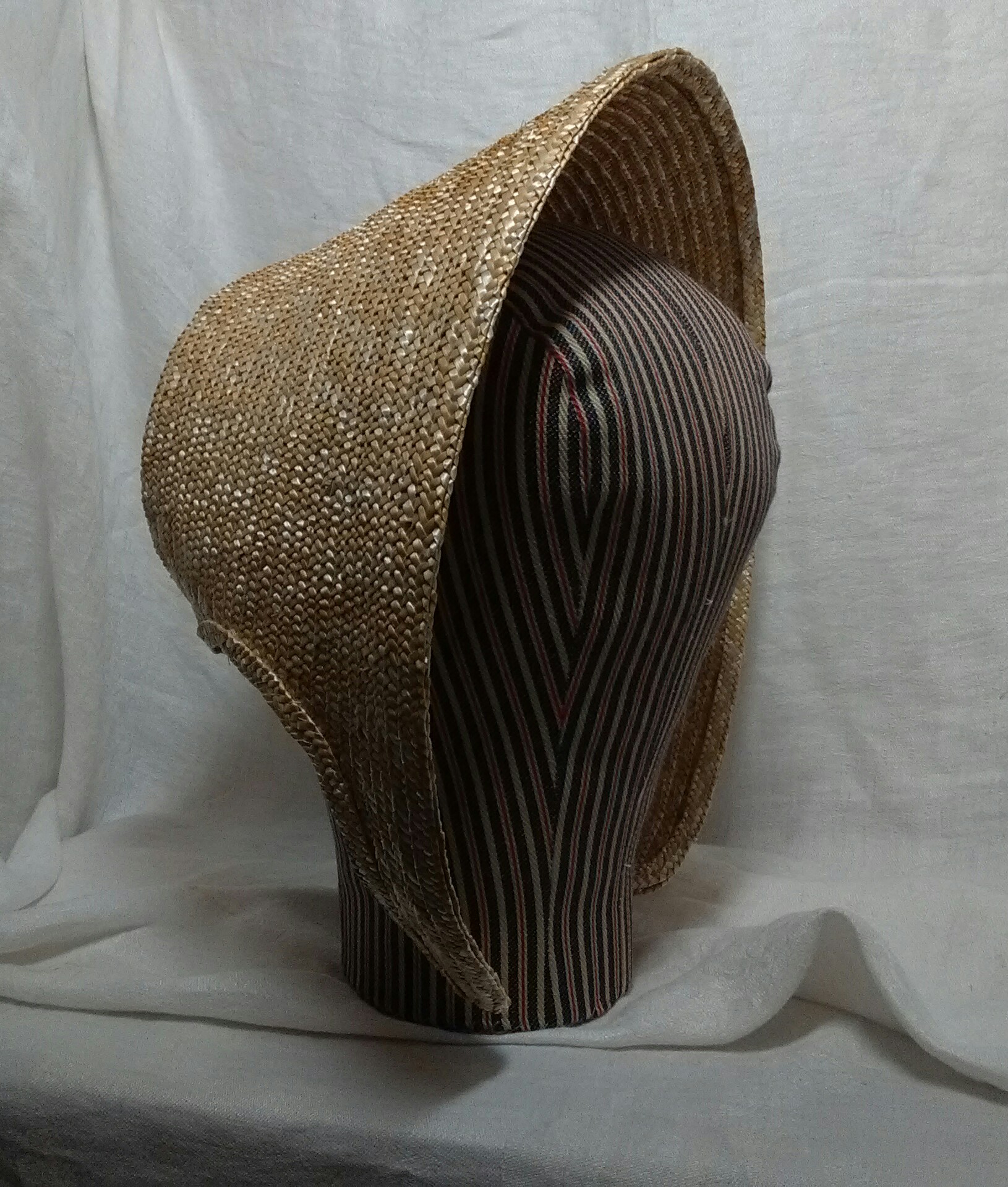
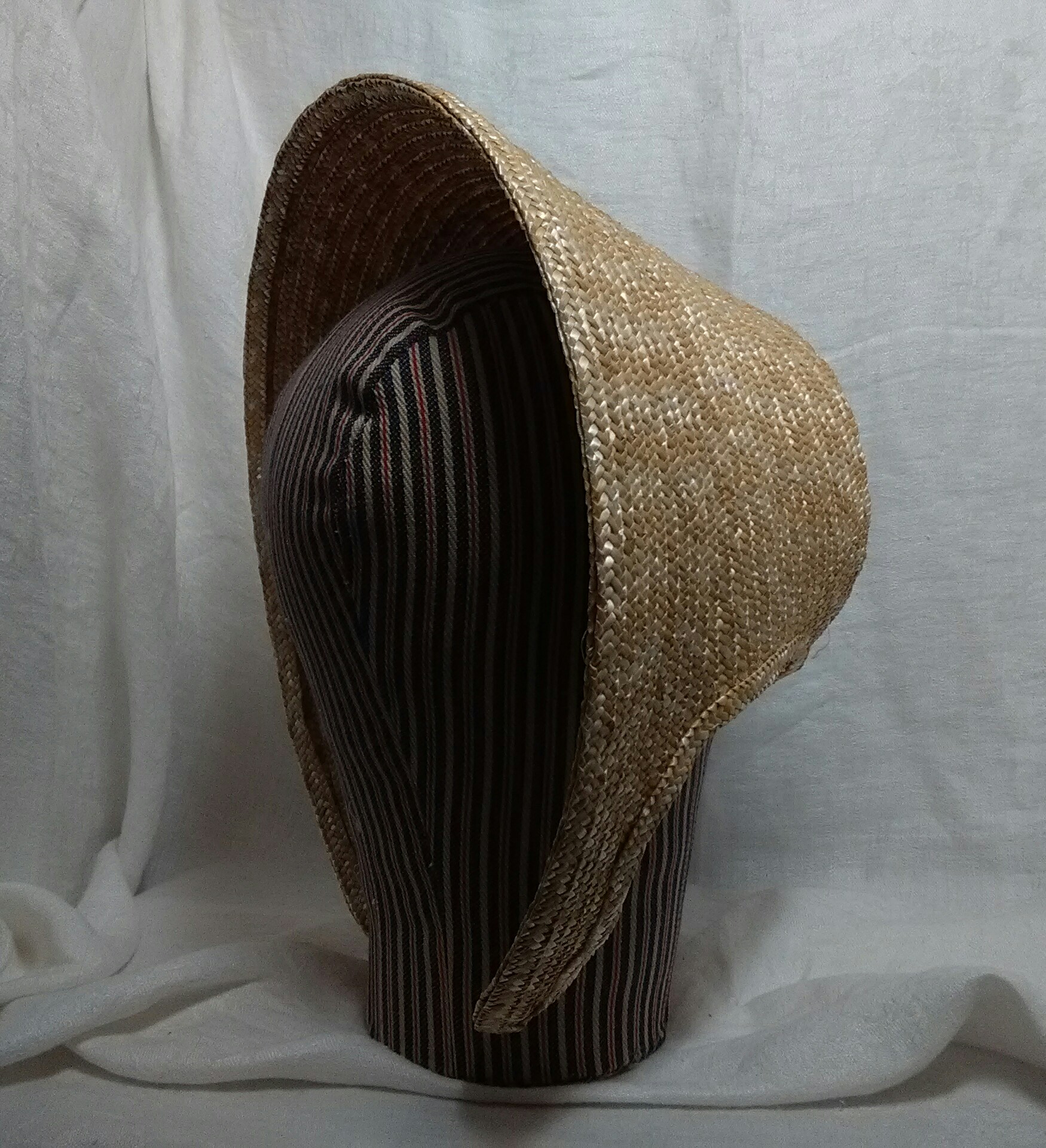
Today I offer a straw bonnet form with a medium high brim. Find it on Etsy
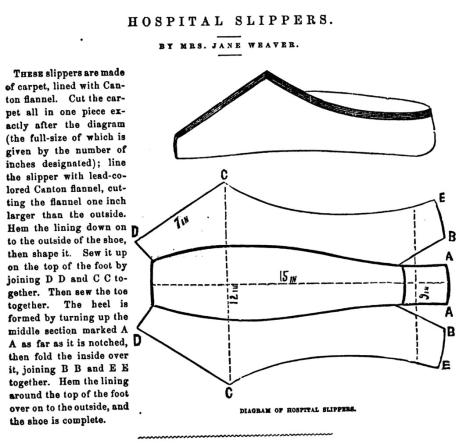
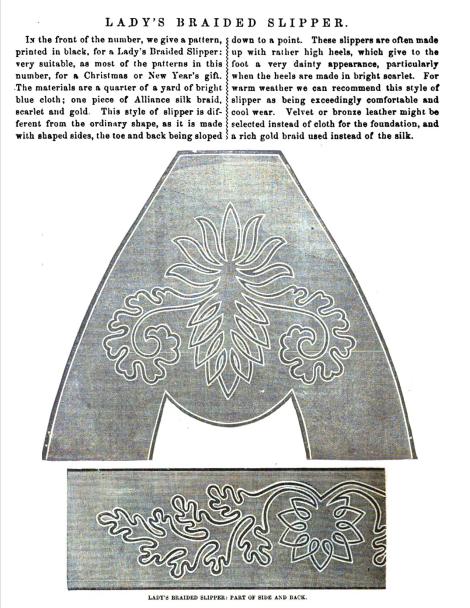
As I mentioned last week, I haven’t made up my mind which slippers I will do. I want to do a patriotic pair, I have materials for an applique wool & ribbon pair and I have wool floss for a Berlin work pair.
If only I had time to do all of them.
But, I don’t.
I’ve narrowed it down to two techniques, using the supplies on hand.
One will be the Berlin work pair. I have a bunch of purples and greens. It is a small, limited supply of beautifully coordinated colors that I lucked upon acquiring together. Fearing how far the wool will go, I think a simple slip-on would make the most of the materials. I was thinking I would do this 1857 Godey’s Slipper, just with purple instead of orange: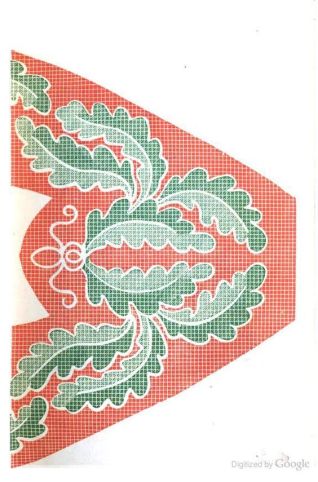
Then, I saw this Peterson’s 1858 slipper: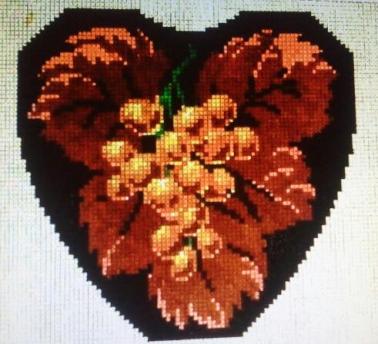
“Nothing more beautiful than our slipper pattern was ever seen in a Magazine. It may be worked, if preferred, in green and purple, instead of in brown and gold.”
In greens and purples???? Why, yes, I think I will….

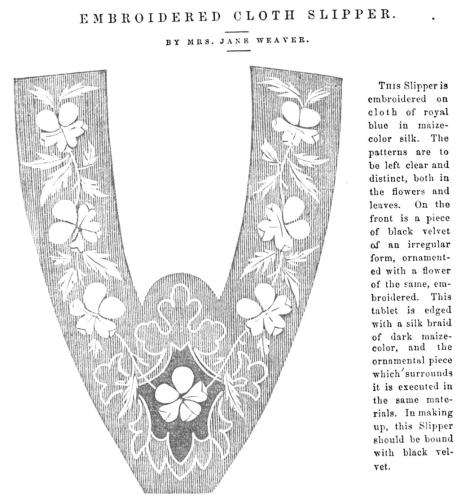
The other pair will be take from the Oriental Slipper design in Peterson’s, January of 1866:

I have a nice black wool for the base. Instead of the three colors of braid to directions call for, I have two widths of light blue ribbon. I am picturing the embroidery either in a dark blue (like what will be left from my purse) or a mix of colors, possibly greens or reds. The other piece that is up in the air is whether to use the cones from the illustration or to shape the ribbons something like this (awfully crude sketch):


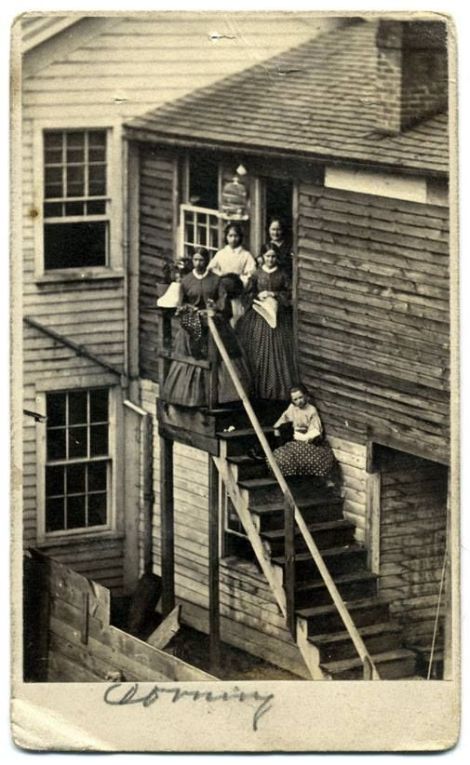
I am excited to receive permission from this image owner to discuss the photo here.Thank you.
At first glance of this Corning, NY image, the unusual angle catches attention. Even with outdoor photography, this angle is unusual. In some ways, this angle and the ‘backyard’ nature of the image reminds me of the 1858 series done in Canandaigua by Augustus Coleman of the city from the cupola of his home. Artistically, the image is full of texture; the lines of the clapboard siding and stairs bringing attention inward to the women.
Looking closer at the women, I was very excited to find not simply a group of women, but women who appear to be milliners. The women themselves appear to be of varying age. No one appears to have reached beyond middle age. The front right (as we see the image) appears to be in her mid to late teens, until the image is enlarged, when she appears older, possibly in her late twenties through early forties. The girl below on the steps may be in her young teens. I suspect there is one more girl peeking from behind the woman on the left’s shoulder.
Each woman is neatly dressed. The woman on the front right is in a one piece dress, simple collar, a ruche just below her dropped shoulder, moderately full cuffed sleeves. The woman front left may have a jacket or faux line to her bodice. Her narrow collar has a small broach in the center. She wears her hair further down over her ears than the other women. Behind her, the woman in the dress that is photographing lighter, also wears a broach with her collar.
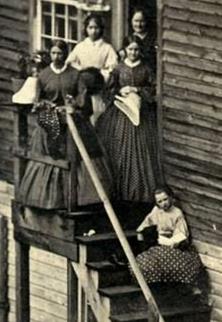
At first glance, this could simply be a group of women holding their bonnets and hats. Until you look at what is sitting on the railing. Along side the potted plants is not a bonnet, but a bonnet block, that which bonnets of straw are shaped over. It could be one made of wood or plaster.

Just below to the left, we see what could be a finished or nearly finished bonnet. The texture and obvious vertical lines suggest this may be a drawn bonnet or a straw bonnet with wider, fancy plait. I think it is more likely a drawn bonnet. 
Nearly in the center of the group, a woman holds what appears to be a straw hat. This may be a black hat or one that photographs black in the blue scale of this type of photography. 
In the front, we see what appears to me to be a buckram form that is in the process of being covered. Notice how the front brim is a different shade than the back crown and tip. I think she has covered one area already. 
Being a photo outside the upstairs backroom, this leads me to think this is outside of the workshop that is often above or behind a millinery shop. It is possible the millinery shop is upstairs, as some are mentioned to be upstairs in some gazetteers and directories. (**Corning note below.) This is important to me because I want to see what women wore in a millinery shop.
———————————–
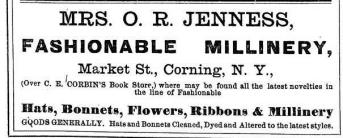
**I was able to find an 1868 directory for Corning. It is 5 to 10 years after this photo was taken. This directory indicates a milliner on Erie Avenue named Mrs. Laura Fordham, a millinery and dress making on Market by a Mrs. L. E. Fuller, a milliner on Erie Avenue named Miss M. Hotchkiss, a Millinery on Market by a Mrs. Octavia Jenness, a millinery and dress making on Market by a Mrs. A. M. Powers, and a millinery at 10 Market by a Mrs. Anna Smith. It also lists additional dressmakers and cloak makers but I do not think this is a dressmaker’s. The directory mentions that in 1850 a fire destroyed nearly all of the business section of the village. In 1865, Corning had a population of 6,724 people. At the bottom of page 190 is this advertisement:
***The same Flickr account has an excellent side view of a woman in in a bonnet, a post-CW occupation image showing a shorter skirt length, and a trio of larger straw hats,
[Adding: If you don’t want to know the personal stuff, skip the italics.]
For a few weeks I’ve been occasionally thinking about writing a post about food at events and those many of us that have food issues. I kept pushing it back as silly. But, between a quasi-recent FB post about someone having food issues at an event, a less recent FB discussion about children needing allergy identifiers and today’s ALFAM post regarding interpreting butchering, I think I am going to go ahead and write a little something.
Past experiences make me want to make a yearly statement of:
Don’t get pissed off or offended if I don’t eat your food.
I have food issues. I am a long, long term, nearly 30 year vegetarian. This means I do not have the enzymes to digest meat, meat products, meat by-products, meat juices, meat flavorings, etc. I also have trouble digesting most dairy. I food allergies. While my doctor gave me an epi-pen, for my birthday, I have no intention of needing to use it. If you are thinking “Salad”, that won’t work. That results in badness and, in one awful instance, an ER visit. It has something to do with the chemicals used to clean the lettuces.
When it comes to food at events, it is simpler and saver to eat what I bring. If I join you for a meal, you’ll notice I stick to the simplest of dishes, the cut fruit or simple grains. Chances are I am not actually there for the meal, I am there for the companionship.
If it comes at meal times, I am hanging out in my tent or house eating alone, there is a reason. I may be letting my stomach settle or I may be sneaking a modern food source. As kindly meant as it is to send me a plate heaping with food you think I should like, I simply can not eat it.
I suppose this is the point where I have to address the questions, those questions that I heard fairly often as a teen, then not again until recent years regarding being a vegetarian. Let’s see… a) I have officially been a vegetarian since I was 11. That is when my father gave up on trying to get me to eat meat. Choosing not to eat meat is very personal and in many ways spiritual for me. From when I was very young, I felt it was wrong for me to eat meat. Please know this is different from feeling it is wrong for others to eat meat. Like I said, it is very personal. b) I am not a clueless vegetarian. I know where meat, and food in general comes from. My father was a good hunter. He used to hang his game from the swing set, which happened to be outside my bedroom window. I can recall deer, boar and sheep hang there. I was also there when the chickens came to their end. I helped Dad and Mom make sausage from the butchering to the stuffing. This was my parent’s attempt to get me involved with the food in hopes that I would eat it. I’ve milked cows and goats. I’ve collected eggs from chickens, ducks and geese. Related to this, I have a very sharp nose and I can smell when an animal has run or been in fear before it dies. c) No, I have absolutely no interest in eating meat or a meat product. d) I am in constant turmoil over the use of leather and fur products in reproduction garments, being drawn between correctness and my personal ethics. This is to the level of nausea and sleeplessness.
After all that blabbering, what I really want to say is… .
There are a great many people who attend events who have food issues be it allergies, sensitivities, religious/spiritual or health related. These can be a challenge enough in the modern world. But, at a historical reenactment/event there are so many other factors. Children may not know the details of their allergies. Medical ID bracelets may not be as visible. Adults may be trying to get into the “mindset” dulling their personal awareness of food dangers. Weather conditions may effect reactions from foods.
Please be careful about who you give food to. Don’t get upset if someone doesn’t eat the food you offer. If you are cooking for a group, be careful of cross contamination.
Okay, so at this point I’ve decided to post a slipper an hour for the rest of the morning.
Peterson’s 1862