Travel (research) Reflections

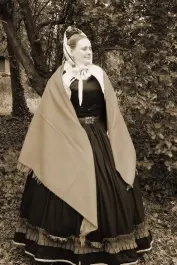
I’ve been working on an 1830s travel program for GCVM. In the process I’ve learned a few things about travel, as well as a few other things I would like to share.

First, I have a big challenge going from an 1850s and 60s ‘mindset’ to an 1830s ‘mindset’. I am such a visual person, I need the aid of photographs and paintings to help me develop that mental picture. I also find I really need maps, detailed maps to aid in this visual. Another aspect is that I’ve spent my time from college on focusing on the time frame between approx 1848 and 1865 often obsessing right down to the minute detail. This amount of time can not compare to June, July and August.

In terms of clothing, the guide books I focused on suggested a dress to have sleeves that were not tight to prevent sweating. I altered my dress to have deeper armscyes and looser sleeves, especially through the upper arm. I find this aspect of the dress to be exceptionally comfortable. I have full movement of my arms comfortably. I believe even in exceptionally hot and humid weather, the sleeve will do well with not sticking or bunching against the skin. I do think the armscye is rather noticable in the front. This also throws off my attempt at a 30s sleeve since the change from the upper part of my sleeve, which is loosely fitted around my larger upper arms, to the larger lower sleeve is minimal. (I’ll see if I can get a good photo of that.)

When it came to the bodice, I couldn’t see how the back closing dresses of the 30s could possibly work for a woman who was supposed to be traveling alone. With several nights at inns and with rough travel, she would need a comfortable front closing dress. I opted for a cross-over bodice closing at the waist in the front. I fully admit, now that it is done it feels far more like a 50s bodice than a 30s. While sitting the neckline sits just above the drop of my shoulder but when standing it does not have the wider neckline of the time. If I were to have been working on a later 50s or 60s version, I definitally would have opted for a sacque & petti or sacque and dress combination in a seasonall appropriate material, ie linen or wool.

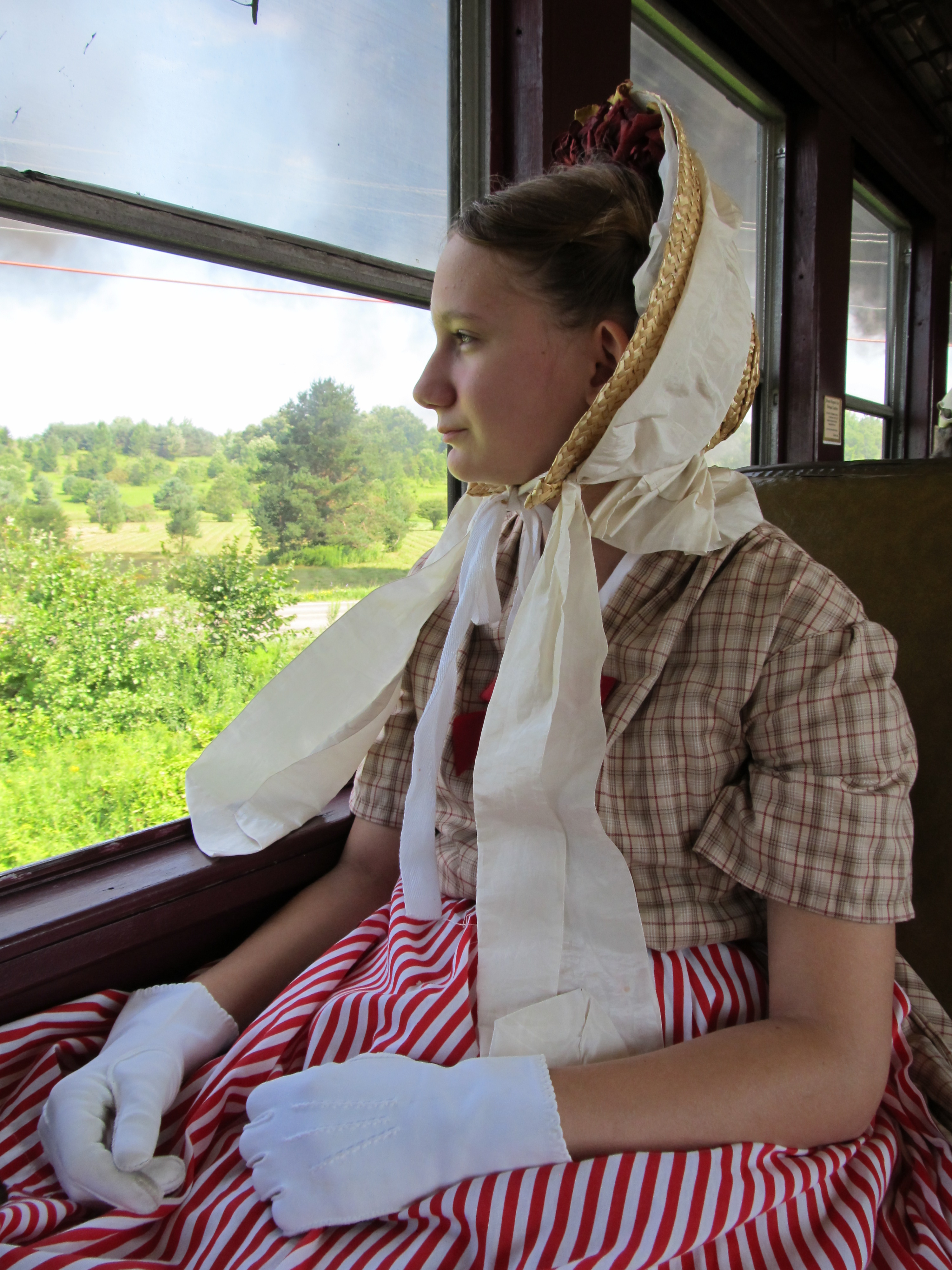
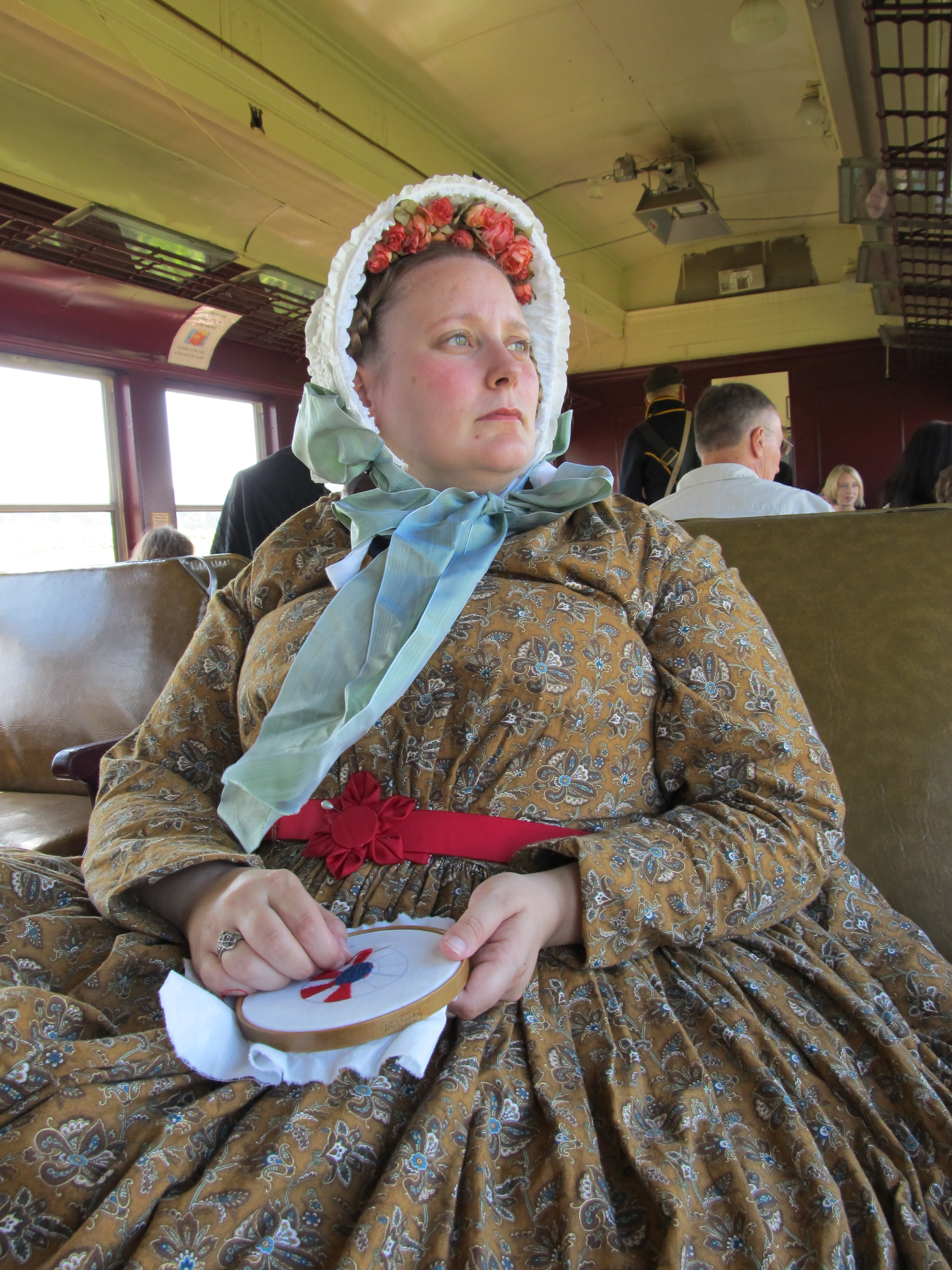
The weekend before the session run-through I learned the challenges of soot. I found out to late that my straw bonnet got smooshed while being stored in the car. (FYI – Hot, humid cars are not a good place to store bonnets.) Instead of the straw, I wore my white sheer cotton drawn bonnet. The material was a magnet for the soot coming from the steam engine. Before I knew it my white bonnet was speckled with little black spots. These little black spots do not come off. Of course, upon learning this first hand, I needed to include it in my discussion.

During that same event I found reason to question the wearing of white petticoats during railroad travel. With the second day’s weather being so wet, the soot gathered on the landing and steps of each car. While the front of my skirts could be controlled to avoid much of the layer of black, sticky soot mud, the backs could not. My inner petticoat, that directly over my cage, became black with soot a good foot up the inside. I should mention these are petticoats that get cleaned once a season due to the time involved in the starching and ironing. While I was able to wash most of the soot out with a good soak and wash in oxyclean, I am not certain when a traveler would have the time to have her petticoats washed. She certainly wouldn’t be able to on a regular basis during the journey even if washing services were available at the inns she stayed at. Would she go about in blackened petticoats? Would she opt for petticoats of a different color? I don’t know.

Boots, shoes and slippers. The wearing of stout leather boots certainly makes sense to any of us who have stood at the edge of a giant puddle while wearing something pretty on our feet. Some authors (I’ll double-check who if you need me to) suggest packing a pair of slippers in your travel bag, the one you carry with you. initially, when I read this years back I thought is was a nice idea. I didn’t think much beyond that. I think I figured out why these are so important. I’ve found if one sits too long in tight stockings, held snug at the knee, and tight boots, that the feet and ankles tend to swell. If on longer railroad or packet boat trips, one is able to remove her boots and loosen her stockings, there will be significantly more comfort. Now of course the question is, how does a woman do this while maintaining all decency? In the case of a woman staying in a ladies’ car, this would not be a big challenge. But what about a woman traveling in combined company?

 Oh back to bonnets. There is a good reason why guide books suggest traveling hoods. When you need to rest your head due to a long journey, or a weather induced migraine in my case, a bonnet is exceptionally uncomfortable to lean you head against a seat or side of the rail car. I suppose the same would be true on a stage. So, I really understand the suggestion of a hood. But, my quandary is what we are seeing in images. Most of them show women in bonnets with traveling veils. So, do you board in your bonnet then change to you hood when you need to rest? The challenge I see there is where to put the bonnet. Do you have your band box with you? Is there even room for it to be carried with you? If you opt to wear your hood, do you, and if so, how do you attach a veil to a traveling hood? There are items like a bonnet shade or ugly intended for use with a bonnet during travel. These would suggest wearing the bonnet for the duration of travel, at least during non-rest times. At the same time, there are a great number of hoods. (But, these are more mid-century rather than the earlier 30s which I don’t know as well.)

Relatively random reflections on this process. Maybe in September I’ll have reflections on a scripted presentation style program verse an interactive student focused one.

Published in: on August 26, 2011 at 11:35 am  Leave a Comment  
Tags:

Railroad travels – Arcade reflections

This past weekend was quite the roller coaster event for me. I wasn’t sure how to write about it as my perspective changed so often. So, instead of something inspiring or thematic, I’m just going to share some reflections. (warning I do get a bit venty and even catty)

This Arcade and Attica Railroad event was one of my favorite events from the very beginning of Civil War reenacting. The event primarily takes place on a series of train rides where visitors ride out through the country on a vintage train. Reenactors interact with the visitors who are quite the captive audience. Over the years this interaction has ranged from improvisational first person to scripted first person to third person instructional. Each version has its own benefits and draw-backs.

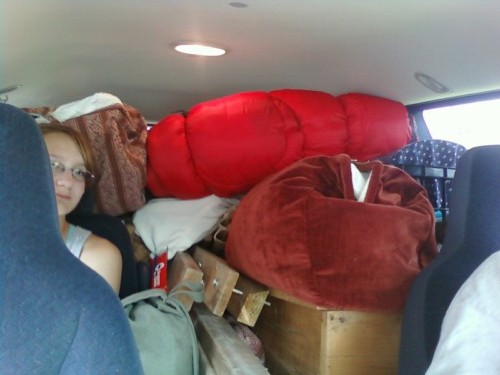
This year we had a good deal of trouble deciding if we were going because we have so many real-life challenges with still being unemployed since our move back to New York and not having our own home to really prep, plan and pack properly. My big motivator was taking my little sister to an event after so many years. But, truly money was tight, more like non-existent. After lots of figuring, vehicle swapping and back-n-forth, we were going. Thursday night was a quick pack and attempt at sleep… 3 hours for me since I have these pre-planning issues. Next came the sardine style packing of a van with three stops of having to pick up gear and a sister that had to go. Having never packed a van before, this was quite the experience in space. (I’m still not certain any vehicle will ever beat the little Shadow I used to have for size of vehicle to packing space.)

Despite each of the places we needed to stop on Friday and a detour, we still managed to make good time arriving at the park in day time and good weather. Shortly after we arrived some good friends arrived as well. The guys were able to get their camp layed out and start setting it up. Beth and I needed to wait for Rob to make the run from work with the tentage. It was nice because it gave us time to figure out what we were going to do and to have fun catching up. We were a bit silly, taking the chairs and laying out our camp plan with them. With the weather report calling for heavy rain and thunderstorms, this was the perfect opportunity to use a set up I’ve been wanting to do for years. We faced the two large tents in towards each other with the fly running in between. When Chrissy and Kim arrived they set their tents adjacent to ours in the same set up. With the children along for the weekend this was a very nice set-up. I was a little sad when I saw my old tent arrive with Chrissy. Seeing it was a quick flash-back to working on the uprights and ridge with Dad. My teary-eyedness over that should give you a good idea of my emotional and overly stressed state going into this weekend.

 I admit it. I am quite particular in how things are set up.  Setting up the interior of the tent was the beginning of my “I wish I had ___ from storage”. We were able to find and get out of storage one barn-board box. Besides that everything else was in carpet bags or the one band box for bonnets. For a weekend guaranteed to be wet, this was a challenge. (Check out my post last week on wet events to see some of those things I would normally want.) In hind-sight the one item I really would have wanted out of everything was one more box or trunk to work with. I far prefer to have clothing neatly packed in a trunk where it can be dry and layer in order of need. That is one box/trunk. The other, which we did have, was filled with a combination of food stuffs and toiletries. In a completely organized system these would of course be separate. This need for better organization started me thinking about the advertising box I used to used for food. Somehow it kept cool inside. It had wheels underneath that kept it just enough off the ground to help against ants. I can’t picture at all where that box is. I’m hoping it is buried somewhere in storage that I just haven’t seen it.

With the air turning cold and the lack of sleep the night before, I turn in rather early. Well, I should say I attempted to turn in early. Here is part of my roller coaster. I have the worst time trying to sleep sometimes. This time was just awful. I just couldn’t get to sleep. I tried counting. Didn’t work. I tried counting backwards. Didn’t work. I was still awake long after the park became quite. Ugh. Then came the morning bugle. I just pleaded with myself – please more sleep. But, that was mote. As soon as my bladder woke up, the rest of me had to wake up. Ugh. I’m certain I made little sense to anyone that morning.

Once dressed I felt a bit more myself, though an exhausted self. It was off to the train. Elizabeth and I had a lovely walk into town with Bevin and Chris Lynn. This morning walk was quite enjoyable as long as I was still in the shade. As soon as I hit the sun at the depot I could feel that odd feeling again. So, inside we went to head to the train. Train cars are full of shade.

How pleased was I when I saw the improvements at the train station and the new paint for the cars inside and out. The inside of the depot felt more open than the years before. I can’t pin-point what it was inside. It was just great. The cars looked beautiful. Outside they had a new coat of green. Inside, most had a new coat of a burgundy that was quite comfortable. Some of the cars even had carpet. I don’t know if the carpet is authentic. But, from a comfortability, esthetic and safety standpoint, it is great.

Now we come to the 2 hours that pressed my buttons. Really pressed my buttons. Ready for a vent and stump?

Please, please, please do not talk about something you know absolutely nothing about! If you don’t know, say you don’t know when asked. If you don’t know, don’t pretend you do know. For about 20 or 30 minutes I listened to a bunch of ladies at the other end of the car go on and on as if they had never heard the work carpet before, insinuating that carpet did not exist in the mid-19th century. There was absolutely no need to comment on the new carpet at all. If the carpet is an anachronism, simply do not mention it. If it is something appropriate to the scene but you don’t know about it, do not dwell on it. To make this inappropriate form of ‘interpretation’ worse, this was all done with some of the worst southern accents I’ve heard in a long time. This is another situation where if you can’t do it, don’t do it. You sound ridiculous. As the train got going this screechy attempt at an accent went through a variety of over-the-top story-lines trying to pull other reenactors and spectators in. This was the absolute low point of my whole experience this event as I tried so very hard to bite my tongue. Then came the “why are you in your underwear” approach. Have I ever mentioned how I hate this and think it is completely inappropriate? I do. I think it is a waste of time. There are so many, far better ways to bring the spectators in. I was extremely glad when that first train ride was over.

Now, lets move on.


The train runs were running longer than expected. Sadly, this meant missing our lunch plans. We needed to roll right into the second train. This was a much better experience as we traveled with Bevin and Chris. Okay, so we spent most of the time catching up. It was nice. At the turn-around point where the engine moves to the other end of the train, I was able to get some photos of my sister’s dress I made the week prior.

By the time the train got back to the depot after 3, we were starving for lunch. Warning, farby moment. We went next door to the Chinese restaurant and devoured some veggie lomein. It was so good. But, it came back to bite me. About half way back to camp as we walked in the heat and sun my stomach started yelling at me and my temp went right up. Now, I’m really not sure if this was the quick late eating or me. I’ve discovered this year that about the same time each afternoon at an event my body revolts with this odd heavy exhausted over-heating feeling. I really do not like it both for the feeling and the way it pulls me out of doing anything. I don’t know if it my weight gain or my undetermined health thing or just getting older. What ever it is, I don’t like it. Upon getting back to camp, off came everything down to my underpinnings as I layed down on the cot with an ice cold cloth trying to bring my temperature back down and get the stomach and head under control.

After a little laying down and some lovely ibuprofen and berry flavored tums, I found I was quite comfortable in my pink dress. I am so glad I stumble across that ridiculously cheap, $1/yd fabric that arrived surprisingly lovely. This dress is so light weight. Any lighter and it would have to be a sheer. This began a very enjoyable, relaxed evening with old friends. This was a must needed evening. While my sister played with the other kids on the park’s playground, we adults hung out and talked then all gathered around the fire well into the night.

While I still didn’t sleep deeply that night it was far more restful. That was until morning when a certain bungler decided to do more than the few notes of good morning, opting instead to go on, and on, and on, and on. Later, we shot said bugler.

Sunday was the rain day. It was a heavy rain with thunder. The tent arrangement proved itself useful. A bucket or large pot was needed between the flies to catch the center run-off. It filled rather quickly. With the rain, we opted to drive up to the depot.

This second day of train rides were nice despite my on coming migraine in the afternoon due to the combination of air pressure and me. (yes, that earlier low point out ranks a migraine on a train.) The cool air and moist air was so comfortable. It is much easier to add a layer in the form of a shawl or coat than to try to keep cool. The one downside is the mess caused by wet soot from the steam engine. I have soot in such odd places including half way up the inside of the back of my petticoats from going down the stairs. Luckily, the rain decided to move on by the later afternoon for us to pack up.

I think we all headed home very tired, very hungry and rather damp.

All in all – It was a great weekend even with the heat, rain, stomach aches, and migraine.

I did learn a few things this weekend. My red carpet bag does resist water nicely. Traveling hoods do make much more sense than bonnets, especially for longer trips where one may want to rest one’s head. White sheer drawn bonnets are a very bad choice as the soot will stain the bonnet with black spots. Over shoes are very important for the soot and mud (covering Bevin’s boots). The sleeve alterations suggested in many travel guides or advice guides are very comfortable. Sheers and dresses with trim will get damaged. (observation of dresses.) The suggestions for simple dresses with resistant fabric (those which dirt and soot can be dusted from) are very important.

Looking back on some of the photos, I’ve discovered something disturbing. Since making this dress for the Fort Stanton event this past year, I’ve altered my corset. It now sits a bit lower allowing my bust to sit lower. But now…. I have this baggy issue. I do believe with the aid of gravity I have reached the age where I need bust pads for some of my dresses. This will help smooth out the transition from my shoulder to my bust.

I do have some additional posts either from requests or inspiration over the weekend I will hopefully get to soon without forgetting about them.

Published in: on August 15, 2011 at 3:23 pm  Comments (4)  
Tags:

Storing Shawls

Another post I started a while back but didn’t finish to post…

A recent conversation led to thinking I should put together a post about storing shawls. Ideally, I could show you photographic examples of what can result from different conditions. Until I can give you those photos, we will stick with a list – Folding can cause creases and breakages. Moist conditions can lead to mold, mildew and rot. Dry conditions can lead to fiber brittleness. Bugs can cause holes. Contact with wood or acidic surfaces or being stored in non-acid free containers can lead to discoloration. Pretty awful right?

Guidelines for the Care of Textiles from the Textile Museum in Washington DC

How do I store antique textiles at home? From the Smithsonian

Preserving Your Treasures-Care and Storage Methods for Clothing and Textiles by the Missouri Historical Society


Published in: on July 20, 2011 at 1:43 pm  Leave a Comment  
Tags:

More Sewing Cases

Here are a couple more sewing cases.

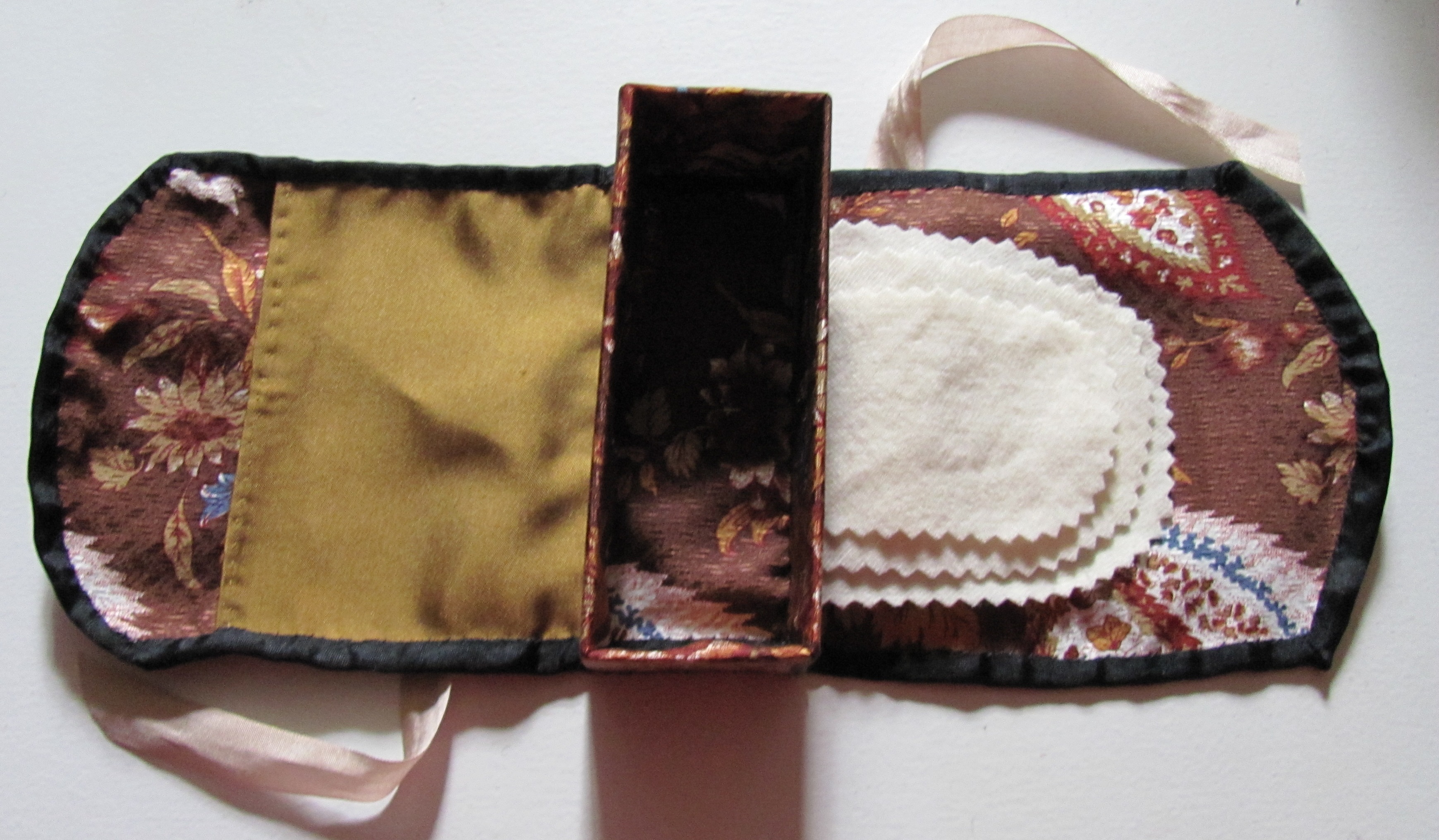
I am particularly fond of this fold-over case style. It has lots of room to store needles, thread spools, thread winders, scissors or what have you. The exterior is a black felted wool. The interior is a silk with a cone motif on a damask weave. The pocket is a twill weave golden silk. The whole case is bound with black silk taffeta ribbon. The trio of wool pages will hold plenty of needles.

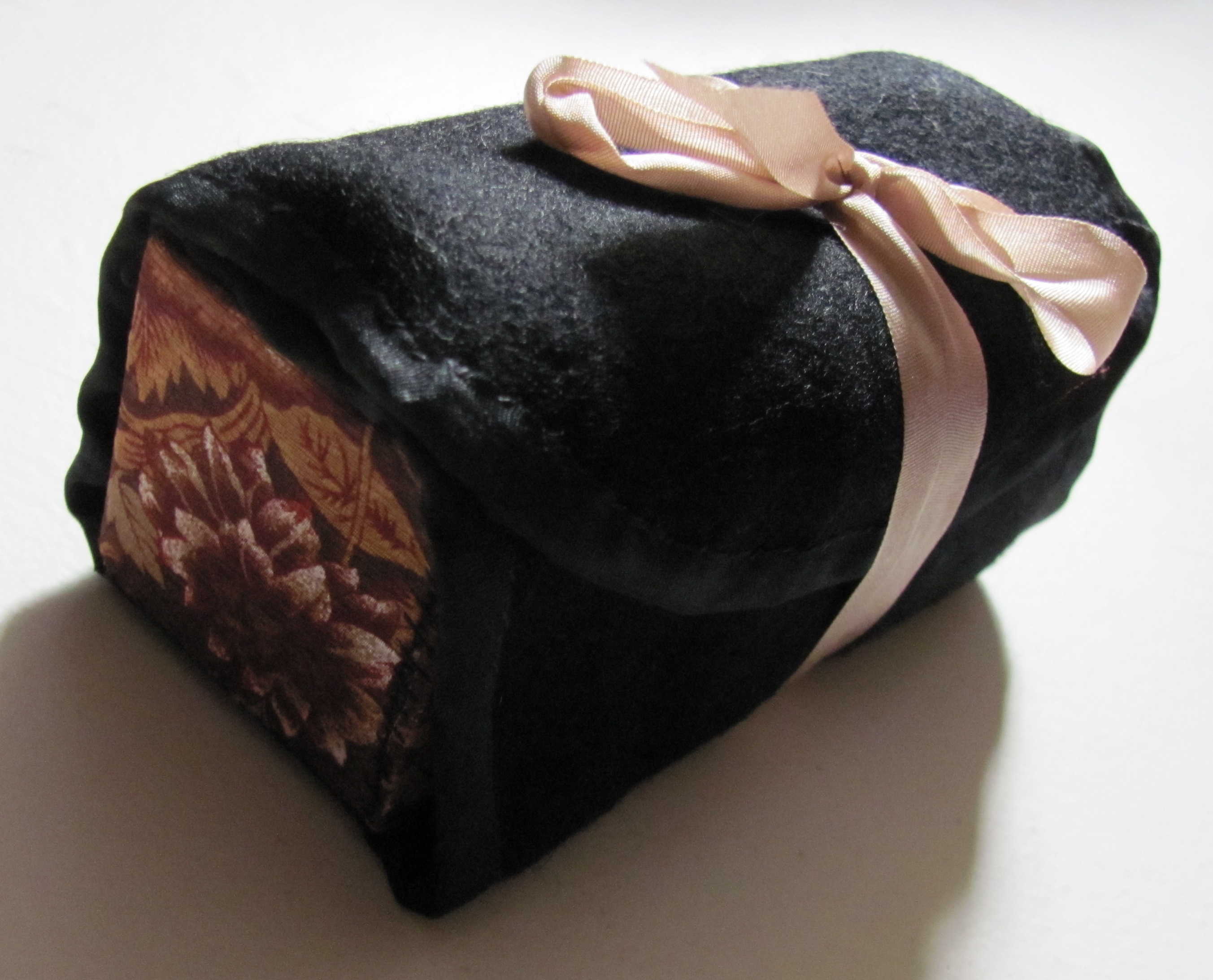
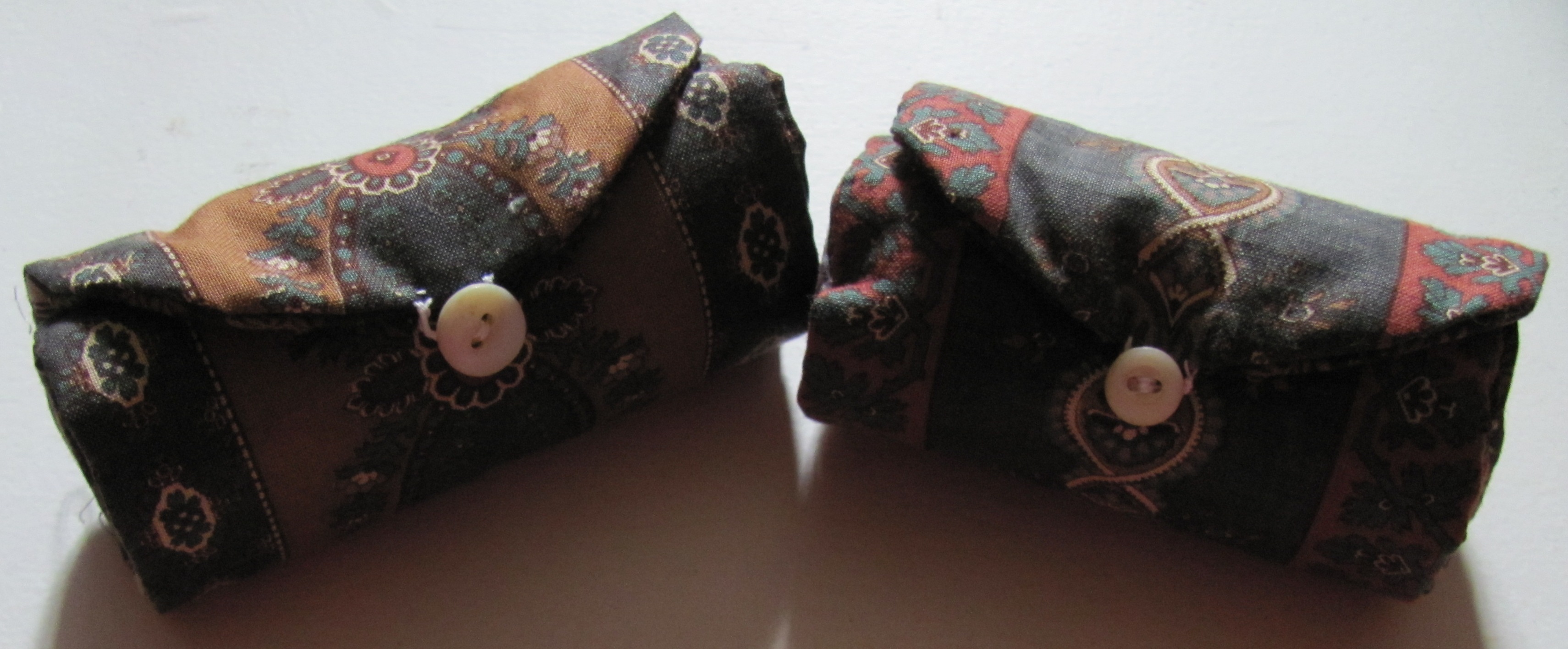
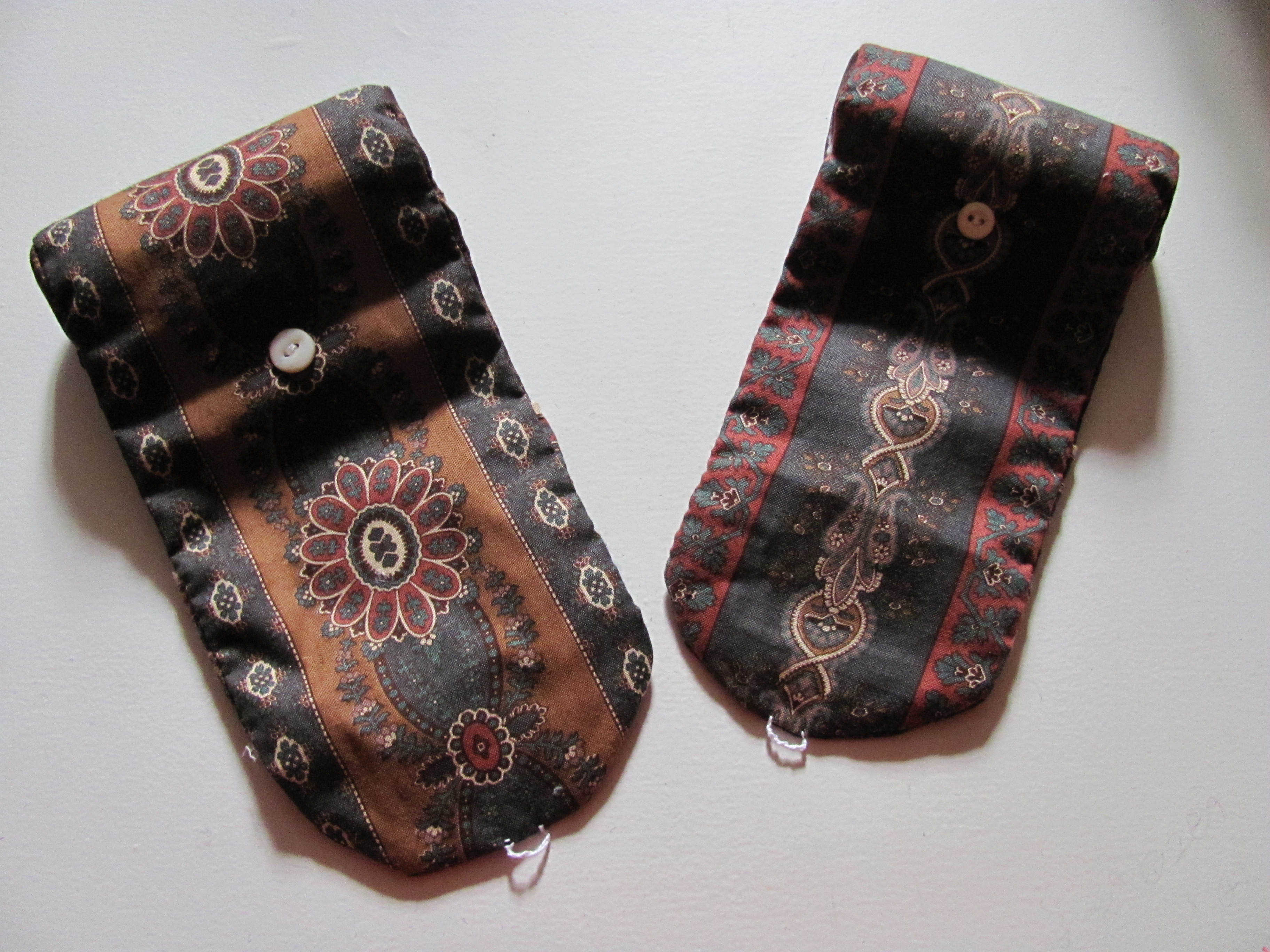
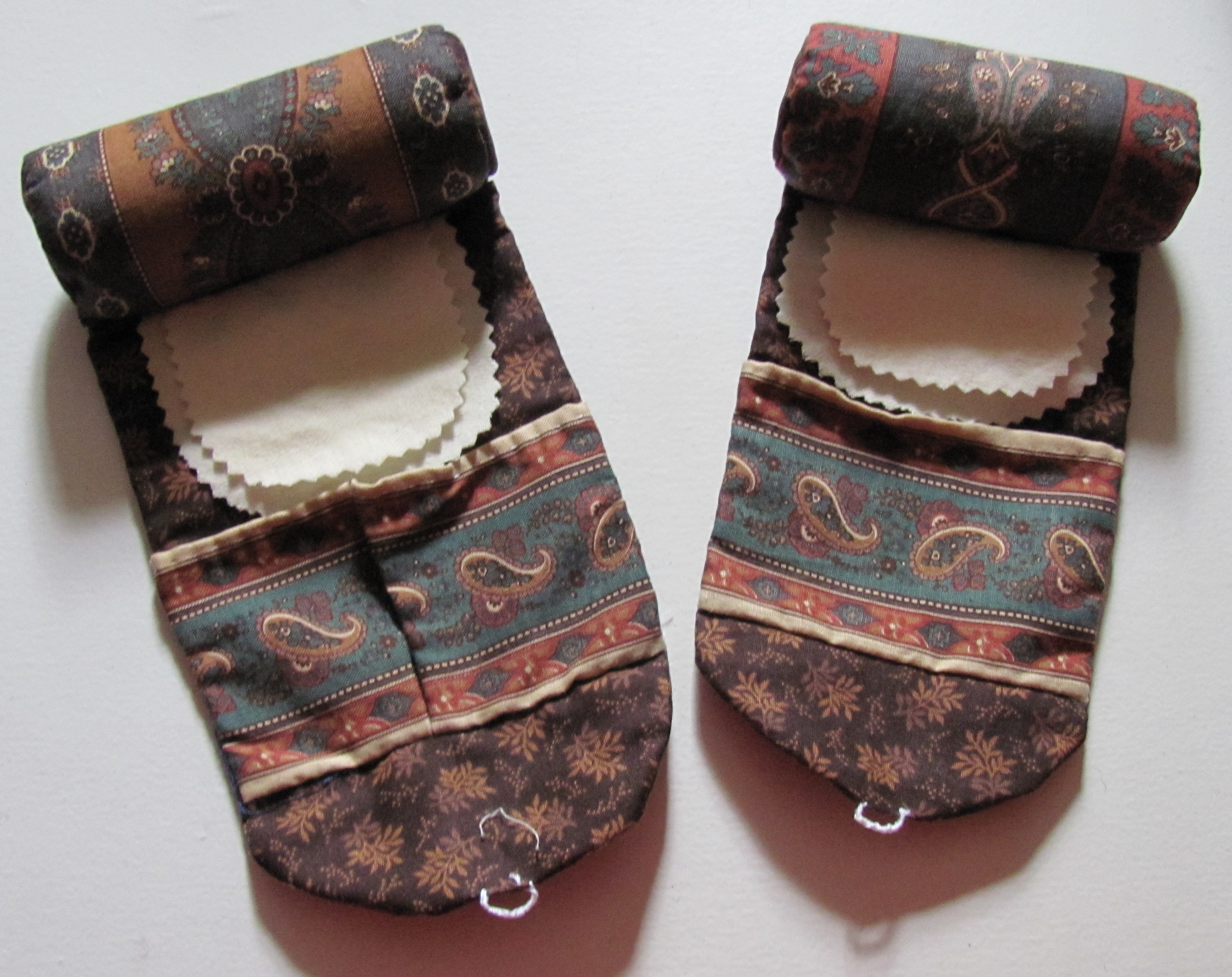
When I saw this fabric, I knew it had to be a sewing case. Or, in this instance a pair of sewing cases. I would love to see this pair say as a pair possibly for a husband and wife, a pair of brothers or a father and son. Each rolled case is handsewn. The pinked needle-pages are off white wool. The button placement with button loop allows the case to be filled and still closed.

Published in: on May 26, 2011 at 9:40 am  Comments (5)  
Tags:

Barbara’s Sewing Case

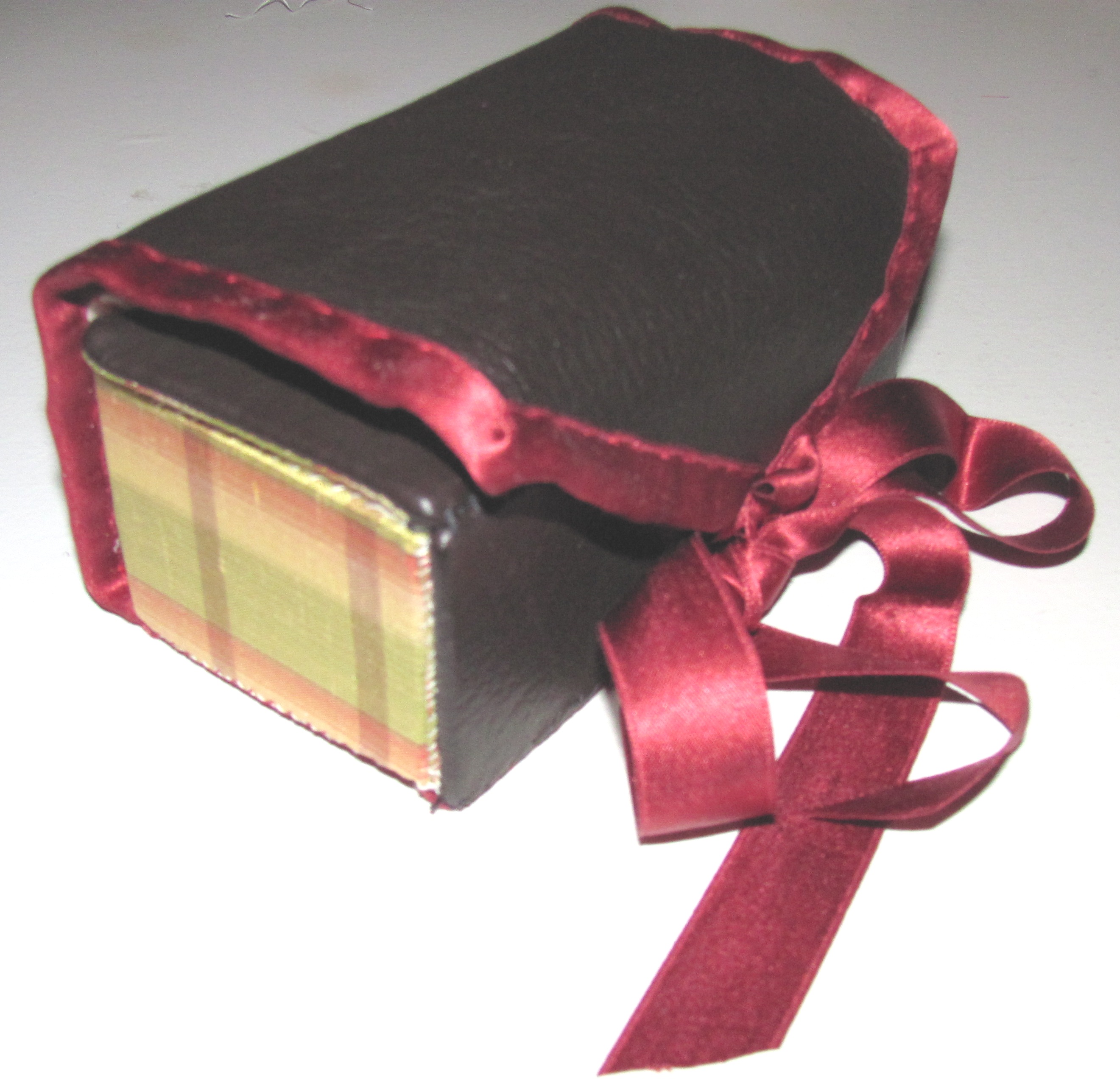
For months now Barbara has been asking me to make her a sewing case all her own. After months of saying ‘no’, I finally broke down and said yes. Now, Barbara is the one and only owner of a custom sewing case based on an original mid-century sewing case.

Barbara’s case has a dark brown leather exterior bound with red silk, satin ribbon.  Inside it is lined with a red and off white large scale plaid. The case is a red, yellow and green plaid. The scissors case, also of dark brown leather, was shaped to fit her scissors, tying closed with a cream silk taffeta ribbon. The pages alternate red and off white, each with a blanket stitch. She also has a bell shaped needle-book of silk with pinked wool pages inside.


The interior case opens to show a pincushion of off-white wool and space for sewing notions. 

How do you get this case?

You don’t. It is Barbara’s. She has the only one. I may be talked into doing a similar one. But, as Barbara will attest, it takes a bit of coaxing.

I will have other cases available though including a lovely striped silk rolled case I have been working on. (Stay tuned for photos.)

You can also make your own case following the directions in Fanciful Utility: Victorian Sewing Cases which should be ready for taking pre-publication orders in early August, shipping in early September.
.

Published in: on May 23, 2011 at 6:43 pm  Comments (3)  
Tags:

Sewing Cases….. Available Soon

With my job search comes the need to de-stress. Lucky for those who have been asking for sewing cases, I’ve been de-stressing with sewing some cases and needle-books.

For those of you wanting to make your own sewing cases or needle-books, Fanciful Utility: Victorian Sewing Cases & Needle-Books should be available for pre-publication orders in Early August for shipping in Early September.

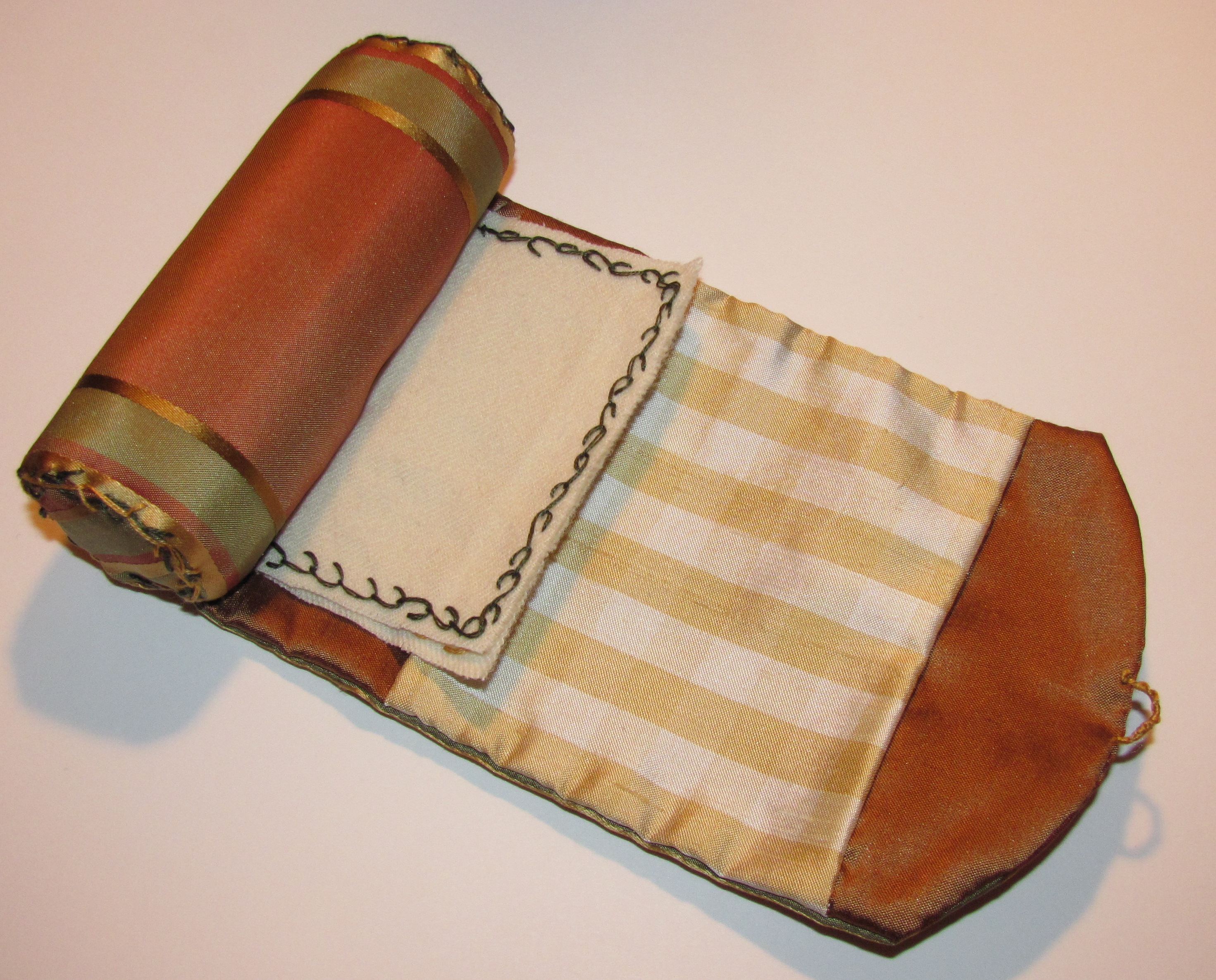
This case is made with a lovely fall toned striped silk on the exterior and a coppery shot silk on the interior. The spacious pocket is a white and golden yellow plaid silk. The two off white wool needle-pages are vine stitched with dark green on the first and golden yellow on the second. The viney stitch is continued on the ends of the cotton batted roll. The case is held closed with a tiny mother of pearl button and loop. This case is entirely hand-sewn and based on an original formerly in my collection and featured in the up-coming  Fanciful Utility

The bell shaped needle-book is made of coppery silk with a pair of off white needle-pages inside. It is tied at top with a cream silk taffeta ribbon.

Published in: on May 23, 2011 at 5:58 pm  Comments (2)  
Tags:

Hats against Bonnets – Peterson’s 1865

My friend, Sue L., found a must share passage regarding the wear of hats in a July, 1865 Peterson’s Magazine.  On page 74 in the Editor’s Table….

Hats against Bonnets.–The attempt to make hats unfashionable has not succeeded. There are, indeed, more bonnets worn: but many ladies still prefer hats: in fact look better in them. The hats are so various that it would be difficult to indicate which form is preferred. Some ladies wear hats more like the high-crowned black hats worn by men: the crown is not quite so high, and the brim is broader–these are the only differences; we have engraved one of these hats. Very little trimming is added; a flower is usually placed at the side, and appears to fasten a scarf, which is twisted round the top of the brim and falls on the shoulders. These hats are made of either black or white sewed-straw, and the color of the veil corresponds with that of the hat. The toquet, with brim turned up at the sides, and forming a point both at the back and front, is very becoming to the generality of faces; a long feather is won round these toquets, and forms the sole ornament to them. The jardinière hats are also worn. These have round brims, which are turned down and bound with velvet, to which is added either a gauze or lace veil. These hats are worn alike by young girls and their mothers, and especially by those who are not sufficiently youthful to adopt any of the faster forms.

Folding Chairs

June 2015 – I am receiving an increased number of requests for information on particular chairs and appraisals. While I love to see original chairs, I am not in a position to give advice on the value or restoration of chairs. I simply find patent furniture to be a fascinating research subject. 

Here is some information that will hopefully help if you are considering a folding chair….

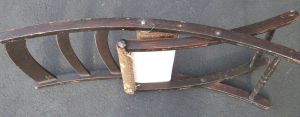
This 1855 Patent is one of the earlier 19th century folding chair patents. It has a simple side X construction with a slight curve in the back to leg piece. The seat is solid with a cushion set in.

This chair from the New York State Museum, is circa 1866. This walnut chair was made in NYC by B.J. Harrison And Company. The museum’s descriptions is as follows “32 1/2 x 16 x 17 in.  Curved crest rail above two side rails ending in molded rear seat rail. Beneath this are two dowels fitted to another molded rail. Oriental-type rug seat (not original).” The seat folds up with a side X pivot while the back folds down. A similar chair construction can be seen in this  1863 Patent.
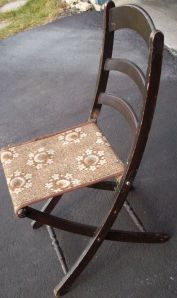
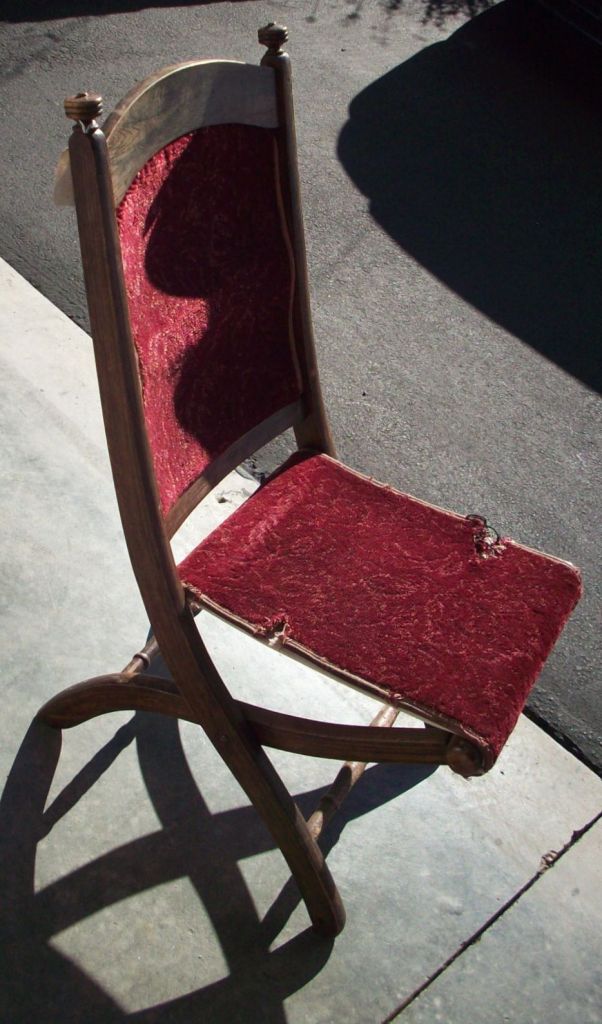
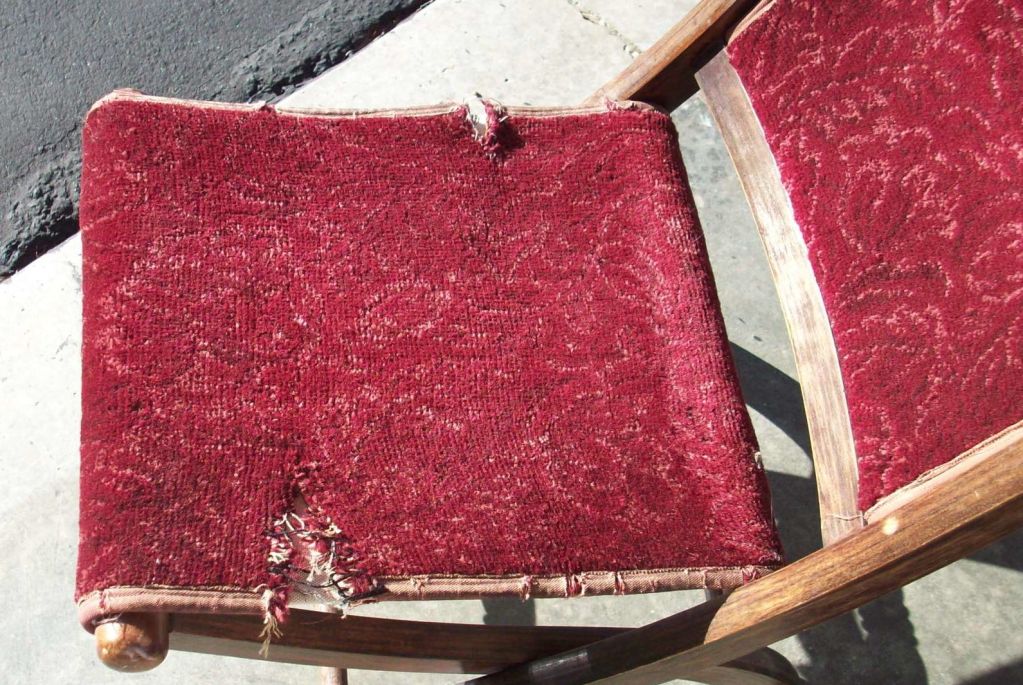
 This circa 1860-70 chair is Marta Vincent’s. It has been repaired and recovered from the naked state in which it was found with the finish was completely worn off and the carpet seat was in tatters. The back splint has been replaced. The seat is now a piece of ingrain wool carpet supported by canvas.
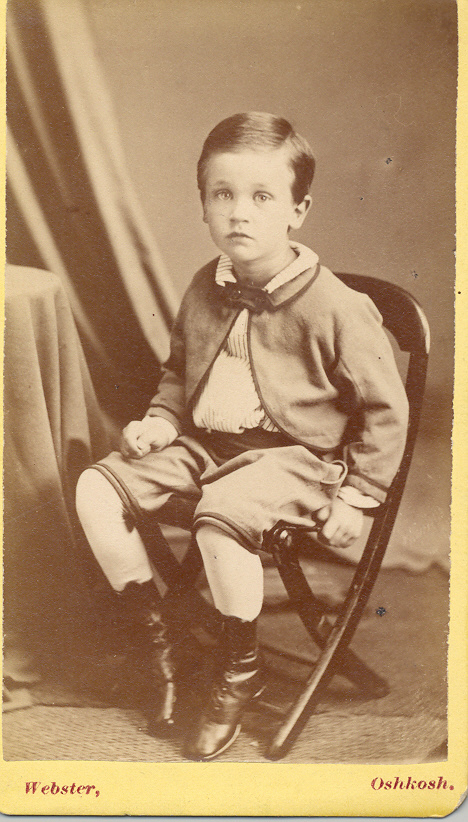
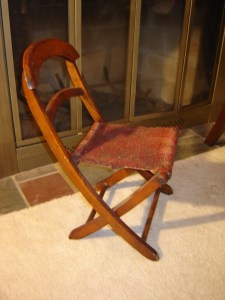
Martha’s above chair is a similar folding shape as the chair in this post war photograph

The shape of this chair’s curved pieces making the side X construction seen in many full-size chairs attributed to those who worked with Vaill. This construction can be seen in this  1870 Patent 1.

Added March 15th, 2010: A reader contacted me about a chair coming from a private collection. She has been kind enough to share this lovely child’s folding chair which looks much like the one in the photograph above. This chair has a great glowing patina. Notice the darker areas where the chair would have been picked up and carried when folded. The carpet seat is in good condition with deep reds and greens in a large, well centered design. The curves of the legs tend to suggest it was made by someone who worked with Vaill. The back piece is curved nicely while appearing quite solid.


img_20160819_151413.jpg

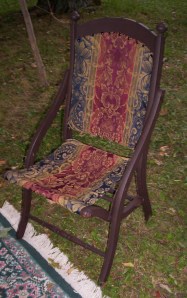
Circa 1870-90. These chairs were manufactured by Edward W. Vaill. It is a side X construction with a second pivot point on the back and a hinge on the lower back leg. The top chair has an incorrect material. The bottom chair shows a floral or scenic design done in tapestry, possibly original or a replacement. In both cases, the wood is likely walnut Notice the curves in the leg and cross support piece. Also notice the turned finials on the top. Both chairs have paper labels found on the front cross runner underneath the fabric. The construction of this chair can be seen in this 1875 Patent by Wakefield, assignor Vaill. This is a similar patent from  1876.

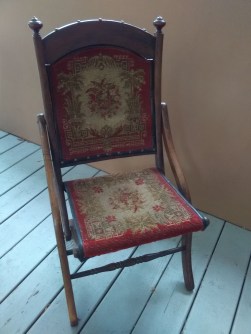
 This chair is Marta Vincent’s. I think it could have been made between 1863 and the 1880s. It has the original red carpet, which she has supported with canvas underneath. It appears to have a back similar to the back in the Vaill chair above. The back to front leg cross piece has a slight curve while the other leg begins to show an S curve. It appears to be a walnut. Notice the location of the splits in the seat. These weaknesses are very much at risk of further damage if not supported.

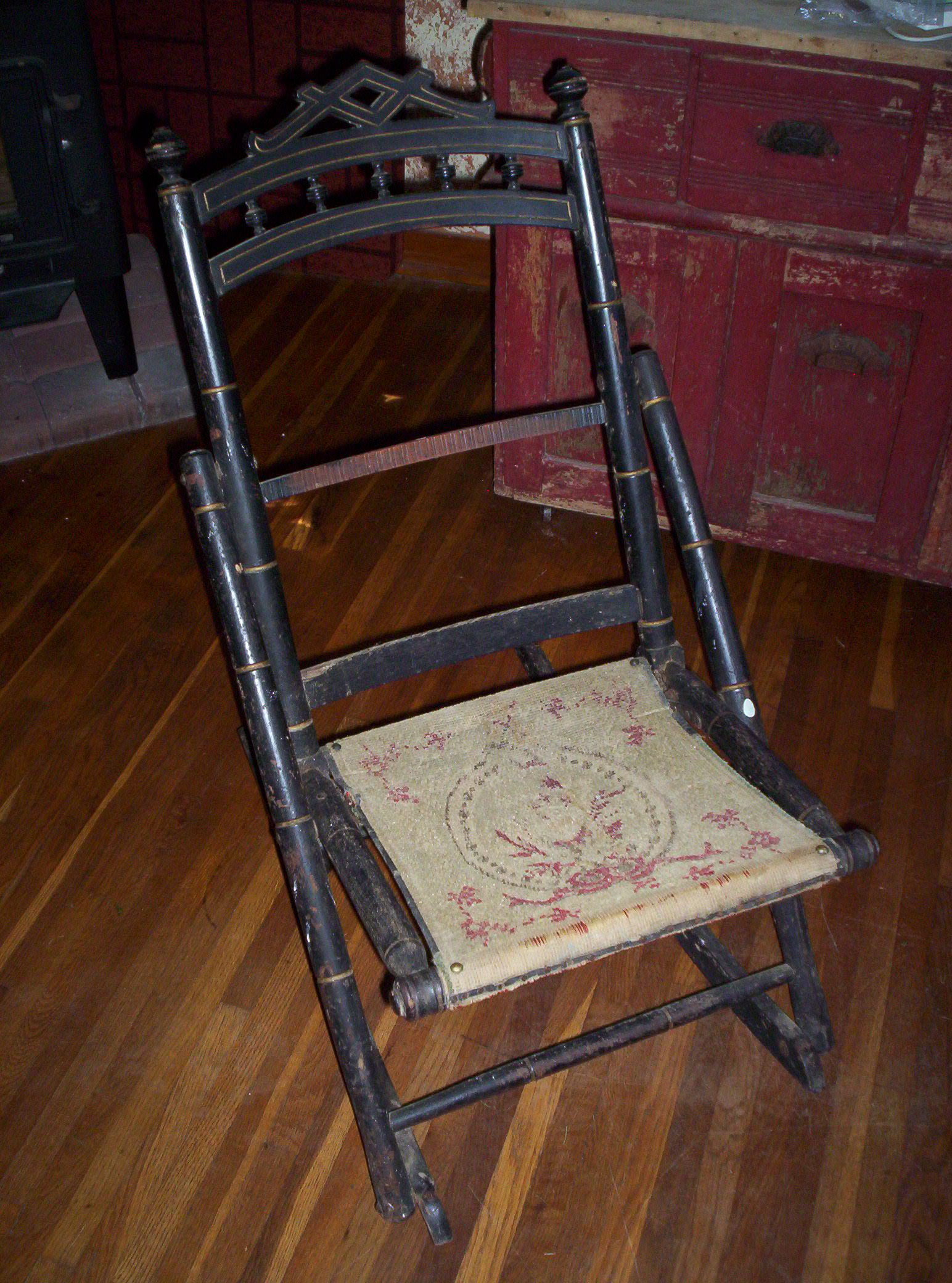
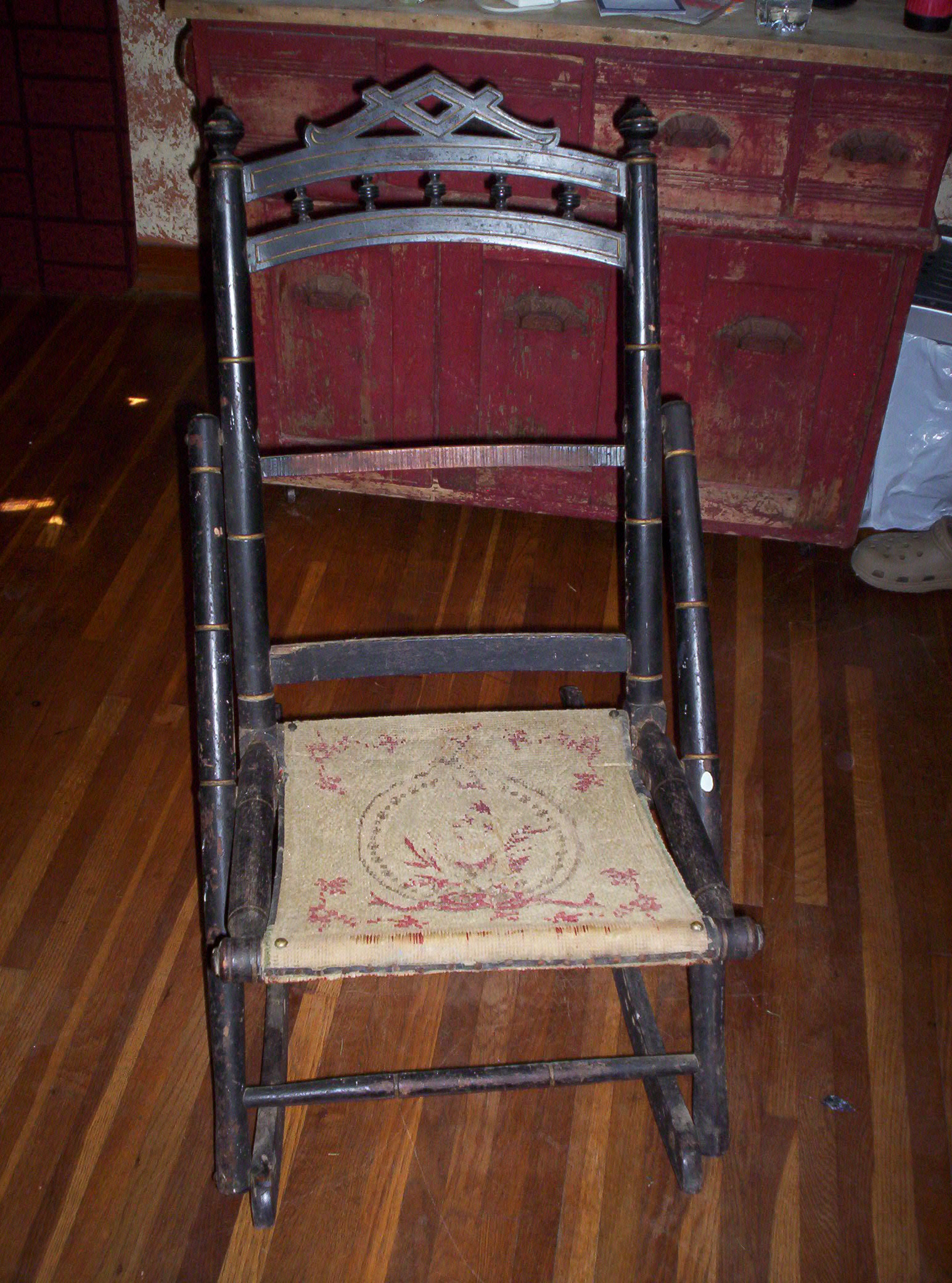
This is my chair, one Dad had for me that was found after he passed. I still have have yet to spend time really looking at this chair. It is an early Eastlake style from the last quarter of the century.  The seat material is likely original.

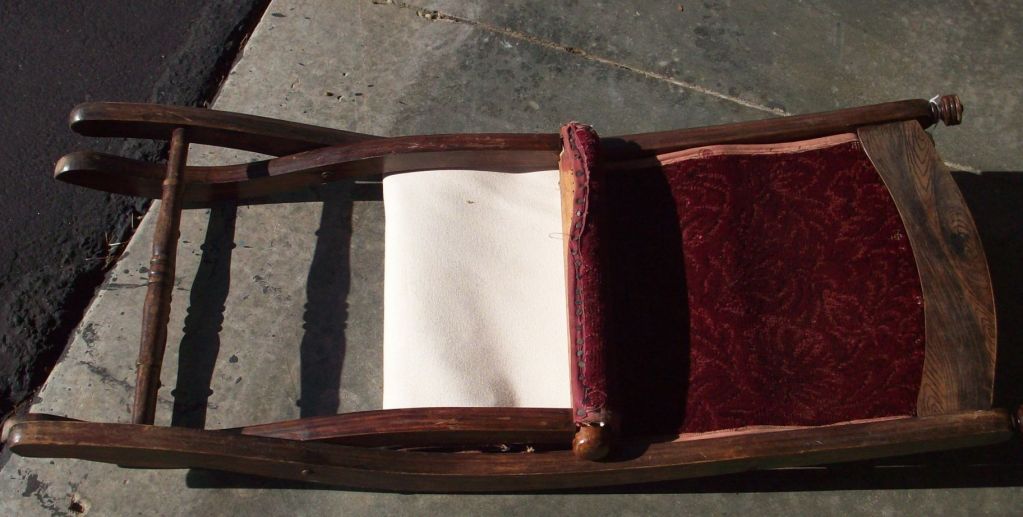
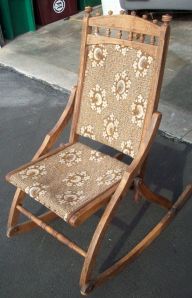
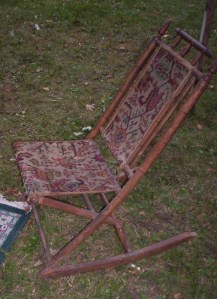
 This rocker folding chair is Marta Vincent’s. When Marta found it, it was in pieced needing to be put back together. The seat and back are a vintage ingrain wool carpet with the sear supported by canvas and the outside back is covered  in brown cotton sateen similar to the method of the original covering on the red one.

 This chair is as it was found. Though nicely intact, the seat and back may not be original. The turning and finials on this chair are quite different then the other chairs seen here. The closest patent I’ve found for dating is this 1881 Patent with a far more complex construction.
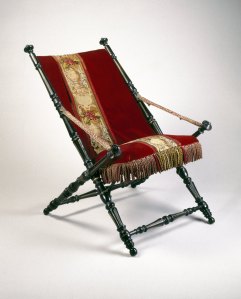
 

This Chair is held by the Brooklyn Museum. It is attributed to P. J. Hardy as the maker while Hunzinger was likely the designer based on the style and the metal tag Hunzinger label. The Museum’s description is “Folding chair. Ebonized wood with gilt incised decoration, metal hardware, and original upholstery. Turned gilt incised members that terminate in small ball pads intersect at mid-point on sides, secured by small metal rods on which they pivot and allow folding action. Identical turned and gilt incised stretchers connect lower front and back legs. Dark red plush upholstery with central vertical machined floral tapestry panel. Multi-colored fringe to front and sides of seat secured with domed metal tacks. Slung narrow woven textile strips with red key pattern on white ground form arms attached to front and rear stiles with metal attachments; the attachment on back stile has pressed head of putti. Movable black metal members hinged to underside of seat at sides and attached to upper front legs below seat to secure chair when open for seating. CONDITION – Original upholstery faded and distressed, but intact.” For more on Hunzinger’s furniture, please visit this Hunzinger blog.
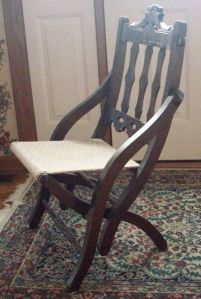
 Late 19th century folding chair with an Eastlake feel.
Post-CW Catalog of Folding Chairs.

A pre-Civil War English patent chair:

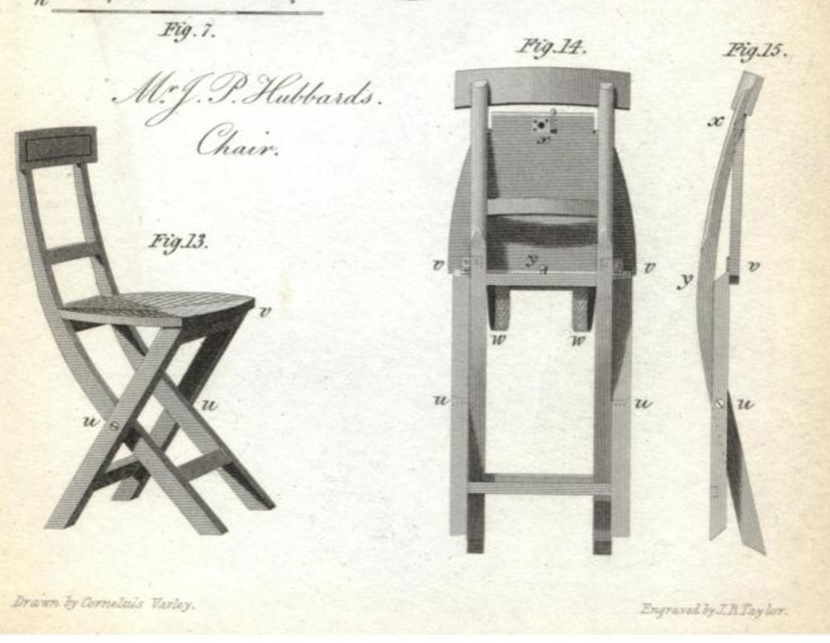
This is one chair I would have dated to later in the 19th century if I came across it in person. This illustration and description comes from 1824 though, in the Transactions of the Society, Instituted at London, for the Encouragement of Arts, Manufactures, and Commerce volume 43.1824 folding chair My previous research indicated folding chairs did not appear notably in the US prior to 1850. This illustration, 26 years earlier, is from London.

Folding Chair

The Silver Vulcan Medal was this session presented to Mr. J.P. Hubbard, Leadenhall-street, for a Folding Chair. A specimen which has been placed in the Society’s repository.

In camp, on board ship, and in other situations in which stowage room is very limited, demads are continually making on the ingenuity of the cabinet-maker, to compress into as small a space as possible all articles of domestic furniture when not actually in use. The common camp-stool, either with or without a back, thus forms the substitute for a chair; but the webbing does not make a very firm or convenient seat, and this circumstance induced Mr. Hubbard (who is not a cabinet-maker) to add to it a folding wooden seat, with a spring catch. The result is, a light chair of a very firm and simple construction, which may be afforded at a small cost, and when not in use may be hung upon a peg, or may be stowed away in any other manner, occupying not more than one third the space required for a chair of common construction.

Plate VII, fig 13, shows the chair when open or ready for use. It consists, like the camp-stool with a back, of two frames crossing each other, and united by the screw-pins u u; v is the wooden seat, having two hinges v v in front, and a hole x at the back to receive the spring catch y in the back rail, as shown fig. 14; beneath the seat are two pieces of webbing w w to limit the expansion of the two frames, and thereby to cause the spring catch to fall into its hole without any trouble: fig. 15 is a side view of the chair when folded.

Frequently Asked About Chairs:

not-correct

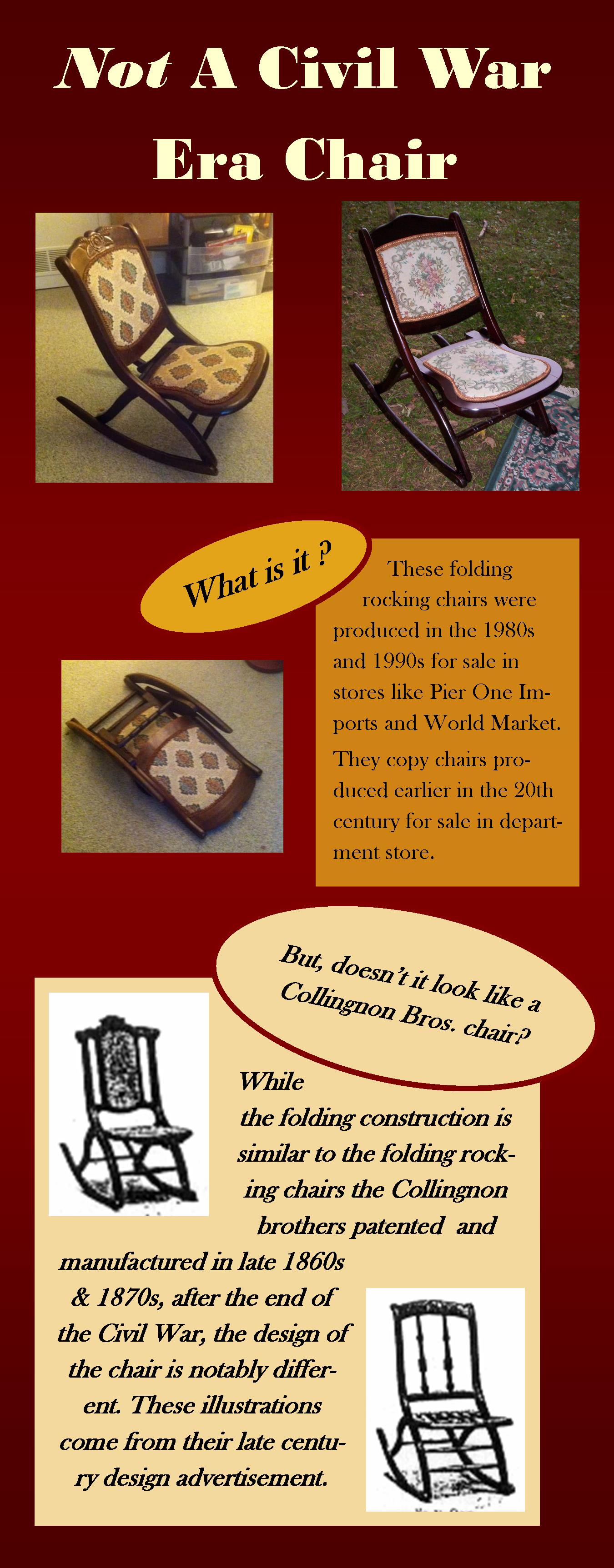
Folding Rockers like this one seem to be every where… good reason…. They were reproduced for stores like World Market and Pier One in the 80s. They are Not a reproduction of a mid-century chair. They are a reproduction of an early 20th century chair.

They are Not Collingnon Brothers chairs. Please cautiously read the Collingnon chair site. I find some pieces are unclear. I recommend looking at this set of search results for their patents, including the 1868 patent which if for a folding chair, not a rocker.


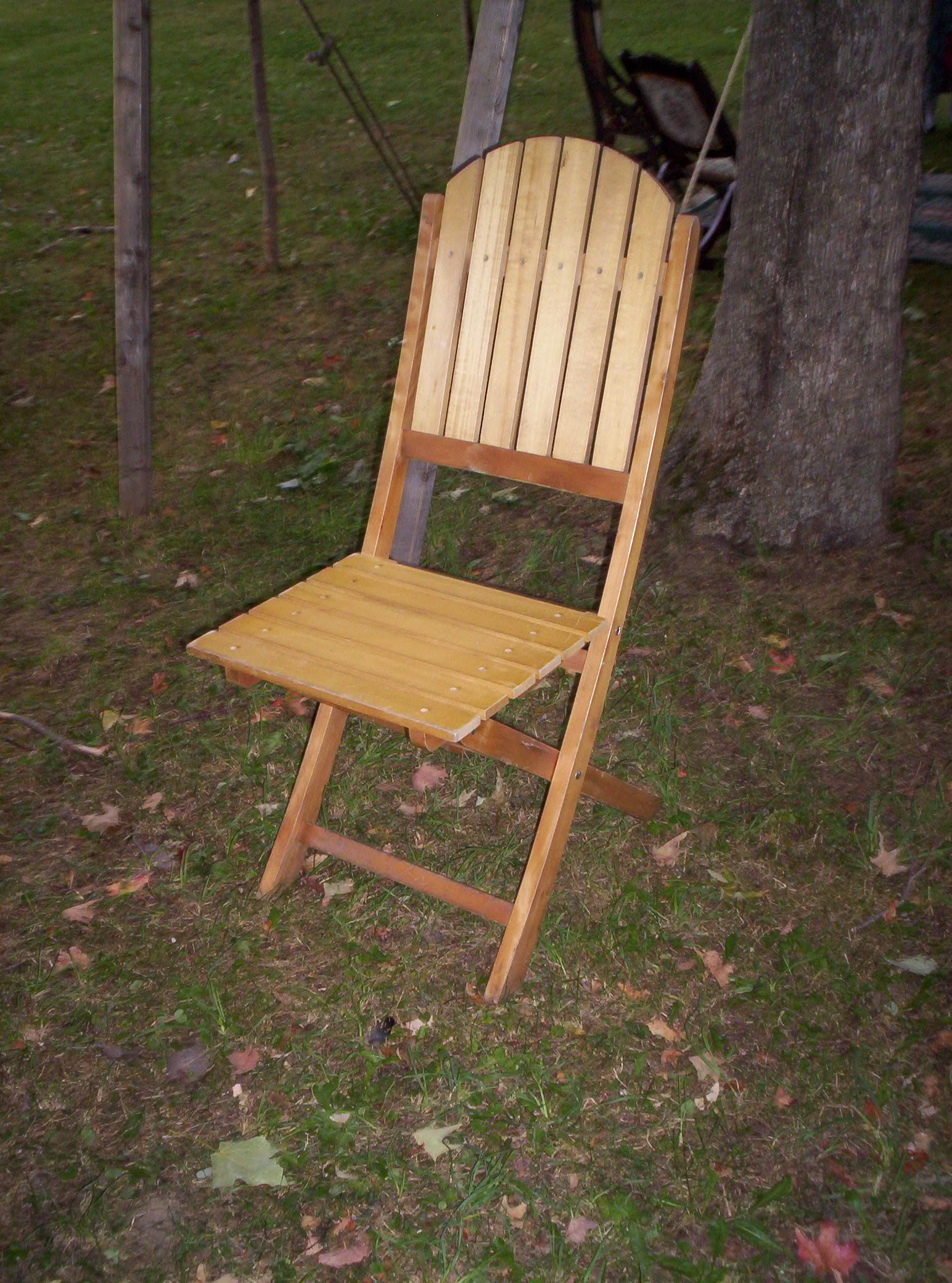
 21st century chair manufactured for camping, modern camping. Not a style produced during the Civil War.

Published in: on November 12, 2010 at 6:41 pm  Comments (49)  

A post on another blog about the straw cottage industry

http://nemasket.blogspot.com/2010/05/industrious-middleborough-1860.html

Published in: on August 18, 2010 at 8:23 am  Leave a Comment  

Give Away – From Field to Fashion

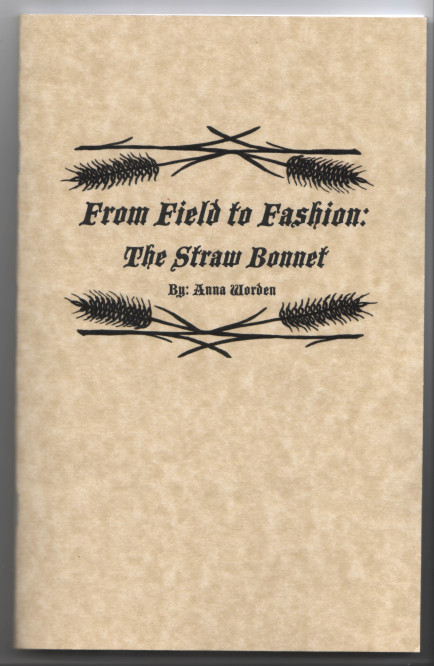
In celebration of July, I will be giving away 1 copy of From Field to Fashion: The Straw Bonnet.

Entries are open from now until July 15th at midnight NM time.

To enter….. Either…..

 Post a comment here in the comments section below. Your comment can be about millinery, this blog or other publications of mine.  

or

Post a comment about From Field to Fashion and link to this page on your Facebook account or Blog.  

The winner will be chosen at random from all entries.

Thank you for participating.