A Year in Millinery Fashion – 1864

Bonnet of white chip, trimmed with a long white plume. The inside trimming is of Ophelia velvet. (Godey’s, September, 1864)
3

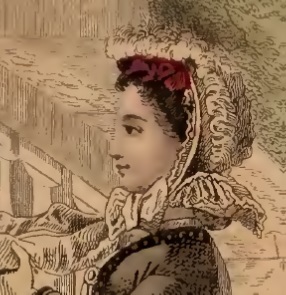
Bonnets – The capes of the bonnets have almost entirely disappeared. In fact, in Paris, not only the capes, but the crowns also, have disappeared. The bonnets there, during the past summer, have consisted of a straw or tulle front, profusely ornamented with flowers and lace, and only a half-handkerchief of lace falling over the hair at the back, this being trimmed with sprays of flowers – no crown, no cape. It will be seen that we are fast approaching thse models by one of our wood-cuts. Still, the apprehension of neuralgia will prevent us from adopting this style in full for the winter. A Paris authority says:

“The bonnet shape, as it now stands, is small in every respect, and is not intended to hide either hair or face; on the contrary, it seems rather to connive at showing both. The mass of hair at the back, the bandeaux in front, the ears and ear-rings are all left unconcealed. A vast quantity of both white and colored tulle is worn about the bonnets of the present day, which proves soft and vastly becoming, when brought in such close contact with the skin, and will be found advantageous to both old and young faces. Long tulle strings are very general; and tulle is frequently arranged in such away as to do away with the necassity of a cap at the sides. Instead of being placed as a scarf upon the outside of the front, it is placed upon the edge, thus falling half inside and half outside the bonnet; a quilling is then unnedassary, the plain tulle scarf providing equally as becoming, and not crushing so easily as the quilled blonde.” (Peterson’s, September, 1864)

Published in: on September 1, 2014 at 1:01 am  Leave a Comment  
Tags:

Black & White on Straw

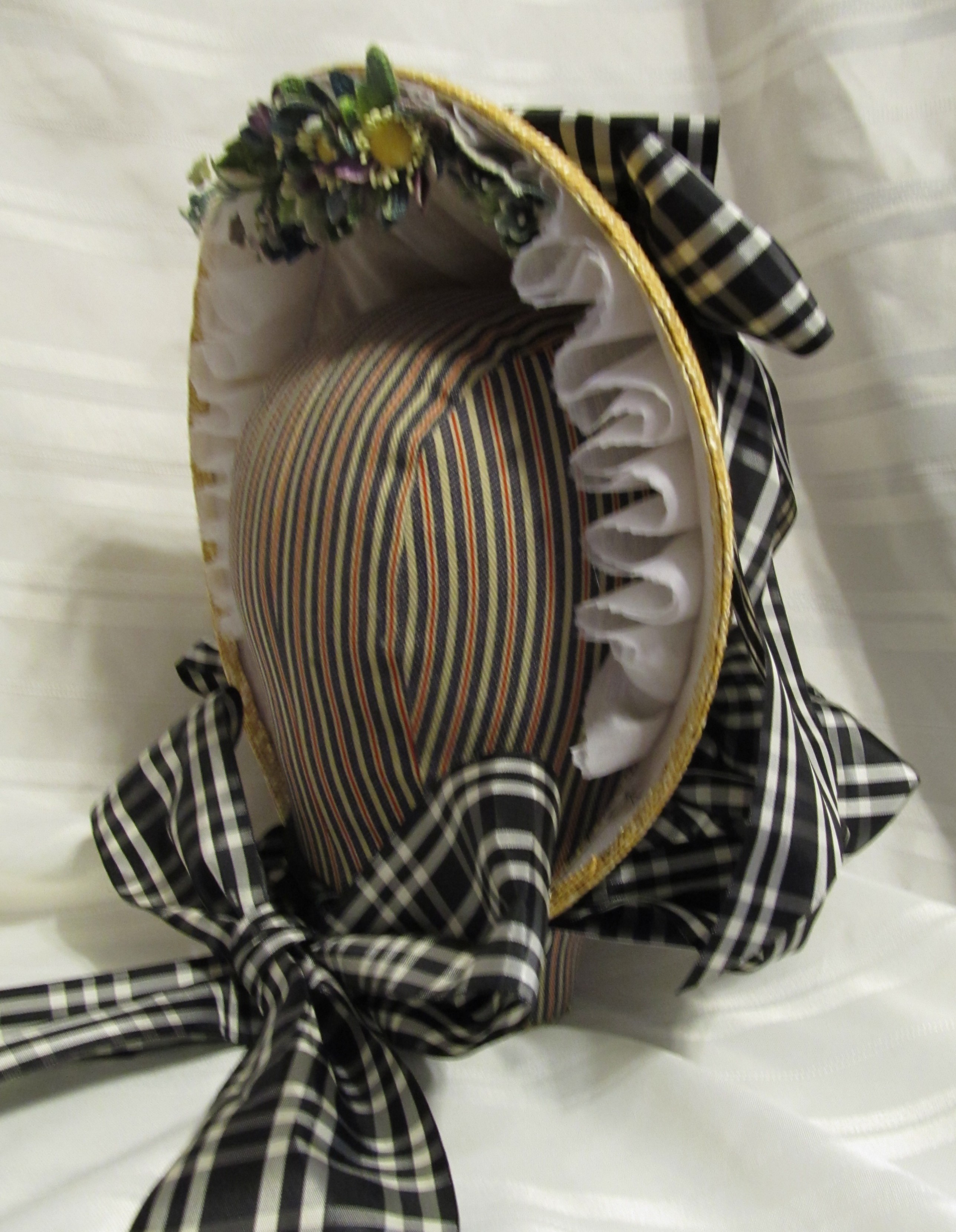
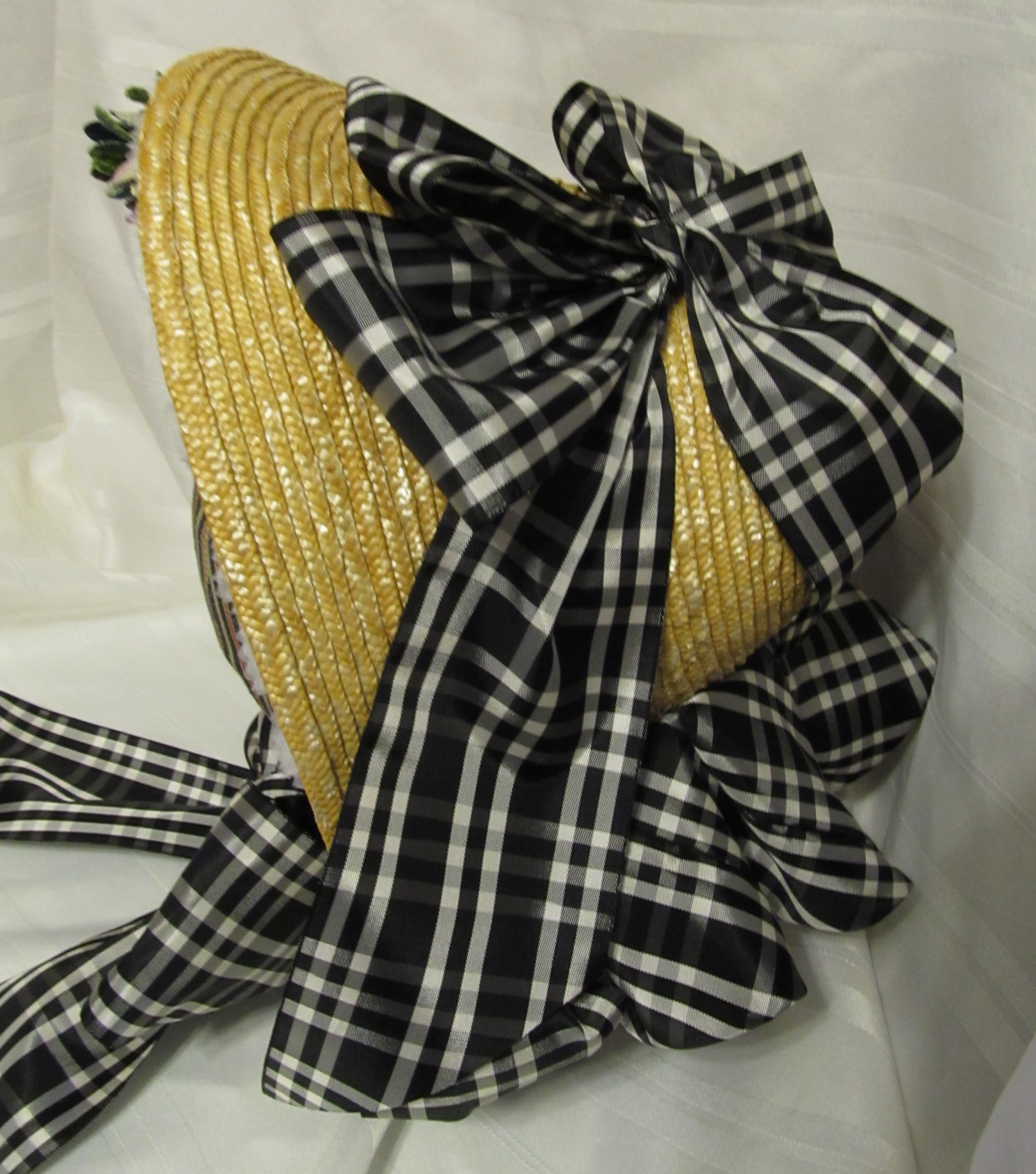
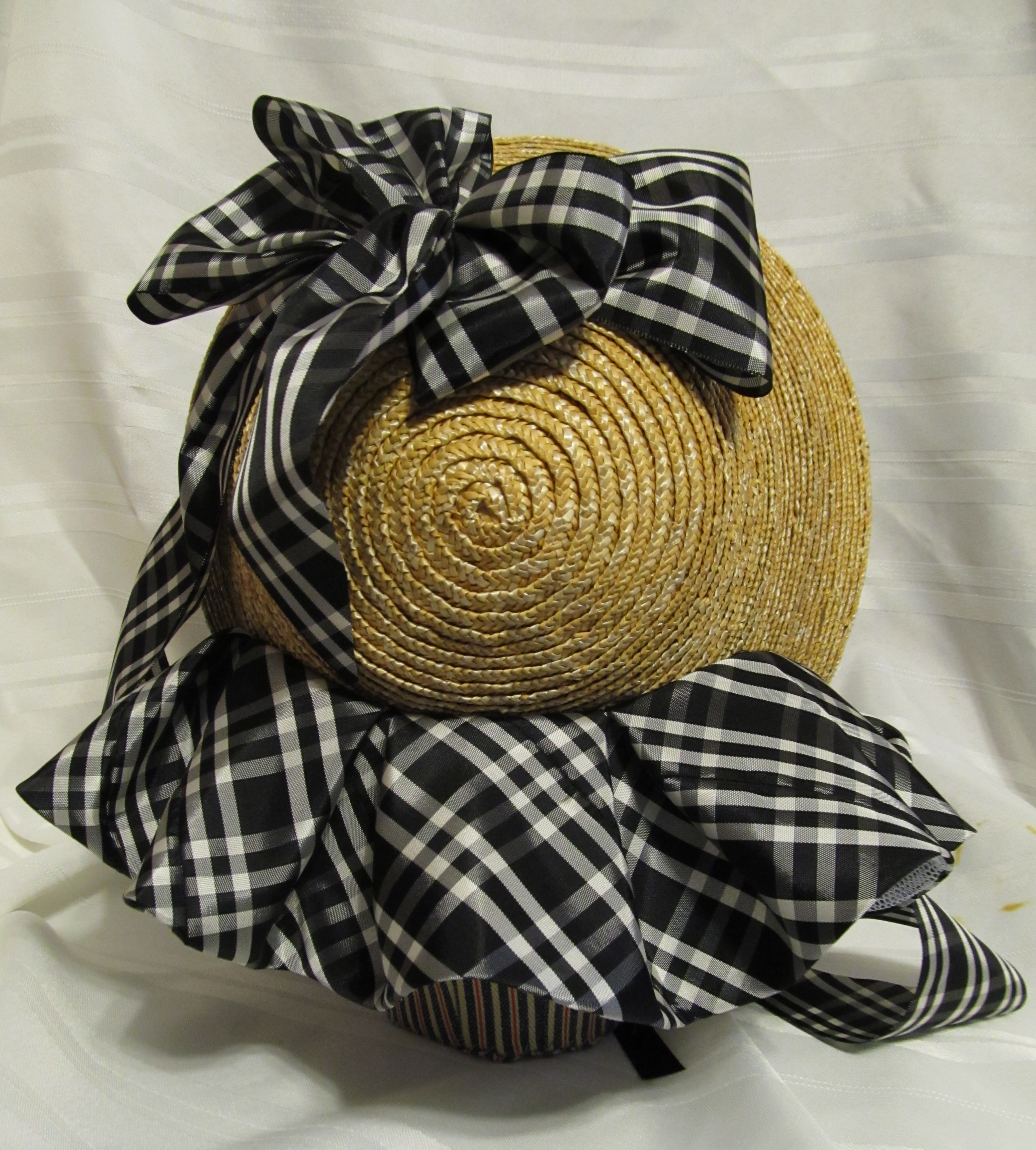
???????????????????????????????I’ve been delayed in sharing this bonnet. I actually thought I had.

This straw for a local client who was inspired by the black and white drawn bonnet.


The straw form is made of the French plait I’ve come to like so much. It has a flattering brim height and shape. The bonnet’s shape and size fit her perfectly.

Inside the brim is an organza frill and colorful assortment of flowers.
???????????????????????????????

This bonnet took a whole lot’a ribbon. The bavolet is pieced bias cut sections of the ribbon. The fashion ties are a full yard long each. Then a full, four loop bow decorates the exterior. ??????????????????????????????? ??????????????????????????????? ???????????????????????????????


Published in: on August 28, 2014 at 2:15 pm  Comments (2)  
Tags:

A Year in Millinery Fashion – 1864

In bonnets, bombazine, crape Maretz silk covered with crape, and all crape with crape ruche inside, are the only styles admissible for deep mourning.

There is no dress that requires more discretion in the choice and arrangement than that called second mourning, but it is one of the most elegant, when well selected.

For half mourning at this season of the year, Mme. Demorest is making black grenadine richly trimmed with flutings and silk, or ribbon quilled and laid on in various designs, while an endless variety of chine grenadines, lustiness, crapes, and Mozambiques, in black, gray, and lavender, give ample scope for a display of taste in all the gradations of mourning dress.

Some very beautiful designs in shawls have been exhibited this summer, in black grenadine with a border composed of white and violet stripes edged with a heavy silk fringe.

Basquines and circulars made in lusterless silk, and without trimming, are in light mourning.

For a half mourning bonnet black tulle puffed and trimmed with violet; or, for full dress, white crape covered with black lace and trimmed with violet flowers and violet strings; the latter is very much admired as a reception bonnet.

One of the most elegant bonnets we have seen this season was composed of a new material having the appearance of fine Tarleton and velvet woven together to form small diamonds; the bonnet was covered plain with the material, while a simple, trailing vine of black ivy leaves, veined with white, fell over the crown and cape inside; white and black flowers and white strings. (Godey’s, August, 1864)


A Year in Millinery Fashion – 1864

Fig. 4 is a black crinoline bonnet, with loose crown of white spotted tulle; the crown is divided from the bonnet by a shaped piece of pink silk, edged at the bottom with a narrow black velvet and a jet fringe, and having in the centre a group of white roses, rose-buds, and a few tufts of grass; the front edge of bonnet is finished by a narrow guipure lace turned back. The curtain of pink silk edged with a black velvet and jet fringe; the strings are of pink silk, and the cap is of blonde or tulle, trimmed with white roses, buds, and a few fullings of black lace. (Godey’s, August, 1864)

1

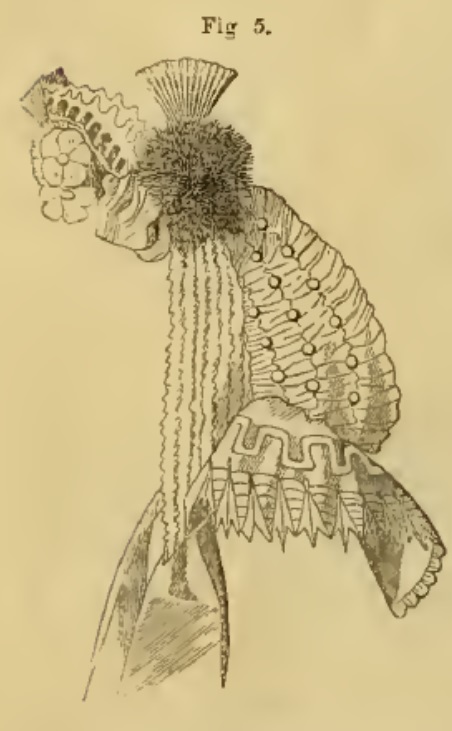
                         Fig. 5 is a dress bonnet, composed entirely of fullings of white tulle, those on the crown being formed into a species of boullions, divided lengthwise at intervals by small artificial pearls; at the top of front, rather towards the left side, is a group of green leaves, with a tuft of white silk or feathers; the curtain is formed of broad white lace. The strings are of white silk, and the cap is of blonde, trimmed at the top with a group of large white flowers. (Godey’s, August, 1864)

 2

 Fig. 7 is a Leghorn bonnet; the front trimmed with a shaped piece of maize silk, plaited like a fan towards the top; at the top is a plume of maize ostrich feathers. Strings of maize silk, and blonde cap with a few roses and rose-buds. (Godey’s, August, 1864)

 3

A Year in Millinery Fashion – 1864

Fig. 2 is a bonnet of white chip, with loose crown of spotted tulle; all round the upper edge of crown is a band of plaid ribbon, and on the top part of crown is a half diamond of tulle, edged with a plaid ribbon, and a chenille fringe to match the plaid. The curtain is of white lace, and has in the centre a small square of plaid ribbon, edged at the bottom and sides by chenille fringe. The strings are of white silk, and the cap is of blonde or tulle, and is trimmed with roses, rose-buds, and bluets. (Godey’s, August, 1864)

 2

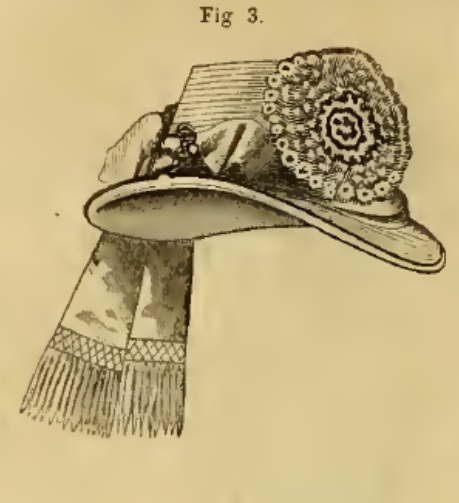
                          Fig. 3 is a Monsqueraire hat of Leghorn or white straw. Round the hat is a scarf of blue ribbon, with a large bow and long fringed ends at the back; in front is a rosette of black and white speckled feathers, surrounded by an edging of blue flowers or bluets. The brim is edged with black velvet. (Godey’s, August, 1864)

1

Published in: on August 11, 2014 at 1:01 am  Comments (1)  
Tags:

A Year in Millinery Fashion – 1864

This commences our series for the fall months, and it is made in silk or light cloth, as the season requires. The piquancy and convenience of the style renders its fashion one that is widely popular. The passamenteries vary greatly, so that the tastes and pecuniary considerations of all may be accommodated. The above was drawn from a rich Manganese brown summer cloth, adorned with an exceedingly neat gimp and pendent button ornaments

For the present “heated term” of course the various shapes and styles of laces are the mode. The great mass, however, of our friends having already made up their summer toilets, are looking for the approaching autumn fashions. We, therefore, prefer giving the above. (Godey’s, August, 1864)

 2

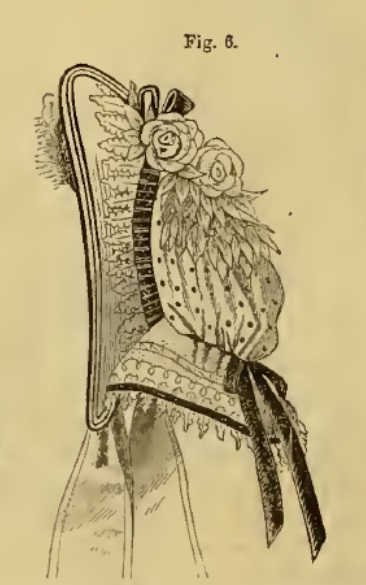
                         Fig. 6 is an elegant bonnet of white chip, with loose crown of spotted net; the crown is separated from the front of bonnet by a black velvet, edged with black lace; at the top of this is a small bow of black and velvet, with a group of roses and rose-buds, the front edge is bound with black velvet. The strings are white, and has a bow and long ends of black at the back. Cap of blond, trimmed with roses and buds. (Godey’s, August, 1864)


Bonnets have suddenly shrunk to the tiniest proportions, and, if they contract no more, will prove very becoming. They are so small that, sometimes, the ear is left entirely exposed, displaying the large, unbecoming ear-rings, which are again coming into fashion.

Some of the simplest and prettiest bonnets are those made after the style of fifteen years ago, viz: a very transparent white muslin, lined with some pretty, delicate shade of silk.

Hats are of a variety of shapes. The high-crowned, narrow-brimmed hat is still worn, byt it usually has a scarf of black lace, or net, tied in a bow behind. The front can be trimmed with either bows of ribbon, flowers, or plumes. Then the little round hat, known, in England, as the “pork-pie,” which is- youthful and pretty, but utterly useless for shade; and the casquette, with the rim covered with velvet, and turned-up in front, but sloping off at the sides and into a point behind. (Peterson’s, August, 1864)

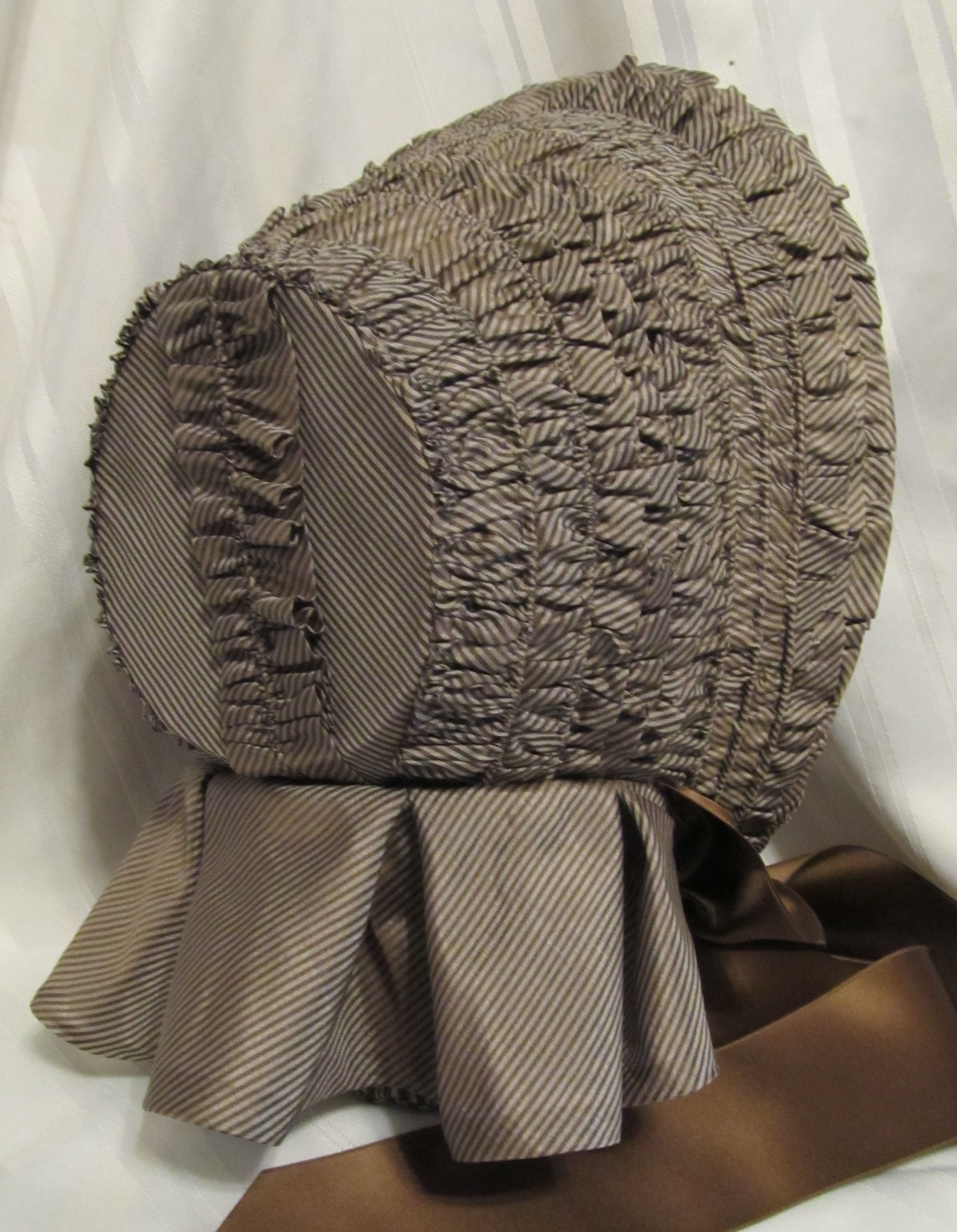
Brown Stripes Drawn

This is a bonnet that I really wanted to keep. I actually pouted as taped its box closed. I just love how the little ruffles and drawn canes worked together with the little stripe. It is the texture, the color, the technique.

???????????????????????????????

The new owner will be adding her own flowers and decoration.

??????????????????????????????? ??????????????????????????????? ???????????????????????????????

Published in: on July 30, 2014 at 4:26 pm  Comments (1)  
Tags:

Straw with a Most Incredible Ribbon

This straw bonnet with beautiful blue and green ribbons is a special request for a client.

When I opened the box and bag that had this dark blue satin ribbon inside, I swooned the ribbon felt so nice. I knew it just had to have something special done with it.


IMG_4529

I highlighted the blue with a beautiful green to make this large ribbon placed asymmetrically on the bonnet’s crown. The bavolet is made of bias cuts of the ribbon. ???????????????????????????????

The interior flowers were also set asymmetrically to emphasize the bow placement. The full organza frill balances the large bow the ribbon makes. ???????????????????????????????

Published in: on July 29, 2014 at 8:58 pm  Comments (3)  
Tags:

A Year in Millinery Fashion – 1864

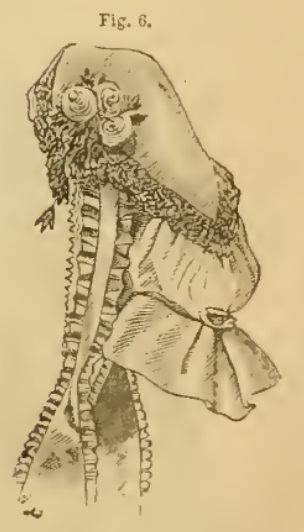
Fig. 6 is a bonnet of Marie Stuart form. The top of the bonnet is formed of a half diamond shaped piece of Ophelia crepe, edged round with black lace; at the left side of this are three white roses and a few fuchsias of black velvet. The loose crown is of white spotted muslin, and the curtain is of Ophelia crepe. The strings, instead of starting only from the ears, pass along the front edge of bonnet; they are of white satin edged with quillings of Ophelia crepe. (Godey’s, July, 1864)

                      1   

Fig. 8 is a bonnet of green crepe; at the top of crown is a group of lilac flowers. All round the front edge is a narrow garland of lilac, covered by fullings of tulle; the space between the garland and the crown is covered by narrow fullings of tulle. The curtain is partly covered by a deep white lace flounce, and the strings are of green ribbon. (Godey’s, July, 1864)

2

Yellow Silk Soft Crown Bonnet

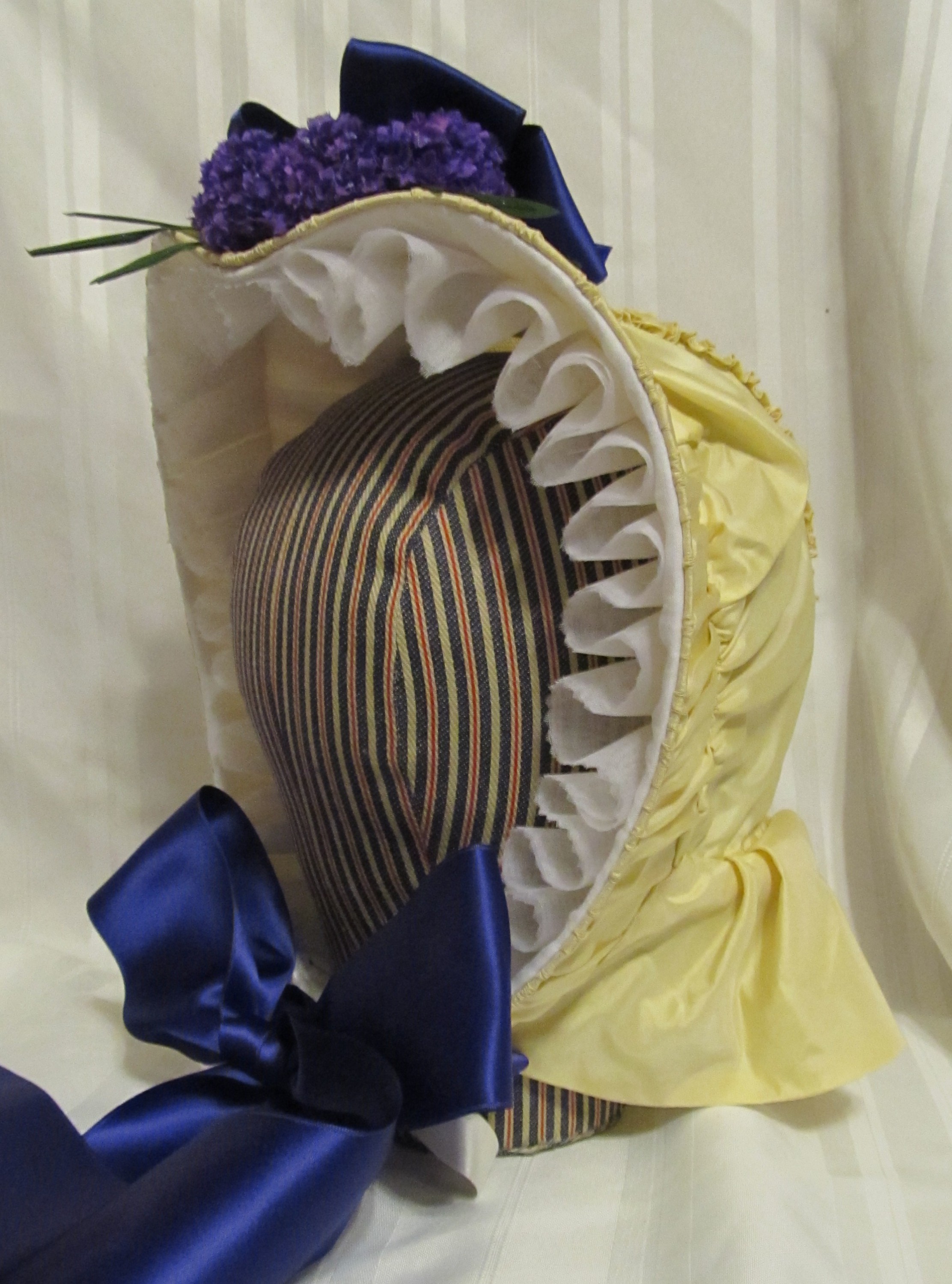
???????????????????????????????When this silk arrived, it really wanted to be made up … It didn’t want to wait. So, I obliged.  This pale shade of yellow reminds me of the soft yellow of some blossoms, very light and delicate. ???????????????????????????????The brim is drawn on cane over buckram in the fashionable Marie Stuart shape, while the crown is soft draped over net with the center drawn on canes vertically. Inside the brim is a full organza frill that can be fluffed out as desired.  The decorative ties are wide regal blue satin while the functional ties are a white silk taffeta. ??????????????????????????????? Atop the brim, in the Marie Stuart dip is a cluster of purple flowers and a bow of the same ribbon as the ties, just in a narrower width. ??????????????????????????????? This bonnet had a new home even before it was finished. I understand it will meet the world at a special occasion.

Published in: on July 21, 2014 at 5:45 pm  Leave a Comment  
Tags: