The Millinery Market

This passage from Twelve Letters to a Young Milliner  says a good deal about the mindset of women in terms of fashion and shopping. The passage comes from an 1883 advice manual for new milliners set in the form of letters.

With this general idea of the quality of your stock the next question that will confront you will be this, “Where shall I buy?” If it were a stock of soap or of sugar, of boots of of bedsteads, the place they came from would be of little consequence. If the soap took out the dirt, the sugar sweetened the tea, the books kept out the water, and the bedsteads did not fall to pieces, it would matter but little to the customer whether they came originally from New York or from New Orleans, from Boston of from Buffalo; but when it comes to articles of wearing apparel into whos manufacture taste and fashion enter, the customer does wich to know wheterh they are bough in th ewoods or in the center of civiliazation. In articles of Millinery, in which fashion is so large an element, it is of the highest importance that they come from the center of fashion. Present to your customers two Hats, both of the same style and quality; mark the one, New York; the other, Smithville, which will be sold first? There is but one answer to the question. Even the woman that buys a Hat but once in five years, if one ther be, will choose the Hat marked New York. Now, you buy your goods to sell; therefore, buy goods that will sell. You have neither the time nor the money, nor is it your duty to teach a benighted generation that Smitheville goods are superior or equal to New York goods. A Milliner’s life is too short for any such Quitotic enterprise. This prejudice is favore of New York Millinery may be without foundation, may be unfair, but it exists; and a beginner in the trade, if she desires success, must yeild to that which is useless to resist. If it becomes noised abroad, in the beginning of your business career, that your goods are out of date, that they are old style, in a word unfashionable, you may as well dispose of your stock at acution and go into the book-peddling business. Let your neighbors see that your boxes and bundles have the New York mark upont them and your reputation for being in the height of fashion will be estableished. That such reputation is neede for success, you will not deny.”

 The same guide continues… A millinery saleswoman – “She will know the names of the braids used in Hats where and how they are made. She will inform herself about the reputation for taste acquired by different manufacturers and wholesale dealers. Her knowledge of artificial flowers, the materials used, mode of manufacture, will be as extensive as her reading can make it. It is said that the female nature has a large share of curiosity in its make-up. Some customers desire to know all these things. If they find your assistant able to give them this information in a pleasant and an agreeable manner they feel sure that you understand the business and that what you say is so and not guessed at.

Again, this knowledge of the goods enables the assistant to set forth their advantages in a stronger manner than she would otherwsie be able to do. This inspires confidence in the buyer, and the occasional buyer soon becomes a regular customer through the influence of your intelligent assistant.

Published in: on March 23, 2013 at 9:00 am  Leave a Comment  
Tags: ,

A Bonnet Cover

Ooops. This wasn’t supposed to post until this weekend. But given the weather I am about to venture out into, I’ll leave it.

From Eliza Leslie’s House Book, (Philadelphia, 1844)

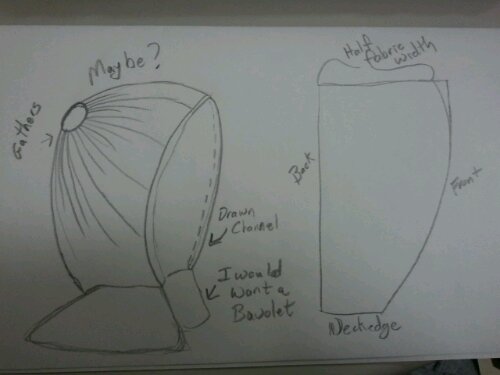
A BONNET-COVER – When travelling in dry weather on a road that is likely to be dusty, you may effectually protect your bonnet from injury, by taking with you a cover for it. To make this cover, get a yard of white glazed cambric muslin, and cut it into the form of a large straight hood; gathering it close at the back of the head upon a small circular piece about the size of a half-dollar. Slope it away at the sides of the neck, and put a case with a drawing-string of fine tape along the edges of the front: the string to tie at the side.

If you commence your journey by water, you can roll up this bonnet-cover, and keep it in your reticule while in the steam-boat; putting it over your bonnet, and drawing round your face, just before you get into the vehicle in which you are to ride. You will find when you take it off, that it has effectually screen your bonnet and its ribbons from the dust and sun. It must, of course, be made very large and loose, that it may not flatten or discompose the trimming.

We have seen bonnet-covers of green silk; but, if it chances to get wet, the green dye will run down and stain the bonnet. This same thing may happen, if the cover is of coloured muslin. White is undoubtedly the best for this purpose; and when soiled, it can be easily washed.

After being out in the damp, do not immediately put away your bonnet; but wipe the front and crown with a clean handkerchief, and put some wadding or tissue paper into the bows, to keep them from losing their shape: taking it out, however, as soon as the ribbon is perfectly dry. Also, never put away a shawl or cloak while it is in the least damp. Do not always fold a shawl on the same creases, lest it wear out along the wire edges of the folds. When you take off a veil, stretch it evenly on the bed, and let it remain there an hour or two, in case there should be any dampness about it.

When ever the atmosphere is cloudy or humid, it is well to take the feathers out of your bonnet before you go out, lest they loose their curl, or their whiteness.

EDIT TO ADD: Deanna asked for a sketch of my interpretation. This is what I picture from Eliza Leslie’s description. I would want a bavolet/curtain to cover that part of my bonnet as well. I would think the gathers of the light weight fabric allow for the least amount of weight on the bonnet decorations underneith. I’m not sure how well this bonnet cover would do in any amount of wind or moisture. Honestly, I am still bothered by the recommendations of traveling caps for men but bonnet covers for women. I’ve been looking at paintings of travel scenes trying to determine what each woman has on her head. A traveling hood seems far, far more practical then a delicate fashion bonnet.

image

Published in: on March 19, 2013 at 6:00 am  Comments (6)  
Tags: ,

A Springy New Series – Another Look at Millinery

As we move into spring, Oh, Happy Spring, my Saturday posts are going to move from travel to millinery. Don’t worry, I am continueing my travel research. The forthcoming millinery posts will primarily focus on theories, ideas, trends and storys revolving around millinery rather than just straight fashion.

To start, here is a passage from “Aesthetics of Dress” from Blackwood’s Edinburgh Magazine,  1845. It takes a different look at bonnets than we are accustom.

Bonnets, however, have more to do with women than with men; and we defy our fair friend to prove that these articles of dress, about which they are always so anxious (a woman – a regular genuine woman, reader – will sacrifice a great deal for a bonnet), are either useful or ornamental. And first, for their use; if they were good for anything, they would protect the head from the cold, wet, and sunshine. Now, as far as cold is concerned, they do so to certain degree, but not a tenth part so well as something else we shall talk of by and by: as for wet – what woman ever trusted her bonnet in a shower of rain? What woman does not either pop up her parasol, or green cotton umbrella; of if she had not these female arms, ties over it her pocket-handkerchief, in a vain attempt to keep off the pluvious god? Women are more frightened at spoiling their bonnets than any other article of dress; let them but once get their bonnets under the dripping eaves of and umbrella, and, like ostriches sticking their heads under ground, they think their whole persons safe – we appeal to any man who has walked down Cheapside with his eyes open, on a rainy day, whether this be not true. And then for the sun – who among the ladies trusts to her bonnet for keeping her face from freckling? Else why all the paraphernalia of parasols? why  all these endless patents for sylphides and sunscreens of every kind, form, and colour? why can you never meet a lady in a summer-walk without one of these elegant little contrivances in her hand? Comfort, we apprehend, does not reside in a bonnet: look at a lady travelling, whether in a carriage or a railroad diligence – she cannot for a moment lean back into one of the nice pillowed corners of the vehicle, without running imminent risk of crushing her bonnet: her head can never repose; she has no travelling-cap, like a man, to put on while she stows away her bonnet in some convenient place; the stiffened gauze, or canvass, or paper, of which its inner frame-work is composed, rustles and crackles with every attempt at compression; and a pound’s worth or two of damage may be done by a gentle tap or squeeze. Women, if candid, would allow that their bonnets gave them much more trouble than comfort, and that they have remained in use solely as conventional objects of dress – we will not allow, of ornament. The only position in which a bonnet is becoming – and even then is only the modern class of bonnets – is, when they are viewed full front; further, as we observed before, they make a nice encadrement for the face; and, with their endless adjuncts of lace, ribands, and flowers, they commonly set off advantage. But it is only the present kind of bonnet that does so; the old-fashioned, poking, flaunting, square-cornered bonnet never became any female physiognomy; it is only the small, tight, come-and-kiss-me style of bonnet now worn by ladies, that is at all tolerable. All this refers, however, only to that portion of the fairer half of the human race which is in the bloom of vigour of youth and womanhood; those that are still in childhood, or are sinking into the vale of years, cannot have a more inappropriate, more useless, covering for the head than what they now wear, at least in England. Simplicity, which should be the attribute of youth, and dignity, which should belong to age cannot be compatible with a modern bonnet: fifty inventions might be made of coverings more suitable to these two stages of life.  

I also want to add – Isn’t it interesting what we find inspiring or what spurs ideas for us? This particular passage takes a very different look at bonnets than we are used to. Within it is a basic notion that has been bugging me for some time now in my research. The way this gentleman phrases this concept has planted an idea, more like framework, in my head. Yes, I am being vague on purpose. This framework could either become a facinating conference presentation or blog series. Which is tbd.


“Two Heads…..”

How much fluff can there be in one person’s head?
I now know the answer….. A full bag.

With my recent revival in millinery fascination, it is time for new model heads. (Okay, the part where I can’t get to my bonnet stands from Dad, nudged this along.)

Tonight, I made a pair of red and blue striped heads to hold my bonnets. The pattern I used  by Lynn McMasters (here) was easy to follow. I used a heavier canvas weight fabric I picked up at Bits & Pieces. Good choice. Inside each is a full back of poly-fill. Really. The base is a thick piece of wood my tech friends cut for me.

image

These will be nice for working on my bonnets. I can pin right through the bonnet. (I do have a third cut & pieced, awaiting fill and a base.)
A few numbers to add – Just under 1 yard of 44″ fabric made 3 heads. I only paid $.60 at Bits & Pieces. Regularly, figure $5-8 with a Joann’s coupon. The wood was cut for me at no cost. The fiber-fill I also had on hand. I think it was $4.99 a bag. If bought from scratch with one of Joann’s sales and coupons, 3 heads would cost about $12.50 to $23. Not bad.


Mid-Winter Millinery

I should say this is millinery worked on in the midst of winter looking forward to spring.
Here are the two other of the four bonnets I started last week during recess. Both of these are made from bits and pieces in my sewing case pile. It was such a fun challenge to try to piece the fabric together to make a bonnet. While working on these, I thought about when an original cast milliner may have tried to piece together what she had in her supply drawers to make inventory to sell, whether she was low on funds or had a delay in the delivery of materials. I also thought about the techniques a woman might have used to remake her existing bonnet(s) for the next season when she couldn’t get a new bonnet. Sadly, such remakes are likely not the ones to survive over a hundred and fifty years for us curious sorts to examine extensively.
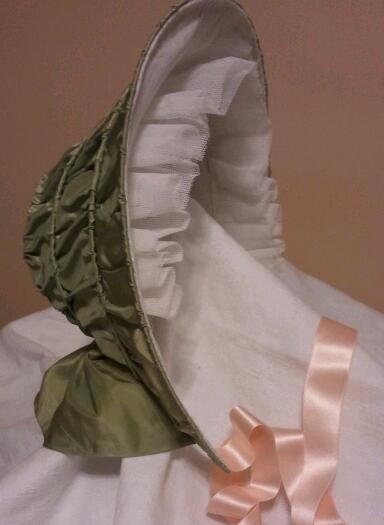
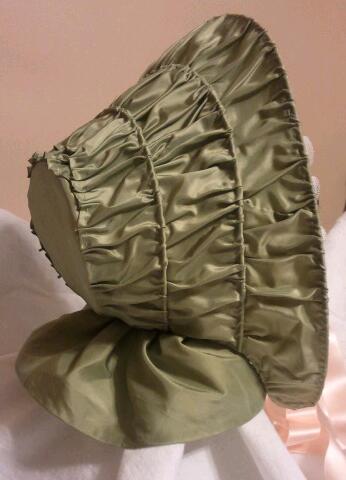
This is the seafoam green that will be my little sister’s. I love this color. The gathering on the cane brings out the color in my opinion.

image

image

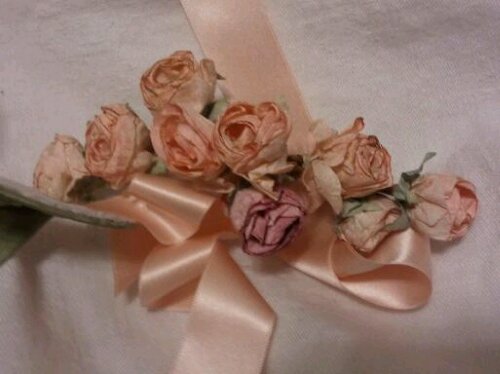
The seafoam green calls for pink, a pretty pale pink. Here are some of the flowers it will get. There needs to some additional green and maybe some white accents. I also need to get the wider ribbon either in a satin weave or a moire.

image

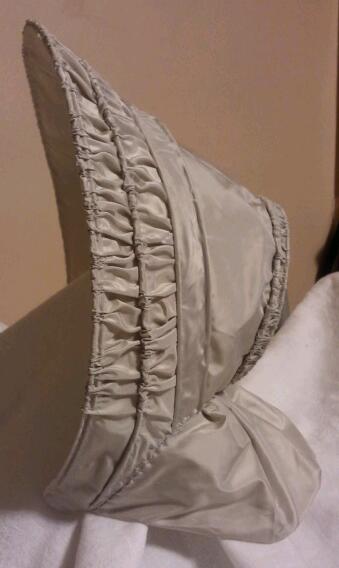
This is the fourth bonnet. I was going to do a shot brown & blue, but there wasn’t enough. So, this pearl color it was. I’m convinced the color changed as I worked, adding this silvery tone.

image

I’ve not yet decided what this one will get decorated with. I still need to find the rest of my ribbons.

A Millinery Mood

If you recall my Planning for Recess post, I started the week off thinking I would tackle a few pieces on my travel impression list. Well, as the week rolled on… it seems I as much more in a millinery mood.
Monday and Tuesday were all about getting the sewing room together. (Check out my Updates blog for before and after photos.) While there is still a long way to go, the space finally has space to move in. Yeah!  Rather excited finally to have some personal decorative items out including Grandma’s “Tip-Toeing Through the Tulips” and the quilt from my NM friends. Soon, new shelves will be purchased & in place, and my trunks, okay some of my trunks, will be moved in.
Now on to the sewing ….
After the lifting & moving, a nice simple, calming project was a must. A nice piece of silk gauze had been waiting almost a year to become a veil. This was just the relaxing, quick project I needed. (I do still have to find either the narrow silk ribbon or cord to attach it to a bonnet with.)

image

underneath the veil is what held my attention next. I had been thinking about bonnets the week prior. So, I was happy to find some straw to work with. This is the first straw bonnet I’ve made in years. Too many years.

image

I had also been thinking about a drawn bonnet. But, I had no buckram. It was time to appease a curiosity. I sized a fabric I bought while in NM. I was quite happy with how it stiffened up. It was an incredibly light weight frame. Since the silk I was going to use is too soft to give the volume I wanted, I peeked at my sewing case pieces. I happened to have enough of this slate grey silk.

image

I rather like how it came out. This week, it will get trimmed with this ribbon & flowers.

image

I have two other frames to finish up tonight. On will be a sea foam green drawn silk for Lily. The other will either be a chocolate silk or a shot brown silk or a bright sunset orange shot…. Not sure which.

Hat Boxes

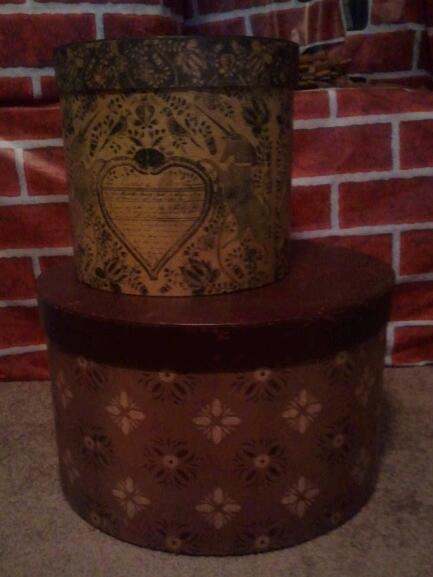
For some time we’ve needed a larger hat box for one of Dan’s hats. It didn’t need to be anything fancy, just something to safely store his hats. At first we were certain Joann’s or Tuesday Morning would have something big enough. Wrong. Their boxes all fell short of the 16.5″ minimum diameter. We even looked at Christmas gift boxes. Finally, I found the right box! Bevin suggested Dogwood Trading Company in Dansville, NY. Please see their contact information below. They had just the right assortment of band boxes. Large. Small. Tall. Wide. Round. Oval. Square. Each one is nicely sturdy. The designs range with many reflecting the look of paper. The prices are very nice too. The bottom box, the one for Dan’s hat, is 17″ across. It is taller than the 8″ his one hat needed. So, I foresee this box holding more than one of his hats. This was only $18.99. The store has at least 4 other prints in this size. They do have a larger one in a beautiful print that looks like a woven blue blanket. Love it! I just haven’t a clue where it would go right now. At the very affordable price on it, I may have to go back for it. There are others this size too.

image

The top box isn’t a size or shape I was actively looking for. But, it looks like it will nicely hold a mid-century bonnet or hood. Plus, look at that paper. It had to come home. An alternative thought process was that while I previously/currently store my bonnets in totes, there isn’t as much tote storage space in this apartment. (Confession – at one point, I had a tower of bonnet totes in my front closet.) It may be time to go back to hat and band boxes for millinery. They look great and are great storage. If you need strong boxes for storage, do give Dogwood Trading Company at try. The staff were extremely nice & helpful.

image

Straw Bonnet Critique

As I promised, here is a critique of one of my bonnets. I’m going to try to honestly cover the good, the bad and the ugly.

A little background first- This is a straw bonnet I made while in New Mexico. We were invited to an event at Ft Sheldon by some local friends. We had just a short time to pull everything together. I realized I didn’t have any millinary with me that was appropriate for the very sandy, red-dusty terrain I saw in photos. This bonnet was made in a few days out of materials I found in Alamogordo since there wasn’t time to order anything.

Now, a look at the materials. 

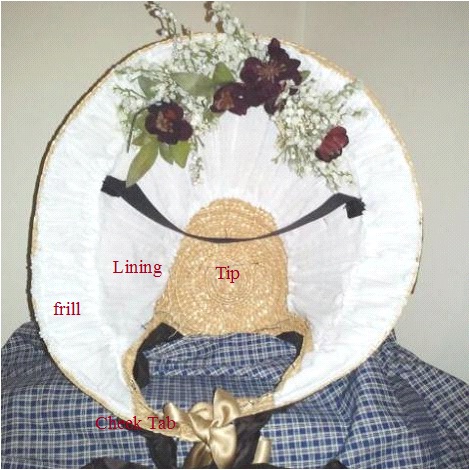
The straw came from a vintage hat from a thrift shop. It is just about 3/8ths of an inch thick and rather smooth. This is about as wide as I would suggest for a fashion straw bonnet. The width of the plait and the width of the split straw borders on what would have been considered ‘coarse’ in the 1850s and 1860s. The coarser the straw and plait, the cheaper. The finer the split straw the finer the plaits or other straw work can be and thus the more expensive. The straw plait was completely unsew from its original state, soaked to let the sewing holes fill back in then let to dry to an almost dry state. Then it was sewn back together into the bonnet.

The white lining is made of white cotton voile I had on hand. I stiffened this with lots of my husband’s uniform spray starch despite it already having a fairly full body for a cotton sheer. (I’ll talk a little more about this later.) The spray starch method is not one I would normally use preferring a material with more body and stiffness already.

The flowers came from the local floral shop. They were the closest to natural looking I could find. These are rather sparse/thin for my preferences and what appears to be the level of fullness in period images

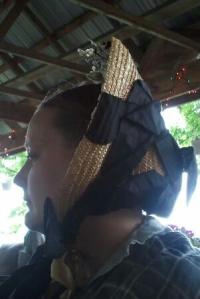
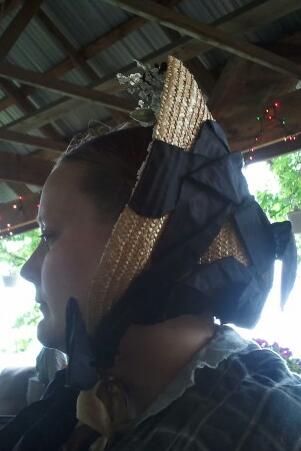
The ribbon and bavolet, or curtain, are silk taffeta I had in my stash. The ribbons are cut straight on the grain. The edges are frayed on the body of the bonnet and sized with a glue mixture to keep the silk from fraying more. While this can be seen in a few examples of extant bonnet, it is less common than ribbon which has a selvage edge. You would not see the ribbon fashion ties set on the bias.   The width, about 4″, is common for mid-century fashion bonnets. The ribbons are an adequate length. I would not suggest going any shorter. The ribbon does stand fairly well despite spending the mid-day out in the rain and thoroughly damp.The bavolet is cut and pieced on the bias. The bias in the bavolet helps with the fullness. As you can see in the side view of me wearing the bonnet the bavolet is rather limp. This is because I do not have any net backing the silk. If I had net, I would hem the net into the silk or tack it to the silk. Then I would pleat the top of the silk and net as one.

Just under the taffeta ties, is the silk functional ties. This is 1″ wide silk ribbon

Now, let us look at shape and parts.
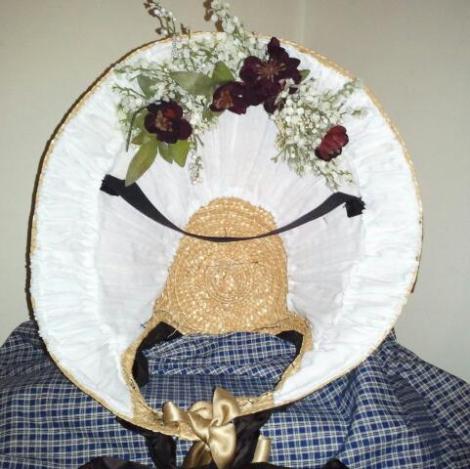
Looking at the side view of me wearing the bonnet, this is what happens when I put on a bonnet without a mirror, using the side of the car instead. The bonnet is angled backwards more than I would like. While it doesn’t need to be perfectly vertical, it certainly should be more vertical than this. To adjust what I see, I would sit the tip slightly higher on my small bun (I often wear my hair with braids flat against the back of my head, but opted for a bun instead which does stick out further from the back of my head.) with the top of the brim angled closer to vertical.

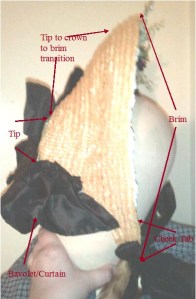
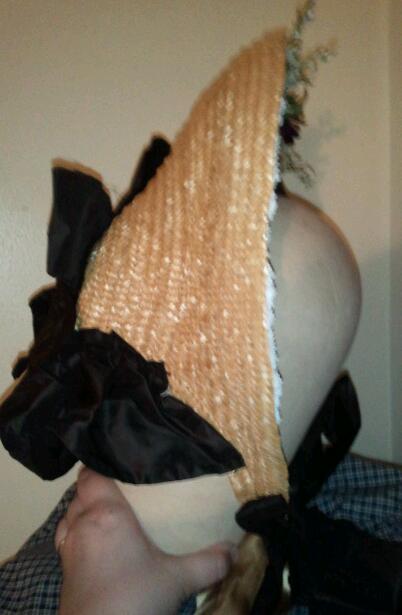
Looking at the overall shape of bonnets, one of the first things I see is the transition line from the tip though the crown to the brim. This should be a gentle transition not a drastic one. See how in this straw the transition has gentle curves? Compare that to this original straw bonnet which has a markedly deeper tip or this lovely original black straw

 As I noted the depth of the tip in the original compared to mine, we can look at that next. Yes, mine could be deeper. I think one or two rows of plait moving into the crown would make the difference. One thing to keep in mind when looking at the tips on straw bonnets is that they were not flat. Instead, they rounded from the back of the tip to the sides. Sometimes this was a small curve, other times it was more ball-like.

 The cheek tabs are an area that was quite the challenge when I started working with straw. At first they were thick and angular. But, as I looked at more bonnets, I saw cheek tabs were more narrow with a nice curve to them. Sometimes they were almost pointy.  

 Back to the frill. It isn’t frill enough to be a true frill. I would much rather have another layer of stiffer material double box pleated with the raw edges filling the edge of the brim. When thinking frill, think full and three-dimensional. The flowers need to be much fuller too.

The black across the inside is the velvet band that holds the bonnet on my head. I love these. They work wonderfully. Even with the bonnet perched at the odd angle on my head, the rain coming down and repeatedly wacking myself in the bonnet with my umbrella, the bonnet stayed put without feeling like it wanted to move at all thanks to this strip.

I’m sure there is more I can pick apart on this. But, that is all for tonight.

Published in: on June 13, 2012 at 5:06 pm  Comments (2)  
Tags:

Straw Bonnet Critique

When someone asks for an opinon on a bonnet, it can be difficult to try to explain what is not quite right about a bonnet for a variety of reasons – technology based conversations, trying to be sensitive, not knowing who will take offense, etc. Well, this is the bonnet I made in NM out of what I could find at the local shops in a couple days for an event we never actually made it to. I’m going to go through it this week talking about the shape, materials… basically ‘the good, the bad and the ugly.’

image

image

image

image

Published in: on June 11, 2012 at 5:34 am  Leave a Comment  
Tags:

Anatomy of a Bonnet

There is a helpful little file here for developing a better understanding of late 50s & early 60s millinery. Use it alongside browsing museum collections.
https://annaworden.wordpress.com/welcome/pdf-pages/

Published in: on May 29, 2012 at 7:39 pm  Comments (1)  
Tags: