Women’s History Month – Readings

In celebration of Women’s History Month, each day I will add a new book to this list. The growing list contains favorite books from my book shelf as well as many books from my own wish list. (I annotated these BS and WL in the list.)

You will notice my list focuses on the everyday lives of women, mostly in 19th Century America with a dabbling of further connection.

I hope you find some new additions to your reading list. Each book is available through your local library, book seller, or Amazon.

  1. Employments of Women by Virginia Penny (Primary) (BS)
  2. Novel Craft: Victorian Domestic Handicraft and Nineteenth-Century Fiction, by Tilia Schaffer (WL)
  3. The Dress Diary: Secrets from a Victorian Woman’s Wardrobe by Dr. Kate Strasdin (WL)
  4. Female Economy: The Millinery and Dressmaking Trades, 1860-1930, by Wendy Gamber (BS)
  5. American Milliners and Their World: Women’s Work from Revolution to Rock and Roll, by Nadine Stewart (WL)
  6. An American Girl’s Book, by Eliza Leslie (Primary) (BS)
  7. Women in Business, 1700-1850, Nicola Phillips (WL)
  8. Eliza’s Story, by Eileen Hook (BS)
  9. Maritcha: A Nineteenth-Century American Girl, by Tonya Bolden (WL)
  10. Untidy Origins: A Story of Women’s Rights in Antebellum New York, by Lori D Ginzberg (BS)
  11. Only the Clothes on Her Back: Clothing and the Hidden History of Power in the
    Nineteenth-Century United States, by Laura F. Edwards. (WL)
  12. The Chinese Lady: Afong Moy in Early America, by Nancy E. Davis (WL)
  13. All That She Carried: The Journey of Ashley’s Sack, a Black Family Keepsake, by Tiya Miles (BS)
  14. Women and the Law of Property in Early America, by Marylynn Salmon (WL)
  15. Face Value: The Consumer Revolution and the Colonizing of America, by Cary Carson (WL)
  16. Threads of Life: A History of the World Through the Eye of a Needle, by Clare Hunter (BS)
  17. Buying into the World of Goods: Early Consumers in Backcountry Virginia, by Ann
    Smart Martin (WL)
  18. Village Life in America, 1852-1872, by Caroline Cowles Richards (Primary) (BS)
  19. Material Lives: Women Makers and Consumers in the 18th Century, by Serena Dyer (WL)
  20. The Business of Charity: The Woman’s Exchange Movement, 1832-1900, by Kathleen Sander (WL)
  21. Bound in Wedlock: Slave and Free Black Marriage in Nineteenth Century, Tera W.
    Hunter (WL)
  22. The Wrongs of Woman: Milliners and Dressmakers, by Charlotte Elizabeth (Primary) (BS)
  23. An Intimate Economy: Enslaved Women, Work, and America’s Domestic Slave Trade, by Alexandra J. Finley (WL)
  24. Mothers and Daughters of Invention: Notes for a Revised History of Technology, by
    Autumn Stanley (BS)
  25. Sisters in Spirit: Haudenenosunee Influence on Early American Feminists, by Sally Roesch Wagner (WL)
  26. Vanished Arizona, by Martha Summerhayes. (A recommendation from Marna Davis.)
  27. Shirts Powdered Red: Haudenosunee Gender, Trade, and Exchange across Three Centuries, by Maeuve Kane (WL)
  28. The Lucky Ones: One Family and the Extraordinary Invention of Chinese America, by Mae M. Ngai (A recommendation from Anneliese Meck)
  29. Polly Bemis: The Life and Times of a Chinese American Pioneer, by Prascilla Wegars. (A recommendation from Anneliese Meck)
  30. Letters of a Homesteader, by Elinore Pruitt Stewart. (S recommendation from Marna Davis.)


Published in: on March 30, 2023 at 12:10 am  Leave a Comment  

A Monday Morning Smile

This morning, after a silly unfolding of Monday-morning-pre-caffeine happenings, I stumbled upon a delightful video featuring my Lappet style Quilted Winter Hood.

I don’t know if I am more thrilled by how Marie introduced my digital pattern or that she chose it for the role as Beth’s hood.

Please, hop over to Historic Belle’s channel and check out her other videos.

Then, I stumbled onto another video.

This video features a piece of past work in the first half as she strips and re-trims a straw bonnet from my workbook.

Nearly two decades ago now, I created a Straw Bonnet Workbook for local weekend long workshops making straw bonnets. I made the workbook available in print, then digitally. The workbook showed how to make a handsewn straw bonnet using straw plait. A handful of years ago, I took the directions down as I felt they were out of date with my current research & techniques, and needed to be updated. With all the things that are life, that project has fallen through the cracks.

Seeing this video, more specifically, the work put into the bonnet, re-writing my straw bonnet workbook has moved up my project list.

Published in: on March 27, 2023 at 9:35 am  Leave a Comment  

A Hair Essentials Kit

I am reposting favorite helpful posts each Monday throughout March, April, and May.

My recommendations for a basic hair kit:
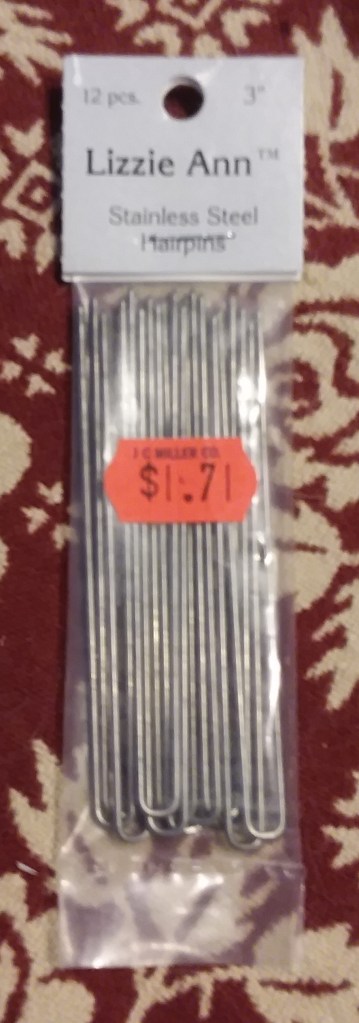
● Straight hair pins
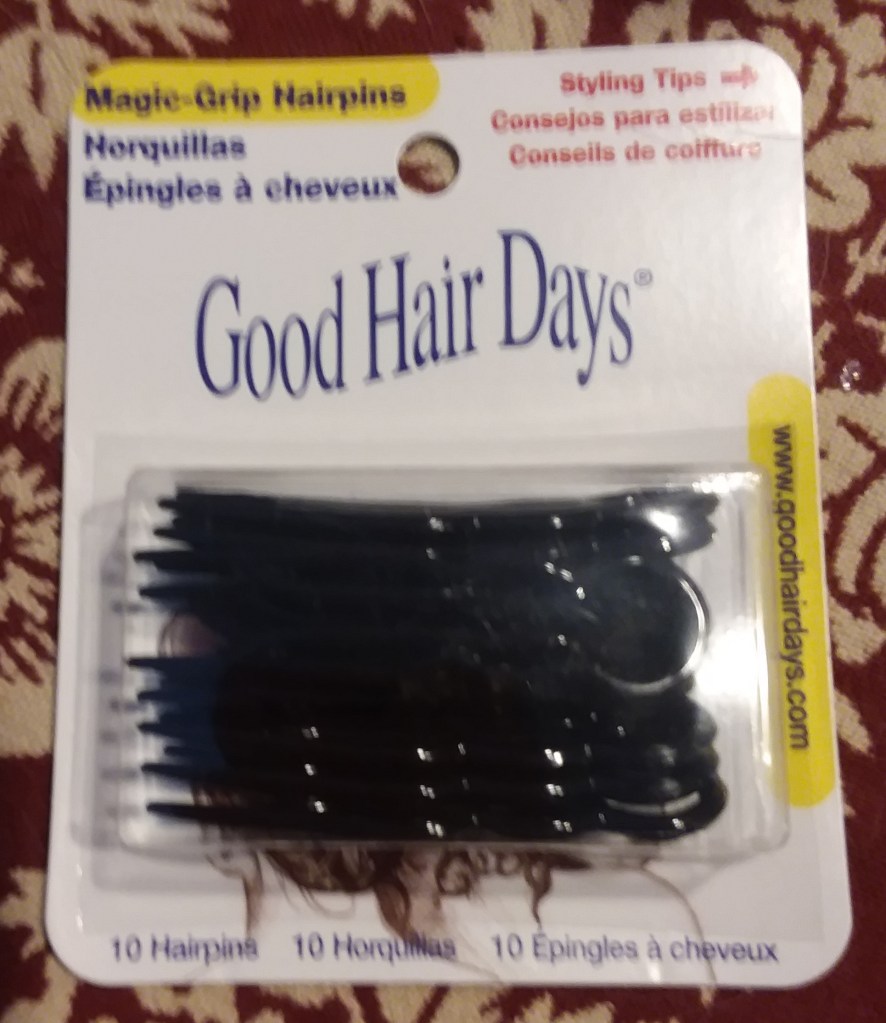
● Faux tortoise hair pins
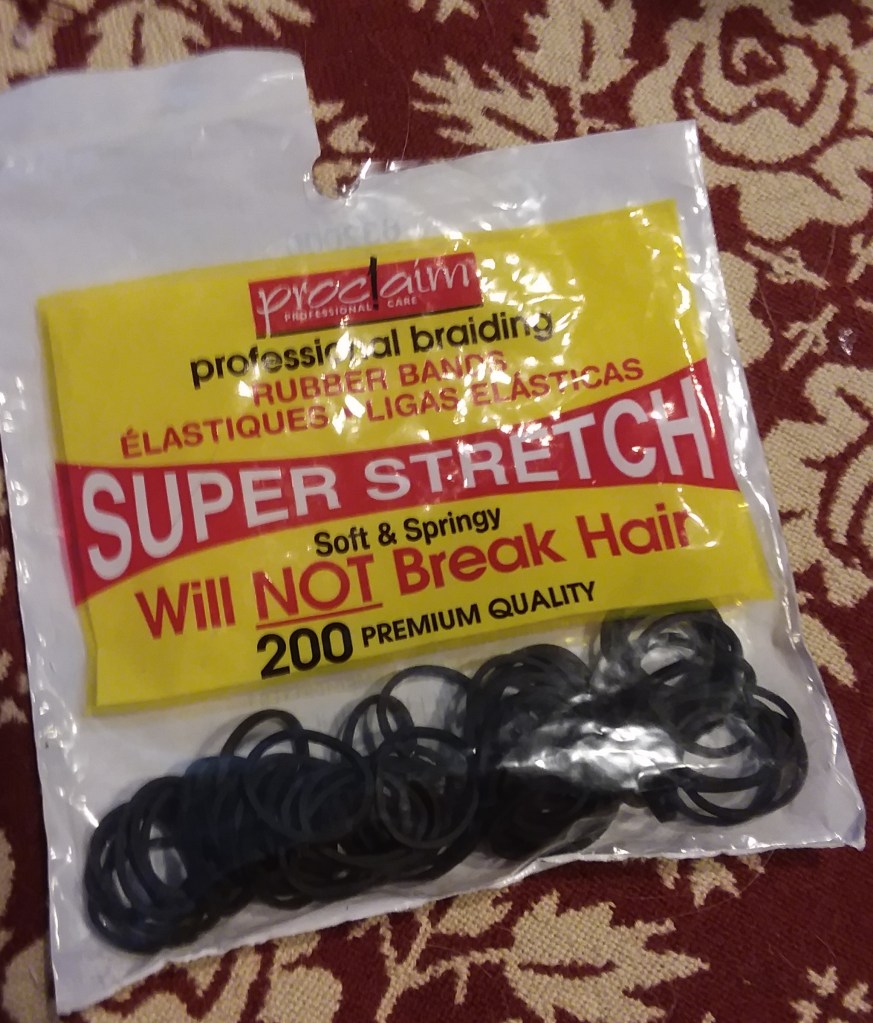
● Plain black elastics
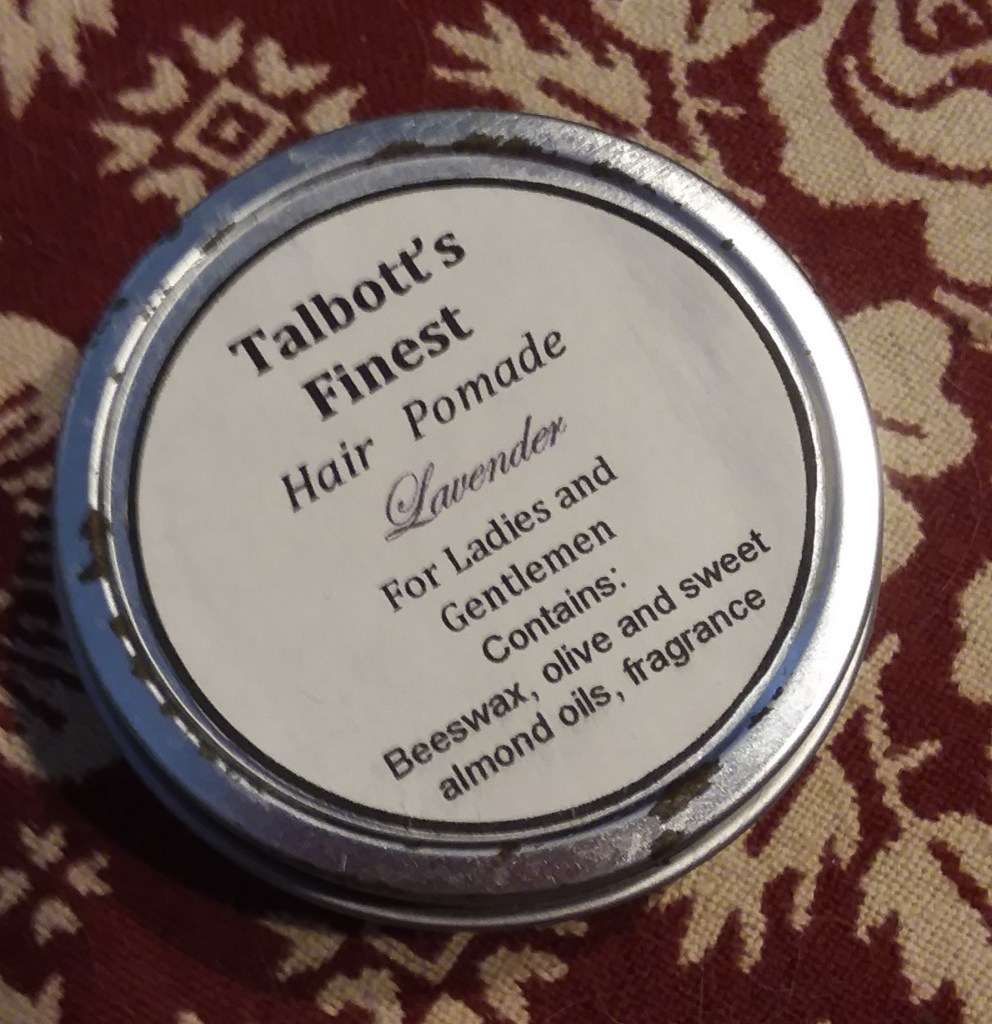
● Hair Pomade
● A Plain net or two
● Faux horn hair comb or two

I am lucky enough to be able to purchase these items in person, including the straight hairpins during a day trip through the Finger Lakes. Not everyone has similar local resources. With this in mind, I am including two shopping lists: one that can be done online from home and one that can be done mostly in person. The online list supports small businesses, with the exception of one item through Amazon.

***Note – I originally did this video and pricing a couple years ago. Some prices have changed.***

Shopping from home:
Order from Timely Tresses:
~~1 set of faux tortoise hair pins $4.00 or 4 chignon faux tortoise hair pins $5.00
~~1 plain hair net $4.00
~~1 back comb $4.00 or 2 side combs $4.00
Amazon:
~~2 sets of 12 straight hair pins in 2” or 3″ and 2.5” $12.00
Talbott and Co on Etsy:
~~1 tin of pomade $14.00

Shopping mostly in person:
Local pharmacy:
~~Plain hairnet $2 for a set of 3
~~Faux tortoise hair pins $3
~~Hair elastics $2
Amish dry goods shop:
~~Straight hair pins 2 sets for $4
Talbott and Co on Etsy:
~~1 tin of pomade $21 (new 2023 prices)

Sources:


Are you one of the many readers enjoying my millinery blog posts?
Consider becoming a Patreon patron. Doing so helps support my work and helps me write more useful articles.
https://www.patreon.com/AMillinersWhimsy

Published in: on March 27, 2023 at 12:05 am  Leave a Comment  

Keeping a Mid-19 Century Bonnet on – Cheektabs & Bonnet Stays

I have two videos for you focusing on cheektabs and bonnet stays, both important features in keeping your 1850s & 1860s Bonnet on your head.

This video looks at how a straw bonnet stays on the head. I talk a little bit about how the cheektabs, ribbon, and inner brim decorations work together in tonight’s video. I plan to do a video that looks further at this. In the meantime, here is information on how a bonnet stay works and helps a bonnet stay on:

This video looks further at cheektabs – what they look like on original bonnets, how they should look on reproduction bonnets, and how they should frame the face.

Published in: on March 20, 2023 at 12:05 am  Comments (1)  

Having a Sad…..

Some anniversaries are easier, some are harder. This one feels harder.

If it wasn’t for my Dad, there likely wouldn’t be a From Field to Fashion. If there wasn’t a FFtF, likely there would be any of the subsequent publications. Dad gave me the money for the first printing of FFtF many years ago.

This morning on the drive in, I decided to do a little something in recognition. From Field to Fashion is half off today, March 17th*.

.

(*and March 18th since Etsy won’t let me do a 1 day sale.)

Published in: on March 17, 2023 at 6:56 am  Leave a Comment  

Please Read Before You Spend Time or Money

This was going to be a quick reminder that I have several e-publications available in my Etsy shop. But, then I realized that isn’t really what I want to say. I want to remind people to read and do research before diving into a project or spending money.

This past weekend, I saw a post going around with a YouTube video link. The video was nicely made with a lovely exploration of a particular project. The problem is the video had the incorrect date attached to the video and item; incorrect by over a decade. The person who created the video shared the information they were given, including the incorrect date. There was no citation in the video information. Tracking back the image shared, I found the illustration and directions on Etsy with a more likely date but still no citation. When I watched the video, it had over 21,000 views with a long thread of comments from people eager to make their own. I envisioned oodles of people with this item, over a decade out of place, made with materials and techniques inconsistent with the era prompted in the video.

Sadness.

That brings us back to please read before you spend time or money.

I would love for you to read on of my publications (available in my Etsy shop.)

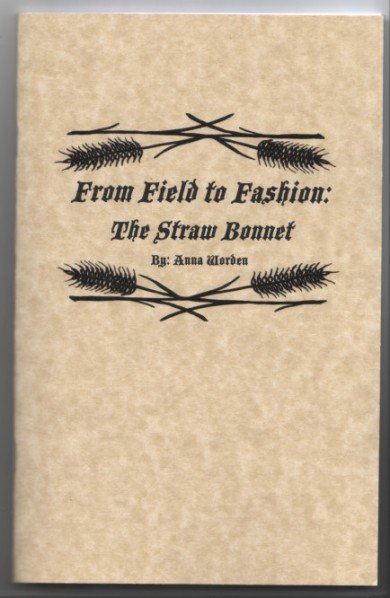
From Field to Fashion: The Straw Bonnet looks at the types of straw and plait used to make mid-nineteeth century straw bonnets and hats. FFtF is available in my Etsy Shop as an eBook.

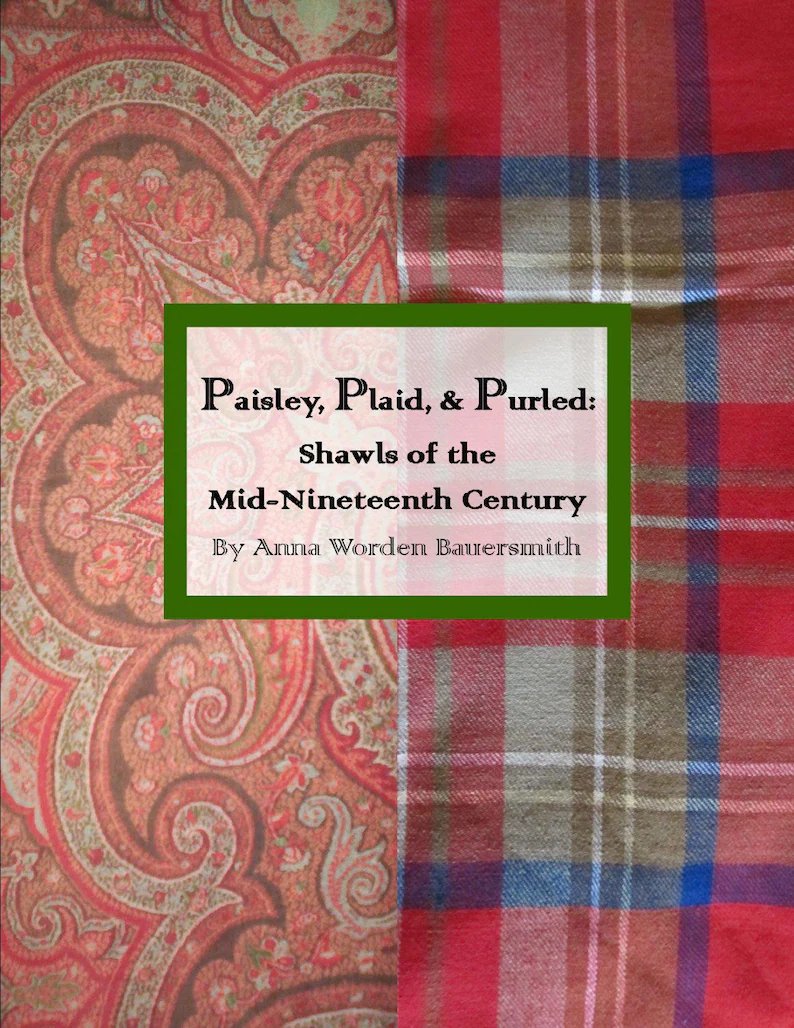
Paisley, Plaid, and Purled discusses shawls of the mid-Victorian era, including the styles, sizes, and how they were worn. It also has directions for making your own accurate shawls. PP&P is available in my Etsy Shop as an eBook.

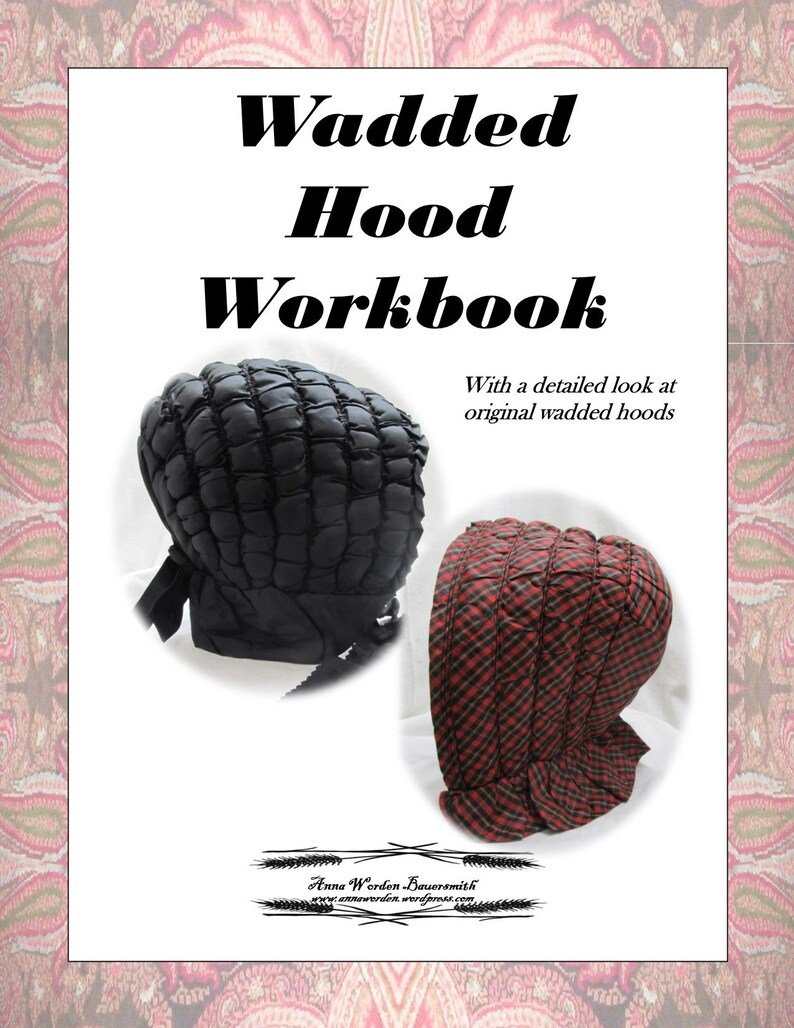
The Wadded Hood Workbook takes a close up look at these winter hoods sometimes called Pumpkin Hoods. This E-publication includes directions for making your own.

To Net, or Not to Net: Revisited is my newest book, diving deep into the hair nets of the Civil War era. This book looks at the types of hair nets, how they were made, and how they were worn. TNNtN is available in my Etsy Shop as an eBook.

Published in: on March 14, 2023 at 2:40 pm  Leave a Comment  

Straw Hat FAQ

This week is a casual Hat Q&A talking about the questions I am asked most often. The focus is on American Civil War hats. I will talk about bonnets in a future video.
How do I wear my hat?
Which is the front?
How do I measure my head?
Where do I put the flowers and ribbon?
How do I keep my hat on my head?

If you have more questions about straw hats or bonnets in the nineteenth century, put them in the comments below. I will do more millinery Q&As in the future.

More details on measuring and fit.

This is where to find me:
Consider Patreon for special content: http://www.patreon.com/AMillinersWhimsy
A Milliner’s Whimsy – If I Had My Own Blue Box (History Blog):www.amillinerswhimsy.com
Don’t Paint the Cat (Crafty Blog): https://dontpaintthecat.wordpress.com
Instagram for If I Had My Own Blue Box: http://www.instagram.com/if.i.had.my.own.blue.box
Instagram for Don’t Paint the Cat: http://www.instagram.com/dont.paint.the.cat

Published in: on March 13, 2023 at 12:05 am  Leave a Comment  

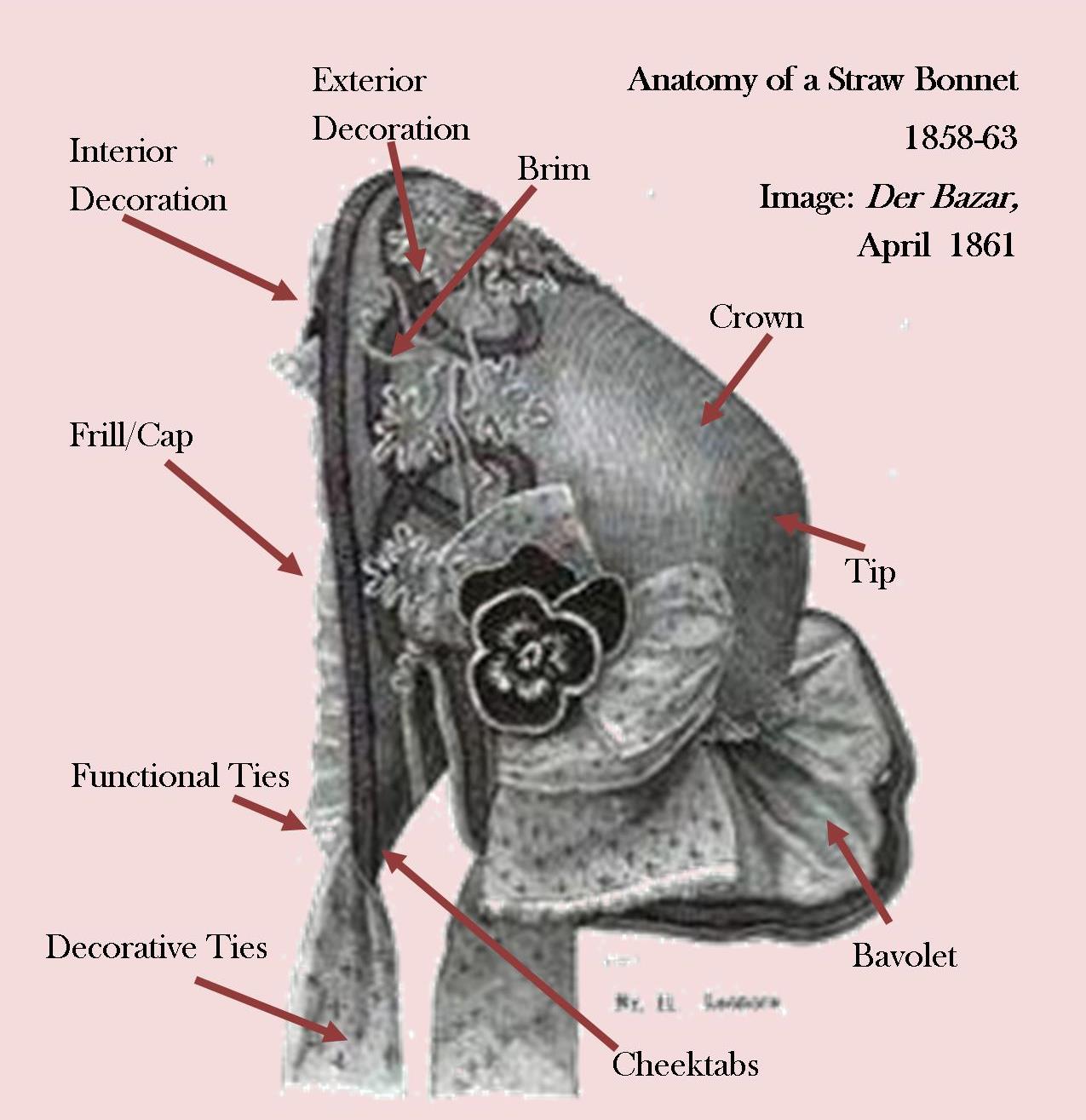
Anatomy of a Straw Bonnet

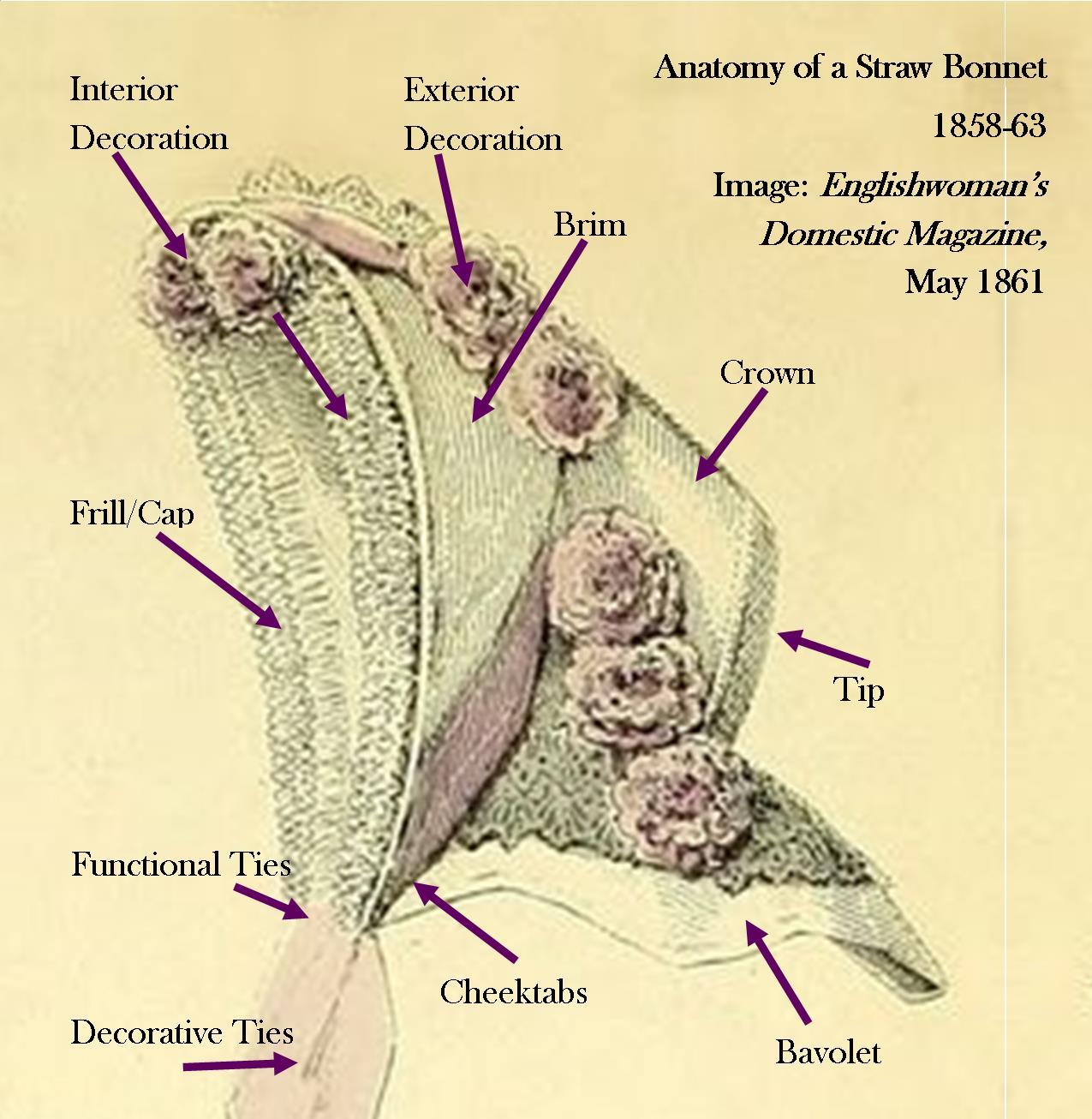
Each of these points are general for fashionable bonnets made of straw, primarily straw plait, from approx 1858 through 1863. Finer points adjust with each season’s prevailing fashion.

General Construction – Straw bonnets were sewn by hand in the round. Plaits ranged from 1/8″ split straw to wider whole straw and fancy plaits. Woven straw was also used.

Anatomy 1

Tip – The back section of the crown in the tip. On a straw bonnet this can either be domed, flattened at the back curving to the side of the crown. It should not have a sharp angular transition from the back to the sides.

Crown – The crown of a straw bonnet should create a smooth transition from the crown to the brim. Much of the shaping in the bonnet will be created in this transition area.

Brim – The brim of a straw bonnet will vary according to fashion. The brim’s edge should be a single or double row of straw plait. It should not have raw edges needing to be bound.

Cheek-tabs – The cheek-tabs should have a gentle curve coming from the neck edge of the crown along the side of the bonnet dropping down to roughly your jaw line meeting the brim edge. This is a graceful line, not a straight edge or angular transition. There is a variation in the twist of the cheek-tab from the fifties into the sixties. The cheek-tab is part of what helps hold a bonnet in place.

Binding – The binding on a straw bonnet should be straw plait. Raw edges were covered on the exterior and sometimes the interior along the back of the cheektabs, sides and tip. Multiple rows were used as well.

Lining – A lining is a functional layer of light weight, open-weave cotton covering most of the interior of the bonnet. It aids in keeping the straw from snagging the hair while worn. The lining can not be seen when the bonnet is worn.

Frill/Cap/Ruche –This decorative layer of gathered cotton or silk  covers fills the inside of the brim. This is very fine most often net, lace or organza. The full frill aides in holding the bonnet in place.

Facing – Some bonnets have a facing of silk from the edge of the brim through the first couple inches of the interior brim.

Bavolet/Curtain – The bavolet is attached to the binding edge on a straw bonnet along the sides and crown. This silk piece should be lined with net to give it more body. The bavolet may be a single piece of fabric, most often on the bias and occasionally on the grain, or pieced from bias cuts of ribbon. The bavolet may also be decorated.

Functional Ties – The functional ties are attached to the interior of the cheek-tabs or under the decorative ties. These are narrower ribbon to hold the bonnet in place.

Decorative Ties – Decorative ribbons are wide, 3″-8″ based on a wide survey I did years ago. They are on the grain, not bias. Tied, they do not take the support of the bonnet.

Interior Decoration – Interior decoration also helps hold the bonnet in place.

Anatomy 2

Find the earlier video on Bonnet Stays here: https://youtu.be/gcnLtlDGblk

Measuring Your Head for Mid-19th Century Hats – Picking the Hat that Fits

There are two factors for finding a comfortable fit: Size and shape.

Size

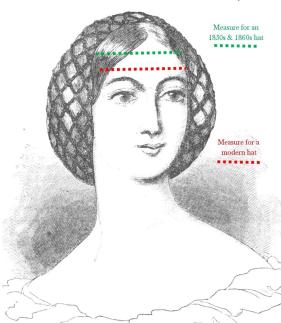
The difference in wear or placement means we measure for a mid-nineteenth century had differently than we do for a twentieth or twenty-first century hat. The modern hat is measured just above the eyebrow. (This is also where many of us measure for bonnets. We want to keep you on your toes.) For mid-nineteenth century, we measure higher, at the hair line. In this illustration, we can see the difference between where the two measurements would be.

measure

These higher, hairline measurements are often smaller than those taken at the eyebrow. A hat worn at this point can be slightly smaller to slightly larger for comfort. So, add and subtract an inch to your hairline measure.

For example: I am 22.5″ around at my eyebrows and 21.5″ at my hairline. The vast land of the internet tells me that the average woman’s head measures 22.5″ to 22 5/8″ around at the modern measuring point. So, I am about average. I comfortably wear a mid-nineteenth century hat that is 19.5″ to 21.5″

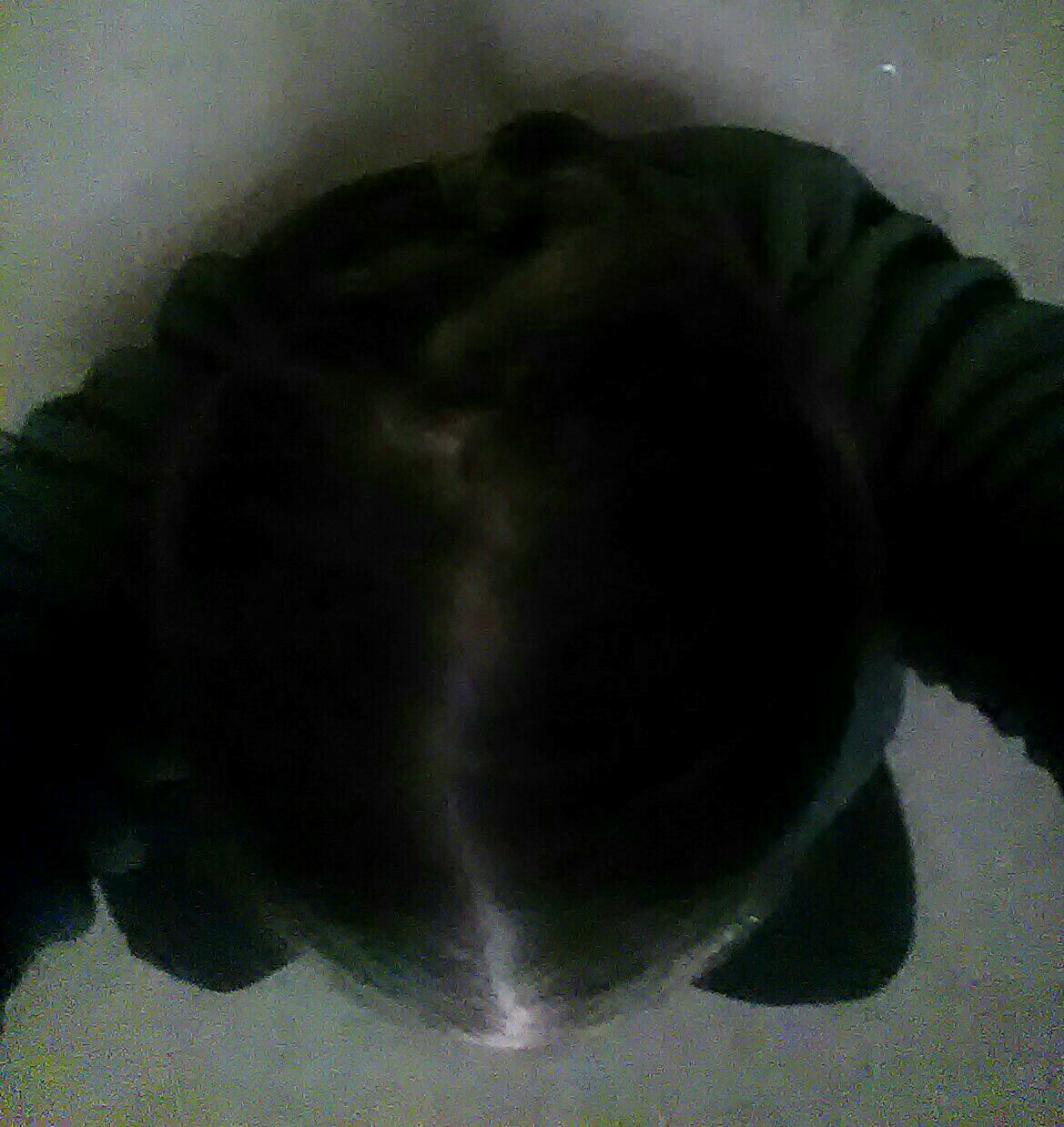
Here is my head with the tape showing where to measure. This is where I wear most CW era hats. This is the circumference of my head. My measurement is 21 1/2″. (Note: this is a full inch smaller than the modern measurement take lower.)

General guidelines I use:

  • Small = Less than 21″ at the hairline (crown less than 20″)
  • Average = 21″-22.5″ at the hairline (crown 20-21.5″)
  • Large = Greater than 22.5″ at the hairline (crown greater than 22″)

Shape

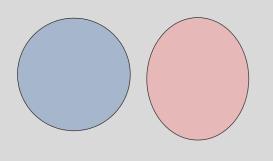
It is helpful to know whether your head is more round or more oval.When looking from above, some people have rounder heads while other have more oval heads. I have an average oval head. Very round hats don’t work for me without adding to the lining.

round oval

Hat blocks can be more round or more oval with the same circumference. To illustrate: Both of these shapes to the right can have a circumference of 22.5″. Yet, the same hat would fit each head differently.

My straw hats and bonnets are available in my Etsy shop as I finish them: https://www.etsy.com/shop/AnnaWordenBauersmith

Are you one of the many readers enjoying my millinery blog posts?
Consider becoming a Patreon patron. Doing so helps support my work and helps me write more useful articles.
https://www.patreon.com/AMillinersWhimsy
Published in: on March 1, 2023 at 1:05 am  Leave a Comment  

Follow Up to Yesterday’s Corset Post

After writing yesterday’s post and a mid-day meeting, I spent the afternoon trying to back track the sources behind the BBC/Netflix corset ban story.

To the right is a sample of the search results.  While I am not familiar with many of the UK publications,  I do recognize several of the results as tabloid style publications. Each references an undisclosed “source.” I find this frustrating because I like documentation.  I want to read official written announcements or, in this case, the equivalent of an inter-office memo.

I haven’t found such.

So, this makes me wonder… Who is the “source”? Is there really a “source”?

Or… Is this just another one of the quasi-annual “corsets are awful” PR stunts?

As I continued looking through the search results, I found several 2021 articles of a similar tone – actresses being quoted as saying corsets are awful, uncomfortable, etc.. The articles are filled with claims propagating the myth of the evil corset.

I can’t help but wonder: Just how many actresses actually complain about period support garments? How many are pushed into saying negative things about their experiences? How many have snip-its of their statements spun to dramatize corset wearing as awful?

Corsets as awful, painful, unhealthy, degrading is news. The headlines get shared and make money.

After all, who wants to read about how comfortable a corset is to wear?


ADDITION: This article from Jezabel takes a different look, also seeing this as a PR move, and contacted the BBC that denies the foundation of the story.

Published in: on February 24, 2023 at 12:40 am  Leave a Comment