A Millinery Mood

If you recall my Planning for Recess post, I started the week off thinking I would tackle a few pieces on my travel impression list. Well, as the week rolled on… it seems I as much more in a millinery mood.
Monday and Tuesday were all about getting the sewing room together. (Check out my Updates blog for before and after photos.) While there is still a long way to go, the space finally has space to move in. Yeah!  Rather excited finally to have some personal decorative items out including Grandma’s “Tip-Toeing Through the Tulips” and the quilt from my NM friends. Soon, new shelves will be purchased & in place, and my trunks, okay some of my trunks, will be moved in.
Now on to the sewing ….
After the lifting & moving, a nice simple, calming project was a must. A nice piece of silk gauze had been waiting almost a year to become a veil. This was just the relaxing, quick project I needed. (I do still have to find either the narrow silk ribbon or cord to attach it to a bonnet with.)

image

underneath the veil is what held my attention next. I had been thinking about bonnets the week prior. So, I was happy to find some straw to work with. This is the first straw bonnet I’ve made in years. Too many years.

image

I had also been thinking about a drawn bonnet. But, I had no buckram. It was time to appease a curiosity. I sized a fabric I bought while in NM. I was quite happy with how it stiffened up. It was an incredibly light weight frame. Since the silk I was going to use is too soft to give the volume I wanted, I peeked at my sewing case pieces. I happened to have enough of this slate grey silk.

image

I rather like how it came out. This week, it will get trimmed with this ribbon & flowers.

image

I have two other frames to finish up tonight. On will be a sea foam green drawn silk for Lily. The other will either be a chocolate silk or a shot brown silk or a bright sunset orange shot…. Not sure which.

Trunk Inventories – What was carried for travel

While other inventories have come to mind, I hadn’t previously thought of looking at court records for travel information until I stumbled across a court case regarding lost luggage which included the values for the trunk’s (or 2 trunks’) contents. The trunks, owned by a Mrs. Frances Davis, were lost on a steamship leaving New Orleans for Indianola in August of 1853. It appears one of the trunks were later discovered and returned while the other was not top be found. One of the trunks contained the following:

1 gold locket, $20
1 gold bracelet, $18
1 gold ring, $2
1 gold cuff pin, $2
2 silk dresses, $25
5 muslin dresses, $25
silk velvet cloak, $25
lace mantel, $12
silk sacque, $5
1 dozen handkerchiefs, $12
Laces and ribbons, $15
Underclothing, $15
Fan, $2
Parasol, $3
Corset, $5
Shoes, $4
Music, $7
Books, $5
Sundries, thread, thimbles, etc, $1
Work-box, $3
Trunk, $20
Port-folio, stationary, etc. $5
Total $231


The notes on the case continue discussing another trunk. I am not certain if this is a second trunk or the trunk found:
Note by the clerk, in the transcript, as follows: “No citations to be found among the papers.” March 19th, 1855, amended petition alleging “that the trunk mentioned in the original petition contained a large amount of valuable wearing apparel and divers other articles, a bill of particulars containing a schedule of the same, together with the value thereof, is herewith filed marked Z, which is made of a part of his amendment; and she states that the value of said trunk was $437.75, etc.; damages laid at $800. Schedule Z was as follows:

Forbes, master, and the owners of the steamship Perseverance, To Frances Davis, Dr. [reformatted list for easier reading]

1 fine sheet iron traveling trunk, $40;
1 fine Velvet cloak, $40;
 1 fine silk sacque, $10;
1 fine silk dress, $25;
1 fine tissue dress $18;
1 fine tissue dress $15
3 white Swiss dresses, at $10, $9, $8, $27;
1 organdy dress, $12;
5 lawn dresses at $5, $25;
1 fine pocket-hdkf. $8;
2 fine pocket-hdkf. At $5, $10;
8 plain pocket-hdkf at 50 cts. $4;
18 pieces under-clothing $25;
1 fine parasol $6;
1 fine fan $4;
1 work-box and contents $12;
1 fine lace mantle, $15;
1 fine lace veil, $3;
1 fine lace chemisette $5;
1 fine French chemisette;
3 common chemissets at $1.25, $3.75;
3 pieces India ribbon $5;
2 fine French collars at $3, $6;
1 fine lace collar at $5;
5 yds. Velencia lace $5;
5 French work-bands at $1 each, $5;
1 fine gold locket $200; [this does say $200 in the text. I don’t know if this is correct since above the locket is $20.]
1 fine gold bracelet $18;
1 fine gold ring $2;
1 pair cuff pins $2;
2 fine long net gloves at $1.50.
Published in: on February 23, 2013 at 9:37 am  Comments (2)  

Travel Advice Exerpts

Today’s exerpt is “Travelling” from Frost’s Laws and by-Laws of American Society.( By S.A. Frost. 1869. )

TRAVELLING.

THERE are many little points of etiquette and  courteous observances which, if attended to, serve very materially to lighten the tedium and fatigue of travel, the non-observance of them being at tended with proportionally disagreeable effects. No situation can be named where the difference between the well-bred and ill-bred of either sex is more marked than when they are upon a journey; and in this country, where all classes are thrown into contact in the various public conveyances, the annoyance of rude company can scarcely be exaggerated.

The duties of an escort to a lady are manifold and various, and the true lady will make them as light as possible, striving, by her own deportment and agreeable conversation, to compensate her gentleman  friend for the trouble she may occasion him. To weary him constantly by complaints of the heat, dust, or flies; to worry for half an hour over some unavoidable mishap or annoyance; to lose or miss some part of her hand-baggage every five minutes; forcing him to rise and search for what she eventually finds in her own pocket; to inquire every few moments, “Where are we now? what time is it? are we nearly at our journey’s end?” to delay him, when the train or boat does stop, for arrangements that should have been made ten minutes before; to fidget about her baggage; or to find constant fault with what he cannot control, are all faults in which lady travellers are prone to indulge, but which all mark low breeding, founded upon intense selfishness.

Good-nature, perfect courtesy, patience, punctuality, and an easy adaptation to perhaps untoward circumstances mark the perfect lady
in travelling. When you see a lady, detained perhaps for hours by a snow-storm, pleasantly trying to beguile the time by conversation, relieving tired mothers, perhaps, of the care of fretful children, jesting pleasantly upon the unpleasant delay, and uttering no complaint or impatient word, even if half frozen or in utter discomfort, you may be certain you see a perfectly well-bred lady in every sense of the words.

No lady should ever allow her escort to enter with her any saloon devoted exclusively to the use of ladies. Because he may be her own
 husband, son, father, or brother does not excuse her, as he cannot stand in such relation to others present.

If a lady in a car or stage finds the exertion of talking tiresome or painful, she may say so frankly, and no gentleman must take offence. Weak lungs may be really injured by the effort made to be heard above the noise of a locomotive or wheels.

In travelling alone, a lady should speak to the conductor on a train, or, in a long steamer passage, introduce herself to the captain, explaining her unprotected situation, and they are bound to extend every courtesy in their power. It is better for a lady so travelling to wait until the rush of passengers is over before quitting a train or  boat, and then, if not waiting to meet any one, leave the station.

A lady travelling alone may, with perfect propriety, accept courtesy from strange gentlemen, such as raising or lowering a window, the offer of a hand across a slippery plank, or any such attention, being careful always to thank him politely for the same, and in a tone that will not encourage conversation or further advances.

Any apology made during a journey for accidental crushing, crowding, reaching over the seat, or the like, must be accepted, a silent but courteous bow being the best acknowledgment of the politeness dictating such apology.

A gentleman, on entering a public  carriage or omnibus, must never step before a lady, but stand aside until she enters, raising the hat slightly if she acknowledges his courtesy, as a true lady will, by a bow. He may offer to assist her if she appears to need it, even if she is a perfect stranger to him.

If a gentleman consents to act as escort to a lady, he must carefully fulfill all the requirements of that rather arduous position. If she meets him at a wharf or depot, he must be a little before the hour for starting, to procure her ticket, check her baggage, and secure for her a pleasant seat. He must never leave her to stand in an office or upon a wharf whilst he attends to her tickets and baggage; but, having seen her comfortably seated in a ladies’ room or cabin, return for those duties. In arriving at a station, he must see her seated in a hack before he attends to the trunks.

In a hotel, the gentleman must escort the lady to the parlor before securing her room, but not detain her afterwards. However agreeable she may be, he may be certain she is longing to rest after her journey, and remove the travel stains from her face and dress. He must at once escort her to her room, ascertain what hour it will be agreeable for her take the next meal, and meet her again in the parlor at that hour. He must not leave her upon arriving at the journey’s end until he has escorted her to the house, and if he remains in the  city, he must call the next day to inquire after her health. After that, the lady may continue the acquaintance or not, as she pleases; but if she declines to do so, by nonrecognition at the next meeting, he is at liberty to decline acting in the capacity of escort to her again.

A gentleman who is travelling alone may offer little courtesies to strangers, and even to ladies, carefully maintaining a respectful manner, that may assure them they need not fear to encourage impertinence by accepting the preferred civilities.

In travelling abroad, the truest courtesy is to observe as far as practicable every national prejudice. The old proverb, to “do in Rome as Romans do,” is the best rule of etiquette in foreign travel. The man who affects a supercilious disdain for all foreign customs and forms will not convince the natives of his vast superiority, but impress them with the belief that he is an ill-bred idiot. The most polite, as well as agreeable travellers are those who will smilingly devour mouse-pie and bird’s-nest soup in China, dine contentedly upon horse-steak in Paris, swallow their beef uncooked in Germany, maintain an unwinking gravity over the hottest curry in India, smoke their hookah gratefully in Turkey, mount an elephant in Ceylon, and, in short, conform gracefully to any native custom, however strange it may appear to him.

“Comparisons are odious,” and to be continually asserting that everything in the United States is vastly superior to everything abroad is a mark of vulgarity. If you really think there is nothing to be seen abroad as good as you have at home, why, you are foolish not to stay at home and enjoy the best.

A lady may, under certain circumstances, as, if she be a married lady, and not too young, begin a conversation with a strange gentlemen; but he must not, under any circumstances, begin a conversation with her. An unmarried lady, unless advanced in life, is not supposed to begin conversation with a strange gentleman.

When a lady, travelling alone, wishes to descend from a railway car, it is the duty of the gentleman nearest the door to assist her in alighting, even if he resumes his seat again. He may offer to collect her baggage, call a hack, or perform any service her escort would have attended to.

If a train stop for refreshments, a gentleman may, with perfect propriety, offer to escort a strange lady, who is alone, to the refreshment-room, or to bring to her any refreshments she may desire. If she accepts his offer, he must see that she is served with all that she desires before attending to his own wants. A lady may always accept such an offer of attention, thanking the gentleman for his politeness, and dismissing him by a courteous bow, which he must accept as an intimation that his services are no longer required.

Smoking in the presence of ladies is uncourteous, even if there is no law against it in the car, stage, or boat. Some smokers, of more inveterate weakness in the direction of tobacco than of strength in politeness, make a parade of asking the permission of any lady who
 may be present; but this is hardly enough. A lady will not like to refuse, although she may dislike the smoke, and she ought not to be put to her election between two alternatives almost equally disagreeable. If gentlemen only are present, the question should be put to each and every one of them whether they have any objection to smoking in their presence. One dissentient voice should carry the day; for no gentleman has a right to insist upon his own special gratification if it will cause annoyance and discomfort to others present. Should there be no objection on the part of the entire party, the gentleman who first strikes his fusee should offer it to any others near him about to indulge also before he uses it himself.

As regards the right to have the window up or down, the person who sits facing the the engine has the command. Ladies, being present,
should, of course, be consulted, no matter on which side they may be sitting, and their wish must be considered a final settlement of the question.

If a gentleman have any newspapers, he must offer them first to his travelling companions. If refused, he may use them himself, thus leaving them free to read also if they so desire.

It is a breach of etiquette for a lady to touch her baggage in a hotel after it is packed. There are plenty of servants to attend to it, and they should carry to the hack even the travelling- shawl, satchel, and railway novel. Nothing looks more awkward than to see a lady, with both hands full, stumbling up the steps of a hotel hack.

Published in: on February 16, 2013 at 9:52 am  Leave a Comment  

Happy Valentines Day!!!

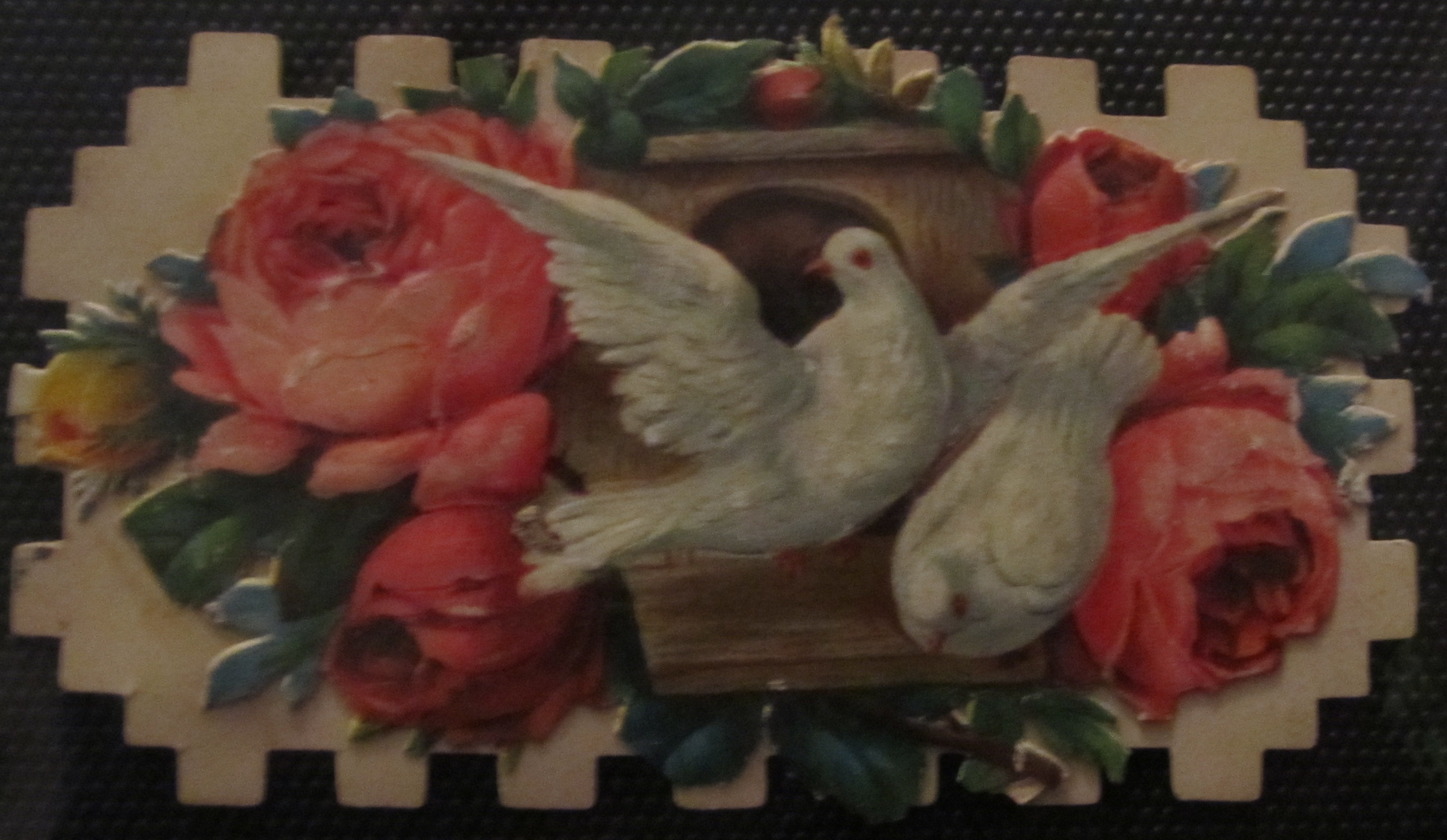
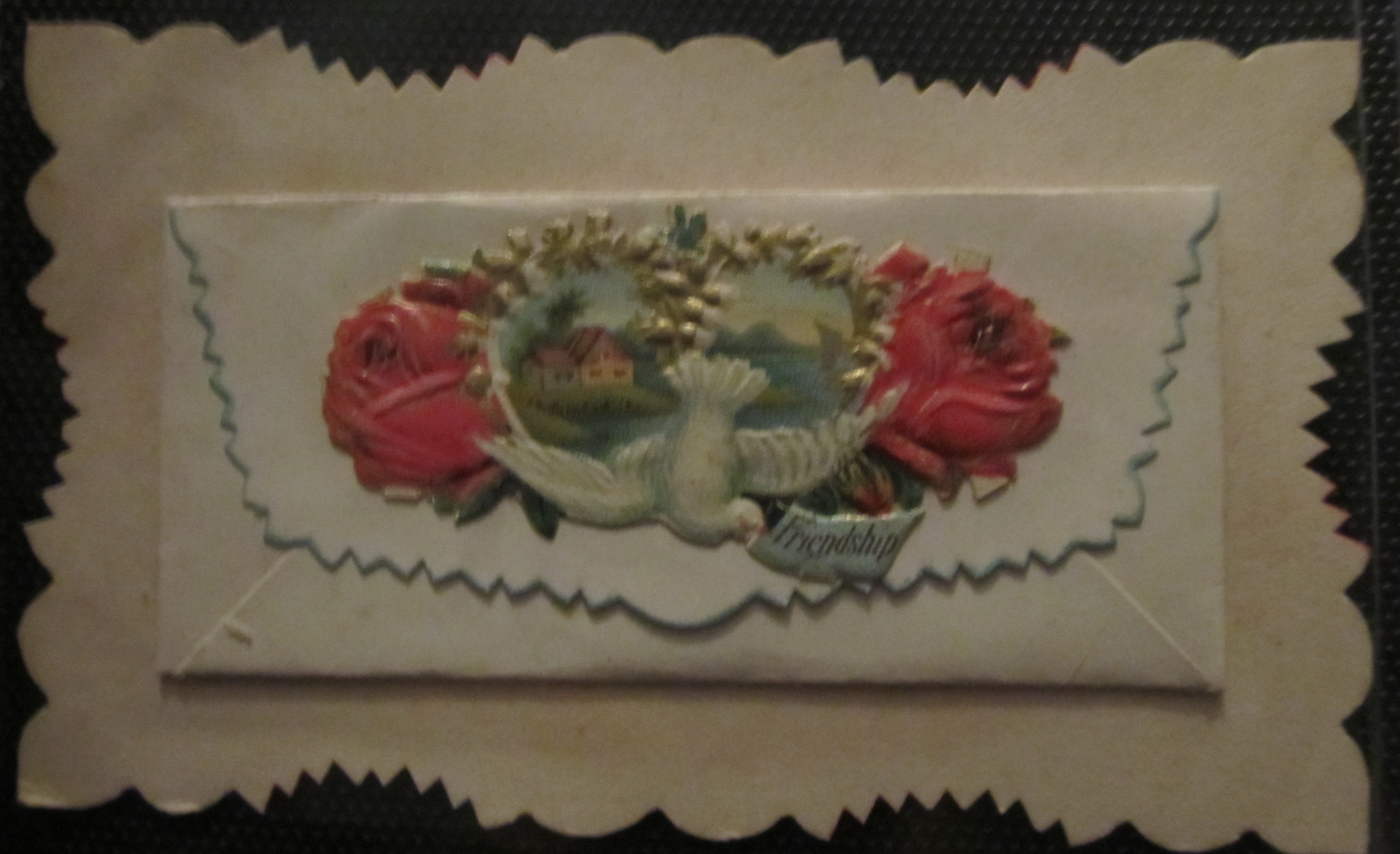
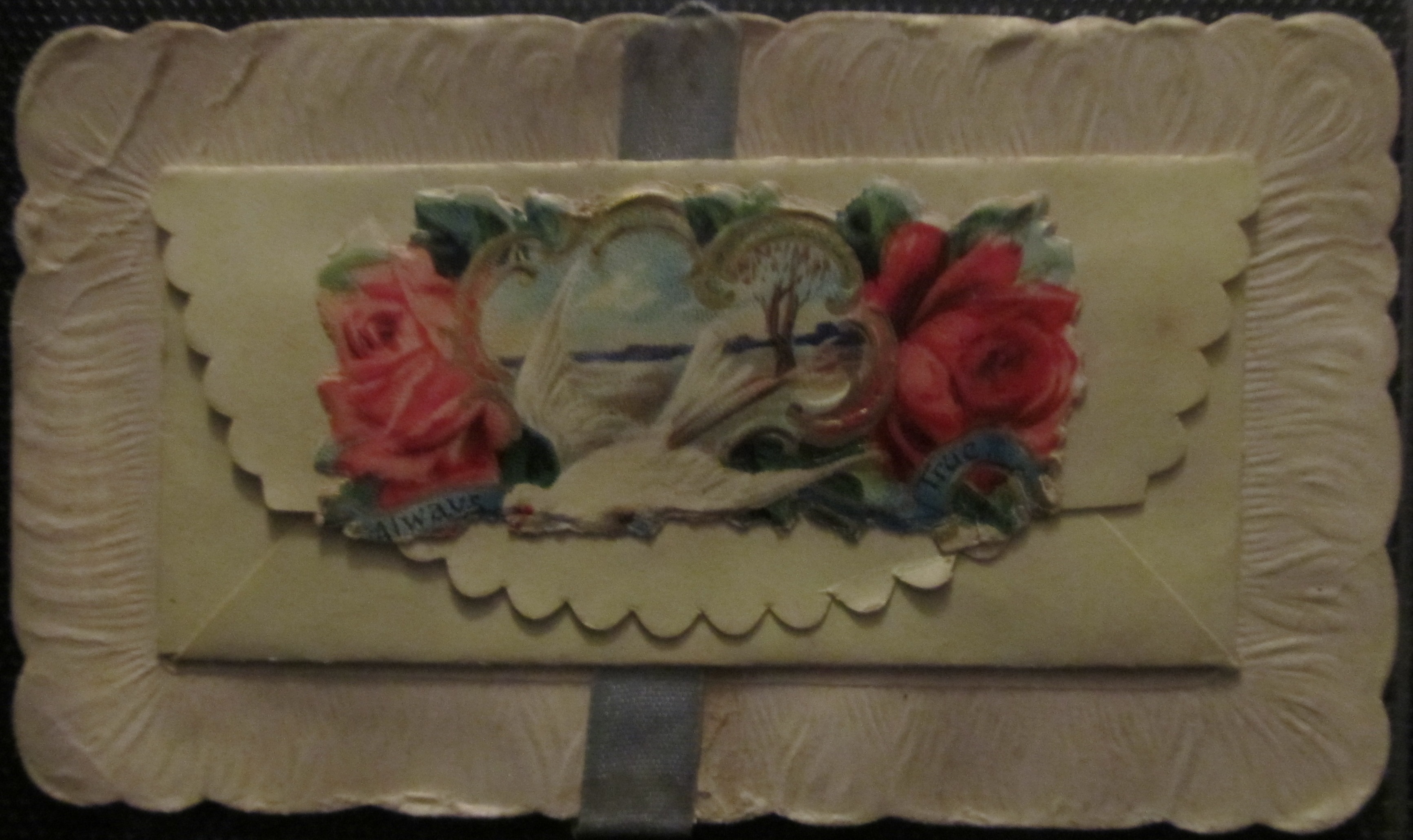
These antique Valentines have been lucky a few times over. First the recipient saved them. Then, they survived a flood in Dad’s basement. While everything else in the box they were in was sadly soaked and ruined, these were tucked safely in a water-tight plastic bag. I’ve been wanting to share these pretties for a while. They’ve spent the last few years packed away, just waiting to be seen. Here is a small sampling (and, yes, I took photos instead of scanning for a reason)…..

Vintage Valentines ??????????????????????????????? ??????????????????????????????? ??????????????????????????????? ??????????????????????????????? ??????????????????????????????? ??????????????????????????????? ???????????????????????????????

Interested in more information on Victorian Valentines? May I suggest: The Secret Life of Victorian Cards   and Valentines; the Language of Love.

Published in: on February 14, 2013 at 1:03 am  Leave a Comment  

How to Pick February Recess Projects

With a week off from work coming up, I want to put a dent in my sewing projects. The challenge? There are just so many sewing projects to do (with a good many house projects also calling for my attention.)

With this in mind, how do I go about deciding? One train of thought is choosing something new to me along with something that I know well. Another option is to choose something that must be done along with something frivolous and fun. A third option is to pick something big and something small. 

Regardless of which direction I go, there are  still quite a few options to choose from. If you flipped through my dress project list from earlier this week, you’ll see just how how many dresses I have on the drawing board. Toss into the mix that I have an itch for millinery lately and a list of tiny items to do. I’ve narrowed down the “I could”s to….

  • My Regency corset. After all, I need to get this done before doing any of the Regency dresses on the list. (This would count as something new to me.)
  • If I was to pick a dress from the project list to work on, I would go for the peach sheer, I think. Though, this green would really like to be made up. Or, my travel ensemble would be good to work on as well.
  • A drawn bonnet. I have some lovely silk lengths to play with. Lily needs a bonnet and I could always use more. I would really like to work with some straw, but I don’t have a clue where mine is and didn’t order any in time. (This would count as something medium-ish, and something fun.) (I happen love, love this bonnet. If I happen to discover a piece of velvet at home… )
  • A piece of winter millinery. I have a silly amount of goods for winter hoods waiting around to be made up. (A, B, C) This is something that could end up on Etsy. On the other hand, I do have a traveling hood on my list of items for the travel impression…. hmmm, this may be moving up the list.
  • A fancy headpiece – Another use for bits of silk. This could be a fun, yet calming fiddly little project.
  • A veil. I’ve had the piece of black silk gauze sitting around for quite a while waiting to be made for the travel impression.
  • Also from the travel impression, is this bonnet bag that I’ve wanted to make for years. I think the cane I picked up will work nicely.

Of course, I do have a modern sewing project to get done before the second weekend. That will hopefully go smoothly.

Now, what is your vote?


EDIT: It looks like our anniversary get-away to Gettysburg at the end of recess isn’t going to happen. *great sadness* This means I will have a couple extra sewing days and may or may not be doing that modern sewing project. As of this morning, I am leaning towards a combination of travel impresssion items – travel bonnet/hood with veil, bonnet bag and a start on the linen travel combination.

Published in: on February 13, 2013 at 3:13 pm  Leave a Comment  

Project List

I wanted to have this list of projects with a survey of fabric done in the beginning of January. A month or so past due… Here it is.

You will notice some gaps in the fabric photos. These are fabrics I know I have but haven’t been able to take photos of yet. I should really do something similar to this for the smaller pieces of fabric, those used for hoods, bonnets, husband shirts, fichus, Mae dresses, etc, so I can pin down those projects as well. So many ideas floating in my mind.

This is a PDF to flip through: Project Index

Published in: on February 11, 2013 at 4:32 pm  Comments (2)  

A Day on a Railroad

I have to admit, reading this chapter, “A Day on a Railroad” from At Home and Abroad; or, How to Behave, by Mrs. Manners (Evans & Dickerson: New York, 1854), I am not the most patient, nor comfortable 19th century railroad traveler. Left myself or in a quiet party, I am okay assuming I get comfortable, the sun is not touching me, there is fresh air and it is moderately quiet. I find it difficult to carry on a conversation at length or to sit with the sun falling on our side of the car. If off set, I can be down-right cranky.

A Day on a Railroad

“Was you ever in the cars before?”

“If I had a’been I shouldn’t be here now,” was the reply, in a nasal and querulous tone.

I was sitting before the speakers, in a fine car on the — railroad, and the above question was asked and answered, at the first station which we reached, after leaving the city of S—. I turned around to see who the persons conversing might be, for the answer of the old lady had amused me. She was a fresh arrival from the heart of New England. She had accompanied her son, who, with his family lived at the South, on this long, and to her mind, most perilous journey. A “wagon” had conveyed them to the ship, which landed them at S—-. She was not afraid at sea, for a neighbor of her’s “had been a sea-faring man for forty-odd years, and never been drownded;” but the horrid din, “the supernat’ral speed” of the cars was too much for her, and then “Miss Johnson’s brother’s wife’s son, by her first marriage, had been killed, she believed, in this very State of Georgia, on the railroad. He ‘tended the ingine, and had been throw’d off and fractioned his skull.”

These particulars, I heard her give to her questioner, a respectably-cladwoman from the interior, who was so much more at home on the outlandish vehicles, because “the road run now within a mile and a  half of her house, which used to be more  than thirty-six miles from a town.”

The old lady groaned and complained during the remainder of the day, and reproached her son for bringing her to a place which must be reached by such a mode of travelling. Sometimes the scenes between them were amusing, at other times they were annoying to the involuntary listeners. These were not all the annoyances of that day. The heat was most excessive – the dust and smoke perfectly unbearable, and the scarcity of good water a great source of discomfort to the crowded, wearied passengers. There were some small children along with us, who were foolishly supplied with candies and cakes almost incessantly, which aggravated the thirst incident to the heat and suffocation. They were greedy, dirty, cross, sleepy, and altogether very uncomfortable little associates. Two of them, however, formed an exception to these remarks. One was a lively, intelligent child, about two years old – the other a noble, though rather delicate looking lad of perhaps ten years.

“Oh papa,” said he, as he caught sight of the younger child in a remote part of the car, “how much that little boy is like my little brother Malcolm. May I go ask his mother to let him come and sit with us?”

The permission was granted, the request made and acceded to, – the little one was enchanted with the prospect of a relief from the monotony of his own seat, from which he dared not wander alone, – and all parties looked pleased. The lad, whose name was Leslie, took most tender care of the little Bertie. If the cars stopped long enough for any one to leave them, Leslie’s father carried Bertie out in his arms to give him some fresh air. Leslie himself continually pointed out every object which could interest the child.

I was pleased as I regarded him forgetting his own discomforts to please the little fellow; whenever he had a chance he bathed his face and hands in the cool water, – often giving  him a drink. He was most solicitous lest the child should eat anything which would provoke thirst; an unripe banana was thrown away, a ripe one carefully peeled, a ginger-cake put out of sight, a piece of juicy apple given, – and thus he was continually consulting the happiness of this little protégé. Not a complaint was heard from Leslie during the whole weary day. He changed his seat, preferring to have the sun in his own face rather than in the child’s; he patiently held his head when he fell asleep, and carefully protected him from the black motes which are so annoying in the cars.

I truly  believe Leslie was the happiest person in the cars that day, because he was the least selfish; he was so much occupied attending to the comfort of the little one, as to entirely forget himself, and consequently his own troubles. That was the secret of the day’s pleasure, and the kind of words and looks which all gave him who saw his unselfishness. I can answer for Berties’ mamma, that she blessed the lad in her heart, and will never forget his kindness. When we reached M—-, Leslie said – “It has been a pleasant day, papa, has it not?” The weary passengers who heard him smiled; but all acknowledged he had deserved the day should be a pleasant one to him.

Published in: on February 9, 2013 at 9:10 am  Comments (3)  

Exerpts on Travel Advice

Today’s exerpts come from Eliza Bisbee Duffey’s The Ladies’ and Gentlemen’s Etiquette. (Philadelphia: Porter and Coates, c1877.)

THERE is no time or place where true ladyhood is more plainly indicated than in traveling. A lady’s traveling costume will be exquisitely neat and plain, without superfluous ornament of any kind.  Jewelry, artificial flowers or lace are out of place on either dress or bonnet.

TRAVELING-DRESS.

The first consideration in a traveling-dress is comfort; the second, protection from the dust and stains of travel.  In summer, for a short journey, a large linen duster or overdress may be put on over the ordinary dress, and in winter a waterproof cloak may be used in the same way. But a lady making an extensive journey will find it convenient to have a traveling-suit prepared expressly. Linen is still useful in summer, as the dust is so easily shaken from it and it can be readily washed. In winter a waterproof dress and sacque are the most serviceable. There are a variety of materials especially adapted for traveling costumes, of soft neutral tints and smooth surfaces, which do not catch dust. These should be made up plainly and always quite short. The underskirts should always be colored woolen in winter, linen in summer. Nothing displays vulgarity and want of breeding so completely as the white petticoat in traveling. Gloves should be of Lisle thread in summer and cloth in winter, never of kid. Boots thick soled, stout and durable. The hat or bonnet must be plainly trimmed and completely protected by a large veil. Velvet is unfit for a traveling-hat, as it catches and retains the dust. Plain linen collar and cuffs finish the costume. The hair should be put up in the plainest manner possible. Curls or fancy braids are inadmissible. A waterproof and a warm woolen shawl are indispensable in traveling. Also a satchel or handbasket, in which should be kept a change of collars, cuffs, gloves, handkerchiefs, towels and toilet articles. A lunch-basket is sometimes desirable. A traveling-dress should be well supplied with pockets. The Waterproof should have large pockets; so should the sacque. The pocket of the dress should be deep and large. In an underskirt there should be provided a pocket in which to carry all money not needed for immediate use. The latter may be entrusted to the portemonnale in the ordinary pocket, or in the bosom of the dress.

GOING TO EUROPE.

The most sensible directions we have observed for a sea-voyage appeared recently in a well-known paper. They are so good that we take the liberty of transferring them to these pages. Even though the directions may not be complied with to the letter, they will serve as a basis upon which to build the needs and requirements of a voyage across the Atlantic.

It should be borne in mind that it is desirable not to be encumbered with too much baggage at such a time. It is always troublesome to look after and really unneeded, for one is going where all the requirements of civilized life are to be found in abundance, and where one must shop, whether there is any need or not, merely to be in the fashion. Therefore it may be well to create the need, that the shopping may be done with a clear conscience. It is not necessary to supply ones self with many changes of underclothing in traveling; washing is always easily done on the journey at short notice. We not long since heard of a lady who was offered by her husband a trip to Europe if she would get all her personal belongings into a hand-valise. She did so, went and returned, and enjoyed the trip immensely.

The writer above referred to says: “An elastic valise and a hand-satchel, at the side of which is strapped a waterproof,” are enough baggage to start with. “In the valise changes of linen, consisting of two garments, night-gowns and `angel’ drawers. These latter are made of cotton or linen, and consist of a waist cut like a plain corset-cover, but extending all in one piece in front with the drawers, which button on the side. Usually the waists of these drawers are made without sleeves or with only a short cap at the top of the arm, but for
a European trip it is advisable to add sleeves to the waist, so that cuffs-paper cuffs if preferred-can be buttoned to them. Thus, in one garment easily made, easily removed, and as easily washed as a chemise, is comprised drawers, chemise, corset cover and under-sleeves, the whole occupying no more room than any single article of underwear, and saving the trouble attending the care and putting on of many pieces. A gauze flannel vest underneath is perhaps a necessary precaution, and ladies who wear corsets can place them next to this. Over these the single garment mentioned adds all that is required in the way of underwear, except two skirts and small light hair-cloth tournure.

“Of dresses three are required-one  traveling dress of brown de bege, a double calico wrapper and a black or hair-striped silk. The latter is best, because it is light, because it does not take dust, because it does not crush easily and because by judicious making and management it can be arranged into several costumes, which will serve for city sightseeing throughout the journey and be good
after ward to bring home. Then, if there is room, an old black silk or black alpaca skirt may be found useful, and an embroidered linen or batiste polonaise from last summer’s store.

“Add to these a black sash, a couple of belts, an umbrella with chatelaine and requisite attachments, a pair of neat-fitting boots and pair of slippers, some cuffs, small standing collars and a few yards of fraising, a striped or cheddar shawl, a `clouds for eveiiings on deck, some handkerchiefs and gray and brown kid gloves, and, with a few necessary toilet articles, you have an outfit that will take you over the world and can all be comprised in the space indicated, leaving room for a small whisk broom, essential to comfort, and a large palm-leaf fan.
“Stores, such as lemons, a bottle of glycerine, spirits of ammonia and Florida water, which are really all that are required-the first for sickness, the last three for the toilet-should be packed in a small case or box in such a way that the flasks containing the liquid will not come in contact with the fruit. After landing the box will not be wanted, as the lemons will have been used and the flasks can be carried with dressing-combs and the like in the satchel.”

Published in: on February 2, 2013 at 9:48 am  Leave a Comment