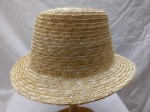
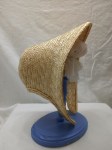
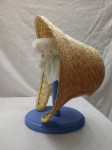
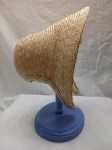
Finishing a Straw Bonnet

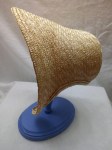
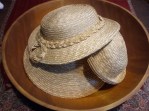
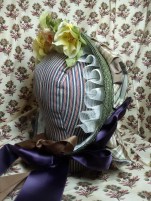
20180723_092546.jpgWe are entering the time of year when people are thinking spring and about decorating their bonnets. Straw bonnets have a great appeal because they are cooler to wear in the heat as the straw allows the head to breathe, and the embellishments can be changed fairly easily without leaving as obvious thread holes.
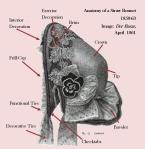
Just as with most other garments and material culture pieces, millinery is an investment. You want to finish your straw bonnet as accurately as possible. This will include several factors:

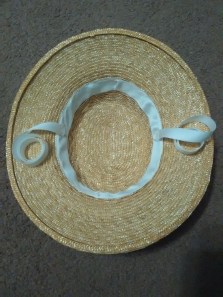
  • A lining to protect the straw from your hair products and to protect your hair from snagging on the straw. While not every extant bonnet has a lining or evidence or a lining, a lining can extend the life of your bonnet
  • A frill or cap for the inside of the bonnet’s brim. This frill simultaneously frames the face and helps hold the bonnet in place. You may also want to add a facing to the front couple inches of the inside of the brim. This is found in many originals.
  • The bavolet will need a cotton net lining to give it the proper fullness. I believe this net also physically supports the materials of the bavolet. The silk, whether from fabric or ribbon, is most frequently seen on the bias in original bonnets. The net will help the bias cut hold its shape, especially if addition elements such as straw, lace, or bead-work is added. Consider reading “Understanding the Ribbon Bavolet” for additional information.
  • A bonnet will need 2 sets of ties – A functional set of narrow ties which will hold the bonnet on, and a decorative set of wider ribbons.
  • You may want to add a stay to assist in holding the bonnet to your head. The easiest to add is a simple strip of velvet. More information with images can be found in the post “Bonnet Stays
  • Then, of course, you need your decorations – flowers, feathers, ribbons, lace, etc.
  • I will add – A storage box and stand – While this is not an immediate need, a stand and box will help your bonnet last by protecting it from being mis-shappened, and from dust.

Recommended Shopping List:

  • I highly recommend Danielle’s book from Timely Tresses: Finishing a Straw Bonnet Form
  • Cotton net to line your bavolet
  • Fine cotton or silk net (bobbinette), or silk organza or lace for your frill/cap
  • Fine cotton voile or silk taffeta to line your brim
  • 3 yards minimum of wide (silk or quality rayon) ribbon (2 yards for ties, 1 yard for bavolet, additional for decoration/bows) (silk taffeta is also an option for the bavolet.)
  • 1 yard of 3/4″-1″ wide silk or cotton sateen ribbon for ties.
  • Ribbon and laces of choice for decoration
  • Flowers and feathers of choice for decoration
  • 1/2″-3/4″ wide velvet for optional stay

20180730_175702.jpg

Recommended Reading List:

20180730_175123.jpg

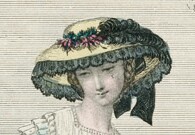
Godey’s, November 1856

Straw Bonnets.—Straw bonnets generally require some sort of lining, crape, muslin, or a thin silk. Very few are now worn with a plain lining. It requires just the same quantity to make a little fullness, which is more becoming. I will explain to you how to make a plain lining or a plain bonnet will take just the same quantity; or, if any difference, the plain requires more than the full. I think I hear my readers say this if very strange. You are aware that, in cutting out a plain bonnet or lining, there are several small pieces cut out to the shape. The piece make the fullness, for the material is used on the straight when put in the easy and on cross-way when plain, which compels you to cut pieces off , which on the straight and put in full, is not required. A head lining of silk or muslin should be put in after the lining to make all neat and clean when the bonnet is worn. Straw curtains are worn; but a great many ladies prefer a silk curtain made of the ribbon to match the trimming. The curtain is best cross-way with a narrow straw on the edge. The curtain will not quite take a yard of ribbon; three and a quarter or three and a half are sufficient to trim a bonnet. Plain colors on a straw are neater than mixed, such as primrose, light or dark blue. Sarcenet ribbon is better than satin. It is a good plan to sew narrow strings on the bonnet at the same time you sew the wide tie; the narrow first: it keep the bonnet more firm on the head. When I say narrow ribbon, I mean an inch and a half wide. An old fancy straw bonnet will make up again very weill by putting some silk between each row of straw. You must have a wire frame, and unpick the bonnet; cut some pieces of silk on the cross for puffings, and now lay your straw alternately with the silk. Unless the straw is a very good color, mix colored silk with it. This bonnet will require a lining.

Published in: on March 12, 2019 at 6:00 am  Leave a Comment  

Hairnets – The Basics and More Indepth

There are several resources available to learn more about hairnets…..

Are you confused about the word “Snood”? Read Getting Snoody by Elizabeth Stewart Clark.

Do you want to know what basic hairnet to buy and have in your hair kit? Watch this video: Invisible Hairnets.

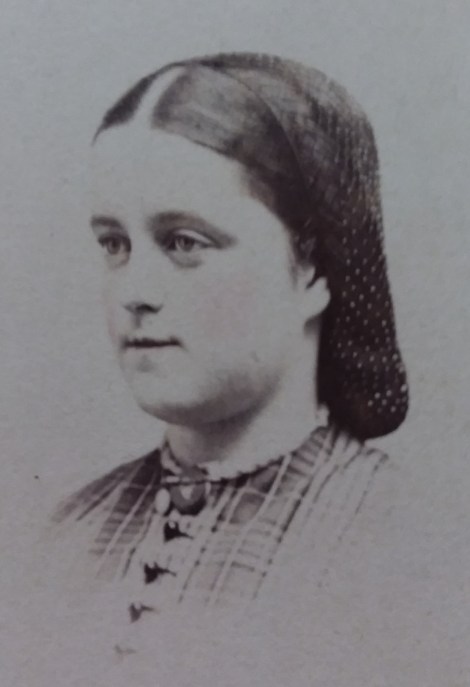
Want to know the basic ins and outs of hair nets? Read To Net, or Not to Net an article by Anna Worden.

Want to know the details of hairnets, who wore what kinds and when with lots of photos and illustrations? Read the full-length e-book To Net, or Not to Net: Revisited, by Anna Worden Bauersmith.

to-net-or-not-to-net-revisited-cover

Published in: on March 11, 2019 at 9:47 am  Leave a Comment  

Interlude

This is going to be a post of miscellaneous random things. Just to prepare you.

I don’t know if I’m being super lazy or just multitasking, but for this post I am attempting to use my phone’s text to speech software. We willll see how it goes. I am wiring a straw hat while I’m attempting to do the post here.

I found this week I was having one of those moments where I keep running the projects I’m working on and want to do through my head. I wrote them all down in my pretty little planner, which really is pretty. But that didn’t satisfy, so I find I Must List and share them publicly.

  • Sitting over there, across the room, is the coat that I started in January. It has one sleeve on and one sleeve off. On the pinking machine table lies the batting and silk for its quilted edge. It has since accumulated a layer of Clara. Initially , I needed it for an event in January. Now it’s new goal date is whenever I’m going to be out in the cold again. Obviously, that is to be determined.
  • I have this idea stuck in my head for a straw sample display put together in and emptied out writing slope. It’s so stuck in my head that if I don’t do it exactly how I want it I’m just not going to be happy with it. So even though I initially had a mid-April deadline, I’ve decided it’s completely flexible, depending on actually finding a gutted writing slope at a decent price. And by decent price I mean I’m being totally cheap. I refuse to pay more for a gutted writing slope then I have for any of my nice ones. And for those wondering why in the world it has to be a writing slope, there are reasons there are really good reasons. Trust me.
  • Okay, so it’s been a long while since I’ve done anything with my travel impression. But, recently I’ve been talking travel bags with a friend. In this conversation, we came across a silk travel bag. It is more utilitarian than pretty. It needs a durable silk, a heavier silk. But it’s interesting enough that I really want to make it. It’s not essential obviously. So, it’s not on the Urgent list, but it’s definitely on the stuck in my brain list.
  • Next on the list is quite unique and I’m going to be a little vague. I’m going to make a bonbon doll. I may make 2, a big one and a small one. For the big one, I need the right head. I keep changing my mind on which one that is. I need it to be an affordable head and not a really good head, just in case. It will be cool when it’s done
  • It does bring me back to the dollies that need bodies. One Dolly had needs a regular body. And another Dolly head is going to get a pen wipe body.
  • In the midst of all of this there is the “do I want to make curtains?” question. I don’t really but the windows need curtains, and I have all this fabric, but there is such a pretty pretty pretty pair at HomeGoods.

Okay so watching this text to speech is rather hysterical. I’m going to do my best to go back and correct all the mistakes and get some punctuation in here. My apologies for what I’ve missed.

Clara stop it.

Okay so maybe I’ll leave that.

Lately I’ve been thinking about depth and breadth. Meaning the death of skill versus the breath of skill, or the depth of interpretation versus breath of interpretation. They’re definitely visitors who are looking for a breath of information, a little bit here and there about a lot of different thing. But at the same time there are visitors who are really looking for death, they want to get into the nitty-gritty about a particular topic.

In thinking about millinery, from me that includes the aspects of women’s employment, women’s business ownership, the the poor health Young milliner’s had in urban millinery shops, Urban to rural variations, the impact of cottage industry, and things like that. Each of these aspects have various challenges in researching them or writing about them, but they have a whole other set of challenges when thinking about how to interpret that or how to visually represent them in a demonstration or display setup. At the moment this is a giant question and goal for me. I want to figure out how I can provide depth in my millinery shop presentation as well as breadth. I’ve been thinking about what objects or arrangments I can use to aid in the conversations connected to that depth, which can of course vary.

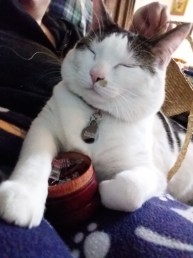
Here’s a cute Clara photo, because you all need some cuteness. She is the guardian of the clips.

Published in: on March 10, 2019 at 1:08 pm  Comments (1)  

Un-Boxing: Quilted Silk Bonnet/Hood

The bavolet/curtain attachment I mentioned:

I don’t know if you can see the stitch holes I mentioned:

Published in: on March 8, 2019 at 7:13 pm  Comments (1)  

Hand Sewing Straw Plait

Each of my straw bonnets and hats are entirely sewn by hand. On average, each piece uses 20 yards of straw plait and 1,500 stitches.

Published in: on March 5, 2019 at 8:19 pm  Leave a Comment  

Mousquetiare March!

Since I focused most of February on the fifties, I’ve decided this month will be Mousquetaire March!

Most, if not all, of the hats I will be making this month will be in the fashionable Mousquetaire style.

Mousquetaire hats have tapered crowns that rise about four to five inches, not quite double the height of other fashion hats of the early 1860s. The brim is shaped, with a curve dipping front and back. This brim is narrow, only a few inches wide. The decorations are primarily at the center front, reaching the height of the crown. A ribbon may or may not circle the crown with a bow or arrangement in the back. This shape is also called a Postilion Hat.

1

Fig. 3 is a Mousquetaire hat of Leghorn or white straw. Round the hat is a scarf of blue ribbon, with a large bow and long fringed ends at the back; in front is a rosette of black and white speckled feathers, surrounded by an edging of blue flowers or bluets. The brim is edged with black velvet. (Godey’s, August, 1864)

1

Fig. 7 is a Mousquetaire hat drab straw, trimmed by two narrow bands of scarlet velvet, and having in front a plume of black and red feathers, and one large ostrich feather. (Godey’s, July, 1864)

Here is an assortment of hats in the Mousquetaire style, with one variation:

Hats of the Mousquetaire or Postillion shape from Godey’s and The Lady’s Friend:

Here are a few of this style I’ve previously made (note: I will not be making more of the woven ones.):

Published in: on March 3, 2019 at 7:40 pm  Comments (3)  

Straw Millinery Gallery

I just added a new straw millinery gallery to the shop page. I think this is the first updated gallery since well before the surgeries. It is so hard to pick which pieces to put in. I think a few headdresses snuck in. I really should do one for winter millinery too.

This will give you an idea of my work, the types of pieces and styles I make, spanning from the Regency era through the Victorian era currently. I hope you enjoy.

This slideshow requires JavaScript.

Published in: on March 1, 2019 at 11:10 pm  Comments (1)  

Why This is Good…. Looking at Clothing

Going through old posts, I found this post that I would like to share again. Many people took the time to contribute to “Why This is Good…. Looking at Clothing”, it is well worth sharing again.

There are two files – A smaller printable version and a larger Power Point. Each are attached in as PDFs for easy viewing. (Though it looks like the notes for the PP are not visible.)

Why This is a Good Impression – Printable Version

Why This is Good Impression Visual Extended Power Point

You will notice in the smaller file there are specific types of impressions I want to add when I have the right images. These will be added to the larger PP as well.

If you submitted an image you do not see, this doesn’t necessarily mean it wasn’t up to par. More likely I either haven’t done those slides yet or it duplicates something I’ve already covered. It does seem the more I cover, the more I still need to cover.

If you are in an image you did not submit, feel flattered because someone thought you had a really great impression. If you want it removed, let me know.

Published in: on March 1, 2019 at 5:00 pm  Comments (4)  

What’s in My Pocket?

Each of my dresses has a pocket on one side, preferably the right side. In this pocket goes the things I will need throughout the day at an event. This includes:

  • Building key
  • A small wallet/pocket with ID and cash. This is roughly 3.5”x2.5”.
  • Handkerchief
  • Possibly a workpocket
  • Possibly a purse (a small item that carries money)
  • Possibly a fan
  • Possibly a glass

Under my skirts, I have a seperate, tie-on pocket* for emergency items. Yes, I am a strong believer in keeping emergency items on you. Between car crashes, floods, debilitating migraines, and rabid racoons, I find it best to be prepared. This is the style recommended for women traveling. In this pocket I keep:

  • Epipen
  • Medications I need immediate access to
  • Car key (mine pop apart)
  • Phone if I need it

The Lady’s Guide to Perfect Gentility and Manners, by Emily Thornwell, 1859.

When I am walking into the village, or event, I carry things in their particular containers:

  • Straw working materials go in a basket or bag or wallet depending on the work and era.
  • Meals go in a basket most often
  • What other stuff have I carried in my pockets?
  • Bananas
  • Water bottles
  • Bag of crackers
  • Camera
  • Workbox
  • Slippers

References:

Separate pocket beneath the petticoat for travelling – Eliza Leslie’s The Behaviour Book , 1853 & 1859. https://hdl.handle.net/2027/wu.89098853203?urlappend=%3Bseq=106 Republished as The Ladies Guide to True Politeness and Perfect Manners, 1864.

*Yes, I am aware some are apposed to the wearing of tie-on pockets for the Civil War era, some strongly apposed. As I do multiple eras, I find keeping my essential items on me in the same place, regardless of era, is the best way for me to make sure I can quickly access what I need.

Published in: on February 28, 2019 at 5:00 pm  Comments (1)  

February Reflections

For being the shortest month, I got a lot of millinery sewing done. Okay, for being any month, I got a lot of millinery sewing done. I made a total of 12 straw millinery pieces this month. Six of those pieces were hats for the Etsy shop. The other six pieces were a special set of three hats and three bonnets for the Victoria’s Closet exhibit at the Wehle Gallery at the Genesee Country Village and Museum. This year the exhibit focuses on the 1850s

This month I was determined to make a dent in the sewing/millinery room, which was still almost entirely in boxes. I unpacked almost all of the millinery blocks. The wooden blocks live in the former fabric cabinet. The plaster blocks moved out to the hallway bookshelf. While I am still not in love with the bookshelf being in the hallway, I do really like seeing the plaster bonnet blocks lined up on one of the shelves.

February recess allowed for a day designated to a great purge of sewing materials. I emptiedeach box and tote, sorting and separating. Paper bags now line the dresser, each with people’s
names on them. Several empty boxes went to recycling, along with two bags for the garbage. I have two boxes, two bags, and some miscellaneous stuff packed up for donation. Some of the
sorting got emotional because there are a couple boxes I hadn’t opened since New Mexico.There was ugly crying there.

For my birthday, I allowed myself to buy one doll. At first glance, she is a rather odd-ball doll with proportions that just seem off. On closer look, she is a much repaired doll. Her upper torso appears to be the oldest and maybe, possibly original to her pretty head. From her waist down, she was repaired in a sorta added onto way once or twice. At some point she go bulky legs that are what really throw her scale off. Her stockings are hand made. Somewhere in the whole process, she got new arms as well. Since it looks like her head was glued on after her arms, I am not even sure if her head belonged to this pieced body. So, I keep changing my mind on whether to leave her head on this body or make her a new one that will let her sit with the other dolls. (she can’t sit right now.)

I am working on figuring out how to make my own plaster blocks. I thought this would be a sensible replacement for the carved foam blocks that just don’t hold up. Not so much. This process I thought would not take long has become a month long process that still is not done. “Dries in 24 hours” is far from an accurate statement. I’ll get into the details in a seperate post….When they are finished.

I did do a quick modern project. A year or two ago, I discovered I like pillows made fromsweaters. So, I picked up two springy sweaters from Goodwill to make pillows out of. The white
one is ridiculously soft. Love it.

Published in: on February 27, 2019 at 8:39 am  Leave a Comment