2019 FanU Holiday Project

I am excited to offer this Silk Stocking Needle-book for this year’s FanU Holiday Project!

Nov 2019 a

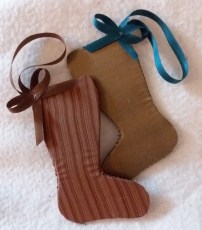
When I saw this adorable silk stocking needle-book, I knew it would be a delightful option for this year’s project. To make it extra fun, I am sharing directions on how to make the original needle-book as well as a smaller pin-keep and ornament.

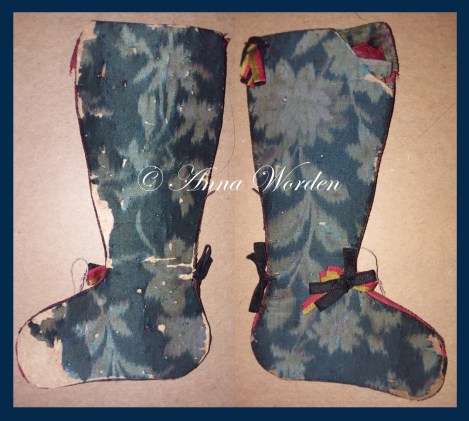
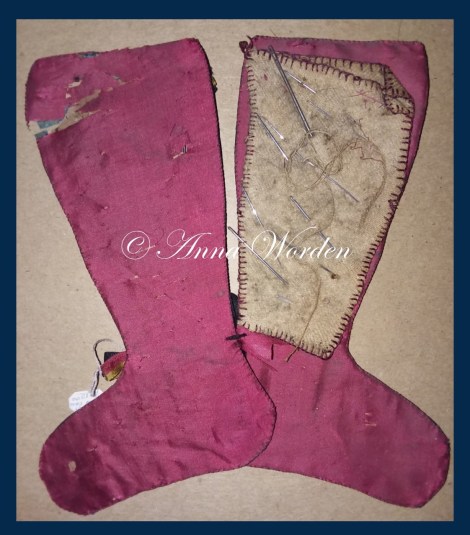
The original needle-book is larger than most needle-books, being 7 1/4″ from foot to calf (18.2cm) 3 13/16″ from toe to heel (9.7cm), and 2 15/16″ across the calf (7.4cm). The foundation is two layers of thin pasteboard for each the front and back. The exterior is covered in a blue on blue clouded silk taffeta in a large floral motif. The interior is a tissue taffeta in solid pinkish-red. The edges are bound in tiny whip stitches worked in red thread. The two wool needle-pages are quasi-polygons with the front edge slightly curved. Both pages are bound with an irregular blanket stitch worked in red thread. One of two thread hinges remains at the ankle. I believe the other was previously at the back of the calf. Three bows remain on the needle-book: at the back of the ankle, at the front of the ankle, and at the top of the calf. A fourth may have once been at the top of the front calf as well. Each bow consists of two ribbons: a yellow and red/orange underneath and a black on top.

Nov 2019 b

Closer looks at some details:

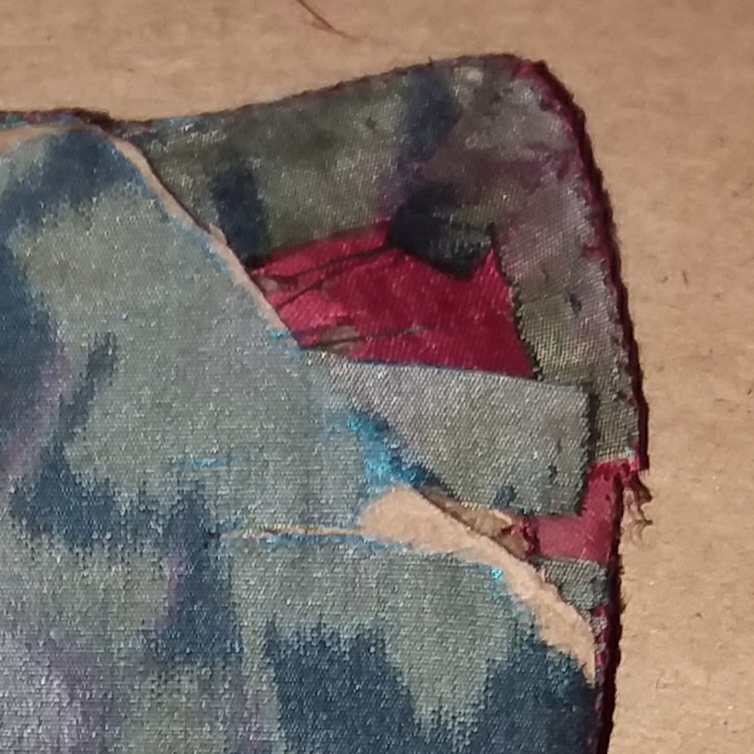
20191016_123650.jpg

This damaged corner shows a few things. It let me see just how thin the pasteboard is on this piece. I do suggest we use the fairly standard pasteboard most of us have on the backs of notebook. There is a thicker version I like for boxes, but that would actually be too thick for this project. Along the edge of the fragment piece, you can clearly see the whip stitch used for binding the exterior and interior fabrics.

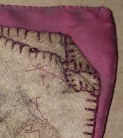
20191016_123810.jpg

This interior corner shows the binding whip stitch as well. This gives a good view of the blanket stitch on the wool needle- pages. This photo also emphasizes the curves this stocking shape has. I think these curvy lines are what make this shape so appealing.

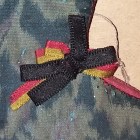
20191016_123715.jpg

This close-up shows how each bow is really two bows stacked on top of each other. I rather like how the use of a two color ribbon gives the suggestion of three ribbons.

The Project:

Please download this PDF for directions on making the original size needle-book, a smaller 4″ pin-keep, and a 4″ ornament. You will need your copy of Fanciful Utility to do this project.

November 2019

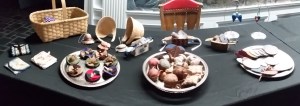
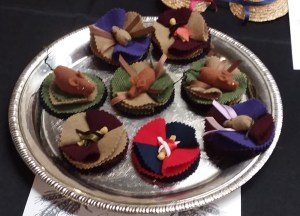
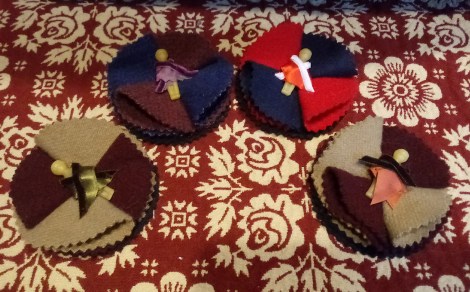
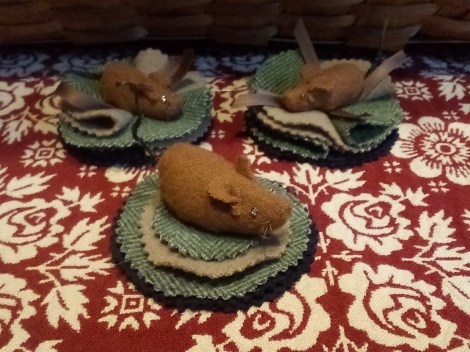
Examples:

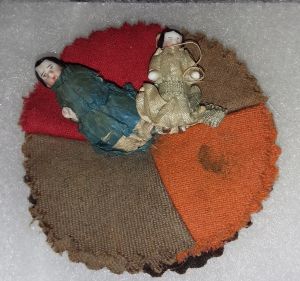
Needle-book

Pin-keep

20191028_185110.jpg

Ornaments

20191028_122145.jpg

Published in: on November 1, 2019 at 1:00 am  Leave a Comment  

Pumpkin Hood

I have decided to share select pieces from my winter hood/bonnet collection. Every few days, I will post a new piece. My collection currently spans most of the 19th century, though lightly at the very beginning and end. The pieces I share will be from the early and mid-Victorian eras, roughly 1830s through the 1870s. All but one of my pieces originate from the United States. (I do have to retake some of tonight’s photos. My phone camera just doesn’t play well with lights.)

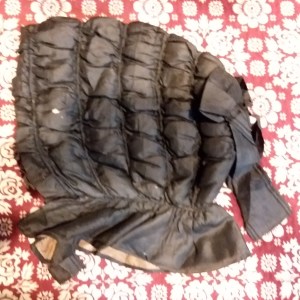
Tonight’s winter millinery pieces is the classic pumpkin hood.

Okay, a little play on words tonight…. A Pumpkin hood on Halloween… Haha?

First, let’s talk about the name: pumpkin. When I first started hearing people call these fluffy hoods “pumpkin hoods” I was skeptical about this being a period name. But, if you hop over to HathiTrust or Google Books, you will find a speckling of search results for “pumpkin hood” including entry and donation lists, as well as references to “old fashioned pumpkin hoods.”

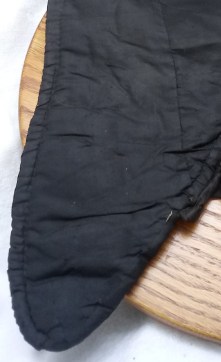
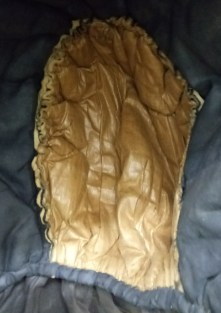
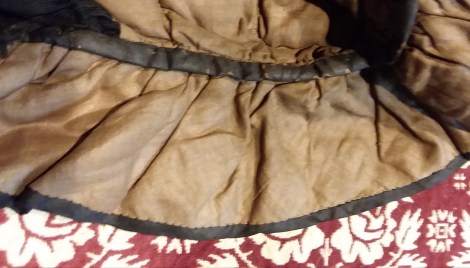
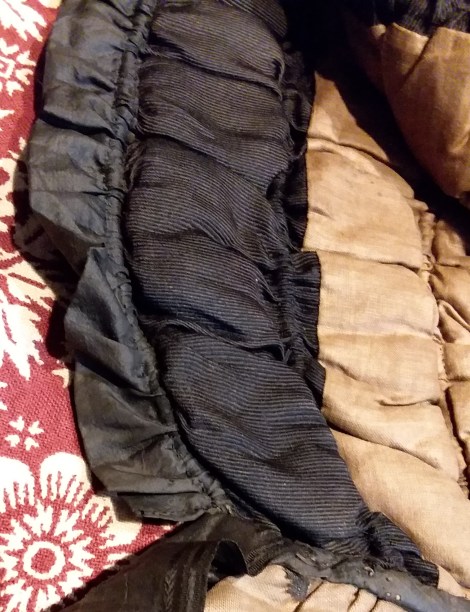
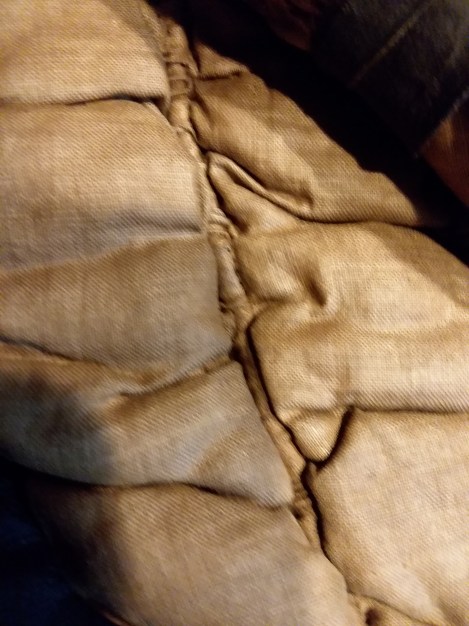
This pumpkin hood is made with a light weight, soft matte black silk taffeta exterior. Inside is a brown cotton lining that may have once been polished and a silk faille facing with soft ribs. Beneath the silk exterior is a light color lining. This style hood is constructed with a single brim/crown piece and bavolet. (in some pumpkin styles a small piece is used it the very back.) There are 5+ softly filled channels that feel as though there may be down inside. Between each loft is a corded channel sewn with a running stitch. A ruffle is formed at the edge of the brim in front of the cord.

The back most loft channel is gathered together as many pumpkin hoods. This lower portion of the channel is turned inside creating the taper on the outside. This makes an elongated heart or teardrop on the back of the hood. This is topped with a ribbon arranged in a bow. This is the same design ribbon used for the ties.

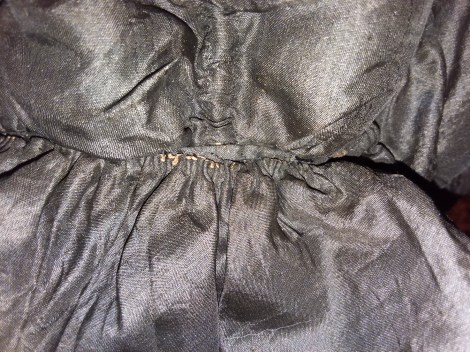
The bavolet was constructed separately of elongated trapazoids, silk and lining. The finished top edge was gathered tightly and attached to the bottom edge of the crown/brim. This technique makes a look similar to gauging.

Inside, the neck edge is covered. Notice the hem of the bavolet with the very even stitches.

Here is the front interior edge showing the cotton lining, silk faille facing, and silk taffeta ruffle.

This is the interior looking at one of the corded channels. This cord is approx 3mm thick, based of feel. It is not overly stiff.

Note 1 – Additional Winter Millinery can be found in posts from September though November, 2019 using the search term: Winter Millinery Series or clicking here.

Published in: on October 31, 2019 at 7:36 pm  Leave a Comment  

Winter Hood

I have decided to share select pieces from my winter hood/bonnet collection. Every few days, I will post a new piece. My collection currently spans most of the 19th century, though lightly at the very beginning and end. The pieces I share will be from the early and mid-Victorian eras, roughly 1830s through the 1870s. All but one of my pieces originate from the United States.

For this edition of the winter millinery series, I have a video to share. This video is of my first observations of this winter moments after I opened it.

Here are some detail photos:

Brim quilting and turn back.

Bavolet quilting and bias piecing

Brim quilting and basting at brim edge

Interior with soiling on lining.

Crown quilting

Interior showing hand stitching of silk facing, how the ribbon ties are attached, quilting on lining.

The neck seam or bavolet seam is bound in silk while the crown to brim is raw.

Cotton or linen warp threads along the sides of the silk ribbon.

Note 1 – Additional Winter Millinery can be found in posts from September though November, 2019 using the search term: Winter Millinery Series or clicking here.

Published in: on October 23, 2019 at 1:05 am  Comments (1)  

Plaid Winter Bonnet

I have decided to share select pieces from my winter hood/bonnet collection. Every few days, I will post a new piece. My collection currently spans most of the 19th century, though lightly at the very beginning and end. The pieces I share will be from the early and mid-Victorian eras, roughly 1830s through the 1870s. All but one of my pieces originate from the United States.

Today’s winter bonnet is a plaid silk adult size bonnet. The structure of this piece classifies it as a bonnet rather than a hood. This piece loosely dates between  the 1840s and 1870s, though the small crown tip and shape of the wide cheektabs with the shorter bavolet makes me think it is an 1840s example. 20191014_102802.jpgA single plaid silk fabric is used throughout for the exterior as well as the interior and for ties. The plaid is asymmetrical in one direction and symmetrical in the other. The entire bonnet is handsewn. Channels of puffs and cord alternate through the brim. While the majority of these are evenly spaced, a couple alter slightly to follow the shape of the bonnet. One in particular, the eighth from the front, widens at the bottom to accommodate the curve transition from the cheektab to the neck edge.

20191014_103013-1.jpgWire, cane, cord, and buckram are used to support this bonnet. Wire is found around the front edge, around the cheektabs and even along the edge of the bonnet. Cane is found in the channels immediately behind the brim edge puff and through the front section of the brim. Further back, the narrow channels between the body puffs are a dense, exceptionally firm cord. At first, I thought these channels also had cane, as other bonnets have. But, I can feel a diagonal ridge indicating a twist in cord. Buckram lines the interior crown tip of this bonnet.

Do compare the left side of the bonnet above with the right side of the bonnet below. You can see where the brim wire has been bent. This brings attention to what can happen to wired and caned millinery during storage. The vast majority of winter bonnets I have seen have the wires and canes bent or broken from being stored flat. This bonnet was lucky. Or, actually, has such a firm “batting” that it made it difficult to store flat. 20191014_102730.jpg20191014_102928-1.jpgThis brings me to the interior. Normally, I use words like “batting” or “wadding” to discuss what is inside a bonnet or hood. Instead of using wool batting, this bonnet is filled with what appears to be bundles of cotton/wool* string. This area where the silk has worn away shows just how densely the string has been packed inside. This is Not something I see commonly. The bavolet is filled as fully as the brim of the bonnet creating a triple tier bavolet rippling around the neck. (Notice you can see the cane, wire, and buckram (which may be willow) in this photo. The back bow is made from the same silk as the bonnet.)
20191014_102753.jpg

20191014_102913.jpg

I have to spend some time with the ties and bow on this bonnet. I find they are remarkably unfrayed for what looks like faux ribbon cut from the silk.20191014_102819-1.jpg

This detail of the cheektab interior shows the wire along the edge and the cane. 20191014_102955.jpg

20191014_102745.jpg

Note 1 – Additional Winter Millinery can be found in posts from September though November, 2019 using the search term: Winter Millinery Series or clicking here.

Notes: * I have not yet looked at the filling under a microscope to determine it is cotton or wool. 

20191014_102812.jpg

20191014_102739.jpg

Published in: on October 16, 2019 at 6:00 am  Leave a Comment  

Quilted Winter Hood

I have decided to share select pieces from my winter hood/bonnet collection. Every few days, I will post a new piece. My collection currently spans most of the 19th century, though lightly at the very beginning and end. The pieces I share will be from the early and mid-Victorian eras, roughly 1830s through the 1870s. All but one of my pieces originate from the United States.

Today’s piece is an adult size hood.  The exterior fashion fabric is a black taffeta with a satin weave dot. It was received with the brim folded back. Black lace is attached to the edge of the brim. I will examine this process closer. Notice how the pieces for this and its overall shape differ from the previous two, making it a winter hood as apposed to bonnet.

The exterior appears to be constructed of two pieces – a single brim, crown, and sides of the bavolet, with a trapazoidal piece for the back of the bavolet. I will look closer at this when I sit down with the piece. The back is gathered where the bavolet meets the crown.

Close-up of the fabric:

Close-up of the lace:

The interior uses a shot silk and a polished cotton. The silk has shaed of gold, green, and purple depending on how the light hits it and where the soiling is. The diamond quilting is only through the silk and batting. The rectangle placed on the lower part of the brim may be a patch as the opposite side has a different shaped piece of polished cotton.

Note 1 – Additional Winter Millinery can be found in posts from September though November, 2019 using the search term: Winter Millinery Series or clicking here.

Published in: on October 9, 2019 at 6:00 pm  Leave a Comment  
Tags:

PEC, Holiday Season, and Winter Millinery

I first became aware of PEC (Post Event Crash) after the 135th Gettysburg event. The day after returning from the event, I found myself sitting on the floor utterly exhausted and at a complete loss for what I needed to do next. The months of planning and preparing built up to a nearly week-long event experience – sights, sounds, people, ideas, followed by a massive adrenaline drop.

Years later, I still feel this “Post Event Crash” after some events. The tiredness is still there, maybe more so with age. The daze is still there, though changed as it has an added sense of accomplishment. “Events” are no longer about just going. Each has some aspect of personal challenge, whether it is skill based, presentation based, or physically for myself. A new aspect of PEC has developed over the years; a combination of contentment and self-separation. The contentment is a calm awareness of balance and self. The self-separation is packing an essential part of myself away in a little box until the next event.

Another aspect of PEC is the “what is next?” Back in my early 20s, the answer to that was “the next event”, which was usually just a week or two away. It was wash, repair, prep, repack. Now, with fewer and rather different events, there is a much greater shift in the doings for the next.

This current shift is from summer straw millinery and fun Ag Fair sample pieces to winter wear and holiday shop pieces. (The catch being I still have some straw pieces to make)

Usually, I prefer to have one type of project going at a time. This is a matter of space and materials management. Straw in straw time. Wool in wool time. Silks in silk time. Nice. Neat. Orderly. When Straw and wool and silks and all the little bits are out on the work surface at the same time chaos ensues.

Thank goodness for pretty stackable band boxes.

One for pincushions. One for penwipers. One for ribbons…..

Holiday Season

It may seem early to most, but, today begins what I am calling my “Holiday Season” to prepare for a trio of: the Domestic Skills Symposium with my straw surgery workshop, “Preparing for the Holidays” also at GCVM, and filling my Etsy shop with gift goodies.

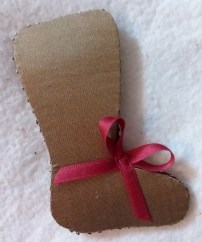
I picked up the cutest stocking shaped needle-book to take a pattern from and make into this season’s holiday project for you. I will put together directions to make it up as the needle-book but also as a pin-keep and ornament.

I plan to “open” the Etsy Holiday Shop right after the Domestic Skills Symposium, just like I did last year. I currently plan to make pin cushions, pin-keeps, and some special gift sets.

By request, I will make a point to have straw millinery available. In past years, I’ve had husbands and boyfriends send messages in mid-December asking about straw hats and bonnets to give as gifts. Please let your loved ones know well in advance if there is a piece you want.

I have also been asked to offer some of my pen wipers. While initially I had planned just to make these for fun, it turns out they are a bit too much fun to make. So, I will offer a few.  I won’t be able to offer the parasol pen wipers or needle-keeps until I find or make new handles.

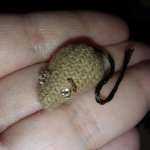
Oh! Ornaments! Do people want an ornament this year?

Winter Millinery

I have had a great many questions about winter millinery in the past few weeks. I figure I should talk about that for a little while.

I still haven’t completely decided whether to make winter hoods this season or how to pull that off. I find it very difficult to work with both types of millinery at the same time. This is a space issue, a mind-set issue, and a type of sewing issue. To make winter hoods, I need to have cutting and basting space to work with the layers. This is the space currently occupied by the big big basket of straw and assorted trims that currently have my attention. The sewing is different – Straw takes long, strong stitches with a heavy, sharp needle that I hold one way. Quilting silk needs small, even stitches with a fine, sharp needle that I hold a different way. One I can do while watching tv in varied light. One needs to be watched while listening in bright light.

That said, I do have a beautiful array of silks in a tote marked “silks for hoods’ and another tote filled with local wool batting for hoods.

I also hear those wanting a third winter hood pattern. I have picked out which one I want to do next. I just have to do it.


Published in: on October 7, 2019 at 6:30 am  Leave a Comment  

Ag Fair – Brought to You by the Letter “P”

This year, I decided to set myself a little rule for my Agricultural Society Fair entries:

All entries must begin with the letter “P”.

The idea was to make myself focus. Instead of a vast endless array of possibilities, I would make myself focus on just those entries that began with P and fit into the entry categories.

  • Pocket
  • Parasol
  • Petticoat
  • Pellise
  • Purse
  • Paltot
  • Pink
  • Pinking
  • Purple
  • Pocketbook
  • Pumpkin

Before I knew it, focusing on “P” entries became a mental game of finding all the things that could begin with “P” and how many things could I make that began with “P”.

Kinda counter-productive.

But, Fun!

Friday afternoon I dropped off the “P” entries of:

  • Pieced Pocket (Pieced article of clothing) (DM-2A)
  • Appliqued Pocket (Appliqued article of clothing) (DM-4A)
  • Quilted Pocket (Hand-quilted article of clothing) (DM-6A)
  • Embroidered Pocket (Embroidery: Embellished Article of Clothing) (DM-35)
  • Pieced Pocket of Pockets (Pieced household article) (DM-1A)
  • Quilted Pocketbook (Hand-quilted household article) (DM-5A)
  • Corded Petticoat (doll) (Handsewn article of clothing – corded) (DM-17A)
  • Petticoat (doll) (Handsewn article of clothing) (DM-18A)
  • Penwipes: Doll, Parasol, and a trio (Handsewn household articles) (DM-19) (5)
  • Doll Pincushion with Parasol Pin Keep (Handsewn Fancy articles) (DM-19)
  • Pink and Purple Corded Pinball (Display of Domestic Manufacture (DM-37A) (which I forgot at home.)

There were a number of P items on my entry form I aspired to make when I sent it in a month previous, but I simply ran out of time to make….

  • A Pink Plaid Pinked Parasol (Display of Domestic Manufacture)
  • Purse (Crochet household goods) (DM-11)
  • Pocketbook (Appliqued household article) (DM-3A)
  • Embroidered Pocket of Pockets (Embroidery – Embellished household article) (DM-34)

Photo gallery entries:

For more information on each project, please visit these posts. Some are on If I Had My Own Blue Box and some are on Don’t Paint the Cat (links are fixed now):

Published in: on October 5, 2019 at 12:01 pm  Comments (2)  

Parasol Pen Wiper

20190930_133204.jpg

I’ve been wanting to make a parasol pen wiper for quite a while now. Between the few originals (far below) and the directions in Godey’s (below), they have been a temptation because of their whimsical fancy while being utterly practical.

The directions call for a “fancy stick” or a wire wrapped in silk. At this point, I can not tell you why I went on my search for broken crochet hooks, but I did. I spent months thinking broken crochet hooks would be easy to find. Nope. Not even with excellent merchants of miscellaneous sewing items just a click away on social media. Eventually and with effort, I acquired 4 and began sanding the broken end to as much of a point as I could. I do have other ideas for “fancy sticks” in mind for future parasols, either pen-wiper or pin-keep.

The parasol top is densely fulled wool. Initially, I thought quarter circles would be about right. Nope. The illustrations are closer to 45 degrees or an eighth of a circle. Mine are closer to a sixth of a circle, making a fuller top.

I opted to bead the wool rather than embroider it because I like the look of the beaded wool on the originals better. I did the beading after the assembly was complete. This was a little tricky. I don’t know that I would advise that for everyone. This technique did let me get the alternating purple and green beading right.

Originals

Published in: on October 5, 2019 at 12:00 pm  Leave a Comment  

Child’s Corded Winter Hood

I have decided to share select pieces from my winter hood/bonnet collection. Every few days, I will post a new piece. My collection currently spans most of the 19th century, though lightly at the very beginning and end. The pieces I share will be from the early and mid-Victorian eras, roughly 1830s through the 1870s. All but one of my pieces originate from the United States.

Today’s winter hood is a child’s size, ca 1840s-1880s. The exterior is a solid brown wool. The exterior is quilted with sets of three narrow rows. These narrow channels may have cording in them, tbd. The seam between the crown and brim is piped. The seam connecting the crown and bavolet may have the cord applied on top. I need to look closer. The brim folds back to show a plaid which is constructed from ribbon.

This may also be made from two pieces – a single brim and bavolet, with a crown piece. I need to look closer to see if I can find a seam connecting the bavolet to the brim, because I did not see one at first looks.

Notice there is no easily visable seam along the bavolet area. It may be skillfully hidden in the quilting. Or, there may not be one.

The interior is made with two solid fabrics, tbd. The whole of the brim and bavolet are lined with the pieced plaid silk ribbon.

I am pointing to the only seam along the bavolet I’ve found. This is nearly center back. (there is a bias piecing seam towards the front.)


Note 1 – Additional Winter Millinery can be found in posts from September though November, 2019 using the search term: Winter Millinery Series or clicking here.

Published in: on October 2, 2019 at 6:00 am  Leave a Comment  
Tags:

Antiques Straw Motifs

I am feeling a bit sad this evening. So, I decided to work on a pick-me-up project that had been waiting to be done.

Some months ago, I got talking with an Etsy merchant in Italy who had an assortment of antique and vintage millinery goods. She told me about these antique straw motifs she had. As I’ve been aspiring to learn to make some of these for a display, I jumped at the idea of having original pieces.

I was very excited to find this beautiful case made by the same local craftsman who makes my Shake style boxes. I really like how the wood is pale with a grain that nearly matches the straw. I also like that the box has no visible hardware; the back slides out as the opening. I can hang the box, but I am afraid of it being knocked off the wall.

I pinned each straw piece in place so it wouldn’t slide around. The heads of the pins are bent to bracked the pieces as best as possible. I may label them with little letters or number. I may do a map label instead. Tbd.

These are each leafs made with splits straw. I’ve learned to make the plain leaves. They are called Spreuerli. I am going to try the leaf with the thread loops next. The bottom right is called a Halmenschüfeli. It represents a head wheat.

These are made with straw threads. The straw is split finely and twisted into threads.

These are types of buttons. The split straw is wrapped around a core that can be wood or wool. The teardrop one is called a Grelot. I don’t know if the one made from straw threads has a name.

*Names of the straw motifs come from the old Straw Museum website on the Swiss Straw Lace page.

Published in: on October 1, 2019 at 5:52 pm  Leave a Comment