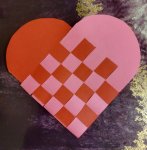
In high school we learned to make heart shaped paper baskets by weaving two rounded rectangles together. They were a fun little craft that played with geometry. Some time later, I used the same principle with wool to make woven heart ornaments. The internet now tells me these woven paper heart baskets have Danish origins.
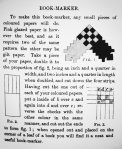
While reading The Girl’s Own Toy-Maker, 1860, I saw this illustration (top right) and couldn’t help but notice the similar construction. This book marker is made by weaving two folded rectangles together. The ends of these rectangles are cut with notches or angles rather than a curve. The pocket created slides over the corner of a page. If the book marker was rotated point down, I still see a heart.
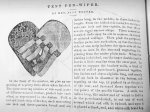
Marna found this pen wiper (right) from eleven years later Peterson’s Magazines. The shape is very much that of the paper baskets from high school. This time the wove heart is made of red and black leather, then filled with leaves of double muslin.
To Make Your Own
You need 2 pieces of paper in different colors. Standard printer weight or scrapbook paper work well. Firmer paper is harder to weave. Lighter, delicate paper tears while weaving. Two 8.5×11 sheets of paper can make 4 hearts by dividing each sheet into 4 pieces 8.5″x2.75″.
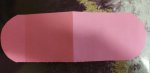
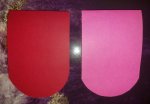
Fold each piece in half length wise. Round the ends as such:
Take one of each piece folded.
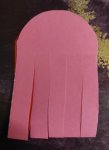
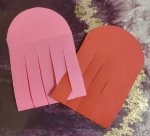
Lay them together, on top or inside each other. Cut strips up from the fold about 2.75″. Cutting a smidgen too far works better than too short.
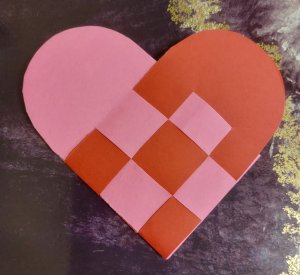
Starting with the inner most strips, weave them in and out of each other. Note, this is weaving them as loops not just as folded strips.
Continue weaving the loops until finished. Tuck in your book.
Are you one of the many readers enjoying my millinery blog posts? Consider becoming a Patreon patron. Doing so helps support my work and helps me write more useful articles. https://www.patreon.com/AMillinersWhimsy
Wearing nineteenth century clothes, we find they fit differently than our modern clothes. The waist is in a different spot. The bust sits differently. Seams are used to accent or de-accent parts of the body. The fit feels different and moving in the clothes is different. The same is true for hats and bonnets. In previous posts I’ve talked about bonnets and perch. Here, we are going to look at how a hat was worn and how it “fits”.
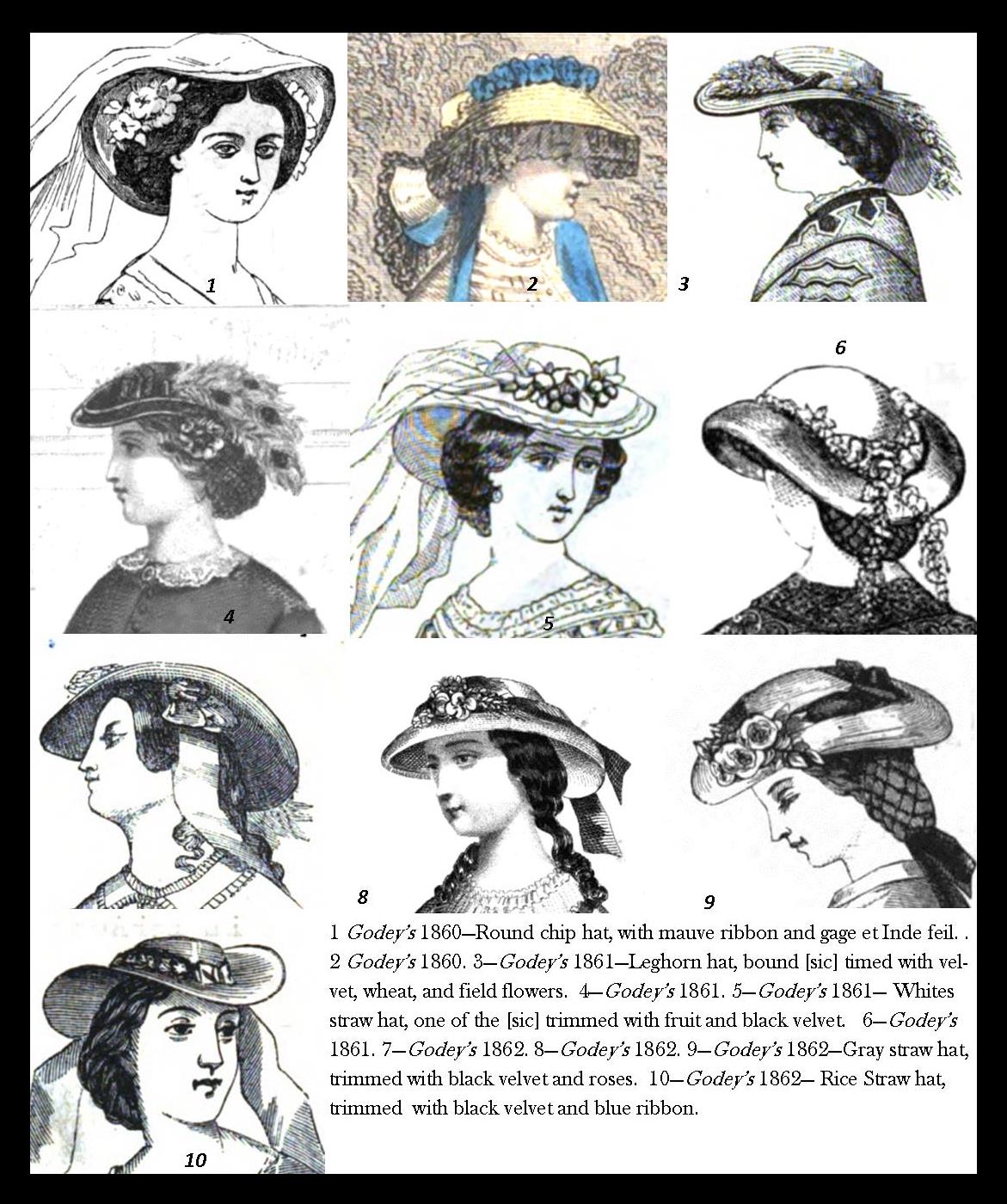
In the 1850s and 1860s, hats were worn much higher on the head than we are accustom to in the twenty-first century. Think about when you wear your modern beach or garden hat. You know that line across your forehead where it sits after a long hot day? You do Not want that. A mid-nineteenth century hat sat higher, at the top of your forehead, at your hair line, or even higher. Take a look at these fashion illustrations from 1860-1862. Notice where each hat sit. In a few illustrations, the front hairline is obviously below the crown line. In others, the crown sits just at this line. The hat sits atop the head, not encompassing it. The curve of the brim is what dips to the eye line, not the hat itself.
What does this mean for you when picking a size?
There are two factors for finding a comfortable fit: Size and shape.
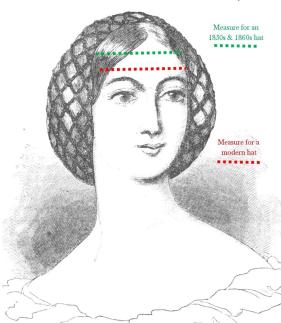
The difference in wear or placement means we measure for a mid-nineteenth century had differently than we do for a twentieth or twenty-first century hat. The modern hat is measured just above the eyebrow. (This is also where many of us measure for bonnets. We want to keep you on your toes.) For mid-nineteenth century, we measure higher, at the hair line. In this illustration, we can see the difference between where the two measurements would be.
These higher, hairline measurements are often smaller than those taken at the eyebrow. A hat worn at this point can be slightly smaller to slightly larger for comfort. So, add and subtract an inch to your hairline measure.
For example: I am 22.5″ around at my eyebrows and 21.5″ at my hairline. The vast land of the internet tells me that the average woman’s head measures 22.5″ to 22 5/8″ around at the modern measuring point. So, I am about average. I comfortably wear a mid-nineteenth century hat that is 19.5″ to 21.5″
General guidelines I use:
Small = Less than 21″ at the hairline (crown less than 20″)
Average = 21″-22.5″ at the hairline (crown 20-21.5″)
Large = Greater than 22.5″ at the hairline (crown greater than 22″)
Just like every head measures a bit differently, they are each shaped a bit differently.
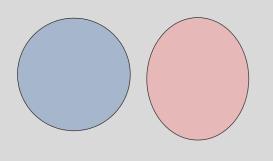
When looking from above, some people have rounder heads while other have more oval heads. Both of these shapes to the right can have a circumference of 22.5″. Yet, the same hat would fit each head differently.
I will try to indicate which hats have rounder crowns or more oval crowns. I am in the process of naming the crowns. Hopefully, that will help.
A little heart filled fun will fill these next two weeks of February. I will share a speckling of posts with a heart theme.
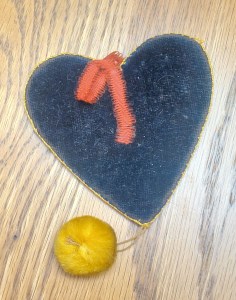
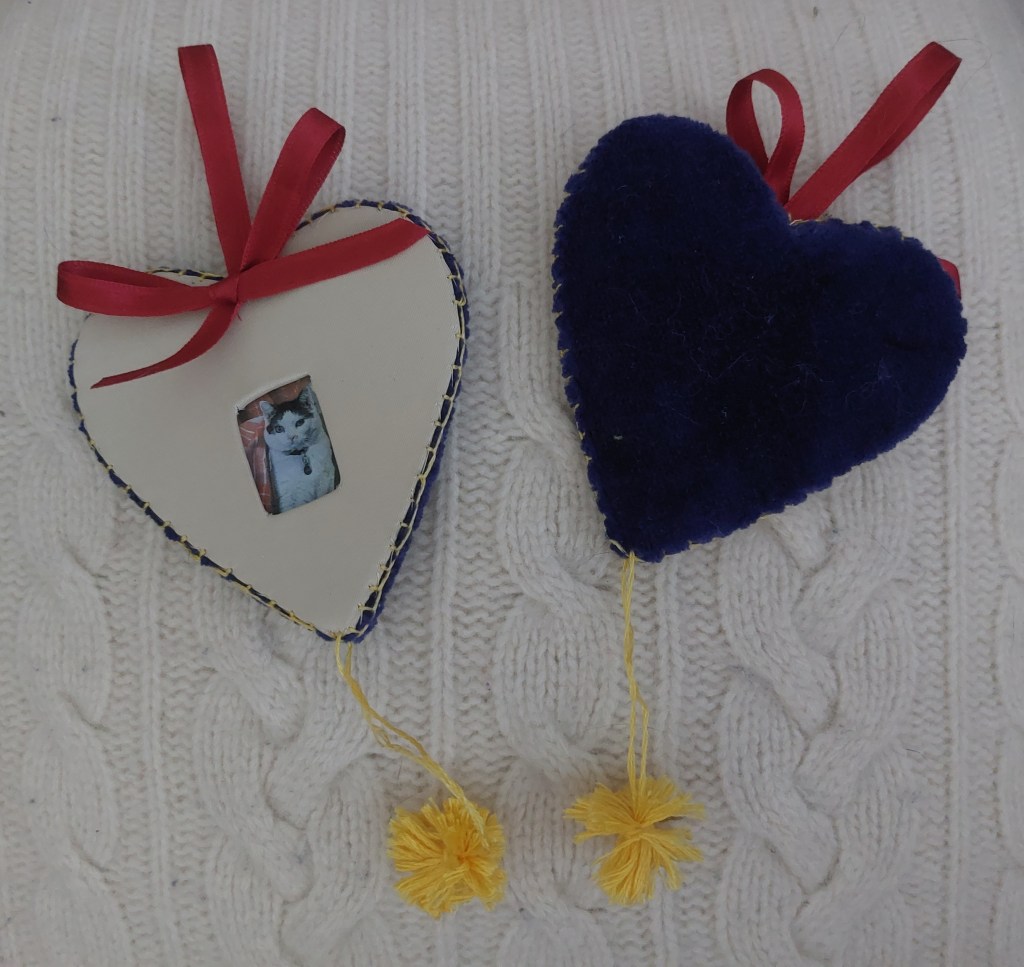
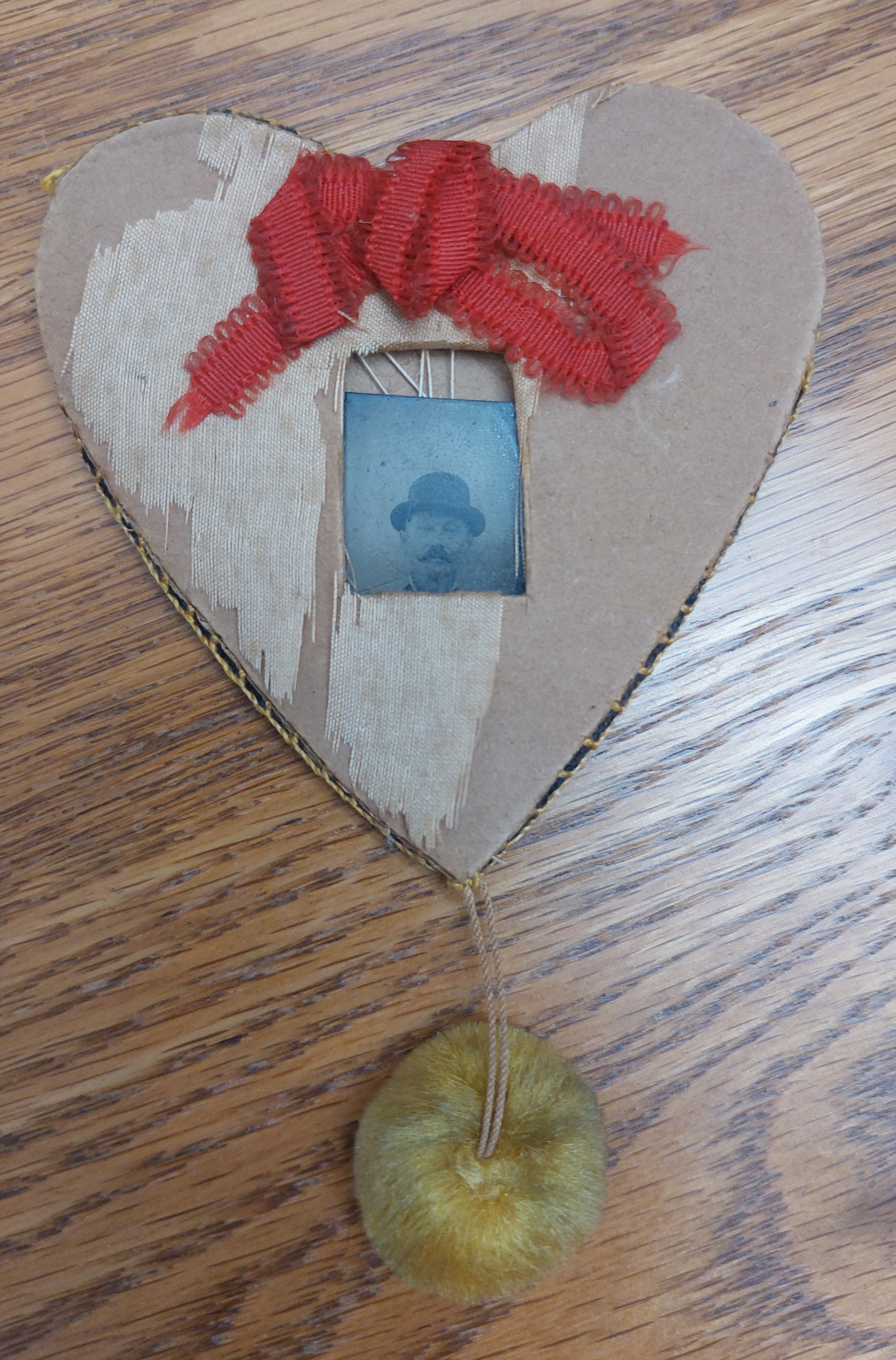
This heart frame is one of my sweetest finds of 2022. It was tucked in a bowl of the corner of a local antique shop changing hands. Luckily, I saw it out of the corner of my eye from many feet away. Time has worn away the silk on oneside, revealing the construction techniques beneath.
It is made of two layers of pasteboard. The back is covered in dark blue velvet. The front is covered in off-white silk taffeta that has disintegrated.
The heart is 3 1/8″ tall and about the same wide. The 1″×3/4″ opening for the tintype photo sits about an inch above the point of the heart.
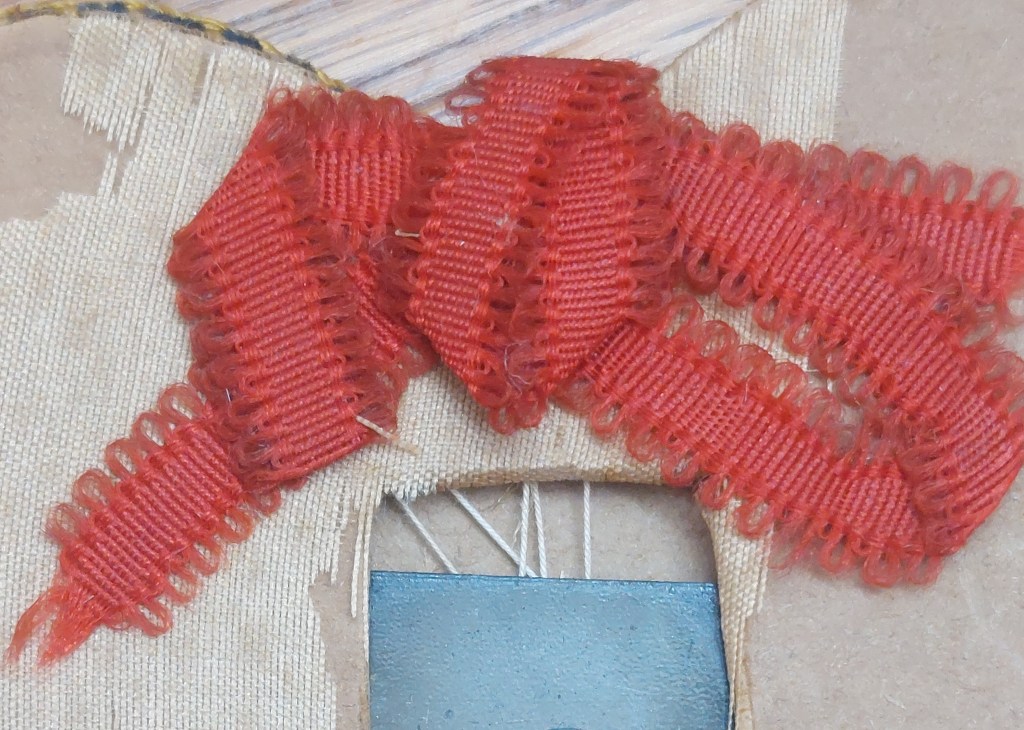
The threads pulling the silk and velvet around the pasteboard can be seen through the photo opening as the photo has slipped.
The whole is bound with a bright golden yellow embroidery floss, likely silk, in a blanket stitch.
At the top of the heart is a red ribbon hanging loop and bow. The ribbon is a silk grosgrain with picot edge. At the bottom is a gold silk pom hanging from cord.
I recreated this heart frame from materials on hand using Fanciful Utility techniques. I think they came out quite darling.
You can create one for yourself using your favorite FanU techniques. Cut two hearts, approximately 3″ tall and wide. Of course, you can make yours a little larger or smaller. Cut a window a smidge smaller than the size of your photo in the center. Cover one heart with velvet. Cover the other heart with silk. Cut an X from corner to corner inside the photo window. Fold the triangles created to the inside and paste down. Secure the photo to the back heart. Sandwich the hearts together and whip stitch the edge. (I could see beadwork added to this edge looking pretty.)
Do you enjoy reading my blog? Do you find it helpful? Please consider supporting through Patreon or Sending a Tip.
I was excited to come home to this particular box waiting for me.
Flipping through after the video, page 37 stopped me in my tracks, mouth wide open. I look forward to spending a lot of time with this book when work isn’t so busy.
Paralleling my Millinery Monday posts, I am going to try to share a regular series of Fancy Work Friday posts this year. I will confess I do not have as solid of a plan for this series of posts. But, I figure I should start in the beginning 🤔 sort of…..
My fascination with fancy work began with the release of my book Fanciful Utility: Victorian Sewing Cases & Needle Books in 2012. FanU, as I and a few others affectionately call it, is packed full of projects for making an assortment Victorian era sewing cases, work pockets, huswifes, and needle books using. The goal of FanU was to share the beauty of handmade, 19th-century sewing accessories while making the period techniques for recreating them accessible.
One of a trio of original sewing cases I purchased in Nunda, NY. This case, and its companions, sparked my interest in handmade sewing cases. Its construction is included in Fanciful Utility. Sadly, I had to sell this case prior to publication.
In opening the door that was FanU, I entered the realm of making small items that were both functional and fanciful, utilitarian and whimsical, the vast majority of which could be made from bits and pieces, odds and ends. I was captivated.
I draw from both extant surviving examples and written literature. The abundance of illustrations and directions for ladies’ fancy work, workpockets, pin cushions, pin keeps, needle-books, etc. in the pages of magazines and books are a veritable rabbit hole, labyrinth, and candy store combined. Once entered….. well….. here we are over a decade later, and I continue to find bits of fancy work I absolutely must make.
I find my focus shifts from year to year, venturing from sewing cases to pin cushions to pen wipes to book novelties to doll novelties to animalia…. Interests steered and derailed by stumbling across a mesmerizing original or the coolest “new” illustration shared by a friend.
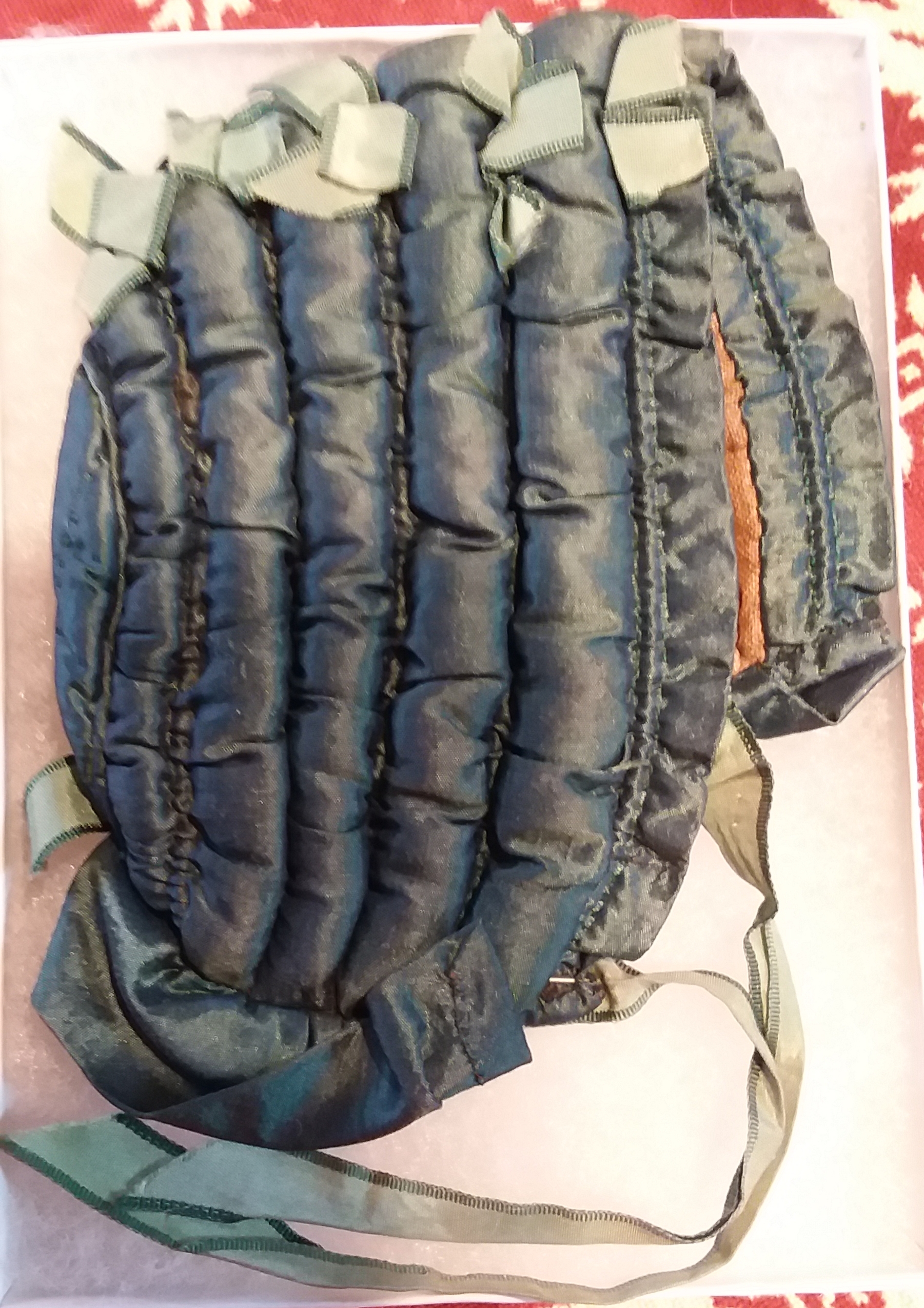
A “Pumpkin” hood or bonnet is a wadded bonnet, most commonly made of silk on the exterior and polished cotton, cotton or silk on the interior. Wide, full channels are filled to a full loft with wool batting either lightly or densely. The channels are separated by smaller channels, single or multiple, that are drawn in by cord or ribbon. The front brim may or may not have a decorative ruffle, attached or tucked from the base exterior fabric. These usually have a petite to moderate bavolet either lightly filled with batting or without batting.
Some other terms that seem to apply: Wadded bonnet/hood, “Ugly”, a “Kiss-me-quick”.
How early were these worn?
Most museums seem to start their dating of wadded, pumpkin style hoods in the second quarter of the century. Some do push earlier, as far as the late 1700s/early 1800s, such as this example from the Boston Museum of Fine Arts.
As domestically made winter hoods were a utilitarian garment rather than a fashionable one, their appearances in fashion literature is limited. I see one set of passages referencing a wadded hood or bonnet, drawn in, worn close to the face that may help us give wadded hoods drawn close to the latter 1830s:
In the Ladies Pocket Magazine, of 1838, London, we see a mention of wadded bonnets as a fashionable item. Of English fashions – “Wadded bonnets which before were very much in vogue, are now almost the only ones adopted in promenade dress, and it must be confessed nothing could be better calculated for the season, particularly when they are worn, as in often the case, over a blond morning cap of the demi-cornette form.” (In this passage, wadded pelisses and wadded mantles are also mentioned.) Of Paris fashions “Winter has set in with all its rigour, but that is of little consequence to our elegantes, who, occupied with the grand dinners, balls, and fetes that are always given in the commencement of winter, have deserted the promenades. Novelty in out-door costume is consequently out of the question, velvet or satin mantles, which are trimmed and sometimes lined in fur, that their busts are defended by a large fur palatine, their hands doubly shielded by fur cuffs, and a muff, and their pretty faces guarded by a large wadded bonnet, which completely meets under the chin, we have said all that can be said of out-door dress.” The year prior, the same publication tells us: “We may cite with confidence, among the new bonnets will be very fashionable, the capotes a conlisse ouatees, or wadded drawn bonnets; the are a most comfortable head-dress, composed of satin or pou de soie, lightly wadded, and simply trimmed with ribbon. They differ a little in shape from the other bonnets, sitting closer round the face.” This may or may not be the beginning point of the wadded, pumpkin style bonnet. Neither publication includes an illustration of this practical winter wear in the midst of the popular large bonnets of the era.
In that same time period, we see wadded and quilted hoods/bonnets constructed for children in The Workwoman’s Guide. The illustrations suggest the quilted versions have larger crowns that are volumous in some cases. It is important to note the difference between this shape and the Pumpkin shape. I believe this is the construction that evolves through the rest of the century as the quilted bonnet.
Blackwood‘s suggested I should look at “quilted wadded capotes” as well as “bonnets” and “hoods”. Though, this February and March 1843 Peterson‘s suggest capotes were quilted, rather than wadded with loft.
One of only photographs clearly depicting a wadded “pumpkin” style bonnet/hood is a bit of tease. While taken in 1897, the photograph does not show contemporary/current wear, rather historical costume wear. This photograph is held by Deerfield.
Were they worn during the Civil War?
Yes, evidence suggest wadded hoods were worn in the 1860s. The 1860 painting, School Girls, by George Augustus Baker, shows the girl on the left in what could be a red silk wadded pumpkin bonnet. The artist did several studies for this painting, including Little Girl in a Red Bonnet,which is undated.
Examples:
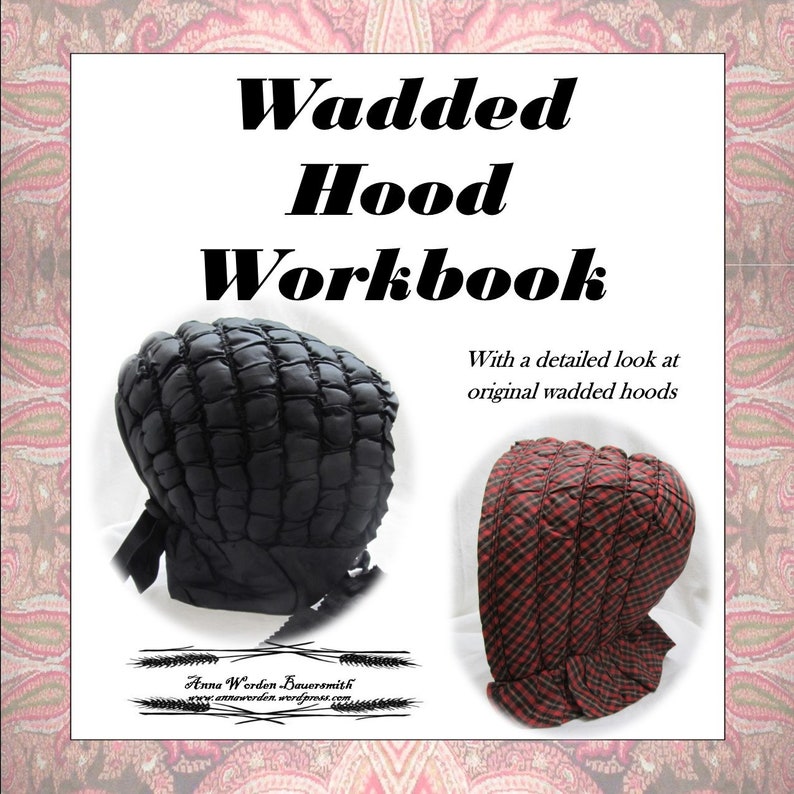
Learn more about Wadded Hoods and How to Make Your Own in my New Wadded Hood Workbook.
I decided to share one of two posts about hat size, fit, and measuring each month to help those looking to select a hat. Thank you for understanding.
There are two factors for finding a comfortable fit: Size and shape.
Size
The difference in wear or placement means we measure for a mid-nineteenth century had differently than we do for a twentieth or twenty-first century hat. The modern hat is measured just above the eyebrow. (This is also where many of us measure for bonnets. We want to keep you on your toes.) For mid-nineteenth century, we measure higher, at the hair line. In this illustration, we can see the difference between where the two measurements would be.
These higher, hairline measurements are often smaller than those taken at the eyebrow. A hat worn at this point can be slightly smaller to slightly larger for comfort. So, add and subtract an inch to your hairline measure.
For example: I am 22.5″ around at my eyebrows and21.5″ at my hairline. The vast land of the internet tells me that the average woman’s head measures 22.5″ to 22 5/8″ around at the modern measuring point. So, I am about average. I comfortably wear a mid-nineteenth century hat that is 19.5″ to 21.5″
Here is my head with the tape showing where to measure. This is where I wear most CW era hats. This is the circumference of my head. My measurement is 21 1/2″. (Note: this is a full inch smaller than the modern measurement take lower.)
General guidelines I use:
Small = Less than 21″ at the hairline (crown less than 20″)
Average = 21″-22.5″ at the hairline (crown 20-21.5″)
Large = Greater than 22.5″ at the hairline (crown greater than 22″)
Shape
It is helpful to know whether your head is more round or more oval.When looking from above, some people have rounder heads while other have more oval heads. I have an average oval head. Very round hats don’t work for me without adding to the lining.
Hat blocks can be more round or more oval with the same circumference. To illustrate: Both of these shapes to the right can have a circumference of 22.5″. Yet, the same hat would fit each head differently.
Easing into 2023, I have developed a few goals for the coming year. While each is a goal with 6 challenges, the true goal may be to find the right balance as the year progresses. This year, I want to:
Better meet the needs of my readers and clients.
Identify and attract new readers and clients.
Better meet my needs. (This is a big balance thing as I do need more “me” time as well as more nature and social time.)
Write more
Enjoy what I do.
Blog
As part of these goals, I plan to provide more consistent and balanced content on my blogs and Patreon. This will include posts on the topics readers have responded they want: millinery, fancy work, events & interpretation, and contextual writing. I am going to use theme days to help remind myself to post:
Millinery Monday – New and Past informative posts about straw millinery.
Work-in-Progress Wednesday – Post about what I am currently work on.
Fancy Work Friday – Victorian fancy work projects such as pin cushions, pen wipes, book marks, etc., featuring original items and projects.
I scheduled much of the year’s foundation of Millinery Monday posts. I will be working up to more Fancy Work Friday posts. I am considering reserving new shop posts for the weekend.i haven’t decided yet.
Projects
I don’t have much of a project list developed yet for the year. What I have so far:
Complete the Quilted Hood Workbook – This will be a format similar to my Wadded Hood Workbook to replace my first Quilted Hood Pattern.
Super secret Ag Fair project.
A couple of items using straw plait including two different straw workbags and slippers.
Possibly an 1850s reform dress ensemble.
Events
Not too many local events have been announced with dates yet. I am currently restricted by how far my aging car will go. I am hoping this year will include GCVM events of Opening Weekend, Mother’s Day, the Antique Show, Chocolate Weekend, Independence Day, and a few others, plus maybe some other small local events.
I would also like to add a couple workshops or discussions/presentations. Those responding to my survey showed a strong interest in virtual programs and in-person programs. I need to develop these on the logistical end.
As with this type of post, I may come back and add to it as new ideas develop. Thank you for your continued support.
I decided to do 22 photos to reflect on 2022. These highlight my favorites, projects I’m proud of, and moments of good.
This was a healing year for me, healing to my soul and heart as well as body. I still have rough moments or days, but those are fewer and further between.
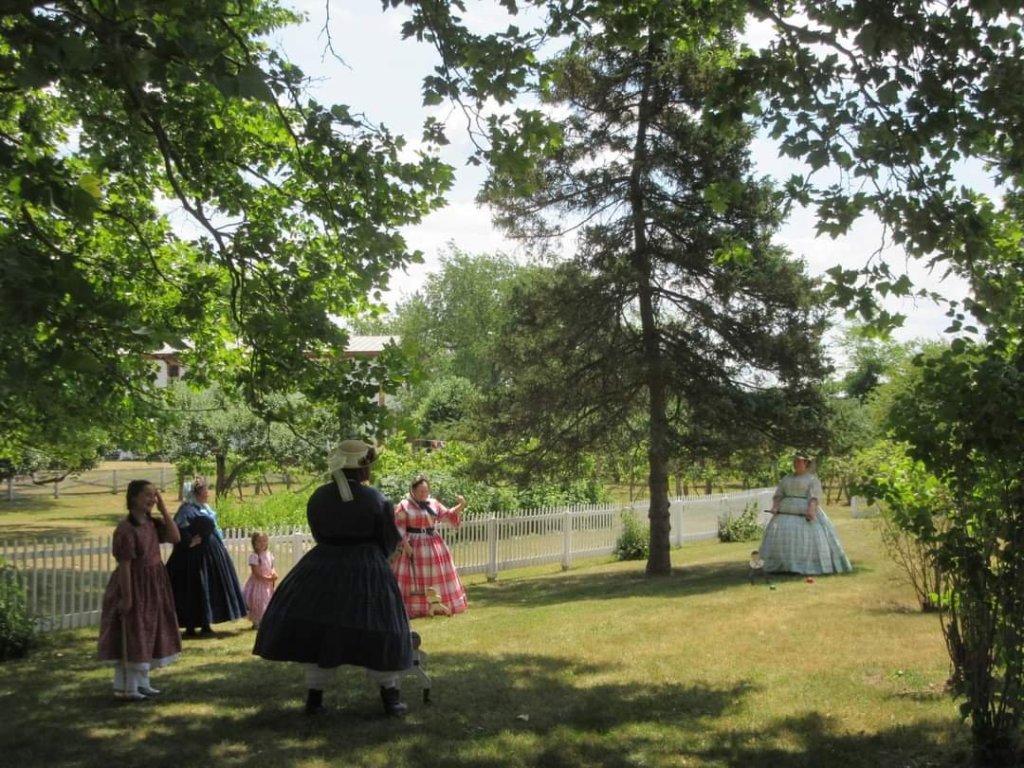
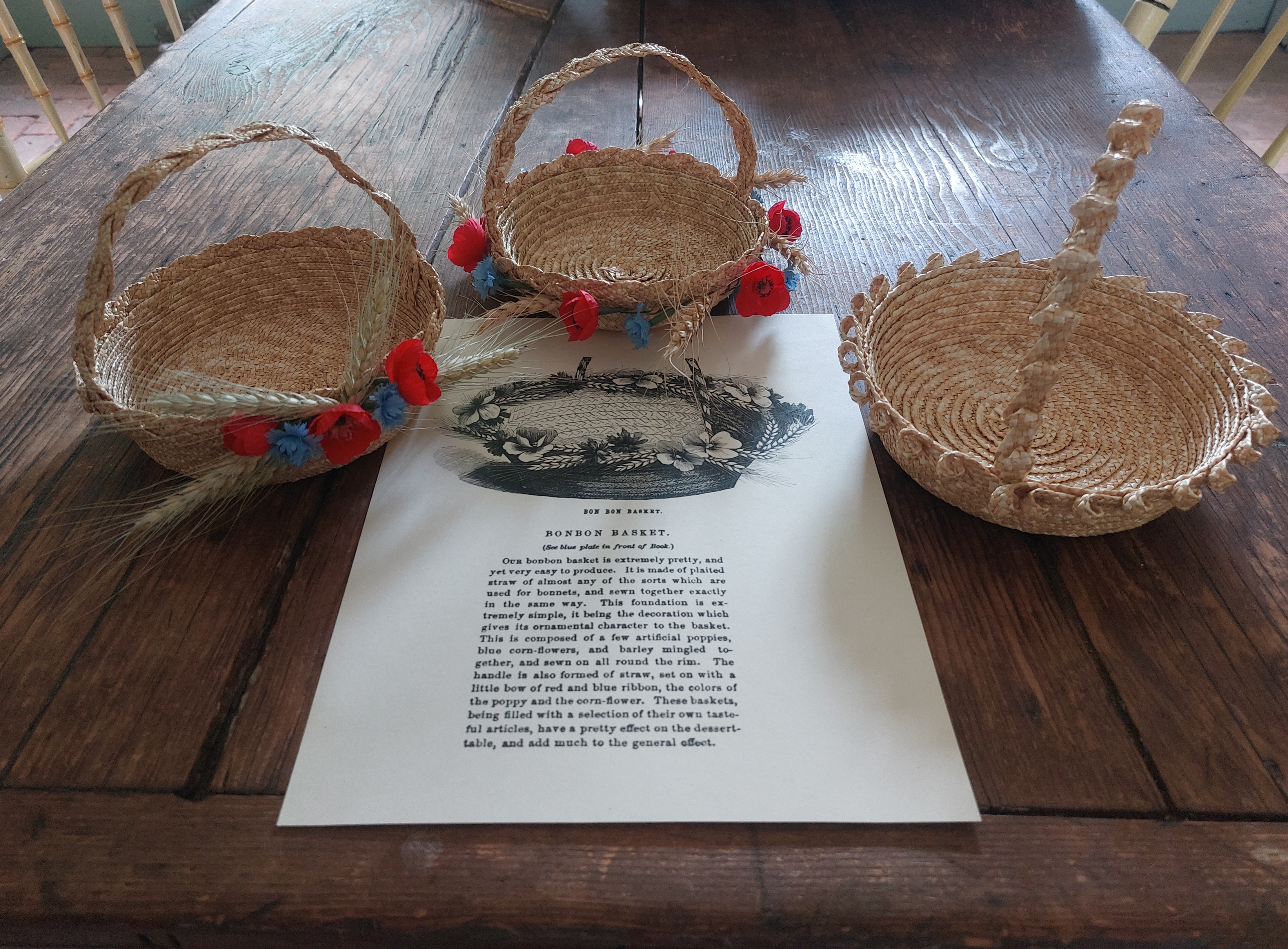
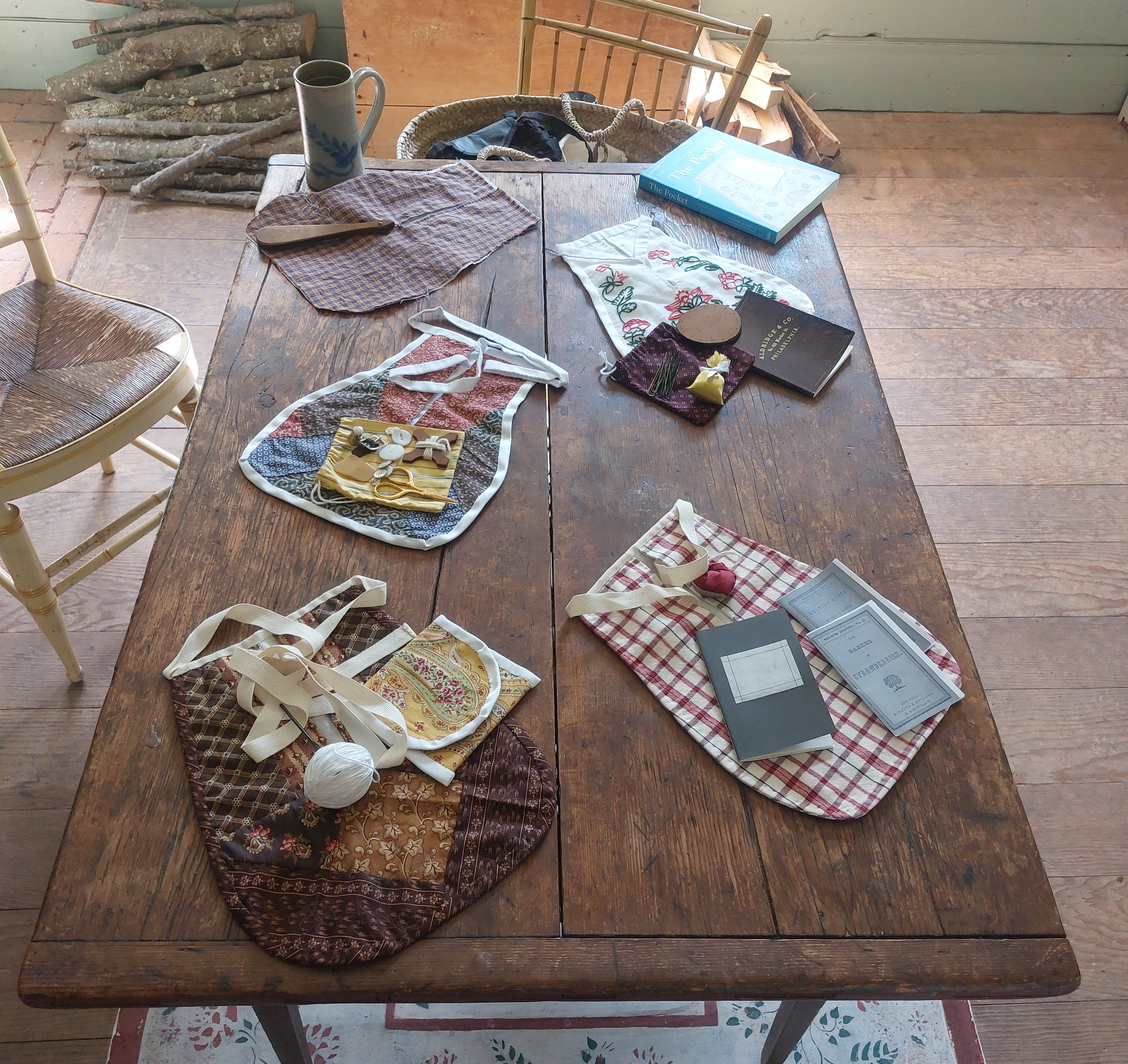
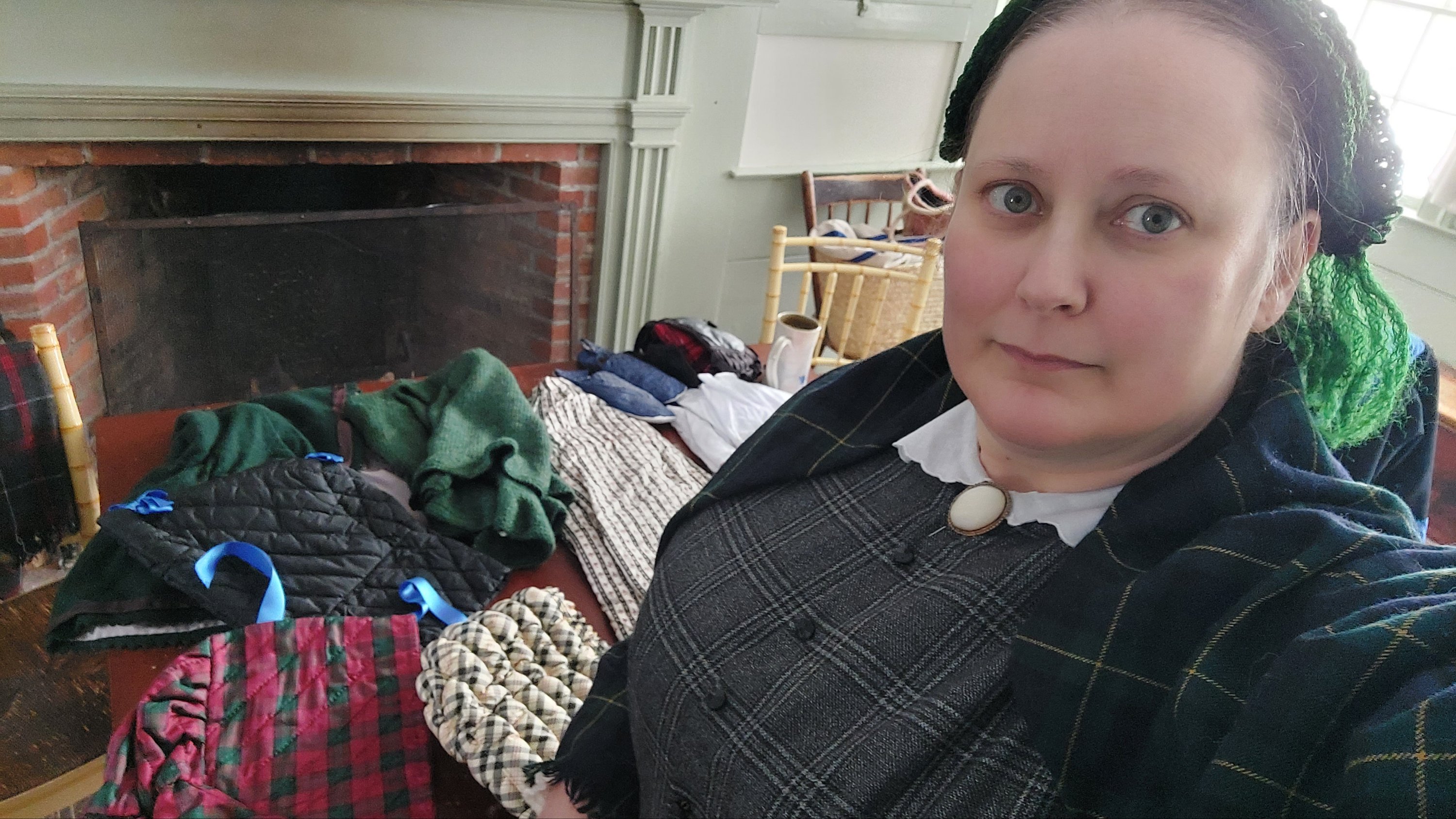
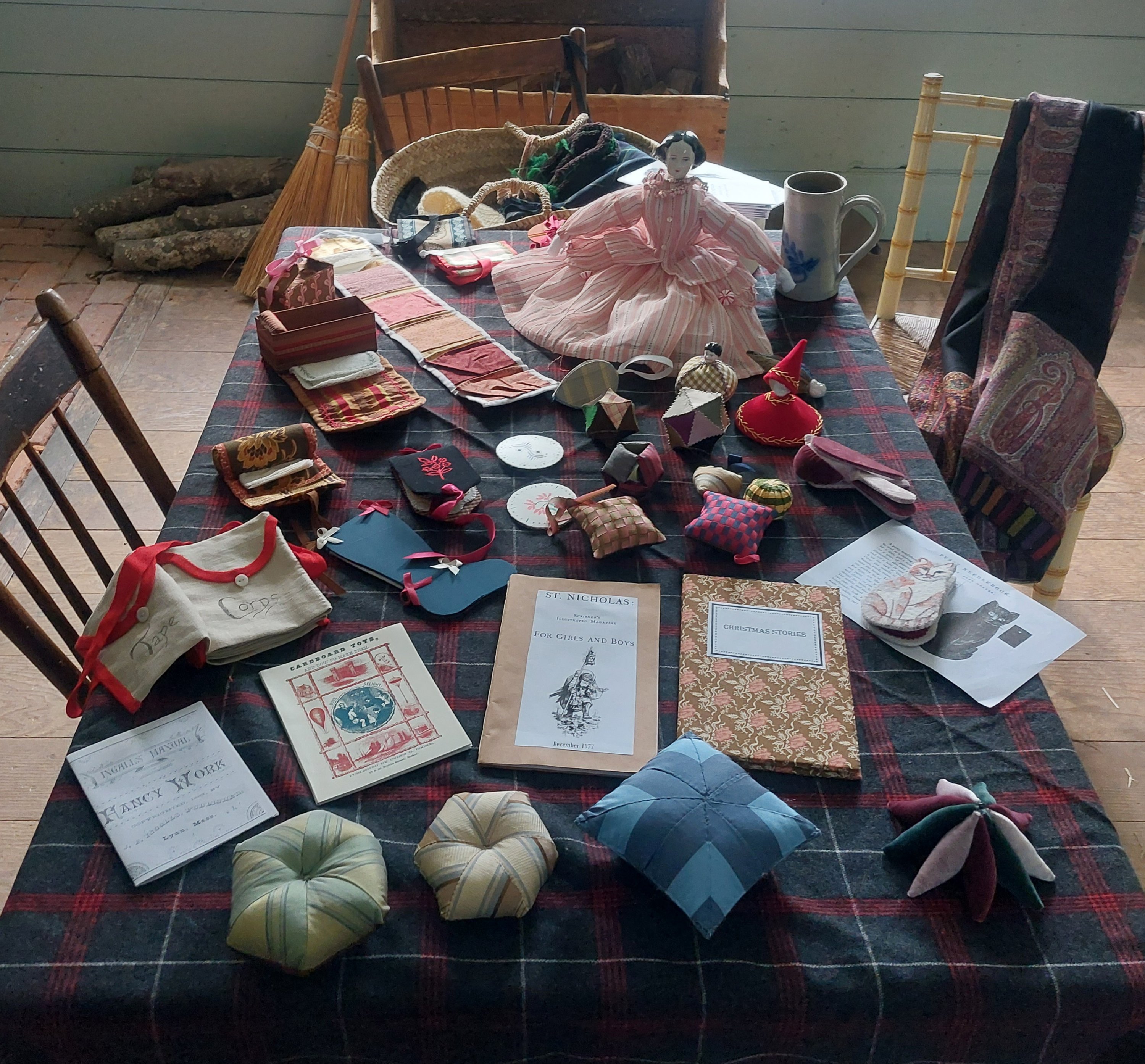
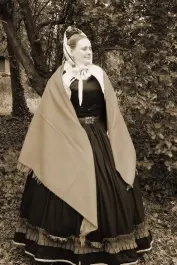
When I first started rescuing dolls, I said they were just for fun, not for interpretation or work. Well, that went out the window didn’t it? For Opening Day & Mother’s Day weekend, I dressed Theo, newly named by visitors, in one of the museum’s reproduction kerchiefs released this year. I love how Theo’s dress came together. I love even more the interest visitors had in the process. During the Antique Show, I shared my “Tools of the Trade” display/demonstration. I talked with visitors about the different tools used to split straw for plaiting, shape millinery, and make the flowers. This is one component of a larger interpretation theme I have rolling around in my head. (Some day?) One of my favorite photos of the year. Independence Day was beautiful. I had so much fun playing a modified game of croquet in the side yard of Livingston. I had a silly amount of fun spinning around taking these photos and playing with the settings on my phone’s camera. I love how this red wool challis 1850s dress came together. I was so excited to read this bon bon basket description. I think I flipped past it many times in the past without reading it. I loved creating something a little different out of straw plait. (I have a couple more descriptions for projects using straw plait I want to make in the coming year if I can get enough affordable straw.)The millinery shop set up is by far the most physical work of the year – getting everything out, sorted, into the car at the right time (east facing car becomes an oven), rearranging the building, setting up….. It is a chance to talk about some of the types of work women did during the mid-19th century. I started developing this pocket based discussion earlier in the year, maybe the year before. During neighbor’s weekend, I did a partial version to see how it was received. Each pocket is filled with items a woman from the village may have carried with her. Each pocket and its contents tells a story. I hope to do more with this. And suddenly…. brrrrr! Preparing for Winter was a cold 🥶 weekend as the first major (4′ in some parts) snow hit west of the village. I used the weekend to test out my mid-nineteenth century layers while talking about winter clothing. I filled the box for Holiday Open House throughout the year. This year I focused on handmade gifts that are sewing items. (Next year, I think I want to either focus on toys or animal items.)I like this photo not only because of my lovely new shawl but because I look relaxed. In all the stress of the year, I find as it wraps up, I am good with myself.
Things I made
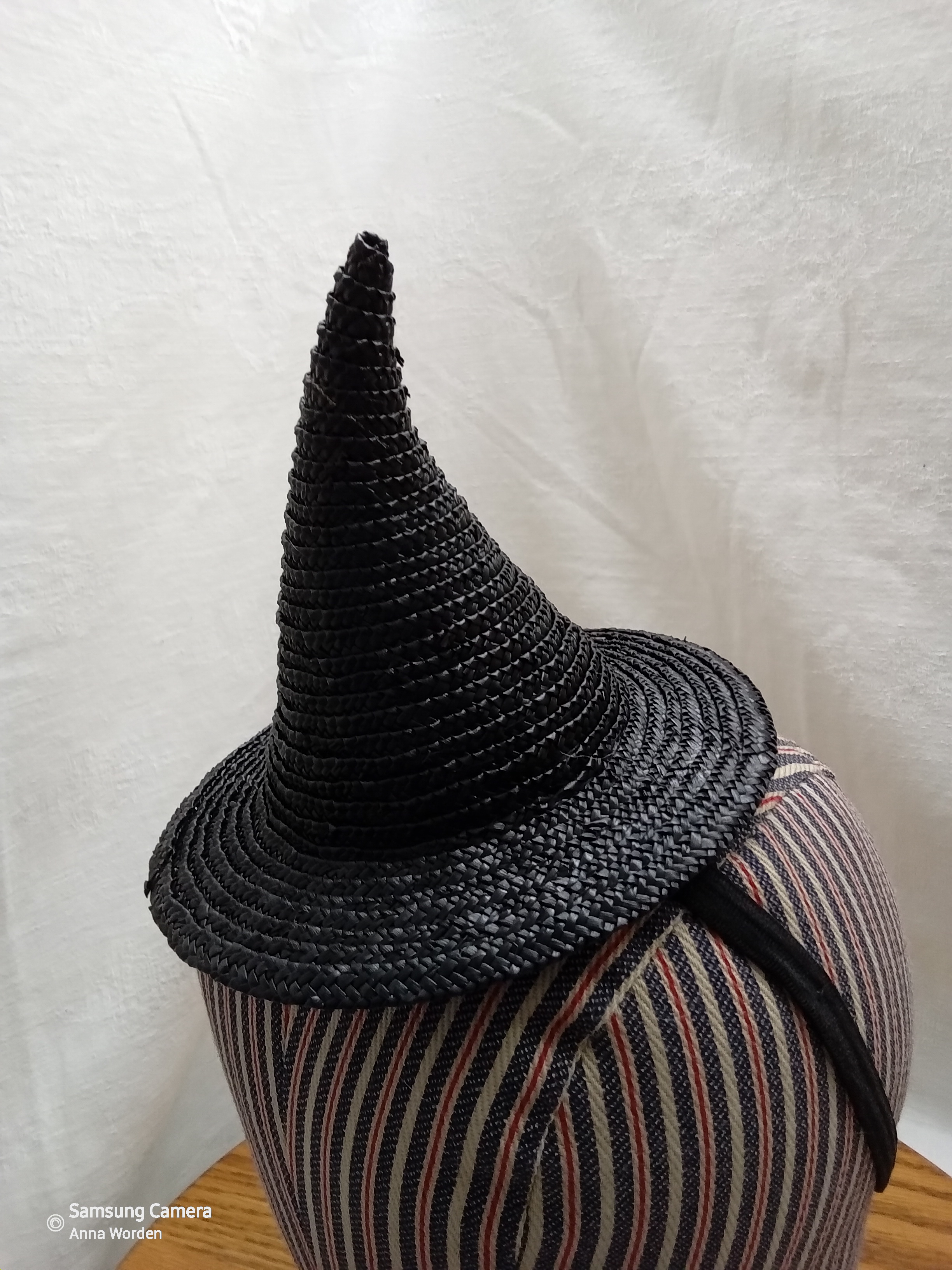
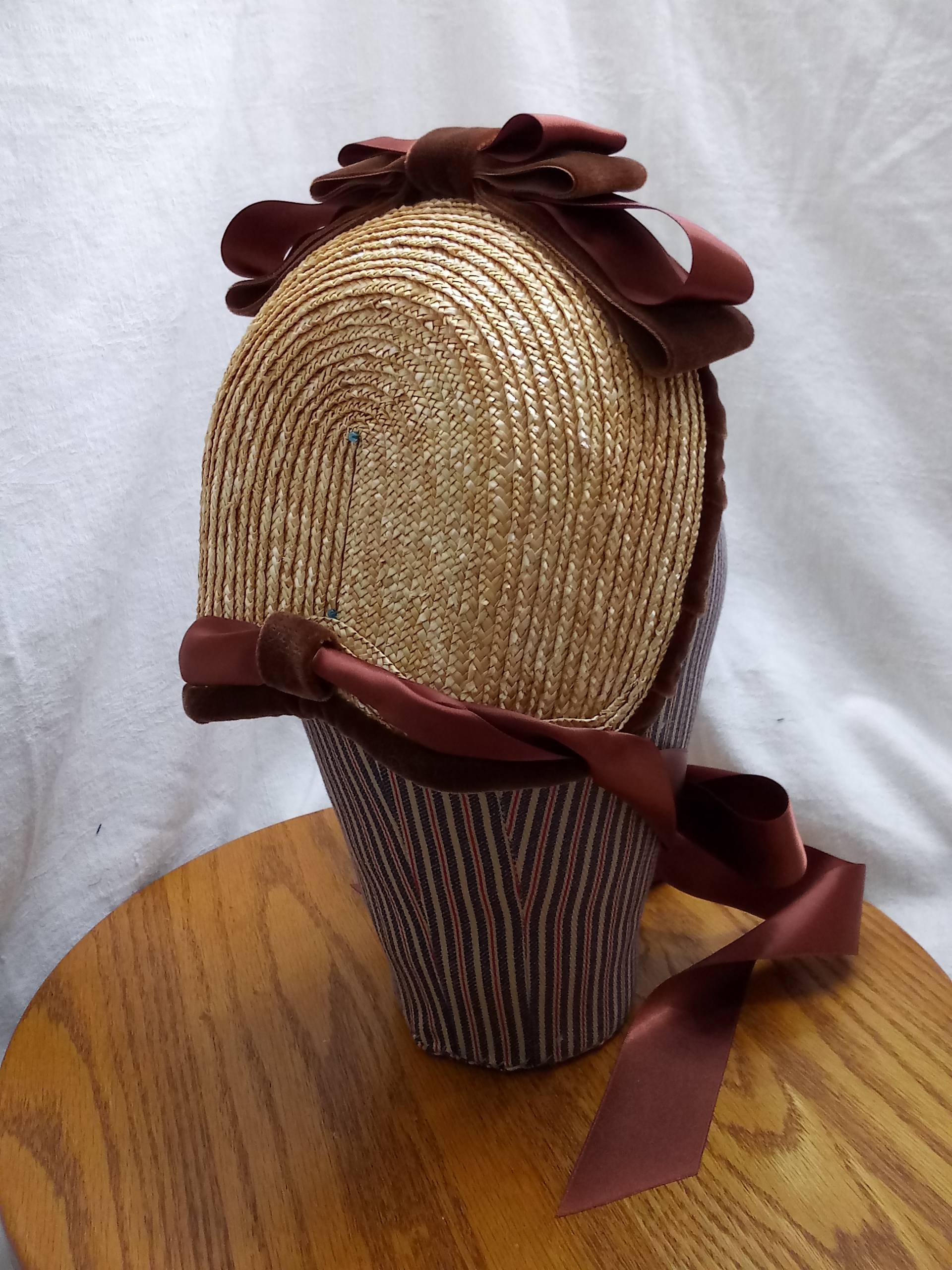
For my Agricultural Society Fair entries this year, I wanted to bring the pieces I made for events through the year, plus a couple other things. I had been wanting to make a bonnet and/or hat with straw motifs for a couple years. It kept getting procrastinated. I am pleased I finally did. This still needs all its decorations. Maybe in the coming year. I loved the idea of these little baskets. Still live them. They are just too darling and fun. Sadly, others didn’t seem to love them as much. They may end up doll accessories instead of decorations. Adding the headbands to my little straw witch hats was a spur of the moment, direction change. I am glad I tried it. You’ll likely see more of these. This 1880s straw capote was one of my favorite pieces of the year. I was shocked to see it sit in the shop for as long as it did. (I have theories why.)Making straw basket pin cushions had been on my to-do list for a while. Okay, a long while. I finally made a few. I am quite pleased with them. I may make more.
Things I found
These triangle shaped friendship books are some of the coolest things I’ve stumbled across. They a curiosity that I will continue to look into. I still can’t believe this beautiful original bonnet is mine. Swoon….This well tattered heart frame was a lucky rescue. I happened to stop at a local shop that changed hands. They were in the midst of rearranging. This was in a little basket in a corner I previously avoided. So glad I saw it. And one last photo group (which counts as one photo) for my Clara fans.


























 If I Had My Own Blue Box: