I am going to start making sheer outerwear such as the fichu and pelerine below soon.
Fichu based on a Godey’s 1859 pattern, in white cotton lawn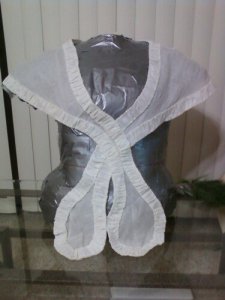
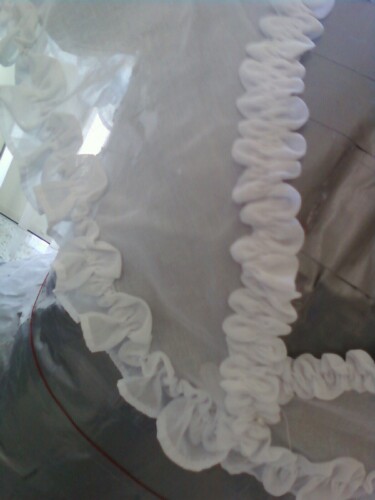
Pelerine in white cotton voile with scalloped ruching and ruffle.
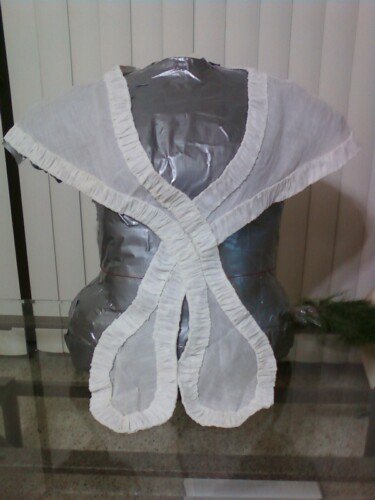
I am going to start making sheer outerwear such as the fichu and pelerine below soon.
Fichu based on a Godey’s 1859 pattern, in white cotton lawn
Pelerine in white cotton voile with scalloped ruching and ruffle.

A passage in the 1845 The Ladies’ Work-Table Book’s, 1845 section on plain needlework is nearly identical to a section in Sarah Josepha Hale’s The New Household Receipt-book.
“Table Linen – This department of plain needlework comprises table cloths, dinner napkins, and large and small tray napkins.
“Table Cloths. – These may be purchased either single or cut from the piece. In the latter case, the ends should be hemmed as neatly as possible.
“Dinner Napkins. – These are the various materials; if cut from the piece, they must be hemmed at the ends the same as table cloths. Large and small tray napkins, and knife-box cloths, are made in the same manner. The hemming of all these should be extremely neat. It is a pretty and light employment for all young ladies; and in this way habits of neatness and usefulness may be formed, which will be found very beneficial in after life.
“Pantry linen. – In this department you will have to prepare pantry cloths, dresser cloths, plate basket cloths, china, glass and lamp cloths, and aprons. Pantry knife-cloths should be of a durable material. The dresser cloths, or covers, look neat and useful. They are generally made of huckaback of moderate fineness; but some ladies prefer making them of a coarser kind of damask. The plate basket cloth is a kind of bag, which is put into the plate basket to prevent the side from becoming greased or discolored. They are made of linen, which is well fitted to the sides, and a piece the size and shape of the bottom of the basket, is neatly seamed in. The sides are made to hang over the basket, and are drawn round the rim by a tape, run into a slit for that purpose. China cloths, and also glass cloths, are to be made of fine soft linen, or diaper; and the cloths used in cleaning lamps, &c., must be of flannel, linen, or silk. All these articles are to be made on the same manner, that is, hemmed neatly at the ends; or if there be no selvages, or but indifferent ones, all round. Nothing looks more slovenly than ragged or unhemmed cloths, which are for domestic use. Little girls of the humbler classes might be employed by the more affluent, in making up those articles and a suitable remuneration given them. ….
There was an interesting passage of the August 17th entry of the 1864 Book of Days:
“‘Table-cloths’ have been in use in Englad certianly since the Saxon period, and in that and every succeeding era. The word ‘napkin’ was fomerly applied to handkerchiefs and table-linens, as well as to cloths for head-dresses, &c. ‘Napery’ was the general term for linen, especially that for the table. ‘Towel’ requires no explaination.”
Additional Reading:
The Linen Trade, Ancient and Modern by Alexander Johnston Warden
Two random thoughts kept me awake for a while the other night, the experience of travel and proving a negative.
The first was spurred on by an audio book about the Rev. War I am attempting to listen to on the way to and from work. One of the characters was traveling by some type of carriage on a muddy, rutty road. In the story, he was trying to keep his mind on something other than the tossing and rocking of the carriage. Of course this got me wondering about what it was actually like to ride for an extended time in a carriage or stage. Several months ago I wrote about travel in regards to the modes and prescribed etiquette. This pondering is more about the actual experience. In our modern car travel we have radios, heaters, air conditioning, artificial light, adjustable seats and so on. On the hour plus trips we tend to take frequently, I curl up in my seat, talk with Dan, check my mail, make shopping lists. I have lots of space and a comfortable seat. Thinking about what I might do on a journey in the 19th century, I first thought I would bring needle-work or a book like is often depicted in movies. But then I started wondering about the amount of natural light in different vehicles. We are accustom too much more artificial light in the present-day. How much natural light would a woman have wanted to do her needle-work or to read by in a closed vehicle? I’m not sure how much light makes it into some of these vehicles. The carriages I usually see used at various events are open or have a roof that can pull up. There is plenty of light in those. When I see closed vehicles, they are in generally on display inside carriage barns. In those situations it is difficult to determine how much light gets in a vehicle when there is limited light inside in the first place. I wish I would have paid more attention on the occasions at the museum when more vehicles were out for use. The next piece I wondered about is the actual riding. I was trying to imagine what it was like to travel in a closed vehicle in a mid-century dress. As I mentioned, I like to curl up in the car. There is a huge difference between me in my jeans or a little modern dress and the cloths from mid-century. I know what it is like to ride in a late century train car with a cage on. The seats are comfortable for an adult woman and a child. But the seating is tight for two adults and extremely tight for two adult women wearing 100″+ cages. In our experience, with the larger cages one woman sits down then the other sits with her skirts on top of the other. This can be Highly inconvenient. With smaller cages, 90-100ish inches it is possible to sit side by side with our skirts tucked to our sides quite comfortably. I wish I knew how the dimensions of these seats compare to the seats of the 1850s. The width, depth, height and space between them would all be factors. So would the aisle width and storage spaces. Even though the seating was tight, I didn’t find it overly uncomfortable because the space was open, air could move around the car and the window let in plenty of light to see by. Would these three aspects still be available in a closed horse-drawn vehicle? Would a mid-19th century woman place as much importance on them as I do?
On to the second pondering….
On of the struggles we have in researching what was or wasn’t available, popular or fashionable during the 1850s and 60s is proving/showing that something wasn’t. With finer points of fashion we can sometimes find a reference to something falling out of fashion. Great! But what about aspects of material culture that don’t have convenient textual references holding against them? When the concept of proving a negative was mentioned in a recent email discussion, I seriously stared thinking about what the process might be or the process I would take. (Okay, so when I am stressed and can’t sleep my mind wanders on the oddest of subjects.) The project that came to mind was the research on folding chairs. While I didn’t start our to prove a negative, in a way that is what I faced for the civilian use of folding chairs. While folding furniture had been around for centuries, the use of folding chairs was not prevalent for domestic use during the first half of the nineteenth century. The reemergence of folding furniture, also referred to as patent furniture, coincided with the onset of the Civil War. What became a vast array of beautiful and creative domestic and travel furniture in the later half of the century, began as functional pieces with a military purpose. Looking at this example it is possible to chart the frequency of patents and advertisements through the century. Doing so, we see the start of chairs for military use and the transition into the domestic sphere. Additionally, we can look at the patents for this furniture and the manufacturing establishments. We see when those contracted for the military moved to producing domestic folding furniture and when their establishments grew. So, my approach to proving a negative requires looking at the timeline or spectrum of the subject matter’s existence and production; looking at when something was in use/favor, when it emerged, when it declined, what was in its place if anything. It would have been nice to have some of my former science wing coworkers to ask how they would scientifically approach proving a negative.
I’ll continue with one of my favorite household guidance authors, Eliza Leslie….
In her Miss Leslie’s Lady’s House-book, 1850, she says this about table linens:
“Table-Linen. – If the circumstances of the family will allow the expenditure, it is advisable always to get the table-linen of the best quality; as that which is fine and thick will last much longer and look better than if comparatively coarse and thin. There is nothing of the sort superior to the best double French damask; it being not only fine and thick, but soft and glossy, like satin’ and it looks as well after washing as before. The appearance of all table-linen is improved by being mangled in a machine, instead of ironing. A tablecloth ought to be considerably larger than the table, so as to hang down all round.”
“Napkins. – There are few genteel families who are not in the practice of using napkins at the table, to spread on the lap while eating, and for wiping the mouth and the fingers. The best size is about three-quarters square. [she doesn’t say three quarters of what] It is now more customary to hem the napkins than to ravel them with a fringe. If fringed, they must be afterwards whipped with a needle and thread, to secure them from ravelling still farther. Napkins with coloured borders look less genteel than those that are all white. The fines French double damask are the best and handsomest, and will last twice as long as any others. For a dinner party it is customary to place the napkins on the table, nicely folded in squares or diamonds, of which there are a variety of ingenious forms. But when the family dine without company, or with only two or three guests, the napkins are usually folded square, and then rolled up tightly and slipped into a ring of silver, ivory, ebony, or box-wood. These rings are generally numbered or lettered, and care should be taken to place the napkin of each person in his own ring. All table-linen should be marked in full with the whole name of the family.”
“Doilies. These are small napkins intended for wiping the fingers after eating fruit, and are placed round the table for that purpose. They are generally of coloured cotton, with a border; the colours are dark, that the stains may not be conspicuous on them. Unless they are washed very frequently, they acquire a rather unpleasant smell, and are not agreeable to use. We think it best to have white ones, as they are much nicer, and the stains can easily be removed from them. Doilies are always fringed.”
“Setting the dinner table. – Before you begin to set the table, see that every thing is ready and in good order; so that, after you once commence, you may not have to quit for the purpose of making something clean, or of remedying some inconvenience. If in winter, first see that the fire is good, and the hearth clean, and the plates set before it in the plate-warmer. In summer, if there is to be wine, attend in proper time to putting the bottles into the cooler, heaping round them pieces of ice. Also have ready, in one or more small glass dishes or saucers, a sufficiency of bright clean ice, broken into small bits, (with a dessert spoon in each dish, ) for the purpose of using while at table to cool the glasses of wine or water. Cut the dinner bread into thick oblong pieces or blocks; as it is not customary to slice bread, except for breakfast or tea; and take care to have enough in the bread-basket to supply all the persons at the table with a second piece, if required. It is extremely awkward to be obliged to replenish the bread-basket in the midst of dinner, some of the company, perhaps, waiting for it in the mean time. Every thing may be so arranged before-hand that the waiter will not have occasion to leave the room during the progress of the dinner.
First lay down the crumb-cloth; and then, if there is a woollen cover on the dining-table, remove it before you put on the linen cloth, which must be laid smoothly and evenly, so as not to hang down more on one side than the other. Bring in the things (as many at one time as you can) on your tray. Set your plates round the table, one for every person, but place them at the sides only, except those that are intended for the master and mistress of the house, who of course occupy the two ends and will not be able to carve so conveniently of any one is seated beside them.
It is always better to have too much space than too little; and it is therefore advisable to set a table rather to large for the company, than one that is in the least too small. We have seen a whole dinner party made uncomfortable all the time, from being crowded at a table of insufficient size; and in warm weather, particularly, this is no trifling inconvenience.” (She continues in detail how to properly set the table on p 257)
I currently plan to put up other notes I have from household guide books as well as some odds and ends. In the last post I said I think I will also put up some notes on the kitchen linens. This would include those used for cleaning, food prep and storage in the pantry. While entering the notes above I was thinking about visuals, primarily of dining rooms. Then while typing the part about napkins on the lap, I wondered about non-genteel usages of the napkin such as in the drinking area of a tavern. So, I think I will try to find some images other than nicer dining rooms as well.
In connection with a previous post on Table Clothes, I’ve decided to put up some additional information on table linens that never quite seemed to get organized into an article to go with the article on trays. I’ll begin with some information from the 1840’s Workwomen’s Guide.
The author provides a nice chart in her House Linens section suggesting the number of linens required. For the table she suggests 8 to 10 damask breakfast cloths in 4 sizes ranging from 1 1/4 yards x 1 1/4 yards to 2 yards x 2 yards, 8 to 10 table cloths each in damask separated into one suggestion for a Common table-cloth 2 1/2 yards by 2 yards, and 4 table cloths ranging from 2 1/2 yards by 2 yards to 5 yards by 2 1/2 yards, 1 to 3 largest size table-cloth in fine damask 8 yards by 2 1/2 yards. 1 to 3 “table linen in the piece, per yard” in damask 1 1/2, 1 3/4, 2, 2 1/2 yards wide, and the same in Diaper, 3 to 6 dozen fine damask dinner napkins 14 nails wide, 3 to 6 dozen breakfast napkins in Damask 12 nails wide, 3 to 6 dozen Doyleys “White or coloured do.” 6 nails square, 6 to 12 dozen large tray clothes in damask or diaper 1 yard 6 nails long by 2 yards 6 nails wide, and 6 to 12 dozen small tray clothes in damask or diaper 1 yard 3 nails by 13 nails. (She also includes price ranges for these items in English prices.) A separate list of kitchen linens suggests 6 to 12 coarse diaper table cloths as well as many other cloths used in the kitchen.
For table cloths the author says “These vary in quality, according to circumstances. The finest are the most expensive, and are only used for company. The price varies not only with the size, but also with the pattern. The material of which they are made is called damask, and may be purchased up to a certain size in single table-cloths, after which it must be bought in the piece. Care should be taken in choosing a table-cloth, to see that the edges are even, and the threads are regular.”
For dinner napkins, she makes suggestions for the napkins then provides information on how to fold them. “Dinner Napkins. These are also made of damask, and vary in quality and price, according to the pattern. The best are from 50s. to 60s per dozen. The second quality from 18s. to 45s per dozen. Dinner napkins are folded in various ways, and are generally put upon the plate, enclosing the roll or bread. The following modes are those usually adopted. [images to come asap]
The Half-Pyramid shape – Plate 21, fig 7,8,9,10. 1st. Take the cloth as it comes from the wash, and open the square length-wise, drawing the folded napkin to its fullest extent. 2nd. Turn up the ends to meet in the centre. Fig. 7. 3rd. Turn the napkin thus folded, so that the turned ends are below, or underneath. 4th. Turn up each corner, half-handkerchief-wise, towards the centre. Fig. 8. 5th. Turn the cloth again the other side uppermost, and again turn the corners up to the centre. Fig. 9. 6th. Take hold of the corners, A B, and by drawing them under, make the napkin stand on its end, so that C stands up, and the cloth is supported by A B D. the bread is within the hollow, or between the folds thus formed.
The Diamond Shape. Plate 21. fig 7,8,9,11,17. 1st Open the square length-wise, drawing out the napkin to its full length. 2nd. Fold the ends to meet in the centre. Fig. 7. 3rd. Turn up each corner, half-handkerchief-wise, towards the centre. Fig 8. 4th. Turn down the corners towards the centre. Fig 11. 5th. Turn the cloth entirely over, and it is ready. Fig. 9. The bread is put in the mouth of the napkin, which should be turned on the plate towards the person. Fig 17.
Another Mode. Plate 21. Fig. 12, 13, 14, 14, 18, 19. 1st. Open the napkin length-wise. 2nd. Fold it down from the centre, half-handkerchief-wise, at the centre, leaving two long ends. Fig. 12, 18. 3rd. Take the right-hand piece, and draw it over towards the left hand, making the point, B, lie upon the point, A, thus forming a second half-handkerchief, fig. 13; turn the end back towards the right from the centre, fold it back again in several neat straight folds towards the centre, Fig. 19; do the same with the left hand piece, Fig. 14, turn the napkin, and it resembles a diamond on the square, Fig. 15.
Napkins are often used to lay under fish, pastry, or sweet things, in which case, they may be folded in the shape of a diamond, or else the whole napkin, being first laid open, is plaited in regular and very small folds till reduced to the proper width; it is then doubled down a little at each end to secure the folds, and to make it fit the dish, Fig. 16.
About doyleys “These may be either white or coloured, and are sometimes open, of six nails square; they are generally fringed. The best linen doyleys are about 11s. pre=””>6d. per dozen. The second linen quality, 8s per dozen. The common sort or cotton, 4s. to 5s. 3d. per dozen.”
The table cloths listed under Kitchen Linen are described such “These should be made of coarse and often unbleached diaper the size must depend on the number of servants, or rather the length of the table.” This is the tablecloth placed upon the table for the servants to dine. It is not the cloth used for covering a cooking table. The cooking table covering is of huckaback or coarse diaper with a minimal fall beyond the edge of the table. The author strongly suggests marking the household linens with ink according to their use (H, P, K, S followed by the type of cloth) as well as purchasing the linens for each area of usage in a different pattern (in the weave) so they will not be easily mixed up.
I will add some more of my notes as I can get to them. I may also add a post on kitchen and pantry linens because as I look back through my notes, I see there are many of those people may be interested in.
I can’t believe it is October. It is actually cooler here than I thought it would be. I have to admit I really am enjoying the cool mornings and nights. Who would have ever thought, me, the person who is so often cold enjoying the cool air?
Anyway… my current projects…. (I’ll fill in a few details in as I have time.)
– I am working on the Powerpoint and handouts for the millinery ribbon presentation for the Genteel Arts Conference. I spent most of the past weekend working on manufacturing information.
– I am slowly working on the sewing cases samples and book. I would really wanted to have this ready for spring. But, it looks like it will be longer than that. I have a list that grew a bit longer than originally planned of pieces for the book. I need to narrow it down as I do the samples.
– I have an additional idea with research that looks like it will also become a booklet based on the amount of information that will go with it. The credit for this idea goes to Dan though.
– I also have a couple non-19th century sewing projects underway.
This is less than what I normally would have going at one time because I’ve found I am down right exhausted after getting home from teaching preschool. I had no idea how tired I would be. I am waiting for a solid piece of inspiration for the next Citizen’s Companion article. I had an idea pop into my head a little while ago looking at the average woman’s participation in society because I’ve had so many museum visitors assume women stayed home all the time. We will see how long it takes for me to get that together.
I want to apologize for neglecting questions on the SA forum and my blog the past many weeks. I have discovered with how busy I am with work and home I have about enough mental energy at the end of the day for farming on Facebook and not much else. I will eventually catch up on things, some how.
Right now I am working on two main projects. First the Millinery Ribbon discussion for the March Conference. Second, a book on making sewing cases based on originals. The only bits I’ve been dabbling with is setting aside notes on veils for Bevin as I come back across them in my Ribbon notes.
There have been a couple local events that I’ve wanted to stop in at as a spectator. The timing just doesn’t seem to work out for us. Hopefully soon we will be able to check out the local happenings. I know Connie is interested on reenacting and mid-century life in this area for the magazine.
It was so nice to receive this month’s magazine this week. I’ve been so stressed, it was nice to be able to relax with something I can wrap my head around. I’ve decided there is more green on the cover of the magazine then in many places around me. (Sorry South-Westerners, I miss the green of New York.) The cover also made me think of the upcoming Agricultural Society Fair at the Genesee Country Village and Museum. It is about this time of year mom is in the midst of canning a variety of vegetables, pickles and preserves. I don’t know what she is working on for this year given the blight problem with the tomatoes. I’m hoping some basil pesto was done a few weeks back. I love homemade pesto. Mom was the one who entered preserves and food stuffs at the fair over the years. Grandma K. entered quilting and rug hooking projects. I remember her last one she changed at the end just so she could enter it in the fair before she left for the hospital. It was supposed to have a whole additional border with some of the birds from the central motif. My fair entries were more frequent as a kid then as an adult. I won ribbons in the children’s categories for floral arrangements, craft projects and penmanship. If you’ve tried to read my hand writing as an adult you know just how funny that is. The year I can remember we had to write out a portion of the Gettysburg Address.
Back to the magazine.
I want to thank Elizabeth Topping for including pictures from the July event at the Genesee Country Village and Museum. Most people know of the event as “Mumford” rather than by the Museum’s name. I’ve always had trouble making the switch because to me Mumford is the hamlet that several of my family members live in, the old stone church where my brother & sister-in-law and my Grandparents were married is, and where much of my family is laid to rest. This Mumford is much, much older than the Museum which opened the year I was born. The pictures Elizabeth included are lovely. She attended in a year of transition for the event. This year the museum opened several of the buildings for reenactors to use for scenarios for the event. The plan to do so again next year as well. I am very excited this is the direction the Museum has chosen to go. Since Elizabeth included a nice picture of what I am pretty sure is the kitchen in Livingston-Backus, I have to mention the pottery shown. This pottery is made at the museum in the working pottery. There have been many great artisans over the years. I won’t try to name them because I don’t want to mutilate their names. The pottery is available at the Museum’s Flint Hill Store and through the Museum’s website www.gcv.org. They have Salt Glaze, Redware and Albany Slip available. I think you will find the prices are very good. For the larger pieces, you may have to visit the store in person. There are many pieces I’ve seen that are not on the site.
That is all for now…..
16th Annual Ladies and Gentlemen of the 1860s Conference
I will be presenting:
Narrow Strands of Silk: Mid-Nineteenth Century Ribbons Used for Millinery
“Period literature abounds with young women excited by the purchase of gifting of a new ribbon. What excited them so much about a narrow strand of silk? What, as Mary Davidson’s Silk says, held the public favor for three centuries? In this presentation we will examine the many various ribbons used in millinery including their weaves, designs, texture, and width along with where and how they were used.
We will begin by looking at the manufacture of ribbons, where they were made both domestically and foreign, and where we imported them from. We will learn about the regional manufacturing centers in Coventry, England and the Canton of Bále, Switzerland and the ribbons they produced. We will also see how the onset of war drastically shifted the levels of importation and production of silk ribbons.
Next we will look at the types of ribbons produced and used in the mid-century. This will include examples of the different size ribbons, the weaves, and designs. When looking at the types of ribbons, we will see a much greater variety of ribbons available in the 19th century then is available today. Exhibition catalogs show ribbons from as simple as plain, fancy, or plain fancy to some we may recognize such as numerous velvets, printed, and embroidered, to some we may not yet recognize such as figured lutestring and cut-edged ribbon. We will discuss which ribbons were more often used for different pieces of headwear; bonnets, caps, nets, etc.
Lastly, we will also look at techniques for achieving the look of period ribbons through textual descriptions and illustrations as well as some original images including how to make bows following period directions. “
I had planned on developing a full article on working support garments. But, I have been utterly swamped (yes after being bored) with a new home style, two major projects, and a new job. So, rather than have the information from the survey just sit around, I am posting it. I ended up with exactly 100 respondants. I had hoped for double that to get a good sample. 100 isn’t bad though. I need to figure out how to properly post the 123 comments people took the time to make in the survey. There are a variety of different views and reasonings in them. This was just the look at how this is interpreted by the living history community. The other, and larger, componant of the original article plan was a look at what literature and photographic evidence tells us about what women worn in different work situations. I will try to get some of that information up over the next several weeks as well.
Question 1. What undergarment do you wear while doing light domestic work such as preparing food, washing dishes or sweeping?
Corset wtih full boning – 83.8% Corset with light boning – 10.1% 10.3% (excluding those who do not do this activity) Stays with soft or light boning – 4% 4.1% (excluding those who do not do this activity) Nothing 0% Modern Bra – 4% 4.1% (excluding those who do not do this activity) Do not do this activity – 2% 1 skipped this questionQuestion 2. What undergarment do you wear while doing heavy domestic work such as cooking in a hearth, on a stove or over a fire or doing laundry?
Corset wtih full boning – 61.6% 79.2% (excluding those who do not do this activity) Corset with light boning – 11.1% 14.3 % (excluding those who do not do this activity) Stays with soft or light boning – 7.1% 9.1% (excluding those who do not do this activity) Nothing – 0% Modern Bra – 4% 5.2% (excluding those who do not do this activity) Do not do this activity – 22.2% 1 skipped this questionQuestion 3. What undergarments do you wear while doing moderate outside work such as collecting firewood or gardening?
Corset wtih full boning – 66.3% 79.3% (excluding those who do not do this activity) Corset with light boning – 10.2% 8.5% (excluding those who do not do this activity) Stays with soft or light boning 6.1- % 7.3% (excluding those who do not do this activity) Nothing – 0% Modern Bra – 6.1% 7.3% (excluding those who do not do this activity) Do not do this activity – 16.3% 2 skipped this questionQuestion 4. What undergarment do you wear while doing heavier agricultural work such as farming or building?
Corset wtih full boning – 25.3% 64.1% (excluding those who do not do this activity) Corset with light boning – 8.1% 20.5% (excluding those who do not do this activity) Stays with soft or light boning – 5.1% 12.8% (excluding those who do not do this activity) Nothing – 1% 2.6% (excluding those who do not do this activity) Modern Bra – 4% 10.3% (excluding those who do not do this activity) Do not do this activity – 60.6% 1 skipped this questionQuestion 5. Is your corset
Custom made in person or by yourself – 58.3% Custom made by measurements – 31.3% Authentically made off the rack – 12.5% Acceptably made off the rack – 1% Something that gets by – 1% 4 skipped this question Question 6. How would you describe the fit of your corset? Comfortable fit with no complaints – 68.0% Right shape for me but a little loose – 4.1% Right shape for me but a little tight – 5.2% Roughly a good fit with some issues to fix – 21.6% Will do now until I replace it – 7.2% 3 people skipped this question Question 7. Does the fit of your corset affect when/if you wear it? Yes – 28.9% No – 73.2% 3 skipped this question Question 8. Does your body type, bust size and/or figure affect when/if you wear a corset? Yes – 24.7% No – 75.3% 3 skipped this question Question 9. Does the weather (heat, humidity, rain) affect when/if you wear a corset? Yes – 15.5% No – 84.5% 3 skipped this question Question 10. Do you think mid-19th century women wore a support garment (corset or stays) while doing work? Yes – 92.9% No – 3.1% Don’t know 5.1% 2 skipped this question




 If I Had My Own Blue Box: