Design Your Own 1860s Dress by Atlanta Shannon at Bonny Blue
This kit is such a great idea. It is good for seamstresses as well as those who have seamstresses making their dresses. Younger kids will absolutely love them.

Design Your Own 1860s Dress by Atlanta Shannon at Bonny Blue
This kit is such a great idea. It is good for seamstresses as well as those who have seamstresses making their dresses. Younger kids will absolutely love them.

It isn’t very often I am exceptionally impressed. I happen to have been so impressed by the Farm and Ranch Museum yesterday, I am doing a double post on both blogs.
Originally we were going for their once a year Antiques Day where they open up thier curatorial storage. The events listing I read said it was the 12th, Saturday. Nope. It was the 13th, Sunday. I’m so glad we decided to stay anyway.
The lobby is nice, open and airy. It is very welcoming. I noticed through the lobby’s wall of windows, there was a presentation area set up in their courtyard. Later we were to notice the large dining area fully set for a function. The receptionist went beyond welcoming us and taking our entry fee. She took the time to explain the museum, point out various things on the map and tell us about the trolley. (Very good since as we pulled into the parking lot, I realized I was one of those women who wore heeled sandles.)
The first exhibit was called What in the World. This is a collection of objects from the about mid-19th century to about the mid-20th century. This is the exhibit that caught my attention. It was wonderfully interactive. As you enter the exhibit, there is an introduction and a rack of clip-boards on the right. The clip-boards held your answer sheet. It was a game to see how many objects you get right. The objects were broken down into true/false, matching, word scrambles and multiple choice. Just looking at the break-down, one might think it is like a quiz. But, when you combine it with their displays, it was definitely fun. Each well displayed lighted object was simply numbered. For the true/false there was a simple statement about what an item was. You decided if it was true or false. Then you could flip up the text plaque to see if you were right. Similar flip-up methods were used for the matching with a group of objects and a group of text plaques with what they were used for. Under the flip-up was a further explanation. They also used a spinning roller with a selection of answers in combination with a covered window to reveal whether you are correct, and a type of turn disk where you move a small knob to reveal the answer. When you are done, you add up your score. We were meant to be curators based on our score. I’ll admit, I was not good at the word scramble. I had to just look at the object. Dan figured out the scrambles. There was one object I was able to point out to Dan that I would love to have; the crimper for doing edging. This room really showed well that interactive exhibits aren’t just for kids. I would love to see about doing something like this for an event public program or a seminar program.
The next exhibit was the one I was least familiar with, the Colcha, Embroidery. It reminded me most of Berlin work. Three things stood out, the interactive how-to section, the display of Colcha Christmas ornaments available for purchase and the feedback stand. The interactive piece caught my attention because it would have worked nicely for PDC camp. They took plastic canvas. Framed it with a solid 1″ frame on both sides. Drew the outline of a flower on the canvas. Attached a plastic needle and thread. On the wall was a nice directions board. (This is also the room where we notice the no photos sign. So, sorry, no pictures.)
The halls between the exhibition rooms were used nicely as display areas of vintage quilts, artwork, and a photo history of school houses.
The large exhibit room traced 3000 years of agriculture in the Rio Grande water shed area. My compliment on this room is how they created multiple levels with walking ramps that made the room feel like more then just a big gallery. The displays were well done with great textual explanations that weren’t to long but created a nice story. They recreated an early 20th century store and post office as well as a kitchen and parlor. Those were fun for me because it showed both items I remember using at home while growing up (no I’m not that old, we just had vintage and antique items everywhere.) and it showed items we see at mid-19th century events in a more appropriate setting. I really wish I could show pictures of that for references for people. The far other end of the room had the modern agriculture. I have to admit, I still just don’t get it, the dryness, the routing of the water in a completely different way than I am accustom. I think I really would have needed my brother there to talk through it to fully appreciate the concept. The only criticism is on Dan pointed out. There wasn’t a flow that we caught on to. I don’t know if we entered the time line wrong or what.
Next we went across the building and outside to the blacksmith shop. I was initially curious to see how similar or different it might be to the blacksmiths I am used to in the 19th century. We didn’t even get to the building before we got pretty excited. There was an area filled with wrought iron for sale. Then as we entered the building there was more, lots more. Oh, how I wish we had pockets of cash to spend. Now, if it ended at the items for sale, I would have been happy. But, the apprentice working that day gave a solid, informative and interesting presentation. The coolest thing is how much they recycle. He started telling us how they use the railroad spikes and horse shoes. Showing us the starting product and the finished product from the displays (for sale). Then he moved on to what must have made my jaw drop; the items made from garage door springs and truck springs. This was fabulous. As he talked and made his nail, he had my full attention. This is not an easy feat. Before we left, I had a mental list – folding grill, awesome tri-pod, several S hooks, simple letter opener. Dan wanted one of the railroad spike knives. I also asked if he could make things on request. Yes! I’m going to bring him a drawing of Grandma’s rug hook I lost at Granger to see if he can make it.
All in all, very happy with the visit.
It is Sunday night. You’ve just made it home from a long weekend of living history. You are exhausted. But, you just can’t get out of your head that one thing; that one thing that you discovered just wasn’t quite right. The question is …. Can I fix it by the next event? Can I fix it by Friday?
We’ve all had this happen at one point or another. Okay, some of us have had it happen over and over several events in a row. Needless to say, it can be a bit stressful. You started this past weekend confident, happy with what you are wearing. Then you learned something. Now you are stuck with the question of what to do about it. Generally, it comes down to these answers:
1 – Change it Now.
2 – Set it aside to change later.
3 – Scrap-it and start over.
Most of us are anxious to have everything together and jump into number 1, have to much of a pile of number 2 and dread the thought of the time and money involved in number 3. Hmm, I wonder why we get stressed.
Lets take a breath and look at our options. Then decide which way is going to work best.
Option 1 generally involves items we absolutly have to have or items that are easier and less timely to change. In this case, honestly look at what time you have in the week or two before the next event. Deside what time you have available, as what materials you have on hand. If there are purchases you need to make locally, make them on Monday or Tuesday so you have them available when you have time to sit down and work. Leave the item out where you can see it and remember to work on it. All to often if we put it away, we will forget about it.
Option 2 usually includes items which we want but can live without for another event, or items that will take more time then is immediatly available. For these items, I suggest a similar plan to that in option 1, just spread out over a little more time. Again, remember to purchase or order materials you need early and leave the item where you remember to work on it.
Option 3 comes into play when something is significantly wrong or the cost of changing it out weighs the cost of replacing it. This last option can be a strain for many reasons. We may have already invested a good deal of time and money into its making or purchase. It is also possible that there is an emotional attachement to it. If the first is the case, consider options for different use or a new home such as a theater department. If the later is the case, I highly suggest find a new use in your home.
Now, lets take a look at some of the common items that tend to bug us on our drive home from an event and determine what we can do about them.
1 – You figured out your hairnet isn’t correct. If you really feel you need a hairnet, this is an easy and inexpensive change. If you can find a hair supply store, they carry fine hair nets that work great. If not, department stores carry something that is close and acceptable. You can wear this kind of net plain or with a decorative silk ribbon attached. To attach a ribbon, first pleat the ribbon decoratively, then attach it to the net. Wear your net with the top edge sitting on an imaginary line running from ear to ear over the top of your head.
2 – You discovered a piece of jewelry was not popular in the mid-19th century. This is one where you will need to consider replacing the item. Most pieces you can do without until you find a replacement. If this is a broach you wear at your neckline, chances are you will want something for the next event. If you are able to do a little research and shop for a new piece before the next event, that is a great option. If time, money or shopping distance is a factor, consider a silk neck bow instead. Make a 2 to 3 inch bow of silk ribbon, securing it with thread. Pin this in place at your neckline instead of a broach.
3 – You’ve been wearing an apron with straps and find you should be wearing a pinner or half-apron instead. This is an easy fix, assuming your fabric is correct. If the pinner section of your apron is the right shape, simply unstitch the straps. If not, you can either reshape the top to be a pinner or remove it. If you find your fabric isn’t quite right, this is a simple sewing project you can do with a minimal about of cotton fabric. I suggest making a new one.
4 – You have found you need or need different collar and/or cuffs. Many of us start out without a collar and cuffs or go for pretty crochet collars when we start. Luckily, collars and cuffs take a minimal about of fabric and time. To make a collar, lay your dress/bodice so one side of the collar is flat. Trace the inside of the collar line marking the front and back. Draw a perpendicular line out from the center back. Measure 1 to 1.5″ out from the tracing line all the way around. Connect this line with a graceful curve. Measure a 1/4″ to 1/2″ inside the tracing line. At the center front draw a line from the tracing line to the outer line which will give you an open V or a V that will best reflect the front of the collar for the years you need. Trace your pattern on a light weight cotton, and cut out. Hem with a tiny rolled hem around the outside. Bind the inside with bias. Baste the collar to your dress starting in the back. To do cuffs, measure the circumference of your dress’s cuffs. Add a half inch to this measurement. Cut 2 strips this length and 4″ wide. Hem all the way around a 1/4″ hem. Fold in half. Place one half inside the dress cuff. Baste in place.
5 – Your dress is in need of adjustments. Depending on the adjustments and your sewing skills, this may or may not be one you can complete by the next event. If you are unsure of your skill or time, I suggest not stressing over the adjustment if you don’t need it. If the adjustment is absolutely needed and you don’t have any other options, ask some one to help if you are not 100% confident.
6 – You have found a piece of furniture you have isn’t right. Due to the cost and other factors involved in furniture, I highly suggest option 2 here. Set what you are using aside, spend some time researching and take your time looking for the right purchase. If this is a table or an essential piece of furniture you must have, consider your options for borrowing from someone or what our original counterparts would have done when they were in need of this piece.
6b – You found a piece of furniture needs a change such as the hardware. This may be an easy fix if you or someone you know has the skills. If you just need to change out screws, take an example of what you have to the hardware store and find the appropriate replacement. (I’ll admit, I am accustom to hardware stores that are used to locals needing 19th century appropriate hardware.)
I’ll be adding more in the next few days. Suggestions welcome.
As we observe our cohorts at events or in photographs, there are those little things that can make or break what we see. These are those visual ques that make us think “yes” or “eaguha”. While we are observing others, others are observing us as well. So, lets honestly ask ourselves, what are those little things that stand out as not so little things? And in the case of those break it things that make us squirm, what can we do to fix them?
Make It
Fit – Fit, corset and skirt support go hand-in hand as they each compliment the other. Even with great silhouette support, a dress can still hit or miss when it comes to fit. Each of us has different body types with different proportions. Some of us are curvy, some slim, some short waisted, some wide shouldered. Combine this endless variety of body shapes with the fashion characteristics of the 1850s and 60s (or really almost any era) and there are bound to be some dresses that just do not go with some body variations. While we are looking for a dropped shoulder seam and armscye, these attention points will fall differently on women of the same size if one woman is narrow shouldered and the other wide shouldered. The same comparison can be said of women who have variations in torso length such as being long vs short waisted or long vs short shouldered. If the same dress is tried on by a woman who is long waisted and by a woman who is short waisted we will see a difference in where the waist falls. Ideally, the waist would fall just above the natural waist. But, on the short waisted woman it may fall at or below the natural waist, while on the long waisted woman it may fall well above the natural waist. There are some instances of impression where variation of fit is necessary. Suggested Reading:
Corset – A properly fitting corset not only effects the entire silhouette of a dress, it also effects how a woman carries herself and her comfortablity. The reality is we can all tell who is or isn’t wearing a corset. The position and shape of our chest is different. I’ll admit my bust height is easily a difference of 4 inches with vs with out a corset. That make a drastic difference in the silhouette of a dress. Beyond the look of the dress is how we stand and sit while wearing a corset. Most of us are much more aware of our posture while wearing a corset. In this modern world where we spend hours working at a desk and computer we tend to slump and roll our shoulders. In the 19th century, women worked at kitchen tables preparing food, in gardens or fields and in chairs sewing. Their corsets helped relieve some of the back strain they experienced while working. This is only part of the comfortablity. A corset helps support the weigh of our skirts and skirt supports. The corset holds the waistbands rather than our skin. Suggested Reading:
Skirt Support – Good skirt support creates a beautiful skirt silhouette. This is a combination of volume, poof off of the waist, curve of the skirts and drop to the ground. The only way to decide if you have good skirt support is to compare your look with the look of women from the years you are portraying. Take photos of yourself in full dress from the front, back and sides. Compare them side by side to CDV images. Suggested Reading:
Collar – A collar is an essential item for keeping the collar of your dress clean. It also finishes the look of a dress nicely. A nice, simple white cotton collar can say allot. The great thing is, personal linens such as a collar and cuffs, cost very little to make. Keep in mind, they should be an inch to an inch and a half wide made of light weight cotton. Some variation in width and angle of the front does exist from year to year. If you are wearing a wash dress, consider a kerchief of other personal linen for the neck of that dress. Suggested Reading:
Cuffs or Undersleeves – Just like a collar, cuffs or undersleeves protect your dress and finishes the look. These can each be very simple or very elaborate depending on the over-all look of your dress. Suggested Reading:
Hair – We all struggle with our hair in both centuries from time-to time, or all the time. But, we all know when someone really “got it”. Their hair looks not only great but just like they stepped out of a CDV. Suggested Reading: “False Hair” by Elizabeth Topping, May 2010 CC
Jewelry – I’ll admit I am not a jewelry follower. But, I know when a woman’s jewelry completes a look. Well chosen jewelry not only encompasses research and taste, it shows completeness in thought. It shows just how much a woman has thought about who she is portraying and what she would have worn. Suggested Reading: “Hands, Hearts and Hair: Motifs and Symbolism of Victorian Jewelry” May 2010 CC
Break It
The “S” word – Nothing can ruin a look like a saggy, baggy, nylon snood. Whether it hangs there like a laundry sack holding piles of loose hair or droops off of what might actually be a nicely fixed chignon, it just screams. This item did not exist in this heavy form in the mid-19th century. This is one area where there is very good news… If you must have a net, the simplest way to go is also a very cost effect way to go. Yes, cheaper then that snood. I know, in this expensive hobby, cheaper can always be appreciated. A simple faux hair net can be purchase at beauty supply stores. This can be worn plain. Or, you can add a simple silk ribbon. Suggested Reading: “To Net or Not To Net”
Pony-tail cameo – This is one of those little things we notice when we are having a conversation with someone. After all, we do have to stand fairly close to see the detail of a cameo. But, for some reason, that long dangly pony-tail on the silhouetted woman just stands out. These cameos from the second quarter of the 20th century are everywhere and easy to pick up. It is even possible that a woman is wearing a well-loved keepsake from a grandmother. The fix for this is simply self-control while shopping. No matter how pretty or how great the price, if the woman in the cameo has a pony-tail save her for someone else or for modern wear. Suggested Reading: “Victorian Cameos” (I’m trying to find the title of this amazing time-line cameo book I had from the library once. It amazed me.)
Flop – This goes along with the skirt support suggestion above. An absolutely beautiful dress can lose all it self-esteem when left drooping over poor skirt supports. Flopping and drooping just kills a look. This goes for any dress worn day or evening, for work or visiting. Skirts were not meant to fall from the waist in the mid-century. They want life and body. The answer is properly full and starched petticoats.
Bones – Along with the above flop comes bones, when we can see the bones of a cage showing through a skirt. This happens when a skirt lays directly over a cage rather then being softened and shaped by layers of petticoats. The solution is the same as above, properly full and starched petticoats.
Leather belts – Many of us have a heightened awareness of our waist and want to wear a belt. While women did wear belts, it was infrequent and far from fashionable to wear a leather belt. Depending on the dress, a self fabric or silk ribbon belt is preferable.
I’ll admit, I faded as I put this together tonight. There will likely be additions, expansions and more reading suggestions. If you have a suggestion for one of those “little things” please let us know in the comment section.
If you haven’t seen it yet, take a moment to look at the photo project the Palmetto Soldiers Relief Society is doing.
While working on the article Connecting with your Audience, I decided I should share some of the activities and techniques I have used. I’m going to throw in some additional stories and observations as well.
Chocolate hands – I’ll never forget this 3 year old girl who was visiting the art gallery with her family. This little girl had just enjoyed a tasty treat before entering the gallery as her hands were covered in chocolate ice cream. While her family walked with her towards the bathroom, she spied a sculpture of a girl holding a bowl of mini-cobs of corn that was just this girl’s height. She headed right for the sculpture with ice cream covered hands out stretched for that bowl of corn. I’ll admit my first thought was not of this girl’s explorative, hands-on learning experience; it was ‘protect the sculpture’. This is the one and only time I ran across the gallery and picked up a child.
Building a village – Kids are so good at role playing families and thinking up stories. When trying to incorporate mapping into our lessons, the idea of letting the kids build a large map of a village came to mind. We put two tables together, outlined some main roads and a stream leading into a pond. Well, as kids do, they took it one step further. Instead of the flat pieces of paper representing each building in their village, the kids build three dimensional buildings and objects. Pretty soon their village was filled with stores, homes, churches, fences, cemeteries, trees, mills, fields, towers, signs, and more. The kids worked incredibly well as a team making sure every paper building was built well and had a place. To my delight, no one and no object was excluded. They talked about what their village needed. What could go where. Where new roads needed to be. There was a good deal of attention given to the cemetery as well.
Family trees – Each time a group of Pioneer Camp kids looked at the Stone family’s tree, I was amazed on how different their interpretations were. Some groups analyzed the family dynamics. They were interested in who was who to each other (siblings, cousins, grandparents) as well as the ages of the individuals. I remember one girl who was extremely concerned about the ages of the women. Other groups were much more creative with the tree. They learned about the individuals. Then they started creating their own stories, expanding on the family and imagining what their lives were like.
There are many things you can do with family trees. You can have kids create their own family trees. But, if that is a bit to ditto-sheet like for you or your kids, stretch a little further. Provide a visually interesting family tree of the family or families connected with the site you are at or are interpreting. Go one step further, work with a child’s sorting skills (developing in school age children) by creating a family tree puzzles. For each family member, on a moveable disk, write their name and how they are related to at least one other person. (such as Mary Anne, is the sister of William.) Have the child or children place the people disks on an outline of the family tree.
Artifact puzzles – As children, my brother, a neighbor and I loved to dig through the newly dug drainage creek in the field across the street from our house. We found fragments of dishes that we were fascinated with. We sorted them then tried to figure out which ones went together. (I wish we would have saved some of those pieces.) The act of digging for treasure is almost universal for children. So is solving puzzles.
Working with the camp kids, I found two ways working with artifacts that appeal to kids’ enjoyment of treasure hunting and puzzle solving. The first is giving the kids a chance to dig for treasure in a pre-made dig site. Don’t just stop at having the kids dig up the items. Have them try to figure out the context of their finds and who may have left them. If working with a larger group, divide them into smaller groups with different dig sites each containing artifacts suggesting a different story. (nothing is more boring or disappointing then being the last group with the same information and nothing new to say.)
Another activity the kids just loved was getting to piece together broken artifacts. Each small group would get a tray with a broken artifact. (The artifacts were look-a-like pieces like plates, bowls or cups which were broken ahead of time in a paper bag. The sharp edges were filed with a file for safety.) The kids used tape to piece together their artifact. (tape is quicker and less stressing then glue.) The fun doesn’t stop there. Once their artifact is put together, they kids develop a story about what happened to their artifact, who it may have belonged to and how it broke. Be ready for some very creative and imaginative stories.
Story bag – Children have endless imaginations, love story telling and learn from hands-on experiences. One game Lisa and I developed for an amazing group of kids was the story bag. We filled my carpet bag with antique and reproduction items. Each kid took turns choosing an item from the bag. They could inspect the item to figure out what it was and how it might be used. (they could check with us to see if they were right.) Then they told a story about their object. In another version, a child picked an item without revealing it to the group. They acted out how their item would have been used similar to charades. The group guessed which item it was and how they were using it.
A few observations
Never underestimate the ability of a child – Educators are often required to learn all about developmental stages of children. I highly suggest being familiar with these as guidelines but not letting them dictate your program or activity development. Children are capable of a great many things. Third grade children can learn to do needlework that will surpass many adults. At the same time, a blind student can learn to do tin punching.
Gotta have limits – It is very important to develop perimeters for any program or activity you develop. At the top of this list is the size of a group. A group of kids that is to large doesn’t work for you and doesn’t work for the kids. You have a difficult (if not impossible) time reaching all of the group. At the same time the children have a difficulty paying attention to you. I’ve discovered tour groups of 50 children and classrooms of over 100 are just not fair to the kids or you. Set the maximum size group of children your particular activity or presentation can accommodate.
Which games for which kids? – Different games appeal to different kids. Both age and personality can determine which games kids will like. (Also keep in mind weather conditions. On particularly hot days, very active games could result in over exhausting.) Some kids like games where they can sit in pairs or small groups. For these kids games like pick-up sticks, marbles or period puzzles are good choices. Other kids like to be active but don’t like to be competitive. For these kids, consider games like puss-in-the-corner, chase the squirrel, or blind-man’s bluff.
Additional Resources for the Citizen’s Companion article “Connecting With Your Audience”
Exhibit and Program Development:
Designing Exhibits for Kids: What Are We Thinking? by Gail Ringel, Vice President, Exhibits and Production, Boston Children’s Museum
Visitor Understandings About Research, Collections, and Behind-the-Scenes at The Field Museum by Eric D. Gyllenhaal, The Field Museum, Chicago, Illinois, and Deborah Perry and Emily Forland, Selinda Research Associates, Chicago, Illinois. This includes a discussion of Heirarchy of knowledge for children.
Teaching With Historic Places – The National Park Service. Check out Teaching Teachers the Power of Place resources, “It’s History, Just for Kids”, “Visualizing History”
Conference Proceedings: Interactive Learning in Museums of Art
Education In Museums: What Should Happen Next?
A list of reports on Learning and Interpretation from the Victoria and Albert Museum. Of particular interest: 2002 Arts and Crafts Demonstrations, 2004 Every Object Tells a Story Half Term Events, and 2005-6 Image & Identity – Identifying with Objects.
Helping Your Child Learn Historywith activities for children aged 4 through 11 by Elaine Wrisley Reed
Child Development and Education:
The Body’s Role in Our Intellectual Education by Anne Chodakowski and Kieran Egan, Faculty of Education, Simon Fraser University
Exhibits and Materials:
Learning from Go East!This website includes materials from three presentations by Selinda Research Associates about their research on the Go East! Asian Exhibit Initiative.
Helping Your Child Read History (be sure to open the pdf as well)
There are several chapters in this ebook from Australia’s National Centre for History Education: Making History
Interpretive Resources
Stuff and Nonsense: Myths That Should by Now Be History by Miley Theobald
For those waiting for From Field to Fashion to be reprinted….. It is Finally here!!!!
Cost: $10.00 plus $.78 shipping (If you are in NM, I need to add tax.)
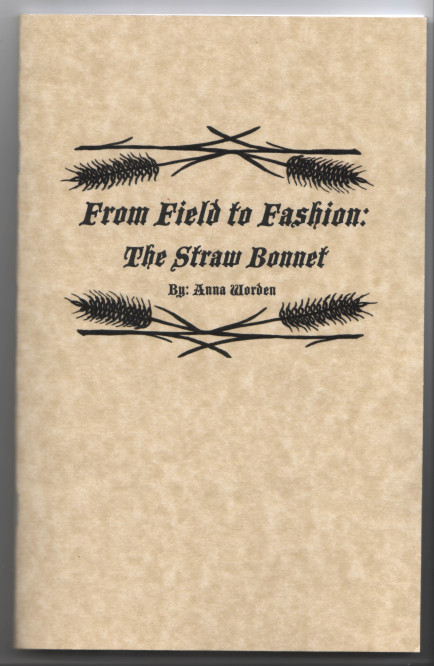
From Field to Fashion is a 46 page booklet with the following sections:
– Straw Bonnets and the Straw Bonnet Industry
– Straw, Harvest and Preparation
– Straw Plait
– Straw Cloth
– The Straw Bonnet Base
– Industry and Labor
– Finishing the Straw Bonnet
– Who Wore a Straw Bonnet When?
and an Appendix:
1 – Original Bonnets Online
2 – Bonnet Production in Massachusetts, 1855
3 – Millinery Establishments by State, 1860
4 – Straw Bonnet Shapes
5 – Fashion Quotes from Harper’s Monthly & Weekly
6 – Fashion Quotes from Godey’s Ladies Book
7 – Straw bonnet quotes from fiction
8 – Wheat and Rye produced, 1850 & 1860
9 – Straw Industry Statistics
10 – Straw and Bonnet Related US Patents




 If I Had My Own Blue Box: