Petersons 62 February illustration
This one should say Chairs and Sofas….
Another aspect of the chair seats I feel we need to look at is cushions. Take a look at what is said in The Workwoman’s Guide about cushions. (I’ll admit, I hadn’t thought about cushions to take to church.) Cushions and coverings not only made the chairs and sofas more comfortable, but protected them as well.
When chairs and sofas are fitted up with damask, merino, stuff, horse hair, or other material that does not wash, they are generally covered with Holland, chintz, or glazed calico, and protects them from dust and dirt, and are easily removed, when required for company. Holland covers are the most durable, but look cold; chintz to fit the chair or sofa, with or without piping at the edge, and with loops fastened down by passing one of the strings through the three loops, and making it tie. Ottomans generally have the covers to fit along beneath the edging of wood, in which case, they must be pinned to the stuffing with very strong pins, which from their length are called sofa pins.
Arm Chairs
It is a good plan to make a kind of case of Holland to fit half way down the cushion, A B C D, which protects the cover from being soiled by the head, on leaning back. Each arm chair should have two or three of these cases for wash and wear.
Church Basses
Flat circular ones are often in use. Sometimes straw ones are covered with green or crimson cloth, and look very neat. Basses may be filled with mill-puff, straw, chaff, bran, or bits of cloth, &c. Some persons prefer a simple cushion or flat pillow to kneel upon, in which case, they may be filled with feathers.
Church Seats
Church pews are generally lined with cloth, and fastened by brass nails andn binding laid on. The cushions, are oblong, and made like a very soft mattress.
They have pieces of cloth, bound round and sewed to them in front, to give an air of comfort and neatness to the seat. The ground or floor is generally covered with a drugget of the same coulour as the lining of the seat.
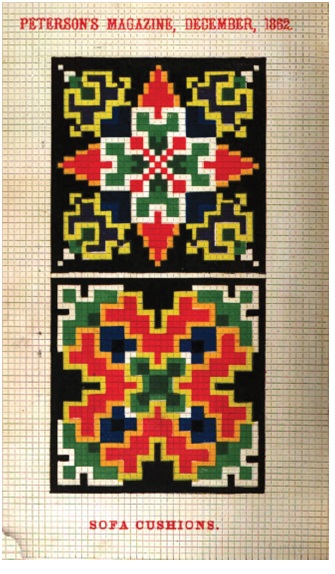
This color plate from Peterson’s shows two colorful sofa cushions.
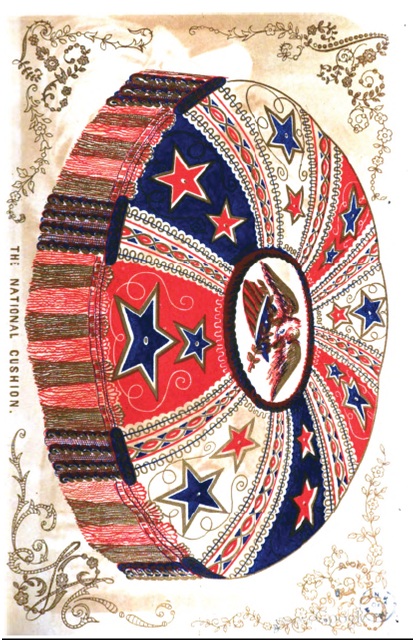
This patriotic cushion comes from an 1850 Godey’s rather than one during the CW.
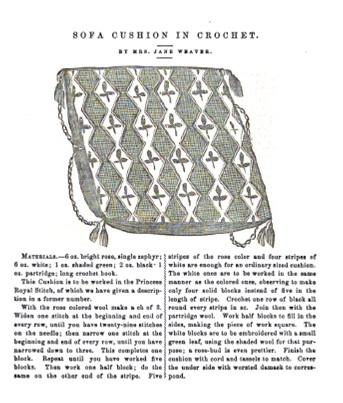
This is a crochet cushion from Petersons in 1862.
1857 was a popular year for chair and sofa cushions in Godeys with these three included:
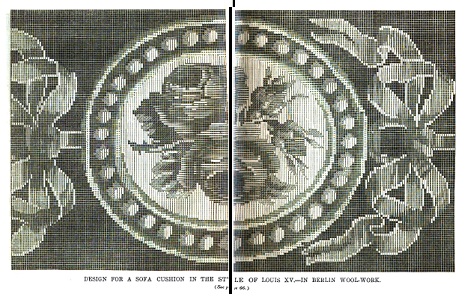
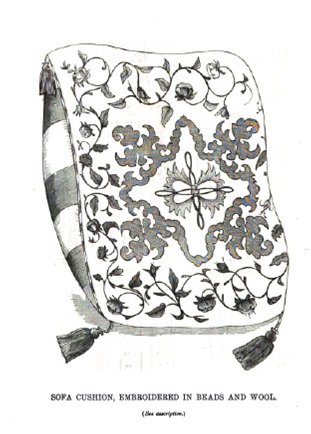
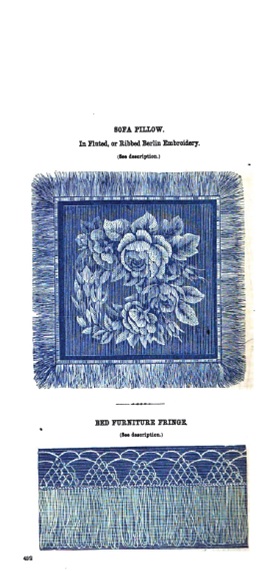

This is a bit delayed… I am going to attempt to share an image for discusison a couple times each month for the year (or at least until the season kicks in and we all get busy.)
Petersons 62 January Bless its little heart
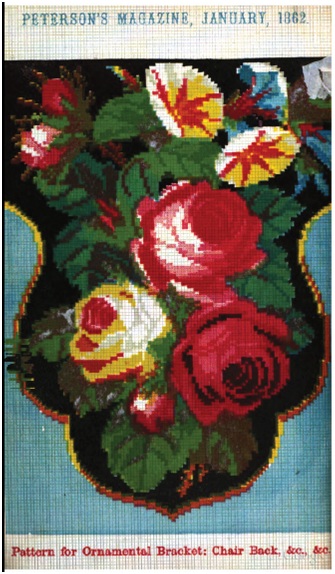
Based on the number of color plates found in Peterson’s and Godey’s in the 1850s and 1860s, I would like to assume there was some level of popularity in making chair seats. This chair seat shows the curved edge shape generally seen with some variation in the publications. Worked in needlepoint, it has a floral pattern that covers nearly the entire seat.
While the previous seat is symmetrical, this chair back is asymmetrical in its floral design.
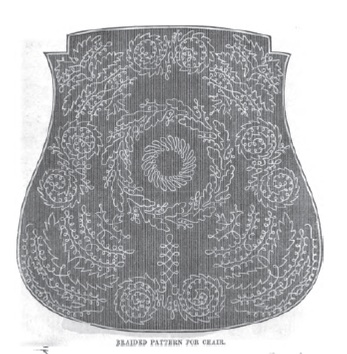
This seat, done in braid, is from Peterson’s 1857. You can see the notches at the top where the seat will fit into the wooden construction of the chair. I would like to find extant examples of a braided seat to see how well they did or did not wear.
When I saw this faded, horribly scanned seat design, I just had to share it. I pieced it back together from Google Books’ edition of Peterson’s. The symmetrical geometric design has a sorta southwest feel to me. Now, I highly doubt that is how those originally reading the magazine, looking at this illustration would have seen this though.

This chair cover also has the distint shape of the chair’s seat. 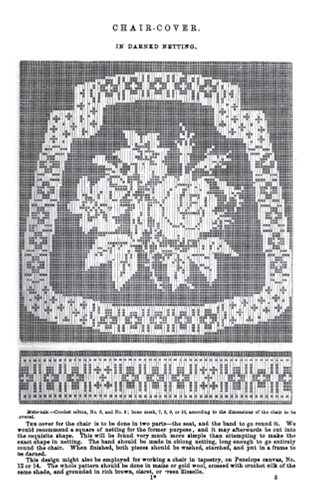
A while back I was asked to look into the seats for chairs, especially folding chairs. It has been quite some time and technically I just have a bunch of notes. Over the next several posts, I’ll be sharing some of these notes in a roughly organized format. We will look at the original seats on chairs, illustrations for homemade seats and cushions.
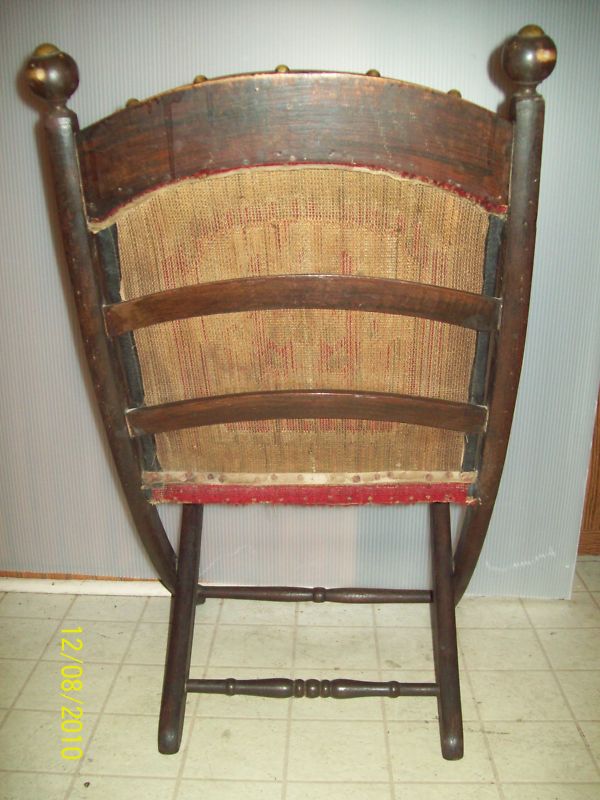
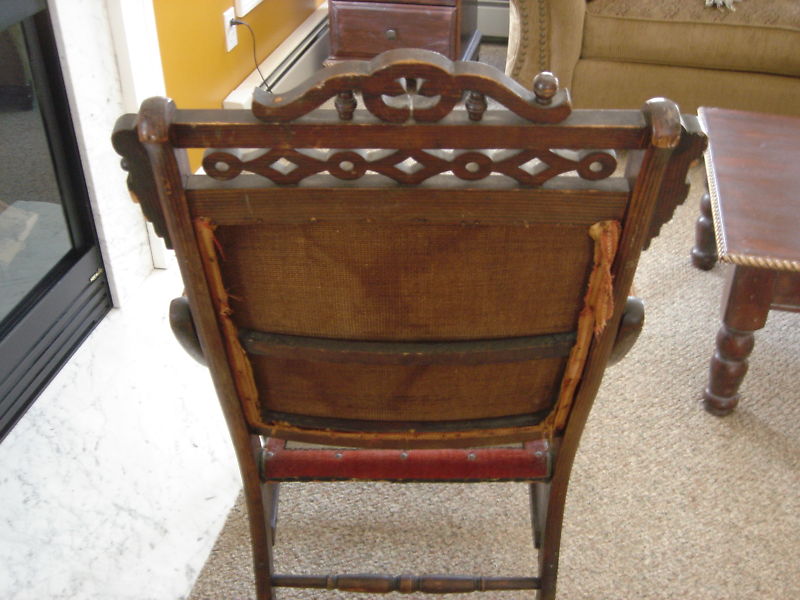
Let’s start by looking at the seats and backs on some original folding chairs. Each of these chairs are appear to have their original seats and backs. The chairs date from the 1860s through the end of the century.
This faded and worn seat comes from my later century chair. Notice the wreath central design and floral corner motifs. The use of a central motif surrounded by corner or border motifs seem to be fairly common for these chairs. The seats and backs seem to mostly be either tapestry twill woven similar to an ingrain carpet or done in needlepoint.
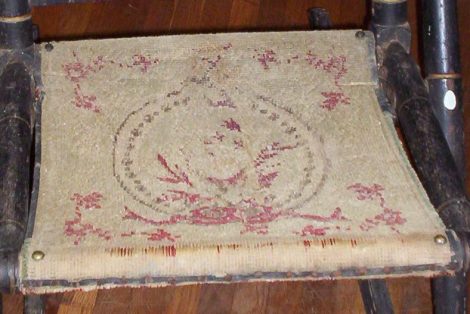
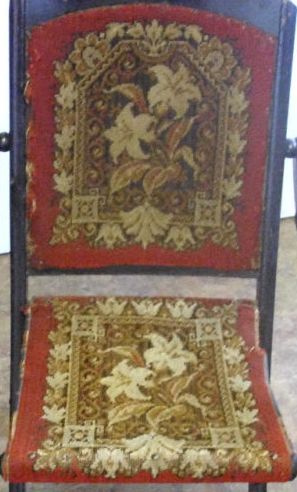
This chair, circa 1870-90s, has a duo of lilies as the central motif. The borders are a combination of geometrics and florals.
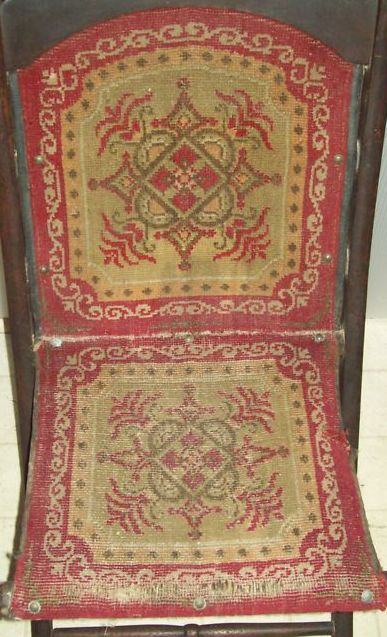
This chair, the one of this set closest to the CW era, has a central design with a floral-esque border. You will notice that the red color can be found in each of the chair seats and backs here. I do not know if this was because this was a common color or if this color just lasted well.
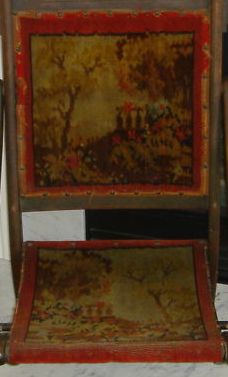
These scenic designs are found on an Eastlake style chair. I wish I could get a closer look at this one to determine the construction method. The lines in the edge of the red appear to be carpet-like.
IMAGES ADDED…..
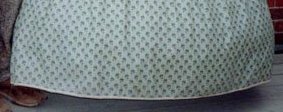
We wrap up this week looking at the bell shaped skirts and hems of recreated dresses.
Notice the hem tape.
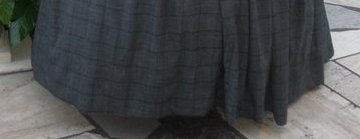
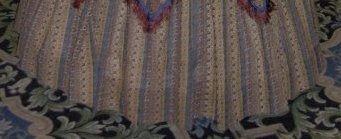

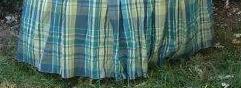
This flounced skirt shows how the bell shape looks with the flounces. 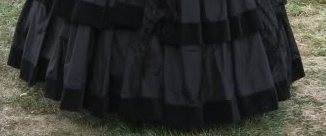
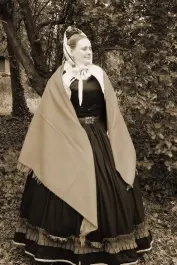
These two originals from Martin’s Mercantile are displayed with a nice bell shape. The skirts drape nicely over the support of a cage and petticoats creating the nice, soft bell that comes out and drops from about the lower calf down.
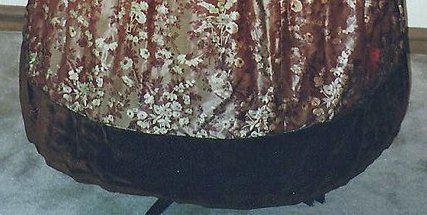
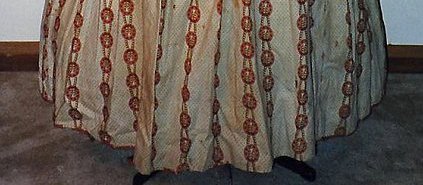
This is technically a 30s dress but it shows how the skirt backing construction process was well in place. 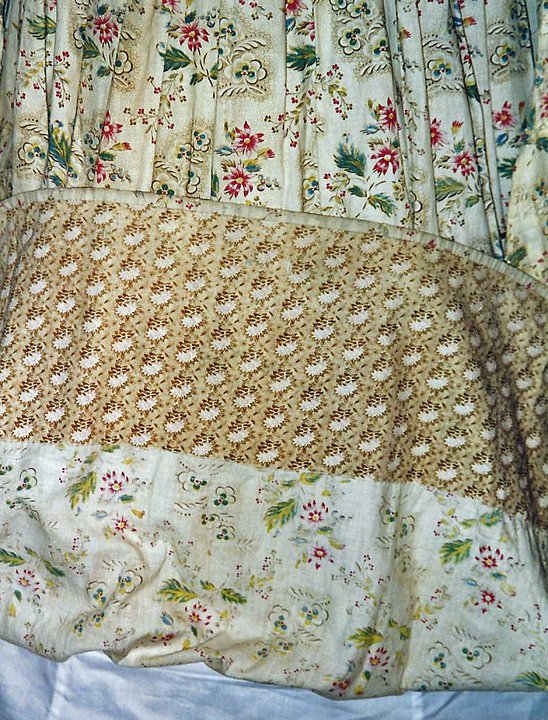
After looking at the top of the skirt last week, let us look at the bottom this week. This includes both the shape and the construction.
This skirt, which is a 3/4 turn view meaning she is slightly turned to the side, shows the bell shape through the bottom of the skirt. In the front, left, you can see a hint of what might be the hem tape.
 This working class mom (those are the feet of her sons on either side of her) has a solid color skirt, likely wool, which shows the hem tape nicely.
 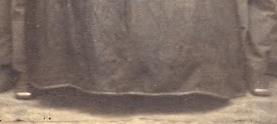 This well tucked wool skirt shows the hem tape. The bell shape is nicely defined. See how the skirt’s bell shapes from about her lower calf down?
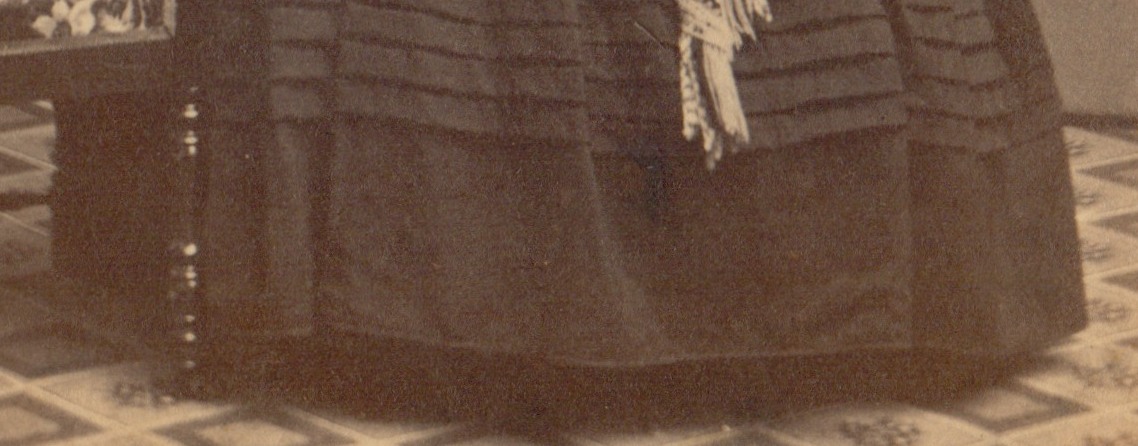 This skirt shows more of the bell on the left hand side than the right. But, what I find interesting (in addition to the panel seams) is the wear evident at the bottom.
  This image is harder to see due the the coloring and scan. The skirt does have a nice bell shape.
I find this Saturday morning I am utterly disheartened and dismayed to the point where I am seriously tempted to just pack up all the costuming, research etc and find a new hobby or interest. In light of being symbolicly told that something I consider to be of primary importance is unimportant, a complete change seems appealing. At the moment a mideaval tunics or a little craft club seem nice.
Besides, eliminating the extensive clothing, fabric, objects, etc. would make the need for a larger apt go away. (Having a gut instinct vs logical math inner conflict)
So, we shall see…….
On the Fridays of this series we look at how seamstresses and reenactors recreate the look of the area we are discussing. Today comes an additional observation. While looking through my images for those to show the waist area, I discovered we must be standing differently in our modern photos because I couldn’t find as many clear shots of the waist as I wanted. In most photos, our arms are covering the area. When pulling CDVs, it wasn’t difficult at all to find clear views of the waist. That is something to think about.
Here is Colleen who has a nice transition off her bodice into her skirts. The poof is developed from her skirt construction and the layering/positioning of her petticoats underneath.  Here is Samantha in her sheer dress which transitions fully off of her waistband with less poof developed from a solid petticoat foundation and the gauging in the sheer fabric.




 If I Had My Own Blue Box: