“Travelers and Traveling” from 1860

I stumbled across this article, “Travelers and Traveling” by Mary A. Denison in Peterson’s Magazine from 1860.

I rather enjoyed the first part, but then it took quite a twist.

“Think for a moment of the masses moving in every direction. From homes of wealth and of poverty they come – from the emigrant’s little cabin of mud by the wayside, and the palace of the titled noble – on the they throng, men, women, and children – sick and well – joyful and sorrowful. Some are in the first flush of wedded happiness, on their bridal tour – some are leaving the home of youth and childhood, where they have been sheltered and fondled, to seek a scanty living in a heartless world. Some go at the call of husbands to the land of the golden mountains – some to while away a leisure that is wearisome, to fill a void no earthly pleasure can satisfy. What endless packing of trunks and bags is perpetually in progress from the rising of the sun till its going down! Did you ever think of it, reader? How all th avenues of commerce are crowded with the constant coming and going of articles needed for transportation. Fourteen trunks carried off from the steps of our next door neighbor, who is going to show her two or three dozen new “loves” of dresses at Saratoga. “That place where really noblemen go sometimes, dear!” Truly man (and woman too) is a living locomotive, under full pressure, flying flashing from town to town, from country to country, never at rest, puffing and blowing, and steaming it through the world. Those who have pockets full of money, and can afford to wait for detention of boat or car, ought to enjoy all the delights of traveling. They can stop when they please, put up at the most expensive hotels, keep a hody-guard of waiters about them, all the time, by a liberal supply of the cash – be stared at, talked about, admired, and envied to their hearts’ content. To such, there is scarcely a higher pleasure than to make a sensation. They love to hear the sly side of communication, “Guess he’s rich.” They love to sit in state, on the right hand of the master of ceremonies – to have the wants of their wives and daughters attended to first, and themselves listened to as “Sir Oracles.” So, their little hearts are contented. Then they smack their lips, and talk smoothly of the little things, whose cognizance has chanced to pass through the avenue of their very limited brains. Others, languid and faint, to whom a straw is a burden, endure with indescribable anguish the discomforts of travel. How often have we seen some pale face, touching in its uncomplaining sorrow, leaning wearily upon the seat of car or steamboat! When the bosom is burdened with sighs, and brain and heart are throbbing with pain, the loud laugh of the throughtless, the chit-chat of the happy, the bounding steps of the little child – how strange they seem! One thought only fills the mind – one star shines through the deep gloom – it is the thought and the star of home! They are going home! The dear, old mother is there. At her touch the fires of the brain will sink into slumber; the heart will throb less heavily. The pillow and the couch are waiting there – the voice of love – the prayer of faith. So long the earth –weary for heaven! Sometimes there is a fugitive from justice on board, who sits in sullen silence, with clenched hands and teeth, and hat drawn over his brows. He dares not look at a single face, for he feels that on his own is branded an indelible mark. As the train nears the village or the town, he cowers in deadly fear, for he knows the very lightnings[sic] have proclaimed his guilt, and the officers of outraged justice are on his track. Poor, guilty wretch! was the paltry gain worth all this shame and anguish? The selfish traveler makes his mark. The windows shall be shut and opened, as his sovereign will dictate; though the winds, soothing to him, strike the chill of death through a tenderer frame, he never disturbs his precious self. He is an unabated nuisance – turn him out. It is passing strange, that many travelers, especially mothers with little children, will not take the precaution to provide themselves with water for the journey; a flask and dipper, or tumbler, would not take up an inconvenient amount of room, and would save much annoyance. Once, in traveling, we were seated near a little family, consisting of a mother and two children – one of whom was quite ill – and an aged grandparent. For the first part of the journey all went well, water could be obtained at the depots, to cool the parched lips of the little stranger. But night came on – a stormy night of wind and tempest, and the child grew very sick and impatient; we seem to hear her moaning little voice, faint, weak, and imploring; we see those large, languid blue eyes floating in tears. “Drink, mamma! – drink, drink, mamma!” resounded at constant intervals, accompanied sometimes with bitter cries. We wondered that we had not thought of obtaining water. The mother, worn out with watching and fatigue, burst into teas and sobbed piteously, while the little voice kept up its pleading, monotonous cry, “Drink, mamma, drink!” The fever burned her lips; her cheeks blazed; her breath was like fire – yet no water could be had for love or money, along the route of the rushing train. Think of it, the child was dying of thirst – absolutely perishing for water – and the thoughtless mother had no resort but teas. Could they but quench the poor child’s thirst, we could have wept till morning. Alas! when morning came the little sufferer had put on wing. She died in the cars, and – here we will leave the subject. It may induce some to think.”

Published in: on September 18, 2012 at 1:00 am  Comments (1)  
Tags:

Latested Edition

The latested edition of the Citizens and Soldier’s Digest is now available on their website. This edition is filled with several articles of interest.

My husband has positively commented on the article discussing blue pants. He is quite thankful for the information.

Published in: on September 17, 2012 at 1:24 am  Leave a Comment  

Slipper progress

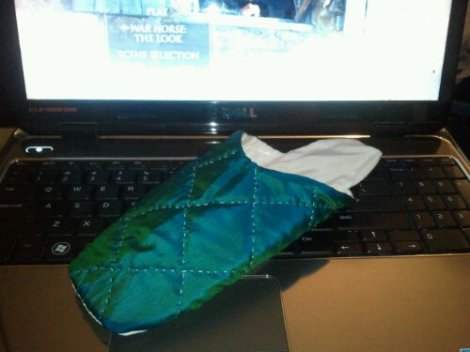
This evening I finished up the quilting and pieced together on slipper. Here it is inside out with a hint to what movie I watched while sewing.

image

Here it is right side out.

image

I opted for wider spaced quilting. I just couldn’t confine this silk with tighter spacing. Maybe the red.

Left to do…. the same for the other slipper, the leather & cork soles (I don’t think I’ll be doing the wool as planned) and the ruching with rosette. The last part will let me play with the lines some more. I’m trying to get a slim/sleek period look while also fitting wide feet.

Published in: on September 12, 2012 at 6:56 pm  Leave a Comment  

Quilted slippers progress

I felt like quilting today. One and a half slippers are quilted. The silk’s weave is very tight. So, it was slow going.

image

Published in: on September 11, 2012 at 5:56 pm  Leave a Comment  

Quilted Slippers Project

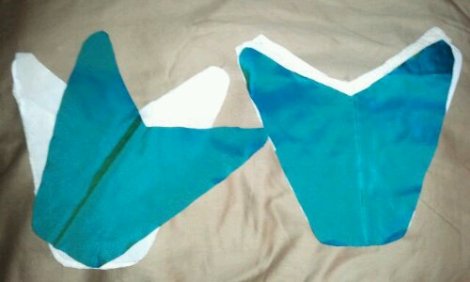
I finally got around to cutting out my slippers. I figured, if I put them on my fair entry form, I should start them. Right?

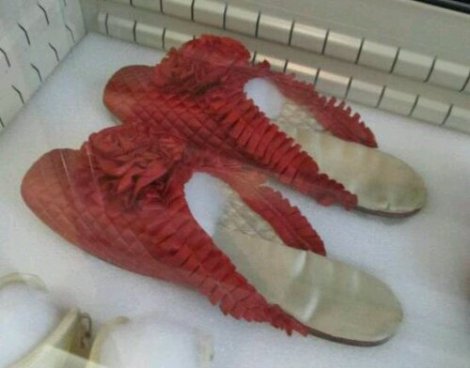
Here are the must have inspiration slippers from the Buffalo, Erie Historical Society:

image

This is the fabulous tealy-green I’ll be making this first pair from (yes, I will make a red pair too):

image

(Goal – post photos at each stage)

Published in: on September 7, 2012 at 5:13 am  Leave a Comment  

Fanciful Utility is released!

ESC Publishing and I are very excited to bring you…

Fanciful Utility: Victorian Sewing Cases & Needle-books!

This book is packed full of detailed instructions for making historically accurate sewing accessories. Each one is based on an extant example or nineteenth century directions. The 180 pages contains 117 illustrations, templates and numerous project variations, over 68 variations actually.


Fanciful Utility…. Major Announcement!

It is ready!

Please hop over to the Sewing Academy announcement for all the details on Fanciful Utility and how to order.

I am so excited for you all to see this book. It is 180 some pages filled with over a hundred illustrations and templates for 68 project variations.

Published in: on September 1, 2012 at 4:25 pm  Comments (2)  
Tags:

Meow

I just had to share this one from Vicki Betts’ nwspaper research…

DAILY CONSTITUTIONALIST [AUGUSTA, GA], May 23, 1861, p. 3, c. 1
Lost Cat.
            The valuable cat which we noticed a short time since as having taken up quarters at the Georgia Engine House, has been lost, strayed, or stolen.  She had on, when missed, a red leather collar, with a silver plate, on which is engraved the name of the cat, “Georgiana.”  Any person finding the animal, and leaving it with Captain T. A. Bones, at his hardware store, will be suitable rewarded.  

Published in: on August 30, 2012 at 5:09 pm  Leave a Comment  

Footwear related tid-bits

From Vicki Betts’ newspaper research:

NASHVILLE DISPATCH, October 24, 1863, p. 2, c. 2
“About Stockings.
                The Empress Eugenie, having established crinoline, has allowed her imagination to take a lower flight, and aspire to set the feminine world its fashion in the matter of stockings.  She has discarded white stockings, and wears blue and white striped, though she should have added a third color, namely, red, and then she should have the tri-color just where the legitimists would to have it like under her foot.  Can her hostility to white stockings be based on the circumstances that white is the old Bourbon color, if white can be called a color?  Certainly the change she has introduced cannot be held an improvement, white stockings being for woman the prettiest things in which they can put their pretty feet.  “A white stocking is infinitely more effective than a black one,” says Mr. Hawthorne, speaking with express reference to young women’s feet, and so forth; and few will dissent from his opinion.  It is better than any other kind of stocking.  James II, when Duke of York, preferred to green stockings, on an interesting occasion, as readers of Grammont will recollect; but he was not a disinterested judge.  Blue stockings are objects of prejudice, though Francis Jeffrey said that it mattered little how blue the stocking is, provided the petticoats be long enough to hide it; but long petticoats are a nuisance, and petticoats never can be tolerated long anywhere.  Black stockings ought to be worn only under peculiar circumstances.  Flesh-colored stockings are open to the charge of being delusive.  The yellow stocking belongs properly only to English charity boys; and the red stocking should be confined to very young people, or to persons old enough to be in their second childhood, or to cardinals.  Pink stockings are nice in their places, which are the feet of young women, but they do not show well on either middle-aged or large ladies, who are often very handsome, and therefore should have handsome footings.  In fact, the pink stocking is fit for girls only.  Grey stockings go well with grey hairs. Mixed, or speckled, or spotted, or ringed, or streaked stockings can be used for show only by children, though some of them answer for a change.  But none or all of these can displace the white stocking, which is an old favorite, and not to be put down, though occasionally it may be thrown into the back ground.  Like the hoop, it is never long out of fashion.  The French Empress will find that she has “put her foot into it” by taking it out of the white stocking, which is to women what to the garden is the white rose.”

MEMPHIS DAILY APPEAL [MEMPHIS, TN], March 3, 1861, p. 1, c. 2-3
“Ladies’ Dresses in Muddy Weather.
            It is an unpleasant sight to see the ladies on the streets, on rainy days, allow their dresses to rail in the mud.  This is unpardonable.  There is no impropriety in raising the skirts high enough to keep them out of the dirt.  There is a very unladylike prudery in refusing to raise them slightly when cleanliness requires it. It is not necessary, however, for any lady to hold her dress with her hands to keep it out of the mud.  The English woman, says an European writer, understanding these things better than we, go out walking in rain and mud, wearing long dresses, and without taking their hands from their muffs, come home with the clothing as clean as when they started.  How do they do it?  They wear skirts that do not reach lower than the ankle; short enough, in fact, to keep clear of the mud without any lifting.  The dress is worn long, but is looped up when the lady is in the street.  The loops are a late invention, and are now the fashion in Great Britain.  A woman who should go out in muddy weather without them would be considered a prude.  They are made thus:
            There is a belt of black ribbon, three quarters of an inch wide, and long enough to go around the lady’s waist, with a hook at one end and an eye at the other, as a fastening; a piece of the same kind of ribbon, three yards long, is attached to the end and the middle of the belt.  The belt is now put on with the hook and eye in front; and hanging down on each side is a loop of black ribbon, three quarters of a yard long.  When a lady is about to go out, she puts on her belt, and puts a part of the lower portion of her dress through each loop, which is thus raised into four festoons, and all of it is above the lower edge of the petticoat.
            She then walks out with her hands free, her dress clear, and her conscience at ease; and if she wishes to enter a house, she can take her dress out of the loops in an instant.  The looped dress is not only clean but graceful, and it shows a white petticoat, one of the most beautiful articles of ladies’ apparel, to much advantage.  In England, however, a white petticoat is not considered indispensable; on the contrary, scarlet woolen petticoats are much worn by most fashionable people, as are also red woolen stockings.  Indeed the white cotton stockings are the exception, and not the rule for London wear in winter.  Wool is ordinarily worn, sometimes scarlet, or scarlet with black stripes, or plaid with a variety of colors.  And then, the shoes are not of thin cloth with paper soles, but Balmoral boots, with heavy uppers and thick soles, lacing up in front, as if they were made for beings of flesh and blood, bred on roast beef, and good for real service, hard work, sturdy health and long life.  Our American women are too much in the habit of following bad fashions, and neglecting good ones.  If they will just adopt the healthful practices, as well as the expensive luxuries, of European aristocracy, it will be far better, as well as more creditable to them.  We are glad to see, however, that a correct taste is being exercised by our ladies.  They study health and comfort more than the fashions, and we may expect to see them as rosy-cheeked and robust as any of our English cousins.—Home Journal.” 

DAILY CONSTITUTIONALIST [AUGUSTA, GA], April 14, 1861, p. 3, c. 2.
            “Protection for Woman’s Foot.—Women must go much in the open air at all seasons of the year, or become pale and feeble.  But in order to do this, their boots must be radically changed.
            As preliminary to this greatly needed reform, we must first get rid of the strange hallucination that where a strong man needs cowhide, a feeble woman needs only morrocco; that where a strong man needs an inch of hard, impervious sole, a feeble woman needs only a quarter inch of soft, spongy sole; that where the strongest Irishman needs thick woolen socks, a delicate, consumptive lady needs only a gauzy silk stocking.  This singular madness must be first scattered.
            But surely one need not seriously discuss such a matter.  If women must go much in the open air at all seasons of the year, (and no one with five grains of common sense doubts it,) then it needs no argument to show that women should wear as much protection on their feet as men find it necessary to wear.  Neither can it require much argument to show that those rubbers which prove so pernicious to the feet of men, must, to say the least, be quite as unhealthy for women.
            Prescriptions for a Fashionable Lady.—Madame, allow me to prescribe for you.  I have had a long experience in the management of delicate women, and believe I can give you some important advice.  For the present, I prescribe only for your feet:
            1.  Procure a quantity of woolen stockings, not such as you buy at the store, under the name of lamb’s wool, that you can read a newspaper through, but the kind that your Aunt Jerusha in the country knits for you, thick as a board, that will keep you dry and warm, in spite of wind and weather.
            2.  If you want to be really thorough, change them every morning, having the fresh ones hang by the fire during the night.
            3.  Procure thick calf skin boots, double uppers and triple soles, and wear them from the first of October until the first of April.  Make frequent applications of some good oil blacking.
            4.  Avoid rubbers altogether, except a thick layer, which you should have cemented to the bottom of the soles.
            5.  Hold your feet in cold water an inch deep, five or six minutes before going to bed, and have them rubbed hard with some one’s naked hand.
            6.  Now, Madame, go much out of doors at all seasons, and believe me not only will your feet have a good circulation, but, as a consequence, your head will be relieved of its pain and congestion, and your heart be relieved of its accumulations.—Boston Journal of Physical Culture.  ”

(Hmmm… found the text limit when posting from my phone.)

Published in: on August 30, 2012 at 5:08 pm  Comments (1)  

Millinery Ribbon Talk

I’ll be talking about millinery ribbons and displaying ribbons from my collection this Saturday, August 25th, at the Genesee Country Village for the “Wrapped Up in Silk” event.   I’ll be in the Romulus Seminary on the village square in the morning. Stop in to see the ribbons and say “hi”.

Published in: on August 21, 2012 at 12:12 pm  Comments (2)  
Tags: