Lovely Blog Award

As with Quinn, I too am fond of the word “Lovely.” I am quite flattered Quinn of The Quintessential Clothes Pen has nominated me for the One Lovely Blog Award. Thank you , Quinn!!! (If you haven’t had a chance to read her blog, hop over to see her stunning projects as well as their inspiration.)

This award is a way of recognizing fellow blogs and blogger. There’s a list of things to do:

1. Thank the person who nominated you.
2. Add the ‘One Lovely Blog Award’ image to your post.
3. Share seven things about you. 
4. Pass the award on to seven nominees. 
5. Include this set of rules.  
6. Inform your nominees by posting a comment on their blogs.
The easier part first. My nominees are….
The Sewing Academy – An excellent resource for mid-19th century clothing. 
 Anna In Technicolor – A fun blog looking at historical and vintage clothing.
The Pragmatic Costumer – An eye-catching blog that connects pieces of costuming and culture brilliantly.
 CW Civilian Living History – An informative blog looking at LH in Texas.
 Romantic History – A beautiful blog exploring many eras.
Miss MacRae’s Blog – Tid-bits of history.
A Graceful Lady – An all around beautiful look at the world.
The harder part, seven things about me. Um??? How about seven things I love?

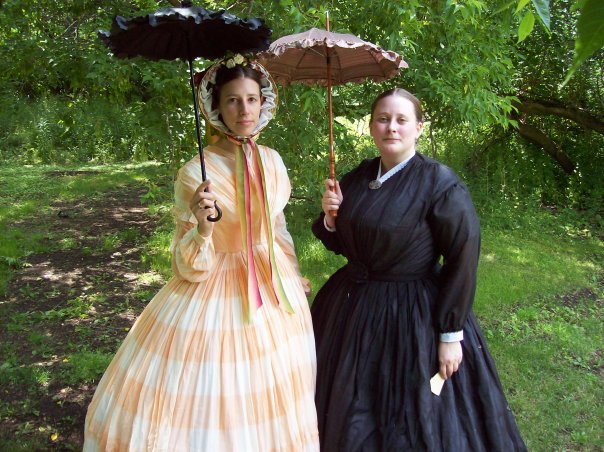
 1 – My husband, Dan. (WordPress seems to think we should be sideways.)

2 – My family

2a - My familyb3

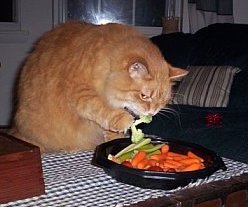
3. My favorite feline. (Fluffy, long-haired ginger cats are fabulous!)My favorite feline.

4. Relaxing lakeside. Whether it is Plattsburg or Canandaigua, there is something about the beauty and tranquility of these lakes.

5. Shady days with friends.

6. Spicy Asian Food. The veggie kind.

 7 – Chocolate, no, silk, no, chocolate, no, silk, no, chocolate, no, silk……… um……

Published in: on January 16, 2013 at 11:02 am  Comments (1)  

Proprieties in Traveling

To start the year, lets look at the “Proprieties of Traveling”, in this passage from At Home and Abroad; or, How to Behave, by Mrs. Manners. (Evans & Dickerson: New York, 1854.)

Proprieties in Traveling

It is not an uncommon thing to find young people who are considered well-bred, and pleasant-mannered at home, not simply regardless of proprieties in traveling, but so inconsiderate of any thing but their own comfort, that they become great nuisances to other travelers. This is the case with such children as are only superficial in their conduct; I mean such as behave, because they have been taught that this thing or that is vulgar, and low-bred, rather than because their hearts are trained to kindness, and their politeness is its outworking. When thrown into new scenes, and exposed to disagreeable circumstances, they act out the natural impulses of their selfish, or querulous spirits, and become wonderfully unpleasant companions,

In bright contrast to these is the conduct of the amiable and unselfish. To be an agreeable traveling companion is a great recommendation, and is a character all would wish to bear if only they could “see themselves as others see them.”

I have traveled much in the last few years, both by sea and land, and, as I am apt to do, I have made many observations on the people around me. I have had occasion to note the well-bred and the ill-bred, the amiable and the unamiable, and have drawn from their conduct some important lessons.

Before I speak of behaviour, however, I wish to refer to some proprieties of dress and other preparations for a journey, which it is desirable to attend to.

Nobody who is aware of the “wear and tear” which assails her garments on a journey, will wear fine or light, or otherwise delicate dresses, or shawls or bonnets. Exposure to the weather, which may unexpectedly become stormy; to the dust, and to the rudeness of those around, in the rush and crush which are the characteristics of traveling now-a-days, will effectually ruin almost any kind of clothing. Ladies, therefore, are accustomed now to provide themselves and their children, the plainest and most substantial kinds of dresses, shoes, shawls, coats, bonnets, and hats. All silks, laces, embroideries, fine ribbons, muslins, and jewelry, are considered, very properly, to be in bad taste in railroad cars or steamboats.

If it is desirable to wear a broach, let it be of the plainest and simplest kind. Wear your watch chain out of sight, or suspend your watch, as some do, by a black cord or ribbon. A thick veil is indispensable, as you are liable to be much annoyed by dust, or smoke and cinders, and also by the stares of rude and vulgar people with whom you are liable anywhere to come in close contact.

As for dresses, a plain-coloured foularde in summer, or a neat linen chambrey, or better still , a de bage, are appropriate materials. Plain straw bonnets, with green or other very neat coloured ribbons on them; linen collars, under handkerchiefs, and cambric sleeves, gloves to match the dress in hue, and gaiter boots, completes a neat traveling costume for ladies. Gentlemen usually carry traveling caps in their pockets, and wear loose brown linen sacques over their coats. It is a good plan to provide yourselves with convenient baskets which will bold night clothes, combs, and brushes, a small needle-case – containing sewing materials, and a pincushion. In addition to these, a bottle of good cologne is of great use; its odor is reviving, and it will refresh you to rub your hands and face with it, where it is not possible to make as plentiful use of water as you desire. I carry, in addition to these, one or two small towels, and a sponge. Children want crackers, oftentimes; and apples are good for them. But candies, cakes, juicy fruits, tarts, &c., are not only unwholesome, but make their faces, hands, and clothes so dirty, that they are to be avoided by all means. Linen coats, trowsers, sacques, and aprons, are best for children’s clothes, unless the weather is very cold.

As children seldom travel alone, it is to be supposed their parents, or those who have the care of them, will keep a close observance of all they do, and try to prevent their becoming annoyances to those around them. On thing, however, the children themselves must attend to. That is, that they pay the most entire and unquestioning obedience to any command given to them, or wish expressed, by those older. There are so many perils attending journeys, especially in these latter days , that there cannot be too much care exercised by their guardians, or too implicit obedience paid by the children. I shall reserve, for another chapter, my personal observations in my journeys.

Published in: on January 12, 2013 at 9:00 am  Comments (4)  

Fashion Plate Pretties

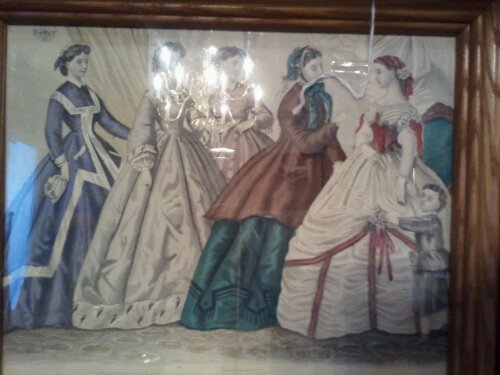
While looking for a couple pieces of furniture we need, I saw a few fashion plates.

This one caught my eye first because of the red cloak. I love red.

image

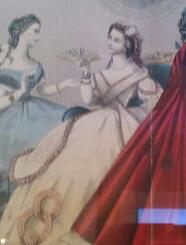
Then I saw the fichu.

image

This plate was next. Actually, I almost missed it because I was looking at a cat painting.

image

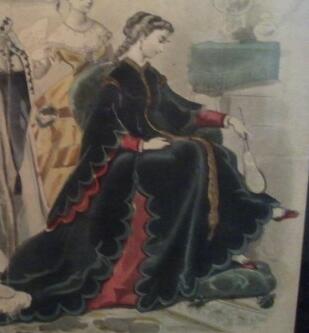
I am glad Dan pointed it out. Do you see that morning wrap/robe?! Wow. I would love to make this. I doubt I have enough of the brown silk velvet. So, I’ll be keeping my eye out for black silk velvet for this dream garment.

image

This is the third print. Nothing screams at me right now. A new green coat is on the list, but it will be longer. I would do this coat if I had just the right fabric, because I enjoy this cut.

image

Published in: on January 6, 2013 at 4:33 pm  Leave a Comment  

Hat Boxes

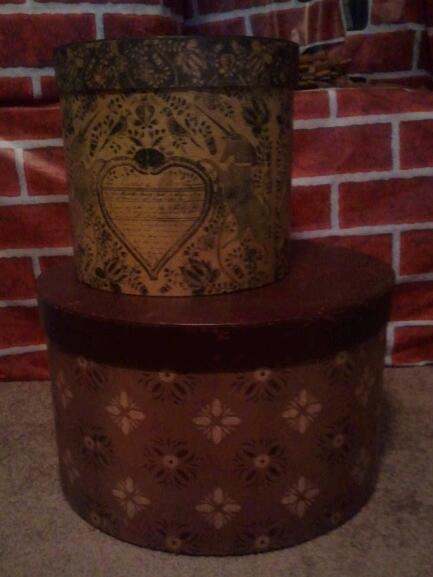
For some time we’ve needed a larger hat box for one of Dan’s hats. It didn’t need to be anything fancy, just something to safely store his hats. At first we were certain Joann’s or Tuesday Morning would have something big enough. Wrong. Their boxes all fell short of the 16.5″ minimum diameter. We even looked at Christmas gift boxes. Finally, I found the right box! Bevin suggested Dogwood Trading Company in Dansville, NY. Please see their contact information below. They had just the right assortment of band boxes. Large. Small. Tall. Wide. Round. Oval. Square. Each one is nicely sturdy. The designs range with many reflecting the look of paper. The prices are very nice too. The bottom box, the one for Dan’s hat, is 17″ across. It is taller than the 8″ his one hat needed. So, I foresee this box holding more than one of his hats. This was only $18.99. The store has at least 4 other prints in this size. They do have a larger one in a beautiful print that looks like a woven blue blanket. Love it! I just haven’t a clue where it would go right now. At the very affordable price on it, I may have to go back for it. There are others this size too.

image

The top box isn’t a size or shape I was actively looking for. But, it looks like it will nicely hold a mid-century bonnet or hood. Plus, look at that paper. It had to come home. An alternative thought process was that while I previously/currently store my bonnets in totes, there isn’t as much tote storage space in this apartment. (Confession – at one point, I had a tower of bonnet totes in my front closet.) It may be time to go back to hat and band boxes for millinery. They look great and are great storage. If you need strong boxes for storage, do give Dogwood Trading Company at try. The staff were extremely nice & helpful.

image

Happy 2013!!!

I hope everyone enjoyed the past couple weeks. I know I enjoyed my week and a half off from work during which I managed not to turn on my laptop, spent some well needed time with family, relaxed with my husband in our new home, hand-sewed some curtains, and just dwelled. It was lovely.

I am rather excited for the new year. Dan and I are in our own place. We have space to organize (which I find to be a fun challenge.) I will have a new sewing room to play in. All around goodness.

This year’s looking forward list is a hodge-podge of activity rather than the traditional beginning of the year to-do list. Let me see if I can group this nicely….

For Fanciful Utility fans:

  • In February, I have an upcoming FanU workshop at the Genesee Country Village & Museum. We will spend a Saturday afternoon learning techniques from the book as we make one of my favorite needle-books.
  • In March, the Mumford library will be hosting a book signing tea. Stop in to my favorite small town library to get your book signed or pick up a copy to have signed. The exact date is to be determined based on the library’s renovation schedule. (This great library is getting a long needed renovation that will give the library more space while preserving the historic building.)
  • Throughout the year, look forward to new templates to accompany Fanciful Utility as well as creative ways to use the techniques from the book.

For Shawl fans:

  • I’m hoping to move forward on the new shawl book……

My general looking forward list:

  • Compile an annotated photo index of my fabric stash as it is organized into the cabinet. Among this stash will be found future sewing projects to include…. a V neck, gathered bodice, flounce skirt sheer 1850s dress… new sleeves for my 1840s dress…. potentially another 1840s dress…. a traveling wardrobe…. a new cotton wrapper…. a long waiting green tropical wool early 1860s dress…. a Regency blue sari dress…. a sheer early 1860s dress …. a new dress or two for Lily as the season needs…. oh, and the court dress.
  • I want to get together a full civilian outfit for my husband. The decade is still to be determined as I think it might be easier to convince him to wear it if it is from the 1840s or 50s.
  • For my relaxation and pure fun of it, I want to do several dresses and accessories for Mae.
  • Finish my red embroidered shawl as well as the ribbon/shawl idea.
  • Pull off a certain secret project by October. shhhhhhh!
  • Keep a regular schedule on both of my blogs. On my personal blog, look forward to stories of getting the apartment organized which will likely reveal some of my obsessions. On the living history blog, my main goal is to finish any series I start. I apologize for the various series I started over the past year and a half but haven’t had the focus to finish.
  • In terms of event to-do, I would like a nice living history event with my husband, a nice civilian event alone,  a social event with my husband (after all he still owes me a dance), some time in the village, a nice event to take my sister to and something educational some place small. (vague, I know)

This 2013 list is far less lofty than previous years’ lists. It is also less specific. My main goals for 2013 is to be happy, healthy and patient.

I hope everyone has a beautiful year.

Published in: on January 2, 2013 at 3:05 pm  Leave a Comment  

Up-coming Needle-Book Workshop

Join me on Saturday, February 16th for a Fanciful Utlity workshop at the Genesee Country Village as we make a needle-book.

319456_10150420792912846_3350978_n

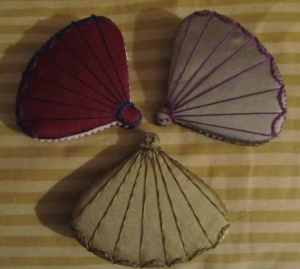
“Spend the afternoon making one of the popular shaped needle-books from the Victorian era.

 You will create a seashell-shaped needle-book with beautiful silk and embroidery. This needle-book is excellent for the novice sewer while giving the experienced needle-worker a place to display her or his skill. Please bring your sewing basket with you, including scissors, needles and thimble.  Age 16 to adults.  Registration deadline February 7.”

Full program details and registration information is here.  All registration goes through the Museum itself. Simply click on the “Reservation Form” on the Museum’s adult education page; fill it out and mail it in. Reservation questions – 585-538-6822.

Keep reading for information on an up-coming book signing tea for Fanciful Utility: Victorian Sewing Cases and Needle-books at the Mumford Library.

Published in: on December 18, 2012 at 10:29 am  Leave a Comment  

Decorating for Christmas in 1869

Excerpts from “Christmas Decorations of the Home” from Cassell’s Household Guide: Being a Complete Encyclopedia of Domestic and Social Economy Volume II, 1869 (published in London and New York.)

“The materials to be used include all kinds of evergreens, everlasting flowers, and coloured and gilt papers. It is a strange thing that, though mistletoe is used in the decoration of house, not a sprig of it is put into a church. But in house decoration no Christmas would be thought complete if there did not hang in hall or dining-room a bunch of its curiously-forked branches, with their terminal pairs of nerveless pale-green leaves, and white crystalline berries.

Holly is of course the special tree of the season. Its leaves bent into various curves, its thorny points, and its bunches of coral-red berries, make it the prince of evergreens. Let it be conspicuous throughout the decorations. It is a good plan to strip off the berries, and use them strung in bunches, as the berries get hidden when the sprigs are worked into wreathes and devices, and the berries, bent into little bunches, dotted about the festoons here and there, look very effective.

Ivy must be introduced with care. Small single leaves come in with good effect in small devices, or to relieve a background of somber yew or arbor vitae. The young shoots of the common ivy are best, or of the kind which grows up trees and old walls, which are very dark and glossy, with a network of light-coloured veins.

Laurel is a very useful green in sprays, and the single leaves may be applied with excellent effect in wreathes, or overlapping one another in borders. The variegated ancuba makes a pleasing variety in the colour.

Yews and arbor vitae are useful, especially the small sprays of them, for covering the framework of devices.

Myrtly and box also are pretty in narrow borderings, into which coloured everlasting flowers may be introduced. The black bunches of ivy berries may sometimes be used with advantage, to give points of contrast in decorations. Of course if chrysanthemums, Christmas roses, primulas, and camellias can be obtained, the general effect is heightened and the decoration becomes more elaborate and more elegant.

[directions for making wreaths]

If holly berries are scarce, a good substitute may be found in rose hips, which may have a small piece of wire passed through them as a stalk, and several twisted together. The fallen holly berries, strung on wire, made into rights, and slipped over the leaves, are very effective, also split peas, glue on here and there in the shape of small rosettes, look like golden flowers, and they may be made to resemble holly berries by pouring over them red sealing-wax melted in spirits of wine.

… Holly strung has a very good effect. It is very quickly done, and looks like a rich cord when finished, and all the banisters in a house may be draped in holly. It is made by threading a packing-needle with the required length of twine, and stringing upon it the largest and most curly looking holly leaves, taking care to pass the needle through the exact centre of each leaf.”

Published in: on December 2, 2012 at 9:09 am  Comments (2)  
Tags:

Lighting a Christmas Tree

I found this little snip-it rather intriguing and a bit horrifying. I just had to share. It comes from the December 1867 edition of the American Agriculturalist. “We housekeepers know that this is really the busiest season of the year, but the work is so agreeable and is interspersed with so much that is delightfully mysterious, we never think of it being work at all, and only regret we have not each two pairs of  hands, that we might accomplish more. Christmas is so near, and then – well – Charlie is coming home from Chicago, and Willie from New York. They will come so late, we must have a tree all trimmed, the presents hung, and the candles ready to be lighted before they arrive. What a pity we cannot have gas out here in the country, and so have a Christmas tree drop-light, like the one cousin Tom has in Liverpool! The most vivid imagination could scarcely convert our little candles and lamps (I beg their pardon for mentioning it. May their shadows never be less, ) into the fifty bright jets which illuminated their tree; or transform Jennie’s doll, which will hover with out-stretched arms over our tree, suspended from the ceiling by a string around her waist – a contrivance of Ralph’s – into the silver Christ-child nestling in the upper branches, “all radiant with light as with a flood of glory,” as Tom described it in his letter to Ralph. Father says if the Petroleum Oil Gas Co. gets to work, and does as well as he thinks it will, we shall have our house lighted with gas before another Christmas. I don’t suppose father would get us a drop with fifty lights, but one with six or eight, as in figures 1 and 2, would be very nice among our candles and lamps. Yes, eight, opened to the best advantage, as shown in figure 1, would quite set off a tree.”

Published in: on December 1, 2012 at 9:08 am  Leave a Comment  
Tags:

Some 19th Century Reading for the Season

Here is a mid-nineteenth century book that takes a look at Christmas, New Years and Twelfth Night. The Book of Christmas: Descriptive of the Customs, Ceremonies, Traditions, Superstitions, Fun, Feeling, and Festivities of the Christmas Season, by Thomas Kibble Hervey (1845)

This short book is filled with history and traditions from the 19th century perspective. The Christmas book: Christmas in the olden time, its customs and their origin : the holly and ivy, sports of the eve, Yule log, boar’s head, the dinner, mummers, Lord of Misrule, Saturnalia, carols, mysteries and plays, boxes, &c. &c, by Pattie & Glaiser (London,1859)  

Another – Christmas in the Olden Time, or The Wassail Bowl,  by John Mills (1846)

Looking for some poetic phrasing for the character growing up in the 1830s? Christmas, a Poem,  by Edward Moxon.

A short to moderate pieces of fiction – Christmas at Under-Tor: An American Christmas Story,  by Clarence Gordon;   Christmas Hours, by Ticknor & Fields (1858)

Published in: on November 28, 2012 at 9:11 am  Comments (2)  
Tags:

Two Surprise Finds – or, When Costumes aren’t Costumes

As many of you know, Dan and I are finally moving. Since I gave away some furniture before going to NM, we are in need of a dining table and bookshelve. Today we stopped in to a warehouse that had some tables listed on craigslist. Inside we found theater sets and racks of costumes instead. Of course, we had to look.

On those racks I found two dresses that needed to be rescued. One is a brown windowpane plaid wool sheer. The other is a simple cotton.

I took some photos to share then rolled them up for a closer look once we are in our place and I can lay them out with some more light. At that point, I’ll take some measurements. Both dresses are study quality because they are damaged and altered in some ways for theater wear.

Here is a slide show of the brown sheer. You will see, it has some significant fracture points in the bodice and skirt. Looking at the bodice, you can see a dart fractured on the left. On the right the same one was removed. There are two darts remaining. The neckline has a very narrow piping. Notice the net applied, likely, at a later date. The waist is pleated through the sides and front; gauged in the back. The change in the turn-over is very noticable. The sleeve is simple a “look at this sleeve”. I look forward to making more notes on it. The net is the same at the neckline. Looking at the repairs and alterations, we see several theatrical ones including one I need to look closer at in the waist on the back right side. There is a,likely, contemporary gusset under the right arm.

This slideshow requires JavaScript.

Here is the cotton dress. This one is either an original or one stallar early reproduction. My ‘iffiness’ is due to a couple features that just aren’t very common in dresses from 1855 to 1865. Maybe these push the dress slightly later time period or maybe it is a costume. The neckline is the big one for me. (of course this is the photo that didn’t come out clear.) The most common neck treatment seen is the narrow piping with self fabric and cord. This has a self fabric strip of fabric that is set on the grain. This brings the neckline slightly higher. The other piece is the closer, actually the top of the closer. This is not a technique I’ve seen before. Two small bits are the piping which is a tad bit thicker than I would expect as well as the lining, which is also a tad heavy. Now, these aspects could just be a utilitarian componant. On the flipside, the aspects that make me think this is an original are the pocket, the deep pocket which is an aspect of mid-nineteenth century dress that moved from a smaller research tid-bit to a wider-known in the past ten years, and the fabric used for the hem backing.

Published in: on November 24, 2012 at 5:05 pm  Comments (1)