A Night in a Sea-Steamer

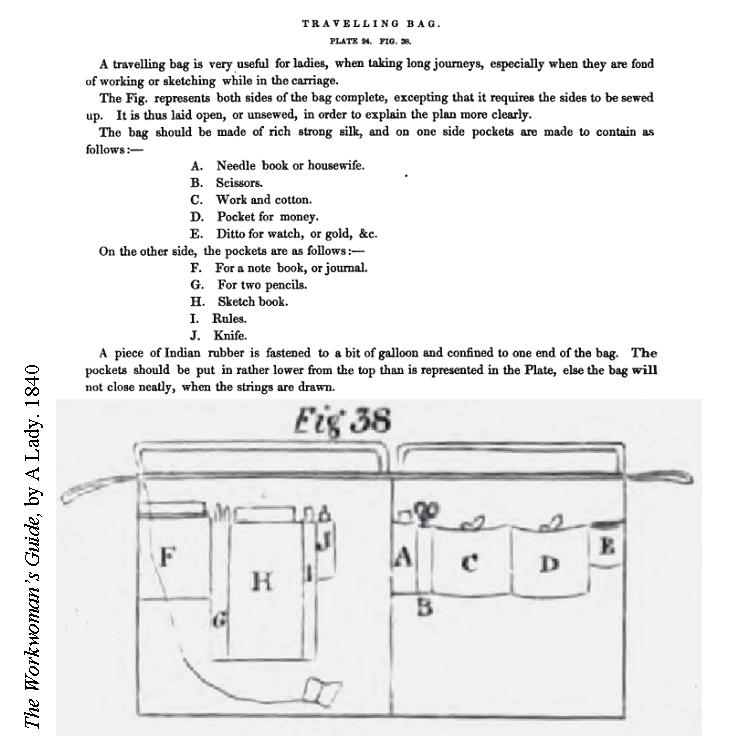
This chapter from At Home and Abroad; or, How to Behave, by Mrs. Manners (Evans & Dickerson: New York, 1854) highlights the different behaviour of passengers on a steamboat in the mid-century. We are so lucky to have sea-sickness medications now. Notice how the one woman who lost her hair, had gingerbread in her workbag. Ginger was helpful, to some extent, for motion sickness.

A Night in a Sea-Steamer

I will not undertake to recall all the many scenes which twelve years of constant travel have brought be, but an incident or two in a recent journey will not prove uninstructive.

When I left the city in which I reside it was in a steamboat, and we were soon at sea, where the water was so rough, and the boat rocked so uneasily, that several of the passengers were sea-sick. Sea-sickness is one of the most unpleasant sensations in the world, and does not dispose those who suffer from it to be very amiable. The little children cared least for it, and though some were sick, it did not appear to affect their temper as much as it did that of some who were older, and ought to have known better.

There were three young girls, who looked very neat in their travelling costume, when they first came on board, and who seemed to be very lively and cheerful, but their liveliness soon subsided into almost total silence, broken only by impatience, and even rude exclamations of annoyance and illness. One was very cross to the chambermaid, who could not do anything to please her; she spoke pettishly to her sister and cousin, which seemed to be the relation the other bore to her. She sent several times for her father, and complained of her unpleasant feeling to him, as if he occasioned or could prevent them. Altogether, she certainly did all she could to make other as uncomfortable as herself, and when I looked at her cross face and listened to her pettish, whining tones, I wondered [if] I could ever have been pleased with her.

Her younger sister was much like her, only she made fewer demonstrations of ill temper; she seemed much more reserved, and would sometimes reprove “Elinor” in a sharp tone for “making such a fuss.” But if she said less, she was certainly no less unamiable than her sister. “Carrie,” as they called their cousin, was a gentle, blue-eyed little girl, who was in reality a much greater sufferer than the sisters were, but she was certainly the sweetest tempered girl; she seemed to try to give as little trouble as possible; she hand gentle tones, and said pleasant words, and even tried to smile when her uncle asked her how she felt.

It seemed they had all been at school during the winter in C., and were now going home, and the father looked very sorrowful as he contemplated the unpleasant countenances of his children, and saw these indications; for whatever change had been effected in his children for the better, it certainly was not their tempers which had improved.

When night came on, and the sea-sickness only grew more unbearable, the confusion became greater, and the scene was sometime ludicrous, and sometimes shocking.

One lady lost her false hair, which, with her side-combs when rolling on the cabin floor, in company with some ginger-bread which strayed from her work-bag. The attentive chambermaid picked them all up, and helped the poor lady to a couch, but her groans were most sonorous and expressive. A curtain was drawn, separating the ladies who, had no accommodations except mattresses on the saloon floor, from the gentlemen, who were similarly unfortunate, on the other side.

Among the ladies was one who had not been long married to her present husband; she had been a widow, and made great pretensions to refinement and intellectual cultivation. The husband was quite a servant to her various whims, which, however, were usually expressed in very insinuating tones. Now, as she rolled on her bed, her groans and complaints were indicative of any thing but refined affection. “Goof Lord, Mr. W.!” “What, my love?” from the other side of the curtain. “Oh, I shall die – I’m awfully sick. Come here and hold my head.” “I can’t, my darling, I also am” – and here his sentence was cut short by sounds of no unequivocal nature. “Come here, I say; what did you take me to sea for, when you could not take care of me? You are a brute, Mr. W. Oh, Lord!” But enough of this.

I have but one more thing to tell, and then I must stop, having hardly finished my sea voyage, and reserving all my railroad adventures for another time.

A friend, who passed most of the night on the upper deck, told me of a little incident which was quite a relief to the usual disagreeable scenes of sickness at sea. There was a lady, evidently from the country, and of plain appearance, who was sitting with her son near the boat-railing. He held her head whenever there came a paroxysm of sickness. By-and-by, the young man also became sick, and was about putting her head down on the bench, while he was to the other side of the boat. A number of well dressed and fashionable young men were walking up and down the deck. One of them observing the mother and son, and the situation of the latter, went up to him at once and kindly asked to be allowed to take his place; and there he sat, and actually held the old lady’s head for two or three hours. When he joined his companions, he had to bear much raillery on the subject of his gallantry, and his odd choice of a lady to whom to be polite. He took it very well, and his reply quite hushed their rattle.

“You may laugh as much as you please, but I thought if she were my mother, how I should feel to see obliged to be neglected, and I am not at all ashamed of the impulse which induced me to offer my services.”

I wish his mother could have heard him; I think she would have been more proud of him than ever. This little incident, and the sweet serenity, under such unpleasant circumstances, which the gentle “cousin Carrie” had shown, impressed me very much, in the contrast they formed, to the usual selfishness of people when sea-sick.

Now, one question would be… which type of passenger would you like to portray? Which would be more educational for guests or an audience? Which would be more interesting? What if you really were motion sick?

 

Published in: on January 26, 2013 at 9:00 am  Leave a Comment  

How to Travel

Appleton’s Illustrated Hand-book of American Travel, by T. Addison Richards (New York: Appleton, 1860) which is actually from the 1857 edition originally, not only gives an over view of how to travel in the mid-century but also the embellishment of the luxury of travel found in some guides of the era. It reminds us read with a critical eye.

To the Traveller: Some Parting Words of Explanation and Advice.

In a journey over so vast a country as the United States, occupying nearly half a continent, and measuring its length and breadth by thousands, and it routes of travel by tens of thousands of miles, one may very readily be pardoned if he sometimes stumbles by the way. May we not beg the benefit of this consideration, if, in our present laborious itineraire, we have occasionally chanced, despite all our watchfulness, to only half look at points of interest or to overlook them altogether; or if, amidst the intricate riticulation of the roads, we may have momently lost our way? We hope, however, that we have not been thus unlucky in any considerable degree, for we have made very honest effort to guide our traveller truly and surely; to show him – hastily, to be sure, as needs must be, yet intelligently – the past and the present, the physique and the morale, of the great country through which we have led him; its differing peoples and places, from the mountains to the prairies – from the cities and palaces of the East to the wildernesses and wigwams of the West.

Though we have thus done our best for the present, we hope to do still better hearafter, as we revise and extend our volume year after year, with the benefit of enlarged personal observations and of the good counsels of others; for we trust that those who follow our guidance will do us the kindness to advise us of any and all errors and omissions they may discover in our pages. To assist them in rendering us this generous service, we have placed some leaves for memoranda, at the end of our book.

….

The Plan of this Book

We have thought it best to follow the familiar geographical order of the various divisions of the country, and thus to begin at Canada on the extreme north-east, and, continuing along the shores of the Atlantic and the Gulf of Mexico, end upon the Pacific, westward. With rare exceptions, we have instead of selecting a particular route and seeing all it offers of attraction, jumped at once to our especial destination, and then imtimated the way by which it is reached. Thus, if the traveller happens to be in New York or Boston, and desires to go to New Orleans, he will, be turning to “New Orleans,” find the routes thither. The chief cities are taken as starting points for all other and lesser places in their neighborhood. It has not, of course, been possible to mention every village or town in the Union, in the narrow limits of a pocket volume, like this.

General Remarks

The foreign tourist will soon observe, to his satisfaction, (and the citizen might remember it oftener, with thanks to his stars,) the great convenience of the total absence in the United States, of all annoying demands for passports – of scowling fortifications and draw-bridges, of jealous gates, closed at a fixed hour of the evening and not to be reopened before another fixed hour of the morning; of custom-housed between the several States, and of all rummaging of baggage by gens d’armes for the octroi; and yet nevertheless, of as perfect a feeling of security, everywhere, as in the most vigilantly policed kingdoms of Europe.

He may or may not like the table d’hote system of our hotels – the uniform fare and the unvarying price; that, excepting in the few metropolitan cities, where the habits of all nations obtain, we must submit to.

From the social equality every where and without exception, he will not suffer, however high his rank at home; and if it be not the highest, he will surely gain in consideration. To win attention and care, both the lofty and the lowly have, and have only, to dispense good will and kind manners as they pass along.

Money

Gold and silver, it should be remembered, are always and every where current, while bank-notes, and especially of distant States, very often are not. Change, too, will save trouble; especially half-dollars, generally the fare of omnibuses and hacks, and invariably the price of meals. Twenty-five cent pieces, too, are useful, as fees for little services by the way. In travelling through the settled districts by the railways and steamboats, and at the best hotels, the daily expenses should be estimated at not less than five or six dollars per day for each person.

Baggage

As little baggage as possible is always a good rule, though a very liberal supply is permitted on the railways and almost any quantity of the steamboats. On the stages, the prescribed limit of sixty or eighty pounds cannot be exceeded without extra charge.

The regular carriages of his hotel will convey the traveller securely and in season, to the railway station of the steamboat landing, where his first care must be to deposit his trunks in the keeping of the baggage-master, and receive a check for each one – corresponding marks will be attached to the baggage, and it will be delivered at the end of the route only to the holder of the checks. It is best to get baggage checked for the entire journey, or for the longest possible stage thereof, and thus save one’s self the trouble of looking our for it more frequently than is necessary.

Before arriving at his destination, the traveller will, on the principal routes, receive a call from an express agent, to whom he may safely resign his check and his address, confidant that his baggage will be duly delivered, and at the fixed tariff  of twenty-five cents for each piece or trunk. On arriving at the end of his journey, he should put himself in one of the carriages marked as in the particular service of the hotel to which he is going. If he employs other vehicles, it will be well to learn the fare beforehand particularly in the city of New York, where hackmen pay but little attention when they can help it, to the law in the case.

tickets

Tickets on the railways should be purchased at the office before starting, otherwise a small additional charge will be made. If a long journey over various roads is intended, it is cheaper and more convenient to buy a through ticket to the end of the route, or for as long a distance as possible. On the steamboats, the tickets for passage and for meals will be purchased at leisure, after starting, at the captain’s office.

Hotels

The hotels of the United States are famous all the world over, for their extent, convenience, comfort and elegance. They are often truly palatial in their sumptuousness, with means and appliances for the prompt gratification of every want and whim. The universal price of board, from one end of the country to the other, is $2 50 or $2 00 per day at the most fashionable, and indeed at all the principal houses. Private parlors and extra rooms involve an additional charge, according to their position. Wines are always extra and always dear enough.

Waiters or Servants

It is not the general custom in America, as in Europe, to fee waiters at the hotels, though it may very properly be done for especial personal service. It is often done by those who like hot dinners better than cold or who may have a fancy for some rare dish when it unluckily happens to be “all out.”

Costume

At the watering places, the same resources of toilette are needed as in the city salon; but though you be thus provided, do not be unprovided with a travelling suit equal to rude usage. If the color be a gray or a brown, so much the better in the dust of  railway or stage routes. Don a felt hat, – it does not crush itself or your head in car or carriage, or blow overboard on steamboats. Leave thin boots (this especially to the ladies) at home, and be well, and comfortably, and safely shod, in stout calf skin. It is a pity to be kept in doors by the fear of spoiling one’s gaiters or wetting one’s feet, when the meadows and hills and brooks are waiting to be explored. In mountain tramps, a generous sized flask, filled with most excellent brandy, may be swung over the shoulder with very picturesque effect.

Published in: on January 19, 2013 at 9:00 am  Leave a Comment  

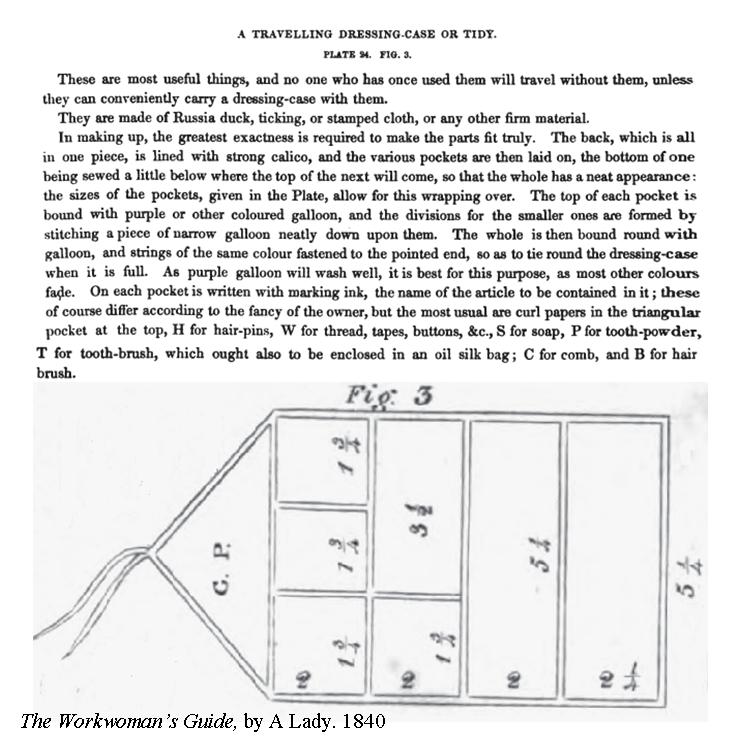
Toilette Cases for Travelling

Part of my 2013 plan is to delve further into traveling in the nineteenth century from what it was like to travel to the baggage. Advice books and contemporary magazines are filled with cases and bags meant to make travel easier. As toilette bags have come up as a topic of conversation on FB, I’ll share a few of toilette cases that can be made at home.

 Toilette cases used a variety of materials. For the exterior, you will want something strong, that will travel well and hold up to moisture.  You will see period recommendations for using firm material such as ticking as well as Oiled silk and Russian duck. As I have seen some sewing case made with a dark painted canvas that I think would do well for a toilette case as well. For closures, buttons with button holes or loops work well, as do pairs of ties done with ribbon.

 The Workwoman’s Guide has a case for just about everything starting on page 208. There are bags for shoes, nightgown bags, travel tidies, etc.

TC2TC1


This Travel Sachet from Godey’s has each pocket embroidered with the contents. It can roll up as well as hang. Click on the image to see it reproduced.

Published in: on January 18, 2013 at 12:10 pm  Leave a Comment  

Lovely Blog Award

As with Quinn, I too am fond of the word “Lovely.” I am quite flattered Quinn of The Quintessential Clothes Pen has nominated me for the One Lovely Blog Award. Thank you , Quinn!!! (If you haven’t had a chance to read her blog, hop over to see her stunning projects as well as their inspiration.)

This award is a way of recognizing fellow blogs and blogger. There’s a list of things to do:

1. Thank the person who nominated you.
2. Add the ‘One Lovely Blog Award’ image to your post.
3. Share seven things about you. 
4. Pass the award on to seven nominees. 
5. Include this set of rules.  
6. Inform your nominees by posting a comment on their blogs.
The easier part first. My nominees are….
The Sewing Academy An excellent resource for mid-19th century clothing. 
 Anna In Technicolor – A fun blog looking at historical and vintage clothing.
The Pragmatic Costumer – An eye-catching blog that connects pieces of costuming and culture brilliantly.
 CW Civilian Living History – An informative blog looking at LH in Texas.
 Romantic History – A beautiful blog exploring many eras.
Miss MacRae’s Blog – Tid-bits of history.
A Graceful Lady – An all around beautiful look at the world.
The harder part, seven things about me. Um??? How about seven things I love?

 1 – My husband, Dan. (WordPress seems to think we should be sideways.)

2 – My family

2a - My familyb3

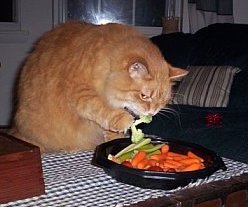
3. My favorite feline. (Fluffy, long-haired ginger cats are fabulous!)My favorite feline.

4. Relaxing lakeside. Whether it is Plattsburg or Canandaigua, there is something about the beauty and tranquility of these lakes.

5. Shady days with friends.

6. Spicy Asian Food. The veggie kind.

 7 – Chocolate, no, silk, no, chocolate, no, silk, no, chocolate, no, silk……… um……

Published in: on January 16, 2013 at 11:02 am  Comments (1)  

Proprieties in Traveling

To start the year, lets look at the “Proprieties of Traveling”, in this passage from At Home and Abroad; or, How to Behave, by Mrs. Manners. (Evans & Dickerson: New York, 1854.)

Proprieties in Traveling

It is not an uncommon thing to find young people who are considered well-bred, and pleasant-mannered at home, not simply regardless of proprieties in traveling, but so inconsiderate of any thing but their own comfort, that they become great nuisances to other travelers. This is the case with such children as are only superficial in their conduct; I mean such as behave, because they have been taught that this thing or that is vulgar, and low-bred, rather than because their hearts are trained to kindness, and their politeness is its outworking. When thrown into new scenes, and exposed to disagreeable circumstances, they act out the natural impulses of their selfish, or querulous spirits, and become wonderfully unpleasant companions,

In bright contrast to these is the conduct of the amiable and unselfish. To be an agreeable traveling companion is a great recommendation, and is a character all would wish to bear if only they could “see themselves as others see them.”

I have traveled much in the last few years, both by sea and land, and, as I am apt to do, I have made many observations on the people around me. I have had occasion to note the well-bred and the ill-bred, the amiable and the unamiable, and have drawn from their conduct some important lessons.

Before I speak of behaviour, however, I wish to refer to some proprieties of dress and other preparations for a journey, which it is desirable to attend to.

Nobody who is aware of the “wear and tear” which assails her garments on a journey, will wear fine or light, or otherwise delicate dresses, or shawls or bonnets. Exposure to the weather, which may unexpectedly become stormy; to the dust, and to the rudeness of those around, in the rush and crush which are the characteristics of traveling now-a-days, will effectually ruin almost any kind of clothing. Ladies, therefore, are accustomed now to provide themselves and their children, the plainest and most substantial kinds of dresses, shoes, shawls, coats, bonnets, and hats. All silks, laces, embroideries, fine ribbons, muslins, and jewelry, are considered, very properly, to be in bad taste in railroad cars or steamboats.

If it is desirable to wear a broach, let it be of the plainest and simplest kind. Wear your watch chain out of sight, or suspend your watch, as some do, by a black cord or ribbon. A thick veil is indispensable, as you are liable to be much annoyed by dust, or smoke and cinders, and also by the stares of rude and vulgar people with whom you are liable anywhere to come in close contact.

As for dresses, a plain-coloured foularde in summer, or a neat linen chambrey, or better still , a de bage, are appropriate materials. Plain straw bonnets, with green or other very neat coloured ribbons on them; linen collars, under handkerchiefs, and cambric sleeves, gloves to match the dress in hue, and gaiter boots, completes a neat traveling costume for ladies. Gentlemen usually carry traveling caps in their pockets, and wear loose brown linen sacques over their coats. It is a good plan to provide yourselves with convenient baskets which will bold night clothes, combs, and brushes, a small needle-case – containing sewing materials, and a pincushion. In addition to these, a bottle of good cologne is of great use; its odor is reviving, and it will refresh you to rub your hands and face with it, where it is not possible to make as plentiful use of water as you desire. I carry, in addition to these, one or two small towels, and a sponge. Children want crackers, oftentimes; and apples are good for them. But candies, cakes, juicy fruits, tarts, &c., are not only unwholesome, but make their faces, hands, and clothes so dirty, that they are to be avoided by all means. Linen coats, trowsers, sacques, and aprons, are best for children’s clothes, unless the weather is very cold.

As children seldom travel alone, it is to be supposed their parents, or those who have the care of them, will keep a close observance of all they do, and try to prevent their becoming annoyances to those around them. On thing, however, the children themselves must attend to. That is, that they pay the most entire and unquestioning obedience to any command given to them, or wish expressed, by those older. There are so many perils attending journeys, especially in these latter days , that there cannot be too much care exercised by their guardians, or too implicit obedience paid by the children. I shall reserve, for another chapter, my personal observations in my journeys.

Published in: on January 12, 2013 at 9:00 am  Comments (4)  

Fashion Plate Pretties

While looking for a couple pieces of furniture we need, I saw a few fashion plates.

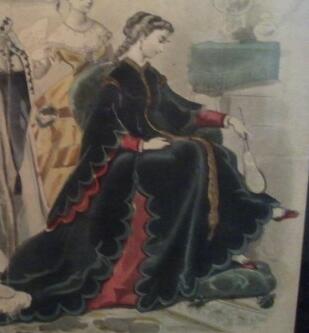
This one caught my eye first because of the red cloak. I love red.

image

Then I saw the fichu.

image

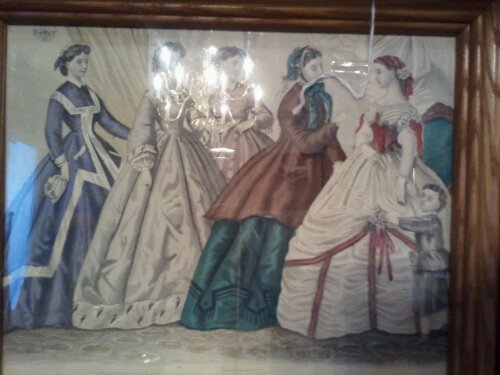
This plate was next. Actually, I almost missed it because I was looking at a cat painting.

image

I am glad Dan pointed it out. Do you see that morning wrap/robe?! Wow. I would love to make this. I doubt I have enough of the brown silk velvet. So, I’ll be keeping my eye out for black silk velvet for this dream garment.

image

This is the third print. Nothing screams at me right now. A new green coat is on the list, but it will be longer. I would do this coat if I had just the right fabric, because I enjoy this cut.

image

Published in: on January 6, 2013 at 4:33 pm  Leave a Comment  

Hat Boxes

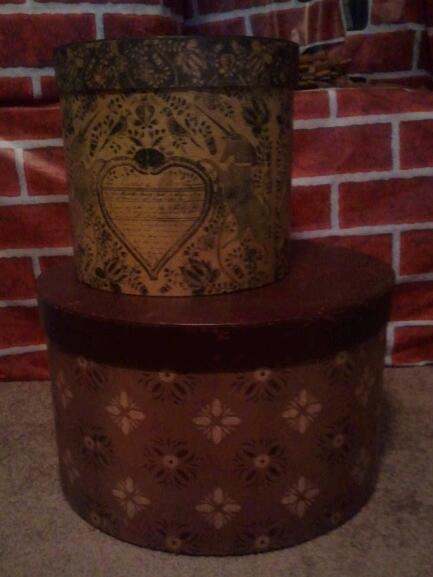
For some time we’ve needed a larger hat box for one of Dan’s hats. It didn’t need to be anything fancy, just something to safely store his hats. At first we were certain Joann’s or Tuesday Morning would have something big enough. Wrong. Their boxes all fell short of the 16.5″ minimum diameter. We even looked at Christmas gift boxes. Finally, I found the right box! Bevin suggested Dogwood Trading Company in Dansville, NY. Please see their contact information below. They had just the right assortment of band boxes. Large. Small. Tall. Wide. Round. Oval. Square. Each one is nicely sturdy. The designs range with many reflecting the look of paper. The prices are very nice too. The bottom box, the one for Dan’s hat, is 17″ across. It is taller than the 8″ his one hat needed. So, I foresee this box holding more than one of his hats. This was only $18.99. The store has at least 4 other prints in this size. They do have a larger one in a beautiful print that looks like a woven blue blanket. Love it! I just haven’t a clue where it would go right now. At the very affordable price on it, I may have to go back for it. There are others this size too.

image

The top box isn’t a size or shape I was actively looking for. But, it looks like it will nicely hold a mid-century bonnet or hood. Plus, look at that paper. It had to come home. An alternative thought process was that while I previously/currently store my bonnets in totes, there isn’t as much tote storage space in this apartment. (Confession – at one point, I had a tower of bonnet totes in my front closet.) It may be time to go back to hat and band boxes for millinery. They look great and are great storage. If you need strong boxes for storage, do give Dogwood Trading Company at try. The staff were extremely nice & helpful.

image

Happy 2013!!!

I hope everyone enjoyed the past couple weeks. I know I enjoyed my week and a half off from work during which I managed not to turn on my laptop, spent some well needed time with family, relaxed with my husband in our new home, hand-sewed some curtains, and just dwelled. It was lovely.

I am rather excited for the new year. Dan and I are in our own place. We have space to organize (which I find to be a fun challenge.) I will have a new sewing room to play in. All around goodness.

This year’s looking forward list is a hodge-podge of activity rather than the traditional beginning of the year to-do list. Let me see if I can group this nicely….

For Fanciful Utility fans:

  • In February, I have an upcoming FanU workshop at the Genesee Country Village & Museum. We will spend a Saturday afternoon learning techniques from the book as we make one of my favorite needle-books.
  • In March, the Mumford library will be hosting a book signing tea. Stop in to my favorite small town library to get your book signed or pick up a copy to have signed. The exact date is to be determined based on the library’s renovation schedule. (This great library is getting a long needed renovation that will give the library more space while preserving the historic building.)
  • Throughout the year, look forward to new templates to accompany Fanciful Utility as well as creative ways to use the techniques from the book.

For Shawl fans:

  • I’m hoping to move forward on the new shawl book……

My general looking forward list:

  • Compile an annotated photo index of my fabric stash as it is organized into the cabinet. Among this stash will be found future sewing projects to include…. a V neck, gathered bodice, flounce skirt sheer 1850s dress… new sleeves for my 1840s dress…. potentially another 1840s dress…. a traveling wardrobe…. a new cotton wrapper…. a long waiting green tropical wool early 1860s dress…. a Regency blue sari dress…. a sheer early 1860s dress …. a new dress or two for Lily as the season needs…. oh, and the court dress.
  • I want to get together a full civilian outfit for my husband. The decade is still to be determined as I think it might be easier to convince him to wear it if it is from the 1840s or 50s.
  • For my relaxation and pure fun of it, I want to do several dresses and accessories for Mae.
  • Finish my red embroidered shawl as well as the ribbon/shawl idea.
  • Pull off a certain secret project by October. shhhhhhh!
  • Keep a regular schedule on both of my blogs. On my personal blog, look forward to stories of getting the apartment organized which will likely reveal some of my obsessions. On the living history blog, my main goal is to finish any series I start. I apologize for the various series I started over the past year and a half but haven’t had the focus to finish.
  • In terms of event to-do, I would like a nice living history event with my husband, a nice civilian event alone,  a social event with my husband (after all he still owes me a dance), some time in the village, a nice event to take my sister to and something educational some place small. (vague, I know)

This 2013 list is far less lofty than previous years’ lists. It is also less specific. My main goals for 2013 is to be happy, healthy and patient.

I hope everyone has a beautiful year.

Published in: on January 2, 2013 at 3:05 pm  Leave a Comment  

Up-coming Needle-Book Workshop

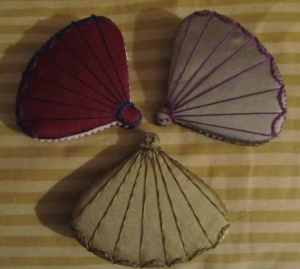
Join me on Saturday, February 16th for a Fanciful Utlity workshop at the Genesee Country Village as we make a needle-book.

319456_10150420792912846_3350978_n

“Spend the afternoon making one of the popular shaped needle-books from the Victorian era.

 You will create a seashell-shaped needle-book with beautiful silk and embroidery. This needle-book is excellent for the novice sewer while giving the experienced needle-worker a place to display her or his skill. Please bring your sewing basket with you, including scissors, needles and thimble.  Age 16 to adults.  Registration deadline February 7.”

Full program details and registration information is here.  All registration goes through the Museum itself. Simply click on the “Reservation Form” on the Museum’s adult education page; fill it out and mail it in. Reservation questions – 585-538-6822.

Keep reading for information on an up-coming book signing tea for Fanciful Utility: Victorian Sewing Cases and Needle-books at the Mumford Library.

Published in: on December 18, 2012 at 10:29 am  Leave a Comment  

Decorating for Christmas in 1869

Excerpts from “Christmas Decorations of the Home” from Cassell’s Household Guide: Being a Complete Encyclopedia of Domestic and Social Economy Volume II, 1869 (published in London and New York.)

“The materials to be used include all kinds of evergreens, everlasting flowers, and coloured and gilt papers. It is a strange thing that, though mistletoe is used in the decoration of house, not a sprig of it is put into a church. But in house decoration no Christmas would be thought complete if there did not hang in hall or dining-room a bunch of its curiously-forked branches, with their terminal pairs of nerveless pale-green leaves, and white crystalline berries.

Holly is of course the special tree of the season. Its leaves bent into various curves, its thorny points, and its bunches of coral-red berries, make it the prince of evergreens. Let it be conspicuous throughout the decorations. It is a good plan to strip off the berries, and use them strung in bunches, as the berries get hidden when the sprigs are worked into wreathes and devices, and the berries, bent into little bunches, dotted about the festoons here and there, look very effective.

Ivy must be introduced with care. Small single leaves come in with good effect in small devices, or to relieve a background of somber yew or arbor vitae. The young shoots of the common ivy are best, or of the kind which grows up trees and old walls, which are very dark and glossy, with a network of light-coloured veins.

Laurel is a very useful green in sprays, and the single leaves may be applied with excellent effect in wreathes, or overlapping one another in borders. The variegated ancuba makes a pleasing variety in the colour.

Yews and arbor vitae are useful, especially the small sprays of them, for covering the framework of devices.

Myrtly and box also are pretty in narrow borderings, into which coloured everlasting flowers may be introduced. The black bunches of ivy berries may sometimes be used with advantage, to give points of contrast in decorations. Of course if chrysanthemums, Christmas roses, primulas, and camellias can be obtained, the general effect is heightened and the decoration becomes more elaborate and more elegant.

[directions for making wreaths]

If holly berries are scarce, a good substitute may be found in rose hips, which may have a small piece of wire passed through them as a stalk, and several twisted together. The fallen holly berries, strung on wire, made into rights, and slipped over the leaves, are very effective, also split peas, glue on here and there in the shape of small rosettes, look like golden flowers, and they may be made to resemble holly berries by pouring over them red sealing-wax melted in spirits of wine.

… Holly strung has a very good effect. It is very quickly done, and looks like a rich cord when finished, and all the banisters in a house may be draped in holly. It is made by threading a packing-needle with the required length of twine, and stringing upon it the largest and most curly looking holly leaves, taking care to pass the needle through the exact centre of each leaf.”

Published in: on December 2, 2012 at 9:09 am  Comments (2)  
Tags: