Ooops. This wasn’t supposed to post until this weekend. But given the weather I am about to venture out into, I’ll leave it.
From Eliza Leslie’s House Book, (Philadelphia, 1844)
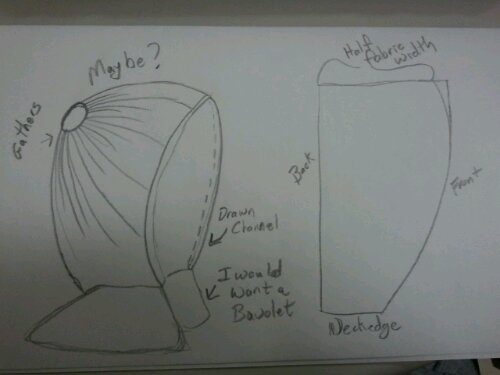
A BONNET-COVER – When travelling in dry weather on a road that is likely to be dusty, you may effectually protect your bonnet from injury, by taking with you a cover for it. To make this cover, get a yard of white glazed cambric muslin, and cut it into the form of a large straight hood; gathering it close at the back of the head upon a small circular piece about the size of a half-dollar. Slope it away at the sides of the neck, and put a case with a drawing-string of fine tape along the edges of the front: the string to tie at the side.
If you commence your journey by water, you can roll up this bonnet-cover, and keep it in your reticule while in the steam-boat; putting it over your bonnet, and drawing round your face, just before you get into the vehicle in which you are to ride. You will find when you take it off, that it has effectually screen your bonnet and its ribbons from the dust and sun. It must, of course, be made very large and loose, that it may not flatten or discompose the trimming.
We have seen bonnet-covers of green silk; but, if it chances to get wet, the green dye will run down and stain the bonnet. This same thing may happen, if the cover is of coloured muslin. White is undoubtedly the best for this purpose; and when soiled, it can be easily washed.
After being out in the damp, do not immediately put away your bonnet; but wipe the front and crown with a clean handkerchief, and put some wadding or tissue paper into the bows, to keep them from losing their shape: taking it out, however, as soon as the ribbon is perfectly dry. Also, never put away a shawl or cloak while it is in the least damp. Do not always fold a shawl on the same creases, lest it wear out along the wire edges of the folds. When you take off a veil, stretch it evenly on the bed, and let it remain there an hour or two, in case there should be any dampness about it.
When ever the atmosphere is cloudy or humid, it is well to take the feathers out of your bonnet before you go out, lest they loose their curl, or their whiteness.
EDIT TO ADD: Deanna asked for a sketch of my interpretation. This is what I picture from Eliza Leslie’s description. I would want a bavolet/curtain to cover that part of my bonnet as well. I would think the gathers of the light weight fabric allow for the least amount of weight on the bonnet decorations underneith. I’m not sure how well this bonnet cover would do in any amount of wind or moisture. Honestly, I am still bothered by the recommendations of traveling caps for men but bonnet covers for women. I’ve been looking at paintings of travel scenes trying to determine what each woman has on her head. A traveling hood seems far, far more practical then a delicate fashion bonnet.