FanU Paisley Fabric Swap!!

Today is the day to sign-up for the FanU Paisley Swap! New ideas 2b
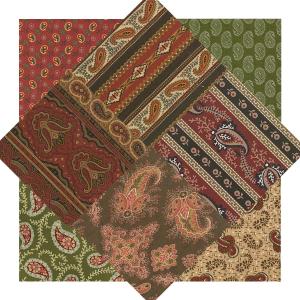
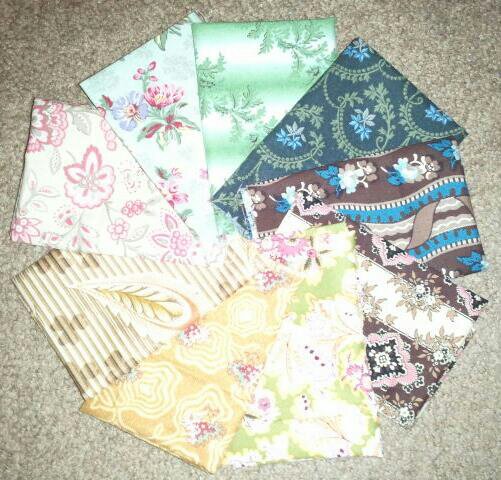
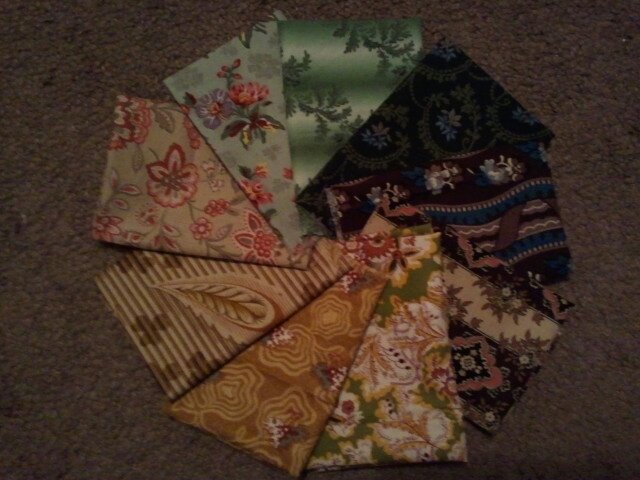
For the Paisley Swap, Swappers will exchange early to mid nineteenth century appropriate cotton fabrics with paisley motifs. These can include organized paisleys, paisleys used in a stripe motif and others reproduced from the century. We will mail our fabrics on February 28th.

Please read all the details below. 

To Sign-up, simply comment below with your email and mailing address. (I’ll erase those before approving your comment, so the whole world doesn’t have that info.)

What is a Swap?

This is a chance for to exchange fabric with a small group of people. Each group will have 8 people exchanging pieces of fabric. All you need is a half yard of fabric and envelopes along with your copy of Fanciful Utility.

To Participate:

1: Sign Up Day!
On sign-up day, groups will be assigned on a first-in basis; the first eight will be the first swap group, second eight in the second group, etc. **Please be certain you will be able to fully participate by mailing your fabrics on the Mail-Out Date.**

Romantic Swap Sign-Up Day: January 13th
Paisley Swap Sign-Up Day: February10th
Mini-Print Sign-Up Day: March 10th

Bonus Patriotic Swap Sign-Up Day: April 14th

2: Mail-Out Day:
Place a 9×9″ piece of fabric suited to the mid-19th century in envelopes for each of the 7 other people in your swap group, stamp them (be sure to double check at the post office, but the small 9×9″ pieces should mail in a regular envelope with a normal stamp), and send them off no later than the Mail-Out Day.

Romantic Swap Sign-Up Day: January 31st
Paisley Swap Sign-Up Day: February28th
Mini-Print Sign-Up Day: March 31st

Bonus Patriotic Swap Sign-Up Day: April 30th

3: Get Fanciful!
Use your Fanciful Utility templates and techniques to make a project from the book, or copy your own from 19th century sources. We’ll all look forward to seeing your projects! You don’t have to sew right away, but don’t keep us waiting forever to see all the fun things!

(If you need a copy of Fanciful Utility, you can purchase them from the publisher at www.thesewingacademy.com

Fabric Guidelines:

  1. For the cotton and silk categories, your fabric should be early to mid-nineteenth century appropriate. (If there is a want for an earlier or later group, we can do that.) Prints and motifs should reflect those available in the 1840s, 50s and 60s. Cotton should be 100% cotton. Silk should be 100% silk.
  2. To keep the swap and sewing possibilities interesting, please avoid solids as best we can.
  3. Fabrics that do not work well for sewing cases should not be swapped. These include sheers, gauzes, heavy, thick, easy-to-fray, slippery and stretch fabrics.
  4. For the “crazy swap” category, think crazy quilt in a sewing case. This could include satins, velvets, textured fabrics. Quality synthetic fabrics are invited.  

Swapper Guidelines:

  1. Please be certain you can fully participate in the swap before you sign-up.
  2. If something arises after you sign-up that will effect the date you are mailing your fabrics, please email your group so everyone is aware.
  3. If you fail to fully participate in a swap, you will not be able to sign-up for future swaps. (We do understand medical and family emergencies. I need to be able to ensure swappers will receive fabrics when they send fabrics out.)

Q&A

Yes, you can participate in 1, 2 or 3 of the swaps.

Yes, if we end up with multiple groups, you can participate in more than one group to swap more fabric. If you participate in 2 groups, you should swap 2 fabrics.

Yes, you can swap large and small scale prints.

Yes, you can swap now and sew later.

Yes, we would love to see what you’ve made with the swapped fabric.

Yes, you can use your own fabric in your swapped project.

Published in: on February 10, 2014 at 6:00 am  Comments (12)  
Tags:

A Year in Millinery Fashion – 1864

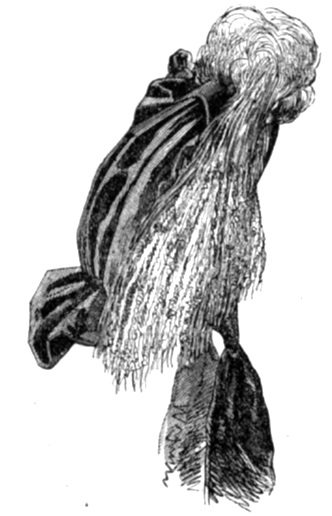
A Black Velvet Bonnet, with
plain front and cap crown, from Mrs. Cripps, 912 Canal street, New York. On the
left side is a heavy rosette of black velvet, under which is fastened a
magnificent cherry willow feather, which sweeps over the front and down the right
side to the bottom of the cape. On the inside are mixed black and white ruches
on both sides; on the top is a full white ruche, a rich bow of cherry velvet,
with an end on the lower side; on the right is a bunch of black feather
flowers. Broad black strings. (Peterson’s, February, 1864)
\2

Published in: on February 10, 2014 at 1:01 am  Leave a Comment  
Tags:

Readings for Rural Life – Don’t Abandon the Hoop Skirt

From Moore’s Rural New-Yorker in Rochester, NY

February 6th, 1864

Don’t Abandon the Hoop Skirt

This is the burthen of a man-ifesto from the Editor of the Scalpel. But “There’s no use o’ talking!” A certain goddess has decreed that skirts shall be smaller, and they will be smaller. If she had said, “let there be none at all,” we are confident they would have been abandoned. But the Editor of the Scalpel is in distress; listen to him:

“We consider the modern hooped skirt of the most admirably artistic and health-giving devices of our time; and no sensible person can fail to appreciate its benefit to the young girl or woman; we will give our reasons for this opinion; of course they will be entirely professional for we are no man milliner.

“It is conceded by all correct observers, and fully recognized by our anatomists and gymnastic teachers, that the muscles of the thorax and its appendages, the arms and abdomen, are not used more than one-fourth as much by our modern women as they are compelled to use those of the legs; nearly all the movements which our unfortunate young people are permitted to perform by the inexorable flat of Japonieadom are what they may be called passive. Her hands must be reverently and lovingly folded across her chest in order that their whiteness may not suffer by permitting the least motion; the lungs, of course, must be kept quiet, not only because she is not allowed to walk fast enough to require much air, but because the position of the arms, and weight of the fore-arm and hand resting upon the lower ribs, will not allow their elevation so that the air can enter the lower part of the lungs at tall. At best, but a sixth part of those life-giving organs are now used, and only their upper part fully inflated. Now if the hooped skirt be hooked to the jacket in four places, at least, and not left to rest upon the hips, the reader will perceive that the backbone and all muscles which inclose[sic] and steady both the great cavities of the body, and keep them elegantly  erect upon the hips, must carry both the hoops and the skirt; then these may be made both light and elegant, or heavy and grand as the seasons my require; while drawers of material adapted to our severe winters, may be so artistically adjusted, and supported by suspenders, as completely to protect and clothe the limbs, without the necessity of the skirts so girding the body by drawn cords to keep them and the drawers in place, as not only seriously to cripple all the viscera, but to interrupt the healthful action of the muscles of the abdomen, and worse than this, to compress all the veins that carry back the blood from the lower limbs to the heart for purification, and often, as we have seen, to render the integument, below this girdle of many cords, very perceptibly dropsical. Every lady, if she will use her eyes, can see this for herself; the ‘horrid marks’ that they cause, she often laments. Now, reader, if the lungs are only used one-sixth part, the muscles of the body scarcely at all, and venous blood from the lower limbs, prevented from returning at the full rate of five-sixths of the speed intended by nature, when you are all walking even at the snail’s pace you are allowed to , what must be the result on the nutrition of the muscles in these limbs? for you know they act and grow by blood alone; depend upon it, though you may make them dropsical and deceptive in size, they will not help you to dance as well, or to go up and down stairs.

“And this brings us to another great evil, if we will sacrifice so much to brown-stone fronts and the fancied necessity of fashionable streets; if we must live in houses furnace-warmed and if we must live in houses furnace-warmed and eighteen feet by five stories high, for pity’s sake let us so distribute the load of dress our climate requires, as to allow every part of the body be used to carry it up stairs; let the jacket or the shoulder-straps give the chest it share of the work; in a word, let our wives and daughters shoulder their loads, if they would have their days prolonged in the land. “If the ladies will pardon us, we will venture to a hint on the dimensions of the skirt. Its most excellent end is to insure the unrestricted use of the limbs in walking; it must, therefore, be of the sufficient diameter to allow a full step and the necessary space for the underclothing; if it restrict the step in the least degree, it is too small. No woman should be ambitious of a short step; the longer the step the more breadth required, and the greater development of the thorax and lungs; quick and energetic walking, with the shoulders thrown back, will do as much for the grown of the vital organs as singing. Women must dress warmly, keep her feet dry, walk more, and eat more, or she will never fulfill the great object of her creation.”


Fashionable Women

Fashion kills more women than the toil and sorrow. Obedience to fashion is a greater transgression of the laws of woman’s nature, a greater injury to her physical and mental constitution, then the hardships of poverty and neglect. The slave woman at her task will live and grow old, and see two or three generations of her mistresses fade and pass away. The washer-woman, with scarce a ray of hope to cheer her in her tolls, will live to see her fashionable sisters all die around her. The kitchen maid is hearty and strong, when her lady has to be nursed like a sick baby.

It is a sad truth that fashion-pampered women are almost worthless for all the good ends of human life. They have but little force of character; they have still less power of moral will, and quite as little physical energy. They live for no great purpose in life; they accomplish no worthy ones. They are only doll-forms in the hands of milliners and servants, to be dressed and fed to order. They dress nobody; they feed nobody; they instruct nobody; they bless nobody. They write no books; they set nor rich examples of virtue and womanly life. If they rear children, servants and nurses do all, save to conceive and give birth to them. And when reared, what are they? What do they ever amount to but weaker scions of the old stock? Who ever heard of a fashionable woman’s child exhibiting any virtue and power of mind for which it became eminent? Read the biographies of
our great and good men and women. Not one of them had a fashionable mother. They nearly all sprang from strong minded women, who had a little to do with fashion as with the changing clouds.

FanU Romantic Swap Fabrics

This round of our Fanciful Utility Swaps was the Romantic Swap, focusing on fabrics from the Romantic Era, the 1820s through the 1840s. These are decades of vibrate color and playful to wild designs. This meant for some very fun fabics arriving in the mail.

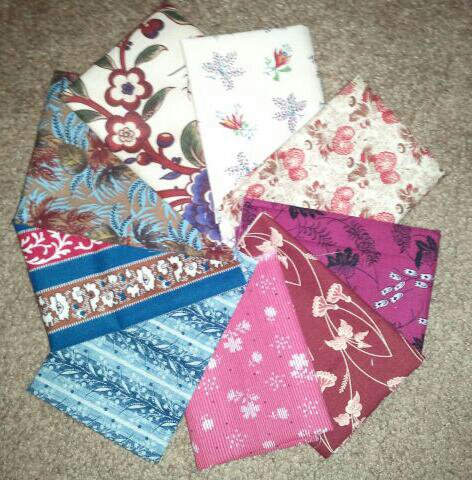
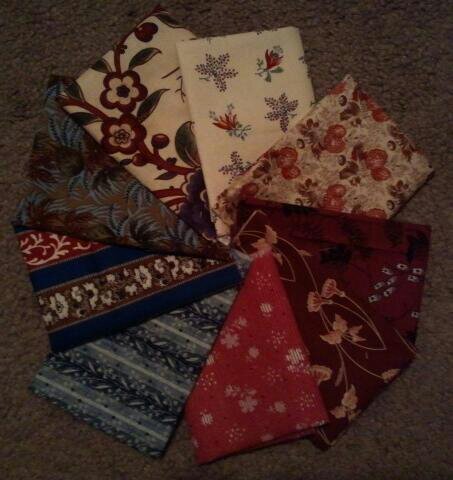
Here are the fabrics we swapped. I had to take the photos with and without the flash, though neither really captured the fabrics in their true light. I hope I have the fabrics labeled right. I flip-flopped which group a couple belong in.

Group 1

imageimage

Clockwise from the top:

  1. Juli Rothemel’s The Mill girls 1830-50
  2. Romantic Old Charleston by Julie Rothermel (group 2)
  3. Windham Dargate Botanicals 1830
  4. or this one is Windam Dargate Botanicals 1830
  5.  Pink and white resist or discharge print with narrow stripes over top, likely a roller print.
  6. The General’s Wives – Blue on blue roller print
  7. Merchants Wife
  8. Dargate Botanicals 1830
  9. Barbara Brackman’s Terry Clothier Thompson 1830

Group 2

imageimage

Clockwise from the top:

  1. Dargate Davinity c1830 by Margo Krager
  2. Grooms Quilt RJR for the Smithsonian c1830-40
  3. Prussian Blue
  4. (ooops should have been in the other photo)
  5. Dargate Botanicals c 1830
  6. New England Quilt Museum for In The Beginning Fabrics
  7. Toast by Jo Morton (should be in group 1)
  8. French General Series Rouenneries Deux in Oyster, c1800s
  9. Collection for a Cause – Mill Brook Seris c1835

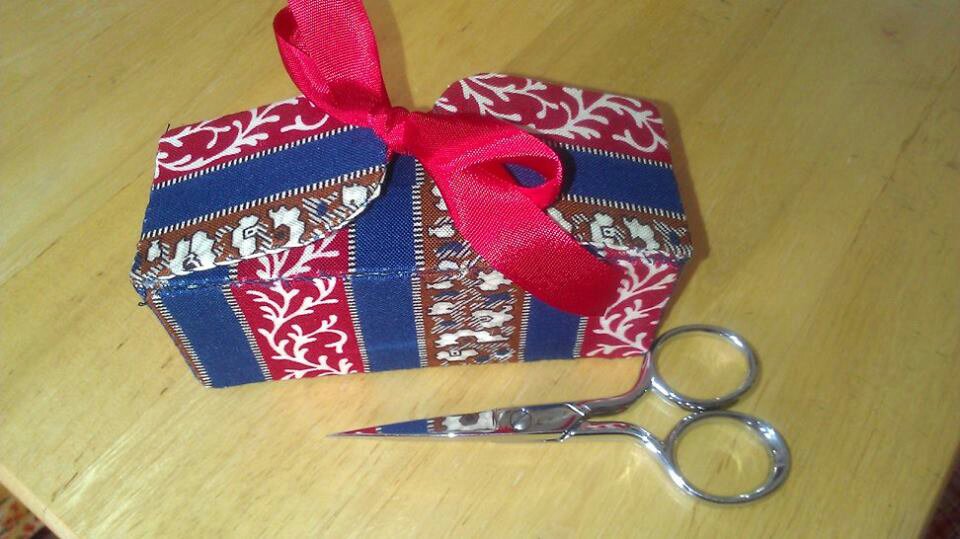
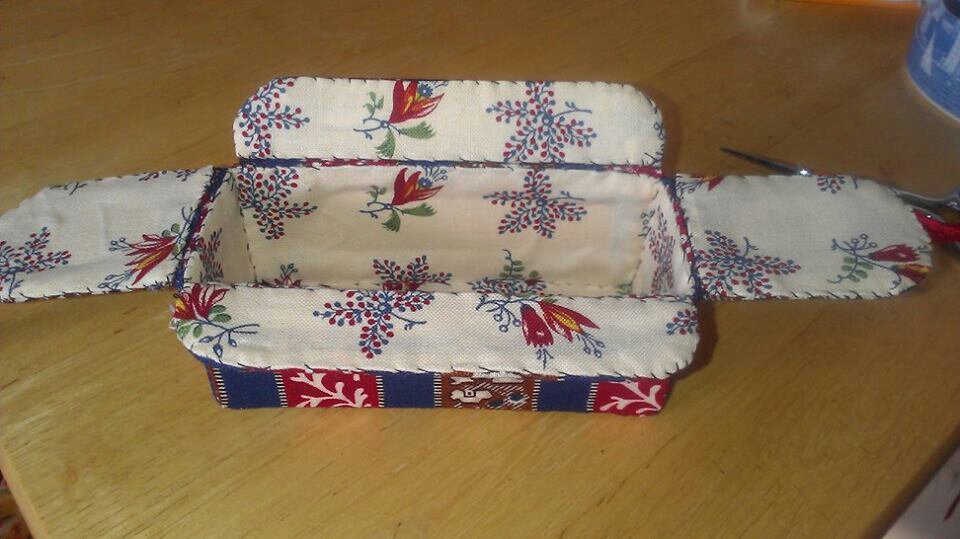
Cindy already dove in with her swap pieces. Using the techniques in Fanciful Utility, she recreated the French sewing box I was obsessed with last fall. She made a great box. I am impressed that she lined up the stripes so well.
image

image

Published in: on February 5, 2014 at 9:11 am  Comments (12)  
Tags:

Resources for Life

“Consider that to-night is the only opportunity the gentlemen may ever have of hearing how adroitly the ladies can flatter them.”

“It is not in the bond,” replied Lucinda.

“What is not?”

“That the ladies should flatter gentlemen.”

“Excuse me,” said Colonel Kingswood; “the ladies having voluntarily taken the responsibility, the gentlemen must insist on their going regularly through the whole ball with all its accompaniments, including compliments, flattery and flirtation, and a seasoning of genuine courtship, of which last article there is always more or less at every large party. And as it appears, that Miss Mandeville has not faithfully done her part during the dance, she must make amends by doing it now.”

“On the latter subject,” said Fitzsimmons, “Miss Mandeville can need no prompting. Her own experience must have made her familiar with courtship in all its varieties.”

“Of course,” resumed the Colonel. “So, Miss Mandeville, you can be at no loss in what manner to begin.”

“And am I to stand here and to be courted?” said Fitzsimmons.

 This comes from “The Ladies’ Ball” in Pencil Sketches; or, Outlines of Character and Manners, by Miss Leslie. (Philadelphia, 1835) https://archive.org/details/atlantictalesor00leslgoog

This earlier compilation of Miss Leslies includes her stories from the periodical series “Pencil Sketches” These include: “The Wilson House; or, Village Gossip”, “The Album”, “The Reading Parties”, “The Set of China”, “Laura Lovel”, “John W. Robertson, A Tale of a Cent” and “The Ladies’ Ball”.

If you enjoy her short stories, you may also enjoy these:

Atlantic Tales: or, Pictures of Youth, by Miss Leslie. Boston. https://archive.org/details/atlantictalesor00leslgoog

Stories for Adelaide: Being a Second Series of Easy Reading Lessons, with Divided Syllables, by Eliza Leslie, Philadelphia, 1829. https://archive.org/stream/storiesforadelai00lesl#page/30/mode/2up

The Gift: A Christmas, New Year, and Birthday Present. Philadelphia, 1845 https://archive.org/stream/giftachristmasa01leslgoog#page/n15/mode/2up (A compilation of stories by others.)


Published in: on February 5, 2014 at 1:35 am  Comments (1)  
Tags:

Video Lectures on the Homefront

Someone, sorry I don’t remember who, shared this website on FB: http://cwmemory.com/2014/02/02/in-the-classroom-with-gary-gallagher/ After listening to the first video “The Confederate Homefront, pt 1”, which covered mostly the political state for the Confederate homefront. I ventured on to the Youtube page. Here I found the more useful “The Confederate Homefront, pt 2” In this video, Gallagher discusses the state of refugees. I would highly suggest this video to newer reenactors or those who need an introduction to refugees.

He also has a two part piece on women during the war, “Women at War” These videos are also very worth watching, being good introductory overviews of women. At approx 6 minutes, he begins to discuss the “ideal”. Of particular interest is American women’s desire to gain weight.

Published in: on February 3, 2014 at 4:00 pm  Leave a Comment  

Fabric Swatch Exchange

I’ve been meaning to write about this fabric swatch exchange I’ve had floating in my head for some time. Now that a local friend has brought up fabric examples, it has floated to the surface. Here is a rough version.

I have this mental picture of each of the members of a group exchanging swatch cards with carefully researched period correct fabrics attached. Each member would cut enough swatches and fill out enough cards for each member of the group. I picture the cards being printed on card-stock. It would be perfectly okay to fill out one card and copy it onto the same/similar cardstock. The cards can then nicely fit into the smaller 9″x6″ three ring binders.

I’ve developed two new swatch cards. The first is for  modern fabrics. This card has space for you to note the current name of the fabric, information on the print/weave/etc, the colors, fiber, appropriate uses, similar original garments and notes.

The second is for swatches from original garments. This card has space to note the source (collection) the sample is from, information on the fiber, weave, print, colors, etc. I envision this card having a photo of the swatch applied to the card. This could be inserted or paste onto the card in the computer or after it is printed. (I also have my previous swatch cards from a few years ago, swatchcards2.)

There are some locations online with original swatchbooks:

I have an electronic swatch exchange in mind as well. In this case, a couple things can happen. At a physical meeting, participants have their swatch cards with swatches layed out on a table so that each one can be photographed with a camera phone or camera. The photos can go into an electronic file to be browsed through. These files can then be shared between friends or groups.

Published in: on February 3, 2014 at 4:00 pm  Comments (1)  

A Year in Millinery Fashion – 1864

The latest Paris creation we have heard of, is a bonnet with fancy net attached, in place of a curtain, and so conveniently arranged that the hair can be immediately placed in it, or relieved at will. As the hair is still worn in the waterfall style, we should think this resille, or net bonnet, an admirable contrivance; we have not, however, seen any. We chronicle all the fashions as we get them from the Paris journals, frequently long before they appear in this country.

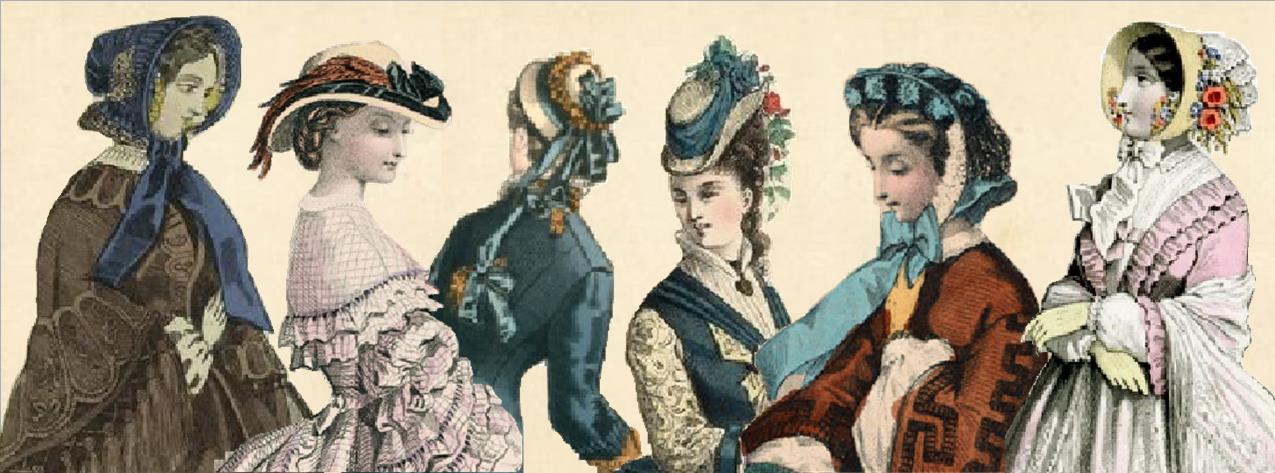
To amateur milliners we would say that the most fashionable bonnet cape is almost a complete horseshoe, measuring at the back five inches, and at the sides three and a half. This allows for a tiny frill at the top, and two very shallow plaits at the back. We can answer for the set and style of this cape – always the most difficult part of a bonnet to arrange. (Godey’s, February 1864)

Looking Forward to Spring Millinery

work in progress 3

With the past few weeks of frigid cold and oppressive snow, I know a good many of us are looking forward to spring. I certainly am.

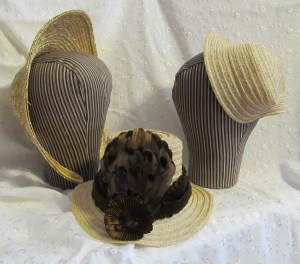
During these weeks I’ve been sewing away. I have a sampling of straw millinery pieces to offer you.

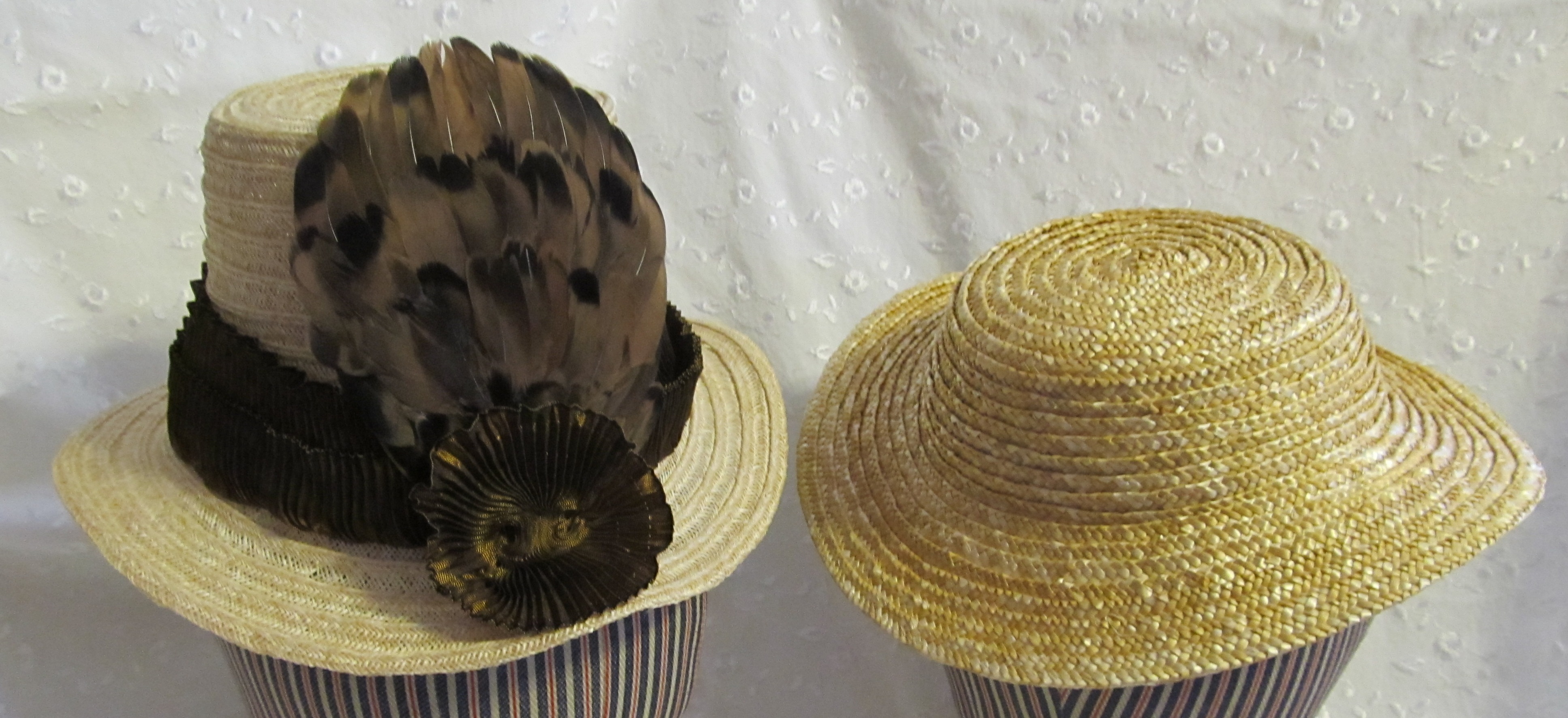
Below, you can see an 1880’s straw bonnet on the right. This little bonnet is one of my favorite later shapes because of the curves the straw does. This bonnet is made from hemp plait. It is ready for you to decorate right now. If someone doesn’t pick it up soon, I’ll pull it down and decorate it. I have some fun ideas for it.

On the left is one of two straw forms suitable for 1859 through 1864. These are whole straw plait, meaning natural straw plaited in whole strands. The one in the photo has a moderately high brim, while the other has a high brim.

In the middle and bottom left is a late 1870s through 1880s hat worked in the hemp plait. It is decorated in a crinkly brown ribbon and an arrangement of feathers. This is my first piece that I hope to step into Steampunk and Whimsy with.

On the bottom right is a fashionable 1860s straw hat for a youth (or young lady with a smaller head). I enjoy this shape quite a bit. It will be fun to decorate and wear.

??????????????????????????????? ???????????????????????????????

This year I plan to work with real straw in a variety of plaits and fineness. I prefer the natural body of the real straw as well as the wonderful smell it has. I have a beautiful fine French plait, a black English plait coming for mourning, an uber-fine, narrow plait for doll pieces and the classic whole straw plait. The four pieces I made this month of the hemp plait is the very last of that plait I have.

Almost forgot. Pricing for the year. 1850s-1864/5 bonnets will start at $85 for whole plait straw. Special plaits or shapes will be higher. Smaller hats for the 60s through 90s will start at $75 depending on how long the shape takes. Special shapes will depend on the time needed and the cost of the plait.

Published in: on February 1, 2014 at 3:50 pm  Comments (4)  

Resources for Life

Women in America; Being an Examination into the Moral and Intellectual Condition of American Female Society, by Mrs. A. J. Graves (New York:1844)

Look round upon the groups of young females who crowd our private parties or public balls; who lounge upon the sofa receiving visits, or throng the city promenades to exhibit their decorated persons or to make morning calls, and how many can you point out among them who have fulfilled one useful purpose of existence to themselves, to their families, or to society? And all this waste of time and energy in the pursuit of folly is in the hope of becoming thereby candidates for matrimony, while by this very means they are seeking to attain. Nor is this all: their efforts defeat the wished for end, inasmuch as the habits of indolence and extravagance in which so many young women are brought up, deter a multitude of young men from becoming husbands, lest they should involve themselves in pecuniary embarrassment; and as wealthy young men are extremely rare, we see marriages in fashionable life every day becoming fewer; thus leaving in our cities a numerous class of finely-dressed, pretty, and accomplished young ladies, doomed to become disappointed “establishment-seekers,” and to fade into fretful and repining “’old maids.” An intelligent, useful woman, who continues in a state of celibacy from choice or from disappointed affection, is an honoured and valuable member of society, but she whose youth has been spent in idleness and folly, and is seeking for a husband in crowded scenes of amusement, becomes a pitiable object – a burden to herself, and the jest and by-word of her acquaintance. (p52-53)

Among the many causes that are tending to deaden in the heart of woman a sense of her appropriate obligations, is the fatal notion that there is something servile in labour. It is, indeed, much to be lamented, that in the praiseworthy effort to redeem herself from the life of slavery and degradation to which past ages doomed her, so many of her sex should have passed to the other extreme – a life of indolence and uselessness Nor is this notion that there is gentility in idleness, confined to females alone: we find it widely and deeply cherished by society at large. Hence we see that the aristocratic titles of “lady” and “gentleman” are by common consent thought to be applicable only to those who hold it beneath their fancied dignity to toil with their hands. The farmer who guides his own plough, and the mechanic who still plies his tools, are thus considered as belonging to a lower caste than the “gentleman” farmer who lives solely upon the toil of his dependant[sic] labourers, or the retired mechanic who has thrown aside his implements, and employs the capital amassed by their use in extensive speculations in lands or stocks. (p25-26)

Published in: on January 30, 2014 at 4:00 pm  Comments (1)  
Tags: