Resources for Life

 There are many different theories concerning the moral purposes of this world in which we dwell, considered, I mean, in reference to us, its human inhabitants; for some regard it merely as a state of transition between two conditions of existence, a past and a future; others as being worthless in itself, except as a probation or preparation for a better and a higher life; while others, absorbed or saddened by the monstrous evils and sorrows around them, have really come to regard it as a place of punishment or penance for sins committed in a former state of existence. But I think that the best definition, – the best, at least, for our present purpose, – is that of Shakespeare: he calls it, with his usual felicity of expression, “this working-day world;” and it is truly this: it is a place where work is to be done, – work which must be done, – work which it is good to do; – a place in which labor of one kind or another is at once the condition of existence and the condition of happiness.

Well, then, in this working-day world of ours we must all work. The only question is, what shall we do?

To few it is granted to choose their work. Indeed, all work worth doing seems to leave us no choice. We are called to it. Sometimes the voice so calling us is from within, sometimes from without; but in any case it is what we term expressively our vocation, and in either case the harmony and happiness of life in man or woman consists in finding our vocation the employment of our highest faculties, and of as many of them as can be brought into action.

And work is of various kinds: there are works of necessity and works of mercy; – head work, hand work; man’s work, woman’s work; and on the distribution of this work in accordance with the divine law, and what Milton calls the “faultless proprieties of nature,” depends the well-being of the whole community, not less than that of each individual.

Sisters of Charity, Catholic and Protestant. And the Communion of Labor, by Mrs. Anna Jameson. (Boston (1857) https://archive.org/stream/sistersofcharity00jame#page/n3/mode/2up

I must say that while reading the paragraphs following these on the work of men and the work of women, I have an urge to make charts of “men’s work” and “women’s work” at various times in our history. I think it would be interesting (and quite telling) to see how the individual tasks move from one to the other.

Published in: on February 26, 2014 at 1:34 am  Comments (1)  
Tags:

A Year in Millinery Fashion – 1864

Bonnets by no means follow the outline of the face, byt are simply lower in front than those which have been so perseveringly worn during the last two years. The sides of the bonnet
are very narrow, being almost close to the cheeks; so little space is left that there is only sufficient for one quilling of blonde at each side, or, if a colored crepe cap is adopted, for one narrow row of box, pleating. In some instances, the front is made very wide at the top, so as to allow a superabundance of trimming in the inside; but the more oval form appears to be
generally preferred. (Peterson’s, February, 1864)

Published in: on February 24, 2014 at 1:02 am  Leave a Comment  
Tags:

Readings for Rural Life – Cold Floors

From Moore’s Rural New-Yorker in Rochester, NY

February 20th, 1864

Cold Floors

“Keep the head cool and the feet warm,” says the physician. Some people are so unfortunate as to live in hired houses, or are too poor to repair their own, or do not wish to lay out money to fix up the old one, when they expect in a year or two that its place will be occupied by a new one. What are such people to do when the floors are filled with cracks that let in the wind and the cold? No sort of chance to follow the advice of the doctor, in such a case. The cracks change things just end for end. Cold feet and blood and heat to the head. We were in just such a fix. We read in the Family Journal, that newspapers being spread between bed clothes were excellent non-conductors, and rendered beds very warm. We applied the principle to our cold floor.  Before laying down the carpet, we covered the whole floor with newspapers, being careful to break joints. It produced a decided change in the temperature of the room. Feet and legs rejoiced, as they were comparatively comfortable. Please tell your readers, Mr. Editor, that this is about the best use some papers can be put to. – L.L.F.

A New Corset Asked For

Susie Perkins complains, in the Scientific American, that the corsets illustrated and recommended in that paper the past year, do not meet her requirements, and those of the sisterhood of corset-wearers. She talks in this wise:

“The air we ladies have to breathe up there in Vermont circulates all round the world, and is breathed by all the filthy creatures on the face of the earth, by rhinoceroses, cows, elephants, tigers, woodchucks, hens, skunks, minks, grasshoppers, mice, raccoons, and all kinds of bugs, spiders, fleas, and lice, lions, tobacco-smokers, catamounts, eagles, crows, rum-drinkers, turkey buzzards, tobacco-chewers, hogs, snakes, toads, lizards, Irish, negroes, and millions of other nasty animals, birds, insects and serpents; besides, it is filled with evaporations from dead, decaying bodies, both animal and vegetable, and we ladies are obliged to breathe it over after them, ough! Bah!

“Now we want, and must have, some contrivance that will effectually keep this foul disgusting stuff  out of our lungs. We have tried the three kinds of corsets which you noticed in your paper last year; but when we do the best with them that we can, about a teacupful of this nasty air will rush into our lungs in spite of these miserable contrivances, and when we blow it out again another teacupful of the disgusting stuff will again rush in, and when we blow that out still another will rush in; and so we are obligated to keep doing from the time we wake up in the morning till we go to sleep at night, and I do not know but we do all night.

“If these corsets are worth anything to keep this disgusting air out of a body, and we have not put them on right, please come immediately yourself, or send the inventors to show up how. If they are a humbug, I hope their inventors will be tarred and feathered and rode on a rail, and you, for noticing them in the Scientific American, be obliged to breathe about sixty pints of the nasty, foul, nauseous, filthy, disgusting, dirty, defiled, loathsome, hateful, detestable, odious, abominable, offensive, stinking air which surrounds this earth per minute for a hundred years.”

The editors, in their zeal to supply the wants of the correspondent, respond as follows:

“We can suggest but one kind of corset which would effectually meet our fair correspondent’s wishes. Instead of the ordinary laced-up corset, take a piece of strong hempen cord and apply it closely about the neck, tie one end of it to a beam, and let the whole weigh of the body suspend at the other end. We guarantee that if the cord is strong enough it will put an end to all future complaints on this subject.”

Published in: on February 20, 2014 at 6:00 am  Leave a Comment  
Tags:

Resources for Life

Women’s Labor Not Compensated

The value of labor is too apt to be estimated, not by its usefulness, and the good it may bring, but by the rate at which it may be obtained – by the necessities of the laborers. Labor should be estimated by the amount of good it does in supplying the necessities, and promoting the welfare of mankind, individually and collectively, and wages should be proportioned thereto.

As business is now done, women’s self-respect and ambition are not called forth. Consequently women employed to work are more idle and less to be depended on – they are more likely to take advantage of an employer’s time than men. But if they had the same number of hours to work that men have, and were paid according to their industry and activity, a better disciple would be established. There would be more honor, and principle, and justice, on both sides.

There is no union or society among women to keep up the regular standard of prices – so the majority work for what they can get. The low wages of female labor tend to increase the feeling of dependence in woman, and tempt her to marry merely for a home.

Many event are tending to draw attention to these matters. How many hundreds, even thousands, of virtuous and worthy girls have been thrown out of employment by the late terrible war! After the great financial revulsion of 1857, many were rendered homeless and helpless. The “New York Tribune,” referring to them, says “It is estimated there are not less than seven thousand ready to go West, because society here has withdrawn its succor from them. At best they can but earn a pittance. A woman may be defined to be a creature that receives half price for all she does, and pays full prices for all she needs. No hotel or boarding-house here (nor elsewhere, we will add) takes a woman at a discount of fifty per cent. Butcher, baker, grocer, mercer, haberdasher, all ask her the upmost penny. No omnibus carries her for half price. She earns as a child – she pays as a many. Besides, her sex, if not barous custom, cuts her off from the best rewarded colleges. Her hands, feet, and brain are clogged.” We ask our readers to pause and inquire if this is not true.


This subsequent work of Virginia Penny’s is Think and Act. A Series of Article Pertaining to Men and Women, Work and Wages. (Philadelphia, 1869) https://archive.org/stream/thinkandactser00pennrich#page/n7/mode/2up

This work is packed full of article’s from Penny’s perspective on women, men, occupation, marriage, health and more. Here is a second passage to give you a better idea of how wide her topics are. (Looking at this passage, I will admit, I am one who must have her “order, system, and harmony”)

What a Woman Should Be

Some women are by nature gifted with more refinement of feeling, more delicacy of thought, than others. Education, or training, makes a still greater difference.

A woman’s virtuous counsels are a beacon-light to save from the rocks and quicksands of this stormy world, but the evil counsels of a woman lead to ruin and misery.

There are a thousand little courtesies that a woman alone is capable of performing; volumes could not contain all the delicate minutiae that form a true lady. The feeling that makes one must be native.

Order and harmony should prevail in all the arrangements of a lady. In the adjustment of her dress – the furniture of her room – her studies – her pastimes – her hours for rest, – in all, order, system, and harmony, are important.

A kind of consideration for the comfort of others is one of the most lovely traits of female character. A woman that does not discharge her duties, as wife and mother, does not deserve the name of woman.

Gentleness, tenderness, and decision should characterize a woman. A cheerful, contented, and forgiving disposition should mark her temper. Nothing is more to be admired than modesty, humility, and consistency. They form bright jewels in the crown of virtues. A warm heart, and refined manners, command admiration and love; but a cultivated intellect will add a greater charm, and enable a woman to accomplish more good.


Published in: on February 19, 2014 at 1:33 am  Leave a Comment  
Tags:

The Ladies National Covenant via The Rural

This is a partial transcription from Moore’s Rural New-Yorker in Rochester, NY on May 21st, 1864. I encourage you to click over to Moore’s Rural to read the entirety.

 The Ladies’ National Covenant

Address to the Women of America – Home Products to be Encouraged.

A meeting of ladies was held at Washington recently, to inaugurate an important National movement. It is proper we should give the results thereof in this department of the Rural. The meeting was composed of the wives of members of the Cabinet, and of Senators and Representatives, of well-known authoresses, women of fashion, mothers who had lost their sons, and wives who had lost their husbands. There was an earnestness and a unison of feeling in this great meeting, which has never been exceeded in this land.

Address to the Women of America.

In the capital of our country we have this day organized a central society for the suppression of extravagance, the diminution of foreign imports, and the practice of economy in all our social relations. To this society we have given the name of “The Ladies’ National Covenant.” Its object is a good and generous one, which should inspire a spirit of patriotism worthy of women who are the glory of a great nation. For this society we have an example a precedent at once august and encouraging.

In 1770, the women of Massachusetts, actuated by the same impulse that inspires us, assembled in the City of Boston, as we have met here, and resolved to serve the country by an effort of self-sacrifice far greater than we are called upon to make.

On the 9th of February [of that year], 300 matrons, each the mistress of a household, met as we do now, and signed a pledge to abstain from the use of tea, the greatest luxury of the time, and the very life of all the social gatherings for which our New-England ancestors were so famous. Three days after, twice that number of blooming young girls met in the same place and signed like pledges. From that brave assemblage of women non-imporation societies sprang up, that produced an effect upon the mother country almost equal to that created by the success of our revolutionary armies. During all the terrors of the war these noble women held firmly to their pledges, and by their earnestness awoke the sympathy and co-operation of every sister colony in the land. The spirit thus aroused extended itself to imported goods of all kinds, and every hearthstone was turned into an independent manufactory. Thus it was that the flax-wheel, the hatchel, and the hand-loom became sublime instruments of freedom in the hands of American women. The house mothers of ’76 not only kept their pledge of non-importation, but with their own hands wrought from the raw materials the garments which clothed themselves, their husbands, and children. The pledge which they took and kept so faithfully evoked not only great self-sacrifice, but hard, hard toil, such as the woman of the present day scarcely dream of. Had they not endured and labored while their husbands fought, we should have had no might Union to pray and struggle for now.

We, the women of ’64, have the same object to attain and the same duties to perform which were so nobly accomplished by the women of ’76. Shall we not follow their example, and take up cheerfully the lesser burdens that the welfare of our country demands? They gave up the very comforts of life without a murmur; can we refuse when a sacrifice of feminine vanity is alone required? Can we hesitate to yield up luxuries that are so unbecoming when the very earth trembles under our feet from the tread of armed men going down to battle, and almost every roof throughout the land shelters some mother lamenting the son who has fallen gloriously with his face to the foe, or a widow whose husband lies buried so deeply among the masses of slain heroes, that she will never learn where to seek for his grave? 

In order to invoke this spirit of self-sacrifice, it is important that the great object of the covenant we have made should be broadly circulated and thoroughly understood. It discourages profligate expenditures of any kind, recommends the use of domestic fabrics whenever they can be substituted for those of foreign make, and advises simplicity of attire, both as a matter of policy and good taste. It asks the great sisterhood of American women to aid in this reform before it is too late. Thank God science has given us the means of reaching thousands on thousands in a single hour. While we make this covenant, the thought that thrills our hearts may tremble in fire along the telegraph, and awake kindred inspiration throughout the entire land. By every means of communication in our power, let us urge the necessity of prompt action. In every town and village throughout the Union, some woman who loves her country is implored to establish an auxiliary society and forward the names of the ladies invited to act for the State in which her duty lies. We ask simultaneous action, earnest work, and generous self-sacrifice at the hands of our sister women. With their ardent help, a work will be accomplished so important in its results, that the woman who shares in it may, hereafter, leave the emblem of our object as the richest jewel that she can leave to posterity.

http://www.libraryweb.org/~digitized/newspapers/moores_rural_new_yorker/vol.XV,no.21.pdf


Published in: on February 17, 2014 at 1:28 pm  Leave a Comment  
Tags:

Women’s Patriotic Association for Diminishing the Use of Imported Luxuries

This is one I was initially going to include in the Resources series. But, with some recent discussions, I would like people to be aware of this movement. It became fairly well known about since I am seeing it in rural papers (which I’ll share) as well as papers in England and Australia (I’ll have to refind that to transcribe.)

The Women’s Patriotic Association for Diminishing the Use of Imported Luxuries (New York, 1864)

https://archive.org/stream/womenspatriotica00wome#page/n5/mode/2up

This book opens with an address from May of 1864. It also contains several letters.

There is something more we can do for our country! We wish to make, we can make, no stronger appeal that this to those who have been working for our sick and wounded soldiers for the past three years, who are working for them now, who means to work for them until the war is over. We ask you to consider seriously the subject now presented; let it commend itself to your reason; for, if once convinced of the importance of the measure, we cannot doubt but that you will show yourself as ready to help our country by not doing, as you have hitherto helped it by doing.

… The most effectual way of doing this, we are told, is to diminish our use of foreign luxuries, although a general economy is all superfluities will do much towards it. At present our imports – or the articles purchased by us from foreign countries – are very much greater in value than our exports – or the articles we produce at home and sell abroad. It is estimated that when the accounts for the year are made up, on the 30th day of this coming June, we shall find that the country has been sending abroad seventy or seventy-five millions of dollars in gold to pay the balance of trade against it. And what have we bought with this money, so much needed at home just now, and which might be dispensed with? Silks, satins, velvets, laces, jewelry, ribbons, trimmings, carpets, mirrors, and other imported luxuries – every woman knows what they are without running through the whole list – things that are not necessary, which would benefit our country should we do without them altogether, but which, if wanted, can, with but few exceptions, be obtained of our own manufacture.


As with the Temperance movement this also has a pledge:

Form of Pledge We, the undersigned, during the continuance of this war of rebellion, pledge ourselves to refrain from the purchase of Imported Articles of Luxury, for which those of Home Manufacture or Production can be substituted.


Edited later to add:

I’ve been reading The Needle’s Eye: Women and Work in the Age of Revolution by Marla Miller. When I reached this passage, I instantly thought of this post. 

After the war ended, women remained conscious of the political impllications of the astorial choices. In November of 1786, more  than one hundred women in Hartford, responding to the postwar economic depression adn the tension swelling to the nrth as Massachusetts coped with Shay’s Rebellion, expressed their patriotic zeal by forming an “Economic Association.” “Taking into serious consideration the unhappy situation of their county, and being fully sensible that our calamities are in great measure occasioned by the luxury and extravagance of individuals,” the founders expressed the hope that “those Ladies that used the to excel in dress… will endeavor to set the ebst examples, by laying aside their richest silks and superfluous decorations, and as far as possible, distinguish themselves by their perfect indifference to those ornaments and superfluities which in happier times might become them.” The resolutions reflected the signers’ sense of themselves as participants in an internationaly network of clothing makers and consumers. They observed that “the English and French fashions, which require manufacture of an infinate variety of gewgaws and frippery,  may be highly beneficial and even necassary in the countries where those articles are madel as they funish employment and subsistence for poor people.” But, thought sympathetic these individuals, they also recognized larger and more sinister interests at work; “foreign nations,” they stated, were anxious to “introduce their fashions into this country, as they thus make a market for their useless manufactures, and enrich themselves at our expense…. Our implicit submission to the fashions of other countries is hightly derogatory to teh reputation of Americans, as it renders uss dependent on the interest, or caprise, of foreigeners, both for taste and manners; it prevents the exercise of our own ingenuity, and makes us the slaves of milliners and mantaumakers in London or Paris. For the next seven months, the women said, they would refrain from purchasing “gauze, ribbons, flowers, feathers, lace and other trimmins from frippery, designed merely as ornaments.” They would reduce new purchases for weddings and mourning, eliminate purchases of new materials for routine visiting, and buy domestic rather than imported goods whenever possible. In sum, they vowed to dress simply, to limit occasions that called for fashionable excces, and to “use [their] influence to diffuse and attention to industry and frugality, and to render these virtues reputable and permanent.” 

The Hardford Association’s success is impossible to gauge – perhaps this was the year that one of the Trumbull girls famously wore the same, plain muslin dress all season long, to great local acclaim for her simplicity – and bravery. Whether the signers abstained from the unneccassary purchases in unknown, but their awareness of the political and economic impact of ephemeral style is striking.     

This also brings to mind Mrs. Philadelphia’s words in my January post.

Published in: on February 17, 2014 at 1:15 pm  Leave a Comment  
Tags: ,

A Year in Millinery Fashion – 1864

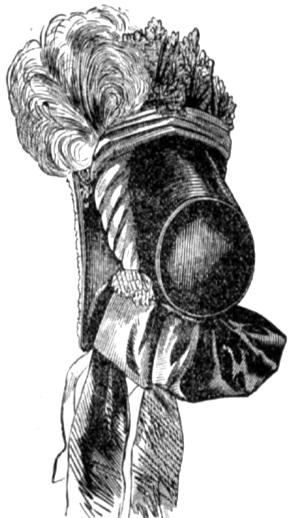
A French Hat of Black
Velvet, from Mrs. Cripps, 912 Canal street, New York. The velvet is laid plain
on the foundation. Directly across the front on the top, is white illusion,
covered by a fullness of black thread lace, which droops slightly over the
front. From the inside on the right, over the joining of the velvet and lace to
the left where it extends down the side, in a roll, to the cape. On the scarlet
velvet, at the top of the cape, is a flower made of black thread lace, and one
to correspond on the folds at the top of the hat. They are something entirely
new. From under the velvet, on the left side, starts a white ostrich feather,
which falls over the front. The inside has full white blonde ruche on either
side; at the top are folds of scarlet velvet and white illusion intermingled;
on the right is a bow of white illusion, in the center of which is a bunch of
white velvet jasmines, with leaves and buds. Rich black strings.  (Peterson’s, February, 1864)

1

Published in: on February 17, 2014 at 1:00 am  Leave a Comment  
Tags:

Readings for Rural Life

From Moore’s Rural New-Yorker in Rochester, NY

February 13th, 1864

Some writer says – “Our daughters do not ‘grow up’ at all now-a-days; they grow all sorts of ways, as crooked and crooked sticks.”

Our girls hardly get sunshine enough to grow at all in. Indeed many women amongst us never could have fully got their growth, else why are they such tiny morsels, looking as if a puff from old Kewaydin would blow them away?

We need to turn our girls out of doors – that is the long and short of it. They will never be good for anything until we do. The boys knock around and get oxygen enough to expand their lungs, broaden their chests, and paint their faces with health’s own hue; but our lazy, lady daughters! Ah, there is the burden that breaks down the mother’s heart. How are they, so frail, and sensitive, and delicate, ever to get along in this rough world? Mother, you must bestir yourself quickly, or they will be as unfit as your gloomiest imagination can paint them. You are responsible chiefly for making them so tender. Protect them suitably from the weather, and send them out of doors. The pure air will brace up their unstrung nerves, strengthen the weak lungs, and some good gust of wind will in time sweep away the ill-nature and peevish spirit which sitting forever in idleness in luxurious home will not fail to engender.

The next thing you should do for your daughter is to give her some domestic employment. If you keep a dozen servants, your duty to her remains the same. No one can be happy of qualified to make others so, who has no useful work to do. Besides this, she must learn sometime, or she will be poorly qualified for ever being at the head of an establishment of her own. No one in this country can rely upon always having good, trained domestics in her house. The best require some instructions, are liable to leave you from sickness or other causes, and any household is in a pitiable condition where the mistress is not equal for such and emergency.


Published in: on February 13, 2014 at 6:00 am  Leave a Comment  
Tags:

Resources for Life

It is very easy to obtain book after book on “The Sphere of Woman,” “The Mission of Woman,” and “The Influence of Woman.” But to a practical mind it must be evident that good advice is not sufficient. That is very well, provided the reader is supplied with the comforts of life. But plans need to be devised, pursuits require to be opened, by which women can earn a respectable livelihood. It is the great want of the day. It is in order to meet that want that this work has been prepared. The few employments that been open to women are more than full. To withdraw a number from the few markets of female labor already crowded to excess, by directing them to avenues where they are wanted, would thereby benefit both parties.

At no time in our country’s history have so many women been thrown upon their own exertions. A million of men are on the battlefield, and thousands of women, formerly dependent on them, have lost or may lose their only support. Some of the mothers, wives, sisters, and daughters of soldiers, may take the vacancies created in business by their absence – others must seek new channels of labor.

An exact estimate of woman as she has been, and now is, furnishes a problem difficult to solve. Biographies and histories merely furnish a clue to what she has been. Prejudice has exaggerated these portraits. Woman as she now is, save in fiction and society, is scarcely known. The future position of woman is a matter of conjecture only. No mathematical nicety can be brought to bear upon the subject, for it is one not capable of data. More particularly is it difficult to define what her future condition in a business capacity will be. Man will have much to do with it, but woman more. I know of no work giving a true history of woman’s condition in a business capacity. Socially, morally, mentally, and religiously, she is written about; but not as a working, every-day reality, in any other capacity than that pertaining to home life. It has been to me a matter of surprise that some one has not presented the subject in a practical way, that would serve as an index to the opening of new occupations, and present feasibility of women engaging in many from which they are now debarred….

The work of a single woman has never been very clearly defined. Those that are without means are often without any to guide them; and the limited avenues of employment open to women, and the fear of becoming a burden on others, have poised some of their best hours and paralyzed some of the strongest powers. There is a large amount of female talent in the United States laying dormant for the want of cultivation, and there has been a large amount cultivated that is not brought into exercise for the want of definite plans and opportunities of making it available. It exist like an icicle, and requires the warmth of energy, thought, and independence to render it useful. It shrinks from forcing itself into notice, like the sensitive plant, and may live and die unseen and unknown. Widen, then, the theatre of action and enterprise to woman. Throw open productive fields of labor, and let her enter.


While I would like to continue on with Penny’s preface to her work, I will instead tell you she details 516 specific employments open to women and also includes articles on employments for the blind, deaf and disabled (lame in her words) as well as topics related to women’s employment. In each of her detailed articles, she addresses the statistics for the employment such as the numbers of women employed and where, the wages paid, hours worked, expected skills and instruction if available.

The Employments of Women: A Cylcopedia of Woman’s Work, by Virginia Penny (Boston: 1863)

Published in: on February 12, 2014 at 1:31 am  Comments (1)  
Tags: ,

Setting the Scene

This post is really a ‘help’ for a discussion we are having elsewhere. It is just easier for me to put my thoughts together here. (If this is of interest, I’ll fix it.)

The questions are – How do we set the scene (individual scene, over-all scene or group of scenes) for visitors? How do we visually signify what the situation is? How do we make a scene accessible to visitors, inviting them to participate in discussion?

I think we need to set a scene or visual story that invites visitors in. I want to interact with them. This means they need to feel welcome to talk, ask questions, make comments, pick things up.

I do think this is much easier interpreting out of a building because I can control a scene easier with my set-up inside walls and an open door already says “come in.” In a camp situation, one very important part of saying “welcome” is making an area easy to walk into and around in. To me, this means easy, flowing tent placement. This can be straight lines or horseshoes or even a spiral. It can not be haphazard with tents placed every-which-way. An area needs to feel safe to families with smaller children. This means keeping fires, ropes, axes/hatches, etc visitor safe. Yes, just the sight of a campfire area can keep a family with pre-school children away. So, placing that fire out of the path between visitors and you is important.

Once you have people in your area, you want them to feel comfortable and safe in your particular “space”. This, again, requires attention to tent placement and ropes as well as furniture. Most of us need a personal space and an interaction space when we set a tent up. Some of us need a clear distinction, some of us do not. Keep this in mind when you create your visitor space. (Personally, I don’t like having to get in and out of my tent over and over. I try to keep what I need neatly at hand or within very easy reach just inside. At the same time, I also need my mid-day nap space.) I’m sure you’ve seen the tall gentleman trying to talk while the edge of the fly is right in his face, or the school-age child leaning on the tent pole trying to see inside. Neither of those are inviting or pleasant.

For your visitor space, think about where your table, work or conversational pieces are. Do their placement give people enough space to stand (or even sit) while you talk/demonstrate/interact? Think about the “display” table. We normally want the visitors to come up to the table, right? What about when we are the interactive display? We want them to come up to us right? They need to have space to do this. They also need to feel comfortable doing this. For me, this means:

  • Giving the visitor space to be there
  • Facing where they enter from (they also like seeing where you are when they approach, whether we are talking a building or tent area.)
  • Greeting them with an appropriate and inviting manner. For beginners or for someone who needs to keep the visitor focused, have an introductory piece prepared. (don’t make it too long because there is a fine line between non-interactive presentation and interaction.)
  • Giving them a moment to look, think, and ask. -Not too long of a moment though. Watch them. Watch where their eyes go. Watch what the kids might move towards or want to pick up.
  • Respond to the visitor – This means respond to their verbal question or their action. Or, lead the visitor – if there is no indication or if there is confusion, direct the conversation by explaining what you are doing or talk your story.

So, what do I mean by visual clues or talking objects??? In my case, when I do my millinery impression in the shop, ideally, I have several types of bonnets displayed, samples of fabrics, ribbon, straw, etc., fashion images, etc. For a scene of a group of ladies making comfort bags, piles of the items going into the bags as well as bags already packed and even a crate of bags ready to send out would be good. For interactive purposes, I see the pieces you are working with and the pieces the visitors can handle. For something like comfort-bags, I would love to see kids be able to help fill one.

So, this is where I wanted to put a bunch of photos grazed from the internet pointing out what I think are good examples. Well, finding some is not as easy as I thought. So, this means either people aren’t taking photos of civilian areas enough, aren’t visiting civilian areas enough or are just catching the not so great examples. Or, it could mean those good instances are so very captivating, visitors don’t think to take photos. (I’ll keep looking)

Okay, this is an original image rather than one from an event. But, take a look at where these ladies are placed. This works well for a photo and would work well for visitors. The arch of people and table create a space for visitors to come up, see what is on the table and talk with the people. The strongest interactive person would sit adjacent to the table while those who may be less confident would sit off to the side.

Published in: on February 11, 2014 at 2:18 pm  Comments (4)