Readings for Rural Life – To Color Black

From Moore’s Rural New-Yorker in Rochester, NY

March 5th, 1864

To Color Black

Eds. Rural: – Seeing an inquiry for a recipe for coloring black, I send you mine. Take four ounces extract of logwood, put in an iron kettle over which pour ten quarts of soft water; let it boil. Stir often, take off the scum, wash the goods in soap suds, put them in the dye, let them boil about half an hour, take out, air well. Add one teaspoonful copperas, one-third do. vitriol, put in the goods, scald about 15 minutes, take out, dry, then dip in sweet milk to set the color, wash in good soap suds, iron while damp and you have as handsome black as you could desire. – From a Subscriber’s Wife.

Another – One pound of logwood; three pounds of yarn; one-fourth a pound of copperas put in three gallons of water; when it boils skim off all the scum, put in the yarn, boil one hour, let it cool sufficient to ring, cover the yarn to prevent it from drying, then boil the logwood in the same water; dip and air three times; dry before washing. – Emily Skeer.

Eds. Rural: – Having noticed in the Feb. 6th No. of the Rural an inquiry for coloring black that will not fade, mother proposes to send you hers, which she has used for a number of years, and knows to be an excellent recipe: – Take one pound of logwood chips, and half an ounce of copperas. This will color two pounds of cloth or yarn, silk or woolen. Put your logwood into sufficient quantity of soft water to cover your cloth, and place it on the stove to soak; then put your copperas into a similar quantity of water; stir till dissolved; then put in your cloth and let it simmer for an hour; take out and hang out to dry. When dry, rinse through two or three waters, and put into the dye. Let it boil very slowly for an hour, then dry and rinse, and you have a black that will neither crock nor fade. It must be stirred frequently while in both copperas water and the dye, to prevent its spotting. – A Rural Reader, Milan, Ohio, 1864.

 

Published in: on March 5, 2014 at 6:00 am  Leave a Comment  
Tags:

Exploring Soft Crown Bonnets – pt 1

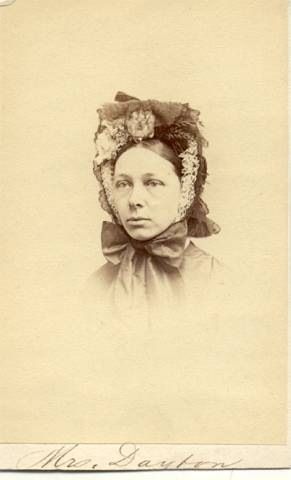
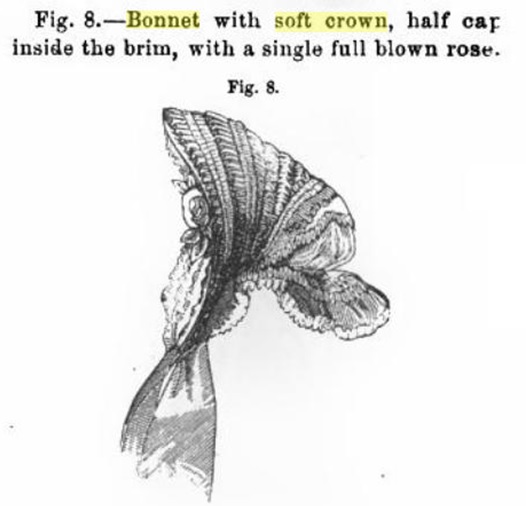
Soft Crown Bonnets – 1858-60

From Grahams, July 1858: “Tuscan bonnets are in great favor, and are generally trimmed with wild flowers and oats, or with a large rose, foliage and buds; sometimes with a tulle trimming, embroidered with jet, and finished with a brown fringe; a brown silk curtain and brown strings. Young ladies wear white crape bonnets, ornamented with ruches and loops of white ribbon, inside; acrss the head there is a bandeau formed of a red rose surrounded with wheat ears and grass. Many bonnets are made of a soft crown of spotted tulle; the edge of pink crape, with blonde falling over the front, and a bouquet of white and pink roses on the left side. A bandeau of the same roses crosses above the forehead, inside of the bonnet.”

SC December 58 Godeys

From Arthur’s Home Magazine, February 1860: “The latest style of bonnet is the soft crown. It is not generally adopted here, but is coming in. It is our province to keep the readers of the Home Magazine apprised of what is the reigning mode, and as nearly as we can – to indicate to them the tendency of the fickle goddess, Fashion.”
From Arthur’s Home Magazine , March 1860: “The plain style of bonnet with soft crown and distinguished in form, is aldo in vogue. It is large and plain in the border all round; but it has a cache of elegance, owing to the flat appearance of the plaited crown.”
Arthur’s Home Magazine , May1860: “The soft crown was of plaits of straw and green silk, alternating. Each ear-ring was of massive gold, in the form of a ring two inches in diameter, like an infinitesimal cart-tire with the outer edge chased.”

From Draper and Clothier, May 1860: “And in the same house, we saw a rice-straw bonnet, with soft crown of plaited tulle. A ruche of mauve ribbon across the front. A bow with rather long ends behind. In the cap, small bunches of lilac all round the face. Wide mauve ribbon strings.”

From Draper and Clothier, June 1860: “A very pretty bonnet has a soft crown of white crape, covered with black spotted tulle, and the front consisting of plain white straw. The trimming, on the outside, is a tuft of red rosebuds, in the inside of the trimming consists of a demi-bandeaux formed of loops of black ribbon, finished at the each end by tufts of rosebuds like those on the outside of each bonnet.”

Published in: on March 4, 2014 at 6:00 pm  Comments (1)  

Marie Stuart Bonnets – pt 2

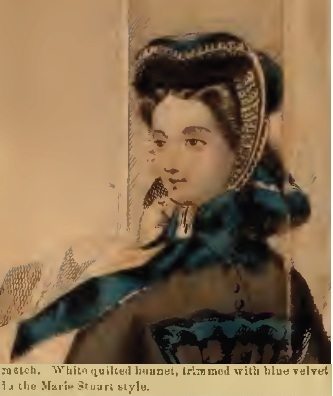
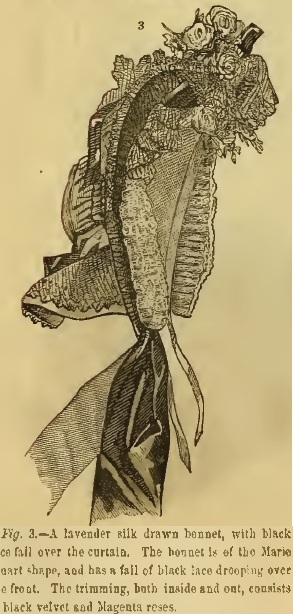
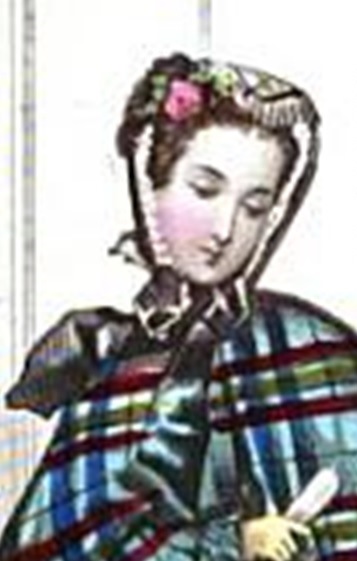
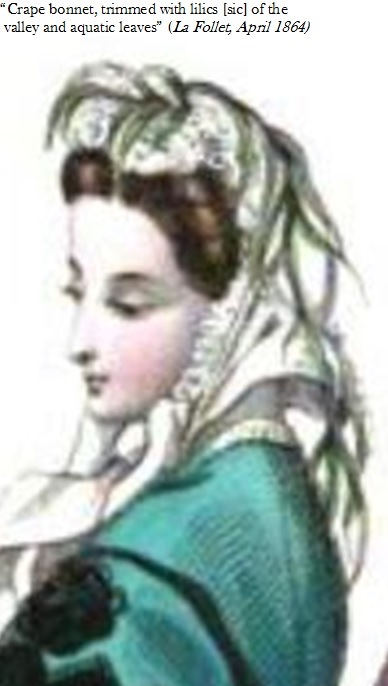
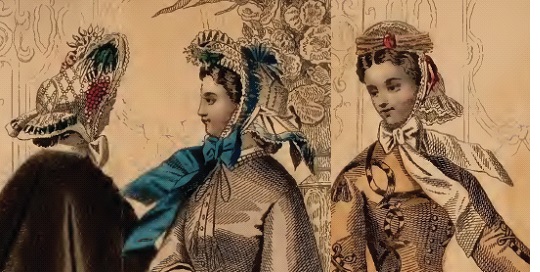
The Marie Stuart bonnet appears in both American and European (London and Paris) publications during the Civil War. The distinctive Marie Stuart shape of the crown varies in the depth of the dip as well as the curviness of the dip. The overall size of the bonnet varies, as does the width. In general, bonnets become smaller late in the war (while emphasising height). Some Marie Stuart bonnets seem to narrow though the sides as well.

MS Feb 1863MS Sept 1863 a

“The Important Subject of Bonnets, and the form they are likely to assume during the forth coming summer, is still a disputed point. Will they continue to be worn high, or are we to wear Marie Stuarts? are questions anxiously asked, but which as yet nobody can answer with any degree of certainty. All we can say on the  subject is, that we have not as yet seen the Marie Stuart bonnets adopted at any of the fashionable resorts, although we are constantly assured, on what would generally be considered reliable authority, that nothing else is to be worn. In Paris the same indecision prevails; the ladies of the Court and of the Chaussee d’Antin continue to wear the high upright bonnets, while the fair denizens of Faubourhs Saint-Germain and Saint Honore have all adopted the Marie Stuart form – not the decided Marie Stuart with a pointed front, as the title would indicate, but with the front slightly coming forward and lowered, imparting a very modest quiet appearance to the wearer – so much so that French milliners have christened this form “The Quaker bonnet.” But one thing is certain, whether the Marie Stuarts are ultimately adopted in London or not, and that is that all the newest forms are made much smaller and less exaggerated, and follow more closely the outline of the face than was the case a month or six weeks ago.” Arthur’s Home Magazine, July 1863MS La Follet Dec 1863

The later war years finds these references:

“One was of black tulle, and of the Marie Stuart form; a fringe of bugles was placed round the front. This bonnet was covered with a fanchon of white guipure. In place of the curtain was a puffing of black tulle, on which were fastened a few black cherries drooping on to the back hair. The strings were of broad black ribbon; over the ends was a broad patte of quipure. A white tulle scarf was fastened under the fanchon of lace, and tied under the chin, over the strings.” (La Follet, July 1864)

“Bonnet of crape. Curtain covered with lace. At the edge of the front is a scarf, with a bunch of flowers on the top. Marie Stuart pointe, edged with lace, falling over the flowers in the cap, and strings of ribbon.” (La Follet, March 1864)

MS La Follet April 1864

Published in: on March 3, 2014 at 4:00 pm  Leave a Comment  

Marie Stuart Bonnets

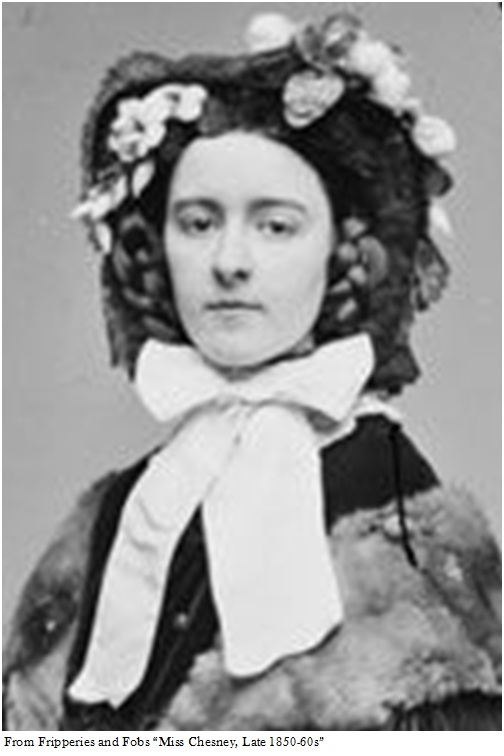
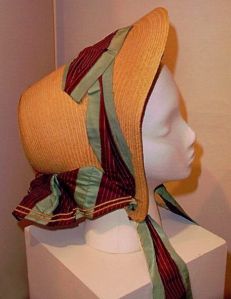
Here is a survey of fashion illustrations, CDVs and extant Marie Stuart bonnets to accompany my newest bonnet on Etsy – This fashionable Marie Stuart Straw Bonnet.

I was trying to track back this photo for permisions but my computer wasn't agreeing. I had to base my caption from the Pin note.If this is your's, please let me know. If you want, I can remove it.

Variations of the Marie Stuart shaping to millinery appear in caps and bonnets off and on through the century.

In the years just prior to the Civil War we see the Marie Stuart bonnet reammerge along side the cottage bonnet and the spoon bonnet:

“Marie Stuart bonnets of white crape or lisse are very distinguished, ornamented only with a fall of very fine guipure lace, thrown back from the front and extending over the curtain. In Paris black ribbon is associated with blue, green or groseille in the decoration of rice, straw, chip or Leghorn bonnets.” (Frank Leslie’s New Family Magazine, August,1858)

“The shape if the bonnet is of the Marie Stuart genre, approaching near the forehead in front, and (evasee) sprung our at the sides, the ears being long and edged with lace, very narrowly. The brides or strings are of blue and white diagonal striped taffetas.” (Arthur’s Illustrated Home Magazine, February 1859)

I have no source info for this photo. It was cached in Pinterest. If it your's, let me know. I'll remove it if you like.

Marie Stuart Bonnet

“There are two shapes of bonnets which divide favor nearly equally; these are the Cottage and Marie Stuart patterns. The latter is distinguished for flaring away from the side of the head and rising to a point at the top of the head three inches back from the forehead. Milliners, who have a supply of bonnet foundations without the point in front are forming it of other material, which proves that bonnets which are not of the cottage shape must have a pointed border over the forehead, or they are ignored by our demoiselles.” (Arthur’s Illustrated Home Magazine, March 1859)

The Marie Stuart is, by most of our Milliners, regarded as the only style; but the Cottage Bonnet, with shirred crown, and the cap crown, is silently and surely winning its way for the next rage.” (Arthur’s Illustrated Home Magazine, May 1859)

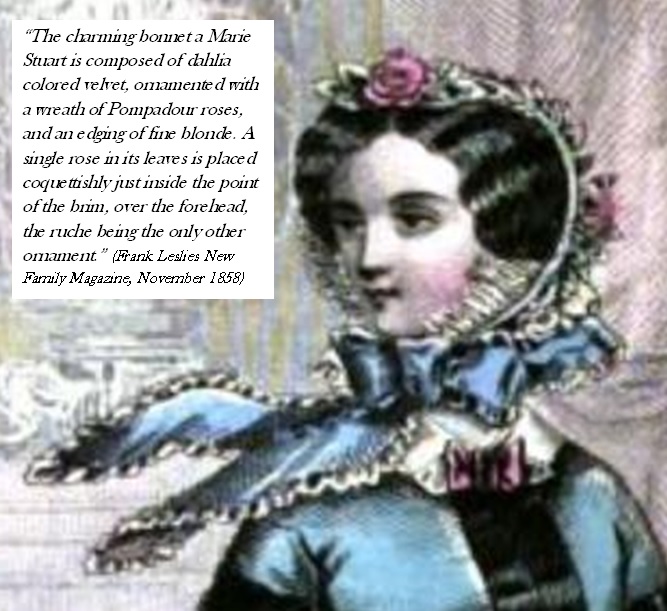
For those wondering “Why this shape?”, here is a painting of Mary Stuart showing her distinctive millinery.

MS Frank Leslies Nov 1858

The “Maybe or Maybe nots”….. There are some bonnets that may or may not be Marie Stuart bonnets. If only we could actually hold them.

This bonnet from the MET’s collection may be a Marie Stuart or it may just have a squashed brim. The top of the brim does dip slightly creating a shallow curve in.

This image comes from The Graceful Lady. I wish I could get a closer look.

Published in: on March 2, 2014 at 4:29 pm  Leave a Comment  

A Year in Millinery Fashion 1864

In this demi-season, when there is a perfect stagnation of fashion, and when milliners and dressmakers lament that there is positively nothing new, we find at Mme. N. Tilman’s, of Ninth Street, a choice lot of new importations.

Among the bonnets was a very peculiar one of black tulle, with scarlet velvet front, and the crown was formed of one large scarlet velvet carnation pick. The inside trimming was of scarlet carnations, and the strings of scarlet and black striped ribbon, quite Scotch-like, and a novelty; for until now plain ribbons alone have been tolerated for bonnet strings. The length of the strings should be one yard and three-quarters. Another very exquisite bonnet was of felt-colored velvet trimmed with aigrette of blonde lace and a heron plume. Inside more Scotch flowers, consisting of tufts of scarlet, green, and blue berries with gold spikes, interwoven with golden veined ivy. The tout ensemble of this bonnet was very charming. (Godey’s, March, 1864)

1

Understanding the Ribbon Bavolet

Straw bonnet from the Greene Collection at the Genesee Country Village

Straw bonnet from the Greene Collection at the Genesee Country Village

~~~This is one of the many wonderful bonnets found in the Susan Greene Collection at the Genesee Country Village. (To see some of their ribbons, be sure to hop over to the Millinery Ribbon Blog.)   ~~~ This straw bonnet shows a great many things from the over-all spoon bonnet shape to the shape of the cheektabs to the fineness of the straw. I would like us to look at the bavolet today. We also know the bavolet as the “curtain.”  The bavolet is a fabric or ribbon pleated into the back neckline edge of a bonnet. This can resemble a flounce in that the top is drawn in while the lower edge floats or flares out. The bavolet can, but does not need to be a single material as we see here. It can be made of layers of silk, net and lace. Some high-end fashion plates show beading as well. (Honestly, I don’t think I could handle beads dangling on my neck.)


~~~The construction seams on the underside are covered by a net. Net is used to give the silk bavolet more body and fullness. It is sewn so the net is not seen from the outside and pleated into the bavolet.  The bavolet reaches all the way around the back of the bonnet (the tip) and up along the sides while the lower edge connects to the cheektabs.

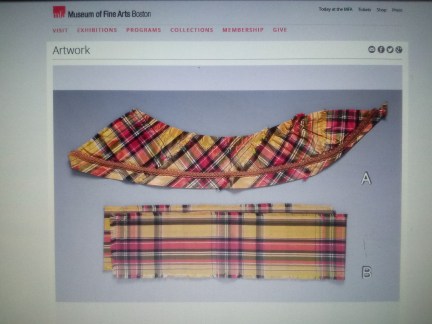
*The section of ribbon that decorates the exterior of the bonnet can be on the grain or on the bias. The ties need to be on the grain. To see a nice example of the ribbon decorating over the top of the bonnet, see this MFA example that happens to have the bavolet on the grain. Notice how the bavolet flops more than floats.

20190312_081424.jpg


Published in: on February 28, 2014 at 3:26 pm  Comments (2)  

Readings for Rural Life – How to make an omlette

From Moore’s Rural New-Yorker in Rochester, NY

(Given my newer found liking of omelets, I was delighted to see them show up in this publication a good number of times. Granted, I like mine with whites and lots of veggies.)

February 27th, 1864

How to Make an Omelet

Seeing and inquiry from “A Young Housekeeper” how to make an “omelet,” I send mine, which I call good: Twelve eggs, well beaten; one cup of sweet cream, and a little salt. Butter your dish, pour in this mixture, set over a slow fire, and stir occasionally until done. – Fannie R., Pavillion, N.Y. 1864

By another correspondent: – Six eggs, well beaten, with one teaspoonful of flour, one teacupful of milk, with one teaspoonful of salt; beat this well; put the milk with the eggs just before you put it in to fry. You must have some melted butter, just enough to fry it in. Run a knife under the edge as it is beginning to fry. – E.M., Wayne, N.Y., 1864.


Published in: on February 27, 2014 at 6:03 am  Leave a Comment  
Tags:

Resources for Life

 There are many different theories concerning the moral purposes of this world in which we dwell, considered, I mean, in reference to us, its human inhabitants; for some regard it merely as a state of transition between two conditions of existence, a past and a future; others as being worthless in itself, except as a probation or preparation for a better and a higher life; while others, absorbed or saddened by the monstrous evils and sorrows around them, have really come to regard it as a place of punishment or penance for sins committed in a former state of existence. But I think that the best definition, – the best, at least, for our present purpose, – is that of Shakespeare: he calls it, with his usual felicity of expression, “this working-day world;” and it is truly this: it is a place where work is to be done, – work which must be done, – work which it is good to do; – a place in which labor of one kind or another is at once the condition of existence and the condition of happiness.

Well, then, in this working-day world of ours we must all work. The only question is, what shall we do?

To few it is granted to choose their work. Indeed, all work worth doing seems to leave us no choice. We are called to it. Sometimes the voice so calling us is from within, sometimes from without; but in any case it is what we term expressively our vocation, and in either case the harmony and happiness of life in man or woman consists in finding our vocation the employment of our highest faculties, and of as many of them as can be brought into action.

And work is of various kinds: there are works of necessity and works of mercy; – head work, hand work; man’s work, woman’s work; and on the distribution of this work in accordance with the divine law, and what Milton calls the “faultless proprieties of nature,” depends the well-being of the whole community, not less than that of each individual.

Sisters of Charity, Catholic and Protestant. And the Communion of Labor, by Mrs. Anna Jameson. (Boston (1857) https://archive.org/stream/sistersofcharity00jame#page/n3/mode/2up

I must say that while reading the paragraphs following these on the work of men and the work of women, I have an urge to make charts of “men’s work” and “women’s work” at various times in our history. I think it would be interesting (and quite telling) to see how the individual tasks move from one to the other.

Published in: on February 26, 2014 at 1:34 am  Comments (1)  
Tags:

A Year in Millinery Fashion – 1864

Bonnets by no means follow the outline of the face, byt are simply lower in front than those which have been so perseveringly worn during the last two years. The sides of the bonnet
are very narrow, being almost close to the cheeks; so little space is left that there is only sufficient for one quilling of blonde at each side, or, if a colored crepe cap is adopted, for one narrow row of box, pleating. In some instances, the front is made very wide at the top, so as to allow a superabundance of trimming in the inside; but the more oval form appears to be
generally preferred. (Peterson’s, February, 1864)

Published in: on February 24, 2014 at 1:02 am  Leave a Comment  
Tags:

Readings for Rural Life – Cold Floors

From Moore’s Rural New-Yorker in Rochester, NY

February 20th, 1864

Cold Floors

“Keep the head cool and the feet warm,” says the physician. Some people are so unfortunate as to live in hired houses, or are too poor to repair their own, or do not wish to lay out money to fix up the old one, when they expect in a year or two that its place will be occupied by a new one. What are such people to do when the floors are filled with cracks that let in the wind and the cold? No sort of chance to follow the advice of the doctor, in such a case. The cracks change things just end for end. Cold feet and blood and heat to the head. We were in just such a fix. We read in the Family Journal, that newspapers being spread between bed clothes were excellent non-conductors, and rendered beds very warm. We applied the principle to our cold floor.  Before laying down the carpet, we covered the whole floor with newspapers, being careful to break joints. It produced a decided change in the temperature of the room. Feet and legs rejoiced, as they were comparatively comfortable. Please tell your readers, Mr. Editor, that this is about the best use some papers can be put to. – L.L.F.

A New Corset Asked For

Susie Perkins complains, in the Scientific American, that the corsets illustrated and recommended in that paper the past year, do not meet her requirements, and those of the sisterhood of corset-wearers. She talks in this wise:

“The air we ladies have to breathe up there in Vermont circulates all round the world, and is breathed by all the filthy creatures on the face of the earth, by rhinoceroses, cows, elephants, tigers, woodchucks, hens, skunks, minks, grasshoppers, mice, raccoons, and all kinds of bugs, spiders, fleas, and lice, lions, tobacco-smokers, catamounts, eagles, crows, rum-drinkers, turkey buzzards, tobacco-chewers, hogs, snakes, toads, lizards, Irish, negroes, and millions of other nasty animals, birds, insects and serpents; besides, it is filled with evaporations from dead, decaying bodies, both animal and vegetable, and we ladies are obliged to breathe it over after them, ough! Bah!

“Now we want, and must have, some contrivance that will effectually keep this foul disgusting stuff  out of our lungs. We have tried the three kinds of corsets which you noticed in your paper last year; but when we do the best with them that we can, about a teacupful of this nasty air will rush into our lungs in spite of these miserable contrivances, and when we blow it out again another teacupful of the disgusting stuff will again rush in, and when we blow that out still another will rush in; and so we are obligated to keep doing from the time we wake up in the morning till we go to sleep at night, and I do not know but we do all night.

“If these corsets are worth anything to keep this disgusting air out of a body, and we have not put them on right, please come immediately yourself, or send the inventors to show up how. If they are a humbug, I hope their inventors will be tarred and feathered and rode on a rail, and you, for noticing them in the Scientific American, be obliged to breathe about sixty pints of the nasty, foul, nauseous, filthy, disgusting, dirty, defiled, loathsome, hateful, detestable, odious, abominable, offensive, stinking air which surrounds this earth per minute for a hundred years.”

The editors, in their zeal to supply the wants of the correspondent, respond as follows:

“We can suggest but one kind of corset which would effectually meet our fair correspondent’s wishes. Instead of the ordinary laced-up corset, take a piece of strong hempen cord and apply it closely about the neck, tie one end of it to a beam, and let the whole weigh of the body suspend at the other end. We guarantee that if the cord is strong enough it will put an end to all future complaints on this subject.”

Published in: on February 20, 2014 at 6:00 am  Leave a Comment  
Tags: