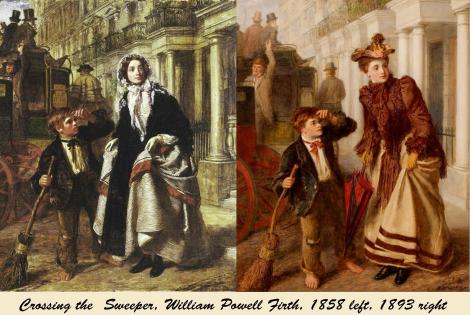
Children’s Headwear
Lately, I’ve been hearing an assortment of “kids didn’t wear…”, “children only wore…”, “she’s too young for….” and so on.
Ehhhh…. not so much. Children had a variety of headwear to choose from. Here is an attempt at a survey of paintings to help us get a better idea. (Clicking on the thumbnails will take you to the full paintings)
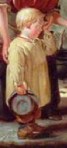
Let us start with this little boy from Britain. The title, A Visit from the Hall, suggests his family rents or works the land. He is young. I would estimate 2 or 3 years of age. He wears a long smock that may be a dress and what might be the start of pants underweight. He holds a cap in his hand.
 This little girl is getting direction from her mother, in Responsibility by Hugh Cameron (1869). I can’t help think “Little Red Riding Hood” here. Except instead of a red hood she is wearing a white, possibly blueish, soft bonnet or hood. It may be a quilted bonnet. The weather may or may not be slightly chilled outside, as she wears a light outer garment and not arm coverings.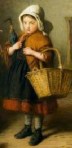
In this Cameron painting, The Village Well (1871), the girl is wearing a short sleeve dress, pinafore and pretty pink sunbonnet. This appears to be a corded sunbonnet to me. The curtain/bavolet is long, hanging over her shoulders protecting her neck. In her hand (sorry I cropped that) is a jug for water. 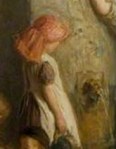 This girl coming through a garden gate is also wearing a pink sunbonnet. This one has a ruffle around the brim and a much longer curtain.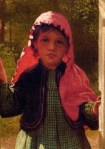
This girl’s sunbonnet is white. You can see it tied under her chin with a ribbon that appears to have color. 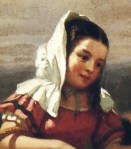 For an additional sunbonnet, see Pay Toll.
The next few images depict fairs. Looking at the whole paintings, we see a wide variety of clothing. In Alfred Mudge’s Walking the Walsall Fair (1859) we see two girls wearing structured bonnets, meaning buckram or straw bonnets. The lower image shows a girl who wears a pinafore type garment over her dress which is just above the ankles. I think she is 11 to 14. Her bonnet hints at straw while distinctly showing the bavolet and ribbons. She is holding the hand of another child, possibly a girl if that is long hair, who is wearing a hat with a ribbon. In the upper image, which is to the right of the first girl in the whole painting, is a girl who may be a bit younger than the first. She wears a bonnet perched far back on her head, to the point of falling off. 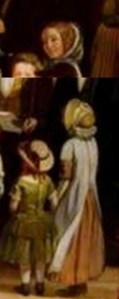 This next child is a bit blurry because I tried to zoom in too far. She is from William Samuel P. Henderson’s Fair Day (1856). She is quite young, maybe 3 to 5. She wears a dark, possibly black, structured bonnet tied with light, possibly blue, ribbons under her chin.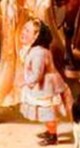
For additional “reading”, this page has several good paintings for clothing in general.
Also see, Looking out for the Engine while the Bell Rings for an assortment of head wear.

Still Life with Bonnets, caps actually
Still Life with Bottles and Breton Bonnets is a slightly different still life than the usually pretty arrangement of dishes and fruit or pretty flowers. How lucky are we that Pierre Roy decided to paint it?!
FanU “Fallen Leaves” Swap
Wow, this first swap of the fall went fast! It may have just been me. But, I received 1 envelop. Then, I received All the envelops.
It was so much fun opening that stack and seeing all the pretty fabrics. It seemed quite suitable that the fallen leaves arrived as the air turned such a chill. Let me tell you, boy do we have a lot of fallen leaves here.
As most of you know, I get migraines. So, this round I didn’t do well at all sorting the fabrics into group 1 and 2. So, we have 1 big photo. Well, 1 collection with 2 photos, a non-flash and a flash.
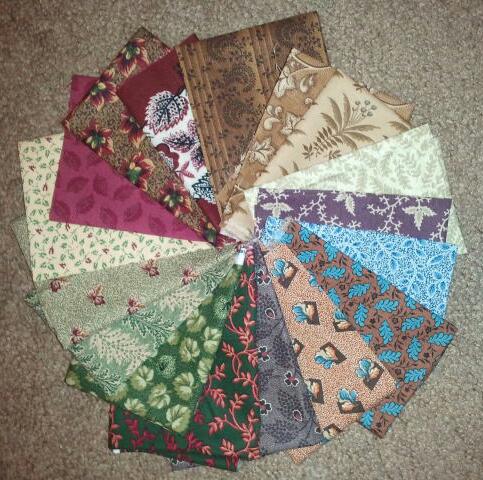
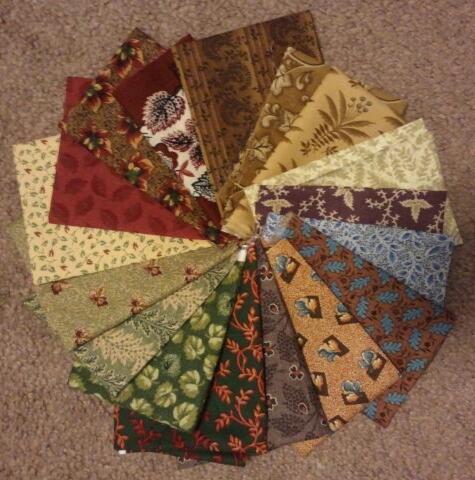
In this grouping we have so many pretty prints spanning a few decades. (We’ll get to talk more about techniques when we get to the ‘Greene’ swap later.) Though, I will say I can se some that were roller prints and at least one I suspect was a bloc print. One is called “Dancing in the Rain”. Another called “TossedLeaves”. We have pieces that come from Old Sturbridge Village and the Victoria & Albert Museum. One is a DAR fabric. There are fabrics from the Civil War Melodies collection, the Windham Winter Carnival collection and the Dargate Botanicals.
Something that I enjoy personally is seeing which fabrics Grandma had or that she likely would have picked. This groups was strong in those respects.
Thank you to all my FanU swappers for participating. I look forward to the next swap!
–
Worth Reading: Berlin Woolwork
This is an inspiring survey of Berlin Woolwork. There are a few pieces that would work for the memorial project. At the same time, the cats are so cute. (Which reminds me of an embroidery piece that really aught to be on the wall.)
http://victorianneedle.blogspot.com/2014/09/kristen-berlin-woolwork.html?m=1
A Year in Millinery Fashion – 1864
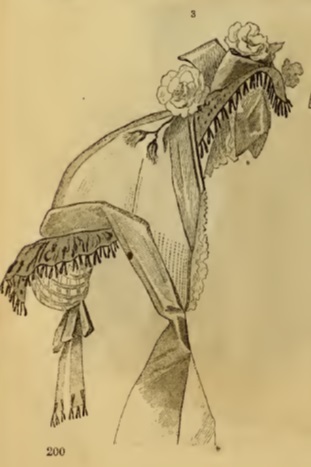
White silk bonnet, trimmed with violet ribbons and pink roses. A net formed of ribbons is attached to the bonnet. (Godey’s, September, 1864)
Readings for Rural Life
From Moore’s Rural New-Yorker in Rochester, NY
Sept 10th, 1861
The economy of crinoline is thus discussed by a French writer: – Dresses require, to be worn over hoop s, at least three meters more than would be needed if worn over an ordinary skirt. As no less than twenty millions of ladies’ dresses are made every year in France, the additional quantity of material necessitated by the use of hoops is sixty millions of meters, which, taken at an average price of two francs per meter, makes a sum of one hundred and twenty millions of francs. In addition must be mentioned the extra quantity of material employed in the manufacture of the hooped petticoat itself, and the long, ample underskirt worn between the crinoline and the dress. This extra material can not be counted at less than one hundred and twenty millions more. The average cost of the hoops and the making of the cages can not be taken at less than an average of fifteen and fifty millions to be added to the cost of the woven goods calculated above. These three sums together make up a tribute of three hundred and ninety millions francs, or about one-fifth of the State Budget, paid yearly to a ridiculous and inconvenient fashion.
A Year in Millinery Fashion – 1864
Pearl-colored crape bonnet, trimmed with black lace. A fan of pearl-colored silk and white feathers, The trimming inside is of pink ribbon and stiff white feathers. (Godey’s, September,
1864)

FanU Workshops at the Domestic Skills Symposium

I will be teaching two Fanciful Utility workshops at the Genesee Country Village and Museum’s Domestic Skills Symposium. 
The Symposium takes place on Saturday, November 1st, with Workshops on Friday and Sunday. This is an incredibly affordable program at $75 for Saturdays Symposium with 4 full presentations.
Key lectures include:
- A survey of printed fabrics from 1760-1860 by Susan Greene, author of Wearable Prints
- Midwifery from colonial times to the Civil War, by Nancy Webster
- A history of 19th-century sweets and confections by Patricia Tice
- Kitchen Gardens and Seasonality by Emily Conable.
Friday and Sunday Workshops cover domestic skills such as:
- 18th century Pastry Making
- Wool Spinning
- Making Your Own Trivet
- Choosing Appropriate Fabrics for Reproduction Clothing
- Sit Not in Idleness
- Make your Own Hand-bound Notebook
- Custom Draping a Personal Pattern
- Recreate a Day Cap From the Susan Greene Historic Clothing Collection
- Making Green Sage Cheese
- Civil War Cookery
- Fun will flax
- Tin Care & Make a Tin Nut Grater
- The Complete Confectioner
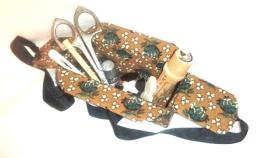
- Making a Rolled Sewing Case **My Workshop**
- Making a Mid-19th Century Sewing Box **My Workshop**
- Make a Cheese Basket
 The only bad thing about teaching workshops is missing attending the others. “Sit not in Idleness” sounds like so much fun. I’ve really wanted to get Lily a trivet. I would love to have a hand-bound notebook for when I set up the millinery. Um, Yum, Cheese! And, a basket too?! It would be great to know more about taking care of tin. Plus, I loved the little tin nut grater we had when I was a kid.
 I hope to see many of you there. The museum is just outside of Rochester, NY; about an hour from Buffalo/Niagara Falls and 2ish hours from Syracuse. There is a beautiful B&B right down the street. There are several nice hotels in Henrietta too.
The full description of the program along with registration information is on the museum’s site: www.gcv.org
FanU Fallen Leaves Fabric Swap!!
Today is the day to sign-up for the FanU Fallen Leaves Swap!
For the Fallen Leaves Swap, Swappers will exchange early to mid nineteenth century appropriate cotton fabrics with leaf motifs. These can include organized leaves, leaves used in a stripe motif and others reproduced from the century. We will mail our fabrics on September 10th.
Please read all the details below.
To Sign-up, simply comment below with your email and mailing address. (I’ll erase those before approving your comment, so the whole world doesn’t have that info.)
What is a Swap?
This is a chance for to exchange fabric with a small group of people. Each group will have 8 people exchanging pieces of fabric. All you need is a half yard of fabric and envelopes along with your copy of Fanciful Utility.
To Participate:
1: Sign Up Day!
On sign-up day, groups will be assigned on a first-in basis; the first eight will be the first swap group, second eight in the second group, etc. **Please be certain you will be able to fully participate by mailing your fabrics on the Mail-Out Date.**
“Fallen Leaves” Swap Sign-Up Day: September 1st
“All Lined Up in a Row” Swap Sign-Up Day: October 1st
“I Couldn’t Live Without It!” Sign-Up Day: November 1st
Bonus The Greene Swap Sign-Up Day: November 15th
2: Mail-Out Day:
Place a 9×9″ piece of fabric suited to the mid-19th century in envelopes for each of the 7 other people in your swap group, stamp them (be sure to double check at the post office, but the small 9×9″ pieces should mail in a regular envelope with a normal stamp), and send them off no later than the Mail-Out Day.
“Fallen Leaves” Swap Sign-Up Day: September 10th
“All Lined Up in a Row” Swap Sign-Up Day: October 10th
“I Couldn’t Live Without It!” Sign-Up Day: November 10th
Bonus The Greene Swap Sign-Up Day: December 1st
3: Get Fanciful!
Use your Fanciful Utility templates and techniques to make a project from the book, or copy your own from 19th century sources. We’ll all look forward to seeing your projects! You don’t have to sew right away, but don’t keep us waiting forever to see all the fun things!
(If you need a copy of Fanciful Utility, you can purchase them from the publisher at www.thesewingacademy.com
Fabric Guidelines:
- For the cotton and silk categories, your fabric should be early to mid-nineteenth century appropriate. (If there is a want for an earlier or later group, we can do that.) Prints and motifs should reflect those available in the 1840s, 50s and 60s. Cotton should be 100% cotton. Silk should be 100% silk.
- To keep the swap and sewing possibilities interesting, please avoid solids as best we can.
- Fabrics that do not work well for sewing cases should not be swapped. These include sheers, gauzes, heavy, thick, easy-to-fray, slippery and stretch fabrics.
- For the “crazy swap” category, think crazy quilt in a sewing case. This could include satins, velvets, textured fabrics. Quality synthetic fabrics are invited.
Swapper Guidelines:
- Please be certain you can fully participate in the swap before you sign-up.
- If something arises after you sign-up that will effect the date you are mailing your fabrics, please email your group so everyone is aware.
- If you fail to fully participate in a swap, you will not be able to sign-up for future swaps. (We do understand medical and family emergencies. I need to be able to ensure swappers will receive fabrics when they send fabrics out.)
Q&A
Yes, you can participate in 1, 2 or 3 of the swaps.
Yes, if we end up with multiple groups, you can participate in more than one group to swap more fabric. If you participate in 2 groups, you should swap 2 fabrics.
Yes, you can swap large and small scale prints.
Yes, you can swap now and sew later.
Yes, we would love to see what you’ve made with the swapped fabric.
Yes, you can use your own fabric in your swapped project.




 If I Had My Own Blue Box: