I’m Drooling

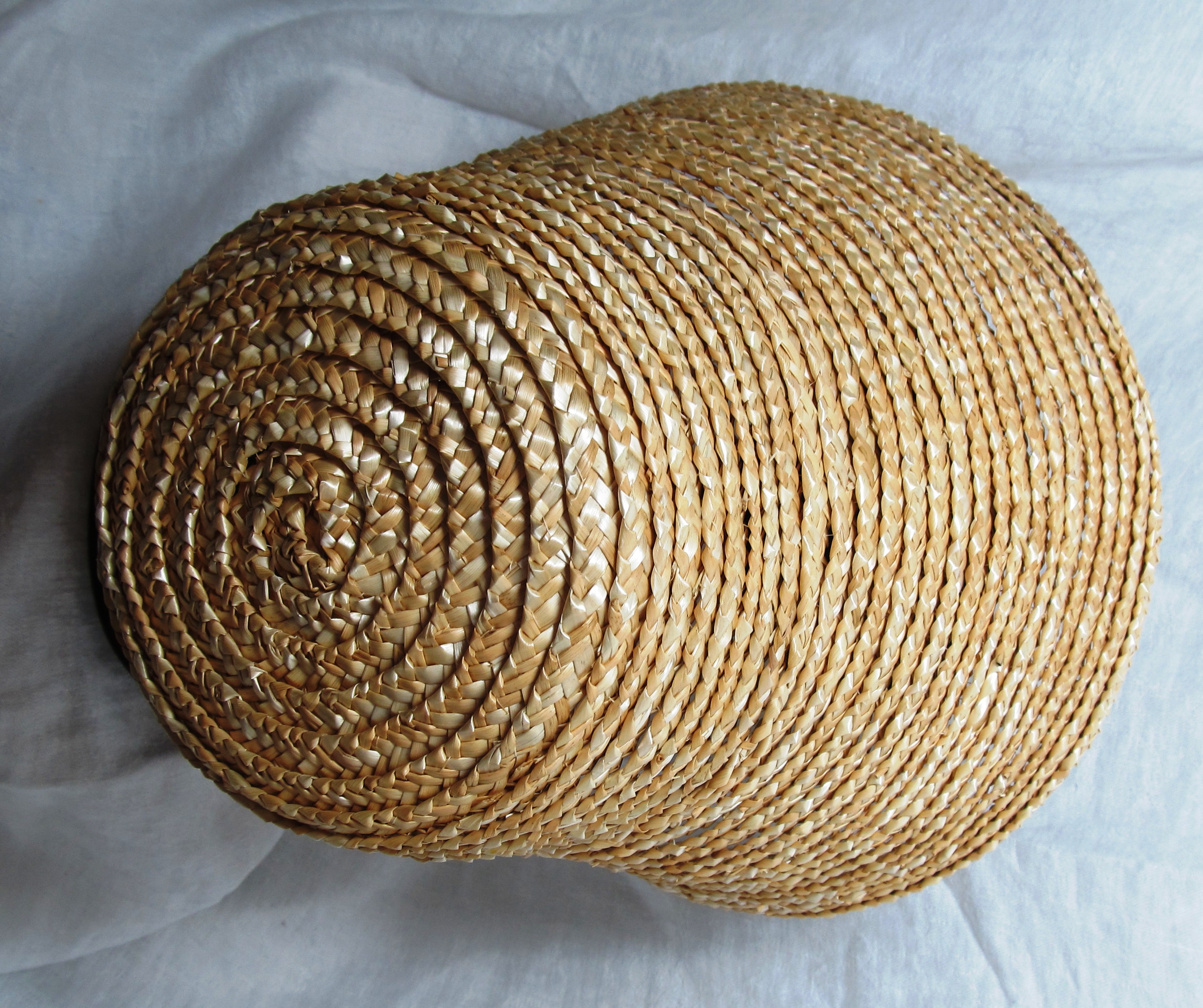
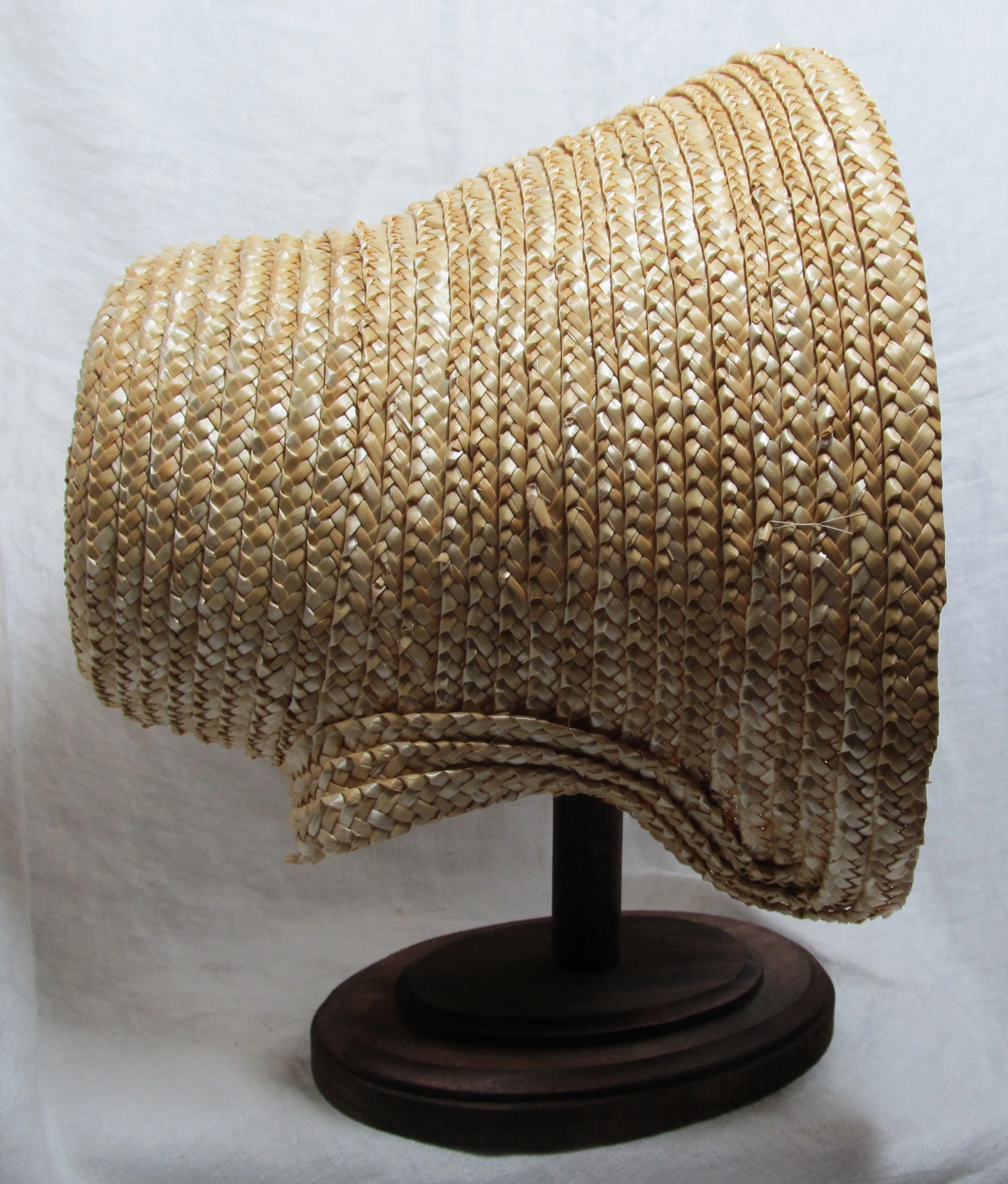
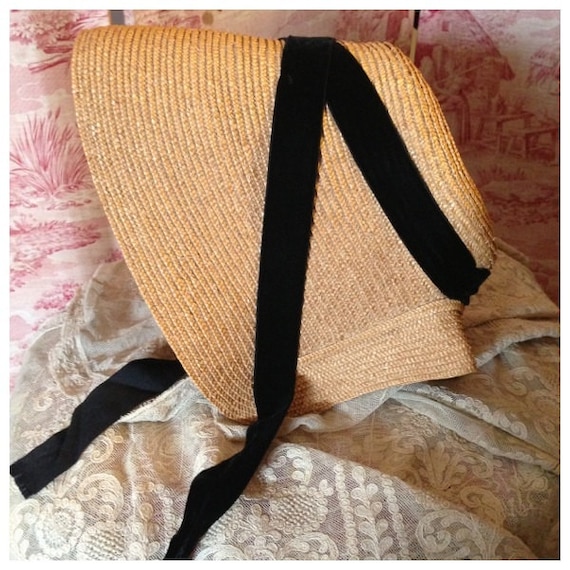
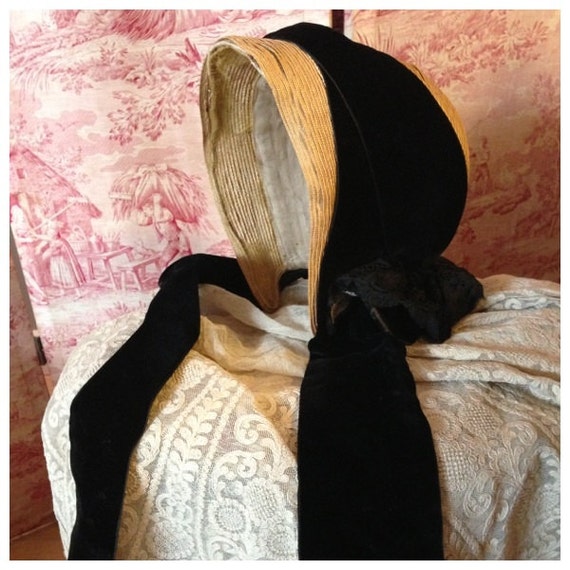
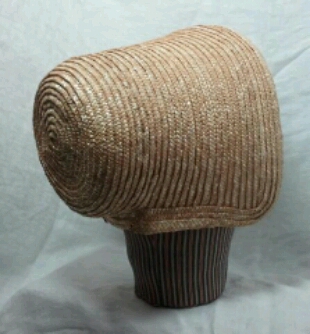
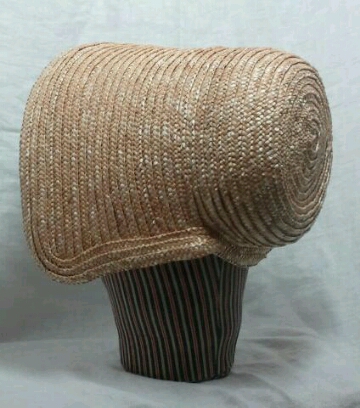
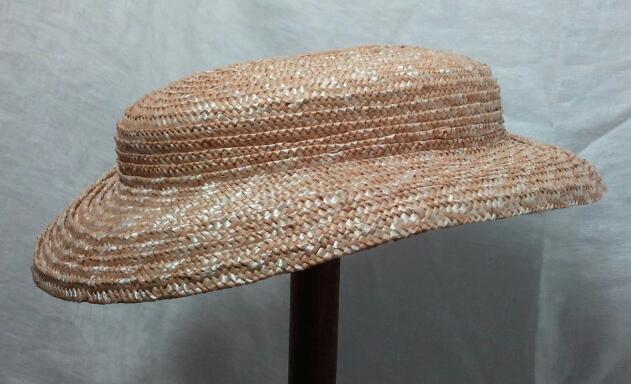
I rarely post items from Ebay or Etsy that aren’t part of a topic specific blog post. But, these two straw bonnets are swoon worthy.

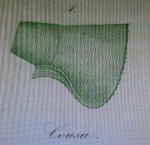
You know what I was saying the other day about the curves in poke bonnets? The first one hasthat same type of beautiful curve in construction I love so much. The simple velvet ribbon wrapping around the tip and crown seems to fit those curves so well. This tempts me to do the same in the future.

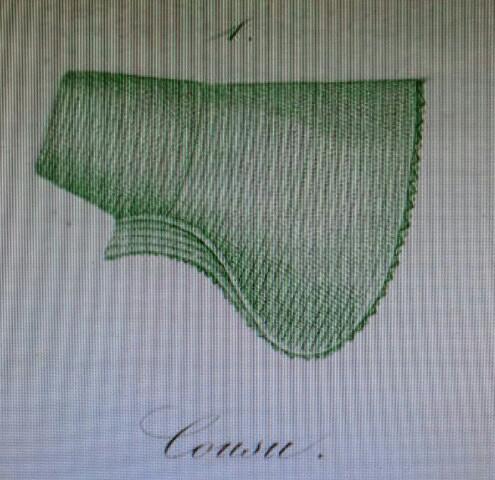
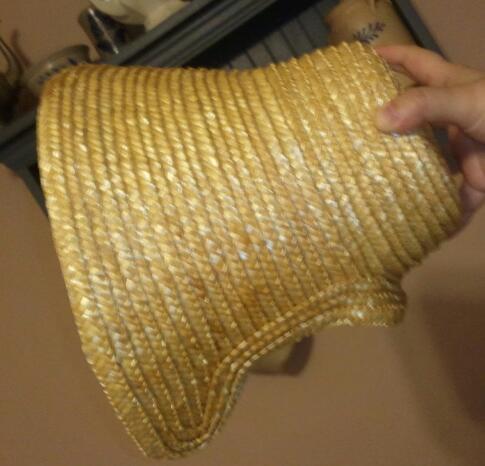
The second appears to be a decade to a decade and a half later to me. Check out that wide velvet ribbon!! There is something about black velvet on natural straw. I am curious as the seller says the bavolet is wired. The quad-photo in the listing gives a nice look at wiring and one way of lining.

Published in: on May 6, 2015 at 6:03 am  Leave a Comment  

Veils

(I had been planning to do a post on veils. But, life has been crazy, photos have not been taken, and the discussion has come up in a FB group. I’ll do an actual real post at some point.)
Here is one of my original veils.
wpid-2014-08-30-18.09.42.jpg.jpeg
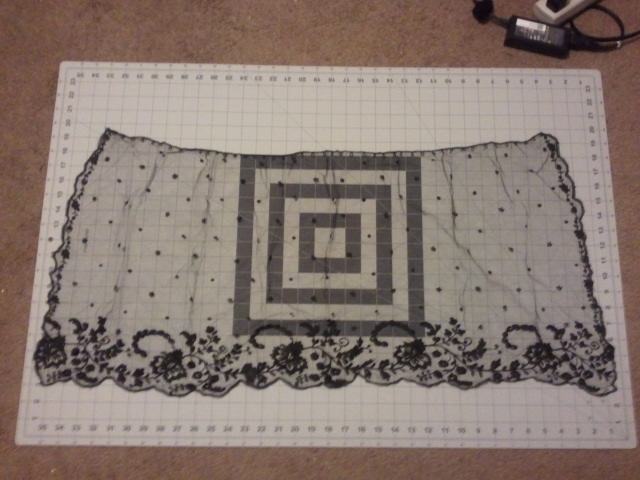
This is the gauze one Bevin made me. I need to double check, but I think it is the same dimensions or a little wider. I know my black gauze is about 36″ wide by 20″ long. These are a must for me to function at many events.
wpid-img_38321-1.jpgA random interesting quote:

The principal feature in the new bonnets [Empire?] is the veil, which has now become the all-important item for bonnets and hats. It is unhemmed black or white illusion spangles with gold, figured net, crepe lisse, or else the regular made veil. It is either caught on the side of the bonnet by a fancy ornament, or is fastened just over the crown. The length varies from three-quarters of a yard to one yard. (Godey’s Lady’s Book, January 1866)

My pinboard for veils.

Published in: on May 5, 2015 at 8:02 pm  Leave a Comment  

Getting Pokey

wpid-2015-05-01-13.37.43-1.jpg.jpeg

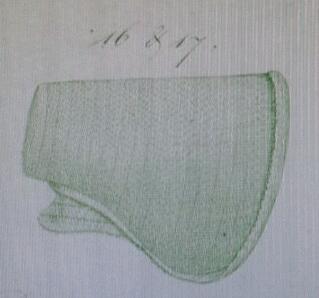
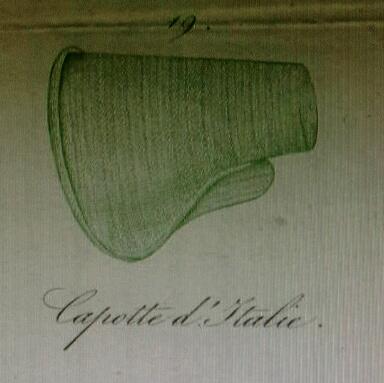
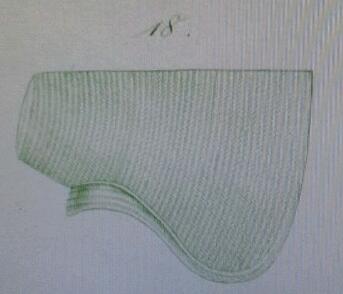
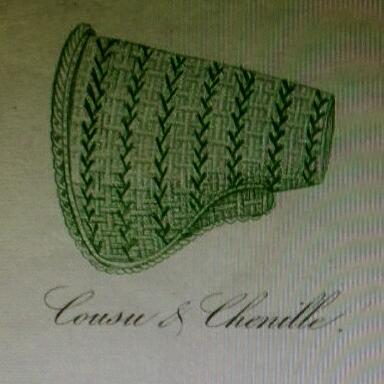
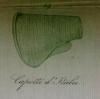
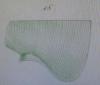
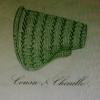
I’ve had this thing about poke straw bonnets lately. It is sort of a curiosity. Looking from the mid-century back…They aren’t the prettiest of bonnets. They aren’t the most fashionable of bonnets. They aren’t the most flattering of bonnets. wpid-2015-05-01-13.37.43-2.jpg.jpegBut, there is something about the lines the straw makes as the shape develops. There are curves and bends in this family of shapes that are just fascinating to me right now. I have oodles of images in my phone that I zoom in on as I play with my straw.wpid-2015-05-01-13.37.34-1.jpg.jpeg The illustrations to the right are some of them. They are from an 1841 French advertisement with several illustrations.
wpid-2015-05-01-13.37.34-2.jpg.jpeg

Let’s look at what a poke bonnet is. Modern costume dictionaries tend to define a poke bonnet with reference to a round brim and/or a brim that projects forward.

“Poke bonnet, poking bonnet (F)

Period: 1799 to end of 19th century

A bonnet with an open brim projecting forward over the face. The term was applied to a large variety of styles, the ‘poke’ often very slight.” (The Dictionary of Fashion History. Cumming, Cunnington & Cunnington.)

Turning to the nineteenth century, this definition from Bartlett’s appears to be a common definition in 19th century dictionaries.

Poke-Bonnet. A long, straight bonnet, much worn by Quakers and Methodists. (Bartlett’s Dictionary of Americanisms, 1859.)

Later in the century, we have an additionally descriptive definition.

Poke-bonnet , n. A bonnet having a projecting front of nearly conical form, worn about the beginning of the nineteenth century and later.” (The Century Dictionary and Cyclopedia.1897)

Variations of the ‘poke’ run through much of the century, from the beginning into the mid and drizzling out as bonnets and hats got smaller. This article “Bergere and Bonnets” has several nice examples of Regency era in the first half of the post. Here are examples as we proceed through the decades – 18151815-18201845, 1848, 18501850, 1865 (I have this theory on the development of poke styles I am still sorting out.) In many stories, the poke bonnet seems to be a go-to descriptor for Quaker women. It is also frequently used for describing young women from the country.The frequency in use of the poke bonnet in fictional writing seems to peek from the latter 1820s through the 1840s.

I’ve been working on a couple poke bonnets.Two I can not show you yet because they need to make their debute. I should be able to show one of those next week. This one is an early Regency shape. It was my first. The straw is a fine Milan plait. The crown has a flat tip that rounds to the sides. The crown to brim transition is flat with a very minimal lift. The cheektabs are barely there being a very slight dip on each side. The front of the brim is flat.
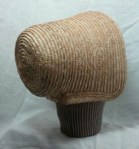
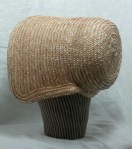
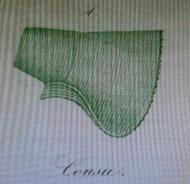
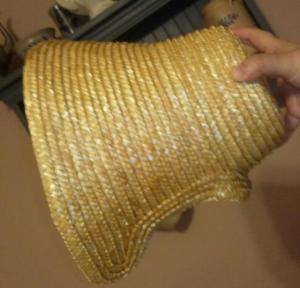
wpid-2015-02-08-09.20.36-1.jpg.jpeg wpid-2015-02-08-09.20.21-1.jpg.jpegwpid-2015-05-07-08.26.42-1.jpg.jpegHere is one of the poke shapes made with the later 30s and early 40s in mind, looking at the illustration to the left, out of coarse straw due to the abundance of 1830s references to coarse straws being worn for morning attire. I made this bonnet with a large flat tip. The crown rises at the slightest of angles to the brim. The cheektabs are short and wide with a nice rounded curve wrapped by the rows of plait that create the straw curtain at the back of the neckline.

[[[[[PHOTOS AS SOON AS IT DRIES]]]]]] I’m in patient. Here is one shot as it is still wet:
wpid-2015-05-07-06.15.28-1.jpg.jpegClose Cousin or the Same??

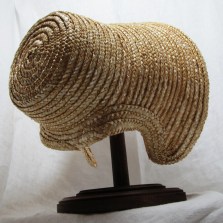
The phrase coal scuttle bonnet is also used to describe a bonnet with a deep brim. Looking at both nineteenth century references and modern ones, at times poke bonnet and coal scuttle bonnet seem to be different and at other times seem to be used interchangeably. According to the Merrieam-Webster dictionary, a coal scuttle bonnet is  “A woman’s bonnet with flat back and stiff projecting brim somewhat resembling a coal scuttle.” This definition seem quite like that of the poke bonnet with the description of the tip as a “flat back” being added. The 1897 A Dictionary of Slang, Jargon & Cant  has an even more similar definition: “Coal-scuttle (American), a nickname for the peculiar bonnet worn by Quackeresses, which was exactly the shape of an old-fashioned coal-scuttle. Some years ago coal-scuttle bonnets were worn in England.” Here is an example of an original coal scuttle. In that 1840s example, the slight difference appears to be the shaping of the brim’s edge, the coal scuttle having a little curve reaching forward on the sides rather than the arching curve of the poke of the same era. In fictional texts,the phrase ‘coal scuttle bonnet’ seems to appear most frequently in the 1830s and very early 40s.

Another word I saw used in place of poke, was Neapolitan. I have to look into this more. Considering the first passage to come up when I started looking was an 1850s fashion description about a “Neapolitan bonnet made of Leghorn”, my head quickly angled sideways. (the later 60s and 70 Neopolitans are quite small & very different than poke bonnets.)

They are calling it poke….

….but I don’t think so. You know how we now like to put names on things but we don’t always agree with each other or with the original time period? Well, this is one of those cases. The way I wrap my head around ‘poke’ conflicts with some of the other bonnets being called ‘poke’. In the 1830s there was a bonnet with a high, tallish crown and large dramatically diagonal brim. Some refer to this as a poke. Here is a Victoria and Albert Museum example. Technically, the brim does project forward over the face. But, it is not a long straight bonnet by any means. Similarly, the MET is calling this bonnet a poke as well. To me, those are leghorn bonnets which is a whole other complication because technically leghorn is a type/variety of straw.

My thoughts & perspective

This has been a post with much of my own speculation. It is highly likely well other well researched individuals will have a different perspective and different thoughts.
Published in: on May 5, 2015 at 5:00 pm  Leave a Comment  

Hats – Which, When, Where?

wpid-2015-04-08-16.06.22-1.jpg.jpegI am trying to refrain from calling this post “Yet Again” or “The Ever Reoccurring” hat question because this question really does come up every year as early spring finally breaks free to full sun and flowers. This year it is seemingly every week or even twice a week some form of the hat question comes up… “can I wear this?”, “Is this shape correct?”, “how can I decorate this?”, and on.

2014-05-22 16.36.06-2 Some are looking for face protecting hats with brims offering shade. Some are looking for an inexpensive head-wear option. Some are looking for a fashionable accessory. Admittedly, not everyone is always happy with the responses they receive. It isn’t as easy as a pretty hat or even a correctly shaped hat.

When choosing a hat, it isn’t just the shape of the hat that needs to be considered. We must al2014-03-29 17.47.54-1so consider several factors including ~who is wearing the hat, ~where the wearer lives and if from, ~what the situation/scenario is for wearing the hat, ~when the hat is being worn in terms of both year and time of year.

An exercise I have envisioned lately, that I believe will help is this: Print several dozen of women wearing hats. I suggest small, but not too small, 2-3″.  Include photographs, paintings and illustrations. On a large piece of paper or your cutting matte, mark sections for Fashionable, Recreation/Picnics/Parks, Recreation/Seaside, Utilitarian along the top of the paper or matte. Along the side, make age groupings such as child, teen, young lady, middle age, mature. Take the printed images and lay them out on the paper or matte where they belong. Notice any trends in the hats you are seeing. (hopefully, this will help.)

Another exercise to help you find an accurate hat that you like is to choose three to five original images of hats, be it photos, paintings or illustrations. Enlarge them to a full 8.5″x11″ page and print them. Now, take a pencil and trace over the lines of the hat just the hat – get the rise of the crown, the shape of the tip, the width of the brim, the curve of the brim. Repeat this with a marker or felt pen that will make the lines stand out. Lay your tracings out across the room where you can see them (maybe up on the bookshelf or around the tv.) Leave them there for a while. Let the lines stand out and sink in. This should help you develop an eye for these shapes, bringing the shapes and construction to the front of your mind when looking at hats.

Here are three previous articles/posts addressing the shape of hats as well as when and where to wear them:

In addition, take a look at this nice collection of images of women wearing hats in The Barrington House Educational Center. (I think I need to make this hat.)

Published in: on May 4, 2015 at 4:00 pm  Leave a Comment  

A Bonnet Cover

This came up in a discussion last week. I could remember reading about the bonnet cover. I forgot that I wrote about it. (No, I didn’t get around to make one.)

If I Had My Own Blue Box:

Ooops. This wasn’t supposed to post until this weekend. But given the weather I am about to venture out into, I’ll leave it.

From Eliza Leslie’s House Book, (Philadelphia, 1844)

A BONNET-COVER – When travelling in dry weather on a road that is likely to be dusty, you may effectually protect your bonnet from injury, by taking with you a cover for it. To make this cover, get a yard of white glazed cambric muslin, and cut it into the form of a large straight hood; gathering it close at the back of the head upon a small circular piece about the size of a half-dollar. Slope it away at the sides of the neck, and put a case with a drawing-string of fine tape along the edges of the front: the string to tie at the side.

If you commence your journey by water, you can roll up this…

View original post 399 more words

Published in: on May 4, 2015 at 11:51 am  Leave a Comment  

Life of a Straw Bonnet – Cutting Down

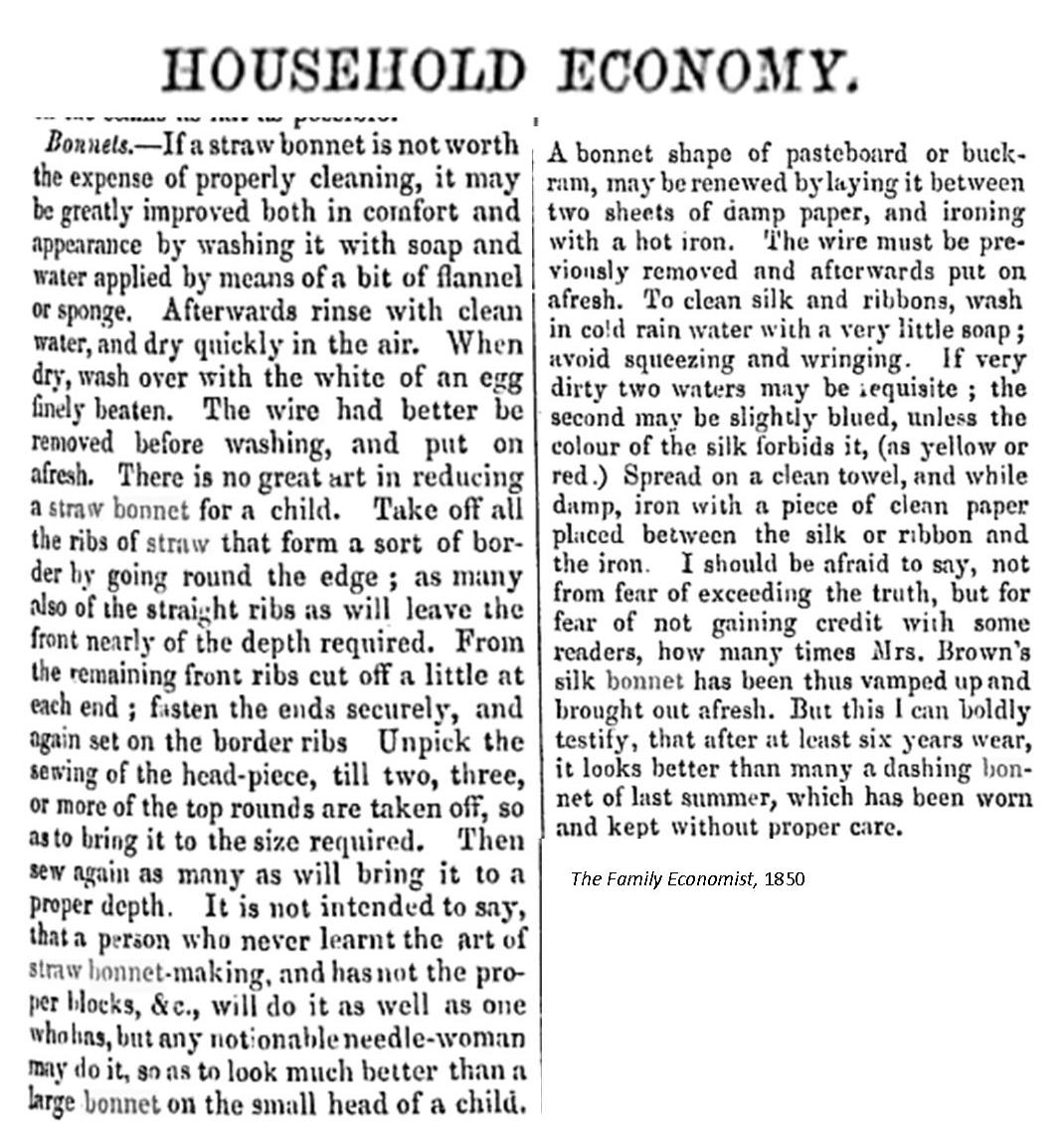
Cleaning bonnet Family Economics 1861insert image of cutting down text

Published in: on May 3, 2015 at 6:00 am  Leave a Comment  
Tags:

Life of a Straw Bonnet – Longevity

a

Published in: on May 2, 2015 at 6:00 am  Leave a Comment  
Tags:

Life of a Straw Bonnet – Cleaning & Care

Miss Leslie’s Lady’s House-book; a Manual of Domestic Economy Containing Approved Directions for Washing, Dress-making, by Miss Eliza Leslie, 1850.

TO CLEAN A STRAW OR LEGHORN BONNETHaving separated the crown from the brim and the cape or neck-piece, and removed the lining and wire, the next thing is to take out whatever stains may be found in the bonnet, the crown of which should be put on a wooden block. For grease, rub on with your finger some powdered Wilmington clay, or a little magnesia; and in an hour or two brush it off, and renew the application, if necessary. For other stains use either cream of tartar or salt of sorrel, put on a little wet. If salt of sorrel,must be washed off again almost immediately, lest it injure the straw by remaining on it. Afterwards (keeping the crown still on the bonnet-block) go over the whole surface of the bonnet with a brush dipped in a weak solution of pearl ash in lukewarm water, (a tea-spoonful to a quart.) Then scour it off at once, with a strong lather of brown soap and cold water, put on with a clean brush. When all the bonnet is well cleaned, rinse it in cold water, and hang it in the sun to dry. Bonnet cleaning should never be undertaken in damp weather. When the bonnet is perfectly dry, you may proceed to whiten it. Fill a chafing dish or portable furnace with burning charcoal; carry it into a small close room or into an empty press or closet, and by a line suspended across, hang the bonnet over the charcoal, at a safe distance, so that it will be in no danger of scorching. Then strew over the coals an ounce or two of powdered brimstone, and immediately go out and shut the door, seeing that no air whatever can get into the room. After the bonnet has hung in the vapour six or seven hours, throw open the door, (having first left open an outside door or window, so as to admit immediately the fresh air,) and go into the room as soon as you find you can do so without inconvenience from the fumes of the charcoal and sulphur. Then bring out the bonnet, and hang it in the open air till the smell of the brimstone has entirely left it. If the day is windy, so much the better; but the bonnet must on no account be hung out if the weather is damp, and it must be brought in before sunset. If it is not sufficiently white, repeat next day the process of bleaching it with charcoal and brimstone.The next thing is to stiffen the bonnet. To make the stiffening, boil in two quarts of soft water, a quarter of a pound of vellum shavings, (the vellum of buffalo’s hide is best,) filling it up occasionally, if it seems to be boiling too dry. It must boil or simmer slowly for six or seven hours. Then, when you take it from the fire, let it stand a while to settle; after which,pour it off into a basin, and it will become a thick jelly. To the sediment left in the pot, you may add a second two quarts of water; and after a second boiling, it will form another jelly or sizing, strong enough for similar purposes. When you are going to use it for a bonnet, melt up a pint of this jelly, and mix with it a small half-tea-spoonful of oxalic acid, (not more, or it will injure the straw,) and then with a clean sponge or brush go all over the bonnet, inside and out, with the sizing. Dry the bonnet; and when quite dry, go over it again with a second wash of the stiffening. Dry it again, and then spread over it a wet piece of jaconet muslin; or damp the bonnet all over with a sponge and lukewarm water, and then cover it with a fine white handkerchief, while you press it hard and evenly with a warm box-iron, exerting all your strength. The crown must be pressed while on the bonnet-block; the brim may be done on an ironing-table. Afterwards expose the bonnet to the air, till it becomes perfectly dry; and next day it will be ready for putting together, lining, and trimming; first mending whatever defective places may be found in it.The front of a bonnet will keep its shape much better if the wire is thick and stout. In lining a bonnet, the best way for a novice in the art, is to pin a large sheet of thin soft paper on the outside of the brim, and (having fitted it smoothly) cut it of the proper shape and size, allowing a little for turning in at the edge. Then pin the paper into the inside of the brim, and if it fits perfectly smooth, cut out the silk lining by it. A piece of oiled silk sewed all round the inside of the crown, at the joining place, and extending down a little upon the brim, will prevent the stain from perspiration, that so frequently disfigures that part of a bonnet.—Without a regular cleaning in the preceding manner, a discoloured straw bonnet may be improved in appearance, if previous to putting on a fresh trimming, you stretch the bonnet on a block, (or something that will answer the purpose,) and go all over it with a sponge dipped in lukewarm water, in which has been dissolved pearl-ash, in the proportion of a small tea-spoonful of pearl-ash to a pint of water; afterwards rinsing it off, wiping it hard with a flannel, and drying it well. Next, go over it with a clean sponge dipped in strong rice-water, which will be the better for having dissolved in it a half-teaspoonful of sugar of lead. Then dry the bonnet, and having damped it all over with a wet sponge, cover it with thin muslin, and press it hard with a heavy and moderately warm iron.TO TAKE CARE OF BEAVER HATS A hat should be brushed every day with a hat-brush; and twice a day in dusty weather. When a hat gets wet, wipe it as dry as you can with a clean handkerchief, and then brush it with a soft brush, before you put it to dry. When nearly dry, go over it with a harder brush. If it still looks rough, damp it with a sponge dipped in vinegar or stale beer, and brush it with a hard brush till dry.A good beaver hat should always, when not in constant use, be kept in a hat-box, with a hat-stick extended inside of the crown.

The Lady’s Receipt-book: A Useful Companion for Large Or Small Families Clean bonnet The House Hook 1843

By Eliza Leslie

Published by Carey and Hart, 1847

BONNETS.—Before you send a straw bonnet to be whitened, it will be well to remove whatever stains or grease marks may be upon it. Do this yourself, as many professed bonnet-cleaners are either unacquainted with the best methods, or careless of taking the trouble; and will tell you, afterwards, that these blemishes would not Come out. You can easily remove grease marks from a straw, leghorn, or Florence braid bonnet, by rubbing the place with a sponge dipped in fresh camphine oil; or by wetting it with warm water, and then plastering on some scraped Wilmington clay, or grease-ball; letting it rest half an hour, and then repeating the application till the grease has disappeared. Magnesia rubbed on dry will frequently remove grease spots, if not very bad. To take out stains, discoloured marks, or mildew, moisten slightly with warm water some stain powder composed of equal portions of salt of sorrel and cream of tartar, well mixed together. Rub on this mixture with your finger. Let it rest awhile ; then brush it off, and rub on more of the powder. When the stain has disappeared, wash off the powder, immediately, and thoroughly, with warm water. By previously using these applications, no trace of grease or stain will remain on the bonnet, after it has undergone the process of whitening and pressing in the usual manner.In cleaning straw bonnets it is best to give them as much gloss and stiffening as possible. The gloss will prevent dust from sticking to the surface, and the stiffness will render them less liable to get out of shape when worn in damp weather. For a similar reason, the wire round the inside of the edge should in all bonnets be very thick and stout. If the wire is too thin, even the wind will blow the brim out of shape.An excellent way of cleaning and whitening straw or leghorn bonnets may be found in the House Book, page 67.In lining bonnets, always fit the lining on the outside of the brim. It is not only the least troublesome way, but the most certain of success. Nothing is more disfiguring to a bonnet than an uneven puckered lining— left too loose in some places, and stretched too tight in others. If the lining is drawn more to one side than the other, the brim will always set crookedly round the face. The best way, is first to fit upon the outside of the bonnet-front, a piece of thin, soft, white paper, pinning it on smoothly and evenly, with numerous pins. Then cut it the proper shape ; allowing it rather more than an inch all round larger than the brim. From this paper cut out the silk lining; allowing still more for turning in at the edges, on account of the silk ravelling. Then (having notched the edge of the lining all round) baste it on the inside of the brim, and try it on before the glass, previous to sewing it in permanently. See that it is perfectly smooth and even throughout. A white silk bonnet-lining should be of the most decided white, (a dead white, as it is called,) for if it has the least tinge of pearl, rose, blue or yellowish-white, it will be unbecoming to any face or complexion. Straw bonnets are frequently lined with white crape or tarletane.The lining of a silk or velvet bonnet should always be put in before the brim is sewed to the crown.In trimming a bonnet, after the bows, bands, &c., have all been arranged with pins, sew them on with a needle and thread; and afterwards withdraw the pins. If pins are allowed to remain in, they leave a greenish speck wherever they have been; besides denting the straw, and probably tearing it. Also, sew on the flowers, after you have arranged them to your satisfaction.Bonnet strings when somewhat soiled may be cleaned by rubbing them with scraped Wilmington clay, or grease-ball, or else magnesia. Roll them on a ribbon- block with the clay upon them; let them rest a few hours ; then brush off that clay, and put on some fresh. Roll the ribbon again on the block, and leave it till next day. You will find it look much cleaner. It is well always to buy an extra yard, or yard and a half of ribbon, to replace with new ones the bonnet strings when soiled.To keep the bows of a bonnet in shape when put away in the bandbox, fill out each bow by placing rolls of wadding inside of all the loops.‘A piece of thin oiled silk introduced between the lining and the outside, partly beneath the upper part of the brim, and partly at the lower part of the crown, will prevent any injury to the bonnet from perspiration of the head, or oiliness of the hair.In bespeaking a bonnet of a milliner, always request her to send you the frame to try on, before she covers it; that you may see if it fits.When a bonnet is to be sent to a distant place in a wooden box, (bandboxes should never visibly travel,) to keep the bonnet steady, and prevent its tumbling or knocking about, sew very securely to the brim and back, some bits of strong tape, and fasten the other end of each bit of tape to the floor of the box, with very small tack nails. Fill all the loops and bows with wadding as above mentioned. A bonnet thus secured may travel uninjured from Maine to Texas.TO KEEP A BONNET WHITE.—If you have a white velvet or silk bonnet that looks well enough to wear a secon^J season, lay beside it in the bandbox a cake of white wax, (such as you get at an apothecary’s for sixpence or a shilling,) cover the bandbox closely, and do not on any account open it till you are about to take the bonnet again into wear. You will then find the cake of wax much discoloured, but the bonnet as white as ever. Shawls of white silk or canton crape, or indeed any white articles, may be kept in the same manner by putting a. cake of white wax in the box with them, and not opening it so as to admit the external air, till the season for wearing them has returned.In bespeaking bandboxes, desire that they shall not be lined with white paper. A lining of the coarsest brown paper is far preferable for preserving either the colours or the whiteness of any articles that are kept in them. The chloride of lime used in manufacturing white paper is very injurious to the colours of silks, and frequently causes in them spots and stains. The very coarse thick brown paper made of old ropes is far better; as the tar remaining about it partakes somewhat of the qualities of turpentine, and is therefore a preservative to colours. White ribbons, blonds, &c., should be kept wound on ribbon-blocks, and – wrapped in the coarse brown ironmonger’s paper. ‘ .

Published in: on May 1, 2015 at 6:00 am  Leave a Comment  
Tags:

The Plain Straw Hat (or Bonnet)

The Plain Straw Hat

Published in: on April 30, 2015 at 4:51 pm  Leave a Comment  
Tags:

Celebrate Mother’s Day at GVCM on Opening Weekend!!!

Published in: on April 29, 2015 at 10:58 am  Leave a Comment