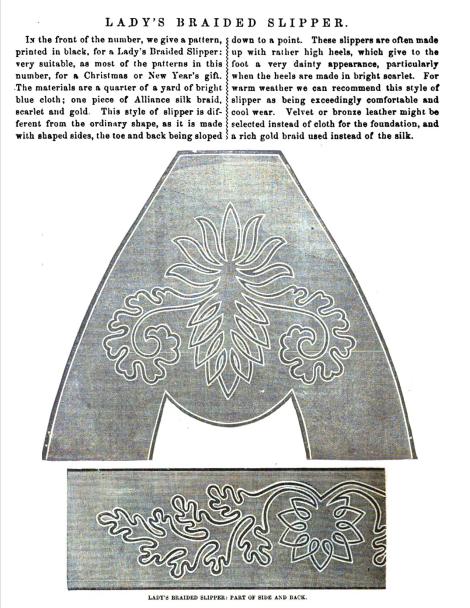
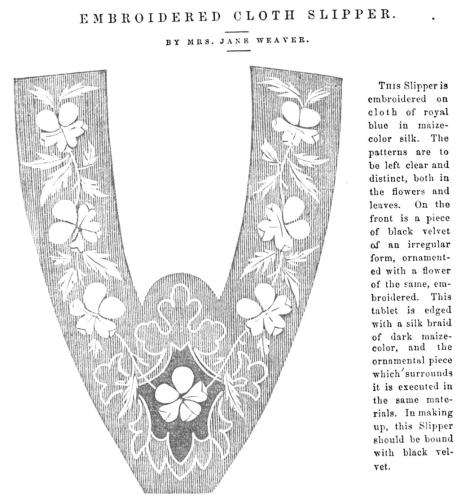
Okay, so at this point I’ve decided to post a slipper an hour for the rest of the morning.
Peterson’s 1862

Oriental Slipper
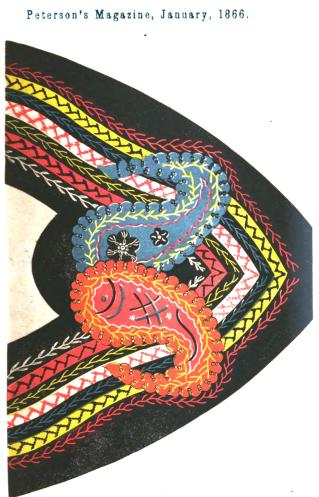
In the front of the number we give a beautiful pattern, printed in colors, of an Oriental Slipper. The materials are 14 inches of black cloth; 1 3/4 yards each of broad silk braid, deep amber, scarlet, and white; a small quantity of bright cerise, blue, amber, and white filoselle; 1 skein each of sewing-silk, black and bright cerise; 4 rows of steel beads, No. 7; few chalk beads; a small piece of blue and bright cerise cloth for the pines.
Trace on tissue-paper the three outlines for the braid, tack this on the cloth, and tack over this, through paper and cloth, the three different braids, and tear the paper away. Now cut out two pines the exact size of those shown in out colored design, one blue, and the other bright cerise, and notch the edges. Tack the pieces in their proper places, and embroider.
There are but two stitches employed, (with the exception of a few dots in the pines,) the herring-bone stitch and coral-stitch. All the braid is fastened down with the simple herringbone stitch, and the design running between the braids is composed of coral-stitch. The braid is put on with the sewing-silk, and the coral stitch is worked with filoselle split to make it sufficiently fine.
The pines are kept in their place by a row of coral-stitch, plain stitching, and two steel beads fastened between every notch. The other ornaments on the pines are embroidered in white, black and blue silk. To the blue piece two small rounds of black cloth are attached, fastened on with white silk and white beads.
For the third Sew Along of 2016, we will be making slippers!
Slippers can be wonderful for wearing in a historic house, warming the feet on a chilly morning or letting the feet relax in the evening.
There are numerous styles to choose for slippers:
Here is a resource page to get you started on your slipper project planning.
Options for soles can include:
 I already have two pair of quilted silk slippers. The first is a comfy blue pair with canvas soles. I think I was in NM when I made these.
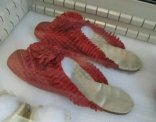
 The next are the green slip-on quilted silk. These were made a few years back. The originals, in a beautiful red, are in the Buffalo-Erie Historical Society.
I know I want to make a pair other than quilted. But, I don’t know which. Part of me wants to do a Berlin work style, or at least some type of needlework. Patriotic styles appeal in this case.
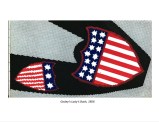

I also have a dense black wool that would be oh-so-warm and comfy. These would work nicely for an applique pair. I’ll be sharing a couple of those ideas next.
Pinterest board for the Slippers Sew Along.
Treasures in Needlework, by Mrs. Warren and Mrs. Pullan, 1855.
Peterson’s Magazine — Just a sampling:
Today, I offer a bonnet with a brim edged in hand shaped VVVVs, finished with antique straw threads. The bonnet is a classically fashionable early Civil War era shape. The deep VVVVs were inspired by an original bonnet in the MET collection.
Look for this bonnet in my Etsy shop.


For I don’t really know how long I’ve been playing with the idea of making my own decorative straw. As you’ve seen, I started shaping straw plait into decorative designs for the edges of bonnets and hats.


A few weeks back, I ordered straw splitters, straw and straw threads. They arrived but I didn’t let myself play with them, trying to focus on a few millinery pieces. Tonight, I finally made my very first leaves:


While they are not perfect, I am pretty happy with them. I think they are rather cute. (I also tried to make a flower with the antique threads. That didn’t go so well. I will need to learn a lot more about flowers.)
What will I do with these? Put them on hats and bonnets of course. (I may also try some ornaments for Christmas. But, those will go up on my other blog.)


***Incomplete Thoughts Post – See Here***
Years ago I became fascinated with the notes Vicki Betts assembled on Red, White and Red. This was very early in my learning research. I was so excited to see so much information in one place, and have it be easy to read. Years later, I still find her research just as wonderful. (If you haven’t spent days and days looking at it, your really should.)
This year, being the year a great many Civil War era reenactors interpret the year 1861 coinciding with me doing as much millinery as I have been is going to give me the opportunity to do a millinery piece (or two) reflecting northern or southern patriotism.
In reading original literature, periodicals, journals, etc., there are two clusters of patriotic apparel and accessories – Those surrounding elections and those surrounding the beginning of the Civil War.
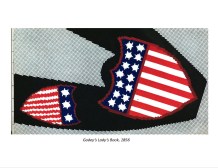 Ah, the elections. I do wish we would interpret the 1840s and 1850s more, as they are filled with so many fascinating events. I also think it would be nice to interpret one of the elections. In the years of presidential elections, the ladies magazines are filled with patriotic themed projects decked out in red, white and blue – slippers, quilts, pillows, etc. Period accounts are filled with descriptive scenes of villages draped in the national colors and women’s bonnets adorned with ribbons of the same. This account of a country election is a short example.
As the Civil War dawned, or possibly pre-dawn, northern millinery reflected patriotic sentiments. Several publications, including Appleton’s Annual Cyclopaedia and Register of Important Events, recount women wearing ribbons of red, white and blue on their bonnets in New York City following the events at Fort Sumter.“On all coats were pinned the red, white and blue cockade, and in every lady’s bonnet ribbons of the same colors were tastefully displayed”
For an understanding of southern patriotism and secession bonnets, please see Vicki Bett’s research (two transcriptions below) and Kathy Kelly Hunt’s article (may require a FB account.)
CHARLESTON MERCURY, March 20, 1862, 1, c. 3
The ladies of Baltimore, notwithstanding Lincoln’s proclamation, appear daily on the streets, in secession colors, to wit “red, white and red.” Bonnets are so constantly trimmed with a red, a white, and again, a red rose, that even the manufacturers have been prohibited from making these rebellious flowers, in order “to support the Government.” Yet, the ladies, who are equal to every emergency, were not to be out-done in this matter. The insulting Yankee soldiers, on several occasions, spoke to the traitorous demoiselles, and even went so far as to tear the trimmings from their bonnets.
“the streets of Charleston were filled with excited people hazzaing for a Southern Confederacy, and several women made a public display of their so-called patriotism, by appearing on the crowded side-walks with “succession bonnets,” the invention of a Northern milliner in Charleston. Small Palmetto flags, with a lone star on each, fluttered with white handkerchiefs out of many a window…” ( Pictorial History of the Civil War in the United States of America Lossing, 1866)
***Incomplete Thoughts Post – See Here***
Why? why? why? …. Do I have to love a topic that has oodles and oodles of research and articles written about the happenings in England, but is all but swept aside in the United States.
Yes, please, read this as a full on pout.
There are so many nifty and info packed articles chewing on the cottage industries, straw plaiting included in England…. …. The Female Labour Market in English Agriculture During the Industrial Revolution: Expansion or Contradiction…. Proto-Industrialization? Cottage Industry, Social Change, and Industrial Revolution….. and, who can’t love a title like: How Saucy did it Make the Poor? The StrawPlait and Hat Trades, Illegitimate Fertility and the Family in Nineteenth-Century Hertfordshire





 If I Had My Own Blue Box: